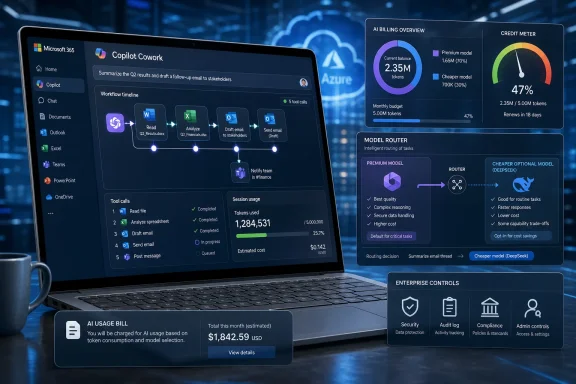
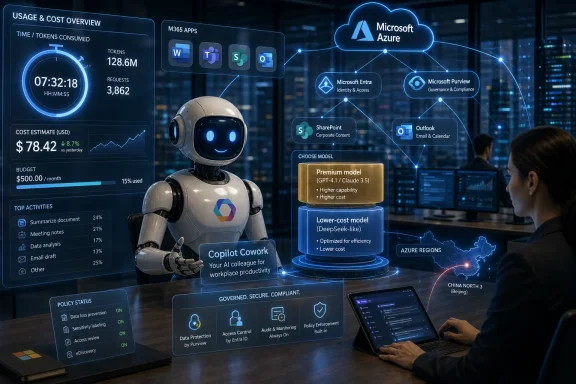
Microsoft is moving Copilot Cowork, its enterprise agent for Microsoft 365 work, to usage-based billing as of its broader 2026 rollout, while reportedly considering an Azure-hosted, fine-tuned DeepSeek V4 option to lower model costs for customers. That is the immediate news, but the larger admission is more important: autonomous AI does not fit neatly into the old per-seat software model. Microsoft spent years teaching customers to buy Copilot like Office; now it is preparing them to meter Copilot like cloud infrastructure. The shift will test whether enterprises want AI coworkers badly enough to manage them like compute workloads.
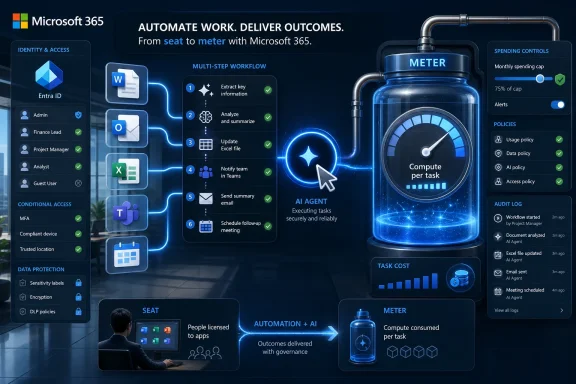
The old Microsoft 365 sales motion was wonderfully legible. A worker had a license, the license had features, and the bill arrived according to headcount. IT departments could argue about adoption, training, and security, but the commercial unit was familiar: one human, one seat, one monthly price.
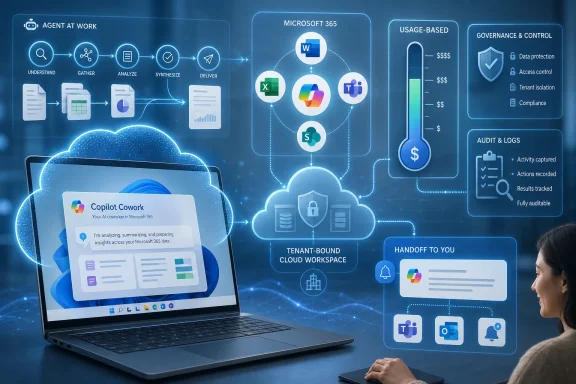
Copilot Cowork breaks that pattern because it is not merely a chatbot sitting in the margin of Word or Teams. It is an agentic system designed to keep working through multi-step tasks, call models repeatedly, inspect documents, generate artifacts, and continue reasoning while the user is somewhere else. That means one employee can produce the cost profile of many employees, or at least many sessions, if the tool is actually useful.
Charles Lamanna’s explanation to Axios was blunt by Microsoft standards. Flat-rate pricing, he said, becomes difficult when some users perform hundreds of tasks a week. In other words, the customer Microsoft most wants — the power user who turns Copilot Cowork into a daily operating layer — is also the customer who can make an unlimited plan uneconomic.
That is the paradox at the center of enterprise AI right now. Vendors promised productivity abundance, but the abundance is built on metered inference, scarce accelerators, and token-heavy reasoning loops. The more Copilot Cowork succeeds, the less plausible it becomes as an all-you-can-eat subscription.
Microsoft’s reported plan is not to send enterprise data to DeepSeek’s cloud. The company is said to be weighing a self-hosted, fine-tuned version running on Azure, presented as an optional model choice and wrapped in Microsoft’s security, compliance, and data-residency controls. That distinction will matter to procurement teams, but it will not eliminate the political optics of putting a Chinese-origin model inside a Microsoft enterprise product.
The practical question for admins is not simply “DeepSeek or no DeepSeek.” It is whether Microsoft can make model routing understandable, governable, and auditable. If Copilot Cowork can choose among OpenAI, Anthropic, Microsoft-tuned, and DeepSeek-derived models, enterprises will want to know which model handled which task, what data it saw, what logs exist, and how policy can constrain the choice.
That is where Microsoft has a credible advantage over smaller AI vendors. The company already sells trust as a control plane: Entra ID, Purview, Defender, Intune, audit logs, compliance boundaries, admin centers, and contractual data commitments. A cheaper model becomes enterprise-acceptable only if it disappears into that machinery without becoming a shadow supply-chain risk.
A conventional Copilot prompt might summarize a thread or draft an email. An agentic workflow might read a folder, compare spreadsheets, prepare a deck, revise the deck, check inconsistencies, write a follow-up memo, and then wait for more instructions. Each step can trigger more model calls, tool calls, context retrieval, and validation.
That is why the pricing conversation has moved from seats to work performed. The agent is no longer just answering the employee; it is doing something adjacent to labor. Microsoft is implicitly asking customers to accept that this new category should be budgeted like a blend of software, cloud compute, and outsourced task execution.
The comparison with GitHub Copilot is instructive. Developers were among the first Microsoft customers to experience the mismatch between fixed subscriptions and heavy AI use. Coding agents can run long, revise often, and consume expensive reasoning capacity. Usage-based billing arrived there first because the token economics were impossible to hide.
Now the same dynamic is moving from developers to office workers. That is a much bigger cultural shift. Engineers are accustomed to metered cloud services; finance, HR, legal, sales, and operations teams are not.
That evolution will be familiar to anyone who watched Azure transform infrastructure procurement. The first pitch was flexibility. The second was scale. The third was a monthly bill that required FinOps discipline. AI agents are following the same arc, but compressed into a much shorter period.
Enterprises that once debated whether Copilot was worth a per-user add-on now have to ask a more operational question: what is a reasonable monthly task budget for a department? A legal team running contract analysis, a sales team generating account plans, and an IT team automating incident writeups may have radically different consumption profiles. A single price per employee no longer reflects actual usage.
This is where Microsoft’s “AI as consumption” framing becomes more than executive rhetoric. If the company wants intense users and intense usage, it must also normalize intense billing visibility. Otherwise, Copilot Cowork risks becoming the next cloud-cost surprise: beloved by early adopters, feared by budget owners, and constrained by administrators who are asked to approve a bill they cannot explain.
The winners inside organizations will be the teams that treat AI agents like managed services from day one. They will define approved use cases, set budgets, monitor consumption, and compare agent output against measurable outcomes. The losers will be the teams that let enthusiastic users turn Cowork into an invisible background worker with no cost model attached.
But model provenance is becoming its own governance category. Security teams increasingly care not only where data goes, but how models were trained, how they behave under adversarial prompts, what safety tuning has been applied, and whether geopolitical risk affects future availability. Azure hosting answers some questions, not all of them.
Microsoft says the model would be customized with safeguards against bias, according to the report. That phrasing will reassure some customers and irritate others, because bias mitigation is now both a technical discipline and a political flashpoint. In practice, enterprises will want documented evaluations, red-team results, policy controls, and the ability to disable the model entirely.
The deeper issue is that multi-model AI makes trust more dynamic. In the old SaaS world, customers evaluated the application. In the agentic AI world, they must evaluate an application that may call different models for different tasks, each with different behavior, cost, latency, and risk. Trust becomes a routing problem.
That is why admin transparency will be decisive. If Microsoft exposes clear controls, model provenance logs, and tenant-level policies, the DeepSeek option could be treated as another entry in a managed model catalog. If it feels opaque, it will become a compliance argument waiting to happen.
Different models are good at different things. Some are better at long reasoning, some at code, some at summarization, some at structured extraction, some at low-cost high-volume tasks. A serious enterprise agent should not use the same expensive model to rename files, draft a memo, inspect a spreadsheet, and reason through a complicated procurement exception.
Nadella’s recent ecosystem argument fits this shift. The point is not that one frontier model wins every task; the point is that enterprises need a marketplace of models, tools, data connectors, and governance layers. Microsoft wants Azure and Microsoft 365 to be where that marketplace is made safe enough for corporate use.
That positioning also helps Microsoft reduce strategic tension. It can keep OpenAI models at the high end, use Anthropic where Claude’s agentic strengths make sense, offer its own smaller or specialized models where it can, and add lower-cost outside models where the economics demand it. The Copilot brand becomes less a model and more an orchestration layer.
This is the same abstraction Microsoft has used for decades. Windows abstracted hardware differences. Office abstracted document workflows. Azure abstracted infrastructure. Copilot is now being positioned to abstract the model market — with Microsoft taking a toll on the orchestration, identity, data, governance, and billing.
But usage billing also shifts risk from vendor to customer. Under a flat plan, Microsoft absorbs the heavy user. Under a consumption plan, the customer does. That makes sense economically, but it changes the buying conversation from “Can we afford Copilot?” to “Can we predict what Copilot will do?”
Prediction is hard with agents because the unit of work is fuzzy. A user may ask for a market brief, but the agent might retrieve documents, browse internal knowledge, rewrite sections, generate charts, and iterate through several plans. The human sees one task; the system sees a chain of billable operations.
This creates a new kind of enterprise UX problem. Microsoft must make cost visible without making users afraid to use the tool. If every Cowork action feels like spinning up an expensive VM, adoption will suffer. If the costs are hidden until the invoice arrives, administrators will clamp down.
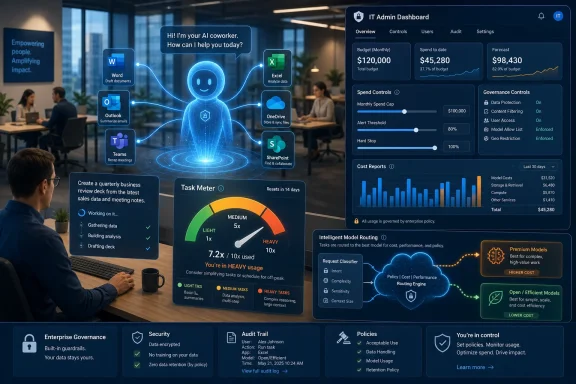
The balance will likely come through budgets, quotas, task classes, and model tiers. Routine work may default to cheaper models. Sensitive or complex work may require approved high-end models. Departments may get monthly pools. Power users may need explicit authorization. In short, Copilot administration is about to look more like cloud administration.
That matters because Microsoft’s enterprise advantage is not just model access. It is distribution. If Cowork becomes a default expectation for Microsoft 365-heavy organizations, Windows endpoints become the front doors to agentic work even when the compute runs elsewhere. The user may think they are asking Copilot to “handle this,” but the workflow crosses Outlook, SharePoint, Teams, Excel, PowerPoint, OneDrive, Entra, Purview, and Azure.
Sysadmins will need to understand the boundaries. Which data can Cowork access? Which connectors are enabled? Which model families are allowed? Are outputs labeled? Are actions reversible? What audit trail exists when an agent modifies files or prepares communications? How are prompts, intermediate reasoning, and generated artifacts retained?
Those questions are not academic. The more autonomous the tool, the more it resembles a privileged user. A bad prompt, compromised account, excessive permission grant, or poorly scoped connector can turn helpful automation into a governance incident. The pricing model may be the news hook, but permission design is the operational story.
Microsoft will argue that its integrated stack makes these problems manageable. That is plausible. It is also why the company is so eager to put agents inside Microsoft 365 rather than leave them as third-party desktop tools floating outside enterprise controls.
That creates a new competitive axis. The best enterprise AI product may not be the one with the most impressive demo; it may be the one that delivers acceptable results at a predictable cost. In agentic work, reliability and economics are inseparable. A tool that performs brilliantly but unpredictably will be hard to deploy broadly.
Microsoft has spent the past year trying to persuade customers that Copilot is more than a chat window. Cowork is one of the clearest attempts to make that case. But the more it behaves like a worker, the more customers will evaluate it like labor: what did it do, how long did it take, how often did it need supervision, and what did it cost?
That is a healthier debate than the vague productivity claims that dominated the first wave of enterprise AI. It forces vendors to show value in operational terms. It also forces customers to stop treating AI as magic and start treating it as a managed resource.
The companies that mature fastest will not necessarily be the ones that buy the most AI. They will be the ones that learn which tasks deserve expensive reasoning, which can run on cheaper models, and which should not involve a generative model at all. The real skill will be orchestration, not enthusiasm.
 Microsoft Discovers That Agents Are Not Seats
The old Microsoft 365 sales motion was wonderfully legible. A worker had a license, the license had features, and the bill arrived according to headcount. IT departments could argue about adoption, training, and security, but the commercial unit was familiar: one human, one seat, one monthly price.Copilot Cowork breaks that pattern because it is not merely a chatbot sitting in the margin of Word or Teams. It is an agentic system designed to keep working through multi-step tasks, call models repeatedly, inspect documents, generate artifacts, and continue reasoning while the user is somewhere else. That means one employee can produce the cost profile of many employees, or at least many sessions, if the tool is actually useful.
Charles Lamanna’s explanation to Axios was blunt by Microsoft standards. Flat-rate pricing, he said, becomes difficult when some users perform hundreds of tasks a week. In other words, the customer Microsoft most wants — the power user who turns Copilot Cowork into a daily operating layer — is also the customer who can make an unlimited plan uneconomic.
That is the paradox at the center of enterprise AI right now. Vendors promised productivity abundance, but the abundance is built on metered inference, scarce accelerators, and token-heavy reasoning loops. The more Copilot Cowork succeeds, the less plausible it becomes as an all-you-can-eat subscription.
The DeepSeek Option Is Really a Margin Strategy
The reported DeepSeek V4 consideration will attract the loudest political reaction, especially in the United States, but the business logic is straightforward. If agentic AI burns through tokens quickly, Microsoft needs a spectrum of models with different price-performance profiles. Not every task needs a top-tier frontier model, and not every customer will tolerate frontier-model pricing for routine office automation.Microsoft’s reported plan is not to send enterprise data to DeepSeek’s cloud. The company is said to be weighing a self-hosted, fine-tuned version running on Azure, presented as an optional model choice and wrapped in Microsoft’s security, compliance, and data-residency controls. That distinction will matter to procurement teams, but it will not eliminate the political optics of putting a Chinese-origin model inside a Microsoft enterprise product.
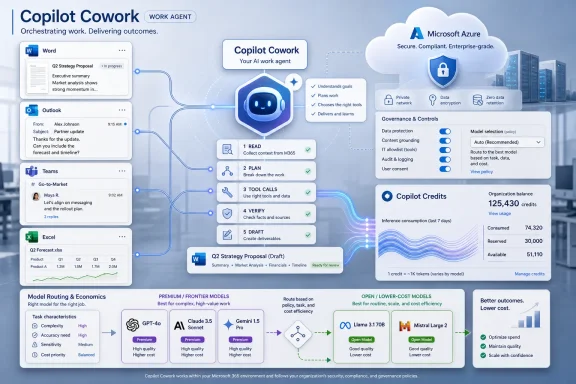
The practical question for admins is not simply “DeepSeek or no DeepSeek.” It is whether Microsoft can make model routing understandable, governable, and auditable. If Copilot Cowork can choose among OpenAI, Anthropic, Microsoft-tuned, and DeepSeek-derived models, enterprises will want to know which model handled which task, what data it saw, what logs exist, and how policy can constrain the choice.
That is where Microsoft has a credible advantage over smaller AI vendors. The company already sells trust as a control plane: Entra ID, Purview, Defender, Intune, audit logs, compliance boundaries, admin centers, and contractual data commitments. A cheaper model becomes enterprise-acceptable only if it disappears into that machinery without becoming a shadow supply-chain risk.
Claude Gave Microsoft the Agent; Consumption Will Give It the Business Model
Copilot Cowork’s Anthropic connection is important because Claude’s reputation has been built around long-context reasoning, coding-style planning, and agentic task execution. Those strengths are exactly what make Cowork compelling for knowledge work that does not fit inside a single prompt. They are also exactly what make it expensive.A conventional Copilot prompt might summarize a thread or draft an email. An agentic workflow might read a folder, compare spreadsheets, prepare a deck, revise the deck, check inconsistencies, write a follow-up memo, and then wait for more instructions. Each step can trigger more model calls, tool calls, context retrieval, and validation.
That is why the pricing conversation has moved from seats to work performed. The agent is no longer just answering the employee; it is doing something adjacent to labor. Microsoft is implicitly asking customers to accept that this new category should be budgeted like a blend of software, cloud compute, and outsourced task execution.
The comparison with GitHub Copilot is instructive. Developers were among the first Microsoft customers to experience the mismatch between fixed subscriptions and heavy AI use. Coding agents can run long, revise often, and consume expensive reasoning capacity. Usage-based billing arrived there first because the token economics were impossible to hide.
Now the same dynamic is moving from developers to office workers. That is a much bigger cultural shift. Engineers are accustomed to metered cloud services; finance, HR, legal, sales, and operations teams are not.
The Office Suite Is Becoming a Metered Compute Surface
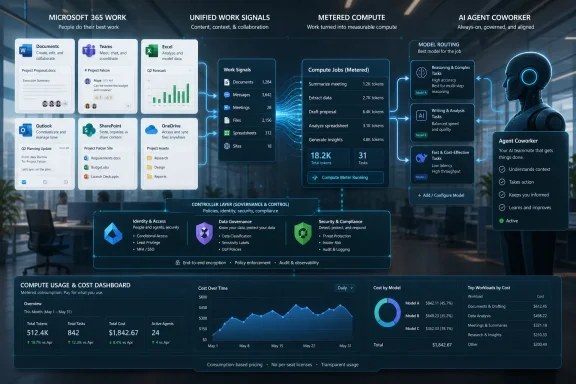
For Windows and Microsoft 365 shops, the headline is not just a new Copilot SKU. It is the gradual conversion of office work into a workload that can be metered, throttled, routed, optimized, and billed. The spreadsheet, inbox, SharePoint library, and Teams channel are becoming inputs for an AI execution engine.That evolution will be familiar to anyone who watched Azure transform infrastructure procurement. The first pitch was flexibility. The second was scale. The third was a monthly bill that required FinOps discipline. AI agents are following the same arc, but compressed into a much shorter period.
Enterprises that once debated whether Copilot was worth a per-user add-on now have to ask a more operational question: what is a reasonable monthly task budget for a department? A legal team running contract analysis, a sales team generating account plans, and an IT team automating incident writeups may have radically different consumption profiles. A single price per employee no longer reflects actual usage.
This is where Microsoft’s “AI as consumption” framing becomes more than executive rhetoric. If the company wants intense users and intense usage, it must also normalize intense billing visibility. Otherwise, Copilot Cowork risks becoming the next cloud-cost surprise: beloved by early adopters, feared by budget owners, and constrained by administrators who are asked to approve a bill they cannot explain.
The winners inside organizations will be the teams that treat AI agents like managed services from day one. They will define approved use cases, set budgets, monitor consumption, and compare agent output against measurable outcomes. The losers will be the teams that let enthusiastic users turn Cowork into an invisible background worker with no cost model attached.
The Security Argument Will Not End at Azure Hosting
Microsoft’s likely defense of a DeepSeek option is predictable and not without merit. If the model is hosted on Azure, governed by Microsoft’s enterprise controls, and optional for customers, then the data-handling risk is materially different from employees pasting company documents into an overseas consumer chatbot. For many regulated organizations, that boundary is the difference between a prohibited tool and a reviewable vendor feature.But model provenance is becoming its own governance category. Security teams increasingly care not only where data goes, but how models were trained, how they behave under adversarial prompts, what safety tuning has been applied, and whether geopolitical risk affects future availability. Azure hosting answers some questions, not all of them.
Microsoft says the model would be customized with safeguards against bias, according to the report. That phrasing will reassure some customers and irritate others, because bias mitigation is now both a technical discipline and a political flashpoint. In practice, enterprises will want documented evaluations, red-team results, policy controls, and the ability to disable the model entirely.
The deeper issue is that multi-model AI makes trust more dynamic. In the old SaaS world, customers evaluated the application. In the agentic AI world, they must evaluate an application that may call different models for different tasks, each with different behavior, cost, latency, and risk. Trust becomes a routing problem.
That is why admin transparency will be decisive. If Microsoft exposes clear controls, model provenance logs, and tenant-level policies, the DeepSeek option could be treated as another entry in a managed model catalog. If it feels opaque, it will become a compliance argument waiting to happen.
Microsoft’s Multi-Model Turn Was Inevitable
Microsoft’s OpenAI partnership made it the early enterprise AI kingmaker, but no platform company wants to be permanently dependent on a single model supplier. The economics, product demands, and customer politics all push toward a multi-model architecture. Copilot Cowork is simply where that architecture becomes visible.Different models are good at different things. Some are better at long reasoning, some at code, some at summarization, some at structured extraction, some at low-cost high-volume tasks. A serious enterprise agent should not use the same expensive model to rename files, draft a memo, inspect a spreadsheet, and reason through a complicated procurement exception.
Nadella’s recent ecosystem argument fits this shift. The point is not that one frontier model wins every task; the point is that enterprises need a marketplace of models, tools, data connectors, and governance layers. Microsoft wants Azure and Microsoft 365 to be where that marketplace is made safe enough for corporate use.
That positioning also helps Microsoft reduce strategic tension. It can keep OpenAI models at the high end, use Anthropic where Claude’s agentic strengths make sense, offer its own smaller or specialized models where it can, and add lower-cost outside models where the economics demand it. The Copilot brand becomes less a model and more an orchestration layer.
This is the same abstraction Microsoft has used for decades. Windows abstracted hardware differences. Office abstracted document workflows. Azure abstracted infrastructure. Copilot is now being positioned to abstract the model market — with Microsoft taking a toll on the orchestration, identity, data, governance, and billing.
The Customer Bargain Is Getting More Complicated
Usage-based pricing is not inherently bad for customers. If done well, it can let cautious organizations start small, expand where value is proven, and avoid paying full freight for inactive users. Many enterprises would rather pay for actual work than blanket licenses that sit unused.But usage billing also shifts risk from vendor to customer. Under a flat plan, Microsoft absorbs the heavy user. Under a consumption plan, the customer does. That makes sense economically, but it changes the buying conversation from “Can we afford Copilot?” to “Can we predict what Copilot will do?”
Prediction is hard with agents because the unit of work is fuzzy. A user may ask for a market brief, but the agent might retrieve documents, browse internal knowledge, rewrite sections, generate charts, and iterate through several plans. The human sees one task; the system sees a chain of billable operations.
This creates a new kind of enterprise UX problem. Microsoft must make cost visible without making users afraid to use the tool. If every Cowork action feels like spinning up an expensive VM, adoption will suffer. If the costs are hidden until the invoice arrives, administrators will clamp down.
The balance will likely come through budgets, quotas, task classes, and model tiers. Routine work may default to cheaper models. Sensitive or complex work may require approved high-end models. Departments may get monthly pools. Power users may need explicit authorization. In short, Copilot administration is about to look more like cloud administration.
Windows Shops Will Feel This in Procurement Before They Feel It in Windows
For WindowsForum readers, the immediate impact will not be a Start menu button or a new Edge sidebar. It will show up in licensing meetings, tenant configuration, procurement reviews, and security questionnaires. Copilot Cowork is a Microsoft 365 story first, but it is part of the same Windows ecosystem strategy: make the PC, identity layer, cloud tenant, and productivity suite feel like one AI workspace.That matters because Microsoft’s enterprise advantage is not just model access. It is distribution. If Cowork becomes a default expectation for Microsoft 365-heavy organizations, Windows endpoints become the front doors to agentic work even when the compute runs elsewhere. The user may think they are asking Copilot to “handle this,” but the workflow crosses Outlook, SharePoint, Teams, Excel, PowerPoint, OneDrive, Entra, Purview, and Azure.
Sysadmins will need to understand the boundaries. Which data can Cowork access? Which connectors are enabled? Which model families are allowed? Are outputs labeled? Are actions reversible? What audit trail exists when an agent modifies files or prepares communications? How are prompts, intermediate reasoning, and generated artifacts retained?
Those questions are not academic. The more autonomous the tool, the more it resembles a privileged user. A bad prompt, compromised account, excessive permission grant, or poorly scoped connector can turn helpful automation into a governance incident. The pricing model may be the news hook, but permission design is the operational story.
Microsoft will argue that its integrated stack makes these problems manageable. That is plausible. It is also why the company is so eager to put agents inside Microsoft 365 rather than leave them as third-party desktop tools floating outside enterprise controls.
The AI Cost Curve Is Now a Product Feature
The most interesting part of the reported DeepSeek move is that cost is no longer a back-office concern. It is becoming part of product design. Model choice, task routing, context size, tool calling, memory, and reasoning depth all determine not only output quality but also price.That creates a new competitive axis. The best enterprise AI product may not be the one with the most impressive demo; it may be the one that delivers acceptable results at a predictable cost. In agentic work, reliability and economics are inseparable. A tool that performs brilliantly but unpredictably will be hard to deploy broadly.
Microsoft has spent the past year trying to persuade customers that Copilot is more than a chat window. Cowork is one of the clearest attempts to make that case. But the more it behaves like a worker, the more customers will evaluate it like labor: what did it do, how long did it take, how often did it need supervision, and what did it cost?
That is a healthier debate than the vague productivity claims that dominated the first wave of enterprise AI. It forces vendors to show value in operational terms. It also forces customers to stop treating AI as magic and start treating it as a managed resource.
The companies that mature fastest will not necessarily be the ones that buy the most AI. They will be the ones that learn which tasks deserve expensive reasoning, which can run on cheaper models, and which should not involve a generative model at all. The real skill will be orchestration, not enthusiasm.
The Cowork Bill Will Teach Enterprises How Agentic AI Really Works
Microsoft’s move gives customers a clearer signal than any keynote demo could. Agentic AI is powerful because it can keep working, but that same persistence creates cost, governance, and trust problems that cannot be solved by branding alone. Near-term buyers should treat Copilot Cowork less like an Office feature and more like a new class of cloud workload.- Organizations should expect Copilot Cowork usage to vary dramatically by role, team, and task complexity.
- Admins should demand tenant-level controls for model availability, budgets, logging, and data access before broad deployment.
- A Microsoft-hosted DeepSeek option would reduce some data-transfer concerns, but it would not eliminate provenance, policy, or geopolitical questions.
- Usage-based billing could be fairer than flat licensing if Microsoft gives customers clear forecasting and guardrails.
- The most valuable deployments will pair agent access with measurable workflows, not vague mandates to “use AI more.”
- Microsoft’s long-term play is to make Copilot the governed orchestration layer for many models, not merely a wrapper around one provider.
References
- Primary source: the-decoder.com
Published: Tue, 16 Jun 2026 19:37:35 GMT
Microsoft's Copilot Cowork moves to usage-based billing and may tap DeepSeek
Microsoft is weighing a fine-tuned version of Deepseek V4 as a cheaper model option for Copilot Cowork. The company is also switching to usage-based billing, since Copilot head Charles Lamanna says flat-rate pricing isn't sustainable. The move fits a broader pattern in the industry.the-decoder.com - Related coverage: axios.com
Microsoft explores DeepSeek for Copilot Cowork
Microsoft will also shift to usage-based pricing for the enterprise agent.www.axios.com
- Related coverage: techradar.com
'The last thing any of us want': Microsoft CEO Satya Nadella warns AI dominance could 'hollow out entire industries' | TechRadar
Satya Nadella says current AI transition is like early years of globalizationwww.techradar.com - Related coverage: windowscentral.com
Microsoft CEO Satya Nadella says AI tokenmaxxing is costly: "I'm a tokenmaxxer too, it's addictive." | Windows Central
The executive wants staffers to rethink how they use frontier AI models to solve problems.www.windowscentral.com - Related coverage: crn.com
Microsoft Q3 Earnings: Nadella Says AI Agents Change How Customers Pay
Microsoft reported Q3 results, with CEO Satya Nadella outlining a shift to per-seat plus consumption-based AI and agent pricing models.www.crn.com - Related coverage: tomshardware.com
Microsoft CEO says the company doesn't have enough electricity to install all the AI GPUs in its inventory - 'you may actually have a bunch of chips sitting in inventory that I can’t plug in' | Tom's Hardware
‘I don’t have warm shells to plug into’www.tomshardware.com
- Official source: docs.github.com
Budgets for usage-based billing - GitHub Docs
Under usage-based billing, budget controls at the user, organization, cost center, and enterprise levels determine how Copilot usage is served, metered, or blocked. docs.github.com
- Related coverage: techspot.com
Satya Nadella argues that Microsoft's AI bet is paying off as Copilot usage nearly triples | TechSpot
The concern stems from Microsoft's capital expenditures, which have soared to near-record levels. The company spent $88.2 billion last fiscal year and $72.4 billion in the first...www.techspot.com - Related coverage: itpro.com
Microsoft CEO Satya Nadella wants an end to the term ‘AI slop’ and says 2026 will be a ‘pivotal year’ for the technology – but enterprises still need to iron out key lingering issues | IT Pro
The Microsoft chief believes “AI slop” arguments need to be put on the back burnerwww.itpro.com - Related coverage: pymnts.com
PYMNTS | Microsoft Combining Commercial and Consumer AI Efforts
Microsoft is reconfiguring the various teams working on its flagship artificial intelligence (AI) offering. www.pymnts.com
- Related coverage: forbes.com
Microsoft CEO Satya Nadella Unveils New Digital Strategy For Businesses: 'Tech Intensity'
Businesses looking to thrive in the digital economy must go beyond simply consuming enterprise software and become relentlessly aggressive creators of their own digital solutions and innovation, says Microsoft CEO Satya Nadella, in a digital initiative that Nadella refers to as "tech...www.forbes.com - Related coverage: mediapost.com
Beyond 'Slop': Microsoft Chief's Vision For An Agent-First Economy 01/02/2026
Beyond 'Slop': Microsoft Chief's Vision For An Agent-First Economy - 01/02/2026www.mediapost.com - Related coverage: rcrwireless.com
Cloud, AI drive Microsoft's strong growth - RCR Wireless
Microsoft reported a record quarter driven by its cloud business, which saw revenues boom 22% year-over-year to $42 billion.www.rcrwireless.com - Official source: microsoft.com
- Official source: anthropic.com
Claude Cowork | Anthropic’s agentic AI for knowledge work \ Anthropic
Claude Cowork is a system built by Anthropic that executes multi-step knowledge work on a user's behalf, including research synthesis, document preparation, and file management. It is not a chat assistant.www.anthropic.com - Official source: techcommunity.microsoft.com
Available today: Anthropic Claude Opus 4.8 in Microsoft 365 Copilot | Microsoft Community Hub
Expanding model choice in Microsoft 365 Copilot: Anthropic's Claude Opus 4.8 is rolling out today in Copilot Cowork. techcommunity.microsoft.com
- Related coverage: venturebeat.com
Microsoft announces Copilot Cowork with help from Anthropic — a cloud-powered AI agent that works across M365 apps | VentureBeat
Copilot Cowork operates in the cloud, inside Microsoft 365's infrastructure, and draws on something Claude Cowork simply cannot access: the full graph of a user's enterprise work data.venturebeat.com - Official source: learn.microsoft.com
Anthropic models in Microsoft Online Services | Microsoft Learn
Learn about Anthropic models in Microsoft Online Services.learn.microsoft.com - Related coverage: geekwire.com
Microsoft's new Copilot Cowork integrates Anthropic's Claude in rollout of new E7 licensing tier – GeekWire
Microsoft is launching Copilot Cowork, a new AI assistant built with Anthropic that can run tasks in the background and work across Microsoft 365 apps, as part of a broader wave of updates including a new $99-per-user E7 licensing tier.www.geekwire.com - Official source: azure.microsoft.com
- Related coverage: winbuzzer.com
Microsoft Shifts Engineers from Claude Code to GitHub Copilot CLI
Microsoft is moving Experiences + Devices engineers from Claude Code to GitHub Copilot CLI by June 30, while keeping its broader Anthropic ties intact.winbuzzer.com - Related coverage: computertech.co
Microsoft Copilot Cowork Review 2026 | ComputerTech
Microsoft Copilot Cowork puts Claude inside M365 — but at 30 USD/user/mo on top of your M365 plan, is Wave 3 worth it? Honest 2026 verdict inside.computertech.co - Related coverage: publicservicesalliance.org
Hands On With Anthropics Claude Cowork an AI Agent That Actually Works WIRED
PDF documentpublicservicesalliance.org