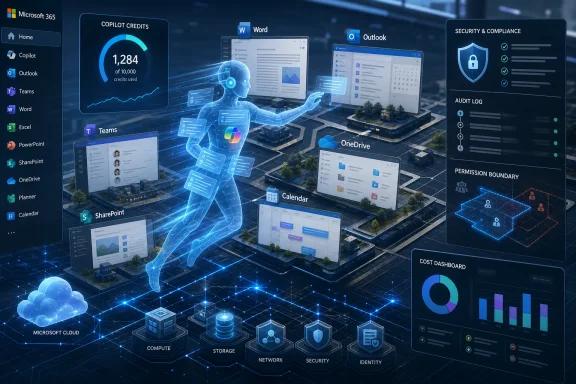
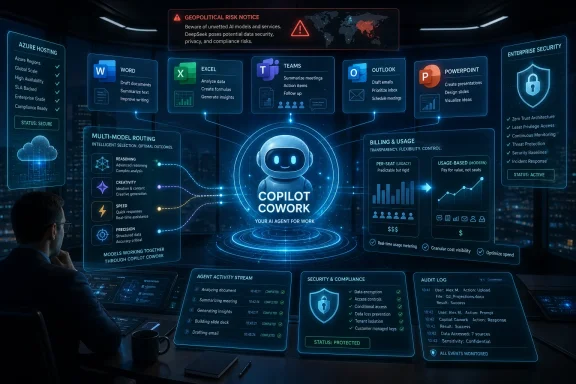
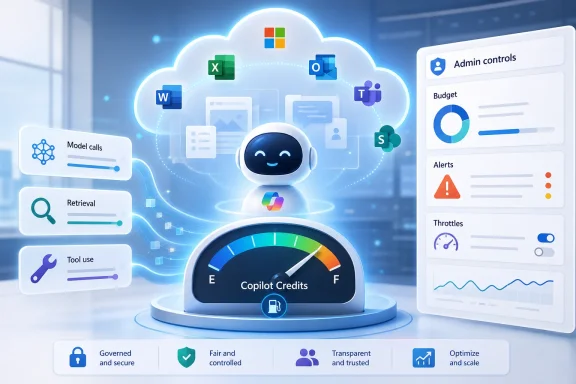
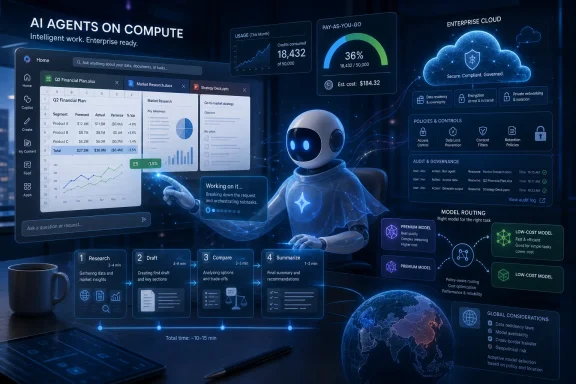
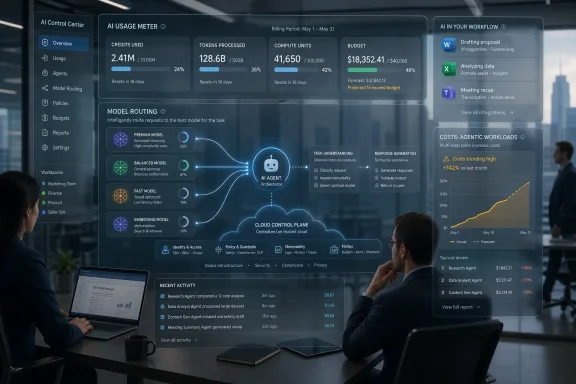
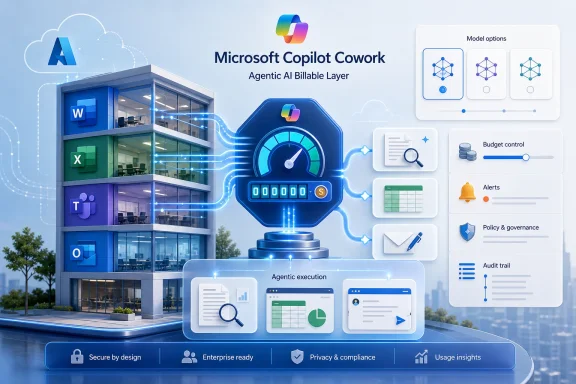
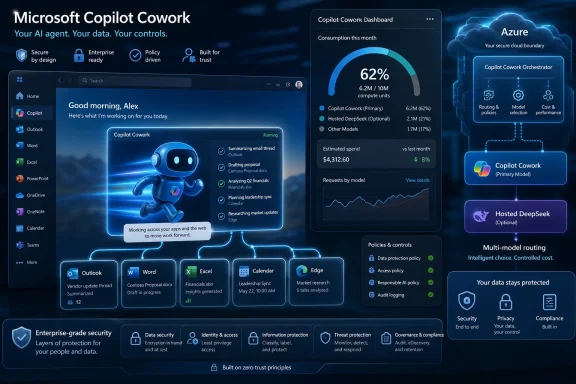
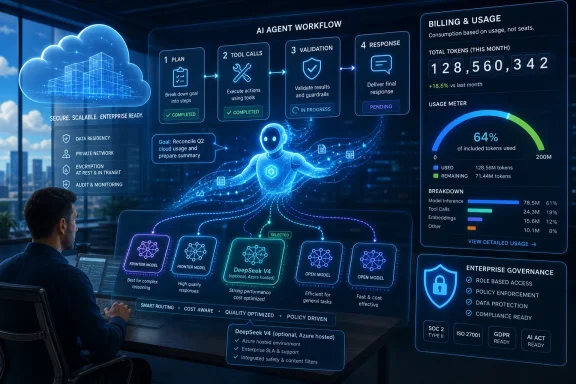
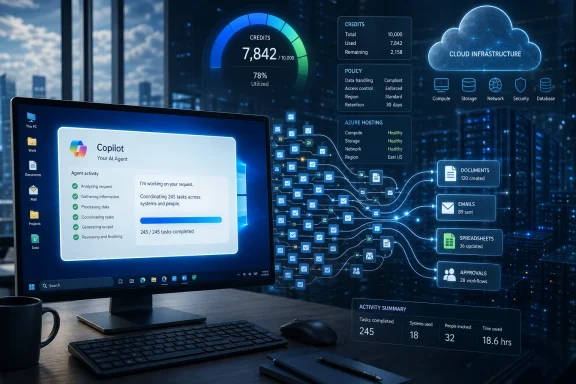
Microsoft made Copilot Cowork generally available worldwide on June 16, 2026, with usage-based billing for enterprise customers, while Axios reports the company is considering a Microsoft-hosted, fine-tuned DeepSeek model as a lower-cost option for the agentic workplace tool. That single pricing change says more about the near future of enterprise AI than another demo reel ever could. Microsoft is no longer selling Copilot Cowork as just a smarter assistant; it is selling access to a meter that can turn business process automation into a variable cloud bill. The DeepSeek angle is politically combustible, but the bigger story is that Microsoft is admitting agentic AI cannot be packaged like Office.
For the last two years, Microsoft has tried to make Copilot feel familiar. It sat in Word, Excel, Outlook, Teams, and the Microsoft 365 app, dressed in the reassuring clothes of a productivity feature. The implicit promise was that AI would arrive as the next ribbon button: powerful, occasionally annoying, but ultimately bounded by the same per-seat subscription logic that enterprise software buyers know how to budget.
Copilot Cowork breaks that pattern. It is not primarily a chat pane. Microsoft describes it as a system for complex, long-running, multi-tool tasks that can execute work end-to-end rather than merely draft a suggestion. That distinction matters because the cost profile of an agent is fundamentally different from the cost profile of a chatbot.
A chatbot answers, stops, and waits. An agent plans, retrieves context, calls tools, checks intermediate results, revises its plan, and may keep doing that until the task is complete. Each loop can consume model tokens, context retrieval, runtime, and tool calls. The productivity pitch is that a user can delegate a chunky piece of work; the accounting problem is that nobody knows in advance how chunky the machine will decide the work is.
That is why Microsoft’s move to charge Cowork by usage is not a footnote. It is the bill finally catching up with the demo. Charles Lamanna’s blunt admission to Axios — that some users run hundreds of tasks a week and costs can go “very high” — punctures the fantasy that agentic work can be bundled infinitely into a flat-rate seat.
The result is a new bargain. Microsoft will give enterprises a more capable worker-like system, but the customer must accept cloud economics inside the productivity suite. Every background task becomes a small act of consumption. Every ambitious workflow becomes not just a productivity experiment, but a budget event.
But Microsoft’s incentive is obvious: agentic AI needs cheaper reasoning. The company already says Copilot Cowork runs at general availability on Anthropic models, including Opus 4.8 and Sonnet 4.6, while GPT 5.5 is available in Frontier and Microsoft’s own Cowork 1 model is coming soon. Axios reports that Microsoft is exploring a fine-tuned version of DeepSeek V4, or another open-source model, as a lower-cost alternative to the Anthropic and OpenAI models now powering Cowork.
That phrasing is important. Microsoft has not announced DeepSeek as the selected model. The company says a cheaper model will be available in the coming weeks and that it will confirm its choice then. In other words, DeepSeek is under consideration, not yet a committed production dependency for every customer.
Still, the trial is revealing. Microsoft’s multi-model strategy is not merely about giving developers philosophical choice. It is about matching task value to model cost. If an expensive frontier model is needed to perform a high-stakes legal review, fine. If a cheaper fine-tuned model can handle routine workplace execution without unacceptable loss of quality, Microsoft wants that option in the stack.
This is the uncomfortable economics of enterprise AI. The agent market is full of magical language about coworkers, researchers, analysts, and digital labor. Underneath that, vendors are desperately searching for models that are good enough to run often. The winning product may not be the one with the smartest model on every task. It may be the one with the best router, the most credible guardrails, and the least terrifying invoice.
That answer will satisfy some buyers and fail to satisfy others. For a CIO, the practical question is not whether the model’s corporate parent is Chinese in the abstract. It is whether prompts, files, embeddings, tool outputs, telemetry, and generated artifacts are leaving the tenant boundary, who can access them, which jurisdiction governs the service, and what audit trail exists after the agent has touched business data.
A Microsoft-hosted model is materially different from sending enterprise prompts to a consumer chatbot or an external API controlled directly by the model developer. Azure hosting gives Microsoft a way to say that the operational surface is Microsoft’s: identity, logging, compliance, retention, access controls, data residency, and contractual commitments. That is the same playbook Azure AI Foundry has used as Microsoft broadened its catalog beyond OpenAI models.
But “hosted by Microsoft” does not erase every concern. Model provenance, training data claims, evaluation results, vulnerability handling, and geopolitical risk all remain live issues. Enterprises in regulated industries may care less about where inference runs and more about whether they can document why a given model was approved for a given class of work.
That is where optionality becomes more than a marketing phrase. If DeepSeek, Cowork 1, OpenAI, and Anthropic models sit behind a model picker or policy layer, admins can segment risk. A financial services firm might allow a cheaper model for internal summarization and prohibit it for client-facing analysis. A manufacturer might approve it for spreadsheet cleanup but not for export-controlled engineering documents. A public-sector tenant might block it entirely.
The burden then shifts to Microsoft to make model choice governable. It is not enough to say customers can choose. Enterprise administrators need policies, defaults, reporting, and defensible evidence that the cheaper choice stayed inside the allowed lane.
A single user asking Copilot to summarize a meeting is not the same economic event as a user asking Cowork to compare thousands of files, consult business systems, generate multiple outputs, and keep running after the laptop is shut. Microsoft’s own blog frames Cowork’s pricing around model use, context retrieval, tool calls, and runtime. That is cloud infrastructure logic inserted into a productivity product.
For IT departments, this changes the nature of rollout planning. The old Copilot adoption problem was, “Will users remember to use it?” The new Cowork problem is, “What happens if the users who remember to use it are extremely good at spending money?” The power users are the success story and the budget hazard at the same time.
Microsoft knows this, which is why cost management is central to the general availability announcement. Cowork is off by default. Admins can decide who gets access, set spending limits at tenant, group, and user levels, configure alerts, and use usage reporting. Microsoft says users will be able to see task-level pricing in credits soon after general availability, and that customers can use pay-as-you-go or commit to a prepaid usage model.
Those controls are necessary, but they are also an admission that agentic AI cannot be trusted to find its own equilibrium. If the system works, people will delegate more. If they delegate more, the meter runs. If the meter runs without visible value attribution, finance will eventually do what finance always does: ask who approved this.
This is where Microsoft’s credibility with enterprises helps and hurts. The company has spent decades building the admin consoles, compliance hooks, and procurement relationships that make IT buyers comfortable. But that same audience is allergic to surprise bills. A tool that “runs end-to-end” sounds wonderful until the end-to-end process crosses a cost threshold nobody modeled.
The addition of Anthropic models to Microsoft’s AI products already pointed in that direction. Cowork makes the strategy concrete. At general availability, Microsoft says Cowork runs on Anthropic models, GPT 5.5 is in Frontier, and Cowork 1 is coming. Axios now reports that DeepSeek or another open-source model could become the cheaper option for cost-sensitive workloads.
This resembles the way cloud buyers already think about compute. Not every workload needs the fastest instance type. Not every database query needs the most expensive tier. The enterprise cloud matured when customers could right-size workloads against price, performance, latency, compliance, and availability. Microsoft is trying to bring that discipline to AI inference.
The hard part is that models are not interchangeable CPUs. They have different failure modes, refusal styles, reasoning strengths, bias profiles, tool-use behavior, latency curves, and context-handling quirks. A task that works on one model may degrade subtly on another. In agentic systems, subtle degradation can be dangerous because the model is not just producing text; it is steering actions.
That means Microsoft’s model-routing layer becomes strategically important. If Cowork can automatically match a task to a cheaper model where safe, and escalate to a frontier model where needed, the customer sees lower cost without becoming an amateur model benchmarker. If that routing is opaque or unreliable, admins will fall back to blunt policies and the promised savings will be harder to realize.
Microsoft’s economic incentives are clear. More model suppliers mean more price pressure. More model choice means less dependence on any single partner. More internal models mean Microsoft can keep margin inside its own stack. The customer benefit is real, but it arrives wrapped in governance complexity.
Cowork’s promise is execution. It can operate across files, business context, plugins, and web access through Edge in Frontier. Microsoft says prompts, responses, and generated artifacts flow through existing Microsoft 365 controls, with audit log, Data Security Posture Management, eDiscovery, and Communication Compliance available at general availability, and more controls such as DLP and lifecycle management coming soon.
That is the right direction, but it should not lull anyone into thinking the problem is solved. Auditability after the fact is not the same as safe authorization before the fact. A logged mistake is still a mistake. A retained artifact can still contain bad analysis. A compliant workflow can still produce an action the business regrets.
This is where agentic AI collides with the messy reality of enterprise permissions. Most organizations already have over-permissioned SharePoint sites, stale groups, inconsistent sensitivity labels, and line-of-business systems with years of accumulated access exceptions. An agent grounded in that environment inherits the mess. Work IQ may give Cowork rich context, but rich context is only as safe as the identity, governance, and data hygiene underneath it.
DeepSeek does not create that problem. It intensifies the conversation around it. A cheaper model makes high-volume agent use more plausible, and high-volume use multiplies the consequences of weak controls. If the cost curve improves faster than the governance curve, organizations will automate into risk faster than they can audit their way out.
The right question for sysadmins is therefore not, “Is DeepSeek safe?” It is, “Which classes of work are safe enough for which model, under which permissions, with which approval gates, and with which logs?” That is a less satisfying question for headlines, but it is the one that will determine whether Cowork becomes infrastructure or shelfware.
That does not make it irrelevant to Windows admins. Most Windows environments are Microsoft 365 environments, and the PC remains the place where users encounter the work. If Cowork becomes a standard part of enterprise productivity, it will affect help desks, endpoint policy, browser policy, identity management, data classification, and user training.
The Edge browser detail is especially telling. Microsoft says browser use via Edge is available in Frontier, following the enterprise policies already in place for users. That makes the browser not just a viewport but an execution surface for agentic work. Admins who once thought of Edge policy as a way to control extensions, sign-in, and browsing behavior may soon need to think of it as part of the AI automation boundary.
There is also a device-management implication. Cowork’s cloud hosting means tasks can keep running even when a laptop is off, which is useful for users and slightly unsettling for administrators accustomed to tying activity to an active endpoint session. The locus of work shifts from the user’s machine to Microsoft’s cloud, while the user’s identity and permissions remain the bridge.
In practical terms, endpoint teams should expect Cowork adoption to increase pressure on identity hygiene, conditional access, sensitivity labeling, and audit review. The AI feature may live in Microsoft 365, but the operational fallout lands in the same admin queues that already handle Teams, SharePoint, Edge, Purview, and Entra policy questions.
For many enterprises, the safest version of the story may be Microsoft’s own Cowork 1 branding. Microsoft’s blog says Cowork 1 will be a secure, fine-tuned model designed for everyday Copilot tasks at substantially lower cost. Axios reports that Microsoft is exploring a fine-tuned DeepSeek V4, or another open-source model, but will confirm the choice later. If Cowork 1 is based on DeepSeek technology, Microsoft may try to make the operational contract more important than the model lineage.
That is not unusual in enterprise software. Customers often buy a supported distribution, not the raw upstream project. They care who patches it, who indemnifies it, who operates it, who signs the data-processing terms, and who answers the support ticket. Microsoft’s bet is that Azure-hosted, Microsoft-governed AI models can turn even controversial model origins into manageable vendor risk.
But AI is not quite Linux. Models carry statistical behavior that cannot be inspected like source code, and open weights do not automatically equal transparent training data or predictable outputs. Fine-tuning and safeguards can improve behavior, but they also require trust in Microsoft’s evaluation process. If Microsoft wants enterprises to run cheaper models at scale, it will need to publish enough testing, governance detail, and admin tooling to make that trust auditable.
The broader AI industry should pay attention. If Microsoft succeeds, the premium-model-only era of enterprise agents may be short. Frontier models will remain necessary for the hardest tasks, but the center of gravity will move toward model portfolios, task routing, and cost controls. The best enterprise AI product will feel less like a genius in a box and more like a well-managed fleet.
Microsoft appears to understand this, which is why it is adding visible controls and budget policies. But there is a cultural challenge here. If Cowork is supposed to change how people work, employees need permission to delegate meaningful tasks. If every meaningful task feels like spending company money in real time, adoption may skew toward executives and power users who feel authorized to consume credits.
That could create a two-tier AI workplace. Some employees will use Cowork as a genuine assistant for long-running work. Others will stay with ordinary Copilot Chat because it feels safer, cheaper, or less likely to trigger budget scrutiny. The technology may be broadly available, but the practical freedom to use it may vary by role, manager, and department.
Microsoft’s internal comparison claiming Cowork was 30 to 40 percent cheaper than Claude Cowork with a Microsoft 365 connector is useful, but not definitive. The company itself notes that actual costs and savings can vary by usage, configuration, time, and other factors. Customers should treat vendor cost comparisons as a starting point, not a budget.
The most mature enterprises will build their own baselines. They will classify task types, measure completion quality, track time saved, compare model options, and set policies by workload. The immature ones will either ban the interesting features or turn them on broadly and panic when the bill arrives.
That is the real enterprise divide in 2026. It is no longer between companies that “use AI” and companies that do not. It is between companies that can operationalize AI consumption and companies that still think of AI as a feature toggle.
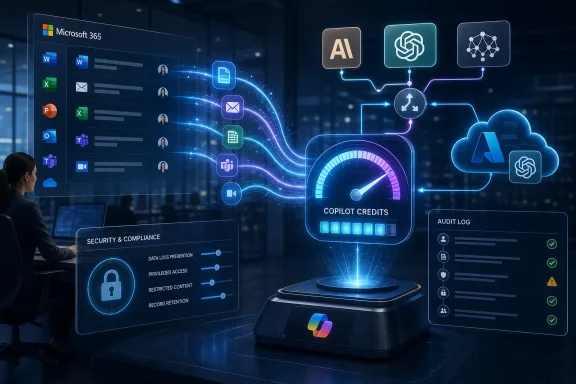 Microsoft Turns the AI Assistant Into a Metered Utility
For the last two years, Microsoft has tried to make Copilot feel familiar. It sat in Word, Excel, Outlook, Teams, and the Microsoft 365 app, dressed in the reassuring clothes of a productivity feature. The implicit promise was that AI would arrive as the next ribbon button: powerful, occasionally annoying, but ultimately bounded by the same per-seat subscription logic that enterprise software buyers know how to budget.Copilot Cowork breaks that pattern. It is not primarily a chat pane. Microsoft describes it as a system for complex, long-running, multi-tool tasks that can execute work end-to-end rather than merely draft a suggestion. That distinction matters because the cost profile of an agent is fundamentally different from the cost profile of a chatbot.
A chatbot answers, stops, and waits. An agent plans, retrieves context, calls tools, checks intermediate results, revises its plan, and may keep doing that until the task is complete. Each loop can consume model tokens, context retrieval, runtime, and tool calls. The productivity pitch is that a user can delegate a chunky piece of work; the accounting problem is that nobody knows in advance how chunky the machine will decide the work is.
That is why Microsoft’s move to charge Cowork by usage is not a footnote. It is the bill finally catching up with the demo. Charles Lamanna’s blunt admission to Axios — that some users run hundreds of tasks a week and costs can go “very high” — punctures the fantasy that agentic work can be bundled infinitely into a flat-rate seat.
The result is a new bargain. Microsoft will give enterprises a more capable worker-like system, but the customer must accept cloud economics inside the productivity suite. Every background task becomes a small act of consumption. Every ambitious workflow becomes not just a productivity experiment, but a budget event.
The DeepSeek Trial Is a Cost Story Wearing a Geopolitical Jacket
The most attention-grabbing part of the Axios report is Microsoft’s consideration of a hosted DeepSeek model for Copilot Cowork. That is understandable. DeepSeek is a Chinese AI company, and any Microsoft move to put a DeepSeek-derived model inside an enterprise Copilot product will attract scrutiny from security teams, regulators, competitors, and politicians who have turned AI supply chains into a proxy fight over national technology power.But Microsoft’s incentive is obvious: agentic AI needs cheaper reasoning. The company already says Copilot Cowork runs at general availability on Anthropic models, including Opus 4.8 and Sonnet 4.6, while GPT 5.5 is available in Frontier and Microsoft’s own Cowork 1 model is coming soon. Axios reports that Microsoft is exploring a fine-tuned version of DeepSeek V4, or another open-source model, as a lower-cost alternative to the Anthropic and OpenAI models now powering Cowork.
That phrasing is important. Microsoft has not announced DeepSeek as the selected model. The company says a cheaper model will be available in the coming weeks and that it will confirm its choice then. In other words, DeepSeek is under consideration, not yet a committed production dependency for every customer.
Still, the trial is revealing. Microsoft’s multi-model strategy is not merely about giving developers philosophical choice. It is about matching task value to model cost. If an expensive frontier model is needed to perform a high-stakes legal review, fine. If a cheaper fine-tuned model can handle routine workplace execution without unacceptable loss of quality, Microsoft wants that option in the stack.
This is the uncomfortable economics of enterprise AI. The agent market is full of magical language about coworkers, researchers, analysts, and digital labor. Underneath that, vendors are desperately searching for models that are good enough to run often. The winning product may not be the one with the smartest model on every task. It may be the one with the best router, the most credible guardrails, and the least terrifying invoice.
Azure Hosting Is Microsoft’s Answer to the DeepSeek Problem
Microsoft’s reported defense, if it proceeds with DeepSeek, is predictably Azure-shaped. Axios says the model would be optional for customers and fully hosted on Azure, with customer data remaining inside Microsoft’s cloud and covered by Azure’s enterprise security, compliance, and data-residency controls. Microsoft also says it has fine-tuned the model and added safeguards, including changes aimed at reducing bias.That answer will satisfy some buyers and fail to satisfy others. For a CIO, the practical question is not whether the model’s corporate parent is Chinese in the abstract. It is whether prompts, files, embeddings, tool outputs, telemetry, and generated artifacts are leaving the tenant boundary, who can access them, which jurisdiction governs the service, and what audit trail exists after the agent has touched business data.
A Microsoft-hosted model is materially different from sending enterprise prompts to a consumer chatbot or an external API controlled directly by the model developer. Azure hosting gives Microsoft a way to say that the operational surface is Microsoft’s: identity, logging, compliance, retention, access controls, data residency, and contractual commitments. That is the same playbook Azure AI Foundry has used as Microsoft broadened its catalog beyond OpenAI models.
But “hosted by Microsoft” does not erase every concern. Model provenance, training data claims, evaluation results, vulnerability handling, and geopolitical risk all remain live issues. Enterprises in regulated industries may care less about where inference runs and more about whether they can document why a given model was approved for a given class of work.
That is where optionality becomes more than a marketing phrase. If DeepSeek, Cowork 1, OpenAI, and Anthropic models sit behind a model picker or policy layer, admins can segment risk. A financial services firm might allow a cheaper model for internal summarization and prohibit it for client-facing analysis. A manufacturer might approve it for spreadsheet cleanup but not for export-controlled engineering documents. A public-sector tenant might block it entirely.
The burden then shifts to Microsoft to make model choice governable. It is not enough to say customers can choose. Enterprise administrators need policies, defaults, reporting, and defensible evidence that the cheaper choice stayed inside the allowed lane.
The Flat-Rate Copilot Dream Hits the Agentic Wall
Microsoft’s standard Copilot licensing taught customers to think in per-user terms. A company bought seats, managed adoption, and argued over whether employees were getting enough value from the monthly subscription. That model was already under pressure, but Cowork exposes its limits more sharply than ordinary chat ever did.A single user asking Copilot to summarize a meeting is not the same economic event as a user asking Cowork to compare thousands of files, consult business systems, generate multiple outputs, and keep running after the laptop is shut. Microsoft’s own blog frames Cowork’s pricing around model use, context retrieval, tool calls, and runtime. That is cloud infrastructure logic inserted into a productivity product.
For IT departments, this changes the nature of rollout planning. The old Copilot adoption problem was, “Will users remember to use it?” The new Cowork problem is, “What happens if the users who remember to use it are extremely good at spending money?” The power users are the success story and the budget hazard at the same time.
Microsoft knows this, which is why cost management is central to the general availability announcement. Cowork is off by default. Admins can decide who gets access, set spending limits at tenant, group, and user levels, configure alerts, and use usage reporting. Microsoft says users will be able to see task-level pricing in credits soon after general availability, and that customers can use pay-as-you-go or commit to a prepaid usage model.
Those controls are necessary, but they are also an admission that agentic AI cannot be trusted to find its own equilibrium. If the system works, people will delegate more. If they delegate more, the meter runs. If the meter runs without visible value attribution, finance will eventually do what finance always does: ask who approved this.
This is where Microsoft’s credibility with enterprises helps and hurts. The company has spent decades building the admin consoles, compliance hooks, and procurement relationships that make IT buyers comfortable. But that same audience is allergic to surprise bills. A tool that “runs end-to-end” sounds wonderful until the end-to-end process crosses a cost threshold nobody modeled.
Multi-Model Copilot Is Also a Negotiating Strategy
Microsoft’s relationship with OpenAI remains one of the defining technology partnerships of the AI era, but Copilot Cowork shows why Microsoft cannot afford to look like a single-model shop. It needs leverage, redundancy, and price competition. It also needs to convince customers that Copilot is a platform, not merely OpenAI wrapped in Microsoft 365 chrome.The addition of Anthropic models to Microsoft’s AI products already pointed in that direction. Cowork makes the strategy concrete. At general availability, Microsoft says Cowork runs on Anthropic models, GPT 5.5 is in Frontier, and Cowork 1 is coming. Axios now reports that DeepSeek or another open-source model could become the cheaper option for cost-sensitive workloads.
This resembles the way cloud buyers already think about compute. Not every workload needs the fastest instance type. Not every database query needs the most expensive tier. The enterprise cloud matured when customers could right-size workloads against price, performance, latency, compliance, and availability. Microsoft is trying to bring that discipline to AI inference.
The hard part is that models are not interchangeable CPUs. They have different failure modes, refusal styles, reasoning strengths, bias profiles, tool-use behavior, latency curves, and context-handling quirks. A task that works on one model may degrade subtly on another. In agentic systems, subtle degradation can be dangerous because the model is not just producing text; it is steering actions.
That means Microsoft’s model-routing layer becomes strategically important. If Cowork can automatically match a task to a cheaper model where safe, and escalate to a frontier model where needed, the customer sees lower cost without becoming an amateur model benchmarker. If that routing is opaque or unreliable, admins will fall back to blunt policies and the promised savings will be harder to realize.
Microsoft’s economic incentives are clear. More model suppliers mean more price pressure. More model choice means less dependence on any single partner. More internal models mean Microsoft can keep margin inside its own stack. The customer benefit is real, but it arrives wrapped in governance complexity.
The Enterprise Risk Is Not Just Data Leakage
The first wave of concern around DeepSeek will naturally focus on data security. That is not wrong, but it is incomplete. The enterprise risk of agentic AI is not only that confidential information may go somewhere it should not. It is also that an approved system may do something wrong, expensive, biased, noncompliant, or merely untraceable while staying entirely inside the tenant.Cowork’s promise is execution. It can operate across files, business context, plugins, and web access through Edge in Frontier. Microsoft says prompts, responses, and generated artifacts flow through existing Microsoft 365 controls, with audit log, Data Security Posture Management, eDiscovery, and Communication Compliance available at general availability, and more controls such as DLP and lifecycle management coming soon.
That is the right direction, but it should not lull anyone into thinking the problem is solved. Auditability after the fact is not the same as safe authorization before the fact. A logged mistake is still a mistake. A retained artifact can still contain bad analysis. A compliant workflow can still produce an action the business regrets.
This is where agentic AI collides with the messy reality of enterprise permissions. Most organizations already have over-permissioned SharePoint sites, stale groups, inconsistent sensitivity labels, and line-of-business systems with years of accumulated access exceptions. An agent grounded in that environment inherits the mess. Work IQ may give Cowork rich context, but rich context is only as safe as the identity, governance, and data hygiene underneath it.
DeepSeek does not create that problem. It intensifies the conversation around it. A cheaper model makes high-volume agent use more plausible, and high-volume use multiplies the consequences of weak controls. If the cost curve improves faster than the governance curve, organizations will automate into risk faster than they can audit their way out.
The right question for sysadmins is therefore not, “Is DeepSeek safe?” It is, “Which classes of work are safe enough for which model, under which permissions, with which approval gates, and with which logs?” That is a less satisfying question for headlines, but it is the one that will determine whether Cowork becomes infrastructure or shelfware.
Windows Shops Will Feel This Through Microsoft 365, Not Windows Itself
For Windows enthusiasts, the instinct is to look for the operating-system angle. Copilot has already been woven into Windows 11 in various ways, and Microsoft’s AI branding tends to blur the boundary between local PC features, Microsoft 365 services, and Azure-backed agents. Cowork, however, is primarily a cloud and Microsoft 365 enterprise story.That does not make it irrelevant to Windows admins. Most Windows environments are Microsoft 365 environments, and the PC remains the place where users encounter the work. If Cowork becomes a standard part of enterprise productivity, it will affect help desks, endpoint policy, browser policy, identity management, data classification, and user training.
The Edge browser detail is especially telling. Microsoft says browser use via Edge is available in Frontier, following the enterprise policies already in place for users. That makes the browser not just a viewport but an execution surface for agentic work. Admins who once thought of Edge policy as a way to control extensions, sign-in, and browsing behavior may soon need to think of it as part of the AI automation boundary.
There is also a device-management implication. Cowork’s cloud hosting means tasks can keep running even when a laptop is off, which is useful for users and slightly unsettling for administrators accustomed to tying activity to an active endpoint session. The locus of work shifts from the user’s machine to Microsoft’s cloud, while the user’s identity and permissions remain the bridge.
In practical terms, endpoint teams should expect Cowork adoption to increase pressure on identity hygiene, conditional access, sensitivity labeling, and audit review. The AI feature may live in Microsoft 365, but the operational fallout lands in the same admin queues that already handle Teams, SharePoint, Edge, Purview, and Entra policy questions.
Microsoft’s “Cheaper Model” Has to Be Boring to Win
The paradox of a DeepSeek-backed Cowork option is that Microsoft needs it to be newsworthy enough to lower costs and boring enough to pass procurement. The model must be cheap, capable, and politically survivable. That is not a trivial combination.For many enterprises, the safest version of the story may be Microsoft’s own Cowork 1 branding. Microsoft’s blog says Cowork 1 will be a secure, fine-tuned model designed for everyday Copilot tasks at substantially lower cost. Axios reports that Microsoft is exploring a fine-tuned DeepSeek V4, or another open-source model, but will confirm the choice later. If Cowork 1 is based on DeepSeek technology, Microsoft may try to make the operational contract more important than the model lineage.
That is not unusual in enterprise software. Customers often buy a supported distribution, not the raw upstream project. They care who patches it, who indemnifies it, who operates it, who signs the data-processing terms, and who answers the support ticket. Microsoft’s bet is that Azure-hosted, Microsoft-governed AI models can turn even controversial model origins into manageable vendor risk.
But AI is not quite Linux. Models carry statistical behavior that cannot be inspected like source code, and open weights do not automatically equal transparent training data or predictable outputs. Fine-tuning and safeguards can improve behavior, but they also require trust in Microsoft’s evaluation process. If Microsoft wants enterprises to run cheaper models at scale, it will need to publish enough testing, governance detail, and admin tooling to make that trust auditable.
The broader AI industry should pay attention. If Microsoft succeeds, the premium-model-only era of enterprise agents may be short. Frontier models will remain necessary for the hardest tasks, but the center of gravity will move toward model portfolios, task routing, and cost controls. The best enterprise AI product will feel less like a genius in a box and more like a well-managed fleet.
The Invoice Is Now Part of the Product Experience
Usage-based pricing changes user behavior even when users are not personally paying the bill. A per-seat subscription encourages experimentation because the marginal cost feels invisible. A credit meter encourages hesitation, gaming, managerial oversight, and eventually internal chargeback politics.Microsoft appears to understand this, which is why it is adding visible controls and budget policies. But there is a cultural challenge here. If Cowork is supposed to change how people work, employees need permission to delegate meaningful tasks. If every meaningful task feels like spending company money in real time, adoption may skew toward executives and power users who feel authorized to consume credits.
That could create a two-tier AI workplace. Some employees will use Cowork as a genuine assistant for long-running work. Others will stay with ordinary Copilot Chat because it feels safer, cheaper, or less likely to trigger budget scrutiny. The technology may be broadly available, but the practical freedom to use it may vary by role, manager, and department.
Microsoft’s internal comparison claiming Cowork was 30 to 40 percent cheaper than Claude Cowork with a Microsoft 365 connector is useful, but not definitive. The company itself notes that actual costs and savings can vary by usage, configuration, time, and other factors. Customers should treat vendor cost comparisons as a starting point, not a budget.
The most mature enterprises will build their own baselines. They will classify task types, measure completion quality, track time saved, compare model options, and set policies by workload. The immature ones will either ban the interesting features or turn them on broadly and panic when the bill arrives.
That is the real enterprise divide in 2026. It is no longer between companies that “use AI” and companies that do not. It is between companies that can operationalize AI consumption and companies that still think of AI as a feature toggle.
The Cowork Bargain Microsoft Is Asking IT to Accept
Microsoft’s Copilot Cowork announcement is not just a product launch; it is a contract rewrite between the productivity suite and enterprise IT. The most important details are concrete enough to plan around, even if the model lineup is still moving.- Copilot Cowork is generally available worldwide for Microsoft 365 Copilot customers, but it requires the underlying Microsoft 365 Copilot user subscription before usage-based Cowork billing applies.
- Microsoft is charging Cowork usage in Copilot Credits, with task cost driven by model use, context retrieval, tool calls, and runtime rather than by a simple unlimited seat entitlement.
- Cowork is off by default, and Microsoft says administrators can control access, set spending limits, configure alerts, and view usage reporting across tenant, group, and user levels.
- At general availability, Cowork runs on Anthropic models, while GPT 5.5 is available in Frontier and Microsoft’s lower-cost Cowork 1 model is expected in the coming weeks.
- Microsoft is reportedly considering a fine-tuned, Azure-hosted DeepSeek model or another open-source model as the cheaper Cowork option, but it has not yet confirmed the final choice.
- The practical decision for enterprises is not whether cheaper AI is attractive, but whether model choice, compliance controls, auditability, and budget governance are strong enough to let agents run real work.
References
- Primary source: Axios
Published: Tue, 16 Jun 2026 16:30:00 GMT
Microsoft explores DeepSeek for Copilot Cowork
Microsoft will also shift to usage-based pricing for the enterprise agent.www.axios.com
- Official source: microsoft.com
Anthropic joins the multi-model lineup in Microsoft Copilot Studio | Microsoft Copilot Blog
In addition to default OpenAI models, Copilot Studio customers can now build agents with Anthropic models Claude Sonnet 4 and Claude Opus 4.1www.microsoft.com - Official source: learn.microsoft.com
Foundry Models sold by Azure - Microsoft Foundry | Microsoft Learn
Learn about Microsoft Foundry Models sold by Azure, their capabilities, deployment types, and regional availability for AI applications.learn.microsoft.com - Official source: azure.microsoft.com
- Related coverage: windowscentral.com
This is Microsoft's new "Copilot Cowork": An experiment with Anthropic's Claude AI models that plans and delegates your work | Windows Central
Microsoft ships Copilot Cowork to its Frontier program.www.windowscentral.com - Related coverage: arstechnica.com
Microsoft now hosts AI model accused of copying OpenAI data - Ars Technica
OpenAI's largest investor now sells access to the "R1" model accused of breaking OpenAI's terms.arstechnica.com
- Related coverage: techtarget.com
Microsoft, AWS and Cerebras launch DeepSeek-R1 model | TechTarget
AWS, Microsoft Azure and Cerebras offer DeepSeek-R1 as the model reshapes industry standards with greater efficiency and lower costs.www.techtarget.com - Related coverage: gigazine.net
DeepSeek-R1がMicrosoftのAzure AIとGitHubモデル経由で利用可能に - GIGAZINE
Microsoftが2025年1月29日に、中国のAI企業・DeepSeekが開発したDeepSeek-R1をAI開発のための統合プラットフォームであるAzure AI FoundryとGitHubモデルに導入したことを発表しました。gigazine.net - Related coverage: techcrunch.com
Microsoft brings a DeepSeek model to its cloud | TechCrunch
Microsoft has brought one of DeepSeek's models to its cloud, and says that 'distilled' versions of the model will come to Copilot+ PCs soon.techcrunch.com - Official source: techcommunity.microsoft.com
Introducing MAI-DS-R1 | Microsoft Community Hub
Authors: Samer Hassan, Doran Chakraborty, Qi Zhang ,Yuan Yu Today we’re releasing MAI-DS-R1, a new open weights DeepSeek R1 model variant, via... techcommunity.microsoft.com
- Official source: devblogs.microsoft.com
What’s new in Microsoft Foundry | October and November 2025 | Microsoft Foundry Blog
Transform AI development with Microsoft Foundry, a unified, interoperable AI platform to build, optimize, and govern AI innovation at scale.devblogs.microsoft.com - Related coverage: tomshardware.com
Microsoft adds Grok 4 to Azure AI Foundry following cautious trials — Elon Musk's latest AI model is now available to deploy for "frontier‑level reasoning" | Tom's Hardware
Comes with a 128K-token context window.www.tomshardware.com - Related coverage: techradar.com
Microsoft 365 confirms new premium tier focused on AI and productivity | TechRadar
Microsoft adds new E7 plan to cope with AI usagewww.techradar.com - Related coverage: itpro.com
Satya Nadella says “our multi-model approach goes beyond choice’ as Microsoft adds Claude AI models to 365 Copilot | IT Pro
Users can choose between both OpenAI and Anthropic models in Microsoft 365 Copilotwww.itpro.com