

Microsoft made Copilot Cowork generally available worldwide on June 16, 2026, and shifted the Microsoft 365 agent from a simple fixed-fee promise toward usage-based billing through Copilot Credits, while reportedly weighing a Microsoft-hosted DeepSeek V4 option to reduce model costs. That is not just a pricing update. It is Microsoft acknowledging that agentic AI has broken the economics of the old software subscription. For Windows shops, the question is no longer whether Copilot can do more work; it is whether the bill, the risk model, and the admin controls can keep up with what the software is now being asked to do.
The first wave of Copilot was sold in language that enterprise buyers understand: a per-user add-on, bolted onto Microsoft 365, predictable enough to put into a procurement spreadsheet. Microsoft 365 Copilot’s $30-per-user monthly license became the clean headline number. It was expensive, but it was legible.
Copilot Cowork makes that simplicity harder to maintain. Cowork is not just a chat box waiting for a user to ask for a paragraph or summarize a meeting. It is an agentic assistant meant to plan work, operate across Microsoft 365 context, and run multi-step tasks through Outlook, Teams, Excel, documents, calendars, and enterprise search.
That distinction matters because the cost curve changes. A chatbot interaction has a start and an end. An agentic workflow may inspect files, make a plan, call tools, revise outputs, compare results, and continue until it reaches something approximating completion. In cloud terms, that is not a feature; it is a workload.
Microsoft’s move to usage-based billing is therefore less surprising than it may first look. The company has spent years teaching customers to think of Microsoft 365 as a per-seat productivity bundle. Cowork asks customers to think of AI labor as consumption infrastructure.
Generative AI never fit that bargain cleanly, and agents fit it even worse. Every substantial AI action consumes inference capacity. Every long context window, model call, reasoning loop, tool invocation, and generated output has an underlying compute cost. The more autonomous the assistant becomes, the less predictable that cost is.
That is the awkward truth behind the billing change. A light user may ask Cowork to summarize a thread and draft a response. A power user may ask it to reconcile thousands of records, prepare a sales-risk analysis, generate materials, update spreadsheets, and iterate until the result is usable. Those two users may hold identical licenses, but they do not impose identical costs.
This is the same pressure that has pushed other AI products toward meters, credits, tiers, and throttles. Vendors want the marketing simplicity of “AI for everyone,” but they also need protection from customers who actually use the product heavily. Cowork’s pricing shift tells customers that the flat-rate AI honeymoon is ending fastest where the product is most capable.
That is why the Anthropic connection matters. At general availability, Copilot Cowork runs on Claude models including high-end options intended for deeper reasoning and more complex work. Microsoft has spent the past few years presenting Copilot as inseparable from OpenAI, but Cowork shows a more pragmatic future: the Microsoft 365 shell may matter more than the model brand underneath it.
For admins, that makes Cowork both more interesting and more difficult to evaluate. The product is not just “Claude inside Office” or “Copilot with a new skin.” It is Microsoft Graph context, tenant permissions, AI model routing, tool access, workflow execution, audit expectations, billing telemetry, and governance controls all colliding in one product surface.
The result is a familiar Microsoft pattern. The company is not necessarily first to every individual idea, but it is unusually well positioned to industrialize the idea inside the software estate companies already use. If Cowork works, it becomes another reason to keep business process, identity, documents, and collaboration inside Microsoft’s cloud.
Still, the strategic signal is blunt. If Microsoft is considering DeepSeek V4 or another open model for Cowork, it is because frontier closed models are expensive enough to force hard choices. Anthropic and OpenAI may offer premium reasoning, but premium reasoning at agentic scale can turn into a punishing cost structure.
A Microsoft-hosted open model offers a different bargain. The model may be cheaper to run, easier to tune for particular workloads, and more controllable inside Microsoft’s own infrastructure. The tradeoff is that customers and regulators will ask whether “hosted by Microsoft” is enough to address their concerns about provenance, behavior, safety, and supply-chain risk.
That debate is not theoretical. Enterprises already distinguish between where data is processed, who operates the service, which subprocessors are involved, and what contractual guarantees apply. A DeepSeek-powered Cowork option would test whether customers care more about model nationality or operational control.
Cowork makes that clearer than almost any previous Microsoft 365 feature. A legal team preparing high-stakes analysis may want the strongest available reasoning model. A sales operations team cleaning routine spreadsheet data may not need the most expensive model in the stack. A finance team may prefer a slower but more auditable path. A startup may simply want the cheapest competent option.
Microsoft’s “Auto” model routing can hide some of that complexity, but it cannot eliminate the underlying tradeoff. Someone still decides what “good enough” means. Someone still absorbs the bill. Someone still explains why one model was allowed for a workflow and another was blocked.
This is where Copilot begins to resemble Azure more than Office. Azure customers already think in terms of regions, SKUs, quotas, workload classes, and cost management. Microsoft 365 admins historically thought more in terms of users, groups, licenses, retention policies, and access controls. Cowork drags the Microsoft 365 admin closer to the Azure consumption mindset.
Usage-based AI billing demands a new muscle. Organizations will need to know which teams are using Cowork, which workflows are burning credits, which models are being selected, and whether recurring automations are quietly turning into budget events. The more successful Cowork is, the more urgent this becomes.
The risk is especially sharp because AI usage does not always feel like resource consumption to the end user. Employees understand that a cloud VM costs money when it runs. They may not intuitively understand that asking an agent to “review all the files in this folder and prepare a board-ready summary” could be materially more expensive than asking a short question in chat.
That gap will create friction. Finance teams will want forecasts. Security teams will want audit trails. Business units will want autonomy. IT will be asked to provide guardrails without smothering adoption. Microsoft can help with dashboards and policy controls, but the organizational problem belongs to the customer.
A Microsoft-hosted DeepSeek option would sit in the middle of that debate. Customer data staying inside Azure would address one major concern, but it would not answer every question. Enterprises may ask how the model was trained, whether it has hidden behavioral quirks, how Microsoft evaluates it, what safety layers are applied, and whether regulated industries can approve it.
The answer may differ by customer. A small business may see an optional lower-cost model as an obvious win. A defense contractor may reject it immediately. A multinational may permit it in some regions and block it in others. A university may care more about cost than geopolitics, while a bank may care more about auditability than model performance.
That variability is precisely why optionality matters. If Microsoft forces one model path, it inherits all the objections. If it offers a governed menu, it can let customers map models to their own risk tolerance. The burden then shifts from Microsoft’s product team to the customer’s governance process.
That matters because founders often adopt productivity tools before they build mature internal controls. A team may enthusiastically wire Cowork into sales, finance, recruiting, and customer support workflows before anyone has defined usage budgets. The first surprise bill will teach the lesson, but not gently.
The practical answer is not to avoid Cowork. It is to treat it like cloud infrastructure from day one. Track usage early, assign ownership, set limits where possible, and decide which kinds of work deserve expensive reasoning. A founder who would never let a developer spin up unlimited cloud instances should not let every employee run unlimited agentic workflows without oversight.
This is also where cheaper models could be genuinely useful. Not every business process needs the AI equivalent of a senior analyst. Some tasks need competent extraction, formatting, comparison, or routing. If Microsoft can pair lower-cost models with sensible policy controls, Cowork could become more accessible rather than merely more expensive.
That has obvious benefits. An agent that understands enterprise context and respects Microsoft 365 permissions could be more useful than a disconnected AI tool pasted into a browser tab. It can work where the documents, calendars, chats, and spreadsheets already live. It can also inherit identity and compliance plumbing that admins already trust more than a random SaaS plugin.
But the same integration raises the stakes. If Cowork can act across Microsoft 365, permission hygiene becomes more important. Overshared SharePoint sites become richer targets for accidental disclosure. Poorly governed mailboxes and Teams channels become part of the agent’s working memory. Old information architecture problems do not disappear when AI arrives; they become easier to exploit at machine speed.
This is the uncomfortable admin lesson of agentic AI. Before letting software “do work,” organizations need to know what work it can see, what actions it can take, which approvals are required, and how to reconstruct what happened after the fact.
That illusion weakens as the tools become more useful. The more an AI system reasons, plans, invokes tools, reads context, generates artifacts, and loops through revisions, the more it resembles a variable compute workload. Software companies cannot indefinitely sell unlimited access to a product whose cost rises with every meaningful action.
Satya Nadella’s framing of AI as a consumption business captures the point. Microsoft knows how to sell consumption. Azure is built on it. The challenge is that Microsoft 365 buyers are not always Azure buyers, and knowledge workers are not trained to think like cloud architects. Cowork imports cloud economics into the daily routine of office work.
That will change behavior. Managers will ask whether a workflow is worth the credits. Admins will create policies around model choice. Vendors will pitch optimization. Consultants will build practices around AI cost management. The phrase Copilot spend will become as normal as cloud spend.
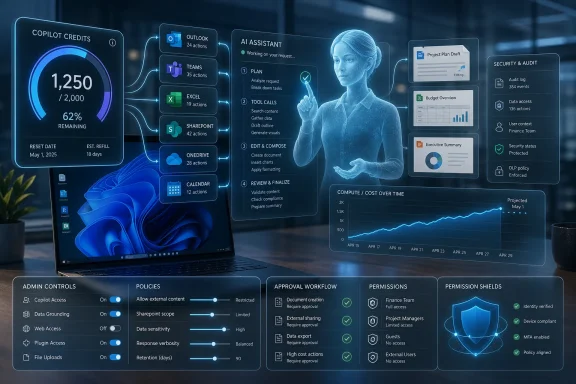 Microsoft Turns Copilot From a Seat License Into a Meter
The first wave of Copilot was sold in language that enterprise buyers understand: a per-user add-on, bolted onto Microsoft 365, predictable enough to put into a procurement spreadsheet. Microsoft 365 Copilot’s $30-per-user monthly license became the clean headline number. It was expensive, but it was legible.Copilot Cowork makes that simplicity harder to maintain. Cowork is not just a chat box waiting for a user to ask for a paragraph or summarize a meeting. It is an agentic assistant meant to plan work, operate across Microsoft 365 context, and run multi-step tasks through Outlook, Teams, Excel, documents, calendars, and enterprise search.
That distinction matters because the cost curve changes. A chatbot interaction has a start and an end. An agentic workflow may inspect files, make a plan, call tools, revise outputs, compare results, and continue until it reaches something approximating completion. In cloud terms, that is not a feature; it is a workload.
Microsoft’s move to usage-based billing is therefore less surprising than it may first look. The company has spent years teaching customers to think of Microsoft 365 as a per-seat productivity bundle. Cowork asks customers to think of AI labor as consumption infrastructure.
The Agent Is the Billable Unit Now
The old software bargain assumed that the vendor could roughly average out user behavior. Some people lived in Excel all day; others opened it twice a month. The license price absorbed that variation because the marginal cost of letting someone open a spreadsheet was close to nothing.Generative AI never fit that bargain cleanly, and agents fit it even worse. Every substantial AI action consumes inference capacity. Every long context window, model call, reasoning loop, tool invocation, and generated output has an underlying compute cost. The more autonomous the assistant becomes, the less predictable that cost is.
That is the awkward truth behind the billing change. A light user may ask Cowork to summarize a thread and draft a response. A power user may ask it to reconcile thousands of records, prepare a sales-risk analysis, generate materials, update spreadsheets, and iterate until the result is usable. Those two users may hold identical licenses, but they do not impose identical costs.
This is the same pressure that has pushed other AI products toward meters, credits, tiers, and throttles. Vendors want the marketing simplicity of “AI for everyone,” but they also need protection from customers who actually use the product heavily. Cowork’s pricing shift tells customers that the flat-rate AI honeymoon is ending fastest where the product is most capable.
Cowork Is Microsoft’s Most Ambitious Office Agent Yet
Cowork is important because it points to where Microsoft wants Office to go. The classic productivity suite was built around documents, messages, meetings, and spreadsheets. Copilot inserted a conversational layer on top of that world. Cowork tries to move one layer deeper, turning the assistant into something closer to a delegated worker.That is why the Anthropic connection matters. At general availability, Copilot Cowork runs on Claude models including high-end options intended for deeper reasoning and more complex work. Microsoft has spent the past few years presenting Copilot as inseparable from OpenAI, but Cowork shows a more pragmatic future: the Microsoft 365 shell may matter more than the model brand underneath it.
For admins, that makes Cowork both more interesting and more difficult to evaluate. The product is not just “Claude inside Office” or “Copilot with a new skin.” It is Microsoft Graph context, tenant permissions, AI model routing, tool access, workflow execution, audit expectations, billing telemetry, and governance controls all colliding in one product surface.
The result is a familiar Microsoft pattern. The company is not necessarily first to every individual idea, but it is unusually well positioned to industrialize the idea inside the software estate companies already use. If Cowork works, it becomes another reason to keep business process, identity, documents, and collaboration inside Microsoft’s cloud.
The DeepSeek Trial Is About Price, Not Romance
The reported DeepSeek angle will attract the loudest reaction, especially in the United States. DeepSeek is a Chinese AI company, and any suggestion that its models might appear inside enterprise productivity software will trigger questions about trust, sovereignty, data handling, and political risk. Microsoft appears to understand that, which is why the reported approach centers on a secured, Microsoft-hosted version running on Azure rather than sending customer data to servers controlled by DeepSeek.Still, the strategic signal is blunt. If Microsoft is considering DeepSeek V4 or another open model for Cowork, it is because frontier closed models are expensive enough to force hard choices. Anthropic and OpenAI may offer premium reasoning, but premium reasoning at agentic scale can turn into a punishing cost structure.
A Microsoft-hosted open model offers a different bargain. The model may be cheaper to run, easier to tune for particular workloads, and more controllable inside Microsoft’s own infrastructure. The tradeoff is that customers and regulators will ask whether “hosted by Microsoft” is enough to address their concerns about provenance, behavior, safety, and supply-chain risk.
That debate is not theoretical. Enterprises already distinguish between where data is processed, who operates the service, which subprocessors are involved, and what contractual guarantees apply. A DeepSeek-powered Cowork option would test whether customers care more about model nationality or operational control.
Microsoft’s Multi-Model Strategy Stops Being Abstract
For years, “model choice” sounded like a developer-platform slogan. In consumer products, most users do not want to pick a model. They want the answer to be good, fast, and reasonably priced. In enterprise AI, however, model choice is becoming a cost-control and governance mechanism.Cowork makes that clearer than almost any previous Microsoft 365 feature. A legal team preparing high-stakes analysis may want the strongest available reasoning model. A sales operations team cleaning routine spreadsheet data may not need the most expensive model in the stack. A finance team may prefer a slower but more auditable path. A startup may simply want the cheapest competent option.
Microsoft’s “Auto” model routing can hide some of that complexity, but it cannot eliminate the underlying tradeoff. Someone still decides what “good enough” means. Someone still absorbs the bill. Someone still explains why one model was allowed for a workflow and another was blocked.
This is where Copilot begins to resemble Azure more than Office. Azure customers already think in terms of regions, SKUs, quotas, workload classes, and cost management. Microsoft 365 admins historically thought more in terms of users, groups, licenses, retention policies, and access controls. Cowork drags the Microsoft 365 admin closer to the Azure consumption mindset.
The New Copilot Admin Job Is Cost Governance
The immediate operational problem is not whether Cowork can produce impressive demos. It probably can. The problem is whether IT can prevent impressive demos from becoming unpredictable spend.Usage-based AI billing demands a new muscle. Organizations will need to know which teams are using Cowork, which workflows are burning credits, which models are being selected, and whether recurring automations are quietly turning into budget events. The more successful Cowork is, the more urgent this becomes.
The risk is especially sharp because AI usage does not always feel like resource consumption to the end user. Employees understand that a cloud VM costs money when it runs. They may not intuitively understand that asking an agent to “review all the files in this folder and prepare a board-ready summary” could be materially more expensive than asking a short question in chat.
That gap will create friction. Finance teams will want forecasts. Security teams will want audit trails. Business units will want autonomy. IT will be asked to provide guardrails without smothering adoption. Microsoft can help with dashboards and policy controls, but the organizational problem belongs to the customer.
The Security Argument Cuts Both Ways
Microsoft’s reported DeepSeek exploration exposes a deeper contradiction in enterprise AI. Closed Western models are often perceived as safer for procurement and compliance, but they can be costly and opaque. Open models can be cheaper and more inspectable in some ways, but they bring provenance and policy concerns that many organizations are not prepared to evaluate.A Microsoft-hosted DeepSeek option would sit in the middle of that debate. Customer data staying inside Azure would address one major concern, but it would not answer every question. Enterprises may ask how the model was trained, whether it has hidden behavioral quirks, how Microsoft evaluates it, what safety layers are applied, and whether regulated industries can approve it.
The answer may differ by customer. A small business may see an optional lower-cost model as an obvious win. A defense contractor may reject it immediately. A multinational may permit it in some regions and block it in others. A university may care more about cost than geopolitics, while a bank may care more about auditability than model performance.
That variability is precisely why optionality matters. If Microsoft forces one model path, it inherits all the objections. If it offers a governed menu, it can let customers map models to their own risk tolerance. The burden then shifts from Microsoft’s product team to the customer’s governance process.
Founders Get Power With a Meter Attached
For startups and smaller firms, usage-based billing is both good news and bad news. The good news is that a lower-cost model could make sophisticated agentic workflows available without paying premium-model prices for every task. The bad news is that variable billing is harder to plan around than a fixed subscription.That matters because founders often adopt productivity tools before they build mature internal controls. A team may enthusiastically wire Cowork into sales, finance, recruiting, and customer support workflows before anyone has defined usage budgets. The first surprise bill will teach the lesson, but not gently.
The practical answer is not to avoid Cowork. It is to treat it like cloud infrastructure from day one. Track usage early, assign ownership, set limits where possible, and decide which kinds of work deserve expensive reasoning. A founder who would never let a developer spin up unlimited cloud instances should not let every employee run unlimited agentic workflows without oversight.
This is also where cheaper models could be genuinely useful. Not every business process needs the AI equivalent of a senior analyst. Some tasks need competent extraction, formatting, comparison, or routing. If Microsoft can pair lower-cost models with sensible policy controls, Cowork could become more accessible rather than merely more expensive.
Windows Shops Will Feel This Through Microsoft 365 First
For WindowsForum readers, the significance is less about the Cowork brand and more about Microsoft’s direction of travel. Windows endpoints, Entra ID, Microsoft 365, Defender, Purview, Teams, SharePoint, OneDrive, and Azure are already intertwined in many organizations. Agentic Copilot features will make that fabric tighter.That has obvious benefits. An agent that understands enterprise context and respects Microsoft 365 permissions could be more useful than a disconnected AI tool pasted into a browser tab. It can work where the documents, calendars, chats, and spreadsheets already live. It can also inherit identity and compliance plumbing that admins already trust more than a random SaaS plugin.
But the same integration raises the stakes. If Cowork can act across Microsoft 365, permission hygiene becomes more important. Overshared SharePoint sites become richer targets for accidental disclosure. Poorly governed mailboxes and Teams channels become part of the agent’s working memory. Old information architecture problems do not disappear when AI arrives; they become easier to exploit at machine speed.
This is the uncomfortable admin lesson of agentic AI. Before letting software “do work,” organizations need to know what work it can see, what actions it can take, which approvals are required, and how to reconstruct what happened after the fact.
The Flat-Rate Dream Was Always a Marketing Phase
The broader industry lesson is that AI is moving from subscription theater to utility economics. Vendors initially needed simple pricing to drive adoption. Buyers needed simple pricing to justify pilots. Everyone benefited from pretending that AI usage could be packaged like email storage or office apps.That illusion weakens as the tools become more useful. The more an AI system reasons, plans, invokes tools, reads context, generates artifacts, and loops through revisions, the more it resembles a variable compute workload. Software companies cannot indefinitely sell unlimited access to a product whose cost rises with every meaningful action.
Satya Nadella’s framing of AI as a consumption business captures the point. Microsoft knows how to sell consumption. Azure is built on it. The challenge is that Microsoft 365 buyers are not always Azure buyers, and knowledge workers are not trained to think like cloud architects. Cowork imports cloud economics into the daily routine of office work.
That will change behavior. Managers will ask whether a workflow is worth the credits. Admins will create policies around model choice. Vendors will pitch optimization. Consultants will build practices around AI cost management. The phrase Copilot spend will become as normal as cloud spend.
The Cowork Meter Is the Message
The concrete lesson from Cowork’s launch is that agentic AI is no longer just a feature announcement. It is a budgeting event, a governance event, and a trust event. Organizations evaluating it should focus less on the novelty of the interface and more on the operating model it requires.- Copilot Cowork is generally available as a Microsoft 365 Copilot capability, but its economics are tied to usage rather than a simple unlimited flat-fee model.
- The base Microsoft 365 Copilot license remains only part of the cost picture because Cowork consumes Copilot Credits as it performs work.
- Microsoft’s reported interest in a hosted DeepSeek V4 option is best understood as a cost-control move for compute-heavy agentic workflows.
- Model choice will become a practical governance decision, not just a technical preference for AI enthusiasts.
- IT teams should treat Cowork workflows like cloud workloads, with monitoring, limits, ownership, and review.
- Permission hygiene, auditability, and approval controls matter more when an assistant can act across Microsoft 365 rather than merely answer questions.
References
- Primary source: Lapaas Voice
Published: 2026-06-23T09:58:16.295172
Microsoft Copilot Cowork Billing Goes Usage-Based
Microsoft Copilot Cowork billing shifts from flat fee to usage-based pay-as-you-go, and may tap DeepSeek V4 to cut AI costs. What it means for businesses.voice.lapaas.com - Related coverage: axios.com
Axios C-Suite: Open-source AI pits cost against security
It's free to download, cheaper to run — and dominated by China.www.axios.com
- Related coverage: techradar.com
Microsoft makes Copilot Cowork open to everyone, and wants to help you tackle even the trickiest work tasks | TechRadar
Copilot Cowork gets an upgrade as it opens to all userswww.techradar.com - Official source: microsoft.com
Copilot Cowork is now generally available | Microsoft 365 Blog
Copilot Cowork is now generally available worldwide, bringing secure, AI-powered automation for complex enterprise tasks in Microsoft 365.www.microsoft.com - Official source: support.microsoft.com
- Official source: learn.microsoft.com
Choose a model for Copilot Cowork | Microsoft Learn
Pick the right model for your task in Microsoft 365 Copilot Cowork.learn.microsoft.com
- Official source: directionsonmicrosoft.com
Microsoft’s Copilot Cowork Gets Model Choice Plus Usage-Based Billing - Directions on Microsoft
Microsoft’s Copilot 365’s Cowork feature, which is generally available worldwide as of June 16, will offer customers a choice of models and won’t be solely Anthropic-based as it is currently. Microsoft also is adding usage-based...www.directionsonmicrosoft.com - Related coverage: computerworld.com
Microsoft launches Copilot Cowork with usage-based pricing – Computerworld
Copilot Cowork customers can choose from Anthropic and OpenAI models to run the AI agent, while Microsoft reportedly plans to offer an open source model from DeepSeek to lower costs. www.computerworld.com
- Related coverage: memeburn.com
Microsoft Copilot Cowork Switches to Usage-Based Billing and Eyes DeepSeek - Memeburn
Microsoft launches Copilot Cowork globally with usage-based billing and explores DeepSeek V4 as a low-cost AI model option. Here's what the pricing shift means for enterprise AI.memeburn.com - Related coverage: windowscentral.com
This is Microsoft's new "Copilot Cowork": An experiment with Anthropic's Claude AI models that plans and delegates your work | Windows Central
Microsoft ships Copilot Cowork to its Frontier program.www.windowscentral.com - Related coverage: briefia.fr
Microsoft Copilot : facturation à l'usage avec DeepSeek | Brief IA
• Microsoft envisage d'intégrer DeepSeek V4 dans Copilot Cowork pour réduire les coûts. • La facturation de Copilot Cowork passera à un modèle basé sur l'utilisation, selon Charles Lamanna. • Cette évolution reflète une tendance générale dans l'industrie vers des modèles de tarification plus... www.briefia.fr
- Related coverage: theinformation.com
Microsoft Mulls Using DeepSeek for Copilot Cowork — The Information
Microsoft is considering adding Chinese AI developer DeepSeek’s V4 as a cheaper model option for powering the Copilot Cowork AI assistant, Axios reported. The U.S. tech giant is exploring a Microsoft-hosted version of DeepSeek V4, or another open-source model, as a cheaper alternative to...www.theinformation.com
