

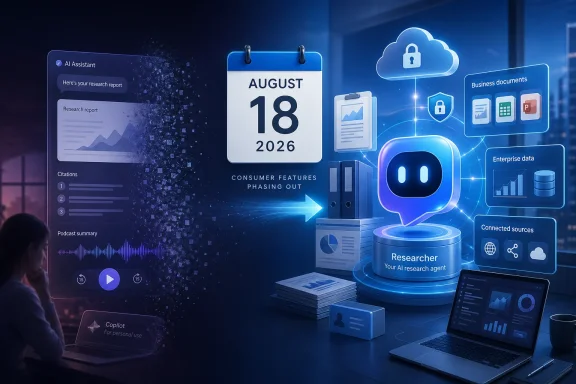
Microsoft will retire Deep Research and Podcasts in the consumer Copilot app on August 18, 2026, removing two of the most distinctive capabilities introduced during the company’s 50th-anniversary showcase little more than a year ago. The decision does not mean Microsoft is abandoning AI-assisted research or generated audio, but it does reveal a sharper division between the broadly accessible Copilot experience and the advanced agents Microsoft increasingly reserves for Microsoft 365 subscribers, business customers, and tightly managed productivity environments.
Microsoft unveiled Deep Research and Copilot Podcasts on April 4, 2025, as part of an unusually ambitious expansion of its consumer AI assistant. The anniversary release also highlighted Copilot Vision, Memory, Actions, Pages, shopping tools, and a redesigned Windows application, presenting Copilot as a personalized companion rather than simply a chatbot attached to Bing.
Deep Research was meant to handle complicated questions that could not be answered reliably with a single search result or a brief conversational response. Copilot would break down a topic, investigate information from multiple online sources, and produce a longer, structured report with citations.
Podcasts targeted a different problem: how to make dense information easier to consume. Users could provide a subject, document, study, or collection of web material and ask Copilot to turn it into a conversational audio program featuring two synthetic hosts.
Both features reflected the industry’s direction in 2025. OpenAI, Google, Microsoft, and other AI vendors were moving beyond one-shot text generation toward multi-step research, source-grounded synthesis, and automatically generated media.
Their retirement on August 18, 2026, therefore matters for more than the users who happened to generate reports or podcasts. It offers a revealing look at how Microsoft is reorganizing Copilot around subscriptions, agents, Microsoft 365 data, and enterprise-oriented workflows.
That distinction is important because ordinary chatbot responses and deep-research reports are not interchangeable. A conventional answer usually prioritizes speed, while a research agent is expected to search more widely, reconcile sources, expose citations, and build a coherent document.
After August 18, that dedicated workflow will disappear from consumer Copilot. Microsoft is directing eligible users toward the Researcher agent in Microsoft 365 Copilot, but that alternative is not a direct replacement for everyone because availability depends on the user’s subscription and account context.
The retirement is more disruptive than an ordinary feature removal because previously generated podcasts will also become inaccessible. Microsoft is not offering a way to download or export the underlying audio files, and shared links will stop functioning after the shutdown.
The result is a hard deadline. Anyone who treated a generated podcast as a durable artifact, embedded a shared link in a study plan, or circulated one among colleagues should assume that access will end on August 18.
Microsoft also permits users to open existing reports in Word and save them locally. That export path turns an AI-generated response into an ordinary document that can be archived, edited, printed, converted to PDF, or stored outside Microsoft’s conversational interface.
Copilot conversation history is not necessarily a permanent archival system. Microsoft’s consumer documentation states that conversation activity is normally retained for a defined period, so locally saving important reports remains the safer approach.
This creates an unusual asymmetry. Users supplied prompts and sometimes uploaded source material, Microsoft’s service generated the audio, and users could share the result—but they could not preserve the resulting file independently.
Google’s NotebookLM, by comparison, provides a download option for Audio Overviews. That does not make every competing service permanent, but it establishes a reasonable user expectation that generated audio should be portable.
That internal grounding is the central advantage. A business user could ask Researcher to compare public market developments with company emails, meeting records, SharePoint documents, and internal reports rather than manually uploading each item to a generic chatbot.
Standard Copilot Chat remains better suited to quick questions, drafting, brainstorming, and short summaries. Researcher intentionally takes longer because the system is expected to investigate, reason across sources, and produce an output that can support a more consequential decision.
Microsoft 365 Personal and Family customers can preserve old Deep Research reports, but they do not automatically receive the same forward-looking research workflow. Users who considered Deep Research part of the value of their existing plan may therefore see the transition as an effective downgrade.
This segmentation appears deliberate. Microsoft is positioning advanced agents as a reason to purchase higher-tier subscriptions rather than as baseline features of the general-purpose Copilot app.
Microsoft has also experimented with computer-use capabilities that allow Researcher to interact with websites and tools in a secured environment. These features move beyond report generation toward task completion, although they introduce additional governance and security considerations.
The underlying message is clear: Microsoft still believes in deep research. It simply appears to believe that the most valuable version belongs inside Microsoft 365’s authenticated, permission-aware productivity graph rather than in a universal consumer chatbot.
Free or lightly monetized consumer use can become difficult to justify when a feature is both expensive and used by only a minority of customers. Moving the workflow into a premium subscription makes its operating cost easier to recover and gives Microsoft clearer usage limits.
Generated podcasts also carry multiple costs. The system must gather or analyze source material, write a script, synthesize multiple voices, store the audio, and stream it whenever the user or a shared-link recipient presses play.
Deep Research in consumer Copilot and Researcher in Microsoft 365 performed conceptually similar tasks through different interfaces. Copilot Podcasts overlapped with audio-generation features appearing in Microsoft 365 Copilot Notebooks and Teams.
Consolidation can reduce duplicate development and direct users toward products with clearer commercial roles. The danger is that it can also make the free or mainstream Copilot experience feel like a temporary testing ground whose best ideas eventually move behind another subscription.
Researcher becomes more valuable when it can safely interpret a user’s authorized work data. The service can assist with sales preparation, competitive analysis, project reviews, policy research, procurement, and executive briefings without requiring users to assemble every relevant document manually.
This does not prove that Microsoft is withdrawing from consumer AI. It does suggest that Microsoft 365 is increasingly the destination for high-cost, high-value Copilot capabilities.
Deep Research gave consumer Copilot a recognizable answer to equivalent capabilities in ChatGPT and Gemini. Podcasts gave it a direct competitor to NotebookLM’s popular Audio Overviews.
Removing both at once reduces Copilot’s breadth precisely where rivals continue combining research, source management, document creation, and multimedia output. Microsoft still offers voice, Vision, Pages, image tools, and other experiences, but the product becomes less compelling for users who prioritize structured research.
Neither feature should be treated as an unquestionable academic authority. AI research systems can misread sources, miss contrary evidence, invent connections, or present weak material with unjustified confidence.
Even with those limitations, the tools lowered the barrier to exploring difficult topics. Replacing them with a Premium-only agent creates a financial boundary around a workflow that had become useful for independent learning.
The podcast format also made complex material less intimidating. A conversational exchange between synthetic hosts could expose key concepts, define unfamiliar terms, and create a mental framework before the user returned to the original documents.
Microsoft still has audio features elsewhere in its portfolio, including notebook overviews and meeting recaps. Their availability and account requirements, however, do not make them universal replacements for consumer Copilot Podcasts.
Permissions remain fundamental. Researcher should only retrieve information the signed-in user is authorized to access, which preserves existing Microsoft 365 boundaries rather than creating a new unrestricted data layer.
This architecture can make AI research more useful, but it also magnifies the consequences of poor information hygiene. Excessively broad SharePoint permissions, outdated documents, duplicated files, and uncontrolled data sprawl can all influence the output.
It also means that the practical quality of Researcher will vary among organizations. One company may provide a carefully governed environment with curated data and clear user training, while another may enable the tool across poorly organized repositories and expect accurate results automatically.
Before broad deployment, organizations should evaluate:
Enterprise customers may benefit if engineering resources previously divided across consumer Deep Research and Microsoft 365 Researcher move toward the latter. The value of that shift will depend on whether Microsoft delivers noticeably better reliability rather than simply narrowing access.
For consumers comparing subscriptions, feature continuity matters almost as much as peak model performance. A slightly weaker capability that remains predictably available may be more valuable than an impressive tool that disappears after a year.
Microsoft can counter that argument by making Researcher substantially better through Microsoft 365 integration. That answer is persuasive for Office-heavy professionals but less relevant to users seeking a general-purpose personal assistant.
Google also links research to Audio Overviews, creating a natural path from investigation to spoken explanation. A user can research a topic, inspect the report, and generate an audio version without changing ecosystems.
That joined-up workflow resembles what Microsoft appeared to be building in 2025. Retiring consumer Deep Research and Podcasts breaks that chain unless users move into Microsoft 365’s higher-tier environment.
Crucially, NotebookLM permits Audio Overview downloads. Microsoft’s decision to make Copilot podcasts non-exportable therefore looks less like an unavoidable technical constraint and more like a product-design choice.
The comparison may influence trust. Users are more likely to invest time building AI-generated artifacts when they know those artifacts can leave the original platform.
That service model enables rapid iteration. It also means the experience shown during a Windows or Copilot launch event may not remain stable for the supported lifetime of a PC.
Users should not interpret the presence of a Copilot button, app, or keyboard key as a guarantee that a particular cloud capability will continue. Hardware branding and online-service continuity operate on very different schedules.
The shared Copilot branding can make these distinctions difficult to understand. Deep Research and Podcasts were service-side consumer Copilot features, not capabilities dependent on a specific Windows processor or NPU.
For WindowsForum readers, the practical lesson is to evaluate each AI feature according to where it runs, what account it requires, whether it stores data in the cloud, and whether its outputs are portable.
Once Microsoft retires the playback system, the apparent object disappears. This is similar to the closure of a social platform, game service, or cloud media store where access depended on the provider continuing to operate the backend.
Clearer product design would distinguish between temporary AI experiences and user-owned exports. If download is prohibited, the interface should state prominently that generated content may become unavailable.
At minimum, services that generate reports, audio, video, presentations, or code should offer:
If Researcher remains exclusive to Premium and commercial licenses, Microsoft will have drawn a firm line between everyday Copilot chat and advanced agentic work. Customers will then judge whether the additional subscription cost is justified by the quality of the reports and Microsoft 365 integration.
A strong successor would support source-grounded audio, downloadable files, transcripts, multiple languages, customizable formats, and clear retention policies. Without those fundamentals, Microsoft risks repeating the same portability problem under another product name.
Observers should watch whether Microsoft introduces substantial new capabilities for ordinary Copilot users or increasingly routes innovations through paid Microsoft 365 experiences. A consumer assistant needs a recognizable identity beyond serving as the entry point to subscription upgrades.
The quality of in-product warnings will matter. Users should receive prominent notifications in the relevant podcast and research interfaces rather than being expected to discover the change through a support page or technology news report.
Microsoft’s best response will not be a marketing campaign. It will be a demonstrably superior Researcher agent combined with transparent subscription rules and a more respectful approach to user-created artifacts.
Microsoft’s August 18 retirement of consumer Copilot Deep Research and Podcasts is not the end of either underlying idea; it is a redistribution of where Microsoft believes those ideas belong. Deep research is moving toward a premium, Microsoft 365-grounded agent, while generated audio is increasingly associated with notebooks, meetings, and managed productivity workflows. That strategy may strengthen Microsoft’s enterprise position, but it leaves consumer Copilot with fewer distinctive tools and raises an uncomfortable question about the durability of cloud-created content. If Microsoft wants users to trust Copilot with serious research, personal documents, and reusable media, future features will need more than impressive demonstrations—they will need stable availability, understandable licensing, and an export button.
 Background
Microsoft unveiled Deep Research and Copilot Podcasts on April 4, 2025, as part of an unusually ambitious expansion of its consumer AI assistant. The anniversary release also highlighted Copilot Vision, Memory, Actions, Pages, shopping tools, and a redesigned Windows application, presenting Copilot as a personalized companion rather than simply a chatbot attached to Bing.Deep Research was meant to handle complicated questions that could not be answered reliably with a single search result or a brief conversational response. Copilot would break down a topic, investigate information from multiple online sources, and produce a longer, structured report with citations.
Podcasts targeted a different problem: how to make dense information easier to consume. Users could provide a subject, document, study, or collection of web material and ask Copilot to turn it into a conversational audio program featuring two synthetic hosts.
Both features reflected the industry’s direction in 2025. OpenAI, Google, Microsoft, and other AI vendors were moving beyond one-shot text generation toward multi-step research, source-grounded synthesis, and automatically generated media.
Their retirement on August 18, 2026, therefore matters for more than the users who happened to generate reports or podcasts. It offers a revealing look at how Microsoft is reorganizing Copilot around subscriptions, agents, Microsoft 365 data, and enterprise-oriented workflows.
What Microsoft Is Retiring
Microsoft has confirmed that Deep Research will no longer be available in the consumer Copilot app after August 18. Copilot Podcasts will disappear on the same date, although the two shutdowns have very different consequences for previously generated material.Deep Research leaves the consumer interface
Deep Research allowed users to submit open-ended and potentially complicated requests, such as comparing technologies, investigating a market, planning a major purchase, or assembling background material for an academic subject. Instead of immediately producing a plausible-sounding answer, the tool could spend more time gathering and organizing information.That distinction is important because ordinary chatbot responses and deep-research reports are not interchangeable. A conventional answer usually prioritizes speed, while a research agent is expected to search more widely, reconcile sources, expose citations, and build a coherent document.
After August 18, that dedicated workflow will disappear from consumer Copilot. Microsoft is directing eligible users toward the Researcher agent in Microsoft 365 Copilot, but that alternative is not a direct replacement for everyone because availability depends on the user’s subscription and account context.
Podcasts will disappear completely
Copilot Podcasts generated audio programs based on either a user-selected topic or supplied content. Generation normally took several minutes, after which users could listen inside Copilot or share a link with another person.The retirement is more disruptive than an ordinary feature removal because previously generated podcasts will also become inaccessible. Microsoft is not offering a way to download or export the underlying audio files, and shared links will stop functioning after the shutdown.
The result is a hard deadline. Anyone who treated a generated podcast as a durable artifact, embedded a shared link in a study plan, or circulated one among colleagues should assume that access will end on August 18.
The Different Fate of Existing Content
Microsoft is handling saved research reports and generated audio in sharply contrasting ways. That difference exposes an unresolved question facing many cloud-based AI services: Does the user own a generated artifact in a practical sense if the service provides no way to retain it?Research reports will remain available
Existing Deep Research content will not be deleted merely because the creation feature is being retired. Microsoft 365 Personal and Family subscribers should continue to find previous reports through Copilot conversation history, while Microsoft 365 Premium users can access relevant research through the Microsoft 365 Copilot experience.Microsoft also permits users to open existing reports in Word and save them locally. That export path turns an AI-generated response into an ordinary document that can be archived, edited, printed, converted to PDF, or stored outside Microsoft’s conversational interface.
Copilot conversation history is not necessarily a permanent archival system. Microsoft’s consumer documentation states that conversation activity is normally retained for a defined period, so locally saving important reports remains the safer approach.
Generated podcasts have no export route
The podcast situation is significantly less user-friendly. The audio lives within Copilot’s service environment, and Microsoft does not provide a supported download or export function before the feature closes.This creates an unusual asymmetry. Users supplied prompts and sometimes uploaded source material, Microsoft’s service generated the audio, and users could share the result—but they could not preserve the resulting file independently.
Google’s NotebookLM, by comparison, provides a download option for Audio Overviews. That does not make every competing service permanent, but it establishes a reasonable user expectation that generated audio should be portable.
What users should do before August 18
Anyone who has used either feature should complete a short preservation review:- Open Copilot conversation history and identify important Deep Research reports.
- Export valuable reports to Word and save additional copies in a trusted local or cloud location.
- Review documents for citations, formatting errors, and information that may have become outdated.
- Notify recipients that shared Copilot podcast links will stop working after August 18.
- Preserve the original source documents or prompts used for important podcasts so the content can be regenerated elsewhere.
- Avoid relying on screen or system-audio recording unless legal, organizational, and copyright requirements have been considered.
Researcher Becomes Microsoft’s Preferred Alternative
Microsoft’s recommended successor is not another mode inside the consumer Copilot app. It is Researcher, an agent available through Microsoft 365 Copilot for eligible subscribers and licensed organizations.How Researcher differs from ordinary Copilot chat
Researcher is designed for layered questions that require more than a fast summary. It can build a structured, cited report and, in work environments, combine public web sources with Microsoft 365 content that the user already has permission to access.That internal grounding is the central advantage. A business user could ask Researcher to compare public market developments with company emails, meeting records, SharePoint documents, and internal reports rather than manually uploading each item to a generic chatbot.
Standard Copilot Chat remains better suited to quick questions, drafting, brainstorming, and short summaries. Researcher intentionally takes longer because the system is expected to investigate, reason across sources, and produce an output that can support a more consequential decision.
Subscription boundaries change the experience
Researcher is available to Microsoft 365 Premium subscribers and to business or enterprise users with the appropriate Microsoft 365 Copilot licensing. That means the replacement sits behind a more restrictive access boundary than the retired consumer capability.Microsoft 365 Personal and Family customers can preserve old Deep Research reports, but they do not automatically receive the same forward-looking research workflow. Users who considered Deep Research part of the value of their existing plan may therefore see the transition as an effective downgrade.
This segmentation appears deliberate. Microsoft is positioning advanced agents as a reason to purchase higher-tier subscriptions rather than as baseline features of the general-purpose Copilot app.
Researcher is becoming more capable
Microsoft has continued developing Researcher beyond the original deep-research concept. Depending on account, licensing, administrator configuration, and rollout status, the agent can use multiple models, connect with organizational content, and participate in more sophisticated agentic workflows.Microsoft has also experimented with computer-use capabilities that allow Researcher to interact with websites and tools in a secured environment. These features move beyond report generation toward task completion, although they introduce additional governance and security considerations.
The underlying message is clear: Microsoft still believes in deep research. It simply appears to believe that the most valuable version belongs inside Microsoft 365’s authenticated, permission-aware productivity graph rather than in a universal consumer chatbot.
Why Microsoft May Be Consolidating Copilot
Microsoft has not supplied a detailed public explanation for removing these particular features. Several strategic and technical factors, however, make consolidation a plausible interpretation.Advanced research is expensive to operate
A deep-research request can involve repeated searches, document retrieval, model calls, source comparison, long-context processing, and report generation. Each job consumes substantially more compute than a short conversational answer.Free or lightly monetized consumer use can become difficult to justify when a feature is both expensive and used by only a minority of customers. Moving the workflow into a premium subscription makes its operating cost easier to recover and gives Microsoft clearer usage limits.
Generated podcasts also carry multiple costs. The system must gather or analyze source material, write a script, synthesize multiple voices, store the audio, and stream it whenever the user or a shared-link recipient presses play.
Overlapping products create confusion
Microsoft has spent several years applying the Copilot name across consumer chat, Windows, Edge, Microsoft 365, GitHub, security products, developer tools, business applications, and specialized agents. The breadth creates distribution, but it also makes it difficult for customers to understand which Copilot they are using and what their subscription includes.Deep Research in consumer Copilot and Researcher in Microsoft 365 performed conceptually similar tasks through different interfaces. Copilot Podcasts overlapped with audio-generation features appearing in Microsoft 365 Copilot Notebooks and Teams.
Consolidation can reduce duplicate development and direct users toward products with clearer commercial roles. The danger is that it can also make the free or mainstream Copilot experience feel like a temporary testing ground whose best ideas eventually move behind another subscription.
Microsoft gains more from work-context AI
Consumer chat is strategically useful, but Microsoft’s strongest competitive assets remain Windows, Office, Microsoft Graph, Entra ID, SharePoint, Teams, OneDrive, and enterprise security infrastructure. An AI agent that can act on those systems is harder for a rival to duplicate than a web-research mode available through a public chatbot.Researcher becomes more valuable when it can safely interpret a user’s authorized work data. The service can assist with sales preparation, competitive analysis, project reviews, policy research, procurement, and executive briefings without requiring users to assemble every relevant document manually.
This does not prove that Microsoft is withdrawing from consumer AI. It does suggest that Microsoft 365 is increasingly the destination for high-cost, high-value Copilot capabilities.
Consumer Impact
For Windows users, the immediate effect depends on how deeply they relied on the two features. Casual users may barely notice, while students, researchers, accessibility-focused customers, and information workers using personal accounts could face a meaningful loss.The free Copilot proposition becomes less distinctive
General conversational AI is now widely available. What differentiates an assistant is not merely whether it can draft an email, summarize a paragraph, or generate an image, but whether it can execute complex workflows reliably.Deep Research gave consumer Copilot a recognizable answer to equivalent capabilities in ChatGPT and Gemini. Podcasts gave it a direct competitor to NotebookLM’s popular Audio Overviews.
Removing both at once reduces Copilot’s breadth precisely where rivals continue combining research, source management, document creation, and multimedia output. Microsoft still offers voice, Vision, Pages, image tools, and other experiences, but the product becomes less compelling for users who prioritize structured research.
Students may be particularly affected
Students could use Deep Research to map unfamiliar subjects, locate starting sources, compare arguments, and create outlines. Podcasts could convert a body of material into a more approachable audio explanation for revision or commuting.Neither feature should be treated as an unquestionable academic authority. AI research systems can misread sources, miss contrary evidence, invent connections, or present weak material with unjustified confidence.
Even with those limitations, the tools lowered the barrier to exploring difficult topics. Replacing them with a Premium-only agent creates a financial boundary around a workflow that had become useful for independent learning.
Accessibility and learning preferences matter
Generated audio is not merely a novelty. Some people absorb information more effectively through speech, while others use audio because reading long documents is difficult, tiring, or incompatible with their daily routine.The podcast format also made complex material less intimidating. A conversational exchange between synthetic hosts could expose key concepts, define unfamiliar terms, and create a mental framework before the user returned to the original documents.
Microsoft still has audio features elsewhere in its portfolio, including notebook overviews and meeting recaps. Their availability and account requirements, however, do not make them universal replacements for consumer Copilot Podcasts.
Enterprise and Organizational Impact
Businesses are unlikely to mourn the disappearance of a consumer research mode if they already use Microsoft 365 Copilot. In many cases, Researcher is the more appropriate tool because it operates within an organization’s identity, permissions, compliance, and data-governance framework.Work-data grounding is the real differentiator
A public research agent can analyze the web and user-supplied documents. An enterprise agent connected to Microsoft Graph can potentially interpret the organization’s own working context, including relevant messages, meetings, files, and sites.Permissions remain fundamental. Researcher should only retrieve information the signed-in user is authorized to access, which preserves existing Microsoft 365 boundaries rather than creating a new unrestricted data layer.
This architecture can make AI research more useful, but it also magnifies the consequences of poor information hygiene. Excessively broad SharePoint permissions, outdated documents, duplicated files, and uncontrolled data sprawl can all influence the output.
Administrators gain control but inherit responsibility
Microsoft 365 administrators can manage access to agents and related features. That control supports staged deployments, regulatory requirements, licensing policies, and risk management.It also means that the practical quality of Researcher will vary among organizations. One company may provide a carefully governed environment with curated data and clear user training, while another may enable the tool across poorly organized repositories and expect accurate results automatically.
Before broad deployment, organizations should evaluate:
- Whether users understand that citations must still be inspected.
- Whether sensitive repositories have appropriate access controls.
- Whether generated reports can be shared outside the organization.
- Whether retention and audit policies cover agent-generated content.
- Whether employees can distinguish public web evidence from internal organizational material.
- Whether research outputs require human approval before informing legal, financial, medical, or strategic decisions.
Consumer retirement may simplify support
Maintaining parallel research systems can create duplicated testing, safety evaluation, documentation, and customer support. Consolidation may allow Microsoft to improve one primary agent more quickly.Enterprise customers may benefit if engineering resources previously divided across consumer Deep Research and Microsoft 365 Researcher move toward the latter. The value of that shift will depend on whether Microsoft delivers noticeably better reliability rather than simply narrowing access.
The Competitive Picture
Microsoft’s decision arrives while competing platforms are expanding rather than shrinking their research and audio capabilities. That contrast risks creating a perception that Copilot is retreating from categories it helped validate.ChatGPT remains a direct research rival
ChatGPT’s deep-research tools are designed to conduct multi-step investigations and deliver cited reports. OpenAI has also expanded the broader ChatGPT environment around files, projects, tools, connectors, and agentic actions.For consumers comparing subscriptions, feature continuity matters almost as much as peak model performance. A slightly weaker capability that remains predictably available may be more valuable than an impressive tool that disappears after a year.
Microsoft can counter that argument by making Researcher substantially better through Microsoft 365 integration. That answer is persuasive for Office-heavy professionals but less relevant to users seeking a general-purpose personal assistant.
Gemini connects research and audio
Gemini continues to provide Deep Research, with options to draw from Google Search, uploaded files, and connected personal sources such as Gmail or Drive where supported. Reports can be exported, shared, copied, and transformed into additional formats.Google also links research to Audio Overviews, creating a natural path from investigation to spoken explanation. A user can research a topic, inspect the report, and generate an audio version without changing ecosystems.
That joined-up workflow resembles what Microsoft appeared to be building in 2025. Retiring consumer Deep Research and Podcasts breaks that chain unless users move into Microsoft 365’s higher-tier environment.
NotebookLM sets a portability benchmark
NotebookLM is centered on source-grounded notebooks rather than open-ended consumer conversation. Users assemble documents, websites, media, and other sources, then create outputs such as reports, study guides, mind maps, slide decks, and Audio Overviews.Crucially, NotebookLM permits Audio Overview downloads. Microsoft’s decision to make Copilot podcasts non-exportable therefore looks less like an unavoidable technical constraint and more like a product-design choice.
The comparison may influence trust. Users are more likely to invest time building AI-generated artifacts when they know those artifacts can leave the original platform.
The Windows Connection
Copilot’s changing role on Windows has been a recurring source of confusion. Microsoft first integrated a web-powered Copilot panel into Windows 11, later shifted toward an app model, and continued adding features such as Vision and voice interactions.Copilot is increasingly a service, not an operating-system component
The current Copilot application can appear integrated with Windows, but many of its core capabilities remain cloud services controlled independently of the operating system. Microsoft can add or remove a feature without waiting for a Windows feature update.That service model enables rapid iteration. It also means the experience shown during a Windows or Copilot launch event may not remain stable for the supported lifetime of a PC.
Users should not interpret the presence of a Copilot button, app, or keyboard key as a guarantee that a particular cloud capability will continue. Hardware branding and online-service continuity operate on very different schedules.
Copilot+ PCs are not directly affected
The retirement does not remove the local AI features associated with Copilot+ PCs. Capabilities built around the neural processing unit, Windows Studio Effects, image tools, search enhancements, or other on-device experiences follow separate product roadmaps.The shared Copilot branding can make these distinctions difficult to understand. Deep Research and Podcasts were service-side consumer Copilot features, not capabilities dependent on a specific Windows processor or NPU.
For WindowsForum readers, the practical lesson is to evaluate each AI feature according to where it runs, what account it requires, whether it stores data in the cloud, and whether its outputs are portable.
Artifact Ownership and Platform Trust
The loss of existing podcasts raises a broader issue that technology companies have not resolved consistently. AI products increasingly generate documents, images, videos, applications, voice recordings, and structured reports, but users do not always receive ordinary files they can control.A shareable object is not necessarily a portable object
Copilot allowed users to share podcast links, which made the audio feel like a persistent piece of content. In reality, the link only pointed to an artifact hosted inside Microsoft’s service.Once Microsoft retires the playback system, the apparent object disappears. This is similar to the closure of a social platform, game service, or cloud media store where access depended on the provider continuing to operate the backend.
Clearer product design would distinguish between temporary AI experiences and user-owned exports. If download is prohibited, the interface should state prominently that generated content may become unavailable.
Local export should become a baseline expectation
Not every intermediate AI response requires a download button. Durable artifacts are different, particularly when generation takes time or depends on user-supplied source material.At minimum, services that generate reports, audio, video, presentations, or code should offer:
- A documented export format that does not require the original service.
- Advance notice before removal or format changes.
- A reasonable migration period.
- Clear retention rules at the moment of creation.
- An explanation of what happens to shared links.
- Administrative export options for organizational accounts.
Strengths and Opportunities
The shutdown can produce benefits if Microsoft uses it to deliver a more coherent, reliable Copilot strategy rather than merely reducing consumer functionality.- Microsoft can concentrate research engineering on one advanced agent. A unified Researcher platform may improve source handling, report quality, model choice, and tool integration faster than two overlapping products.
- Microsoft 365 grounding gives Researcher a genuine competitive advantage. Combining public evidence with authorized workplace information can support tasks that a standalone consumer chatbot cannot perform as naturally.
- Clearer product tiers could reduce Copilot confusion. Microsoft has often blurred consumer, productivity, and enterprise offerings, so a better-defined hierarchy would help customers understand what they are buying.
- The company can redesign audio around durable notebooks. Audio Overviews in Microsoft 365 Copilot Notebooks could become a more structured successor if Microsoft expands availability and adds dependable export controls.
- Windows can remain the access point without pretending every feature is part of Windows itself. A service-based app can evolve quickly as long as Microsoft communicates account, licensing, and retention requirements clearly.
- The retirement creates an opportunity to improve portability standards. Microsoft could respond to criticism by making export a default requirement for future Copilot-generated artifacts.
Risks and Concerns
The decision also creates several risks for Microsoft’s consumer AI ambitions and for trust in Copilot more broadly.- Consumers may view Copilot features as temporary experiments. Deep Research and Podcasts lasted only about sixteen months from announcement to retirement, which may discourage users from incorporating future Copilot tools into serious workflows.
- The Premium transition can feel like an upsell rather than a migration. Researcher may be more powerful, but users on lower-tier plans lose the ability to create new deep-research reports without receiving an equivalent replacement.
- Podcast deletion undermines confidence in cloud-generated artifacts. Users cannot preserve files that they may have invested time in creating, reviewing, and sharing.
- Competitors retain clearer consumer research propositions. ChatGPT and Gemini continue to treat deep research as an important general-purpose capability, while NotebookLM keeps expanding its source-grounded media tools.
- Copilot branding remains difficult to navigate. Microsoft Copilot, Microsoft 365 Copilot, Copilot Chat, Researcher, Notebooks, and Windows integrations may still appear to consumers as variations of one product even when their licensing and data models differ substantially.
- Accessibility use cases may be overlooked. Removing a convenient text-to-conversational-audio workflow affects more than entertainment and could disadvantage users who rely on spoken explanations.
- AI output quality remains a governance challenge. Moving research into Microsoft 365 adds valuable context, but it can also produce authoritative-looking reports based on stale, poorly permissioned, or inaccurate organizational data.
What to Watch Next
The retirement date is fixed, but the larger strategic implications will unfold over the rest of 2026. Several developments will indicate whether Microsoft is executing a deliberate consolidation or simply allowing consumer Copilot to fall behind.Researcher availability and pricing
The first question is whether Microsoft broadens access to Researcher. Bringing a limited form of the agent to Personal or Family subscribers would soften the impact and preserve a consumer research story.If Researcher remains exclusive to Premium and commercial licenses, Microsoft will have drawn a firm line between everyday Copilot chat and advanced agentic work. Customers will then judge whether the additional subscription cost is justified by the quality of the reports and Microsoft 365 integration.
The future of generated audio
Microsoft already offers audio-oriented capabilities in Microsoft 365 Copilot Notebooks and Teams. The next step may be to consolidate those tools into a common generation platform with consistent voices, storage, sharing, accessibility, and export behavior.A strong successor would support source-grounded audio, downloadable files, transcripts, multiple languages, customizable formats, and clear retention policies. Without those fundamentals, Microsoft risks repeating the same portability problem under another product name.
Consumer Copilot’s release cadence
Copilot Health, announced in March 2026 and moved into a United States preview for eligible adult Microsoft 365 subscribers in May, demonstrates that Microsoft is still investing in consumer-facing scenarios. Health is also a specialized, high-trust category rather than a broad productivity function.Observers should watch whether Microsoft introduces substantial new capabilities for ordinary Copilot users or increasingly routes innovations through paid Microsoft 365 experiences. A consumer assistant needs a recognizable identity beyond serving as the entry point to subscription upgrades.
Migration communication
Microsoft’s support guidance gives users less than a month between the July 21 reports and the August 18 retirement. That may be sufficient for an online feature, but it is a narrow window when one category of generated content cannot be exported.The quality of in-product warnings will matter. Users should receive prominent notifications in the relevant podcast and research interfaces rather than being expected to discover the change through a support page or technology news report.
Competitive responses
Google and OpenAI have strong incentives to emphasize continuity, exports, and accessible research features following Microsoft’s withdrawal. Even small product changes could reinforce the contrast.Microsoft’s best response will not be a marketing campaign. It will be a demonstrably superior Researcher agent combined with transparent subscription rules and a more respectful approach to user-created artifacts.
Microsoft’s August 18 retirement of consumer Copilot Deep Research and Podcasts is not the end of either underlying idea; it is a redistribution of where Microsoft believes those ideas belong. Deep research is moving toward a premium, Microsoft 365-grounded agent, while generated audio is increasingly associated with notebooks, meetings, and managed productivity workflows. That strategy may strengthen Microsoft’s enterprise position, but it leaves consumer Copilot with fewer distinctive tools and raises an uncomfortable question about the durability of cloud-created content. If Microsoft wants users to trust Copilot with serious research, personal documents, and reusable media, future features will need more than impressive demonstrations—they will need stable availability, understandable licensing, and an export button.
References
- Primary source: Neowin
Published: 2026-07-21T17:46:01+00:00
Loading…
www.neowin.net - Independent coverage: thurrott.com
Published: 2026-07-21T20:29:27+00:00
Loading…
www.thurrott.com - Related coverage: windowscentral.com
Microsoft just pulled a Sony: The tech giant will get rid of your AI-created podcasts and won't let you save them | Windows Central
Copilot Podcasts will soon be retired, and Microsoft won't provide an option to export or save previously created content.www.windowscentral.com - Official source: support.microsoft.com
Deep Research in Microsoft Copilot | Microsoft Support
Deep Research in Microsoft Copilotsupport.microsoft.com - Official source: learn.microsoft.com
Loading…
learn.microsoft.com - Official source: microsoft.com
Loading…
www.microsoft.com