

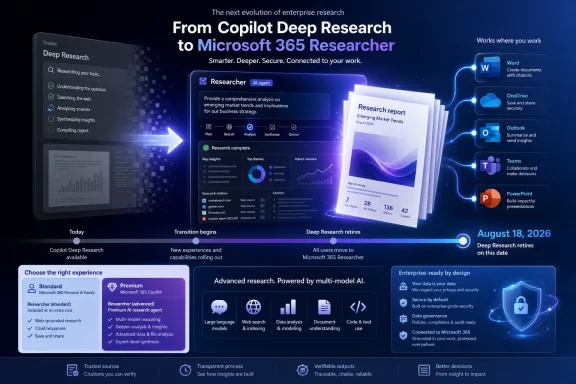
Microsoft will retire Deep Research in the consumer Copilot app on August 18, 2026, ending users’ ability to generate new reports with a feature built specifically for long-form investigation and analysis. The underlying capability is not disappearing, however: Microsoft is consolidating advanced research around Researcher, a more capable agent included with Microsoft 365 Premium and commercial Microsoft 365 Copilot subscriptions. Existing reports will remain accessible, but the transition exposes an increasingly important divide between Microsoft’s mainstream Copilot experience and its premium, agent-driven future.
The Copilot name eventually became an umbrella covering experiences with different models, data access, pricing rules, and intended audiences. A consumer chatting with Copilot on a Windows PC might see a superficially similar interface to an employee using Microsoft 365 Copilot, even though the latter can reason over authorized email, documents, meetings, and organizational data.
Deep Research emerged as part of the industry-wide shift from instant chatbot answers toward longer-running AI tasks. Instead of producing a quick response from a handful of search results, it could plan a research process, gather sources, compare claims, and generate a structured report.
That launch marked an important change in Microsoft’s product philosophy. Copilot was no longer supposed to be only a chatbot embedded beside familiar applications; it was becoming a platform for agents that could spend more time on a task, use multiple information sources, and produce a completed work product.
Microsoft later extended Researcher to Microsoft 365 Premium, its high-end consumer and prosumer subscription. The result was an awkward period in which Microsoft offered two similarly described research experiences: Deep Research in Copilot and Researcher in Microsoft 365 Copilot.
Retiring one of them was therefore predictable, even if the timing will disappoint users who preferred the simpler or more broadly accessible option.
Microsoft describes the change as a feature retirement rather than the removal of AI-powered research from its ecosystem. That distinction matters because the company is preserving the overall workflow while moving it behind a different product, interface, and subscription entitlement.
Deep Research and Researcher are separate implementations, despite their overlapping purposes. Users should not assume that every prompt, report format, or workflow will behave identically after the transition.
An automatically preserved report is not the same as a durable personal archive. Saving a Word document also makes it easier to annotate the material, preserve the current formatting, and store a copy outside Microsoft’s service.
Unlike standard Copilot chat, Researcher is deliberately optimized for tasks that require more processing time. A normal chat response may be appropriate for defining a term or summarizing a short document, while Researcher is intended for questions such as evaluating a market, comparing technical architectures, reviewing a policy proposal, or preparing a strategic briefing.
The typical workflow is straightforward:
This makes Researcher potentially more useful than a consumer-oriented research tool. An employee could ask it to compare public competitor announcements with internal meeting notes, product documents, and customer feedback without manually uploading every relevant file.
That capability also raises the stakes. When an agent synthesizes private and public information into one polished document, users must understand where each claim originated and whether the final report can safely be shared outside the organization.
Deep Research belonged to the broader consumer Copilot environment. Researcher was developed as an agent within the Microsoft 365 Copilot architecture, with stronger connections to productivity applications, organizational information, administration, and enterprise compliance controls.
That architectural difference affects everything from discoverability to data access. It may also affect how long tasks run, how reports are formatted, which models can be selected, and how administrators control the experience.
Microsoft 365 Personal and Family customers can retain access to their old Deep Research reports, but Microsoft’s retirement notice does not grant them equivalent ongoing report generation through Researcher. In practical terms, some users are losing a capability unless they move to the higher subscription tier.
That makes the phrase “replacement” somewhat incomplete. Researcher replaces Deep Research inside Microsoft’s portfolio, but it does not necessarily replace it at the same price or for every person who previously used it.
For Microsoft 365 Premium customers, the change may feel like harmless consolidation. For Personal and Family subscribers, it can look more like an advanced AI feature being used to distinguish the company’s most expensive consumer plan.
Users also had little reason to understand why they should choose one experience over the other. If Deep Research and Researcher both promise comprehensive, cited reports, the distinction becomes another layer of Copilot branding that customers must decode.
Consolidation gives Microsoft a clearer hierarchy:
Microsoft has also been developing multi-model capabilities for Researcher. Rather than relying on one model to plan, investigate, write, and evaluate a report, newer configurations can divide responsibilities between models or compare independently generated results.
This makes Researcher a better strategic platform than a fixed consumer feature. Microsoft can add model selection, administrative controls, connectors, orchestration improvements, and integrations without forcing every capability into the basic Copilot chat interface.
If the model misunderstands the question early, later stages may reinforce the error. A polished final report can then conceal weak sourcing, missing context, or unjustified certainty.
Microsoft’s Critique approach separates generation and evaluation. One model can build the initial analysis, while another reviews claims, presentation, structure, and potential weaknesses. The system can then use that criticism to improve the result.
This does not guarantee accuracy, but it introduces a useful form of adversarial checking. The second model may identify omissions or inconsistencies that the first model failed to notice.
That is especially valuable for ambiguous questions. Two capable models may find different evidence or interpret the same material through different analytical frameworks.
Microsoft’s use of both OpenAI and Anthropic models also signals a broader platform strategy. Although the company remains closely aligned with OpenAI, it increasingly presents Microsoft 365 Copilot as an orchestration layer capable of selecting or coordinating models based on the task.
The competitive advantage may therefore come less from owning one universally superior model and more from securely combining models with Microsoft Graph, Office applications, enterprise identity, and established compliance systems.
These customers may ultimately gain a more capable workflow. Researcher can ask clarifying questions, produce structured reports, and connect its output to the wider Microsoft 365 environment.
However, users should still expect interface and behavioral differences. Saved prompts, familiar formatting, and particular response styles may not transfer perfectly simply because old reports remain accessible.
This is the most controversial aspect of the retirement. Microsoft is not merely eliminating duplication behind the scenes; it is concentrating advanced research in Microsoft 365 Premium.
The change may encourage upgrades, especially among freelancers, students, consultants, and small-business owners who value long-form research but do not need a commercial Microsoft 365 Copilot deployment. It may also push price-sensitive users toward rival AI products that include deep research in a different subscription tier.
Researcher primarily lives within Microsoft 365 Copilot’s agent environment. A Windows 11 user opening the general Copilot app should not assume that the replacement will automatically appear without the correct Microsoft account and subscription.
That distinction remains one of Microsoft’s biggest usability problems. Branding can suggest one unified assistant, while licensing and functionality reveal several related but materially different products.
A product manager could ask Researcher to examine industry developments alongside internal planning documents. A sales leader could compare public market information with meeting notes and approved customer records. An IT team could evaluate a technology migration using vendor documentation, internal architecture files, and prior incident reports.
The value comes from context that a public chatbot cannot safely access by default. Microsoft’s position inside enterprise productivity systems gives it an advantage that standalone AI providers must address through uploads, connectors, or separate integrations.
That protection is essential, but it does not solve every governance problem. Organizations often have overshared SharePoint sites, outdated group memberships, poorly labeled documents, and sensitive files stored in locations with excessive access.
An AI agent can magnify those weaknesses by finding and combining information more efficiently than a person browsing folders manually. Before encouraging broad adoption, administrators should review permissions, retention policies, sensitivity labels, external-sharing rules, and data-loss-prevention controls.
The security question is not simply whether Researcher obeys permissions. It is whether the organization’s permissions were appropriate in the first place.
They do not eliminate hallucinations. An AI system can cite a real source that does not support the exact claim, misunderstand a table, merge facts from different periods, or overlook a more authoritative document.
Users should verify at least the report’s decisive claims. The more consequential the decision, the more rigorous that review should be.
Copilot Podcasts turned selected topics or content into an AI-generated audio discussion. The feature reflected the growing popularity of converting documents and research into a conversational listening format.
Users with episodes they want to retain should preserve them before access disappears, using any download or saving method currently available within the service. The lack of an enduring archive makes this retirement more consequential than the Deep Research transition.
From Microsoft’s perspective, reports may be easier to preserve because they already exist as text-based conversations or documents. Audio files impose different storage, playback, sharing, and rights-management requirements.
From the user’s perspective, however, both are created artifacts. If Microsoft wants Copilot to become a trusted workspace, it needs predictable rules for ownership, export, retention, and feature retirement across every content type.
People will hesitate to build durable workflows around experimental AI functions if the resulting material can become inaccessible when Microsoft changes strategy.
The competitive question is no longer whether an assistant can produce several pages of text. Modern systems compete on source quality, task planning, citation accuracy, access to private data, model choice, speed, export options, and the degree of control given to the user.
Researcher’s strongest differentiator is Microsoft 365 integration. A rival may generate an excellent public-web report, but Microsoft can combine web material with the information already stored in Outlook, Teams, SharePoint, OneDrive, and Office documents.
Competitors can exploit that confusion with simpler offers. A clearly labeled deep-research button attached to one subscription may be more appealing than a theoretically more powerful service hidden inside a maze of Microsoft 365 plans and agent menus.
The retirement therefore improves Microsoft’s product architecture but risks worsening the value proposition for lower-tier customers. Consolidation is beneficial only if users can understand where the replacement lives and what it costs.
Do not rely solely on chat history for material that must be retained for years. Chat interfaces are designed for convenience, not necessarily records management, version control, or permanent archival access.
Users should also capture the original prompt and any follow-up instructions. The final report alone may not reveal the scope, exclusions, assumptions, or constraints that shaped the result.
A direct comparison will help users rewrite prompt templates and adjust expectations. It may also expose workflows that require a different export or organization method.
Organizations should test Researcher with representative tasks rather than a generic demonstration. A successful summary of public information does not prove that the agent will handle specialized terminology, internal documents, or regulated data correctly.
Future improvements are likely to focus on longer-running tasks, richer source controls, stronger model orchestration, and better handoffs between agents. A research agent might gather evidence, pass numerical material to Analyst, and then send approved findings to an Office agent that prepares a document or presentation.
That progression could make Copilot materially more useful than a chatbot. It could also make errors more consequential because an incorrect research finding may propagate through several automated stages.
Deep Research’s retirement is relatively well managed because Microsoft is preserving reports and identifying a replacement. The reported handling of Copilot Podcasts provides a less reassuring example because created audio may become inaccessible.
For Copilot to function as a serious productivity platform, Microsoft must treat user-generated artifacts as durable content rather than disposable outputs tied to a temporary feature. Clear exports, open formats, predictable retention, and advance notice should become standard across the product family.
The end of Copilot Deep Research is therefore less a retreat from advanced AI than a declaration of where Microsoft believes that AI belongs: inside specialized, subscription-backed agents connected to Microsoft 365. Researcher is more extensible, more enterprise-aware, and potentially more powerful, but the transition also narrows access and reinforces the premium divide. By August 18, 2026, Microsoft will have simplified its research lineup; whether users experience that simplification as progress will depend on licensing clarity, report quality, data governance, and the company’s willingness to preserve the work people entrust to Copilot.
 Background
From Bing Chat to a collection of specialized agents
Microsoft’s Copilot strategy has changed repeatedly since the company introduced Bing Chat in early 2023. What began as a conversational search product expanded into Windows, Edge, Microsoft 365, mobile apps, and a growing collection of specialized AI tools.The Copilot name eventually became an umbrella covering experiences with different models, data access, pricing rules, and intended audiences. A consumer chatting with Copilot on a Windows PC might see a superficially similar interface to an employee using Microsoft 365 Copilot, even though the latter can reason over authorized email, documents, meetings, and organizational data.
Deep Research emerged as part of the industry-wide shift from instant chatbot answers toward longer-running AI tasks. Instead of producing a quick response from a handful of search results, it could plan a research process, gather sources, compare claims, and generate a structured report.
Microsoft’s move toward agentic computing
Microsoft introduced Researcher for Microsoft 365 Copilot in March 2025 alongside Analyst, another specialized reasoning agent. Researcher was designed to investigate complex questions, while Analyst focused more heavily on data analysis, calculations, and business intelligence.That launch marked an important change in Microsoft’s product philosophy. Copilot was no longer supposed to be only a chatbot embedded beside familiar applications; it was becoming a platform for agents that could spend more time on a task, use multiple information sources, and produce a completed work product.
Microsoft later extended Researcher to Microsoft 365 Premium, its high-end consumer and prosumer subscription. The result was an awkward period in which Microsoft offered two similarly described research experiences: Deep Research in Copilot and Researcher in Microsoft 365 Copilot.
Retiring one of them was therefore predictable, even if the timing will disappoint users who preferred the simpler or more broadly accessible option.
What Microsoft Is Retiring
New Deep Research reports will stop on August 18
Starting August 18, 2026, Deep Research will no longer be available in the consumer Copilot app. Users will not be able to start new investigations or ask the feature to create additional detailed reports after the retirement takes effect.Microsoft describes the change as a feature retirement rather than the removal of AI-powered research from its ecosystem. That distinction matters because the company is preserving the overall workflow while moving it behind a different product, interface, and subscription entitlement.
Deep Research and Researcher are separate implementations, despite their overlapping purposes. Users should not assume that every prompt, report format, or workflow will behave identically after the transition.
Existing reports are not being deleted
Microsoft says saved Deep Research content will remain available. The location will depend on the user’s Microsoft 365 subscription:- Microsoft 365 Premium subscribers will be able to access saved research through Researcher.
- Microsoft 365 Personal and Family subscribers will find previous Deep Research reports in their Copilot chat history.
- Users can open important reports in Microsoft Word and save local copies for long-term retention.
An automatically preserved report is not the same as a durable personal archive. Saving a Word document also makes it easier to annotate the material, preserve the current formatting, and store a copy outside Microsoft’s service.
Researcher Becomes the Main Replacement
What Researcher actually does
Researcher is an advanced agent inside Microsoft 365 Copilot that handles complex, multi-step questions. It can gather material, analyze competing information, organize findings, and return a structured report with citations.Unlike standard Copilot chat, Researcher is deliberately optimized for tasks that require more processing time. A normal chat response may be appropriate for defining a term or summarizing a short document, while Researcher is intended for questions such as evaluating a market, comparing technical architectures, reviewing a policy proposal, or preparing a strategic briefing.
The typical workflow is straightforward:
- The user opens Researcher from the Agents area of Microsoft 365 Copilot.
- The user enters a detailed question, desired outcome, and any relevant constraints.
- Researcher may ask clarifying questions about scope, audience, format, or source preferences.
- The agent searches and analyzes available information.
- It produces a structured report containing findings, citations, and suggested next steps.
- The user verifies the evidence and moves the result into Word, PowerPoint, Copilot Pages, or another working document.
Web information and work information
For eligible commercial users, Researcher can combine public web sources with information from Microsoft 365. Subject to the user’s existing permissions, that can include files, emails, chats, meetings, and other organizational content exposed through Microsoft Graph.This makes Researcher potentially more useful than a consumer-oriented research tool. An employee could ask it to compare public competitor announcements with internal meeting notes, product documents, and customer feedback without manually uploading every relevant file.
That capability also raises the stakes. When an agent synthesizes private and public information into one polished document, users must understand where each claim originated and whether the final report can safely be shared outside the organization.
Deep Research and Researcher Are Not Exact Equivalents
Similar outcome, different product architecture
Microsoft says both features help create detailed reports and analysis, but it explicitly identifies them as separate experiences. Researcher should therefore be viewed as a successor in purpose, not a renamed version of Deep Research.Deep Research belonged to the broader consumer Copilot environment. Researcher was developed as an agent within the Microsoft 365 Copilot architecture, with stronger connections to productivity applications, organizational information, administration, and enterprise compliance controls.
That architectural difference affects everything from discoverability to data access. It may also affect how long tasks run, how reports are formatted, which models can be selected, and how administrators control the experience.
Access is the most important difference
The most immediate distinction is licensing. Researcher is available to Microsoft 365 Premium subscribers and to eligible business and enterprise users with a Microsoft 365 Copilot license.Microsoft 365 Personal and Family customers can retain access to their old Deep Research reports, but Microsoft’s retirement notice does not grant them equivalent ongoing report generation through Researcher. In practical terms, some users are losing a capability unless they move to the higher subscription tier.
That makes the phrase “replacement” somewhat incomplete. Researcher replaces Deep Research inside Microsoft’s portfolio, but it does not necessarily replace it at the same price or for every person who previously used it.
For Microsoft 365 Premium customers, the change may feel like harmless consolidation. For Personal and Family subscribers, it can look more like an advanced AI feature being used to distinguish the company’s most expensive consumer plan.
Why Microsoft Is Consolidating the Two Experiences
Maintaining duplicate features creates confusion
Running two research products with similar descriptions is difficult to justify indefinitely. Microsoft would need to maintain separate interfaces, documentation, testing procedures, safety systems, storage mechanisms, telemetry pipelines, and support materials.Users also had little reason to understand why they should choose one experience over the other. If Deep Research and Researcher both promise comprehensive, cited reports, the distinction becomes another layer of Copilot branding that customers must decode.
Consolidation gives Microsoft a clearer hierarchy:
- Standard Copilot handles quick questions and everyday assistance.
- Researcher handles deep, source-driven investigations.
- Analyst handles advanced numerical and data-oriented work.
- Other agents address narrower workflows or applications.
Researcher is the more extensible foundation
Researcher fits Microsoft’s broader shift toward specialized agents. It can operate within Microsoft 365, use work context when permitted, and evolve independently of the standard chat experience.Microsoft has also been developing multi-model capabilities for Researcher. Rather than relying on one model to plan, investigate, write, and evaluate a report, newer configurations can divide responsibilities between models or compare independently generated results.
This makes Researcher a better strategic platform than a fixed consumer feature. Microsoft can add model selection, administrative controls, connectors, orchestration improvements, and integrations without forcing every capability into the basic Copilot chat interface.
Multi-Model Research Changes the Equation
Critique separates writing from evaluation
One weakness of conventional deep-research systems is that the same model may perform every stage. It chooses the search plan, evaluates the evidence, writes the answer, and effectively grades its own work.If the model misunderstands the question early, later stages may reinforce the error. A polished final report can then conceal weak sourcing, missing context, or unjustified certainty.
Microsoft’s Critique approach separates generation and evaluation. One model can build the initial analysis, while another reviews claims, presentation, structure, and potential weaknesses. The system can then use that criticism to improve the result.
This does not guarantee accuracy, but it introduces a useful form of adversarial checking. The second model may identify omissions or inconsistencies that the first model failed to notice.
Council compares independent approaches
The Council option goes further by allowing models from different providers to produce standalone reports for the same request. Users can compare the sources, reasoning, priorities, and conclusions rather than receiving one synthesized answer without visibility into alternatives.That is especially valuable for ambiguous questions. Two capable models may find different evidence or interpret the same material through different analytical frameworks.
Microsoft’s use of both OpenAI and Anthropic models also signals a broader platform strategy. Although the company remains closely aligned with OpenAI, it increasingly presents Microsoft 365 Copilot as an orchestration layer capable of selecting or coordinating models based on the task.
The competitive advantage may therefore come less from owning one universally superior model and more from securely combining models with Microsoft Graph, Office applications, enterprise identity, and established compliance systems.
What the Change Means for Consumers
Premium subscribers receive the smoothest transition
Microsoft 365 Premium subscribers should experience the least disruption. Their existing reports are expected to appear through Researcher, and they can continue creating detailed analyses after Deep Research is retired.These customers may ultimately gain a more capable workflow. Researcher can ask clarifying questions, produce structured reports, and connect its output to the wider Microsoft 365 environment.
However, users should still expect interface and behavioral differences. Saved prompts, familiar formatting, and particular response styles may not transfer perfectly simply because old reports remain accessible.
Personal and Family subscribers face a capability gap
Microsoft 365 Personal and Family users retain their historical reports through Copilot chat history, but preservation does not equal continued access to the feature. If they need to create another report after August 18, they may have to upgrade, adopt a competing research service, or recreate the workflow using standard Copilot prompts.This is the most controversial aspect of the retirement. Microsoft is not merely eliminating duplication behind the scenes; it is concentrating advanced research in Microsoft 365 Premium.
The change may encourage upgrades, especially among freelancers, students, consultants, and small-business owners who value long-form research but do not need a commercial Microsoft 365 Copilot deployment. It may also push price-sensitive users toward rival AI products that include deep research in a different subscription tier.
Windows users should not confuse Copilot surfaces
The word “Copilot” appears across Windows, Edge, Microsoft 365, GitHub, Security, Azure, and other Microsoft services. The retirement applies specifically to Deep Research in the consumer Copilot app, not every research-related capability bearing the Copilot name.Researcher primarily lives within Microsoft 365 Copilot’s agent environment. A Windows 11 user opening the general Copilot app should not assume that the replacement will automatically appear without the correct Microsoft account and subscription.
That distinction remains one of Microsoft’s biggest usability problems. Branding can suggest one unified assistant, while licensing and functionality reveal several related but materially different products.
Enterprise Impact
Researcher is more valuable when grounded in organizational data
For businesses already paying for Microsoft 365 Copilot, Deep Research’s retirement is less disruptive because Researcher is the more relevant tool. Its ability to work with authorized organizational information can turn a generic research report into a company-specific analysis.A product manager could ask Researcher to examine industry developments alongside internal planning documents. A sales leader could compare public market information with meeting notes and approved customer records. An IT team could evaluate a technology migration using vendor documentation, internal architecture files, and prior incident reports.
The value comes from context that a public chatbot cannot safely access by default. Microsoft’s position inside enterprise productivity systems gives it an advantage that standalone AI providers must address through uploads, connectors, or separate integrations.
Permissions remain a boundary, not a quality guarantee
Researcher is designed to respect existing Microsoft 365 permissions. In principle, it should retrieve only information the user is already authorized to access.That protection is essential, but it does not solve every governance problem. Organizations often have overshared SharePoint sites, outdated group memberships, poorly labeled documents, and sensitive files stored in locations with excessive access.
An AI agent can magnify those weaknesses by finding and combining information more efficiently than a person browsing folders manually. Before encouraging broad adoption, administrators should review permissions, retention policies, sensitivity labels, external-sharing rules, and data-loss-prevention controls.
The security question is not simply whether Researcher obeys permissions. It is whether the organization’s permissions were appropriate in the first place.
Report Quality and the Need for Verification
Citations improve transparency but not certainty
Researcher can include citations, which is substantially better than presenting an unsupported block of confident prose. Citations allow users to inspect the evidence, identify weak sources, and distinguish documented facts from model-generated synthesis.They do not eliminate hallucinations. An AI system can cite a real source that does not support the exact claim, misunderstand a table, merge facts from different periods, or overlook a more authoritative document.
Users should verify at least the report’s decisive claims. The more consequential the decision, the more rigorous that review should be.
A practical verification workflow
WindowsForum readers using Researcher for serious work should treat the output as a well-organized first draft rather than an unquestionable final authority.- Check whether the prompt defines the period, geography, audience, and decision being made. Ambiguous scope produces ambiguous research.
- Open the citations supporting the report’s central conclusions. Do not review only minor background references.
- Prefer primary sources for specifications, laws, financial results, policies, and product availability.
- Confirm that dates and versions match the question. AI reports frequently combine current and outdated details.
- Separate sourced facts from recommendations generated by the model.
- Ask Researcher to identify contradictory evidence and unresolved uncertainty.
- Have a qualified person review high-stakes legal, medical, financial, security, or personnel conclusions.
Copilot Podcasts Is a More Destructive Retirement
Previously generated episodes require special attention
Microsoft is also reportedly retiring Copilot Podcasts on August 18, 2026, the same date as Deep Research. Unlike research reports, previously generated podcast episodes are not expected to remain accessible indefinitely after the deadline.Copilot Podcasts turned selected topics or content into an AI-generated audio discussion. The feature reflected the growing popularity of converting documents and research into a conversational listening format.
Users with episodes they want to retain should preserve them before access disappears, using any download or saving method currently available within the service. The lack of an enduring archive makes this retirement more consequential than the Deep Research transition.
Different preservation policies send mixed signals
The contrasting approaches reveal an inconsistency in Microsoft’s handling of AI-generated artifacts. Deep Research reports survive through Researcher or chat history, while podcast episodes may vanish with the feature.From Microsoft’s perspective, reports may be easier to preserve because they already exist as text-based conversations or documents. Audio files impose different storage, playback, sharing, and rights-management requirements.
From the user’s perspective, however, both are created artifacts. If Microsoft wants Copilot to become a trusted workspace, it needs predictable rules for ownership, export, retention, and feature retirement across every content type.
People will hesitate to build durable workflows around experimental AI functions if the resulting material can become inaccessible when Microsoft changes strategy.
Competitive Implications
Deep research is becoming a standard AI category
Microsoft is not operating in isolation. OpenAI, Google, Anthropic, Perplexity, and other AI vendors offer tools designed to investigate complex questions, browse sources, and return long-form reports.The competitive question is no longer whether an assistant can produce several pages of text. Modern systems compete on source quality, task planning, citation accuracy, access to private data, model choice, speed, export options, and the degree of control given to the user.
Researcher’s strongest differentiator is Microsoft 365 integration. A rival may generate an excellent public-web report, but Microsoft can combine web material with the information already stored in Outlook, Teams, SharePoint, OneDrive, and Office documents.
Subscription fragmentation could weaken Microsoft’s position
Microsoft’s weakness is complexity. Customers must determine which Copilot they are using, whether the correct agent is available, which subscription enables it, what data it can access, and whether the same experience exists on Windows, the web, or mobile devices.Competitors can exploit that confusion with simpler offers. A clearly labeled deep-research button attached to one subscription may be more appealing than a theoretically more powerful service hidden inside a maze of Microsoft 365 plans and agent menus.
The retirement therefore improves Microsoft’s product architecture but risks worsening the value proposition for lower-tier customers. Consolidation is beneficial only if users can understand where the replacement lives and what it costs.
Strengths and Opportunities
Researcher gives Microsoft a credible foundation for more advanced, work-oriented AI investigation. If the company manages the transition well, it can turn the retirement into a meaningful upgrade rather than another example of feature churn.- Researcher provides a clearer long-term home for complex investigations. Users no longer need to choose between two similarly named research experiences.
- Microsoft 365 integration can produce more relevant reports. Authorized work files, meetings, messages, and public sources can contribute to one analysis.
- Multi-model workflows may expose blind spots. Critique and Council can compare or evaluate outputs rather than trusting one model to perform every role.
- Structured reports are easier to move into real work. Findings can be refined in Word, converted into presentations, or incorporated into collaborative Microsoft 365 content.
- Centralized administration benefits enterprises. Organizations can apply established identity, compliance, and data-governance systems to an advanced research agent.
- Specialized agents can reduce prompt complexity. Users do not need to manually instruct a general chatbot to simulate every stage of a research workflow.
- Consolidation can accelerate development. Microsoft can focus engineering and safety resources on one primary research architecture.
- The agent model creates room for future automation. Researcher could eventually participate in longer workflows that monitor changes, update reports, or hand findings to other agents.
Risks and Concerns
The retirement also highlights problems that Microsoft has not fully resolved, particularly around licensing, trust, and the durability of AI-created content.- Some users will lose ongoing access unless they upgrade. Personal and Family subscribers can keep old reports but may not receive equivalent new-report capabilities.
- The replacement may not reproduce old workflows exactly. Researcher and Deep Research are separate experiences with different interfaces and architectures.
- Copilot branding remains confusing. Consumers may struggle to distinguish the Copilot app from Microsoft 365 Copilot and its agent catalog.
- Polished reports can create false confidence. Citations and professional formatting do not guarantee accurate reasoning or complete evidence.
- Internal data access can amplify weak permissions. Researcher may surface sensitive material that was technically accessible but insufficiently governed.
- Multi-model processing introduces additional governance questions. Enterprises need clarity about enabled model providers, subprocessors, data boundaries, and administrative controls.
- Cloud-only artifacts remain vulnerable to product churn. The Copilot Podcasts retirement demonstrates why export and ownership policies matter.
- Feature consolidation may function as an upsell. Moving advanced capabilities into Premium can feel less like simplification to customers on lower-priced plans.
- Long-running research can consume substantial computing resources. Microsoft may adjust usage limits, performance, or entitlements as adoption grows.
- AI summaries can flatten disagreement. A single coherent report may hide legitimate uncertainty, minority evidence, or conflicting expert interpretations.
What Users Should Do Before August 18
Preserve important Deep Research reports
Microsoft says users do not need to take action, but a brief review is still sensible. Open any report that would be difficult to recreate and save it in Word or another durable format.Do not rely solely on chat history for material that must be retained for years. Chat interfaces are designed for convenience, not necessarily records management, version control, or permanent archival access.
Users should also capture the original prompt and any follow-up instructions. The final report alone may not reveal the scope, exclusions, assumptions, or constraints that shaped the result.
Test Researcher before the deadline
Microsoft 365 Premium subscribers should begin using Researcher before Deep Research disappears. Running the same question through both tools can reveal differences in coverage, citations, report structure, and tone.A direct comparison will help users rewrite prompt templates and adjust expectations. It may also expose workflows that require a different export or organization method.
Organizations should test Researcher with representative tasks rather than a generic demonstration. A successful summary of public information does not prove that the agent will handle specialized terminology, internal documents, or regulated data correctly.
Looking Ahead
Researcher is likely to become more deeply embedded
Microsoft’s direction points toward agents appearing throughout the Microsoft 365 environment rather than remaining isolated inside a chat window. Researcher already has natural connections to Copilot Notebooks, Word, PowerPoint, and collaborative workspaces.Future improvements are likely to focus on longer-running tasks, richer source controls, stronger model orchestration, and better handoffs between agents. A research agent might gather evidence, pass numerical material to Analyst, and then send approved findings to an Office agent that prepares a document or presentation.
That progression could make Copilot materially more useful than a chatbot. It could also make errors more consequential because an incorrect research finding may propagate through several automated stages.
Retirements will test trust in the Copilot platform
Microsoft will continue experimenting as generative AI develops, and some features will inevitably disappear. The important issue is whether customers retain access to what they created and receive a reasonable migration path.Deep Research’s retirement is relatively well managed because Microsoft is preserving reports and identifying a replacement. The reported handling of Copilot Podcasts provides a less reassuring example because created audio may become inaccessible.
For Copilot to function as a serious productivity platform, Microsoft must treat user-generated artifacts as durable content rather than disposable outputs tied to a temporary feature. Clear exports, open formats, predictable retention, and advance notice should become standard across the product family.
The end of Copilot Deep Research is therefore less a retreat from advanced AI than a declaration of where Microsoft believes that AI belongs: inside specialized, subscription-backed agents connected to Microsoft 365. Researcher is more extensible, more enterprise-aware, and potentially more powerful, but the transition also narrows access and reinforces the premium divide. By August 18, 2026, Microsoft will have simplified its research lineup; whether users experience that simplification as progress will depend on licensing clarity, report quality, data governance, and the company’s willingness to preserve the work people entrust to Copilot.
References
- Primary source: Windows Report
Published: 2026-07-22T11:40:42+00:00
Loading…
windowsreport.com - Official source: support.microsoft.com
Deep Research in Microsoft Copilot | Microsoft Support
Deep Research in Microsoft Copilotsupport.microsoft.com - Official source: learn.microsoft.com
Microsoft 365 Copilot Researcher agent frequently asked questions | Microsoft Learn
Frequently asked questions about Microsoft 365 Copilot Researcher agent.learn.microsoft.com - Official source: microsoft.com
Loading…
www.microsoft.com - Official source: developer.microsoft.com
Microsoft 365 Copilot | Extend and Customize Copilot
Extend, enrich, and customize Microsoft Microsoft 365 Copilot. Explore Copilot extensibility options such as agents, API plugins, and Copilot connectors to expand AI-powered productivity, skills, and creativity.developer.microsoft.com - Official source: news.microsoft.com
Copilot Cowork Now Available in the Frontier Program - Source EMEA
 news.microsoft.com