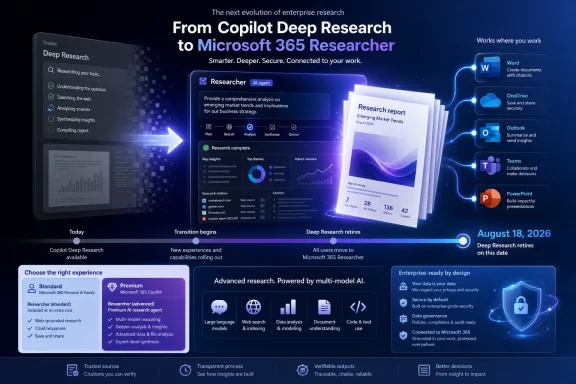
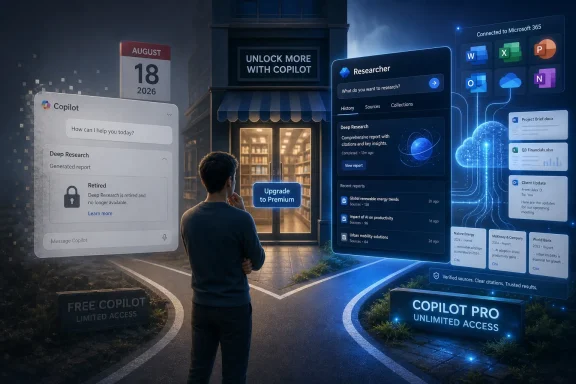
Microsoft’s free Copilot is becoming less of a complete AI assistant and more of a storefront for Microsoft 365 subscriptions, with Deep Research scheduled to disappear from the consumer Copilot app on August 18, 2026. Its closest successor, Researcher, remains available only through Microsoft 365 Premium or qualifying business and enterprise licensing, reinforcing a growing perception that Microsoft used the free tier to test ambitious AI experiences before reserving the most useful versions for paying customers.
Microsoft introduced Deep Research to consumer Copilot in April 2025 as part of a broad attempt to transform the chatbot into what the company called a personal AI companion. The feature could investigate complex questions, examine multiple sources, synthesize its findings, and produce a structured report with citations rather than merely returning a quick conversational answer.
That distinction mattered. Ordinary chatbots are useful for brainstorming and summarization, but research agents attempt to break a problem into stages, search for evidence, compare sources, and spend more computing time developing an answer. Deep Research was therefore one of the features that made free Copilot feel like a serious productivity tool rather than another Bing-powered chat interface.
Microsoft initially used generous access and deep Windows integration to build awareness. Over time, however, the company created an increasingly complicated ladder of free access, consumer Microsoft 365 subscriptions, Microsoft 365 Premium, commercial Copilot Chat, and separately licensed Microsoft 365 Copilot services.
This fragmentation makes it difficult for users to understand which “Copilot” they are receiving. Two people can see nearly identical Copilot icons while having access to substantially different models, usage limits, organizational data, agents, and application integrations.
The strategy encouraged experimentation. Users could try unfamiliar AI workflows without first calculating whether those workflows justified another monthly subscription.
That experimentation also gave Microsoft valuable information about feature demand, completion rates, operating costs, and user behavior. The uncomfortable question is whether free users were being treated as long-term customers or as a large-scale product-testing population.
Some users may lose practical access before the formal retirement date as Microsoft phases out the feature. A published cutoff date does not necessarily mean every account, region, app version, and interface will retain the activation control until that exact day.
Microsoft 365 Premium subscribers will be able to continue working with in-depth reports through Researcher. This does not make Researcher an identical continuation of the consumer feature, but Microsoft is positioning it as the available path for customers who still need advanced research capabilities.
Users with important Deep Research output should take a cautious approach:
Staged removals are normal in cloud services because features can be controlled server-side. They are nevertheless frustrating when customers expect a clearly advertised period in which they can finish projects, revisit workflows, or decide whether to upgrade.
The distinction also affects Microsoft’s messaging. If the feature becomes difficult or impossible to activate weeks before the published retirement, the company should communicate that the phaseout has begun rather than presenting August 18 as the only date that matters.
Researcher can combine web information with Microsoft 365 content that a user is authorized to access. In workplace deployments, that can include files, emails, meetings, and chats, subject to organizational permissions and licensing.
Potential uses include competitive analysis, market assessments, project backgrounders, strategic planning, literature reviews, and internal briefing documents. When connected to Microsoft Graph, Researcher can theoretically understand both the public context of a subject and the private organizational information surrounding it.
That is a substantial capability improvement over a web-only assistant. It also helps explain why Microsoft views Researcher as a premium product: the agent consumes more computing resources and becomes considerably more valuable when integrated with business data.
At its US launch price of $19.99 per month, Premium is not simply a small Deep Research add-on. It is an entire productivity bundle intended to replace the former combination of Copilot Pro and a consumer Microsoft 365 plan.
That bundle may represent good value for someone who needs Office, storage, Defender features, and frequent AI assistance. It is much harder to justify for a user who only wants to run an occasional research report.
Microsoft is not merely imposing a higher usage limit on the existing free feature. It is removing the feature and directing users toward a much larger subscription package.
Microsoft also needs a sustainable business model after investing heavily in data centers, AI infrastructure, models, partnerships, and product development. Free access can introduce customers to a service, but it cannot guarantee indefinite access to every resource-intensive function.
A trial establishes the commercial terms at the beginning. The customer knows that access will end, what the eventual price will be, and whether saved work can be exported.
Copilot’s rollout has often been less explicit. Features appear, receive promotional attention, and encourage users to build habits before Microsoft clarifies their long-term placement in the subscription hierarchy.
That approach can make an ordinary product decision feel like bait and switch, even when Microsoft never legally promised permanent availability. Trust depends not only on contractual obligations but also on how users reasonably interpret a company’s presentation.
That structure would maintain a meaningful free experience without pretending that high-cost AI workloads are unlimited. It would also demonstrate the superiority of Researcher through additional capability rather than through the removal of its closest free alternative.
The key principle is straightforward: paid products should win because they are better, not merely because the free product has been made worse.
A free tier can serve both purposes, but the balance matters. If too much practical functionality moves upward, the remaining service becomes an interactive advertisement.
That competition raises the standard. A familiar Microsoft logo and Windows shortcut are not enough if another service provides better research, more predictable limits, clearer citations, or a simpler subscription.
Deep Research helped differentiate Copilot by offering a workflow that went beyond a quick answer. Removing it reduces the free product to capabilities that competitors can often match, while reminding users that Microsoft’s most interesting tools reside elsewhere.
The strategy works less well when each retirement feels like another demand to move up a tier. Consumers already manage subscriptions for entertainment, storage, password managers, security tools, cloud gaming, creative applications, and AI assistants.
An individual feature may seem inexpensive in isolation, but the total monthly burden shapes purchasing decisions. Microsoft risks discovering that users do not upgrade; they simply move the task to a competing free service.
Copilot Podcasts is also scheduled for retirement on August 18, 2026. That feature converted information into conversational audio, but its shutdown has attracted additional criticism because users reportedly lack a direct way to download previously generated podcast files.
Technically, this is a logical evolution. AI-based preparation can provide deeper context than conventional insights.
Commercially, however, the transition turns a broadly useful productivity function into a reason to buy Microsoft 365 Copilot licensing. Employees without the required entitlement may see a familiar workflow disappear while colleagues with higher-cost licenses receive the replacement.
Some differences have legitimate technical causes. Commercial boards may use OneDrive for Business and support retention, discovery, residency, and data-loss-prevention requirements that do not apply to personal accounts.
Even so, users evaluate the practical result, not merely the backend architecture. When a formerly simple Microsoft utility requires a more specific account or loses functionality outside business environments, it reinforces the belief that free and personal users are becoming secondary.
Students, independent researchers, job seekers, hobbyists, and household users may have used Deep Research intermittently rather than every day. That low-frequency usage makes a monthly subscription particularly difficult to defend.
Yet Microsoft’s current feature matrix places Researcher above them in Microsoft 365 Premium. Personal and Family subscribers can retain access to previous Deep Research reports, but they will not receive the replacement agent through their existing plans.
This creates a tiering problem. Customers may reasonably ask why a feature available with higher usage limits on their subscription can be removed rather than retained at a reduced allowance.
Microsoft can argue that Researcher is a different product. From the user’s perspective, however, the practical sequence is simple: a research tool worked before, it stops working, and a more expensive subscription restores the general capability.
A prominent taskbar entry or dedicated key does not carry much value if the feature opened by that entry repeatedly directs users toward paid plans. Ubiquity can then become counterproductive, turning every Copilot surface into a reminder of an unavailable capability.
Windows users are particularly sensitive to this dynamic because Microsoft controls the operating system. A competitor must persuade users to install an app or visit a website; Microsoft can place Copilot directly in front of hundreds of millions of PC users.
That advantage comes with a responsibility to avoid making Windows feel like a subscription sales channel.
For enterprises, the question is less about whether advanced AI should cost money and more about whether the value justifies broad deployment. A capable agent could save knowledge workers hours, but only if its output is accurate, secure, auditable, and integrated into real processes.
This can complicate collaboration. A team member may produce an AI-assisted report that others cannot reproduce, inspect through the same interface, or update after the author changes roles.
IT departments therefore need more than a purchase decision. They need policies covering who receives access, how reports are stored, when human verification is required, and whether generated work becomes part of the organization’s official record.
That same capability amplifies permission problems. AI does not necessarily create improper access, but it can make existing overexposure easier to exploit by retrieving information that a user technically can access but would not otherwise know how to find.
Enterprises should review SharePoint permissions, Teams membership, external sharing, retention settings, and sensitivity labels before treating agents as routine research tools. An AI agent can expose weak information governance faster than a traditional search box.
A locally installed application can often continue working after its developer stops adding features. A cloud AI mode can vanish instantly because the interface, model access, processing pipeline, and entitlement checks all reside on the provider’s servers.
The Copilot Podcasts situation illustrates the opposite risk. When a service creates an artifact but provides no practical export path, users may discover that they never possessed the result in a durable sense.
Every generative service should support basic portability:
However, users cannot build reliable workflows around permanent uncertainty. If every feature might change models, names, limits, interfaces, or subscriptions within months, Copilot becomes difficult to trust for recurring work.
Microsoft needs a clearer distinction between experimental features and supported services. A preview should have explicit expectations; a generally promoted productivity feature should have stronger continuity and migration commitments.
The competitive question is therefore not whether Microsoft charges. It is whether Copilot’s free-to-paid transition offers better value and greater clarity than rival services.
A simple promise such as “five research reports per month for free” may be more attractive than a matrix involving Copilot, Microsoft 365 Personal, Family, Premium, Copilot Chat, Microsoft 365 Copilot Business, and enterprise add-ons.
Microsoft’s product breadth is strategically powerful but difficult to communicate. Every renamed service and shifted entitlement increases the cognitive cost of choosing Copilot.
If Researcher works reliably across that environment, enterprises and professionals may consider the premium worthwhile. The ability to turn authorized organizational information into a coherent briefing could be more valuable than broad free access to a web research mode.
The danger lies in taking distribution for granted. Users who feel pressured rather than persuaded may establish habits with competing services, reducing the impact of Microsoft’s built-in placement.
The quality of Microsoft’s migration experience will matter. A clean transition, reliable archives, and obvious export controls could reduce frustration, while missing content or confusing interfaces would deepen concerns about cloud dependence.
Three developments would significantly improve the situation:
Yet conversion data can obscure long-term damage. A subset of power users may upgrade while a larger group quietly stops using Copilot, switches to another service, or disables Microsoft’s AI surfaces.
For Windows users, the central question is whether Copilot becomes indispensable enough to support Microsoft’s subscription ambitions. If the free tier offers too little value to build trust and habit, the funnel may stop working before customers ever reach the payment screen.
Microsoft has every right to charge for Researcher, especially when the agent combines expensive AI processing with Microsoft 365 data and enterprise controls. But retiring Deep Research rather than preserving a modest free allowance sends the wrong message: instead of making paid Copilot compelling through clear improvements, Microsoft appears to be making free Copilot less useful until an upgrade feels unavoidable. That approach may produce short-term subscription conversions, but unless Microsoft restores predictability, portability, and meaningful value at every tier, it risks turning Copilot from an AI companion into something Windows users recognize all too quickly—another persistent advertisement built into the software they already use.
 Background
Microsoft introduced Deep Research to consumer Copilot in April 2025 as part of a broad attempt to transform the chatbot into what the company called a personal AI companion. The feature could investigate complex questions, examine multiple sources, synthesize its findings, and produce a structured report with citations rather than merely returning a quick conversational answer.That distinction mattered. Ordinary chatbots are useful for brainstorming and summarization, but research agents attempt to break a problem into stages, search for evidence, compare sources, and spend more computing time developing an answer. Deep Research was therefore one of the features that made free Copilot feel like a serious productivity tool rather than another Bing-powered chat interface.
From Bing Chat to an AI subscription funnel
Copilot’s identity has changed repeatedly since Microsoft launched the new Bing experience in early 2023. It evolved from a search chatbot into a cross-platform brand covering Windows, Edge, Microsoft 365, security products, developer tools, and numerous specialized agents.Microsoft initially used generous access and deep Windows integration to build awareness. Over time, however, the company created an increasingly complicated ladder of free access, consumer Microsoft 365 subscriptions, Microsoft 365 Premium, commercial Copilot Chat, and separately licensed Microsoft 365 Copilot services.
This fragmentation makes it difficult for users to understand which “Copilot” they are receiving. Two people can see nearly identical Copilot icons while having access to substantially different models, usage limits, organizational data, agents, and application integrations.
Deep Research arrived during Copilot’s expansion phase
When Deep Research debuted, Microsoft was adding features rapidly. Memory, Vision, Actions, Pages, Podcasts, Shopping, and enhanced voice experiences all contributed to the idea that consumer Copilot could become a broad personal assistant.The strategy encouraged experimentation. Users could try unfamiliar AI workflows without first calculating whether those workflows justified another monthly subscription.
That experimentation also gave Microsoft valuable information about feature demand, completion rates, operating costs, and user behavior. The uncomfortable question is whether free users were being treated as long-term customers or as a large-scale product-testing population.
Deep Research Is Being Retired
Microsoft says Deep Research will be retired from the consumer Copilot app starting August 18, 2026. Existing reports will not automatically be deleted as part of the change, but the ability to create new reports through the retired experience will disappear.Some users may lose practical access before the formal retirement date as Microsoft phases out the feature. A published cutoff date does not necessarily mean every account, region, app version, and interface will retain the activation control until that exact day.
What happens to existing reports
Microsoft 365 Personal and Family subscribers should still be able to locate previous Deep Research reports through their Copilot chat history. Reports can also be opened in Microsoft Word and saved, giving users a path to preserve important work outside the original Copilot conversation.Microsoft 365 Premium subscribers will be able to continue working with in-depth reports through Researcher. This does not make Researcher an identical continuation of the consumer feature, but Microsoft is positioning it as the available path for customers who still need advanced research capabilities.
Users with important Deep Research output should take a cautious approach:
- Open each report that may be needed later.
- Check that its citations and supporting material still load correctly.
- Export or copy the report into Word or another durable format.
- Save any essential sources separately rather than relying only on Copilot’s history.
- Record the original prompt if the report may need to be reproduced.
Retirement has already begun in practice
The transition appears to be more gradual than the August 18 date suggests. Deep Research may already be unavailable to some users or absent from certain interfaces, even though Microsoft describes the full retirement as a future event.Staged removals are normal in cloud services because features can be controlled server-side. They are nevertheless frustrating when customers expect a clearly advertised period in which they can finish projects, revisit workflows, or decide whether to upgrade.
The distinction also affects Microsoft’s messaging. If the feature becomes difficult or impossible to activate weeks before the published retirement, the company should communicate that the phaseout has begun rather than presenting August 18 as the only date that matters.
Deep Research and Researcher Are Not Identical
Both products can generate long, source-backed reports, but they were designed around different contexts. Deep Research was a consumer Copilot mode focused primarily on online information and user-provided materials, while Researcher is an agent built into the broader Microsoft 365 Copilot environment.Researcher can combine web information with Microsoft 365 content that a user is authorized to access. In workplace deployments, that can include files, emails, meetings, and chats, subject to organizational permissions and licensing.
Researcher targets more demanding workflows
Researcher is intended for complex, multistep assignments that benefit from extended reasoning. It takes longer than ordinary Copilot chat because it performs more analysis before returning a structured response.Potential uses include competitive analysis, market assessments, project backgrounders, strategic planning, literature reviews, and internal briefing documents. When connected to Microsoft Graph, Researcher can theoretically understand both the public context of a subject and the private organizational information surrounding it.
That is a substantial capability improvement over a web-only assistant. It also helps explain why Microsoft views Researcher as a premium product: the agent consumes more computing resources and becomes considerably more valuable when integrated with business data.
The upgrade path carries a significant price
Microsoft 365 Premium launched in October 2025 as the company’s highest consumer productivity subscription. It combines desktop Office applications, cloud storage, security features, elevated AI allowances, and access to advanced agents such as Researcher and Analyst.At its US launch price of $19.99 per month, Premium is not simply a small Deep Research add-on. It is an entire productivity bundle intended to replace the former combination of Copilot Pro and a consumer Microsoft 365 plan.
That bundle may represent good value for someone who needs Office, storage, Defender features, and frequent AI assistance. It is much harder to justify for a user who only wants to run an occasional research report.
Microsoft is not merely imposing a higher usage limit on the existing free feature. It is removing the feature and directing users toward a much larger subscription package.
The Freemium Model Has Reached Its Tension Point
There is nothing inherently improper about charging for advanced software. Research agents are expensive to operate because they perform multiple searches, process large amounts of text, invoke powerful models, and often run much longer than a normal chat response.Microsoft also needs a sustainable business model after investing heavily in data centers, AI infrastructure, models, partnerships, and product development. Free access can introduce customers to a service, but it cannot guarantee indefinite access to every resource-intensive function.
Free trials are different from permanent free features
The problem is expectation management. Users react differently to a clearly labeled trial than to a feature introduced as part of a free product and removed after it becomes useful.A trial establishes the commercial terms at the beginning. The customer knows that access will end, what the eventual price will be, and whether saved work can be exported.
Copilot’s rollout has often been less explicit. Features appear, receive promotional attention, and encourage users to build habits before Microsoft clarifies their long-term placement in the subscription hierarchy.
That approach can make an ordinary product decision feel like bait and switch, even when Microsoft never legally promised permanent availability. Trust depends not only on contractual obligations but also on how users reasonably interpret a company’s presentation.
A healthier tiering strategy is possible
Microsoft could preserve a limited consumer version of Deep Research while reserving Researcher’s more advanced capabilities for Premium. For example, free users might receive one or two reports per month, Personal and Family subscribers could receive a larger allowance, and Premium customers could gain higher limits plus Microsoft 365 data integration.That structure would maintain a meaningful free experience without pretending that high-cost AI workloads are unlimited. It would also demonstrate the superiority of Researcher through additional capability rather than through the removal of its closest free alternative.
The key principle is straightforward: paid products should win because they are better, not merely because the free product has been made worse.
Copilot’s Consumer Proposition Is Weakening
Free Copilot still offers useful conversational assistance, search-based answers, image-related functions, and other features that vary by account and region. Yet the broader direction suggests that Microsoft increasingly sees free Copilot as an acquisition channel rather than a self-contained product.A free tier can serve both purposes, but the balance matters. If too much practical functionality moves upward, the remaining service becomes an interactive advertisement.
A chatbot alone is no longer distinctive
Basic AI chat has become widely available. Users can choose among Microsoft Copilot, ChatGPT, Google Gemini, Claude, Perplexity, and numerous smaller services, many of which offer some form of free access.That competition raises the standard. A familiar Microsoft logo and Windows shortcut are not enough if another service provides better research, more predictable limits, clearer citations, or a simpler subscription.
Deep Research helped differentiate Copilot by offering a workflow that went beyond a quick answer. Removing it reduces the free product to capabilities that competitors can often match, while reminding users that Microsoft’s most interesting tools reside elsewhere.
Habit formation can turn into subscription fatigue
Microsoft’s subscription logic works best when customers perceive Microsoft 365 as one coherent package. Word, Excel, PowerPoint, Outlook, OneDrive, Defender, and Copilot can collectively support a compelling value proposition.The strategy works less well when each retirement feels like another demand to move up a tier. Consumers already manage subscriptions for entertainment, storage, password managers, security tools, cloud gaming, creative applications, and AI assistants.
An individual feature may seem inexpensive in isolation, but the total monthly burden shapes purchasing decisions. Microsoft risks discovering that users do not upgrade; they simply move the task to a competing free service.
The Wider Pattern Extends Beyond Deep Research
Deep Research is not disappearing in isolation. Microsoft has recently retired or restricted other features in ways that strengthen the impression of a coordinated shift from broad experimentation toward monetized AI services.Copilot Podcasts is also scheduled for retirement on August 18, 2026. That feature converted information into conversational audio, but its shutdown has attracted additional criticism because users reportedly lack a direct way to download previously generated podcast files.
Outlook meeting preparation illustrates the licensing divide
Microsoft is retiring Outlook’s Meeting Insights experience and directing licensed business users toward Copilot-powered meeting preparation. The newer capability can assemble relevant emails, chats, documents, action items, and pre-reading material, making it more powerful than a simple calendar summary.Technically, this is a logical evolution. AI-based preparation can provide deeper context than conventional insights.
Commercially, however, the transition turns a broadly useful productivity function into a reason to buy Microsoft 365 Copilot licensing. Employees without the required entitlement may see a familiar workflow disappear while colleagues with higher-cost licenses receive the replacement.
Whiteboard adds to the sense of retrenchment
Changes surrounding Microsoft Whiteboard and its account requirements have generated similar concern, particularly where personal and business account capabilities differ. Whiteboard has long straddled consumer, education, and enterprise scenarios, making licensing changes especially visible.Some differences have legitimate technical causes. Commercial boards may use OneDrive for Business and support retention, discovery, residency, and data-loss-prevention requirements that do not apply to personal accounts.
Even so, users evaluate the practical result, not merely the backend architecture. When a formerly simple Microsoft utility requires a more specific account or loses functionality outside business environments, it reinforces the belief that free and personal users are becoming secondary.
Consumer Impact
Consumers are the group most likely to feel that the product is being hollowed out. They generally lack an employer-funded Copilot license, and many do not need enough Microsoft 365 functionality to justify Premium.Students, independent researchers, job seekers, hobbyists, and household users may have used Deep Research intermittently rather than every day. That low-frequency usage makes a monthly subscription particularly difficult to defend.
Personal and Family subscribers occupy an awkward middle tier
Microsoft 365 Personal and Family already include Office applications, storage, and various Copilot benefits. These customers are not free riders; they are paying subscribers.Yet Microsoft’s current feature matrix places Researcher above them in Microsoft 365 Premium. Personal and Family subscribers can retain access to previous Deep Research reports, but they will not receive the replacement agent through their existing plans.
This creates a tiering problem. Customers may reasonably ask why a feature available with higher usage limits on their subscription can be removed rather than retained at a reduced allowance.
Microsoft can argue that Researcher is a different product. From the user’s perspective, however, the practical sequence is simple: a research tool worked before, it stops working, and a more expensive subscription restores the general capability.
Windows integration magnifies every disappointment
Copilot is promoted throughout Microsoft’s ecosystem, including Windows, Edge, Bing, and Microsoft 365. The more visible the branding becomes, the more users expect the service to deliver meaningful utility.A prominent taskbar entry or dedicated key does not carry much value if the feature opened by that entry repeatedly directs users toward paid plans. Ubiquity can then become counterproductive, turning every Copilot surface into a reminder of an unavailable capability.
Windows users are particularly sensitive to this dynamic because Microsoft controls the operating system. A competitor must persuade users to install an app or visit a website; Microsoft can place Copilot directly in front of hundreds of millions of PC users.
That advantage comes with a responsibility to avoid making Windows feel like a subscription sales channel.
Enterprise Impact
Business customers face a different calculation. Researcher becomes much more compelling when it can securely work across organizational data and produce reports grounded in internal files, communications, and meetings.For enterprises, the question is less about whether advanced AI should cost money and more about whether the value justifies broad deployment. A capable agent could save knowledge workers hours, but only if its output is accurate, secure, auditable, and integrated into real processes.
Licensing inequality can fragment teams
If only some employees receive Microsoft 365 Copilot licenses, organizations can develop two classes of productivity workflow. Licensed employees may use Researcher and meeting preparation, while unlicensed colleagues perform the same work manually or rely on approved alternatives.This can complicate collaboration. A team member may produce an AI-assisted report that others cannot reproduce, inspect through the same interface, or update after the author changes roles.
IT departments therefore need more than a purchase decision. They need policies covering who receives access, how reports are stored, when human verification is required, and whether generated work becomes part of the organization’s official record.
Data integration is both the prize and the risk
Researcher’s access to Microsoft 365 information may be its strongest advantage over consumer Deep Research. It can reduce the need to gather context manually by finding relevant documents, conversations, and meeting records.That same capability amplifies permission problems. AI does not necessarily create improper access, but it can make existing overexposure easier to exploit by retrieving information that a user technically can access but would not otherwise know how to find.
Enterprises should review SharePoint permissions, Teams membership, external sharing, retention settings, and sensitivity labels before treating agents as routine research tools. An AI agent can expose weak information governance faster than a traditional search box.
Trust, Ownership, and Cloud Dependence
Feature retirement is not just a pricing issue. It exposes the fragile ownership model of cloud-based AI output.A locally installed application can often continue working after its developer stops adding features. A cloud AI mode can vanish instantly because the interface, model access, processing pipeline, and entitlement checks all reside on the provider’s servers.
Generated work needs an exit path
Microsoft deserves credit for allowing Deep Research reports to be opened and saved in Word. That is far better than trapping every report inside an inaccessible proprietary viewer.The Copilot Podcasts situation illustrates the opposite risk. When a service creates an artifact but provides no practical export path, users may discover that they never possessed the result in a durable sense.
Every generative service should support basic portability:
- Users should be able to export text in common document formats.
- Audio and video output should be downloadable without unofficial workarounds.
- Citations should remain attached to the exported material.
- Prompts and relevant settings should be preservable for reproducibility.
- Retirement notices should provide enough time for bulk export.
- Organizations should receive administrative tools for retention and discovery.
Constant experimentation has a cost
Microsoft frequently labels new AI capabilities as previews, experiments, or evolving experiences. That flexibility is understandable in a rapidly changing technical field.However, users cannot build reliable workflows around permanent uncertainty. If every feature might change models, names, limits, interfaces, or subscriptions within months, Copilot becomes difficult to trust for recurring work.
Microsoft needs a clearer distinction between experimental features and supported services. A preview should have explicit expectations; a generally promoted productivity feature should have stronger continuity and migration commitments.
Competitive Implications
Microsoft is not alone in monetizing advanced AI. The economics of frontier models have pushed nearly every major provider toward paid tiers, usage limits, credit systems, or premium agents.The competitive question is therefore not whether Microsoft charges. It is whether Copilot’s free-to-paid transition offers better value and greater clarity than rival services.
Competitors can exploit Microsoft’s complexity
A rival does not need to offer every Microsoft 365 integration to compete effectively. It can win users by making the product easier to understand.A simple promise such as “five research reports per month for free” may be more attractive than a matrix involving Copilot, Microsoft 365 Personal, Family, Premium, Copilot Chat, Microsoft 365 Copilot Business, and enterprise add-ons.
Microsoft’s product breadth is strategically powerful but difficult to communicate. Every renamed service and shifted entitlement increases the cognitive cost of choosing Copilot.
Microsoft still owns a major distribution advantage
Despite the criticism, Microsoft retains formidable assets. Windows, Office, Edge, Bing, OneDrive, Teams, Outlook, SharePoint, and Microsoft Graph create an integrated environment no standalone AI startup can easily replicate.If Researcher works reliably across that environment, enterprises and professionals may consider the premium worthwhile. The ability to turn authorized organizational information into a coherent briefing could be more valuable than broad free access to a web research mode.
The danger lies in taking distribution for granted. Users who feel pressured rather than persuaded may establish habits with competing services, reducing the impact of Microsoft’s built-in placement.
Strengths and Opportunities
Microsoft can still turn this transition into a stronger and more sustainable Copilot strategy. The underlying technology and ecosystem integration remain significant advantages.Where Microsoft has a credible case
- Researcher offers more than a simple renamed chatbot mode. Its Microsoft 365 grounding can support richer professional analysis than a consumer web-research tool.
- Microsoft 365 Premium consolidates several previously separate purchases. Customers who need Office, storage, security, and advanced AI may find the complete package competitive.
- Existing Deep Research reports are not scheduled for deletion. Users can retain reports in chat history and export important work to Word.
- Tiered AI pricing reflects real operating costs. Long-running research agents consume more resources than ordinary chat responses.
- Microsoft can connect AI output directly to productivity applications. Reports can move into Word, PowerPoint, Excel, and collaborative business workflows.
- The transition creates an opportunity to simplify Copilot branding. Clearer plan names, entitlement indicators, and usage dashboards could reduce confusion.
Risks and Concerns
The retirement creates several immediate and longer-term risks for Microsoft’s consumer AI ambitions.The most serious problems
- Free Copilot may become too limited to remain competitive. Basic chat is widely available, so removing distinctive capabilities weakens Microsoft’s acquisition funnel.
- Paying Personal and Family subscribers may feel unfairly downgraded. Their existing Deep Research access is being removed without Researcher joining their plans.
- The formal retirement date may not reflect actual availability. A phased shutdown can leave users unable to complete work before August 18, 2026.
- Repeated removals damage confidence in new Copilot features. Users may avoid investing time in tools that could disappear or move tiers.
- Poor export options can undermine ownership. Cloud-generated artifacts need durable, standard-format downloads.
- Complex licensing can obstruct adoption. Consumers and businesses may choose simpler alternatives rather than decipher Microsoft’s entitlement matrix.
- Aggressive upselling can worsen Windows resentment. Built-in Copilot surfaces may feel like advertising if useful functions repeatedly require upgrades.
- Enterprise agents can magnify weak permissions. Organizations must improve information governance before enabling broad internal research.
What to Watch Next
The decisive issue is whether Deep Research represents a one-off product consolidation or the beginning of a more comprehensive contraction of free Copilot. Microsoft’s treatment of other features will reveal the answer.August 18 will be an important test
Both Deep Research and Copilot Podcasts are tied to August 18, 2026, making that date a notable checkpoint for Microsoft’s consumer AI strategy. Users should watch whether saved reports and podcast entries remain accessible exactly as promised.The quality of Microsoft’s migration experience will matter. A clean transition, reliable archives, and obvious export controls could reduce frustration, while missing content or confusing interfaces would deepen concerns about cloud dependence.
Subscription entitlements may continue to change
Microsoft frequently adjusts AI limits as models, infrastructure costs, and product priorities evolve. Personal, Family, and Premium allowances should therefore be monitored rather than assumed to be permanent.Three developments would significantly improve the situation:
- Microsoft could introduce a small monthly Researcher allowance for free or lower-tier subscribers.
- It could publish clearer lifecycle rules for experimental Copilot features.
- It could guarantee export tools before retiring any generative experience.
User behavior will reveal whether the strategy works
The success of the paywall will not be measured by complaints alone. Microsoft will examine upgrades, retention, agent usage, report completion rates, and the number of customers who move from free Copilot into Microsoft 365 Premium.Yet conversion data can obscure long-term damage. A subset of power users may upgrade while a larger group quietly stops using Copilot, switches to another service, or disables Microsoft’s AI surfaces.
For Windows users, the central question is whether Copilot becomes indispensable enough to support Microsoft’s subscription ambitions. If the free tier offers too little value to build trust and habit, the funnel may stop working before customers ever reach the payment screen.
Microsoft has every right to charge for Researcher, especially when the agent combines expensive AI processing with Microsoft 365 data and enterprise controls. But retiring Deep Research rather than preserving a modest free allowance sends the wrong message: instead of making paid Copilot compelling through clear improvements, Microsoft appears to be making free Copilot less useful until an upgrade feels unavoidable. That approach may produce short-term subscription conversions, but unless Microsoft restores predictability, portability, and meaningful value at every tier, it risks turning Copilot from an AI companion into something Windows users recognize all too quickly—another persistent advertisement built into the software they already use.
References
- Primary source: Windows Central
Published: 2026-07-22T13:56:34+00:00
Free Copilot is turning into a demo as Microsoft shifts real features to paid tiers | Windows Central
Deep Research is the latest free Copilot feature to disappear, replaced by a Microsoft 365 Premium tool.www.windowscentral.com - Official source: support.microsoft.com
Deep Research in Microsoft Copilot | Microsoft Support
Deep Research in Microsoft Copilotsupport.microsoft.com - Official source: news.microsoft.com
Copilot Cowork Now Available in the Frontier Program - Source EMEA
 news.microsoft.com
- Official source: microsoft.com
- Related coverage: techradar.com
Microsoft's planned new AI trick for Edge will 'automatically open the Copilot side pane' with Outlook email links — and I can feel the hate already | TechRadar
New feature is on the roadmap for May 2026www.techradar.com - Official source: learn.microsoft.com
2025 Release Notes for Microsoft 365 Copilot | Microsoft Learn
Lists the features that reached General Availability in each release of Microsoft 365 Copilot last year.learn.microsoft.com