

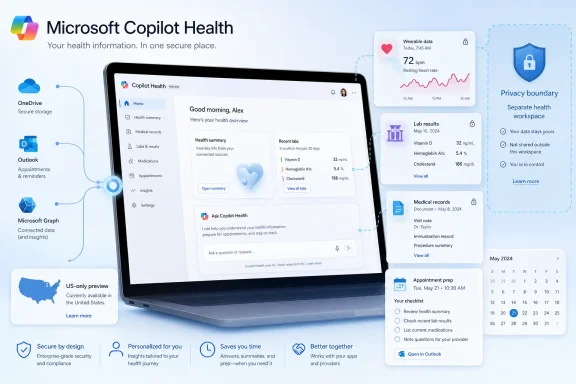
Microsoft has expanded access to the Copilot Health preview in the United States, allowing more eligible Microsoft 365 Personal, Family, and Premium subscribers aged 18 or older to try the English-language health experience inside Copilot as of late May 2026. The move is small in rollout language but large in implication: Microsoft is no longer merely answering health questions with a chatbot. It is asking users to connect wearables, lab results, and medical records to a consumer AI system that sits under the same Copilot brand already spreading through Windows and Microsoft 365. That makes Copilot Health less a side experiment than a test of whether Microsoft can turn trust, subscriptions, and data integration into a new kind of personal health interface.
The first wave of generative AI health tools mostly behaved like better search engines with bedside manner. Users asked about a rash, a blood test, a medication, or a symptom, and the assistant responded with caveats, confidence, and sometimes too much confidence. Copilot Health is built around a different proposition: the assistant should know enough about you to make the answer more useful.
That is why the expansion matters. Microsoft is not simply widening a preview; it is widening the circle of people who can test a model where consumer AI becomes a broker for personal health context. The company says Copilot Health can bring together wearable data, health records, lab results, and health history, then use that combined picture to explain trends and prepare users for appointments.
For WindowsForum readers, the natural comparison is not WebMD. It is OneDrive, Outlook, and Microsoft Graph. Microsoft’s durable advantage has rarely been that it invents a category first; it is that it turns a category into an account-linked, permissioned, cross-service workflow that becomes hard to ignore once it is everywhere.
Health is a far more sensitive domain than email or files, of course. But the strategic shape is familiar. Copilot Health is Microsoft’s attempt to make the AI assistant more valuable by making it more contextual, and to make it more contextual by asking users to hand it data that is difficult to re-create elsewhere.
Those limitations matter because healthcare is regulated, localized, and operationally messy. A health assistant that can search for U.S. providers by insurance acceptance, specialty, language, and location is not automatically portable to the United Kingdom, Germany, India, or Brazil. Every market has its own data-sharing rails, provider directories, consent rules, liability expectations, and cultural assumptions about medical advice.
Yet the preview already reveals the shape of Microsoft’s bet. It supports more than 50 wearable devices and health services, including Apple Health, Fitbit, and Oura. It can connect to records from more than 50,000 U.S. hospitals and provider organizations through HealthEx. It can also incorporate lab data from Function.
That combination is the important part. Wearables show what happens between appointments. Medical records show what clinicians documented. Lab results show the measurements that often confuse patients most. Copilot Health is designed to sit between those islands and produce a narrative.
Microsoft’s pitch is that users do not simply need more data. They need help understanding the data they already have. That claim is persuasive because anyone who has downloaded a medical record knows the truth: modern healthcare has produced a mountain of portals, PDFs, lab ranges, acronyms, and after-visit summaries that are technically accessible but practically opaque.
A lab result is a perfect example. Many patients see a value marked high or low, a reference range, and a cascade of anxiety. The result may be clinically urgent, entirely benign, or meaningful only in combination with other values and history. A competent AI assistant can help explain what a test commonly measures, what a reference range means, and what questions a patient might bring to a clinician.
Appointment preparation may prove even more useful. Most healthcare visits are short, emotionally loaded, and easy to mismanage. People forget symptoms, omit timelines, fail to mention medications, or leave without asking the question that sent them searching at midnight. An assistant that summarizes concerns and generates a focused list of questions could improve the human appointment rather than compete with it.
That is the strongest version of Copilot Health: not a diagnosis machine, but a patient-side organization layer. If it can help users understand their records, spot patterns worth discussing, and walk into appointments better prepared, it could address a real failure in consumer healthcare technology.
The weaker version is also obvious. A confident assistant can nudge a user toward false reassurance or unnecessary alarm. It can overfit wearable noise, misread context, or explain lab data in a way that sounds definitive even when it is not. In health, the difference between “informational” and “actionable” is not always visible to the user.
Consumer AI already has a trust problem. Users have learned that chatbots can hallucinate, that “private” sometimes means “processed somewhere,” and that AI products evolve faster than their settings pages. Health magnifies all of that. A user may tolerate a mistaken restaurant suggestion; they will not tolerate a mishandled cancer screening result.
The separation from general Copilot conversations is therefore a necessary design claim. It tells users that their cholesterol report, medication list, and wearable trends are not simply another thread in the same assistant they use to draft emails or summarize PDFs. Microsoft wants Copilot Health to feel like a distinct room inside the Copilot house.
Still, privacy promises in previews deserve scrutiny. The practical questions are not limited to whether data trains models or targets ads. Users and administrators will want to know how data is stored, how long it persists, how consent is revoked, what happens when a connected source is disconnected, what logs are retained, and how account compromise is handled.
Microsoft can answer some of those questions with policy language. It will answer the rest only through product behavior over time. In health technology, trust is not won by a launch post; it is accumulated through boring reliability, transparent controls, and the absence of nasty surprises.
By using HealthEx to connect records from more than 50,000 U.S. hospitals and provider organizations, Microsoft is trying to leap over the cold-start problem that has hampered personal health record products for decades. A health assistant with no records is a chatbot. A health assistant with visit summaries, medications, test results, and wearable context becomes something more durable.
This is also where the product will be judged most harshly. Record aggregation can be incomplete, delayed, duplicated, or full of clinician shorthand. Medication lists are often wrong. Visit notes may contain boilerplate. Test names vary. Patients may have records spread across systems that do not reconcile neatly.
If Copilot Health can make sense of that mess without pretending the mess is cleaner than it is, Microsoft has a serious product. If it presents partial records as a complete picture, the risk rises quickly. The interface must be as good at saying “I do not appear to have that information” as it is at producing polished summaries.
That kind of uncertainty handling is not a secondary feature. It is the difference between an assistant that improves patient agency and one that creates misplaced confidence.
That is a classic Microsoft move. The company can use Microsoft 365 as a distribution engine, a trust anchor, and a monetization path. If users already pay Microsoft for their family documents, photos, email, and productivity tools, the company can argue that a private health workspace is an extension of the same relationship.
The risk is that health becomes another lever in subscription stratification. Features that help people understand lab results or prepare for medical appointments occupy a different moral category than premium PowerPoint templates. Microsoft will have to tread carefully if Copilot Health becomes more capable and more central to everyday healthcare navigation.
For now, the subscription requirement also limits the preview to a population that is not representative of everyone who might benefit from health literacy tools. Microsoft 365 subscribers may be more digitally fluent, more likely to own wearables, and more likely to have the time and resources to manage health data across services.
That does not make the preview invalid. It does mean Microsoft is starting with the users most likely to connect devices, consent to data sharing, and tolerate preview friction. The harder test comes later, if the company tries to expand from enthusiasts and subscribers to broader populations with more complex healthcare access problems.
Searching for providers by specialty, location, accepted insurance, and spoken languages addresses a real pain point. Finding care in the United States is often a miserable combination of outdated directories, insurance confusion, phone calls, and dead ends. If Copilot Health can reduce that friction, it could become useful even for users who never connect a wearable.
But provider search also raises the stakes. A list of clinicians is not neutral if ranking, availability, network status, or sponsored placement ever enters the picture. Microsoft has emphasized trusted sources and privacy protections, but health navigation products eventually face commercial pressure from insurers, providers, employers, and marketplaces.
The company will need to be clear about how results are generated. Users should know whether Copilot Health is simply querying real-time directories, whether any ranking logic is applied, and whether commercial relationships influence what appears. In healthcare, opacity is not just annoying; it can shape access to care.
That is one reason the preview period matters. Microsoft is testing not only technical integrations but user expectations. A health assistant that feels helpful today can feel invasive tomorrow if the boundaries are not explicit.
But citations and expert cards do not eliminate the central challenge. The hard part is not producing general health information; it is applying general information appropriately to an individual’s context without overstepping. A Harvard Health explanation of blood pressure is useful, but it cannot know every nuance of a patient’s medication history, kidney function, pregnancy status, or clinician’s intent.
The best AI health products will therefore need to combine grounding with humility. They should explain, contextualize, and encourage appropriate follow-up. They should avoid implying that a normal wearable trend rules out disease or that an abnormal lab marker automatically indicates catastrophe.
This is where Microsoft’s product design will matter as much as its model quality. The interface should slow users down when stakes are high. It should distinguish between educational content, record summaries, trend observations, and prompts to seek medical care. It should make uncertainty legible.
The challenge is that consumer AI interfaces are optimized for fluent answers. Healthcare often requires the opposite: conditional language, missing-context warnings, and clear escalation paths. Making that feel helpful rather than evasive is a design problem Microsoft has not yet fully had to solve in mainstream Copilot.
Microsoft’s advantage is breadth. It has consumer subscriptions, enterprise identity, cloud infrastructure, healthcare partnerships, and a Copilot brand that is being pushed across Windows, Office, Edge, and mobile. It can place a health assistant in front of users who already live inside Microsoft accounts.
Apple has the wearable and phone-level health data advantage. Google has search behavior, Android reach, Fitbit, and deep AI research. Amazon has pharmacy, care delivery experiments, and consumer logistics. Microsoft’s path is to become the neutral-ish integration layer for records, wearables, lab data, and health conversations.
That “neutral-ish” qualifier is important. Microsoft is a platform vendor with commercial incentives, not a public utility. Its claim to trust rests on whether users believe the company can separate health data from advertising, model training, and cross-product monetization pressure.
The company’s enterprise reputation may help. Microsoft has spent decades convincing regulated industries that it can manage sensitive data. But consumer health is not enterprise compliance with a friendlier icon. It is personal, emotional, and politically charged in ways that productivity software is not.
The company says health data remains separate from regular Copilot conversations. That is the right starting point. But the Copilot ecosystem is rapidly becoming a mesh of assistants, agents, plugins, and app-specific experiences. Boundaries that are clear in a preview can become confusing as features converge.
Consider a simple future scenario. A user asks Copilot to help prepare for a doctor appointment, create a calendar event, draft a note for a spouse, and summarize relevant lab trends. That workflow crosses health, Outlook, Word, family sharing, and perhaps mobile notifications. The value comes from integration, but so does the risk.
Microsoft will need controls that ordinary users can understand. “Do not use my health data outside Copilot Health” should not require reading a compliance document. “Delete this connected source and its derived summaries” should mean what a normal person thinks it means. “Export my data” should be practical, not ceremonial.
Administrators may also care, even if Copilot Health is currently a consumer Microsoft 365 feature. Many users mix personal and work devices, accounts, browsers, and identities. Health data appearing in the same general Copilot universe as business data will make security teams nervous unless the separation is technically and visibly robust.
The deeper test is whether Copilot Health can handle ambiguity responsibly. Health data is full of conflicting signals. A wearable may show poor sleep after travel. A lab result may be slightly abnormal because of medication. A visit summary may omit what the patient remembers as the most important part of the appointment.
A useful assistant must be comfortable with incompleteness. It should say when data is missing, when a pattern is weak, when a finding is nonspecific, and when a clinician is needed. It should resist the product-manager temptation to turn every data point into an “insight.”
That restraint will be difficult because AI products are sold on usefulness. Users like confident answers. Companies like engagement. But in healthcare, engagement is not automatically a virtue. A product that encourages obsessive checking of noisy metrics may make some users less healthy, not more.
Microsoft’s challenge is to build a health AI that is helpful enough to justify the data connection but cautious enough to deserve it. That balance will define whether Copilot Health becomes a trusted companion or another overreaching assistant with a medical vocabulary.
Health changes the metaphor. A copilot in a cockpit has responsibilities. A copilot in a medical context may influence decisions, emotions, and care-seeking behavior, even if every screen says it is not a doctor. Microsoft cannot rely on disclaimers to carry that burden.
This is why the branding choice matters. Microsoft could have launched a wholly separate health app with a distinct identity. Instead, it is extending Copilot into health while saying the experience is separate and secure. That gives the product instant familiarity but also imports every concern users already have about Copilot’s reach.
The company has spent the past few years putting Copilot into more places than many users expected or wanted. Some of that expansion has been useful; some has felt like branding sprawl. Copilot Health needs to avoid feeling like another surface in the same campaign.
If Microsoft wants users to connect medical records, the product cannot behave like a growth experiment. It has to feel conservative, transparent, and reversible. That may be culturally difficult for an AI organization operating in a market defined by speed.
That quietness may be deliberate. Health AI is a category where hype can backfire. A giant announcement invites giant scrutiny, especially around safety, privacy, and medical reliability. A phased expansion lets Microsoft observe behavior, fix onboarding, and measure demand without declaring victory.
It also lets the company test which parts of the product resonate. Users may come for lab explanations but stay for provider search. They may connect wearables but hesitate on medical records. They may trust Harvard Health cards but avoid deeper personalization. Preview telemetry, support requests, and abandonment patterns will tell Microsoft where the trust line actually sits.
The risk is that quiet expansion can feel like stealth deployment in a sensitive domain. Microsoft should be explicit with users about what is new, what is experimental, what data is connected, and what protections apply. In healthcare, a low-drama rollout is good; a low-information rollout is not.
For now, the expansion suggests Microsoft believes Copilot Health is ready for a wider consumer test. That does not mean the product is mature. It means the company wants more real-world evidence before deciding how central health should become to Copilot’s future.
 Microsoft Moves Copilot From Search Box to Health File
The first wave of generative AI health tools mostly behaved like better search engines with bedside manner. Users asked about a rash, a blood test, a medication, or a symptom, and the assistant responded with caveats, confidence, and sometimes too much confidence. Copilot Health is built around a different proposition: the assistant should know enough about you to make the answer more useful.That is why the expansion matters. Microsoft is not simply widening a preview; it is widening the circle of people who can test a model where consumer AI becomes a broker for personal health context. The company says Copilot Health can bring together wearable data, health records, lab results, and health history, then use that combined picture to explain trends and prepare users for appointments.
For WindowsForum readers, the natural comparison is not WebMD. It is OneDrive, Outlook, and Microsoft Graph. Microsoft’s durable advantage has rarely been that it invents a category first; it is that it turns a category into an account-linked, permissioned, cross-service workflow that becomes hard to ignore once it is everywhere.
Health is a far more sensitive domain than email or files, of course. But the strategic shape is familiar. Copilot Health is Microsoft’s attempt to make the AI assistant more valuable by making it more contextual, and to make it more contextual by asking users to hand it data that is difficult to re-create elsewhere.
The Preview Is Narrow, but the Ambition Is Not
On paper, the current availability is still constrained. Copilot Health remains a U.S.-only preview, supports English, requires a qualifying Microsoft 365 subscription, and is limited to adults. Microsoft has not announced a timetable for additional countries or languages.Those limitations matter because healthcare is regulated, localized, and operationally messy. A health assistant that can search for U.S. providers by insurance acceptance, specialty, language, and location is not automatically portable to the United Kingdom, Germany, India, or Brazil. Every market has its own data-sharing rails, provider directories, consent rules, liability expectations, and cultural assumptions about medical advice.
Yet the preview already reveals the shape of Microsoft’s bet. It supports more than 50 wearable devices and health services, including Apple Health, Fitbit, and Oura. It can connect to records from more than 50,000 U.S. hospitals and provider organizations through HealthEx. It can also incorporate lab data from Function.
That combination is the important part. Wearables show what happens between appointments. Medical records show what clinicians documented. Lab results show the measurements that often confuse patients most. Copilot Health is designed to sit between those islands and produce a narrative.
Microsoft’s pitch is that users do not simply need more data. They need help understanding the data they already have. That claim is persuasive because anyone who has downloaded a medical record knows the truth: modern healthcare has produced a mountain of portals, PDFs, lab ranges, acronyms, and after-visit summaries that are technically accessible but practically opaque.
The Real Product Is Translation, Not Diagnosis
Microsoft is careful to describe Copilot Health as an assistant for insight, preparation, and information, not as a doctor. That distinction is more than legal varnish. The most credible use case for consumer health AI is not replacing clinicians; it is translating the artifacts of healthcare into language a patient can actually use.A lab result is a perfect example. Many patients see a value marked high or low, a reference range, and a cascade of anxiety. The result may be clinically urgent, entirely benign, or meaningful only in combination with other values and history. A competent AI assistant can help explain what a test commonly measures, what a reference range means, and what questions a patient might bring to a clinician.
Appointment preparation may prove even more useful. Most healthcare visits are short, emotionally loaded, and easy to mismanage. People forget symptoms, omit timelines, fail to mention medications, or leave without asking the question that sent them searching at midnight. An assistant that summarizes concerns and generates a focused list of questions could improve the human appointment rather than compete with it.
That is the strongest version of Copilot Health: not a diagnosis machine, but a patient-side organization layer. If it can help users understand their records, spot patterns worth discussing, and walk into appointments better prepared, it could address a real failure in consumer healthcare technology.
The weaker version is also obvious. A confident assistant can nudge a user toward false reassurance or unnecessary alarm. It can overfit wearable noise, misread context, or explain lab data in a way that sounds definitive even when it is not. In health, the difference between “informational” and “actionable” is not always visible to the user.
Microsoft Wants Trust to Be a Feature
Microsoft’s privacy claims are central to the product, not a footnote. The company says Copilot Health data is kept separate from regular Copilot conversations, is not used for advertising, and is not used to train AI models. Those assurances are essential because health data changes the emotional contract between user and platform.Consumer AI already has a trust problem. Users have learned that chatbots can hallucinate, that “private” sometimes means “processed somewhere,” and that AI products evolve faster than their settings pages. Health magnifies all of that. A user may tolerate a mistaken restaurant suggestion; they will not tolerate a mishandled cancer screening result.
The separation from general Copilot conversations is therefore a necessary design claim. It tells users that their cholesterol report, medication list, and wearable trends are not simply another thread in the same assistant they use to draft emails or summarize PDFs. Microsoft wants Copilot Health to feel like a distinct room inside the Copilot house.
Still, privacy promises in previews deserve scrutiny. The practical questions are not limited to whether data trains models or targets ads. Users and administrators will want to know how data is stored, how long it persists, how consent is revoked, what happens when a connected source is disconnected, what logs are retained, and how account compromise is handled.
Microsoft can answer some of those questions with policy language. It will answer the rest only through product behavior over time. In health technology, trust is not won by a launch post; it is accumulated through boring reliability, transparent controls, and the absence of nasty surprises.
HealthEx Gives the Assistant Its Most Important On-Ramp
The HealthEx integration is one of the most consequential details in the announcement because medical records are the hard part. Wearables are comparatively easy: Apple Health, Fitbit, and Oura already package consumer-facing metrics in relatively coherent forms. Clinical records are fragmented across provider systems, portals, and standards that often work better in theory than in lived experience.By using HealthEx to connect records from more than 50,000 U.S. hospitals and provider organizations, Microsoft is trying to leap over the cold-start problem that has hampered personal health record products for decades. A health assistant with no records is a chatbot. A health assistant with visit summaries, medications, test results, and wearable context becomes something more durable.
This is also where the product will be judged most harshly. Record aggregation can be incomplete, delayed, duplicated, or full of clinician shorthand. Medication lists are often wrong. Visit notes may contain boilerplate. Test names vary. Patients may have records spread across systems that do not reconcile neatly.
If Copilot Health can make sense of that mess without pretending the mess is cleaner than it is, Microsoft has a serious product. If it presents partial records as a complete picture, the risk rises quickly. The interface must be as good at saying “I do not appear to have that information” as it is at producing polished summaries.
That kind of uncertainty handling is not a secondary feature. It is the difference between an assistant that improves patient agency and one that creates misplaced confidence.
The Microsoft 365 Requirement Turns Health Into a Subscription Perk
The preview’s Microsoft 365 requirement is easy to overlook, but it says a great deal about Microsoft’s consumer AI strategy. Copilot Health is not being introduced as a free-floating medical chatbot for everyone. It is being tied to the subscription bundle that already includes Office apps, cloud storage, and increasingly AI features.That is a classic Microsoft move. The company can use Microsoft 365 as a distribution engine, a trust anchor, and a monetization path. If users already pay Microsoft for their family documents, photos, email, and productivity tools, the company can argue that a private health workspace is an extension of the same relationship.
The risk is that health becomes another lever in subscription stratification. Features that help people understand lab results or prepare for medical appointments occupy a different moral category than premium PowerPoint templates. Microsoft will have to tread carefully if Copilot Health becomes more capable and more central to everyday healthcare navigation.
For now, the subscription requirement also limits the preview to a population that is not representative of everyone who might benefit from health literacy tools. Microsoft 365 subscribers may be more digitally fluent, more likely to own wearables, and more likely to have the time and resources to manage health data across services.
That does not make the preview invalid. It does mean Microsoft is starting with the users most likely to connect devices, consent to data sharing, and tolerate preview friction. The harder test comes later, if the company tries to expand from enthusiasts and subscribers to broader populations with more complex healthcare access problems.
Provider Search Pushes Copilot Toward the Front Door of Care
The “Find a doctor” action is more than a convenience button. It signals that Microsoft wants Copilot Health to participate not just in understanding health information but in navigating the healthcare system itself. That is where the assistant starts to move from explanation to coordination.Searching for providers by specialty, location, accepted insurance, and spoken languages addresses a real pain point. Finding care in the United States is often a miserable combination of outdated directories, insurance confusion, phone calls, and dead ends. If Copilot Health can reduce that friction, it could become useful even for users who never connect a wearable.
But provider search also raises the stakes. A list of clinicians is not neutral if ranking, availability, network status, or sponsored placement ever enters the picture. Microsoft has emphasized trusted sources and privacy protections, but health navigation products eventually face commercial pressure from insurers, providers, employers, and marketplaces.
The company will need to be clear about how results are generated. Users should know whether Copilot Health is simply querying real-time directories, whether any ranking logic is applied, and whether commercial relationships influence what appears. In healthcare, opacity is not just annoying; it can shape access to care.
That is one reason the preview period matters. Microsoft is testing not only technical integrations but user expectations. A health assistant that feels helpful today can feel invasive tomorrow if the boundaries are not explicit.
Harvard Health Cards Are a Guardrail, Not a Cure
Microsoft says some Copilot Health responses may include source links and expert-written answer cards from Harvard Health. That is a sensible design choice. In a domain where misinformation can cause harm, grounding AI responses in reputable medical material is essential.But citations and expert cards do not eliminate the central challenge. The hard part is not producing general health information; it is applying general information appropriately to an individual’s context without overstepping. A Harvard Health explanation of blood pressure is useful, but it cannot know every nuance of a patient’s medication history, kidney function, pregnancy status, or clinician’s intent.
The best AI health products will therefore need to combine grounding with humility. They should explain, contextualize, and encourage appropriate follow-up. They should avoid implying that a normal wearable trend rules out disease or that an abnormal lab marker automatically indicates catastrophe.
This is where Microsoft’s product design will matter as much as its model quality. The interface should slow users down when stakes are high. It should distinguish between educational content, record summaries, trend observations, and prompts to seek medical care. It should make uncertainty legible.
The challenge is that consumer AI interfaces are optimized for fluent answers. Healthcare often requires the opposite: conditional language, missing-context warnings, and clear escalation paths. Making that feel helpful rather than evasive is a design problem Microsoft has not yet fully had to solve in mainstream Copilot.
The AI Health Race Is Really a Data Context Race
Microsoft is not entering a quiet field. OpenAI, Amazon, Google, Apple, and a constellation of health startups are all circling the same idea: AI becomes more useful when it understands the user’s body, habits, records, and goals. The competitive frontier is no longer just model intelligence; it is permissioned context.Microsoft’s advantage is breadth. It has consumer subscriptions, enterprise identity, cloud infrastructure, healthcare partnerships, and a Copilot brand that is being pushed across Windows, Office, Edge, and mobile. It can place a health assistant in front of users who already live inside Microsoft accounts.
Apple has the wearable and phone-level health data advantage. Google has search behavior, Android reach, Fitbit, and deep AI research. Amazon has pharmacy, care delivery experiments, and consumer logistics. Microsoft’s path is to become the neutral-ish integration layer for records, wearables, lab data, and health conversations.
That “neutral-ish” qualifier is important. Microsoft is a platform vendor with commercial incentives, not a public utility. Its claim to trust rests on whether users believe the company can separate health data from advertising, model training, and cross-product monetization pressure.
The company’s enterprise reputation may help. Microsoft has spent decades convincing regulated industries that it can manage sensitive data. But consumer health is not enterprise compliance with a friendlier icon. It is personal, emotional, and politically charged in ways that productivity software is not.
Windows Users Should Watch the Account Boundary
For Windows and Microsoft 365 users, the practical question is where Copilot Health’s boundary will sit. Today it is a separate experience inside Copilot. Tomorrow, users will want to know whether health context can appear in other Copilot surfaces, whether it can be invoked from Windows, and how strictly Microsoft will wall it off from general productivity features.The company says health data remains separate from regular Copilot conversations. That is the right starting point. But the Copilot ecosystem is rapidly becoming a mesh of assistants, agents, plugins, and app-specific experiences. Boundaries that are clear in a preview can become confusing as features converge.
Consider a simple future scenario. A user asks Copilot to help prepare for a doctor appointment, create a calendar event, draft a note for a spouse, and summarize relevant lab trends. That workflow crosses health, Outlook, Word, family sharing, and perhaps mobile notifications. The value comes from integration, but so does the risk.
Microsoft will need controls that ordinary users can understand. “Do not use my health data outside Copilot Health” should not require reading a compliance document. “Delete this connected source and its derived summaries” should mean what a normal person thinks it means. “Export my data” should be practical, not ceremonial.
Administrators may also care, even if Copilot Health is currently a consumer Microsoft 365 feature. Many users mix personal and work devices, accounts, browsers, and identities. Health data appearing in the same general Copilot universe as business data will make security teams nervous unless the separation is technically and visibly robust.
The Preview’s Biggest Test Is Not Whether It Can Answer
The obvious benchmark for Copilot Health is answer quality. Can it explain a lab result? Can it summarize a visit note? Can it identify a trend in sleep, resting heart rate, or activity? Those are important questions, but they are not the deepest ones.The deeper test is whether Copilot Health can handle ambiguity responsibly. Health data is full of conflicting signals. A wearable may show poor sleep after travel. A lab result may be slightly abnormal because of medication. A visit summary may omit what the patient remembers as the most important part of the appointment.
A useful assistant must be comfortable with incompleteness. It should say when data is missing, when a pattern is weak, when a finding is nonspecific, and when a clinician is needed. It should resist the product-manager temptation to turn every data point into an “insight.”
That restraint will be difficult because AI products are sold on usefulness. Users like confident answers. Companies like engagement. But in healthcare, engagement is not automatically a virtue. A product that encourages obsessive checking of noisy metrics may make some users less healthy, not more.
Microsoft’s challenge is to build a health AI that is helpful enough to justify the data connection but cautious enough to deserve it. That balance will define whether Copilot Health becomes a trusted companion or another overreaching assistant with a medical vocabulary.
The Copilot Brand Now Carries a Heavier Burden
Copilot began as a productivity metaphor: a helper riding alongside the user. In Word, Excel, Teams, and Windows, that metaphor is mostly safe. A bad draft can be edited. A clumsy summary can be ignored. A mistaken formula can be checked.Health changes the metaphor. A copilot in a cockpit has responsibilities. A copilot in a medical context may influence decisions, emotions, and care-seeking behavior, even if every screen says it is not a doctor. Microsoft cannot rely on disclaimers to carry that burden.
This is why the branding choice matters. Microsoft could have launched a wholly separate health app with a distinct identity. Instead, it is extending Copilot into health while saying the experience is separate and secure. That gives the product instant familiarity but also imports every concern users already have about Copilot’s reach.
The company has spent the past few years putting Copilot into more places than many users expected or wanted. Some of that expansion has been useful; some has felt like branding sprawl. Copilot Health needs to avoid feeling like another surface in the same campaign.
If Microsoft wants users to connect medical records, the product cannot behave like a growth experiment. It has to feel conservative, transparent, and reversible. That may be culturally difficult for an AI organization operating in a market defined by speed.
The Quiet Expansion Says Microsoft Is Measuring Trust in Public
The most interesting detail in this latest development is how quietly it appears to have happened. A broader set of eligible U.S. Microsoft 365 users can now access the preview directly, without the same waitlist friction that characterized the initial rollout. Microsoft has not framed this as a grand relaunch.That quietness may be deliberate. Health AI is a category where hype can backfire. A giant announcement invites giant scrutiny, especially around safety, privacy, and medical reliability. A phased expansion lets Microsoft observe behavior, fix onboarding, and measure demand without declaring victory.
It also lets the company test which parts of the product resonate. Users may come for lab explanations but stay for provider search. They may connect wearables but hesitate on medical records. They may trust Harvard Health cards but avoid deeper personalization. Preview telemetry, support requests, and abandonment patterns will tell Microsoft where the trust line actually sits.
The risk is that quiet expansion can feel like stealth deployment in a sensitive domain. Microsoft should be explicit with users about what is new, what is experimental, what data is connected, and what protections apply. In healthcare, a low-drama rollout is good; a low-information rollout is not.
For now, the expansion suggests Microsoft believes Copilot Health is ready for a wider consumer test. That does not mean the product is mature. It means the company wants more real-world evidence before deciding how central health should become to Copilot’s future.
The Lesson for Microsoft 365 Users Is to Treat Health AI Like a New Account Tier
The practical takeaway is not panic and not blind enthusiasm. Copilot Health may be genuinely useful, especially for people drowning in portals, lab reports, and wearable dashboards. But users should approach it as they would any new sensitive-data service: deliberately, skeptically, and with a clear sense of what they are connecting.- Copilot Health is currently a U.S.-only English preview for eligible Microsoft 365 subscribers who are at least 18 years old.
- The service is designed to combine wearable data, medical records, lab results, and health history rather than merely answer generic health questions.
- Microsoft says Copilot Health data is separated from regular Copilot chats and is not used for advertising or AI model training.
- HealthEx record connectivity and Function lab support are the integrations that make the product more than a conventional chatbot.
- The most useful early scenarios are likely to be lab-result explanations, appointment preparation, trend summaries, and provider search.
- Users should connect only the data sources they are comfortable sharing and should treat AI-generated health guidance as preparation for clinical conversations, not a substitute for them.
References
- Primary source: Windows Report
Published: 2026-05-31T06:12:11.058195
- Official source: microsoft.ai

Introducing Copilot Health
We’re launching Copilot Health, a separate, secure space where medical intelligence makes sense of your information and delivers personalized health insights that you can act on. microsoft.ai
- Official source: microsoft.com
- Related coverage: powershealth.org
Microsoft Unveils AI Health Tool That Can Read Medical Records
 www.powershealth.org
- Related coverage: fortune.com

Microsoft launches Copilot Health, a dedicated space for personal health data and AI-driven insights | Fortune
Microsoft joins OpenAI and Anthropic in the race to become the AI front door for consumer healthcare.fortune.com
- Related coverage: icthealth.org

Microsoft introduces AI-powered Copilot Health | ICT&health
 www.icthealth.org
- Related coverage: techtarget.com

Microsoft joins the AI chatbot market with Copilot Health | TechTarget
Microsoft is framing Copilot Health as a complement to patient–provider relationships, but the company's own data suggest it's filling in where care access falters.www.techtarget.com
- Related coverage: axios.com

Microsoft enters one of AI's fastest-growing arenas — health care
Microsoft bets that its health care track record will help it beat OpenAI.www.axios.com
- Related coverage: drugs.com
- Related coverage: gadgets360.com
- Related coverage: winbuzzer.com

Microsoft Launches Copilot Health to Link Medical Records and Wearables
Microsoft has launched Copilot Health, a secure AI space connecting medical records from 50,000 U.S. hospitals and 50-plus wearable devices for personalized health insights. winbuzzer.com
- Related coverage: windowsforum.com

Microsoft Copilot Health Preview: A Patient Health Data Hub (March 2026)
Microsoft’s March 12, 2026 preview of Copilot Health turns the company’s consumer-facing Copilot from a general productivity assistant into an expressly medical-facing workspace that promises to read your electronic health records, ingest continuous wearable telemetry, pull in lab results, and... windowsforum.com
- Related coverage: healthcare-brew.com

Microsoft launches AI platform, Copilot Health
But don’t get too excited—you’ll have to join a waitlist to use it.www.healthcare-brew.com
- Related coverage: windowscentral.com
