Microsoft moved Copilot Health into preview on May 29, 2026, making the health-focused AI experience available on the web to U.S. Copilot users aged 18 and older with Microsoft 365 Personal, Family, or Premium subscriptions. The move turns what was a March announcement into a live consumer product test, and it does so in one of the few software categories where “preview” is not a comforting word. Microsoft is not merely adding another Copilot tab; it is asking users to connect sleep metrics, lab results, medical records, and care-search decisions to an AI intermediary. That makes Copilot Health a useful product experiment, a trust exercise, and a warning label for where consumer AI is headed.
The most important thing about Copilot Health is not that it answers health questions. Chatbots already do that, often badly, sometimes helpfully, and almost always without enough context. The notable shift is that Microsoft wants Copilot to become the place where a consumer’s health context lives.
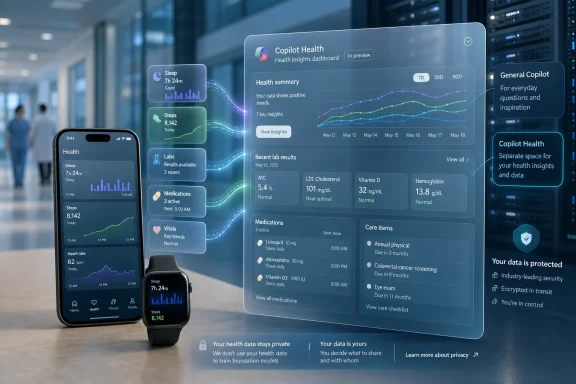
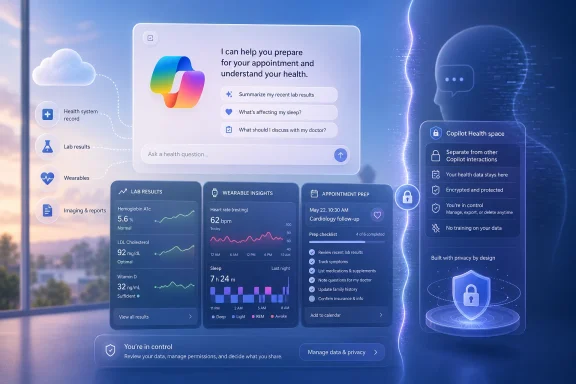
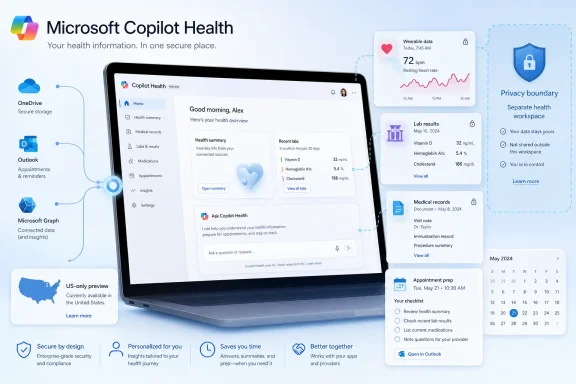
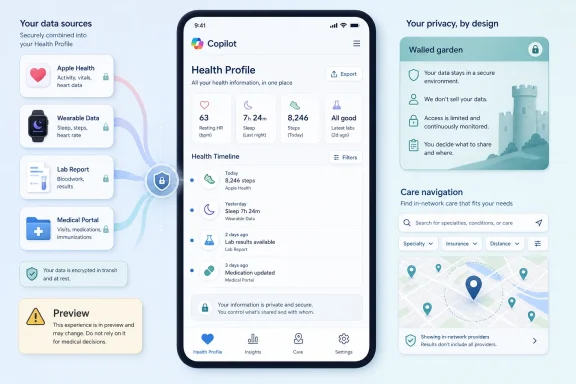
That is a much larger ambition than “AI search for symptoms.” Microsoft describes Copilot Health as a secure space inside Copilot where users can bring together a health profile, wearable data, health records, and conversations. In practice, the pitch is simple: your Apple Watch may know how you slept, your doctor’s portal may know your cholesterol, your lab report may know your iron levels, and your memory may know how you felt last Tuesday. Copilot Health is supposed to make those fragments legible.
That fragmentation is real. Anyone who has juggled a hospital portal, a pharmacy account, a smartwatch dashboard, and a PDF from a lab vendor knows that personal health data is rarely absent; it is scattered, inconsistent, and often written for billing systems rather than humans. Microsoft is betting that AI’s killer consumer health use case is not diagnosis but translation.
The subscription gate matters. This preview is not being offered broadly to every Copilot user. It is available to adults in the United States with Microsoft 365 Personal, Family, or Premium, and work accounts are excluded. That makes Copilot Health both a consumer health product and another brick in Microsoft’s broader effort to make the Microsoft 365 subscription feel less like an Office rental and more like a personal operating layer for everyday life.
That bundle says a lot about where Microsoft thinks the first commercial foothold lies. Copilot Health is not launching as a virtual physician. It is launching as a personal health interpreter and concierge, wrapped in the Copilot brand and backed by a cloud company with deep healthcare ambitions.
There is a practical reason for that restraint. If Microsoft presents Copilot Health as a diagnostic engine, every error becomes an existential liability. If it presents the tool as a way to make existing information clearer, the value proposition is easier to defend. The user remains the decision-maker, the clinician remains the authority, and Copilot sits in the middle as a summarizer, explainer, and preparer.
Still, middlemen shape decisions. A tool that helps a user understand lab results may influence whether they book an appointment. A tool that suggests which provider to search for may affect what kind of care they seek. A tool that asks follow-up questions may nudge a user toward urgency or reassurance. Microsoft’s disclaimer that Copilot Health is not intended to diagnose, treat, or prevent disease is necessary, but it does not erase the behavioral power of the product.
The company says Copilot Health conversations are separate from the rest of Copilot and are not used to train AI. It says data is encrypted at rest and in transit, and users can manage, delete, or disconnect health data sources. It also says the service was developed with an internal clinical team, informed by an external panel of more than 250 physicians across more than 24 countries, and built with guardrails designed to reduce health misinformation while supporting emotional wellbeing.
Those are serious claims, and they are also the minimum price of entry. In consumer AI, vendors have trained users to assume that their prompts may become product telemetry, that their conversations may be used to improve models, and that privacy terms may evolve faster than public understanding. Copilot Health has to fight that inherited suspicion from day one.
The ISO/IEC 42001 certification Microsoft cites is part of the same trust-building campaign. It signals that an external party has assessed the company’s AI management system for governance and continuous improvement. That does not prove the tool will always give good health guidance, but it does show Microsoft understands that “we tested it” is no longer enough.
Wearables made health data ambient. Lab services made biomarkers more accessible. Patient portals made clinical notes and test results visible. But visibility is not comprehension. A mildly abnormal value, a vague symptom, and a week of poor sleep can produce a midnight search spiral faster than any hospital system can respond.
That is the gap Microsoft is aiming at. If Copilot can reduce anxiety, prepare users for appointments, and explain why a metric may or may not matter, it could provide genuine value. The best version of this product is not a know-it-all doctor substitute; it is a calm, context-aware assistant that helps people ask better questions of real professionals.
The risk is that calm can become overconfidence. A polished answer with references to trusted organizations may feel more authoritative than it deserves to be. A model that is good at explaining population-level health information may still fail on edge cases, comorbidities, medication interactions, or symptoms that require physical examination. In medicine, the difference between “usually fine” and “go now” is often hidden in details the patient does not know to mention.
The presence of trusted sources does not automatically solve the problem of medical advice, however. High-quality sources can be summarized poorly. Correct general guidance can be misapplied to an individual. A model can ask a reasonable follow-up question and still miss the one question that matters most.
This is where Microsoft’s language becomes revealing. The company promises guidance you can trust, not clinical decision-making you can outsource. It emphasizes medical intelligence, follow-up questions, and clear next steps. The ideal user outcome is not “Copilot told me what disease I have.” It is “Copilot helped me understand what to ask my doctor.”
That distinction will be hard to preserve in the wild. People use chatbots because they are available, patient, and nonjudgmental. They use them at night, when clinics are closed. They use them when they are embarrassed, uninsured, waiting for an appointment, or unsure whether a concern is serious. Microsoft knows this; its own health usage research has highlighted the scale of health-related Copilot queries. Copilot Health exists because consumers are already using AI for health, whether vendors bless it or not.
The company is explicit that features, experiences, and usage limits may change during the preview period. That is normal for AI products, where model behavior, safety systems, and interface constraints are constantly tuned. It is also a reminder that users are participating in a live product-development process with deeply personal data.
To Microsoft’s credit, the eligibility limits are conservative. The preview is U.S.-only, adult-only, and consumer-account-only. Work accounts are excluded, which avoids immediate confusion with employer-managed environments and enterprise compliance frameworks. That boundary matters because an employee should not have to wonder whether a workplace identity system has any relationship to personal health exploration.
But the consumer boundary creates its own challenge. Microsoft 365 Family subscriptions can involve household dynamics, shared billing, and confusing account ownership. If AI benefits are tied to subscription ownership or particular account states, Microsoft will need to make access and privacy boundaries painfully clear. Health features cannot rely on the same casual account assumptions that already annoy families trying to understand which Copilot features they get.
But Apple Health is also a reminder that Microsoft is building on top of ecosystems it does not control. Wearable data varies in quality, frequency, and clinical relevance. Sleep staging, calorie estimates, heart-rate trends, and activity rings can be useful signals, but they are not equivalent to a physician’s assessment. Even when the data is accurate, interpretation is hard.
The more sources Microsoft adds, the more normalization becomes the product. Oura, Fitbit, Garmin, lab vendors, pharmacy records, and provider portals all speak different dialects of health. Copilot Health’s long-term value will depend less on whether it can ingest data and more on whether it can rank uncertainty honestly.
That is a difficult user-interface problem. Consumers want a clear answer. Responsible health AI must often say, “This pattern might matter, but it depends.” The companies that win this category will be the ones that make uncertainty feel useful rather than evasive.
That is the real Copilot strategy. Windows integration gets the headlines, but Microsoft’s more durable asset is the Microsoft account attached to services, billing, files, and now potentially health context. If Copilot becomes the assistant that knows your documents, calendar, purchases, and health goals, the operating system becomes less important as a boundary and more important as one of many entry points.
This is also where administrators should pay attention, even though work accounts are excluded from the preview. Consumer AI features have a habit of shaping employee expectations. A worker who becomes comfortable asking Copilot Health to summarize personal lab results may expect the same kind of conversational explanation from HR benefits portals, occupational health tools, or enterprise wellness programs.
Enterprise IT will not manage this preview directly, but it will inherit the cultural consequences. The line between consumer AI and workplace AI is already blurry. Health makes that line radioactive.
That breadth is both an advantage and a conflict risk. Microsoft can credibly claim experience with healthcare data, enterprise security, and regulated environments. It can also use its consumer AI reach to learn what ordinary people ask, fear, misunderstand, and need before and after clinical encounters.
But healthcare is not like productivity software, where the same vendor can sell tools to employees, managers, and customers without raising many eyebrows. If Microsoft builds AI for hospitals and AI for patients, users will want to know whose interests are being optimized in any given moment. Is the assistant helping a patient advocate for care, helping a system reduce unnecessary visits, helping a payer steer networks, or helping Microsoft deepen subscription value?
The answer may be “all of the above” over time, which is precisely why transparency will matter. Care navigation is particularly sensitive. A provider search feature sounds benign, but ranking, availability, insurance filtering, and commercial relationships can shape access. Microsoft will need to be clear about how results are ordered and what business logic sits behind them.
A general-purpose assistant is rewarded for answering. A health assistant must sometimes interrupt, escalate, defer, or refuse. It must detect emergencies without causing panic. It must avoid false reassurance while not sending every worried user to urgent care. It must be sensitive to mental-health context, self-harm risk, medication questions, pregnancy, pediatric concerns, and chronic disease complexity.
That is why Microsoft’s mention of emotional wellbeing guardrails matters. Health questions are often not just informational. They are wrapped in fear, shame, grief, frustration, and distrust. A technically accurate answer can still be harmful if it lands coldly or misses the user’s state of mind.
The product’s success will depend on evaluation that goes beyond answer correctness. Microsoft will need to measure whether users understand limitations, whether they seek appropriate care, whether they over-trust the tool, and whether certain groups receive worse guidance. Responsible AI principles are easy to state; health equity is harder to operationalize.
Product gravity pulls data toward integration. Once a service knows your health goals, it is tempting to connect that context to meal planning, calendar reminders, exercise suggestions, insurance paperwork, travel planning, or shopping. Some of those integrations could be useful. Some could be creepy. Some could be both.
The cleanest version of Copilot Health is a walled health workspace with explicit user-controlled connections. The messier version is a Copilot universe where personal context becomes increasingly fluid and users struggle to understand which memory, profile, or data source informed which answer. Microsoft’s announcement wisely emphasizes separation. The long-term test is whether that separation survives feature expansion.
Security-minded users should also distinguish between training use and operational use. Saying data is not used to train AI does not mean data is never processed by AI systems to provide the service. It does not mean no logs exist. It does not answer every question about retention, law-enforcement requests, third-party integrations, support access, or account compromise. Those details will matter more as the product moves from preview curiosity to daily utility.
If Copilot Health gives a user a clear explanation of lab results, suggests likely next steps, and recommends a specialist search, the distinction between “guidance” and “advice” will feel academic. The user may still make a medical decision based on the interaction. Microsoft can disclaim diagnosis, but it cannot disclaim influence.
This is not an argument that Microsoft should stay out of health. The current alternative is not a pristine world where everyone consults a doctor promptly and understands their records perfectly. The alternative is millions of people searching symptoms on the open web, reading forum posts, watching dubious videos, and asking general chatbots with little medical grounding. A better-designed, better-sourced, more privacy-conscious assistant could reduce harm.
But that only holds if Microsoft resists the incentive to make the product sound more capable than it is. The marketing line should never outrun the safety case. In health AI, overpromising is not just embarrassing; it is dangerous.
This also explains why Copilot Health is tied to Microsoft 365 rather than sold as a standalone medical app. Microsoft wants Copilot to be the premium layer that makes the subscription feel broader than Word, Excel, PowerPoint, and cloud storage. The company has already added AI features to consumer subscriptions; health gives the bundle a more intimate claim on daily life.
The challenge is that health does not behave like other premium features. A better image generator can be delightful. A better spreadsheet assistant can save time. A health assistant can change whether someone sleeps, worries, books care, ignores pain, or trusts a clinician. The stakes are not evenly distributed.
That may be why Microsoft is moving deliberately. The company is expanding access only after safety testing and evaluation, while promising more features later. The cautious rollout is not just corporate responsibility; it is market management. If Copilot Health’s first public phase produces a major safety or privacy incident, the category will become harder for everyone.
That use case also fits Microsoft’s strengths. The company knows documents, summaries, search, identity, and workflow. It does not need to “solve medicine” to make a patient’s next appointment better. It needs to help the user arrive less confused.
The second defensible use case is longitudinal self-understanding. Health data becomes more meaningful over time, especially when lifestyle signals, labs, medications, and symptoms can be discussed together. If Copilot Health can show a user how sleep, activity, and lab trends relate without overstating causality, it may fill a real gap between annual checkups.
The weaker use case is acute decision-making. When a user has chest pain, neurological symptoms, severe abdominal pain, suicidal thoughts, or dangerous medication questions, the product must behave less like a chatbot and more like a triage signpost. Microsoft’s guardrails will be judged harshly in exactly those moments, and rightly so.
The most concrete points are already visible:
 Microsoft Is Turning Health Anxiety Into a Subscription Feature
The most important thing about Copilot Health is not that it answers health questions. Chatbots already do that, often badly, sometimes helpfully, and almost always without enough context. The notable shift is that Microsoft wants Copilot to become the place where a consumer’s health context lives.That is a much larger ambition than “AI search for symptoms.” Microsoft describes Copilot Health as a secure space inside Copilot where users can bring together a health profile, wearable data, health records, and conversations. In practice, the pitch is simple: your Apple Watch may know how you slept, your doctor’s portal may know your cholesterol, your lab report may know your iron levels, and your memory may know how you felt last Tuesday. Copilot Health is supposed to make those fragments legible.
That fragmentation is real. Anyone who has juggled a hospital portal, a pharmacy account, a smartwatch dashboard, and a PDF from a lab vendor knows that personal health data is rarely absent; it is scattered, inconsistent, and often written for billing systems rather than humans. Microsoft is betting that AI’s killer consumer health use case is not diagnosis but translation.
The subscription gate matters. This preview is not being offered broadly to every Copilot user. It is available to adults in the United States with Microsoft 365 Personal, Family, or Premium, and work accounts are excluded. That makes Copilot Health both a consumer health product and another brick in Microsoft’s broader effort to make the Microsoft 365 subscription feel less like an Office rental and more like a personal operating layer for everyday life.
The Product Starts With Aggregation, Not Medicine
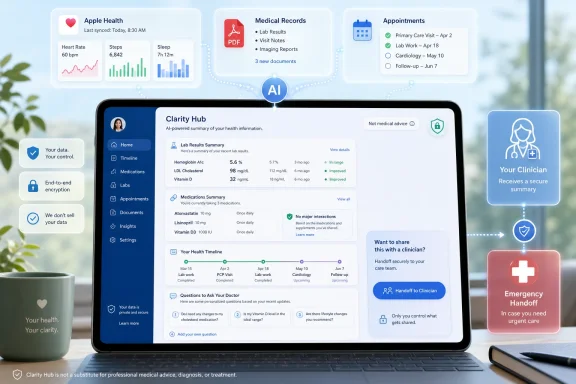
Microsoft’s preview feature set is carefully framed around guidance, insight, and navigation rather than diagnosis. Users can create a health profile with relevant background and goals. They can connect wearable and wellness data, beginning with Apple Health, and combine that with records from more than 50,000 U.S. provider organizations. They can ask questions against that combined context and use the service to search for healthcare providers by specialty, language, gender, insurance, and location.That bundle says a lot about where Microsoft thinks the first commercial foothold lies. Copilot Health is not launching as a virtual physician. It is launching as a personal health interpreter and concierge, wrapped in the Copilot brand and backed by a cloud company with deep healthcare ambitions.
There is a practical reason for that restraint. If Microsoft presents Copilot Health as a diagnostic engine, every error becomes an existential liability. If it presents the tool as a way to make existing information clearer, the value proposition is easier to defend. The user remains the decision-maker, the clinician remains the authority, and Copilot sits in the middle as a summarizer, explainer, and preparer.
Still, middlemen shape decisions. A tool that helps a user understand lab results may influence whether they book an appointment. A tool that suggests which provider to search for may affect what kind of care they seek. A tool that asks follow-up questions may nudge a user toward urgency or reassurance. Microsoft’s disclaimer that Copilot Health is not intended to diagnose, treat, or prevent disease is necessary, but it does not erase the behavioral power of the product.
The Trust Pitch Is Doing More Work Than the AI Pitch
Microsoft’s announcement spends as much energy on safety architecture as it does on features, and that is not accidental. Health data is among the few categories of consumer information that can damage a person’s employment prospects, insurance standing, relationships, and dignity if mishandled. A breached email archive is bad. A breached health profile can be life-altering.The company says Copilot Health conversations are separate from the rest of Copilot and are not used to train AI. It says data is encrypted at rest and in transit, and users can manage, delete, or disconnect health data sources. It also says the service was developed with an internal clinical team, informed by an external panel of more than 250 physicians across more than 24 countries, and built with guardrails designed to reduce health misinformation while supporting emotional wellbeing.
Those are serious claims, and they are also the minimum price of entry. In consumer AI, vendors have trained users to assume that their prompts may become product telemetry, that their conversations may be used to improve models, and that privacy terms may evolve faster than public understanding. Copilot Health has to fight that inherited suspicion from day one.
The ISO/IEC 42001 certification Microsoft cites is part of the same trust-building campaign. It signals that an external party has assessed the company’s AI management system for governance and continuous improvement. That does not prove the tool will always give good health guidance, but it does show Microsoft understands that “we tested it” is no longer enough.
Microsoft Is Selling Calm in a Market Built on Confusion
The emotional premise of Copilot Health is stronger than the technical one. The opening scenario Microsoft uses — sleep data saying one thing while blood work says another — captures the modern health-tech trap perfectly. Consumers have more measurements than ever and less confidence about what those measurements mean.Wearables made health data ambient. Lab services made biomarkers more accessible. Patient portals made clinical notes and test results visible. But visibility is not comprehension. A mildly abnormal value, a vague symptom, and a week of poor sleep can produce a midnight search spiral faster than any hospital system can respond.
That is the gap Microsoft is aiming at. If Copilot can reduce anxiety, prepare users for appointments, and explain why a metric may or may not matter, it could provide genuine value. The best version of this product is not a know-it-all doctor substitute; it is a calm, context-aware assistant that helps people ask better questions of real professionals.
The risk is that calm can become overconfidence. A polished answer with references to trusted organizations may feel more authoritative than it deserves to be. A model that is good at explaining population-level health information may still fail on edge cases, comorbidities, medication interactions, or symptoms that require physical examination. In medicine, the difference between “usually fine” and “go now” is often hidden in details the patient does not know to mention.
The Harvard Health and National Academy Framing Is a Shield, Not a Cure
Microsoft says Copilot Health answers are informed by trusted health organizations globally, using sourcing principles independently published by the National Academy of Medicine and through a partnership with Harvard Health. That is an important distinction from the general chatbot experience, where answers may be generated from a noisy blend of web content, training data, and model confidence.The presence of trusted sources does not automatically solve the problem of medical advice, however. High-quality sources can be summarized poorly. Correct general guidance can be misapplied to an individual. A model can ask a reasonable follow-up question and still miss the one question that matters most.
This is where Microsoft’s language becomes revealing. The company promises guidance you can trust, not clinical decision-making you can outsource. It emphasizes medical intelligence, follow-up questions, and clear next steps. The ideal user outcome is not “Copilot told me what disease I have.” It is “Copilot helped me understand what to ask my doctor.”
That distinction will be hard to preserve in the wild. People use chatbots because they are available, patient, and nonjudgmental. They use them at night, when clinics are closed. They use them when they are embarrassed, uninsured, waiting for an appointment, or unsure whether a concern is serious. Microsoft knows this; its own health usage research has highlighted the scale of health-related Copilot queries. Copilot Health exists because consumers are already using AI for health, whether vendors bless it or not.
The Preview Label Carries More Weight in Healthcare
Microsoft’s phased rollout is sensible, but the preview label is awkward in a health context. In productivity software, preview means features may move, break, or change. In a health assistant, preview means Microsoft is still learning how people behave when the tool is placed between them and sensitive medical decisions.The company is explicit that features, experiences, and usage limits may change during the preview period. That is normal for AI products, where model behavior, safety systems, and interface constraints are constantly tuned. It is also a reminder that users are participating in a live product-development process with deeply personal data.
To Microsoft’s credit, the eligibility limits are conservative. The preview is U.S.-only, adult-only, and consumer-account-only. Work accounts are excluded, which avoids immediate confusion with employer-managed environments and enterprise compliance frameworks. That boundary matters because an employee should not have to wonder whether a workplace identity system has any relationship to personal health exploration.
But the consumer boundary creates its own challenge. Microsoft 365 Family subscriptions can involve household dynamics, shared billing, and confusing account ownership. If AI benefits are tied to subscription ownership or particular account states, Microsoft will need to make access and privacy boundaries painfully clear. Health features cannot rely on the same casual account assumptions that already annoy families trying to understand which Copilot features they get.
Apple Health Is the Opening Move, Not the Destination
The preview starts with Apple Health integration, with more sources promised later. That is a pragmatic choice. The iPhone and Apple Watch dominate the U.S. consumer-wearable imagination, and Apple Health already acts as a hub for a wide range of wellness data.But Apple Health is also a reminder that Microsoft is building on top of ecosystems it does not control. Wearable data varies in quality, frequency, and clinical relevance. Sleep staging, calorie estimates, heart-rate trends, and activity rings can be useful signals, but they are not equivalent to a physician’s assessment. Even when the data is accurate, interpretation is hard.
The more sources Microsoft adds, the more normalization becomes the product. Oura, Fitbit, Garmin, lab vendors, pharmacy records, and provider portals all speak different dialects of health. Copilot Health’s long-term value will depend less on whether it can ingest data and more on whether it can rank uncertainty honestly.
That is a difficult user-interface problem. Consumers want a clear answer. Responsible health AI must often say, “This pattern might matter, but it depends.” The companies that win this category will be the ones that make uncertainty feel useful rather than evasive.
The Windows Angle Is Identity, Not an App Tile
For WindowsForum readers, the obvious question is whether this is a Windows story at all. Copilot Health is launching on the web, not as a Windows 11 control-panel feature. But the strategic connection is unmistakable: Microsoft is turning Copilot into a cross-device identity layer that follows the user across browser, subscription, cloud storage, and eventually whatever Windows surface the company chooses.That is the real Copilot strategy. Windows integration gets the headlines, but Microsoft’s more durable asset is the Microsoft account attached to services, billing, files, and now potentially health context. If Copilot becomes the assistant that knows your documents, calendar, purchases, and health goals, the operating system becomes less important as a boundary and more important as one of many entry points.
This is also where administrators should pay attention, even though work accounts are excluded from the preview. Consumer AI features have a habit of shaping employee expectations. A worker who becomes comfortable asking Copilot Health to summarize personal lab results may expect the same kind of conversational explanation from HR benefits portals, occupational health tools, or enterprise wellness programs.
Enterprise IT will not manage this preview directly, but it will inherit the cultural consequences. The line between consumer AI and workplace AI is already blurry. Health makes that line radioactive.
Microsoft’s Healthcare Ambition Is Bigger Than Consumers
Copilot Health arrives alongside Microsoft’s broader healthcare AI push, including clinical assistant work under the Dragon brand and cloud services aimed at providers. The consumer preview should be understood as one front in a multi-front campaign. Microsoft wants to be useful to clinicians, hospitals, payers, life sciences organizations, and patients.That breadth is both an advantage and a conflict risk. Microsoft can credibly claim experience with healthcare data, enterprise security, and regulated environments. It can also use its consumer AI reach to learn what ordinary people ask, fear, misunderstand, and need before and after clinical encounters.
But healthcare is not like productivity software, where the same vendor can sell tools to employees, managers, and customers without raising many eyebrows. If Microsoft builds AI for hospitals and AI for patients, users will want to know whose interests are being optimized in any given moment. Is the assistant helping a patient advocate for care, helping a system reduce unnecessary visits, helping a payer steer networks, or helping Microsoft deepen subscription value?
The answer may be “all of the above” over time, which is precisely why transparency will matter. Care navigation is particularly sensitive. A provider search feature sounds benign, but ranking, availability, insurance filtering, and commercial relationships can shape access. Microsoft will need to be clear about how results are ordered and what business logic sits behind them.
The Hardest Safety Problem Is Not Hallucination
The public discussion of medical AI often begins with hallucination, and for good reason. A confident falsehood in a health context can be dangerous. But Copilot Health’s hardest safety problem may be subtler: the system must decide when not to sound helpful.A general-purpose assistant is rewarded for answering. A health assistant must sometimes interrupt, escalate, defer, or refuse. It must detect emergencies without causing panic. It must avoid false reassurance while not sending every worried user to urgent care. It must be sensitive to mental-health context, self-harm risk, medication questions, pregnancy, pediatric concerns, and chronic disease complexity.
That is why Microsoft’s mention of emotional wellbeing guardrails matters. Health questions are often not just informational. They are wrapped in fear, shame, grief, frustration, and distrust. A technically accurate answer can still be harmful if it lands coldly or misses the user’s state of mind.
The product’s success will depend on evaluation that goes beyond answer correctness. Microsoft will need to measure whether users understand limitations, whether they seek appropriate care, whether they over-trust the tool, and whether certain groups receive worse guidance. Responsible AI principles are easy to state; health equity is harder to operationalize.
The Privacy Promise Will Be Tested by Product Gravity
Microsoft says Copilot Health conversations are not shared with the rest of Copilot and are not used to train AI. That is the sentence many users will look for before trying the preview. It is also the sentence Microsoft must protect from future product gravity.Product gravity pulls data toward integration. Once a service knows your health goals, it is tempting to connect that context to meal planning, calendar reminders, exercise suggestions, insurance paperwork, travel planning, or shopping. Some of those integrations could be useful. Some could be creepy. Some could be both.
The cleanest version of Copilot Health is a walled health workspace with explicit user-controlled connections. The messier version is a Copilot universe where personal context becomes increasingly fluid and users struggle to understand which memory, profile, or data source informed which answer. Microsoft’s announcement wisely emphasizes separation. The long-term test is whether that separation survives feature expansion.
Security-minded users should also distinguish between training use and operational use. Saying data is not used to train AI does not mean data is never processed by AI systems to provide the service. It does not mean no logs exist. It does not answer every question about retention, law-enforcement requests, third-party integrations, support access, or account compromise. Those details will matter more as the product moves from preview curiosity to daily utility.
The Medical Disclaimer Is Necessary, But It Cannot Carry the Product
Microsoft states that Copilot Health is not intended to diagnose, treat, or prevent diseases or other conditions and is not a substitute for professional medical advice. That language is familiar, legally important, and practically insufficient. Users do not experience software through disclaimers; they experience it through answers.If Copilot Health gives a user a clear explanation of lab results, suggests likely next steps, and recommends a specialist search, the distinction between “guidance” and “advice” will feel academic. The user may still make a medical decision based on the interaction. Microsoft can disclaim diagnosis, but it cannot disclaim influence.
This is not an argument that Microsoft should stay out of health. The current alternative is not a pristine world where everyone consults a doctor promptly and understands their records perfectly. The alternative is millions of people searching symptoms on the open web, reading forum posts, watching dubious videos, and asking general chatbots with little medical grounding. A better-designed, better-sourced, more privacy-conscious assistant could reduce harm.
But that only holds if Microsoft resists the incentive to make the product sound more capable than it is. The marketing line should never outrun the safety case. In health AI, overpromising is not just embarrassing; it is dangerous.
The Preview Draws a Map of Microsoft’s Next Consumer Platform
Copilot Health is part of a larger pattern in Microsoft’s consumer strategy. The company is no longer merely bundling AI into Office documents. It is looking for domains where users have recurring questions, fragmented data, and willingness to pay for clarity. Productivity was the first obvious target. Health may be the most emotionally powerful one.This also explains why Copilot Health is tied to Microsoft 365 rather than sold as a standalone medical app. Microsoft wants Copilot to be the premium layer that makes the subscription feel broader than Word, Excel, PowerPoint, and cloud storage. The company has already added AI features to consumer subscriptions; health gives the bundle a more intimate claim on daily life.
The challenge is that health does not behave like other premium features. A better image generator can be delightful. A better spreadsheet assistant can save time. A health assistant can change whether someone sleeps, worries, books care, ignores pain, or trusts a clinician. The stakes are not evenly distributed.
That may be why Microsoft is moving deliberately. The company is expanding access only after safety testing and evaluation, while promising more features later. The cautious rollout is not just corporate responsibility; it is market management. If Copilot Health’s first public phase produces a major safety or privacy incident, the category will become harder for everyone.
The Concrete Test Is Whether Copilot Helps Before the Appointment
The most defensible use case for Copilot Health is appointment preparation. Many patients have limited time with clinicians, incomplete recall, and a poor grasp of which details are relevant. A tool that can summarize records, highlight trends, translate lab ranges, and help generate concise questions could improve the clinical encounter without pretending to replace it.That use case also fits Microsoft’s strengths. The company knows documents, summaries, search, identity, and workflow. It does not need to “solve medicine” to make a patient’s next appointment better. It needs to help the user arrive less confused.
The second defensible use case is longitudinal self-understanding. Health data becomes more meaningful over time, especially when lifestyle signals, labs, medications, and symptoms can be discussed together. If Copilot Health can show a user how sleep, activity, and lab trends relate without overstating causality, it may fill a real gap between annual checkups.
The weaker use case is acute decision-making. When a user has chest pain, neurological symptoms, severe abdominal pain, suicidal thoughts, or dangerous medication questions, the product must behave less like a chatbot and more like a triage signpost. Microsoft’s guardrails will be judged harshly in exactly those moments, and rightly so.
The First Preview Tells Us Where the Fight Will Be
Copilot Health’s preview is narrow enough to be cautious and ambitious enough to be consequential. The early product is not a revolution in care delivery, but it sketches a future in which consumer AI tools sit between people and the healthcare system by default. That future could be helpful, exploitative, or some uneasy mix of both.The most concrete points are already visible:
- Copilot Health is available in preview to U.S. users aged 18 and older with eligible Microsoft 365 consumer subscriptions, while work accounts are not eligible.
- The service begins with Apple Health connectivity and health-record access from more than 50,000 U.S. provider organizations, with additional data sources expected later.
- Microsoft says Copilot Health conversations are separated from the rest of Copilot, encrypted, user-manageable, and not used to train AI.
- The product is positioned as health guidance, record interpretation, personalized insight, and care navigation, not as a diagnostic or treatment system.
- The real test will be whether Microsoft can preserve user trust as Copilot Health expands from a contained preview into a broader consumer AI platform.
References
- Primary source: Microsoft
Published: Fri, 29 May 2026 13:40:55 GMT
Copilot Health: Now in Preview | Microsoft Copilot Blog
Your sleep data says one thing. Your blood work says another. It’s not that your health information is missing—it’s that nothing has brought it together in a way that makes sense. We’re building Copilot Health to change that.www.microsoft.com - Official source: support.microsoft.com
AI credits and limits for Microsoft 365 subscriptions | Microsoft Support
Learn about AI credits and feature limits in Microsoft 365 subscriptions.support.microsoft.com - Related coverage: icthealth.org
Microsoft introduces AI-powered Copilot Health | ICT&health
www.icthealth.org
- Official source: wwwqa.microsoft.com

Log In ‹ Microsoft 365 Blog — WordPress
wwwqa.microsoft.com
- Related coverage: gadgets360.com
Microsoft Makes a Move Towards AI-Powered Healthcare With Copilot Health | Technology News
Microsoft introduced Copilot Health, a new artificial intelligence (AI)-powered medical insights feature, on Thursday.www.gadgets360.com - Related coverage: fortune.com
Microsoft launches Copilot Health, a dedicated space for personal health data and AI-driven insights | Fortune
Microsoft joins OpenAI and Anthropic in the race to become the AI front door for consumer healthcare.fortune.com
- Related coverage: agent-wars.com
Microsoft Launches Copilot Health, Backed by Diagnostic AI That Outscored Physicians on Complex Cases
Agent Wars — Tracking the rise of AI agents. The definitive directory of AI agent platforms, tools, and frameworks. agent-wars.com
- Related coverage: healthcare-brew.com
Microsoft launches AI platform, Copilot Health
But don’t get too excited—you’ll have to join a waitlist to use it.www.healthcare-brew.com
- Related coverage: axios.com
Microsoft's Copilot Health competes with OpenAI, Amazon
Microsoft bets that its health care track record will help it beat OpenAI.www.axios.com
- Related coverage: techtarget.com
Microsoft joins the AI chatbot market with Copilot Health | TechTarget
Microsoft is framing Copilot Health as a complement to patient–provider relationships, but the company's own data suggest it's filling in where care access falters.www.techtarget.com - Related coverage: bloomberg.com
- Related coverage: windowscentral.com
Microsoft 365 is paywalling most of Copilot in its Office apps | Windows Central
Commercial customers will soon need a Microsoft 365 Copilot license to use Copilot Chat in Word, Excel, PowerPoint, and OneNote.www.windowscentral.com - Official source: cdn-dynmedia-1.microsoft.com
- Related coverage: djamgamind.com