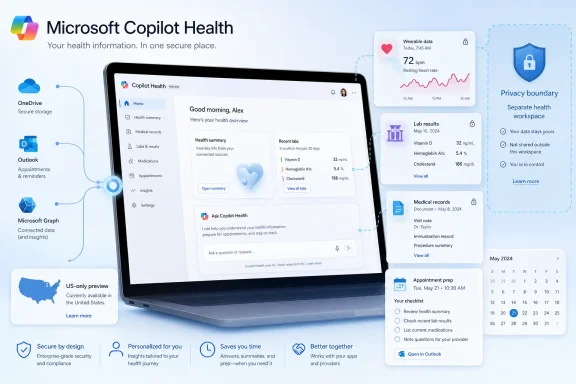
Microsoft moved Copilot Health into preview on May 29, 2026, making the health-focused AI experience available on the web to U.S. Copilot users aged 18 and older with Microsoft 365 Personal, Family, or Premium subscriptions. The move turns what was a March announcement into a live consumer product test, and it does so in one of the few software categories where “preview” is not a comforting word. Microsoft is not merely adding another Copilot tab; it is asking users to connect sleep metrics, lab results, medical records, and care-search decisions to an AI intermediary. That makes Copilot Health a useful product experiment, a trust exercise, and a warning label for where consumer AI is headed.

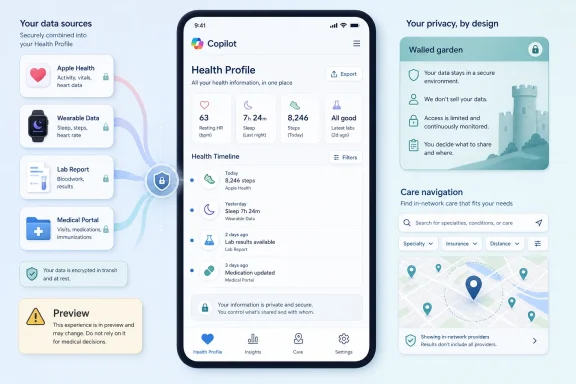
Mock smartphone screens showing a health profile and privacy features with data sources and in-network care search.Microsoft Is Turning Health Anxiety Into a Subscription Feature​

The most important thing about Copilot Health is not that it answers health questions. Chatbots already do that, often badly, sometimes helpfully, and almost always without enough context. The notable shift is that Microsoft wants Copilot to become the place where a consumer’s health context lives.
That is a much larger ambition than “AI search for symptoms.” Microsoft describes Copilot Health as a secure space inside Copilot where users can bring together a health profile, wearable data, health records, and conversations. In practice, the pitch is simple: your Apple Watch may know how you slept, your doctor’s portal may know your cholesterol, your lab report may know your iron levels, and your memory may know how you felt last Tuesday. Copilot Health is supposed to make those fragments legible.
That fragmentation is real. Anyone who has juggled a hospital portal, a pharmacy account, a smartwatch dashboard, and a PDF from a lab vendor knows that personal health data is rarely absent; it is scattered, inconsistent, and often written for billing systems rather than humans. Microsoft is betting that AI’s killer consumer health use case is not diagnosis but translation.
The subscription gate matters. This preview is not being offered broadly to every Copilot user. It is available to adults in the United States with Microsoft 365 Personal, Family, or Premium, and work accounts are excluded. That makes Copilot Health both a consumer health product and another brick in Microsoft’s broader effort to make the Microsoft 365 subscription feel less like an Office rental and more like a personal operating layer for everyday life.

The Product Starts With Aggregation, Not Medicine​

Microsoft’s preview feature set is carefully framed around guidance, insight, and navigation rather than diagnosis. Users can create a health profile with relevant background and goals. They can connect wearable and wellness data, beginning with Apple Health, and combine that with records from more than 50,000 U.S. provider organizations. They can ask questions against that combined context and use the service to search for healthcare providers by specialty, language, gender, insurance, and location.
That bundle says a lot about where Microsoft thinks the first commercial foothold lies. Copilot Health is not launching as a virtual physician. It is launching as a personal health interpreter and concierge, wrapped in the Copilot brand and backed by a cloud company with deep healthcare ambitions.
There is a practical reason for that restraint. If Microsoft presents Copilot Health as a diagnostic engine, every error becomes an existential liability. If it presents the tool as a way to make existing information clearer, the value proposition is easier to defend. The user remains the decision-maker, the clinician remains the authority, and Copilot sits in the middle as a summarizer, explainer, and preparer.
Still, middlemen shape decisions. A tool that helps a user understand lab results may influence whether they book an appointment. A tool that suggests which provider to search for may affect what kind of care they seek. A tool that asks follow-up questions may nudge a user toward urgency or reassurance. Microsoft’s disclaimer that Copilot Health is not intended to diagnose, treat, or prevent disease is necessary, but it does not erase the behavioral power of the product.

The Trust Pitch Is Doing More Work Than the AI Pitch​

Microsoft’s announcement spends as much energy on safety architecture as it does on features, and that is not accidental. Health data is among the few categories of consumer information that can damage a person’s employment prospects, insurance standing, relationships, and dignity if mishandled. A breached email archive is bad. A breached health profile can be life-altering.
The company says Copilot Health conversations are separate from the rest of Copilot and are not used to train AI. It says data is encrypted at rest and in transit, and users can manage, delete, or disconnect health data sources. It also says the service was developed with an internal clinical team, informed by an external panel of more than 250 physicians across more than 24 countries, and built with guardrails designed to reduce health misinformation while supporting emotional wellbeing.
Those are serious claims, and they are also the minimum price of entry. In consumer AI, vendors have trained users to assume that their prompts may become product telemetry, that their conversations may be used to improve models, and that privacy terms may evolve faster than public understanding. Copilot Health has to fight that inherited suspicion from day one.
The ISO/IEC 42001 certification Microsoft cites is part of the same trust-building campaign. It signals that an external party has assessed the company’s AI management system for governance and continuous improvement. That does not prove the tool will always give good health guidance, but it does show Microsoft understands that “we tested it” is no longer enough.

Microsoft Is Selling Calm in a Market Built on Confusion​

The emotional premise of Copilot Health is stronger than the technical one. The opening scenario Microsoft uses — sleep data saying one thing while blood work says another — captures the modern health-tech trap perfectly. Consumers have more measurements than ever and less confidence about what those measurements mean.
Wearables made health data ambient. Lab services made biomarkers more accessible. Patient portals made clinical notes and test results visible. But visibility is not comprehension. A mildly abnormal value, a vague symptom, and a week of poor sleep can produce a midnight search spiral faster than any hospital system can respond.
That is the gap Microsoft is aiming at. If Copilot can reduce anxiety, prepare users for appointments, and explain why a metric may or may not matter, it could provide genuine value. The best version of this product is not a know-it-all doctor substitute; it is a calm, context-aware assistant that helps people ask better questions of real professionals.
The risk is that calm can become overconfidence. A polished answer with references to trusted organizations may feel more authoritative than it deserves to be. A model that is good at explaining population-level health information may still fail on edge cases, comorbidities, medication interactions, or symptoms that require physical examination. In medicine, the difference between “usually fine” and “go now” is often hidden in details the patient does not know to mention.

The Harvard Health and National Academy Framing Is a Shield, Not a Cure​

Microsoft says Copilot Health answers are informed by trusted health organizations globally, using sourcing principles independently published by the National Academy of Medicine and through a partnership with Harvard Health. That is an important distinction from the general chatbot experience, where answers may be generated from a noisy blend of web content, training data, and model confidence.
The presence of trusted sources does not automatically solve the problem of medical advice, however. High-quality sources can be summarized poorly. Correct general guidance can be misapplied to an individual. A model can ask a reasonable follow-up question and still miss the one question that matters most.
This is where Microsoft’s language becomes revealing. The company promises guidance you can trust, not clinical decision-making you can outsource. It emphasizes medical intelligence, follow-up questions, and clear next steps. The ideal user outcome is not “Copilot told me what disease I have.” It is “Copilot helped me understand what to ask my doctor.”
That distinction will be hard to preserve in the wild. People use chatbots because they are available, patient, and nonjudgmental. They use them at night, when clinics are closed. They use them when they are embarrassed, uninsured, waiting for an appointment, or unsure whether a concern is serious. Microsoft knows this; its own health usage research has highlighted the scale of health-related Copilot queries. Copilot Health exists because consumers are already using AI for health, whether vendors bless it or not.

The Preview Label Carries More Weight in Healthcare​

Microsoft’s phased rollout is sensible, but the preview label is awkward in a health context. In productivity software, preview means features may move, break, or change. In a health assistant, preview means Microsoft is still learning how people behave when the tool is placed between them and sensitive medical decisions.
The company is explicit that features, experiences, and usage limits may change during the preview period. That is normal for AI products, where model behavior, safety systems, and interface constraints are constantly tuned. It is also a reminder that users are participating in a live product-development process with deeply personal data.
To Microsoft’s credit, the eligibility limits are conservative. The preview is U.S.-only, adult-only, and consumer-account-only. Work accounts are excluded, which avoids immediate confusion with employer-managed environments and enterprise compliance frameworks. That boundary matters because an employee should not have to wonder whether a workplace identity system has any relationship to personal health exploration.
But the consumer boundary creates its own challenge. Microsoft 365 Family subscriptions can involve household dynamics, shared billing, and confusing account ownership. If AI benefits are tied to subscription ownership or particular account states, Microsoft will need to make access and privacy boundaries painfully clear. Health features cannot rely on the same casual account assumptions that already annoy families trying to understand which Copilot features they get.

Apple Health Is the Opening Move, Not the Destination​

The preview starts with Apple Health integration, with more sources promised later. That is a pragmatic choice. The iPhone and Apple Watch dominate the U.S. consumer-wearable imagination, and Apple Health already acts as a hub for a wide range of wellness data.
But Apple Health is also a reminder that Microsoft is building on top of ecosystems it does not control. Wearable data varies in quality, frequency, and clinical relevance. Sleep staging, calorie estimates, heart-rate trends, and activity rings can be useful signals, but they are not equivalent to a physician’s assessment. Even when the data is accurate, interpretation is hard.
The more sources Microsoft adds, the more normalization becomes the product. Oura, Fitbit, Garmin, lab vendors, pharmacy records, and provider portals all speak different dialects of health. Copilot Health’s long-term value will depend less on whether it can ingest data and more on whether it can rank uncertainty honestly.
That is a difficult user-interface problem. Consumers want a clear answer. Responsible health AI must often say, “This pattern might matter, but it depends.” The companies that win this category will be the ones that make uncertainty feel useful rather than evasive.

The Windows Angle Is Identity, Not an App Tile​

For WindowsForum readers, the obvious question is whether this is a Windows story at all. Copilot Health is launching on the web, not as a Windows 11 control-panel feature. But the strategic connection is unmistakable: Microsoft is turning Copilot into a cross-device identity layer that follows the user across browser, subscription, cloud storage, and eventually whatever Windows surface the company chooses.
That is the real Copilot strategy. Windows integration gets the headlines, but Microsoft’s more durable asset is the Microsoft account attached to services, billing, files, and now potentially health context. If Copilot becomes the assistant that knows your documents, calendar, purchases, and health goals, the operating system becomes less important as a boundary and more important as one of many entry points.
This is also where administrators should pay attention, even though work accounts are excluded from the preview. Consumer AI features have a habit of shaping employee expectations. A worker who becomes comfortable asking Copilot Health to summarize personal lab results may expect the same kind of conversational explanation from HR benefits portals, occupational health tools, or enterprise wellness programs.
Enterprise IT will not manage this preview directly, but it will inherit the cultural consequences. The line between consumer AI and workplace AI is already blurry. Health makes that line radioactive.

Microsoft’s Healthcare Ambition Is Bigger Than Consumers​

Copilot Health arrives alongside Microsoft’s broader healthcare AI push, including clinical assistant work under the Dragon brand and cloud services aimed at providers. The consumer preview should be understood as one front in a multi-front campaign. Microsoft wants to be useful to clinicians, hospitals, payers, life sciences organizations, and patients.
That breadth is both an advantage and a conflict risk. Microsoft can credibly claim experience with healthcare data, enterprise security, and regulated environments. It can also use its consumer AI reach to learn what ordinary people ask, fear, misunderstand, and need before and after clinical encounters.
But healthcare is not like productivity software, where the same vendor can sell tools to employees, managers, and customers without raising many eyebrows. If Microsoft builds AI for hospitals and AI for patients, users will want to know whose interests are being optimized in any given moment. Is the assistant helping a patient advocate for care, helping a system reduce unnecessary visits, helping a payer steer networks, or helping Microsoft deepen subscription value?
The answer may be “all of the above” over time, which is precisely why transparency will matter. Care navigation is particularly sensitive. A provider search feature sounds benign, but ranking, availability, insurance filtering, and commercial relationships can shape access. Microsoft will need to be clear about how results are ordered and what business logic sits behind them.

The Hardest Safety Problem Is Not Hallucination​

The public discussion of medical AI often begins with hallucination, and for good reason. A confident falsehood in a health context can be dangerous. But Copilot Health’s hardest safety problem may be subtler: the system must decide when not to sound helpful.
A general-purpose assistant is rewarded for answering. A health assistant must sometimes interrupt, escalate, defer, or refuse. It must detect emergencies without causing panic. It must avoid false reassurance while not sending every worried user to urgent care. It must be sensitive to mental-health context, self-harm risk, medication questions, pregnancy, pediatric concerns, and chronic disease complexity.
That is why Microsoft’s mention of emotional wellbeing guardrails matters. Health questions are often not just informational. They are wrapped in fear, shame, grief, frustration, and distrust. A technically accurate answer can still be harmful if it lands coldly or misses the user’s state of mind.
The product’s success will depend on evaluation that goes beyond answer correctness. Microsoft will need to measure whether users understand limitations, whether they seek appropriate care, whether they over-trust the tool, and whether certain groups receive worse guidance. Responsible AI principles are easy to state; health equity is harder to operationalize.

The Privacy Promise Will Be Tested by Product Gravity​

Microsoft says Copilot Health conversations are not shared with the rest of Copilot and are not used to train AI. That is the sentence many users will look for before trying the preview. It is also the sentence Microsoft must protect from future product gravity.
Product gravity pulls data toward integration. Once a service knows your health goals, it is tempting to connect that context to meal planning, calendar reminders, exercise suggestions, insurance paperwork, travel planning, or shopping. Some of those integrations could be useful. Some could be creepy. Some could be both.
The cleanest version of Copilot Health is a walled health workspace with explicit user-controlled connections. The messier version is a Copilot universe where personal context becomes increasingly fluid and users struggle to understand which memory, profile, or data source informed which answer. Microsoft’s announcement wisely emphasizes separation. The long-term test is whether that separation survives feature expansion.
Security-minded users should also distinguish between training use and operational use. Saying data is not used to train AI does not mean data is never processed by AI systems to provide the service. It does not mean no logs exist. It does not answer every question about retention, law-enforcement requests, third-party integrations, support access, or account compromise. Those details will matter more as the product moves from preview curiosity to daily utility.

The Medical Disclaimer Is Necessary, But It Cannot Carry the Product​

Microsoft states that Copilot Health is not intended to diagnose, treat, or prevent diseases or other conditions and is not a substitute for professional medical advice. That language is familiar, legally important, and practically insufficient. Users do not experience software through disclaimers; they experience it through answers.
If Copilot Health gives a user a clear explanation of lab results, suggests likely next steps, and recommends a specialist search, the distinction between “guidance” and “advice” will feel academic. The user may still make a medical decision based on the interaction. Microsoft can disclaim diagnosis, but it cannot disclaim influence.
This is not an argument that Microsoft should stay out of health. The current alternative is not a pristine world where everyone consults a doctor promptly and understands their records perfectly. The alternative is millions of people searching symptoms on the open web, reading forum posts, watching dubious videos, and asking general chatbots with little medical grounding. A better-designed, better-sourced, more privacy-conscious assistant could reduce harm.
But that only holds if Microsoft resists the incentive to make the product sound more capable than it is. The marketing line should never outrun the safety case. In health AI, overpromising is not just embarrassing; it is dangerous.

The Preview Draws a Map of Microsoft’s Next Consumer Platform​

Copilot Health is part of a larger pattern in Microsoft’s consumer strategy. The company is no longer merely bundling AI into Office documents. It is looking for domains where users have recurring questions, fragmented data, and willingness to pay for clarity. Productivity was the first obvious target. Health may be the most emotionally powerful one.
This also explains why Copilot Health is tied to Microsoft 365 rather than sold as a standalone medical app. Microsoft wants Copilot to be the premium layer that makes the subscription feel broader than Word, Excel, PowerPoint, and cloud storage. The company has already added AI features to consumer subscriptions; health gives the bundle a more intimate claim on daily life.
The challenge is that health does not behave like other premium features. A better image generator can be delightful. A better spreadsheet assistant can save time. A health assistant can change whether someone sleeps, worries, books care, ignores pain, or trusts a clinician. The stakes are not evenly distributed.
That may be why Microsoft is moving deliberately. The company is expanding access only after safety testing and evaluation, while promising more features later. The cautious rollout is not just corporate responsibility; it is market management. If Copilot Health’s first public phase produces a major safety or privacy incident, the category will become harder for everyone.

The Concrete Test Is Whether Copilot Helps Before the Appointment​

The most defensible use case for Copilot Health is appointment preparation. Many patients have limited time with clinicians, incomplete recall, and a poor grasp of which details are relevant. A tool that can summarize records, highlight trends, translate lab ranges, and help generate concise questions could improve the clinical encounter without pretending to replace it.
That use case also fits Microsoft’s strengths. The company knows documents, summaries, search, identity, and workflow. It does not need to “solve medicine” to make a patient’s next appointment better. It needs to help the user arrive less confused.
The second defensible use case is longitudinal self-understanding. Health data becomes more meaningful over time, especially when lifestyle signals, labs, medications, and symptoms can be discussed together. If Copilot Health can show a user how sleep, activity, and lab trends relate without overstating causality, it may fill a real gap between annual checkups.
The weaker use case is acute decision-making. When a user has chest pain, neurological symptoms, severe abdominal pain, suicidal thoughts, or dangerous medication questions, the product must behave less like a chatbot and more like a triage signpost. Microsoft’s guardrails will be judged harshly in exactly those moments, and rightly so.

The First Preview Tells Us Where the Fight Will Be​

Copilot Health’s preview is narrow enough to be cautious and ambitious enough to be consequential. The early product is not a revolution in care delivery, but it sketches a future in which consumer AI tools sit between people and the healthcare system by default. That future could be helpful, exploitative, or some uneasy mix of both.
The most concrete points are already visible:
  • Copilot Health is available in preview to U.S. users aged 18 and older with eligible Microsoft 365 consumer subscriptions, while work accounts are not eligible.
  • The service begins with Apple Health connectivity and health-record access from more than 50,000 U.S. provider organizations, with additional data sources expected later.
  • Microsoft says Copilot Health conversations are separated from the rest of Copilot, encrypted, user-manageable, and not used to train AI.
  • The product is positioned as health guidance, record interpretation, personalized insight, and care navigation, not as a diagnostic or treatment system.
  • The real test will be whether Microsoft can preserve user trust as Copilot Health expands from a contained preview into a broader consumer AI platform.
Microsoft’s move is easy to caricature as Big Tech trying to become your doctor, but the more interesting story is that people have already made AI part of their informal health workflow. Copilot Health is Microsoft’s attempt to civilize that behavior inside a more controlled, sourced, and subscription-funded product. If it works, the company gains one of the stickiest consumer use cases in AI; if it fails, it will remind everyone that health is the one domain where a confident assistant must first learn humility.

References​

  1. Primary source: Microsoft
    Published: Fri, 29 May 2026 13:40:55 GMT
  2. Official source: support.microsoft.com
  3. Related coverage: icthealth.org
  4. Official source: wwwqa.microsoft.com
  5. Related coverage: gadgets360.com
  6. Related coverage: fortune.com
 

Microsoft opened Copilot Health in preview on May 29, 2026, for adults in the United States using English-language Microsoft 365 Personal, Family, or Premium subscriptions, moving the health-focused Copilot experience beyond the waitlist it introduced in March. The launch is modest in geography but not in ambition. Microsoft is no longer merely asking users to trust Copilot with calendar items, drafts, and spreadsheets; it is asking to sit between patients and the fragmented record of their own bodies. That makes Copilot Health less a new chatbot feature than a test of whether consumer AI can earn trust in the most sensitive category of personal data.

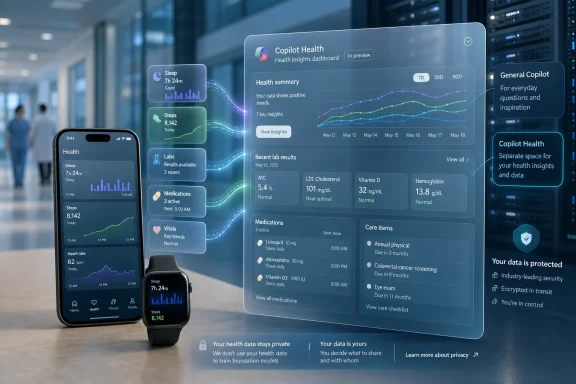
Digital health dashboard overlay shows Copilot Health analytics beside a phone and smartwatch in a modern office.Microsoft Moves Copilot From Productivity Assistant to Health Intermediary​

Copilot Health arrives as a dedicated experience inside Microsoft’s consumer Copilot world, not as a Windows feature, not as an enterprise Microsoft 365 Copilot add-on, and not as a clinical product sold to hospitals. That distinction matters. Microsoft is aiming at the ordinary person who already has a pile of disconnected health information: lab results in one portal, sleep data in another, medication lists in a doctor’s system, and a smartwatch dashboard that turns physiology into a streak.
The promise is familiar but powerful. Copilot Health can connect to wearable services including Apple Health, Fitbit, and Oura, pull in records through HealthEx from tens of thousands of U.S. provider organizations, and incorporate lab results from Function. In Microsoft’s telling, the product’s value is not that it knows medicine in the abstract; it is that it can interpret your own scattered data in one place.
That is a sharper pitch than the usual “ask an AI anything” approach. General chatbots already get millions of health questions because symptoms, lab values, and clinical jargon are confusing. Copilot Health tries to convert that existing behavior into a more structured experience, where answers are grounded in connected data and framed with material from recognized health publishers and organizations.
The risk is that the interface can feel more authoritative than it actually is. Microsoft says Copilot Health is not intended to diagnose, treat, or prevent disease and is not a substitute for professional medical advice. But the more personal the input becomes, the more users may treat the output as something heavier than information.

The Waitlist Was the Safety Valve, Not the Product Strategy​

When Microsoft announced Copilot Health in March, the waitlist performed two jobs at once. It gave the company a controlled rollout for a sensitive product, and it gave the public a signal that this was not just another Copilot tab being switched on globally overnight. Health AI needs that choreography because mistakes here are not embarrassing; they can be consequential.
The May 29 preview changes the posture. Access is still limited to the United States, English, adults, and qualifying consumer Microsoft 365 subscribers, but the waitlist era has effectively given way to a broader consumer test. Microsoft can now observe how paying subscribers use the product at larger scale, which questions they ask, which integrations they connect, and where the experience breaks down.
That preview label is doing a lot of legal and product work. It gives Microsoft room to change features, adjust limits, and refine the experience as it learns from usage. It also reminds users that this is not a finished medical appliance with the predictability people expect from regulated clinical systems.
For WindowsForum readers, the lesson is familiar from years of Windows and Microsoft 365 rollouts: “preview” does not mean unimportant. It often means Microsoft is ready to put real users into the loop before the boundaries are fully settled.

Personalization Is the Feature, and Also the Problem​

Copilot Health’s strongest argument is that health information is useless when it is trapped in silos. A lab result without context can be alarming, a wearable trend can be misleading, and a portal message from a provider can be difficult to translate into practical next steps. A system that can synthesize those inputs could help users prepare better questions for doctors and spot patterns they might otherwise miss.
That is the humane version of the product. A person managing a chronic condition, caring for a family member, or trying to understand a new diagnosis could benefit from an assistant that organizes records and turns medical language into plain English. Even something as basic as helping a user prepare for an appointment can improve the quality of the ten rushed minutes they may get with a clinician.
But personalization also changes the trust equation. A generic chatbot answer about cholesterol is one thing; an answer based on your labs, your sleep history, your medications, and your provider records is another. The more useful Copilot Health becomes, the more sensitive the data flow becomes.
That is why Microsoft’s privacy commitments are central to the launch, not a footnote. The company says Copilot Health data and conversations are separated from general Copilot chats, are not used for advertising, and are not used to train AI models. Those promises will be tested not only by policy language but by user confidence, interface clarity, and Microsoft’s history of changing Copilot packaging and defaults across products.

Microsoft Wants Credibility Without Becoming Your Doctor​

Microsoft is trying to solve the “AI said so” problem by grounding Copilot Health responses in credible health organizations and expert-written material, including answer cards from Harvard Health. That is a necessary move. Health answers generated from raw model probability are not good enough when users are interpreting test results or deciding whether a symptom is urgent.
Grounding, however, is not the same as clinical judgment. Medical advice depends on context that may not be present in the data Copilot can access: physical examination, family history, changing symptoms, comorbidities, local practice standards, and the messy reality of what a patient does or does not report. Even a well-grounded answer can be incomplete if the input is incomplete.
Microsoft’s “find a doctor” functionality also shows where the product is likely headed. Copilot Health is not just an explainer; it is a navigation layer. It can help users search for providers by specialty, location, language, and insurance coverage, which puts it closer to the front door of the healthcare system.
That may be genuinely useful in the United States, where finding an in-network specialist can feel like debugging a failed driver install with worse stakes. But it also turns Microsoft into a broker of patient intent. The company will need to make clear when it is informing, when it is recommending, and when it is merely filtering a directory.

The Subscription Gate Says Plenty About Microsoft’s AI Economics​

Copilot Health is not launching as a free public health resource. It is available to Microsoft 365 Personal, Family, and Premium subscribers, with work accounts excluded. That makes the product part of Microsoft’s broader consumer subscription strategy, even if the subject matter is far more intimate than Word templates or OneDrive storage.
The move fits Microsoft’s recent pattern. Copilot is increasingly not a single product but a family of gated experiences attached to accounts, subscriptions, and contexts. Some Copilot features live in Windows, some in Microsoft 365 apps, some in Edge, some in business tenants, and now one in a health-focused consumer space.
For users, this fragmentation can be confusing. A Microsoft 365 subscription may unlock Copilot Health, while a work account does not. Enterprise data protections may apply in one Copilot context, while consumer privacy controls and product-specific promises govern another. The branding says “Copilot,” but the boundaries are different depending on where you enter.
That is not just a communications problem. In health, account context is a safety issue. Users need to know which identity they are using, where their data is stored, how it can be deleted, what integrations remain connected, and whether a workplace administrator has any role at all. Microsoft says work accounts are not eligible, which is the right separation; now the product has to make that separation obvious.

For IT Pros, This Is a Consumer Launch With Enterprise Echoes​

Copilot Health is not something most admins will deploy next week through Intune. It is a consumer preview, limited to personal Microsoft 365 subscriptions in the United States. Still, IT teams should pay attention because consumer AI behaviors have a way of bleeding into workplace expectations.
Employees who become comfortable asking Copilot Health to summarize labs or prepare doctor questions may expect similar fluency from workplace AI systems handling benefits, leave policies, wellness programs, or occupational health data. That creates pressure on enterprises to clarify which Copilot experiences are approved and which categories of data are off-limits.
There is also a shadow-IT angle. Workers already paste sensitive information into general-purpose tools when sanctioned workflows are inconvenient. A health-branded Copilot experience may reduce some risk for personal data by creating a dedicated space, but it could also normalize the idea that highly sensitive records belong in AI systems by default.
Organizations in regulated industries should treat this as part of a broader education problem. The question is not whether Copilot Health itself is enterprise software. The question is whether users understand that “Copilot” is not a universal privacy guarantee across every Microsoft surface.

The Competitive Race Is Really About Becoming the Default Interpreter​

Microsoft is not alone in seeing health as a defining AI use case. The broader industry has been moving quickly toward assistants that answer health questions, summarize records, and guide patients through next steps. The prize is not simply chatbot traffic; it is becoming the layer people consult before and after interacting with the healthcare system.
That layer could be enormously valuable. Whoever owns it may influence which providers users find, how they understand diagnoses, what questions they ask, and how often they seek care. Even without making diagnoses, an assistant that shapes interpretation can become part of the medical decision chain.
Microsoft has advantages here. It has a large consumer subscription base, a long history in enterprise healthcare technology, and the infrastructure credibility to argue that it can handle sensitive information. It also has Copilot distribution across Windows, the web, mobile apps, and Microsoft 365.
But the company also carries baggage. Users have watched Copilot branding shift, features appear and disappear, and AI settings become another layer of Microsoft account complexity. In health, the margin for ambiguity is smaller. Trust is not built by market share; it is built by predictable behavior over time.

The Best Version of Copilot Health Is Boringly Careful​

The most successful version of Copilot Health will not be the one that sounds the most like a doctor. It will be the one that is disciplined about uncertainty, explicit about limitations, and useful in the tedious parts of healthcare where patients are routinely left alone. Explaining lab ranges, organizing visit notes, drafting questions, and spotting trends are less glamorous than “AI doctor” rhetoric, but they are also more defensible.
Microsoft should resist the temptation to overstate the product as medical intelligence. The phrase may excite investors, but users need something less grandiose: a reliable assistant that helps them understand information without pretending to replace clinical care. The difference is not semantic. It is the line between empowerment and automation theater.
The product’s future will depend on how well it handles edge cases. Does it urge urgent care when symptoms sound dangerous? Does it avoid false reassurance? Does it explain when data is missing? Does it distinguish between a normal lab result and a normal result for this user’s situation? These are the areas where health AI earns or loses legitimacy.
The preview phase should be judged against those mundane standards. Not whether Copilot Health can produce polished paragraphs, but whether it helps users ask better questions, make fewer avoidable mistakes, and keep physicians in the loop.

The Real Copilot Health Test Starts After the First Connected Record​

The launch gives users a few concrete facts to act on, and it gives Microsoft a much larger responsibility than another productivity demo. Copilot Health’s value depends on connected data, but its legitimacy depends on restraint.
  • Copilot Health is now in preview for U.S. adults using English with eligible Microsoft 365 Personal, Family, or Premium subscriptions.
  • Work accounts are not eligible, which keeps the preview positioned as a consumer health experience rather than an enterprise deployment.
  • The product can combine wearable data, provider records, and supported lab results to help users interpret trends and prepare for medical appointments.
  • Microsoft says Copilot Health data and conversations are separated from general Copilot chats and are not used for advertising or AI model training.
  • The service is not meant to diagnose, treat, or prevent disease, and its usefulness will depend on how clearly it keeps clinicians in the decision loop.
  • The preview’s biggest unresolved question is whether users will trust Microsoft enough to connect the records that make the experience valuable.
Microsoft’s Copilot Health launch is both cautious and consequential: cautious because it is still a U.S.-only preview behind a subscription gate, consequential because it moves consumer AI into the space where personal convenience, medical uncertainty, and data sensitivity collide. If Microsoft can keep the product humble, transparent, and genuinely helpful, Copilot Health could become one of the more practical uses of AI in everyday life. If it drifts toward overconfident medical theater or murky data boundaries, it will remind users why healthcare remains the hardest place for Big Tech to earn trust.

References​

  1. Primary source: Neowin
    Published: Fri, 29 May 2026 16:12:00 GMT
  2. Official source: microsoft.com
  3. Related coverage: gadgets360.com
  4. Related coverage: agent-wars.com
  5. Related coverage: windowscentral.com
  6. Related coverage: techradar.com
 

Microsoft opened Copilot Health in preview on May 29, 2026, for U.S. adults with Microsoft 365 Personal, Family, or Premium subscriptions, giving them a dedicated Copilot space to connect health records, Apple Health data, medical questions, and care-navigation searches online. The move is not just another chatbot feature bolted onto Microsoft’s AI brand. It is Microsoft’s latest attempt to turn Copilot from a general-purpose assistant into a trusted broker for the most sensitive data most people own. That ambition is enormous, useful, and unsettling in almost equal measure.

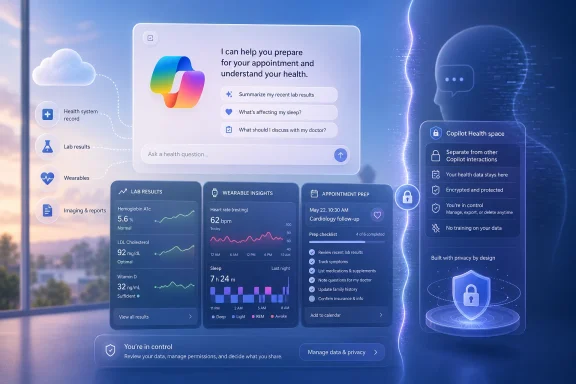
Digital health dashboard shows lab results, sleep insights, and appointment prep beside a privacy-protected Copilot.Microsoft Is Reopening a Door It Once Closed​

Copilot Health lands with a strange sense of déjà vu. Microsoft has been here before: consumer health records, personal data vaults, partnerships with care providers, and the promise that software can make the medical system less opaque. HealthVault, Microsoft’s earlier personal health record platform, was discontinued years ago after never becoming the consumer default its backers imagined.
The difference in 2026 is not that people suddenly enjoy managing medical data. The difference is that generative AI gives Microsoft a reason to ask for that data again. HealthVault was mostly a cabinet; Copilot Health wants to be an interpreter, organizer, coach, appointment prep tool, and health-search front end.
That distinction matters. A folder full of lab PDFs is boring until a model can summarize trends, compare numbers over time, and tell a user what to ask a physician. Microsoft is betting that the missing piece in consumer health records was never storage. It was comprehension.
The company’s timing is also telling. AI assistants are moving from novelty into infrastructure, and health is one of the few domains where a truly useful assistant could feel indispensable. If Copilot can help users understand blood work, wearable sleep data, and fragmented hospital records before a doctor visit, Microsoft earns a place in a daily routine that is far stickier than drafting emails.

The Pitch Is Clarity, Not Diagnosis​

Microsoft is careful to say Copilot Health is not a doctor. That caveat is legally necessary, ethically important, and commercially convenient. The product is positioned as guidance, not diagnosis; context, not treatment; navigation, not medical authority.
But the boundary will be blurry in practice. A user who uploads records, links wearable data, and asks why a number is rising is not looking for a Wikipedia-style overview. They are looking for a meaningful answer about themselves.
That is the product’s real appeal. Microsoft says Copilot Health can build a health profile, connect wearable and health-record sources, provide personalized insights, surface information from trusted health organizations, and help users find local providers by specialty, language, gender, insurance, and location. The preview starts with Apple Health support and records from more than 50,000 U.S. provider organizations, with Microsoft promising more sources over time.
This is not merely “answer all your health questions,” as the consumer-tech headline version has it. It is an attempt to combine three previously separate behaviors: searching symptoms, collecting records, and preparing for care. That combination is why the product deserves attention from Windows users and IT pros, even if it arrives through the consumer Copilot web experience rather than Windows Update.

The Records Are the Product​

The most important part of Copilot Health is not the chat window. It is the ingestion layer.
Medical data is famously scattered. One provider has blood work, another has imaging, a pharmacy has medication history, a wearable has heart-rate and sleep patterns, and the patient has a half-remembered timeline of symptoms. In theory, modern health data standards and patient portals were supposed to make this manageable. In practice, many people still arrive at appointments with screenshots, printouts, and guesses.
Microsoft’s value proposition is that Copilot Health can sit above those silos. The company wants users to connect records and wellness data so the assistant can reason across them. That is the difference between asking “what does high LDL mean?” and asking “what should I understand about my cholesterol trend given my recent labs, age, and health goals?”
For consumers, that could be genuinely helpful. For Microsoft, it creates a new class of personal context that is more intimate than email, more persistent than search history, and more valuable than a fitness dashboard. The assistant that understands your health history may become the assistant you hesitate to leave.
That is the strategic heart of the announcement. Copilot Health is not just a health feature; it is a trust feature. Microsoft is asking users to believe that Copilot can be a safe custodian for data that could affect employment, insurance, relationships, finances, and personal dignity if mishandled.

Security Promises Meet the Reality of Consumer Trust​

Microsoft says Copilot Health conversations are separate from general Copilot chats, encrypted at rest and in transit, and not used to train AI. Users can manage, delete, or disconnect health data sources. The company also says the service was developed with internal clinical teams, informed by an external panel of more than 250 physicians across more than 24 countries, and governed under its responsible AI principles.
Those are not trivial claims. They show Microsoft understands that “trust us” is not enough in health AI. The company also points to ISO/IEC 42001 certification for AI management, which is exactly the kind of governance language enterprise readers expect to see around high-risk AI systems.
Still, consumer trust is not earned through certification alone. Microsoft has spent the past few years pushing Copilot into Windows, Edge, Office, search, and the taskbar, sometimes faster than users wanted. That history cuts both ways: it gives Microsoft massive distribution, but it also makes some users suspicious that every new Copilot feature is another data gravity well.
Health data raises the stakes. A bad restaurant recommendation is annoying. A misleading interpretation of symptoms is dangerous. A vague privacy policy around cholesterol results or mental-health conversations would be unacceptable.
The preview’s separation from work accounts is a smart line. Copilot Health is for eligible personal Microsoft 365 subscribers, not Microsoft 365 business tenants. That avoids an immediate collision with employer-managed identity, workplace compliance, and corporate data-retention policies. It also makes clear that this is a consumer health product riding on Microsoft’s subscription base, not an enterprise clinical workflow tool.

The Windows Angle Is Bigger Than an App Icon​

Copilot Health is launching on the web, but Windows users should still see the broader platform story. Microsoft has been steadily turning Copilot into the connective tissue across its consumer software stack. Health is one of the few domains where that connective tissue could become personal enough to change how users think about the Microsoft account itself.
Today, the preview is a web destination. Tomorrow, it is not hard to imagine health context appearing in Copilot mobile experiences, appointment preparation workflows, Edge searches, calendar prompts, or Windows notification surfaces. Microsoft may not announce those integrations now, but the direction of Copilot as a platform makes them plausible.
That is where enthusiasts and administrators should pay attention. Microsoft’s consumer AI strategy increasingly depends on context: what you are doing, what you have stored, what you have asked before, and what services you have connected. Copilot Health adds a new category of context that should remain walled off with unusual rigor.
For WindowsForum readers, the issue is not whether Copilot Health will appear as a Start menu tile next week. It is whether Microsoft can build high-trust AI experiences without repeating the pattern of broad rollout first and nuanced controls later. Health is the wrong place to discover that defaults were too generous.

Microsoft Is Chasing the Midnight Search​

One of the more revealing claims around Microsoft’s health push is that people are already asking Copilot huge numbers of health-related questions. That should surprise no one. The internet has been the first stop for symptom anxiety for decades, from WebMD spirals to Reddit threads to late-night search queries typed in panic.
The problem is that traditional health search often makes users more anxious. Search engines return pages, not judgment. Forums return anecdotes, not triage. Medical sites return accurate general information that may or may not apply to the person reading it.
AI promises to make that experience conversational. It can ask follow-up questions, explain jargon, and help a user distinguish between “monitor this” and “seek care.” In the best case, Copilot Health could turn a frightened midnight search into a better prepared morning appointment.
But that same conversational confidence is risky. Large language models can sound calm while being wrong. They can overfit to user-provided details, understate uncertainty, or fail to appreciate rare but serious edge cases. Health AI must be designed to escalate, defer, and admit ambiguity more often than ordinary productivity AI.
Microsoft’s messaging acknowledges this with guardrails and professional-advice disclaimers. The real test will be behavioral: whether Copilot Health consistently pushes users toward appropriate care when symptoms warrant it, and whether it avoids turning every benign data fluctuation into an emergency.

The Doctor Is Still in the Loop, Whether the Product Likes It or Not​

Copilot Health could change the clinical encounter before it changes medicine. Patients may arrive with AI-generated summaries, lists of questions, interpretations of labs, and suggested specialists. Some clinicians will welcome that. Others will see another source of misinformation to unwind in a 15-minute visit.
The best version of this product helps users become better historians of their own health. A patient who can clearly explain when symptoms began, what changed, what medications they take, and what the trend lines show is easier to help. A patient who arrives convinced that an AI has already solved the case is harder.
Microsoft appears to understand that the product must support navigation rather than replace clinicians. Care navigation is part of the preview, and the company’s language repeatedly frames Copilot Health as guidance. Still, consumer AI products tend to be judged by how useful they feel, not by how carefully their disclaimers are written.
That puts Microsoft in a difficult position. If Copilot Health is too timid, users will ignore it. If it is too assertive, physicians and regulators will scrutinize it. The product has to be useful enough to matter and cautious enough not to become a shadow medical authority.

The Business Model Hides in the Subscription Gate​

The preview is limited to U.S. users aged 18 and over with Microsoft 365 Personal, Family, or Premium subscriptions. That is a practical rollout constraint, but it is also a signal about Microsoft’s consumer AI economics.
Copilot Health is not being presented as a free public-health utility. It is a subscription-enhancing feature for Microsoft’s paying consumer base. In that sense, it resembles Microsoft’s broader strategy: make Microsoft 365 feel less like Office licensing and more like a bundle of personal productivity, storage, security, and AI services.
That could work. Health assistance has obvious perceived value, especially for families managing chronic conditions, caregivers juggling appointments, or users trying to make sense of lab results. If Copilot Health becomes genuinely helpful, it may reduce churn more effectively than another template pack or cloud-storage perk.
But subscription gating also complicates Microsoft’s equity narrative. The company says people lack access to trusted health guidance when it matters most. Yet the preview starts with paying Microsoft 365 subscribers in the United States. That is understandable for testing, but it underscores a familiar pattern in consumer AI: the users most able to pay get early access to tools that may eventually be framed as democratizing access.

Health AI Is Becoming the New Platform War​

Microsoft is not moving in a vacuum. OpenAI, Amazon, Google, Apple, and a long list of health-tech startups all see the same opening. The next major consumer platform may not be a device or operating system; it may be the trusted assistant that understands a person’s life well enough to mediate services around it.
Health is one of the richest battlegrounds because it combines high user need, fragmented data, expensive professional systems, and enormous regulatory sensitivity. The winner is not simply the company with the smartest model. It is the company that can combine data access, clinical credibility, privacy controls, distribution, and user trust.
Microsoft has assets here. It has Azure, Microsoft Cloud for Healthcare, Nuance, Dragon Copilot for clinicians, Microsoft 365 distribution, identity infrastructure, and years of enterprise security positioning. Copilot Health brings the consumer side into that orbit.
The risk is that the brand “Copilot” now stretches across everything from coding to Windows settings to workplace documents to medical guidance. A mistake in one domain can pollute trust in another. If Microsoft wants Copilot Health to be treated as a serious health experience, it may need more separation, not less, from the everyday assistant that helps rewrite emails.

Regulators Will Care About the Gap Between Advice and Action​

Microsoft’s careful language around diagnosis and treatment is not just legal housekeeping. It reflects the unresolved regulatory reality of consumer health AI. Products that provide general wellness guidance occupy a different space from software that diagnoses disease or recommends treatment.
Copilot Health appears designed to stay on the safer side of that line. It explains, summarizes, contextualizes, and navigates. It tells users it is not a substitute for medical advice. It is framed as a preview whose features and usage limits may change.
But as AI systems become more personalized, the old distinction between information and advice becomes harder to maintain. If a tool analyzes your records, considers your wearable data, asks follow-up questions, and recommends what to do next, many users will experience that as medical advice even if the product page says otherwise.
Regulators may eventually focus less on what vendors call these systems and more on what users reasonably believe they do. That is particularly important if AI health assistants begin influencing decisions about whether to seek urgent care, change behavior, request tests, or select providers.
For now, Microsoft’s preview status gives it room to learn. But “preview” is not a shield against harm. If the product is available to real users with real medical concerns, Microsoft has to treat safety as a production requirement from day one.

The Privacy Story Must Survive Contact With Real Users​

Microsoft’s privacy promises are central to Copilot Health’s credibility. The company says health conversations are not shared with the rest of Copilot and are not used for AI training. It says users can delete or disconnect data. It says the experience is built as a dedicated secure space.
Those statements answer the first wave of concerns. They do not answer every practical question users will have.
How easy is it to see exactly what data has been imported? How clear are the deletion controls? What happens when a provider connection is revoked? Are summaries retained separately from source data? How are safety reviews conducted without exposing sensitive content more widely than users expect? What logs exist, and for how long?
These details matter because privacy failures often happen in the seams between policy and interface. A user may technically have control but fail to understand what has been connected. A deletion option may remove source data but leave derived insights. A “separate” experience may still rely on shared account infrastructure that confuses ordinary users.
Microsoft has enough experience with identity, compliance, and security to design this well. The question is whether it will make the controls legible to consumers rather than merely defensible to auditors.

The Most Useful Feature May Be Appointment Preparation​

The least flashy use case may be the most important one. Copilot Health could help users prepare for appointments by summarizing records, identifying trends, and turning vague concerns into clear questions.
That is not science fiction. It is administrative relief. American healthcare often requires patients to act as project managers for their own care, carrying information across portals, specialists, insurers, and pharmacies. A tool that helps organize that mess could improve outcomes without ever pretending to diagnose anything.
This is where Microsoft should lean hardest. A good appointment-prep assistant can be transparent, cautious, and practical. It can say, “Here are the numbers that changed,” “Here are symptoms you mentioned,” and “Here are questions to ask your clinician.” That is valuable and less risky than presenting a confident theory of disease.
It also fits Microsoft’s strengths. The company knows workflows. It knows documents, summaries, calendars, reminders, and identity. Copilot Health’s most credible future may look less like an AI doctor and more like a brutally competent medical admin assistant working for the patient.

Microsoft’s Health Ambition Now Has a Consumer Front Door​

The Copilot Health preview makes one thing clear: Microsoft does not want its healthcare AI strategy confined to hospitals and clinicians. Dragon Copilot and enterprise healthcare tools address the professional side. Copilot Health addresses the patient side.
That creates an interesting symmetry. On one end, Microsoft helps clinicians document encounters and navigate records. On the other, it helps consumers understand their own health data and prepare for care. If those worlds eventually meet, Microsoft could become a major intermediary in how medical information is summarized, exchanged, and acted upon.
That possibility is powerful, but it should make everyone cautious. Intermediaries shape attention. They decide what gets surfaced, what gets summarized, what gets treated as important, and what gets buried. In medicine, those choices are not neutral.
The company’s challenge is to prove that Copilot Health can make users more informed without making them more dependent. The best patient technology increases agency. The worst creates a new gatekeeper between people and their own bodies.

The Preview That Windows Users Should Watch Closely​

Copilot Health is early, limited, and wrapped in the careful language of a preview, but its implications are larger than its launch footprint. It shows where Microsoft thinks consumer AI is headed: toward assistants that know enough personal context to become hard to replace.
  • Copilot Health is available in preview for eligible U.S. adults with Microsoft 365 Personal, Family, or Premium subscriptions.
  • The service can connect health records from many U.S. provider organizations and begins wearable integration with Apple Health.
  • Microsoft says Copilot Health data is kept separate from general Copilot chats, encrypted, and not used to train AI.
  • The product is positioned as guidance and care navigation, not diagnosis, treatment, or a replacement for medical professionals.
  • The most practical near-term value may be helping users understand records, track trends, and prepare better questions for appointments.
  • The biggest long-term concern is whether Microsoft can maintain consumer trust while expanding Copilot into increasingly sensitive parts of personal life.
Microsoft’s bet is that people do not merely want health information; they want their own health information explained in context, securely, at the moment they need it. If Copilot Health delivers that without overreaching, it could become one of the first consumer AI features that feels less like a demo and more like infrastructure. If it stumbles on privacy, safety, or trust, it will remind users why medical data is the hardest possible place to move fast.

References​

  1. Primary source: Let's Data Science
    Published: Fri, 29 May 2026 21:16:59 GMT
  2. Independent coverage: Digital Trends
    Published: Fri, 29 May 2026 21:16:59 GMT
  3. Related coverage: windowscentral.com
  4. Official source: microsoft.com
  5. Related coverage: techtarget.com
  6. Related coverage: agent-wars.com
 

Microsoft opened Copilot Health preview on May 29, 2026, for eligible United States users 18 and older with Microsoft 365 Personal, Family, or Premium subscriptions, offering a consumer health assistant that can connect medical records, Apple Health data, lab results, and appointment-prep workflows. The pitch is not that Copilot can replace a doctor; Microsoft is careful to say it cannot. The pitch is that AI can sit between patients and the messy administrative sprawl of American health care. That makes Copilot Health less a health product than a trust product, and trust is the hardest feature Microsoft has to ship.

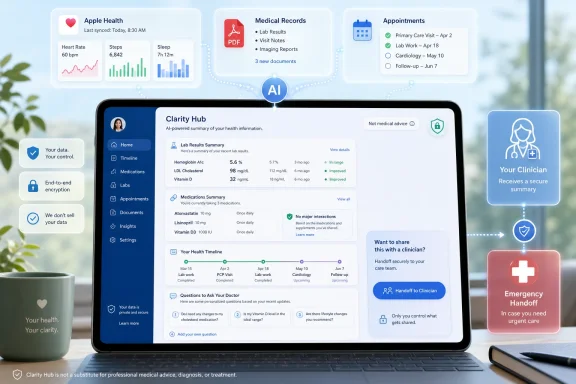
Futuristic AI health dashboard on a laptop showing lab summaries, appointments, and clinician handoff options.Microsoft Is Selling Clarity in a System Built on Friction​

The most persuasive part of Copilot Health is not futuristic at all. It is the very ordinary misery of trying to remember what a doctor said, find the right PDF, compare two lab reports from different portals, and work out whether a number is meaningfully different from the one six months ago. Health care in the United States is full of information, but patients rarely experience it as knowledge.
Microsoft is aiming squarely at that gap. The company says Copilot Health can connect health records from more than 50,000 U.S. provider organizations, pull in Apple Health data, explain lab results, and help users prepare for medical visits. That is a pragmatic bundle, not a moonshot. It recognizes that the patient’s problem is often not the absence of data, but the absence of a coherent view.
That matters because health records are not written for patients. Lab panels are dense, visit summaries are inconsistent, and provider portals often feel like filing cabinets with login screens. Even technically confident users can struggle to translate scattered artifacts into the short, focused story a clinician needs in a 15-minute appointment.
In that sense, Copilot Health is part of a larger Microsoft strategy: move Copilot from a chat box into the middle of real workflows. The assistant becomes useful not because it answers generic health questions, but because it can organize the personal context around those questions. The difference between “What does cholesterol mean?” and “What should I ask my doctor about this cholesterol trend?” is the difference between search and a product.

The Useful Version of This Is Boring, Careful, and Narrow​

The best version of Copilot Health is not the one that sounds like science fiction. It is the one that does mundane things reliably: summarize records, identify dates, extract medication names, explain what a lab marker generally measures, and draft a list of questions for a physician. That may sound unglamorous, but it is exactly where AI assistants can help without pretending to be clinicians.
Appointment preparation may be the killer use case. A patient who can bring a concise timeline, a medication list, recent symptoms, and a few well-phrased questions into the exam room is better equipped than one who arrives with a folder of printouts and a foggy memory. If Copilot Health can reduce that cognitive load, it could genuinely improve the patient experience.
The same is true for caregivers. Many families already run informal health operations for older relatives, children, or partners, juggling portals, prescriptions, discharge notes, and specialist follow-ups. A trustworthy assistant that can turn scattered information into a structured briefing would meet a real need.
But the product becomes dangerous the moment it confuses explanation with direction. Health care is full of edge cases, and the same number can mean different things depending on age, history, symptoms, medication, pregnancy status, recent illness, and a dozen other factors. A useful assistant must be willing to say, in effect, “This is what the term usually means, this is why it may matter, and this is what you should ask a professional.”
That kind of restraint is not a footnote. It is the product.

Health Data Is Not Just Another Copilot Connector​

Microsoft has spent the last few years turning Copilot into an interface for documents, email, Teams chats, code, search, and business data. Copilot Health extends that logic into consumer medicine, but the category is different in kind. A bad meeting summary is annoying. A bad health summary can frighten someone, reassure them falsely, or push them toward a decision they do not understand.
That is why the standard enterprise AI playbook does not transfer cleanly. In a workplace setting, organizations can set retention policies, audit logs, admin controls, data boundaries, and acceptable-use rules. Consumer health data is more intimate, more emotionally charged, and often managed by people who do not think like compliance officers.
The preview’s limits reflect that sensitivity. Microsoft is making Copilot Health available to consumer Microsoft 365 subscribers in the United States, not to work accounts and not globally. That is not just cautious rollout theater. Health features depend on provider integrations, regional privacy laws, medical-data norms, and consent flows that vary dramatically across markets.
The Apple Health integration also raises the stakes. Wearables produce streams of sleep, heart rate, activity, cycle, and wellness data that can feel clinically meaningful even when they are not diagnostic. Combining those signals with formal records can be powerful, but it also risks creating a false sense of medical completeness.
A step count, a sleep trend, and a blood test do not automatically add up to a clinical conclusion. They are inputs. Copilot Health has to keep them in their proper lane.

Microsoft’s Disclaimers Are Necessary, but They Are Not Enough​

Microsoft says Copilot Health is not intended to diagnose, treat, cure, or prevent disease, and that it is not a substitute for professional medical advice. Those disclaimers are necessary. They are also the easiest part of the product to get right.
The harder problem is behavioral. Users do not experience AI systems as legal documents; they experience them as conversations. If a chatbot explains a lab result with confidence, offers a next step, and remembers your history, the interaction can feel authoritative even when the footer says otherwise.
This is the central tension of health AI. The more personalized the assistant becomes, the more useful it is. The more useful it feels, the more likely people are to over-trust it. Microsoft must build not only accurate responses, but friction at the right moments.
That means uncertainty has to be visible in the answer, not buried in a disclaimer. Copilot Health should distinguish between general information, interpretation of a user-provided record, and advice that belongs to a clinician. It should refuse to flatten ambiguity into a neat answer simply because the user asked for one.
This is where Microsoft’s history cuts both ways. The company has deep experience with enterprise security, compliance, identity, and governed data systems. It also has a consumer AI brand that has sometimes been marketed with the usual industry exuberance. Copilot Health cannot afford exuberance. Its credibility will come from restraint.

The Privacy Test Is About More Than Encryption​

Microsoft says Copilot Health conversations are separated from the rest of Copilot, are not used to train AI, and that data is encrypted at rest and in transit. Those are important promises. But for health data, the trust question is not simply “Is it encrypted?” It is “Who can infer what from this, when, and under what business incentives?”
Consumers have learned the hard way that health-adjacent data can leak through unexpected channels. The Federal Trade Commission’s actions against digital health companies over alleged sharing of sensitive user data for advertising created a lasting backdrop for any company entering this space. Even when a service is not a traditional hospital or insurer, users bring hospital-grade expectations to health information.
That gap between expectation and legal architecture is dangerous. Many consumers assume anything involving health data is automatically protected like a medical chart under HIPAA. In reality, consumer health apps, wellness services, advertising identifiers, analytics tools, and data brokers have long occupied murkier territory. A major platform entering that space needs to explain its boundaries in ordinary language.
Microsoft’s privacy promises therefore need to be legible, durable, and easy to act on. Users should be able to see what is connected, what has been imported, what can be deleted, what persists in backups or logs, and what happens when access is revoked. Consent should not be a one-time gate at onboarding; it should be a living control surface.
The company also needs to resist the temptation to treat “not used for training” as the end of the conversation. Training is only one possible use of data. Product improvement, safety evaluation, abuse monitoring, debugging, support, personalization, and compliance can all involve data handling. The distinction may be obvious inside Microsoft. It is not obvious to a user deciding whether to connect years of medical history.

Apple Health Makes the Product More Useful and More Complicated​

The Apple Health connection is strategically important because it gives Copilot Health a bridge into the daily telemetry many users already collect. Medical records show episodes of care. Wearables show patterns of living. Put together carefully, they can make a person’s health story less episodic and more continuous.
But wearable data is a strange category. It is personal enough to feel medical, yet often imprecise enough to require caution. Sleep scores, resting heart rate trends, workouts, oxygen readings, and cycle tracking can be valuable context, but they are not interchangeable with clinician-ordered tests.
An assistant that sees both medical and wearable data must avoid turning correlation into narrative. If a user slept poorly before an abnormal lab result, the assistant should not imply causation. If a wearable shows elevated heart rate, it should not generate panic without context. If a trend looks notable, the responsible move is to frame a question for a clinician, not to provide a diagnosis-shaped answer.
That is especially important because consumer devices are persuasive. Charts feel objective. Scores feel official. People often treat quantified-self metrics as more precise than they are, and AI can amplify that instinct by wrapping them in fluent prose.
Copilot Health’s job should be to make wearable data conversational without making it overconfident. That is a narrow design target, and it is one Microsoft will be judged on in practice, not in launch copy.

The Real Competition Is the Provider Portal, Not WebMD​

It is tempting to describe Copilot Health as a new front in symptom search. That misses the more interesting competitive target. Microsoft is not merely trying to answer “Why does my knee hurt?” It is trying to become the interface layer over fragmented health information.
That puts Copilot Health in tension with provider portals, insurers, electronic health record vendors, pharmacy apps, wearable platforms, and search engines. Each already owns a slice of the patient experience. None owns the whole thing.
Provider portals are particularly vulnerable because they are necessary but unloved. They often expose records without making them understandable. They let patients download information without helping them reason across it. If Copilot Health can sit above those portals and turn their outputs into a useful narrative, Microsoft becomes the layer patients actually interact with.
That would be a powerful position. The company would not need to own the hospital record system to influence how patients understand the record. It would not need to replace clinicians to shape the questions patients bring into appointments. It would not need to be a medical provider to become part of the medical workflow.
This is why the trust issue is also a platform issue. The more useful Copilot Health becomes, the more central it becomes. And the more central it becomes, the more users need confidence that Microsoft’s incentives align with their welfare.

For Windows Users, This Is Another Sign That Copilot Is Escaping the Sidebar​

WindowsForum readers have watched Copilot arrive in the taskbar, in Microsoft 365, in Edge, in search experiences, and across the company’s subscription stack. Copilot Health is not a Windows feature in the narrow sense, but it is part of the same strategic migration. Microsoft is trying to make Copilot the front door to tasks that used to live in separate applications.
That matters for users who think of Copilot as a desktop assistant. The real direction is broader: Copilot as a personal operating layer, available across web, apps, documents, and now potentially health records. The interface may be a chat window, but the ambition is account-level context.
For Microsoft 365 subscribers, Copilot Health also reframes the value of a consumer subscription. Personal and Family plans have historically been about Office apps, OneDrive storage, and household productivity. Adding health features pushes Microsoft 365 toward a personal data hub, where the subscription is not just for creating documents but for managing life admin.
That is a much more intimate role. Users may tolerate aggressive nudges in productivity software and still draw the line at medical information. Microsoft cannot assume that trust earned in Word, Excel, or OneDrive automatically transfers to health records.
It also cannot assume that Copilot brand recognition solves the onboarding problem. Some users love AI assistants. Others see them as surveillance-shaped autocomplete. In health, that skepticism is not irrational; it is prudent.

Administrators Should Watch the Boundary Around Work Accounts​

The preview is not for work accounts, and that detail deserves attention. Microsoft is keeping Copilot Health in the consumer lane for now, which helps avoid an immediate collision with employer-managed identities, enterprise retention policies, workplace compliance, and medical privacy expectations.
That boundary is important. Employers should not be anywhere near employee health records unless a very specific legal and benefits context applies. Even accidental commingling of personal medical data with a work identity would be a nightmare for users, administrators, and legal teams.
For sysadmins, the lesson is not that Copilot Health needs to be deployed. It is that Microsoft’s consumer and enterprise AI surfaces are becoming more numerous and more personal. Identity boundaries, account switching, browser profiles, Edge sign-in behavior, and personal Microsoft accounts on managed devices all become more consequential when the data involved is medical.
Organizations that allow personal Microsoft accounts on work machines should think carefully about user education. The issue is not that Copilot Health is inherently unsafe on a work device. The issue is that users often blur personal and professional contexts, and AI products can make that blur feel seamless.
Microsoft’s decision to exclude work accounts is the right one. It should stay rigid until the company can prove that consumer health workflows cannot leak into enterprise contexts by convenience, confusion, or account sprawl.

AI Safety in Health Is a Product Experience, Not a Certification Badge​

Microsoft says Copilot Health has undergone safety testing, uses guardrails, draws on clinical expertise, and has achieved ISO/IEC 42001 certification for AI management. Those are meaningful signals. They are not a substitute for lived reliability.
Users will judge Copilot Health by the answers it gives at vulnerable moments. A person reading an abnormal result at midnight is not thinking about AI governance frameworks. They are thinking about fear, uncertainty, and whether the next sentence will make things clearer or worse.
The product therefore needs to behave differently from a general-purpose chatbot. It should slow down when stakes rise. It should ask clarifying questions when a user’s prompt omits essential context. It should encourage urgent care when symptoms suggest immediate risk. It should avoid presenting “normal ranges” as universal truths when labs, age, sex, pregnancy, medication, and history may matter.
It should also be humble about records. Medical data is often incomplete, duplicated, delayed, or wrong. If Copilot Health imports a medication list, it should not assume the list is current. If it summarizes a diagnosis, it should identify where that diagnosis came from and when. If records conflict, it should surface the conflict rather than silently harmonizing it.
That may make the assistant feel less magical. Good. In health, magic is not the goal. Accountability is.

The Business Model Has to Stay Boring​

Health AI is attractive because the need is enormous and the data is rich. That is precisely why users should be wary of business models that turn attention, prediction, or targeting into revenue. Microsoft’s subscription framing is helpful here because paying customers are easier to trust than monetized audiences, at least in theory.
But subscription status alone does not settle the matter. Microsoft has advertising businesses, consumer data practices, analytics systems, app ecosystems, and cross-product ambitions. The company needs to be explicit that health data will not become a lever for ads, profiling, or unrelated personalization.
The line should be brighter than legally required. Health data should not influence shopping suggestions, insurance-related offers, fitness marketing, food advertising, productivity nudges, or any other adjacent surface. Even if such uses could be consented to, they would corrode trust.
The same is true for partner ecosystems. If Microsoft eventually expands beyond Apple Health to more wearables, pharmacies, insurers, telehealth providers, or scheduling services, every connector becomes a trust decision. Users need to know whether they are sharing data with Microsoft, retrieving data through Microsoft, or authorizing third parties to receive new information.
A health assistant can quickly become a marketplace. If Microsoft wants Copilot Health to be trusted, it should resist that gravitational pull for as long as possible.

The Preview Is a Test of Governance as Much as Technology​

Preview labels are common in tech, but they are awkward in health. On one hand, Microsoft is right to roll out carefully, gather feedback, and limit availability. On the other, users do not experience a health preview as a toy. If the product can ingest real records and answer real questions, then its mistakes are real too.
That means Microsoft’s feedback loop needs to be more serious than a thumbs-up or thumbs-down button. Users should be able to flag unsafe, confusing, or overconfident answers. Clinicians and patient advocates should have channels to report systemic issues. Microsoft should publish meaningful updates about what it changes during the preview, especially when those changes involve safety behavior.
Transparency will matter because health AI failures may not always be visible as dramatic incidents. A misleading summary might simply cause a patient not to ask a question. An omitted caveat might create unnecessary worry. A plausible but incomplete explanation might crowd out better judgment. These are subtle harms, which makes governance harder.
The company’s advantage is that it can afford to move slowly. Microsoft does not need Copilot Health to become a viral app overnight. It needs the service to become credible enough that users are willing to connect sensitive data and return before appointments.
That is a higher bar than engagement. It is also a healthier one.

Patients Need an Assistant That Knows When to Stop​

The most important design feature in Copilot Health may be the handoff. At some point, the assistant must stop summarizing and start directing the user back to a clinician, emergency services, pharmacist, or qualified care provider. That handoff cannot feel like boilerplate; it has to be specific enough to be useful.
For low-stakes record organization, Copilot can be expansive. It can summarize, compare, define, and prepare. For symptoms, medication changes, abnormal results, mental health concerns, pregnancy, pediatrics, chronic disease management, and urgent warning signs, it needs a stricter posture.
This will frustrate some users. People often turn to AI because they want immediate answers without appointments, hold times, co-pays, or portal messages. The temptation for any assistant is to meet that demand with confidence. A health assistant must instead preserve the difference between being helpful and being authoritative.
That is especially true for people with limited access to care. Copilot Health may be most appealing to users who feel underserved by the medical system. Microsoft should not let convenience become a substitute for care that users cannot obtain.
The humane version of the product helps people navigate the system better. The risky version becomes a pressure valve for a system that is already too hard to use.

The Copilot Health Promise Lives or Dies in These Details​

Copilot Health deserves attention because it aims at a real frustration, not because AI in health is automatically progress. The preview’s narrow scope, subscription requirement, U.S.-only availability, and exclusion of work accounts all suggest Microsoft understands that this category needs a slower rollout. The question is whether the product experience will be as cautious as the launch posture.
  • Copilot Health is currently a U.S. preview for eligible adults with Microsoft 365 Personal, Family, or Premium subscriptions, not a general global rollout.
  • The strongest near-term use case is appointment preparation, where summarizing records and drafting questions can help patients use limited clinician time better.
  • Apple Health integration makes the assistant more useful, but it also requires careful handling so wellness trends are not presented as medical conclusions.
  • Microsoft’s privacy promises must be easy for ordinary users to understand, especially around deletion, disconnection, retention, and non-training uses of data.
  • Work accounts being excluded is a meaningful safeguard, and administrators should still watch personal-account use on managed devices.
  • The product should earn trust through visible uncertainty, conservative handoffs, and clear separation between explanation and medical advice.
Copilot Health could become one of the more genuinely useful consumer AI features Microsoft has shipped, precisely because the underlying problem is so common and so poorly served by today’s portals and apps. But health is the category where convenience cannot be allowed to outrun trust. If Microsoft treats Copilot Health as a careful records-and-prep assistant, it may give patients a better grip on their own information; if it lets the product drift into diagnosis-shaped confidence, the preview will remind everyone why medical data was never just another thing to connect to a chatbot.

References​

  1. Primary source: Tech My Money
    Published: 2026-05-31T13:50:10.707041
  2. Related coverage: ftc.gov
  3. Official source: apple.com
  4. Related coverage: axios.com
  5. Related coverage: dwt.com
  6. Related coverage: epic.org
 

Microsoft has expanded access to the Copilot Health preview in the United States, allowing more eligible Microsoft 365 Personal, Family, and Premium subscribers aged 18 or older to try the English-language health experience inside Copilot as of late May 2026. The move is small in rollout language but large in implication: Microsoft is no longer merely answering health questions with a chatbot. It is asking users to connect wearables, lab results, and medical records to a consumer AI system that sits under the same Copilot brand already spreading through Windows and Microsoft 365. That makes Copilot Health less a side experiment than a test of whether Microsoft can turn trust, subscriptions, and data integration into a new kind of personal health interface.

Microsoft Copilot Health dashboard shown on a laptop with connected secure health data panels.Microsoft Moves Copilot From Search Box to Health File​

The first wave of generative AI health tools mostly behaved like better search engines with bedside manner. Users asked about a rash, a blood test, a medication, or a symptom, and the assistant responded with caveats, confidence, and sometimes too much confidence. Copilot Health is built around a different proposition: the assistant should know enough about you to make the answer more useful.
That is why the expansion matters. Microsoft is not simply widening a preview; it is widening the circle of people who can test a model where consumer AI becomes a broker for personal health context. The company says Copilot Health can bring together wearable data, health records, lab results, and health history, then use that combined picture to explain trends and prepare users for appointments.
For WindowsForum readers, the natural comparison is not WebMD. It is OneDrive, Outlook, and Microsoft Graph. Microsoft’s durable advantage has rarely been that it invents a category first; it is that it turns a category into an account-linked, permissioned, cross-service workflow that becomes hard to ignore once it is everywhere.
Health is a far more sensitive domain than email or files, of course. But the strategic shape is familiar. Copilot Health is Microsoft’s attempt to make the AI assistant more valuable by making it more contextual, and to make it more contextual by asking users to hand it data that is difficult to re-create elsewhere.

The Preview Is Narrow, but the Ambition Is Not​

On paper, the current availability is still constrained. Copilot Health remains a U.S.-only preview, supports English, requires a qualifying Microsoft 365 subscription, and is limited to adults. Microsoft has not announced a timetable for additional countries or languages.
Those limitations matter because healthcare is regulated, localized, and operationally messy. A health assistant that can search for U.S. providers by insurance acceptance, specialty, language, and location is not automatically portable to the United Kingdom, Germany, India, or Brazil. Every market has its own data-sharing rails, provider directories, consent rules, liability expectations, and cultural assumptions about medical advice.
Yet the preview already reveals the shape of Microsoft’s bet. It supports more than 50 wearable devices and health services, including Apple Health, Fitbit, and Oura. It can connect to records from more than 50,000 U.S. hospitals and provider organizations through HealthEx. It can also incorporate lab data from Function.
That combination is the important part. Wearables show what happens between appointments. Medical records show what clinicians documented. Lab results show the measurements that often confuse patients most. Copilot Health is designed to sit between those islands and produce a narrative.
Microsoft’s pitch is that users do not simply need more data. They need help understanding the data they already have. That claim is persuasive because anyone who has downloaded a medical record knows the truth: modern healthcare has produced a mountain of portals, PDFs, lab ranges, acronyms, and after-visit summaries that are technically accessible but practically opaque.

The Real Product Is Translation, Not Diagnosis​

Microsoft is careful to describe Copilot Health as an assistant for insight, preparation, and information, not as a doctor. That distinction is more than legal varnish. The most credible use case for consumer health AI is not replacing clinicians; it is translating the artifacts of healthcare into language a patient can actually use.
A lab result is a perfect example. Many patients see a value marked high or low, a reference range, and a cascade of anxiety. The result may be clinically urgent, entirely benign, or meaningful only in combination with other values and history. A competent AI assistant can help explain what a test commonly measures, what a reference range means, and what questions a patient might bring to a clinician.
Appointment preparation may prove even more useful. Most healthcare visits are short, emotionally loaded, and easy to mismanage. People forget symptoms, omit timelines, fail to mention medications, or leave without asking the question that sent them searching at midnight. An assistant that summarizes concerns and generates a focused list of questions could improve the human appointment rather than compete with it.
That is the strongest version of Copilot Health: not a diagnosis machine, but a patient-side organization layer. If it can help users understand their records, spot patterns worth discussing, and walk into appointments better prepared, it could address a real failure in consumer healthcare technology.
The weaker version is also obvious. A confident assistant can nudge a user toward false reassurance or unnecessary alarm. It can overfit wearable noise, misread context, or explain lab data in a way that sounds definitive even when it is not. In health, the difference between “informational” and “actionable” is not always visible to the user.

Microsoft Wants Trust to Be a Feature​

Microsoft’s privacy claims are central to the product, not a footnote. The company says Copilot Health data is kept separate from regular Copilot conversations, is not used for advertising, and is not used to train AI models. Those assurances are essential because health data changes the emotional contract between user and platform.
Consumer AI already has a trust problem. Users have learned that chatbots can hallucinate, that “private” sometimes means “processed somewhere,” and that AI products evolve faster than their settings pages. Health magnifies all of that. A user may tolerate a mistaken restaurant suggestion; they will not tolerate a mishandled cancer screening result.
The separation from general Copilot conversations is therefore a necessary design claim. It tells users that their cholesterol report, medication list, and wearable trends are not simply another thread in the same assistant they use to draft emails or summarize PDFs. Microsoft wants Copilot Health to feel like a distinct room inside the Copilot house.
Still, privacy promises in previews deserve scrutiny. The practical questions are not limited to whether data trains models or targets ads. Users and administrators will want to know how data is stored, how long it persists, how consent is revoked, what happens when a connected source is disconnected, what logs are retained, and how account compromise is handled.
Microsoft can answer some of those questions with policy language. It will answer the rest only through product behavior over time. In health technology, trust is not won by a launch post; it is accumulated through boring reliability, transparent controls, and the absence of nasty surprises.

HealthEx Gives the Assistant Its Most Important On-Ramp​

The HealthEx integration is one of the most consequential details in the announcement because medical records are the hard part. Wearables are comparatively easy: Apple Health, Fitbit, and Oura already package consumer-facing metrics in relatively coherent forms. Clinical records are fragmented across provider systems, portals, and standards that often work better in theory than in lived experience.
By using HealthEx to connect records from more than 50,000 U.S. hospitals and provider organizations, Microsoft is trying to leap over the cold-start problem that has hampered personal health record products for decades. A health assistant with no records is a chatbot. A health assistant with visit summaries, medications, test results, and wearable context becomes something more durable.
This is also where the product will be judged most harshly. Record aggregation can be incomplete, delayed, duplicated, or full of clinician shorthand. Medication lists are often wrong. Visit notes may contain boilerplate. Test names vary. Patients may have records spread across systems that do not reconcile neatly.
If Copilot Health can make sense of that mess without pretending the mess is cleaner than it is, Microsoft has a serious product. If it presents partial records as a complete picture, the risk rises quickly. The interface must be as good at saying “I do not appear to have that information” as it is at producing polished summaries.
That kind of uncertainty handling is not a secondary feature. It is the difference between an assistant that improves patient agency and one that creates misplaced confidence.

The Microsoft 365 Requirement Turns Health Into a Subscription Perk​

The preview’s Microsoft 365 requirement is easy to overlook, but it says a great deal about Microsoft’s consumer AI strategy. Copilot Health is not being introduced as a free-floating medical chatbot for everyone. It is being tied to the subscription bundle that already includes Office apps, cloud storage, and increasingly AI features.
That is a classic Microsoft move. The company can use Microsoft 365 as a distribution engine, a trust anchor, and a monetization path. If users already pay Microsoft for their family documents, photos, email, and productivity tools, the company can argue that a private health workspace is an extension of the same relationship.
The risk is that health becomes another lever in subscription stratification. Features that help people understand lab results or prepare for medical appointments occupy a different moral category than premium PowerPoint templates. Microsoft will have to tread carefully if Copilot Health becomes more capable and more central to everyday healthcare navigation.
For now, the subscription requirement also limits the preview to a population that is not representative of everyone who might benefit from health literacy tools. Microsoft 365 subscribers may be more digitally fluent, more likely to own wearables, and more likely to have the time and resources to manage health data across services.
That does not make the preview invalid. It does mean Microsoft is starting with the users most likely to connect devices, consent to data sharing, and tolerate preview friction. The harder test comes later, if the company tries to expand from enthusiasts and subscribers to broader populations with more complex healthcare access problems.

Provider Search Pushes Copilot Toward the Front Door of Care​

The “Find a doctor” action is more than a convenience button. It signals that Microsoft wants Copilot Health to participate not just in understanding health information but in navigating the healthcare system itself. That is where the assistant starts to move from explanation to coordination.
Searching for providers by specialty, location, accepted insurance, and spoken languages addresses a real pain point. Finding care in the United States is often a miserable combination of outdated directories, insurance confusion, phone calls, and dead ends. If Copilot Health can reduce that friction, it could become useful even for users who never connect a wearable.
But provider search also raises the stakes. A list of clinicians is not neutral if ranking, availability, network status, or sponsored placement ever enters the picture. Microsoft has emphasized trusted sources and privacy protections, but health navigation products eventually face commercial pressure from insurers, providers, employers, and marketplaces.
The company will need to be clear about how results are generated. Users should know whether Copilot Health is simply querying real-time directories, whether any ranking logic is applied, and whether commercial relationships influence what appears. In healthcare, opacity is not just annoying; it can shape access to care.
That is one reason the preview period matters. Microsoft is testing not only technical integrations but user expectations. A health assistant that feels helpful today can feel invasive tomorrow if the boundaries are not explicit.

Harvard Health Cards Are a Guardrail, Not a Cure​

Microsoft says some Copilot Health responses may include source links and expert-written answer cards from Harvard Health. That is a sensible design choice. In a domain where misinformation can cause harm, grounding AI responses in reputable medical material is essential.
But citations and expert cards do not eliminate the central challenge. The hard part is not producing general health information; it is applying general information appropriately to an individual’s context without overstepping. A Harvard Health explanation of blood pressure is useful, but it cannot know every nuance of a patient’s medication history, kidney function, pregnancy status, or clinician’s intent.
The best AI health products will therefore need to combine grounding with humility. They should explain, contextualize, and encourage appropriate follow-up. They should avoid implying that a normal wearable trend rules out disease or that an abnormal lab marker automatically indicates catastrophe.
This is where Microsoft’s product design will matter as much as its model quality. The interface should slow users down when stakes are high. It should distinguish between educational content, record summaries, trend observations, and prompts to seek medical care. It should make uncertainty legible.
The challenge is that consumer AI interfaces are optimized for fluent answers. Healthcare often requires the opposite: conditional language, missing-context warnings, and clear escalation paths. Making that feel helpful rather than evasive is a design problem Microsoft has not yet fully had to solve in mainstream Copilot.

The AI Health Race Is Really a Data Context Race​

Microsoft is not entering a quiet field. OpenAI, Amazon, Google, Apple, and a constellation of health startups are all circling the same idea: AI becomes more useful when it understands the user’s body, habits, records, and goals. The competitive frontier is no longer just model intelligence; it is permissioned context.
Microsoft’s advantage is breadth. It has consumer subscriptions, enterprise identity, cloud infrastructure, healthcare partnerships, and a Copilot brand that is being pushed across Windows, Office, Edge, and mobile. It can place a health assistant in front of users who already live inside Microsoft accounts.
Apple has the wearable and phone-level health data advantage. Google has search behavior, Android reach, Fitbit, and deep AI research. Amazon has pharmacy, care delivery experiments, and consumer logistics. Microsoft’s path is to become the neutral-ish integration layer for records, wearables, lab data, and health conversations.
That “neutral-ish” qualifier is important. Microsoft is a platform vendor with commercial incentives, not a public utility. Its claim to trust rests on whether users believe the company can separate health data from advertising, model training, and cross-product monetization pressure.
The company’s enterprise reputation may help. Microsoft has spent decades convincing regulated industries that it can manage sensitive data. But consumer health is not enterprise compliance with a friendlier icon. It is personal, emotional, and politically charged in ways that productivity software is not.

Windows Users Should Watch the Account Boundary​

For Windows and Microsoft 365 users, the practical question is where Copilot Health’s boundary will sit. Today it is a separate experience inside Copilot. Tomorrow, users will want to know whether health context can appear in other Copilot surfaces, whether it can be invoked from Windows, and how strictly Microsoft will wall it off from general productivity features.
The company says health data remains separate from regular Copilot conversations. That is the right starting point. But the Copilot ecosystem is rapidly becoming a mesh of assistants, agents, plugins, and app-specific experiences. Boundaries that are clear in a preview can become confusing as features converge.
Consider a simple future scenario. A user asks Copilot to help prepare for a doctor appointment, create a calendar event, draft a note for a spouse, and summarize relevant lab trends. That workflow crosses health, Outlook, Word, family sharing, and perhaps mobile notifications. The value comes from integration, but so does the risk.
Microsoft will need controls that ordinary users can understand. “Do not use my health data outside Copilot Health” should not require reading a compliance document. “Delete this connected source and its derived summaries” should mean what a normal person thinks it means. “Export my data” should be practical, not ceremonial.
Administrators may also care, even if Copilot Health is currently a consumer Microsoft 365 feature. Many users mix personal and work devices, accounts, browsers, and identities. Health data appearing in the same general Copilot universe as business data will make security teams nervous unless the separation is technically and visibly robust.

The Preview’s Biggest Test Is Not Whether It Can Answer​

The obvious benchmark for Copilot Health is answer quality. Can it explain a lab result? Can it summarize a visit note? Can it identify a trend in sleep, resting heart rate, or activity? Those are important questions, but they are not the deepest ones.
The deeper test is whether Copilot Health can handle ambiguity responsibly. Health data is full of conflicting signals. A wearable may show poor sleep after travel. A lab result may be slightly abnormal because of medication. A visit summary may omit what the patient remembers as the most important part of the appointment.
A useful assistant must be comfortable with incompleteness. It should say when data is missing, when a pattern is weak, when a finding is nonspecific, and when a clinician is needed. It should resist the product-manager temptation to turn every data point into an “insight.”
That restraint will be difficult because AI products are sold on usefulness. Users like confident answers. Companies like engagement. But in healthcare, engagement is not automatically a virtue. A product that encourages obsessive checking of noisy metrics may make some users less healthy, not more.
Microsoft’s challenge is to build a health AI that is helpful enough to justify the data connection but cautious enough to deserve it. That balance will define whether Copilot Health becomes a trusted companion or another overreaching assistant with a medical vocabulary.

The Copilot Brand Now Carries a Heavier Burden​

Copilot began as a productivity metaphor: a helper riding alongside the user. In Word, Excel, Teams, and Windows, that metaphor is mostly safe. A bad draft can be edited. A clumsy summary can be ignored. A mistaken formula can be checked.
Health changes the metaphor. A copilot in a cockpit has responsibilities. A copilot in a medical context may influence decisions, emotions, and care-seeking behavior, even if every screen says it is not a doctor. Microsoft cannot rely on disclaimers to carry that burden.
This is why the branding choice matters. Microsoft could have launched a wholly separate health app with a distinct identity. Instead, it is extending Copilot into health while saying the experience is separate and secure. That gives the product instant familiarity but also imports every concern users already have about Copilot’s reach.
The company has spent the past few years putting Copilot into more places than many users expected or wanted. Some of that expansion has been useful; some has felt like branding sprawl. Copilot Health needs to avoid feeling like another surface in the same campaign.
If Microsoft wants users to connect medical records, the product cannot behave like a growth experiment. It has to feel conservative, transparent, and reversible. That may be culturally difficult for an AI organization operating in a market defined by speed.

The Quiet Expansion Says Microsoft Is Measuring Trust in Public​

The most interesting detail in this latest development is how quietly it appears to have happened. A broader set of eligible U.S. Microsoft 365 users can now access the preview directly, without the same waitlist friction that characterized the initial rollout. Microsoft has not framed this as a grand relaunch.
That quietness may be deliberate. Health AI is a category where hype can backfire. A giant announcement invites giant scrutiny, especially around safety, privacy, and medical reliability. A phased expansion lets Microsoft observe behavior, fix onboarding, and measure demand without declaring victory.
It also lets the company test which parts of the product resonate. Users may come for lab explanations but stay for provider search. They may connect wearables but hesitate on medical records. They may trust Harvard Health cards but avoid deeper personalization. Preview telemetry, support requests, and abandonment patterns will tell Microsoft where the trust line actually sits.
The risk is that quiet expansion can feel like stealth deployment in a sensitive domain. Microsoft should be explicit with users about what is new, what is experimental, what data is connected, and what protections apply. In healthcare, a low-drama rollout is good; a low-information rollout is not.
For now, the expansion suggests Microsoft believes Copilot Health is ready for a wider consumer test. That does not mean the product is mature. It means the company wants more real-world evidence before deciding how central health should become to Copilot’s future.

The Lesson for Microsoft 365 Users Is to Treat Health AI Like a New Account Tier​

The practical takeaway is not panic and not blind enthusiasm. Copilot Health may be genuinely useful, especially for people drowning in portals, lab reports, and wearable dashboards. But users should approach it as they would any new sensitive-data service: deliberately, skeptically, and with a clear sense of what they are connecting.
  • Copilot Health is currently a U.S.-only English preview for eligible Microsoft 365 subscribers who are at least 18 years old.
  • The service is designed to combine wearable data, medical records, lab results, and health history rather than merely answer generic health questions.
  • Microsoft says Copilot Health data is separated from regular Copilot chats and is not used for advertising or AI model training.
  • HealthEx record connectivity and Function lab support are the integrations that make the product more than a conventional chatbot.
  • The most useful early scenarios are likely to be lab-result explanations, appointment preparation, trend summaries, and provider search.
  • Users should connect only the data sources they are comfortable sharing and should treat AI-generated health guidance as preparation for clinical conversations, not a substitute for them.
The expansion of Copilot Health is a preview in the software sense, but it is also a preview of a larger platform shift: AI assistants are moving from answering what we ask to interpreting what we are. Microsoft’s opportunity is to make healthcare data less fragmented and less intimidating for ordinary users; its obligation is to prove that personalization does not become overreach. If Copilot Health grows carefully, it could become one of the few AI features that earns its place in a subscription bundle by reducing real-world confusion. If it grows carelessly, health may become the category that teaches users to draw harder boundaries around Copilot than Microsoft ever intended.

References​

  1. Primary source: Windows Report
    Published: 2026-05-31T06:12:11.058195
  2. Official source: microsoft.ai
  3. Official source: microsoft.com
  4. Related coverage: powershealth.org
  5. Related coverage: fortune.com
  6. Related coverage: icthealth.org
  1. Related coverage: techtarget.com
  2. Related coverage: axios.com
  3. Related coverage: drugs.com
  4. Related coverage: gadgets360.com
  5. Related coverage: winbuzzer.com
  6. Related coverage: windowsforum.com
  7. Related coverage: healthcare-brew.com
  8. Related coverage: windowscentral.com
 

Back
Top