Copilot Health: Microsoft's privacy guarded AI for personal health data

  • Thread Author
Microsoft’s Copilot has moved from calendar fixes and document drafting into the most intimate ledger most people own: their medical record, wearable telemetry, and lab results — with the company today previewing Copilot Health, a privacy‑segmented Copilot experience that promises to synthesize electronic health records (EHRs), continuous device data, and laboratory findings into plain‑language insights to help users prepare for clinical visits and better understand personal health trends.

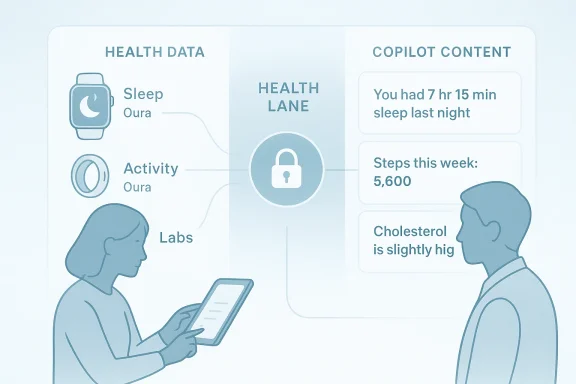
Health data dashboard showing Sleep, Activity, and Labs feeding into a central Health Lane.Background / Overview​

Microsoft’s consumer Copilot strategy has been expanding rapidly across productivity, search, and specialized verticals. Copilot Health represents the company’s clearest move yet into consumer‑facing healthcare: a feature that collects and normalizes data from EHRs, wearable devices, and direct‑to‑consumer lab services, then uses generative and clinical AI tools to describe patterns, highlight anomalies, and produce “appointment prep” briefings and suggested questions for clinicians. Microsoft positions the product as an aid for understanding, not a replacement for professional medical care.
This step is both strategic and predictable. Platforms that become the place users trust to store and query their personal information — calendars, documents, email — are natural candidates to add health as another domain. Microsoft already runs several clinically oriented efforts (for example, Dragon Copilot for clinicians and a slate of healthcare partnerships), and Copilot Health stitches those threads into a consumer‑oriented workspace where wearable telemetry and patient records can be queried conversationally.

What Copilot Health says it does​

Copilot Health’s public preview (U.S. rollout, waitlist model) is built around four core capabilities:
  • Data aggregation: Bring together EHRs, lab results, and wearable streams into a single, personal health profile.
  • Pattern detection and explanation: Use AI to surface trends (sleep, activity, heart rate variability, lab drift) and explain their likely significance in accessible language.
  • Appointment preparation: Generate a concise summary and prioritized questions to take to your clinician.
  • Privacy segmentation and governance: Keep health conversations and stored records in a separate, encrypted “health lane” inside Copilot that Microsoft says will not be used to train its foundation models.
Microsoft and early reporting cite specific integration breadth: Copilot Health can ingest data from more than 50 wearable device types (including Apple Health, Fitbit, and Oura), and connect to medical records from over 50,000 U.S. hospitals and provider organizations via partner services such as HealthEx, while laboratory results can be included through providers like Function. Those headline numbers have been repeated in multiple previews and Microsoft materials.

How the ingestion pipeline is described​

Microsoft’s public materials describe a connector model: device and app integrations (Apple Health, Fitbit APIs, vendor connectors), EHR access through HealthEx‑style record locators and FHIR‑based APIs, and lab feeds from consumer testing platforms. Data is normalized into timelines and contextualized with visit summaries and clinical notes when available, enabling the generative layer to reference both continuous device telemetry and episodic clinical events. Microsoft also indicates the feature draws on its research into clinical AI systems — notably the Microsoft AI Diagnostic Orchestrator (MAI‑DxO) and related research programs — to ground outputs in clinical reasoning patterns rather than free‑form speculation.

Why Microsoft built Copilot Health — the strategic logic​

There are three converging incentives powering Copilot Health:
  • Product differentiation: Health is one of the few deeply personal spaces where an end‑to‑end assistant can add recurring, high‑value interactions (daily telemetry reviews, prep for periodic visits).
  • Data lock‑in and ecosystem expansion: If users aggregate sensitive medical history and device telemetry inside Copilot, Microsoft strengthens the platform’s centrality across devices and subscriptions.
  • Market momentum: Competitors (OpenAI’s health features, Amazon’s health chatbot expansions, and several health‑AI start‑ups) are racing to own patient‑facing interfaces — Microsoft sees Copilot as the most natural consumer front door.
None of these incentives are inherently bad — they explain why a major cloud vendor would pursue consumer health AI — but they also create a strong motivation to encourage users to centralize highly sensitive records in a platform with broad commercial reach. That tradeoff is the central policy and design debate behind consumer health AI today.

Privacy, security, and governance: Microsoft’s promises and limits​

Microsoft emphasizes three privacy controls around Copilot Health:
  • Segregated storage and access controls: Health data and conversations will be stored separately from general Copilot interactions and protected by encryption and fine‑grained access controls. Microsoft’s Copilot privacy documentation reiterates that files and uploaded content are handled with explicit retention and deletion policies and that specific Copilot boundaries exist to limit model training.
  • Not used for model training: Microsoft has repeated that content and conversations in the health lane will not be used to train its foundation models. For enterprise and Microsoft 365 products the company has long published opt‑out controls and contractual commitments; Copilot Health inherits that design principle and the product documentation highlights user controls.
  • Third‑party certification and governance: Microsoft points to ISO/IEC 42001 (AI Management Systems) alignment and related audits as evidence of governance maturity for Copilot services — Microsoft says its Copilot family has attained ISO/IEC 42001 certification at the product level, and the company frames this as a structural safeguard for responsible AI operations.
These are material protections — encryption, access controls, retention policies, and external audits matter — but they are not all the protections critics ask for. Encryption and an ISO certification reduce operational risk but do not, by themselves, eliminate harms that arise when an AI assistant misinterprets clinical data, gives overconfident but incorrect explanations, or when a user acts on AI‑generated suggestions without clinician oversight.

The clinical and safety challenge​

Copilot Health is explicitly designed to support conversations with clinicians, not to replace them. That caveat appears throughout Microsoft’s consumer guidance: the assistant is for education and preparation, not diagnosis or treatment. Yet the technical and social dynamics of consumer health AI complicate that boundary:
  • Wearable data and consumer lab results vary widely in clinical quality. Devices designed for step counting or sleep tracking are useful for trends but are not substitutes for clinical diagnostics. Integrating these starrative requires careful uncertainty calibration and provenance transparency so users understand where signals come from.
  • Generative models can produce plausible but incorrect explanations — the classic hallucination problem — which is especially dangerous in health contexts where confident text can override patient intuition about uncertainty. Microsoft’s use of grounded clinical content and the MAI‑DxO research program seeks to lower this risk, but independent evaluation is necessary.
  • Clinical liability and the clinician‑patient relationship: If Copilot Health produces a list of “urgent” items or a suggested medication question, who is responsible for errors or downstream mismanagement? Microsoft frames outputs as preparatory; the real world makes those outputs part of care conversations, and legal and regulatory frameworks are still catching up.

Triaging accuracy: a practical checklist​

Clinicians, health systems, and informed users should apply a short triage before relying on Copilot Health outputs:
  • Confirm provenance: check whether a flagged lab came from a certified lab or a consumer panel.
  • Assess device accuracy: treat single‑point wearable anomalies cautiously; emphasize trends over isolated readings.
  • Use Copilot outputs as questions for clinicians, not treatment plans.
  • Keep human verification: any recommendation that would change medication, order imaging, or initiate invasive tests should be validated by a licensed clinician.
These simple rules reduce risk and preserve the tool’s core value: improved communication and situational understanding for patients and caregivers.

Interoperability and ecosystem partners — the plumbing that matters​

A headline strength of Microsoft's pitch is that Copilot Health is designed as a connector platform:
  • Device connectors: Apple Health, Fitbit, Oura, and other partner APIs provide continuous telemetry streams that Copilot Health can ingest and summarize. Microsoft’s consumer pages and press reporting list support for dozens of wearable device sources.
  • EHR and provider directory connectivity: Microsoft points to HealthEx and related record‑locator services as the route to provider data across thousands of hospitals and clinics — a pragmatic approach that relies on existing FHIR and TEFCA‑style infrastructures to assemble a patient’s longitudinal record. Healthcare IT reporting shows HealthEx’s ability to surface Epic‑sourced patient records and act as a patient‑directed access layer.
  • Laboratory partners: Consumer lab vendors such as Function (a direct‑to‑consumer testing company) are already providing patient‑facing panels and APIs; Microsoft’s preview materials list lab result ingestion as part of the Copilot Health profile. Function and similar services are a double‑edged sword: they broaden the pool of available data but introduce variability in clinical interpretation and lab standards.
Interoperability is where the product either becomes genuinely useful or merely aggregative window dressing. If Copilot Health successfully stitches FHIR‑standard data with well‑documented device metadata and lab provenance, its summaries will be far more actionable. If instead it treats everything equally and hides provenance, the outputs will be brittle.

Governance, certification, and external oversight​

Microsoft cites ISO/IEC 42001 certification as a governance milestone for Copilot products; this is meaningful because 42001 is the new international standard for AI management systems and offers a framework for risk assessment, lifecycle controls, and accountability. Microsoft’s public compliance materials and community posts indicate that Microsoft 365 Copilot has achieved ISO/IEC 42001 certification and that the company is applying similar governance processes across Copilot experiences. That said, ISO/IEC 42001 is a management‑system standard — it raises the floor on governance controls but does not certify product safety or clinical efficacy in a narrow technical sense.
Two important governance points to track as Copilot Health scales:
  • Independent clinical evaluation: external validation studies that compare Copilot Health’s outputs to clinician review will be essential to quantify accuracy, false positives, and missed findings.
  • Regulatory posture: consumer health tools that remain in the “information” or “education” bucket can avoid medical‑device classification, but that boundary is fragile. If Copilot Health’s outputs begin to recommend specific clinical actions, regulators may require medical‑device level validation. Microsoft’s public guidance currently frames the product as non‑diagnostic, but product changes and feature creep will continuously test that boundary.

User experience and real‑world utility​

In practical terms, Copilot Health’s potential value to typical users is straightforward:
  • Reduce confusion: a patient with fragmented records — a hospitalist note, a telehealth lab, and two months of smartwatch telemetry — currently faces a messy synthesis task. Copilot Health promises to condense these items into a readable timeline with flagged concerns.
  • Improve clinician prep: well‑structured patient summaries and prioritized questions can help clinicians focus visits, possibly making brief appointments more productive.
  • Ongoing monitoring: when configured appropriately, trends (sleep, resting heart rate, activity) might help users and clinicians detect early changes that merit attention.
But usability will depend on how outputs are framed. The best implementations will:
  • Surface provenance and confidence scores,
  • Let users correct errors (link a different provider, fix device attribution), and
  • Provide explicit next‑step pathways (e.g., “Share this summary with your clinician” with a secure export workflow).
If the UI obscures provenance or presents model certainty without caveats, the product will generate both false reassurance and clinician burden.

Risks and open questions​

No product launch eliminates tradeoffs. For Copilot Health, the most important unanswered questions are:
  • How will Microsoft verify and label the clinical quality of consumer lab panels and third‑party device streams?
  • What are the precise retention windows, and how will emergency disclosures (for example, flagged critical lab values) be managed in consumer workflows?
  • How will Microsoft measure and report accuracy, bias, and missed‑event rates in Copilot Health outputs?
  • What legal and regulatory exposures might arise when the assistant’s suggestions affect clinical decisions?
These are not theoretical. Past examples show that even well‑intentioned clinical AI can cause harm when models generalize incorrectly or when poor UI design amplifies rare but serious failures. The right defense is layered: strong governance, transparent provenance, independent evaluation, and clear medicolegal lines for how outputs are used.

How clinicians, health systems, and regulators should respond​

For clinicians and health leaders anticipating Copilot Health adoption among their patients, a pragmatic three‑step approach will reduce risk:
  • Update intake processes: ask patients whether they used consumer AI summaries before visits and include that context in the history‑taking workflow.
  • Define clear verification standards: create protocols for validating consumer lab results and device‑derived signals before acting on them.
  • Advocate for transparency: require vendors to publish evaluation metrics, data‑use policies, and error‑reporting procedures.
Regulators and policy teams should push for public, auditable evaluations of consumer health AI systems and standardized reporting of provenance and confidence metrics. Certification and ISO alignment are helpful, but they must be complemented with domain‑specific evidence of clinical safety.

What to watch next​

As Copilot Health moves from preview to broader availability, watch for the following milestones that will define whether this product is transformative or merely fashionable:
  • Publication of independent evaluations or white papers describing accuracy, false‑positive rates, and clinical concordance. Microsoft has already signaled research outputs will follow; independent peer‑review will matter.
  • Real‑world integration stories from health systems that accept patient‑shared Copilot summaries into workflows, including how clinicians reconcile AI‑generated histories with charted EHR data.
  • Feature changes that move Copilot Health from “explain and prepare” toward “recommend and triage” — the regulatory and safety bar rises dramatically at that point.
  • The transparency of training and governance decisions: Microsoft’s assertion that health lane data won’t be used for model training is meaningful; ongoing audits and clear, user‑accessible opt‑out mechanisms will be a test of trust.

Bottom line​

Copilot Health is a consequential product: it packages wearable telemetry, lab results, and clingle conversational assistant and couples that experience with Microsoft’s broad cloud, identity, and governance infrastructure. That combination could materially improve patient understanding and clinician communication — but only if Microsoft and its partners deliver strong provenance, meaningful independent evaluation, and clear behavioral guards to prevent over‑reliance on imperfect AI outputs.
Microsoft’s promises (segregated storage, no training on health lane data, ISO/IEC 42001 governance) are meaningful steps toward safer consumer health AI, and the company’s scale makes this an influential experiment for the industry. Still, the real measure of success will be whether Copilot Health reduces clinical confusion without adding new vectors for error, whether it proves useful across diverse patient populations and devices, and whether regulators, clinicians, and patients see the transparency and independent evidence they need to trust the results.

Practical guidance for readers today​

If you’re curious to try Copilot Health when the preview expands, keep these pragmatic rules in mind:
  • Treat AI summaries as preparation tools, not diagnoses.
  • Verify provenance on every flagged lab or clinically actionable suggestion.
  • Share Copilot summaries with your clinician as a discussion aid, not as a prescription.
  • Use built‑in privacy controls and understand retention settings before uploading sensitive records.
Microsoft has launched an important experiment in consumer health AI. The company’s combination of scale, governance commitments, and technical research gives Copilot Health a credible platform; the stakes — privacy, clinical safety, and user trust — are high. If Microsoft, its partners, and external evaluators treat those stakes with the seriousness they deserve, Copilot Health could be a useful bridge between fragmented personal data and better, more informed clinical conversations. If not, the product will be another well‑funded attempt that amplifies convenience while leaving critical risks unaddressed.

Source: Digital Watch Observatory AI-powered Copilot Health platform introduced by Microsoft | Digital Watch Observatory
 

Microsoft’s Copilot just moved from productivity and search into the most intimate ledger many users keep: their medical records and wearable telemetry, with a U.S.-only preview called Copilot Health that promises to aggregate electronic health records (EHRs), lab results, prescriptions and continuous biometric streams into a private Copilot workspace that explains findings, highlights trends, and suggests actionable next steps.

Person at a computer reviews HealthEx medical records, lab results, and wearables on a secure dashboard.Background / Overview​

Microsoft has been steadily expanding the Copilot family from productivity assistants into specialized vertical copilots, and Copilot Health represents the company’s clearest push yet into consumer-facing healthcare. The preview — announced in mid‑March 2026 — is positioned as a privacy-segmented lane inside the broader Copilot experience where users can import or connect medical records and wearable data, then ask an AI to summarize results, prepare visit notes, or spot trends across data sources.
This launch is being paired with partner integrations to make the product useful from day one. One of the most notable announcements is Microsoft’s partnership with HealthEx, which will provide a bridge between users’ personal health records and Copilot Health by linking TEFCA-style networks and FHIR-based access to make EHR data and PHRs available to the Copilot workspace. HealthEx’s role is described as a practical interoperability layer to surface patient-authorized records into the Copilot Health environment.
Taken together, the product and partner news signal a strategic ambition: become the consumer “front door” to personalized, AI‑assisted health guidance. That ambition brings clear benefits — convenience, personalization and the potential to translate dense clinical notes into plain language — but it also raises urgent questions about accuracy, provenance, privacy and regulatory compliance. Multiple early previews emphasize Microsoft’s stated design choices: keep health chats separate from general Copilot activity, avoid using consumer health conversations as training data for general models, and surface provenance for clinical claims.

What Copilot Health Claims to Do​

Data types and connectors​

Copilot Health is designed to ingest a range of personal health data types:
  • Electronic health records (EHRs): visit notes, diagnoses, medications, problem lists and imaging/lab reports.
  • Lab results and imaging summaries: clinical test results converted into a timeline and trend analysis.
  • Wearable telemetry: continuous or episodic streams such as heart rate, sleep stages, activity, SpO2 and step counts from consumer devices.
  • Personal health records (PHRs): patient‑held summaries and third‑party PHR services that consolidate records across providers, which HealthEx intends to help integrate.
The product preview emphasizes an ability to synthesize across these streams — for example, correlate an elevated resting heart rate on a wearable with recent lab values or new prescriptions — and to produce short, actionable outputs: plain-language summaries, appointment prep sheets, and “what to ask your clinician” prompts. Microsoft frames these capabilities as patient empowerment tools, not clinician decision-support systems, but the line is functionally thin.

UX: a “privacy-segmented health lane”​

Microsoft has described Copilot Health as a distinct and privacy-segmented experience inside the Copilot ecosystem. That segmentation aims to prevent routine Copilot usage (shopping lists, email drafting) from mixing with sensitive clinical interactions, and Microsoft says health-specific data won’t be used to train the general Copilot models. Early reporting of the preview reiterates that Copilot Health will provide provenance markers and clarify when the assistant is quoting licensed medical content versus summarizing a patient’s record. However — and critically — those promises will require independent verification and ongoing audits to be trusted in practice.

HealthEx partnership: why it matters​

HealthEx’s announced role is practical and strategic. The company says it will help link TEFCA-style interoperability networks and FHIR interfaces into Copilot Health, effectively allowing patient-authorized EHR and PHR records to flow into Microsoft’s consumer-facing assistant. That solves one of the hardest problems for any consumer health product: access to fragmented data sitting across tens of thousands of provider systems. By promising to map TEFCA-like connectivity and FHIR standards onto Copilot Health, the integration could make the product useful for a far larger set of users at launch than a single‑vendor connector approach would allow.
HealthEx’s positioning suggests Microsoft will rely on specialized intermediaries for the plumbing — not unlike how major platforms rely on identity or payments partners. This reduces one engineering burden for Microsoft and concentrates interoperability complexity in a partner that purports to specialize in record access and consent flows.
Caveats:
  • The announced approach depends on wide provider participation in TEFCA-style networks and the willingness of health systems to accept third-party PHR bridging. Adoption remains uneven.
  • FHIR endpoints vary dramatically in completeness and the quality of structured data. HealthEx will need robust mapping, normalization and reconciliation logic to produce clinically useful output rather than noisy, partial summaries.

Clinical accuracy, provenance and the Harvard content angle​

Microsoft has taken steps to shore up clinical accuracy by licensing or pointing to curated medical content to ground Copilot answers. Prior reporting indicates Microsoft has pursued licensing arrangements with recognized medical publishers to provide authoritative consumer health content that Copilot can draw from when answering general medical questions. The goal is to reduce hallucinations and deliver safer, more reliable guidance.
That strategy has merit: combining patient-specific EHR content with vetted clinical guidance offers a two-layer approach — personalized context plus authoritative explanation. But it is not a silver bullet. The practice of blending curated editorial content with generative outputs requires strong provenance signals (what’s patient data vs. what’s publisher guidance) and conservative answer framing when evidence is incomplete. Early previews promise provenance tagging; operationalizing it at scale will be difficult and requires auditing.
Important limitations to flag:
  • Copilot Health is presented as a consumer tool, not a replacement for clinician judgment. Microsoft’s messaging stresses appointment-prep and explanation, not autonomous clinical decision-making. Still, patients may treat AI outputs as medical advice.
  • Licensed publisher content helps with high-level guidance but doesn’t validate inferences drawn by the model from raw clinical notes or ambiguous wearable signals.
  • Independent clinical validation — ideally peer-reviewed or overseen by healthcare organizations — will be necessary before clinicians can meaningfully rely on Copilot outputs in care delivery.

Privacy, security, and regulatory risk matrix​

The stakes for privacy and security are unusually high: medical records are among the most sensitive data types, and wearable telemetry can reveal behavioral patterns that matter for employment and insurance decisions. Microsoft’s preview is explicitly U.S.-only for now, which frames much of the compliance discussion in HIPAA and U.S. state privacy law terms, but global rollout would trigger additional regulatory regimes.
Key security and privacy talking points:
  • Data segmentation promises: Microsoft says health interactions will be kept in a separate Copilot lane and will not be used to train general-purpose models, a central claim for user trust. This needs technical validation (logs, data flows, retention policies) and third-party audits to have credibility.
  • HIPAA and Business Associate concerns: If Microsoft handles PHI (Protected Health Information) in support of Copilot Health for covered entities, multiple contractual and technical obligations apply. The product’s use cases — consumer-managed PHRs and direct-to-consumer wearable ingestion — may reduce some covered-entity obligations, but mixed flows (provider-connected EHRs plus wearables) create complex compliance surfaces that must be spelled out in provider contracts and terms of service.
  • Data breach risk and attack surface: A centralized hub of consolidated medical records and biometric streams becomes a high-value target. Microsoft’s enterprise-grade security posture matters, but attackers disproportionately target user endpoints and credential systems; robust multi-factor authentication, strong session controls, and encrypted-at-rest and in-transit protections are non-negotiable.
  • Consent and revocation mechanics: Practical privacy requires simple, auditable consent flows and the ability to revoke access. HealthEx’s bridge role should simplify the consent orchestration, but it must also provide transparent logs and revocation that are meaningful to users.
Regulatory landscape and enforcement risk:
  • U.S. regulators are already scrutinizing AI in healthcare. Any claims that resemble diagnostic accuracy or treatment advice will invite higher scrutiny from the FDA and state authorities. Microsoft’s consumer framing reduces immediate FDA risk, but ambiguous product messaging or misuse by clinicians could attract enforcement.
  • State privacy laws (e.g., consumer data privacy statutes) and federal HIPAA rules create overlapping obligations. The line between a consumer-directed PHR and a covered health service is not always clear; Microsoft and HealthEx will have to be explicit about roles and liabilities.

Clinical and technical risks: hallucinations, provenance, and data quality​

Generative models are powerful pattern-matchers but they are also prone to confident, incorrect outputs — the well-known hallucination problem. In a health context, hallucinations can be harmful. Microsoft’s strategy of combining patient data with licensed content and of surfacing provenance is important, but not sufficient by itself.
Three interlocking risk categories deserve emphasis:
  • Model inference risk
  • Correlating wearable anomalies with clinical pathology is inherently probabilistic. For example, a transient heart‑rate elevation on a fitness tracker may reflect exercise, anxiety, or device error. Presenting a single, deterministic clinical explanation without uncertainty bounds is dangerous. Copilot must present uncertainties and allow users to escalate to clinician review.
  • Data quality and interoperability risk
  • EHRs are often incomplete, inconsistent and filled with copy‑forward artifacts. FHIR endpoints vary by vendor and health system. HealthEx’s normalization will be crucial, but it cannot invent missing clinical context. Users and clinicians must be reminded of the limitations of incomplete data sources.
  • Provenance and auditability risk
  • Knowing which claim came from which source — a lab result, a note, a device reading, or licensed guidance — matters for trust and liability. Copilot Health’s user interface must make provenance explicit and keep auditable logs suitable for clinical review and legal scrutiny. Early product descriptions promise provenance tagging; real-world usefulness depends on clarity and retrievability.

Practical implications for users, healthcare providers, and payers​

For consumers​

  • Copilot Health could make it easier to understand complex results and to prepare for clinician visits, potentially improving health literacy and shared decision-making.
  • Users should approach outputs as informational rather than authoritative; always confirm interpretation with a clinician, especially for new symptoms or abnormal labs.

For health systems and clinicians​

  • Health systems should evaluate how patient-delivered AI summaries might change workflow. For example, a patient who arrives with a Copilot‑generated prep sheet could save visit time — or could require clinicians to correct AI errors, increasing workload.
  • Institutions will need clear policies around if/when Copilot outputs can be attached to the medical record or used in clinical decision-making.

For payers and employers​

  • Consolidated consumer health records create questions about secondary use. Payers may see opportunity in care management and prevention, but any attempt to use Copilot outputs for underwriting or employment decisions would raise ethical and legal red flags.

Competitive and strategic analysis​

Microsoft’s play is logical from a platform perspective. The company already occupies productivity, identity, cloud and device ecosystems; adding a health layer gives Copilot a potentially sticky, high-value consumer role. Owning the “personal health interface” across devices and EHRs would create a defensible moat if Microsoft can deliver reliable, private and clinically useful assistance. Multiple cloud giants are pursuing adjacent plays, and Microsoft’s combination of enterprise credibility, partnerships with publishers and interoperability intermediaries like HealthEx offers a practical path to scale.
But the strategic win is not guaranteed. Success hinges on:
  • Effective, trustworthy privacy and compliance controls.
  • High-quality interoperability that reduces noise and preserves provenance.
  • Conservative clinical-risk framing and transparent scientific validation.
  • User experience that clearly communicates uncertainty and sources.

What Microsoft, HealthEx and partners must get right​

  • Implement transparent, auditable consent and revocation flows that are understandable to non-technical users.
  • Publish technical documentation and external audit results on data flows, retention, training exclusions and provenance mechanisms. Independent third-party attestations will be essential to build trust.
  • Constrain the product’s language around diagnosis and treatment; use conservative phrasing, uncertainty bands and automatic escalation prompts when the model detects potentially serious findings.
  • Invest in rigorous clinical validation studies, ideally with academic partners, to evaluate the assistant’s accuracy across representative patient cohorts and real-world data.

Practical user checklist: before you add your records​

  • Confirm whether Copilot Health will be covered by a HIPAA business associate agreement for your provider’s connection, and understand which entity holds what data.
  • Review consent prompts carefully; note whether the platform stores data long-term and whether it is shared with third parties (e.g., HealthEx) for interoperability.
  • Use strong authentication (MFA) on accounts that will hold health data and enable device-level encryption where possible.
  • Treat Copilot Health outputs as preparatory materials — bring them to your clinician for confirmation rather than using them as self-diagnosis tools.

Where reporting is thin or claims are currently unverifiable​

Several important claims in early product reporting require independent confirmation:
  • The exact technical architecture for isolating health data from model training pipelines is not yet public; Microsoft’s statements must be backed by technical attestations and logs. If you are evaluating risk, treat training-exclusion promises as claims that need verification.
  • The completeness and quality of FHIR endpoints HealthEx will access (and any normalization rules HealthEx will apply) are not yet transparently documented. Real-world FHIR variability means outputs will vary by provider.
  • Claims about publisher-licensed content integration (e.g., Harvard Health) can reduce hallucination risk, but how models reconcile conflicting sources or handle gaps remains unclear in published previews and should be audited.
Where statements are unverifiable in public previews, we recommend caution and expect Microsoft and its partners to publish technical whitepapers and third-party audit summaries if they want broad clinical and institutional uptake.

Conclusion — a consequential, cautious opportunity​

Copilot Health is a consequential product move: it compresses messy, distributed health data into a single, AI‑assisted place intended to improve understanding and convenience. The HealthEx partnership addresses a core interoperability problem and could materially improve the product’s utility at launch. Together, these announcements mark a strategic push by Microsoft to be the consumer-facing layer for personal health data and insights.
That potential comes with commensurate responsibility. Microsoft and its partners must prove, publicly and technically, that health data is both protected and used responsibly; that model outputs are conservative, auditable and provenance-laden; and that users understand the scope and limits of AI-generated health guidance. Until those proofs exist and are verified by independent auditors and clinicians, Copilot Health will be a powerful convenience tool with real benefits — but also real, non-trivial risks that users and health organizations should treat with healthy skepticism.
If Microsoft delivers on the technical and governance promises it is making in previews — and if HealthEx’s interoperability plumbing proves resilient in the messy world of live EHRs — Copilot Health could raise the bar for consumer health assistants. If not, it risks delivering a high-value target of consolidated sensitive data and confident, yet potentially misleading, medical assertions. The next months of product documentation, third-party audits and clinical validation studies will determine which path this product ultimately follows.

Source: WinBuzzer Microsoft Launches Copilot Health to Link Medical Records and Wearables
Source: HLTH HealthEx and Microsoft Partner to Integrate Personal Health Records into Copilot Health
 

Back
Top