

Microsoft’s Copilot Health preview became available on May 29, 2026, to eligible U.S. adults with consumer Microsoft 365 subscriptions, letting them connect medical records, lab results, Apple Health data, and provider searches inside a health-focused Copilot experience that Microsoft says is separate from workplace Copilot services. The launch is not simply another Copilot feature; it is Microsoft asking consumers to bring one of the most sensitive categories of personal data into an AI assistant. For IT leaders, the important question is less whether Copilot Health is useful and more whether employees, patients, and administrators understand what kind of product it actually is.
Microsoft wants Copilot Health to feel like a practical answer to a familiar problem: health information is scattered across portals, lab reports, wearables, PDFs, and half-remembered appointment notes. That is a real problem, and AI is well suited to summarizing messy information into plain English. But the same convenience that makes the tool appealing also makes it risky, because health data does not become less sensitive when it moves from a hospital portal into a consumer assistant.
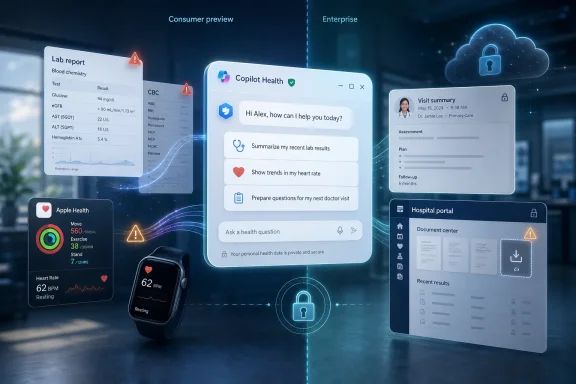
Copilot Health is framed as a consumer preview, not an enterprise clinical system. That distinction sounds procedural, but it is the load-bearing fact of the launch. Microsoft says the preview is for U.S. users 18 and older with Microsoft 365 Personal, Family, or Premium subscriptions, and that work accounts are not eligible.
That separation is meant to draw a bright line between consumer Copilot experiences and Microsoft 365 Copilot services sold to businesses under commercial security, privacy, and compliance commitments. It also gives Microsoft room to experiment without representing Copilot Health as a hospital-grade clinical workflow tool. The trouble is that users do not always live inside those product boundaries.
A nurse with a family subscription, a benefits manager reviewing workplace health paperwork at home, or a patient forwarding lab results to themselves can all collapse the neat distinction between consumer and enterprise use. That is where IT policy has to do what product packaging cannot. If an organization handles protected health information, occupational health records, claims data, or benefits documentation, it needs to say clearly whether consumer AI tools may touch that data at all.
Microsoft is also entering a market that is moving faster than regulatory comfort. OpenAI, Amazon, Perplexity, and others have all been pushing health-oriented AI experiences, each with its own mix of disclaimers, privacy promises, and ambitions. Copilot Health matters because Microsoft already sits inside so much of the workplace stack. Even when a product is technically consumer-only, the brand halo of Microsoft 365 can make it feel more enterprise-ready than it is.
That is not a trivial promise. Anyone who has tried to compare a blood panel, an after-visit summary, a medication list, and a year of sleep or activity data knows how hostile modern health information can be to ordinary people. Even technically fluent users can struggle to understand what matters, what is routine, and what should be raised with a clinician.
Microsoft’s bet is that a conversational assistant can act as a translation layer. A user could ask what a lab result means, what questions to bring to a doctor, or how sleep trends might relate to a broader health goal. Those are sensible use cases when the assistant stays in the lane of explanation and preparation.
But aggregation changes the risk profile. A single lab result is sensitive. A medication list is sensitive. Wearable trends are sensitive. Combine them with symptoms, provider searches, insurance filters, and longitudinal records, and the dataset becomes a detailed map of a person’s body, routines, anxieties, and future medical concerns.
That is why “not used for ads” and “not used to train models” are important but incomplete assurances. The deeper issue is not only whether Microsoft monetizes the data. It is whether users understand the consequences of centralizing it, how long it persists, how it can be exported or deleted, what happens during account compromise, and whether a future product expansion changes the practical boundaries of the service.
That point is essential to understanding Copilot Health. If a user independently chooses to connect personal records to a consumer AI tool, the legal framework may differ from the one that applies when a hospital contracts with a vendor to process patient data. The data may be medically intimate, but it may not sit inside the same HIPAA relationship.
This is where public understanding tends to fail. Many users hear “health records” and assume HIPAA follows the data wherever it goes. In practice, privacy obligations depend heavily on who holds the data, why they hold it, and under what relationship. A consumer product can be privacy-sensitive without being a HIPAA-covered clinical system.
According to reporting around the preview, Microsoft does not currently offer a HIPAA-compliant version of Copilot Health and has framed the product as a direct-to-consumer experience. That does not mean Microsoft is free to do anything it wants with user data. Consumer protection law, state privacy laws, health breach rules, contract promises, and reputational risk still matter. But it does mean enterprise buyers should not treat Copilot Health as interchangeable with a contracted Microsoft cloud service configured for regulated health care use.
The better way to read HIPAA here is as a warning light, not a binary answer. If a health system, insurer, employer, or benefits administrator is tempted to tell users to put documents into Copilot Health, legal and compliance teams should stop the conversation immediately. The relevant question is not “does the product mention health?” but “what agreement, controls, auditability, retention policy, and liability structure govern this data flow?”
The problem is that AI health privacy is not a single-switch issue. Users need protection from advertising exploitation, but they also need protection from accidental disclosure, account takeover, confusing sharing flows, data retention surprises, overbroad integrations, and unsafe reuse of AI-generated outputs. A product can keep data out of ads and still create operational risk.
There is also the matter of model behavior. Microsoft says Copilot Health is not intended to diagnose, treat, or prevent disease and is not a substitute for professional medical advice. That disclaimer is expected and prudent. It is also at odds with the way many people actually use chatbots when they are worried, confused, or unable to get timely care.
The more personalized the assistant becomes, the harder that line becomes to maintain. A generic chatbot explaining cholesterol is one thing. A chatbot reading your lab results, medication list, wearable trends, and visit summaries is operating much closer to the emotional center of care. It may still be “informational,” but users will experience it as advice-adjacent.
That matters for WindowsForum’s audience because this is not merely a consumer privacy story. It is a governance story. IT teams have spent the last two years trying to explain to employees that not every Copilot-branded surface carries the same data commitments. Copilot Health adds a new high-sensitivity category to that confusion.
Enterprise administrators already know this tension. Copilot can summarize, retrieve, and synthesize only because it can see a lot. Microsoft’s security model leans heavily on existing permissions, tenant boundaries, and compliance controls. When those controls are misconfigured or when product behavior surprises users, AI turns latent data exposure into an immediate user-facing event.
Health data raises the stakes. A confidential email mishandled by an assistant is bad. A cancer screening result, fertility record, psychiatric medication list, genetic marker, disability accommodation document, or insurance dispute mishandled by an assistant is worse. The sensitivity is not just legal; it is personal, social, and sometimes employment-related.
This is why IT leaders should resist the temptation to treat Copilot Health as someone else’s consumer problem. Employees will bring consumer tools into work-adjacent contexts unless told otherwise. Patients will bring AI-generated summaries into clinical settings. Clinicians may be asked to interpret something a chatbot said. Support desks may be asked why a Microsoft account cannot access a health preview from a work login.
None of that makes Copilot Health a mistake. It makes it the kind of product that requires explicit boundaries before habits form. Once users become comfortable dumping health PDFs into an AI assistant, policy will be playing catch-up.
But it is not proof that Copilot Health gives clinically accurate answers in the wild. It does not substitute for peer-reviewed outcome studies, third-party red-team results, specialty-specific accuracy evaluations, or transparent reporting on failure modes. It tells us something about management process, not everything about product performance.
That distinction is especially important in health AI because many errors are plausible rather than obvious. A chatbot that fabricates a drug interaction may be caught by a clinician. A chatbot that subtly over-reassures a user about a borderline result, or fails to emphasize urgency in a symptom pattern, may not be caught until later. The danger is not only hallucination; it is misplaced confidence.
Microsoft says it has conducted safety testing and involved physicians. That is useful, but the public evidence base remains thin. If Copilot Health is going to become a routine companion for interpreting lab results and medical records, independent evaluation should not be treated as a luxury. It should be the price of admission.
The software industry has a long history of confusing process maturity with user safety. Health AI cannot afford that shortcut. A well-governed system can still be wrong, incomplete, biased, or poorly understood by users. The more intimate the data, the higher the bar should be.
That is how shadow IT works in 2026. It does not need a rogue server under a desk. It needs a convenient AI box and a user with a confusing document. If the tool is useful enough, policy friction will lose unless the policy is clear, justified, and backed by sanctioned alternatives.
For employers, the danger is especially sharp around benefits and occupational health. Many organizations hold sensitive employee health information in specific administrative channels with restricted access. If staff copy that material into a consumer AI assistant, the organization may lose control of where the data went, what commitments applied, and whether the disclosure violated internal policy or law.
For health systems, the issue is both inbound and outbound. Patients may use Copilot Health to prepare for visits, which could improve engagement. But they may also bring summaries that omit context, misread significance, or encourage adversarial interpretations of care. Clinicians will need workflows for acknowledging AI-assisted patient questions without validating the tool as a diagnostic authority.
For insurers and benefits teams, provider search is another point of sensitivity. Copilot Health’s ability to search by insurance coverage sounds helpful, but coverage information is notoriously conditional. Network status, prior authorization, plan type, and local billing practices can change the actual patient experience. AI can make the search feel simpler than the financial reality.
This is not science fiction. Prompt injection has already become one of the defining security problems of AI assistants that retrieve and summarize external content. In a health context, an attacker might not need to steal a database to cause harm. Manipulating what an assistant says, hides, emphasizes, or recommends could be damaging enough.
The consumer nature of Copilot Health complicates mitigation. Enterprise systems can enforce data loss prevention, logging, conditional access, and admin policy. Consumer tools typically give organizations far less visibility. If an employee uses a personal account to analyze a benefits document, the employer cannot easily audit the interaction or remediate the output.
Health data also creates unusual social-engineering opportunities. A convincing AI-generated explanation of an insurance denial, a provider bill, or a lab abnormality could push users toward scams, unnecessary purchases, or unsafe care decisions. The more personalized the assistant appears, the more persuasive it becomes.
Microsoft has the security expertise to address many of these risks, but users and IT leaders should not assume the preview has solved them all. Preview status matters. It means the product is still being tested, expanded, and shaped by real-world behavior. That is exactly when organizations should set boundaries, not after the product becomes routine.
That classification should be written into AI acceptable-use policies. Employees should know that work accounts are not eligible for Copilot Health and that personal accounts must not be used to process company-held health information, patient records, claims files, occupational health documents, or benefits administration materials. This is not anti-AI; it is basic data governance.
Organizations also need a response for legitimate demand. People use unsanctioned tools when sanctioned systems are slow, confusing, or unavailable. If employees need help understanding benefits documents, give them approved support channels. If clinicians need summarization, evaluate enterprise clinical AI products under proper agreements. If patients need plain-language explanations, provide vetted educational materials and portal messaging pathways.
Security teams should also revisit browser, endpoint, and data loss policies. Blocking every consumer AI surface may be unrealistic, but monitoring uploads of sensitive file types, restricting managed-device access to consumer AI destinations, and educating users about health data can reduce accidental disclosure. The right answer will vary by sector, but doing nothing is no longer defensible.
The most important policy language should avoid legalese. Users need plain rules: do not upload patient information to personal AI tools; do not paste benefits or occupational health records into consumer chatbots; do not rely on AI for diagnosis; do bring confusing results to a qualified professional. If the rule sounds like a compliance memo, it will not survive contact with a worried employee at 11 p.m.
That is why the preview deserves more scrutiny than an ordinary feature launch. Microsoft is not merely adding another connector. It is normalizing the idea that AI assistants should sit between people and their most intimate records. The company’s privacy promises, safety disclaimers, and product boundaries are therefore not fine print; they are the product.
There is a real upside here. A well-designed health AI assistant could help people understand confusing records, prepare better questions, notice gaps, and become more active participants in care. It could be especially valuable in a fragmented U.S. system where patients often serve as their own data integrators.
But the upside does not erase the asymmetry. If Copilot Health works well, Microsoft gains a privileged position in consumer health behavior. If it fails, misunderstands, leaks, or overreaches, users bear the consequences in one of the most sensitive areas of their lives. That imbalance is why external evaluation and transparent governance matter.
The long-term question is whether Microsoft keeps Copilot Health as a carefully bounded consumer assistant or gradually connects it to more clinical and enterprise products. The company already has deep health-sector ambitions, including clinical documentation and health cloud offerings. A consumer health assistant could remain separate, or it could become a bridge. IT leaders should watch that boundary closely.
Microsoft wants Copilot Health to feel like a practical answer to a familiar problem: health information is scattered across portals, lab reports, wearables, PDFs, and half-remembered appointment notes. That is a real problem, and AI is well suited to summarizing messy information into plain English. But the same convenience that makes the tool appealing also makes it risky, because health data does not become less sensitive when it moves from a hospital portal into a consumer assistant.
 Microsoft Has Put a Consumer Door on a Clinical Problem
Copilot Health is framed as a consumer preview, not an enterprise clinical system. That distinction sounds procedural, but it is the load-bearing fact of the launch. Microsoft says the preview is for U.S. users 18 and older with Microsoft 365 Personal, Family, or Premium subscriptions, and that work accounts are not eligible.That separation is meant to draw a bright line between consumer Copilot experiences and Microsoft 365 Copilot services sold to businesses under commercial security, privacy, and compliance commitments. It also gives Microsoft room to experiment without representing Copilot Health as a hospital-grade clinical workflow tool. The trouble is that users do not always live inside those product boundaries.
A nurse with a family subscription, a benefits manager reviewing workplace health paperwork at home, or a patient forwarding lab results to themselves can all collapse the neat distinction between consumer and enterprise use. That is where IT policy has to do what product packaging cannot. If an organization handles protected health information, occupational health records, claims data, or benefits documentation, it needs to say clearly whether consumer AI tools may touch that data at all.
Microsoft is also entering a market that is moving faster than regulatory comfort. OpenAI, Amazon, Perplexity, and others have all been pushing health-oriented AI experiences, each with its own mix of disclaimers, privacy promises, and ambitions. Copilot Health matters because Microsoft already sits inside so much of the workplace stack. Even when a product is technically consumer-only, the brand halo of Microsoft 365 can make it feel more enterprise-ready than it is.
The Product’s Best Feature Is Also Its Biggest Risk
The appeal of Copilot Health is aggregation. Microsoft has described connections to records from more than 50,000 U.S. hospitals and provider organizations through HealthEx, support for Function lab results, Apple Health wearable data at preview, and provider search by specialty, location, language, gender, and insurance coverage. In plain English, the pitch is that Copilot can turn a fragmented health life into a single conversational interface.That is not a trivial promise. Anyone who has tried to compare a blood panel, an after-visit summary, a medication list, and a year of sleep or activity data knows how hostile modern health information can be to ordinary people. Even technically fluent users can struggle to understand what matters, what is routine, and what should be raised with a clinician.
Microsoft’s bet is that a conversational assistant can act as a translation layer. A user could ask what a lab result means, what questions to bring to a doctor, or how sleep trends might relate to a broader health goal. Those are sensible use cases when the assistant stays in the lane of explanation and preparation.
But aggregation changes the risk profile. A single lab result is sensitive. A medication list is sensitive. Wearable trends are sensitive. Combine them with symptoms, provider searches, insurance filters, and longitudinal records, and the dataset becomes a detailed map of a person’s body, routines, anxieties, and future medical concerns.
That is why “not used for ads” and “not used to train models” are important but incomplete assurances. The deeper issue is not only whether Microsoft monetizes the data. It is whether users understand the consequences of centralizing it, how long it persists, how it can be exported or deleted, what happens during account compromise, and whether a future product expansion changes the practical boundaries of the service.
HIPAA Is the Wrong Shortcut and the Right Warning Light
HIPAA is often invoked as if it were a magic privacy seal. It is not. In the United States, HIPAA generally applies to covered entities and business associates: health care providers, health plans, clearinghouses, and vendors handling protected health information on their behalf. A direct-to-consumer health app is not automatically a HIPAA-covered patient portal simply because it contains health data.That point is essential to understanding Copilot Health. If a user independently chooses to connect personal records to a consumer AI tool, the legal framework may differ from the one that applies when a hospital contracts with a vendor to process patient data. The data may be medically intimate, but it may not sit inside the same HIPAA relationship.
This is where public understanding tends to fail. Many users hear “health records” and assume HIPAA follows the data wherever it goes. In practice, privacy obligations depend heavily on who holds the data, why they hold it, and under what relationship. A consumer product can be privacy-sensitive without being a HIPAA-covered clinical system.
According to reporting around the preview, Microsoft does not currently offer a HIPAA-compliant version of Copilot Health and has framed the product as a direct-to-consumer experience. That does not mean Microsoft is free to do anything it wants with user data. Consumer protection law, state privacy laws, health breach rules, contract promises, and reputational risk still matter. But it does mean enterprise buyers should not treat Copilot Health as interchangeable with a contracted Microsoft cloud service configured for regulated health care use.
The better way to read HIPAA here is as a warning light, not a binary answer. If a health system, insurer, employer, or benefits administrator is tempted to tell users to put documents into Copilot Health, legal and compliance teams should stop the conversation immediately. The relevant question is not “does the product mention health?” but “what agreement, controls, auditability, retention policy, and liability structure govern this data flow?”
Microsoft’s Privacy Promises Are Necessary but Not Sufficient
Microsoft says Copilot Health conversations are separate from the broader Copilot experience, encrypted, not used to train AI models, not used for advertising, and not sold to insurers, employers, or advertisers. Those promises address the obvious fears. They also show that Microsoft knows exactly where public suspicion will land.The problem is that AI health privacy is not a single-switch issue. Users need protection from advertising exploitation, but they also need protection from accidental disclosure, account takeover, confusing sharing flows, data retention surprises, overbroad integrations, and unsafe reuse of AI-generated outputs. A product can keep data out of ads and still create operational risk.
There is also the matter of model behavior. Microsoft says Copilot Health is not intended to diagnose, treat, or prevent disease and is not a substitute for professional medical advice. That disclaimer is expected and prudent. It is also at odds with the way many people actually use chatbots when they are worried, confused, or unable to get timely care.
The more personalized the assistant becomes, the harder that line becomes to maintain. A generic chatbot explaining cholesterol is one thing. A chatbot reading your lab results, medication list, wearable trends, and visit summaries is operating much closer to the emotional center of care. It may still be “informational,” but users will experience it as advice-adjacent.
That matters for WindowsForum’s audience because this is not merely a consumer privacy story. It is a governance story. IT teams have spent the last two years trying to explain to employees that not every Copilot-branded surface carries the same data commitments. Copilot Health adds a new high-sensitivity category to that confusion.
The Confidential Email Bug Is the Context Microsoft Cannot Avoid
The TechRepublic report points to a recent Microsoft 365 Copilot bug that processed emails marked confidential. That incident matters not because it proves Copilot Health is unsafe, but because it illustrates the trust gap around AI assistants embedded in productivity ecosystems. The modern Copilot pitch depends on access; the modern Copilot anxiety depends on access going too far.Enterprise administrators already know this tension. Copilot can summarize, retrieve, and synthesize only because it can see a lot. Microsoft’s security model leans heavily on existing permissions, tenant boundaries, and compliance controls. When those controls are misconfigured or when product behavior surprises users, AI turns latent data exposure into an immediate user-facing event.
Health data raises the stakes. A confidential email mishandled by an assistant is bad. A cancer screening result, fertility record, psychiatric medication list, genetic marker, disability accommodation document, or insurance dispute mishandled by an assistant is worse. The sensitivity is not just legal; it is personal, social, and sometimes employment-related.
This is why IT leaders should resist the temptation to treat Copilot Health as someone else’s consumer problem. Employees will bring consumer tools into work-adjacent contexts unless told otherwise. Patients will bring AI-generated summaries into clinical settings. Clinicians may be asked to interpret something a chatbot said. Support desks may be asked why a Microsoft account cannot access a health preview from a work login.
None of that makes Copilot Health a mistake. It makes it the kind of product that requires explicit boundaries before habits form. Once users become comfortable dumping health PDFs into an AI assistant, policy will be playing catch-up.
ISO 42001 Is Governance Theater Unless It Meets Product Reality
Microsoft also cites responsible AI processes, physician input, and AI management-system certification in the broader Copilot trust story. ISO/IEC 42001 is meaningful in the sense that it concerns how an organization establishes, maintains, and improves an AI management system. It can show that a company has documented governance structures around AI development and risk management.But it is not proof that Copilot Health gives clinically accurate answers in the wild. It does not substitute for peer-reviewed outcome studies, third-party red-team results, specialty-specific accuracy evaluations, or transparent reporting on failure modes. It tells us something about management process, not everything about product performance.
That distinction is especially important in health AI because many errors are plausible rather than obvious. A chatbot that fabricates a drug interaction may be caught by a clinician. A chatbot that subtly over-reassures a user about a borderline result, or fails to emphasize urgency in a symptom pattern, may not be caught until later. The danger is not only hallucination; it is misplaced confidence.
Microsoft says it has conducted safety testing and involved physicians. That is useful, but the public evidence base remains thin. If Copilot Health is going to become a routine companion for interpreting lab results and medical records, independent evaluation should not be treated as a luxury. It should be the price of admission.
The software industry has a long history of confusing process maturity with user safety. Health AI cannot afford that shortcut. A well-governed system can still be wrong, incomplete, biased, or poorly understood by users. The more intimate the data, the higher the bar should be.
Consumer AI Will Leak Into Enterprise Workflows Through People, Not APIs
The most likely enterprise impact of Copilot Health is not a formal integration. It is behavior. Employees will use consumer tools to understand benefits letters, medical leave paperwork, test results, and provider options. Patients will arrive with AI-generated questions. Managers may see employees reference chatbot interpretations of occupational health documents. Clinicians may be asked to correct or contextualize summaries that did not come from the health system’s approved tools.That is how shadow IT works in 2026. It does not need a rogue server under a desk. It needs a convenient AI box and a user with a confusing document. If the tool is useful enough, policy friction will lose unless the policy is clear, justified, and backed by sanctioned alternatives.
For employers, the danger is especially sharp around benefits and occupational health. Many organizations hold sensitive employee health information in specific administrative channels with restricted access. If staff copy that material into a consumer AI assistant, the organization may lose control of where the data went, what commitments applied, and whether the disclosure violated internal policy or law.
For health systems, the issue is both inbound and outbound. Patients may use Copilot Health to prepare for visits, which could improve engagement. But they may also bring summaries that omit context, misread significance, or encourage adversarial interpretations of care. Clinicians will need workflows for acknowledging AI-assisted patient questions without validating the tool as a diagnostic authority.
For insurers and benefits teams, provider search is another point of sensitivity. Copilot Health’s ability to search by insurance coverage sounds helpful, but coverage information is notoriously conditional. Network status, prior authorization, plan type, and local billing practices can change the actual patient experience. AI can make the search feel simpler than the financial reality.
The Security Model Must Assume Prompt Injection and Dirty Documents
Any AI system that reads user-supplied records, PDFs, portal exports, or connected data has to reckon with prompt injection. Health records are not just data; they are documents containing text that a model may parse. If malicious or compromised content enters that stream, the assistant may be exposed to instructions hidden inside what appears to be ordinary information.This is not science fiction. Prompt injection has already become one of the defining security problems of AI assistants that retrieve and summarize external content. In a health context, an attacker might not need to steal a database to cause harm. Manipulating what an assistant says, hides, emphasizes, or recommends could be damaging enough.
The consumer nature of Copilot Health complicates mitigation. Enterprise systems can enforce data loss prevention, logging, conditional access, and admin policy. Consumer tools typically give organizations far less visibility. If an employee uses a personal account to analyze a benefits document, the employer cannot easily audit the interaction or remediate the output.
Health data also creates unusual social-engineering opportunities. A convincing AI-generated explanation of an insurance denial, a provider bill, or a lab abnormality could push users toward scams, unnecessary purchases, or unsafe care decisions. The more personalized the assistant appears, the more persuasive it becomes.
Microsoft has the security expertise to address many of these risks, but users and IT leaders should not assume the preview has solved them all. Preview status matters. It means the product is still being tested, expanded, and shaped by real-world behavior. That is exactly when organizations should set boundaries, not after the product becomes routine.
Windows Admins Need a Policy Before Users Need a Workaround
The practical response for IT leaders is not panic. It is classification. Copilot Health should be treated as a consumer AI service handling highly sensitive personal data, not as an enterprise-approved system for clinical, benefits, or regulated health workflows.That classification should be written into AI acceptable-use policies. Employees should know that work accounts are not eligible for Copilot Health and that personal accounts must not be used to process company-held health information, patient records, claims files, occupational health documents, or benefits administration materials. This is not anti-AI; it is basic data governance.
Organizations also need a response for legitimate demand. People use unsanctioned tools when sanctioned systems are slow, confusing, or unavailable. If employees need help understanding benefits documents, give them approved support channels. If clinicians need summarization, evaluate enterprise clinical AI products under proper agreements. If patients need plain-language explanations, provide vetted educational materials and portal messaging pathways.
Security teams should also revisit browser, endpoint, and data loss policies. Blocking every consumer AI surface may be unrealistic, but monitoring uploads of sensitive file types, restricting managed-device access to consumer AI destinations, and educating users about health data can reduce accidental disclosure. The right answer will vary by sector, but doing nothing is no longer defensible.
The most important policy language should avoid legalese. Users need plain rules: do not upload patient information to personal AI tools; do not paste benefits or occupational health records into consumer chatbots; do not rely on AI for diagnosis; do bring confusing results to a qualified professional. If the rule sounds like a compliance memo, it will not survive contact with a worried employee at 11 p.m.
Microsoft’s Health Push Is Really a Trust Test
Copilot Health is part of a broader strategic move: Microsoft wants Copilot to become a personal layer across work, life, and decision-making. Health is the ultimate test of that ambition. If users trust Copilot with lab results and medical histories, they may trust it with almost anything.That is why the preview deserves more scrutiny than an ordinary feature launch. Microsoft is not merely adding another connector. It is normalizing the idea that AI assistants should sit between people and their most intimate records. The company’s privacy promises, safety disclaimers, and product boundaries are therefore not fine print; they are the product.
There is a real upside here. A well-designed health AI assistant could help people understand confusing records, prepare better questions, notice gaps, and become more active participants in care. It could be especially valuable in a fragmented U.S. system where patients often serve as their own data integrators.
But the upside does not erase the asymmetry. If Copilot Health works well, Microsoft gains a privileged position in consumer health behavior. If it fails, misunderstands, leaks, or overreaches, users bear the consequences in one of the most sensitive areas of their lives. That imbalance is why external evaluation and transparent governance matter.
The long-term question is whether Microsoft keeps Copilot Health as a carefully bounded consumer assistant or gradually connects it to more clinical and enterprise products. The company already has deep health-sector ambitions, including clinical documentation and health cloud offerings. A consumer health assistant could remain separate, or it could become a bridge. IT leaders should watch that boundary closely.
The Boundary Lines IT Should Draw Now
Copilot Health is still a preview, but previews are where habits begin. The safest approach is to treat this launch as an early warning that consumer health AI will become common before enterprise governance is comfortable with it.- Copilot Health should be classified as a consumer AI tool, not an approved system for patient care, benefits administration, occupational health, or regulated enterprise workflows.
- HIPAA should not be used as a shorthand for safety, because consumer health apps may handle extremely sensitive data outside the traditional covered-entity relationship.
- Organizations should update AI acceptable-use policies to explicitly cover medical records, lab reports, wearable data, insurance documents, and employee health information.
- Health systems should prepare clinicians for patients arriving with AI-generated summaries, questions, and interpretations that may be useful but incomplete.
- Security teams should assume that document upload, prompt injection, account compromise, and accidental disclosure are realistic risks for health-oriented AI tools.
- Microsoft should be pressed for independent accuracy evaluations, clearer retention details, and transparent reporting on safety failures before Copilot Health becomes more widely embedded.
References
- Primary source: TechRepublic
Published: Tue, 02 Jun 2026 08:38:24 GMT
Microsoft Copilot Health Preview Raises Privacy and HIPAA Questions - TechRepublic
Microsoft’s Copilot Health preview lets consumers connect health records and wearable data, raising privacy, HIPAA, and governance questions for IT leaders.www.techrepublic.com
- Official source: microsoft.com
Copilot Health: Now in Preview | Microsoft Copilot Blog
Your sleep data says one thing. Your blood work says another. It’s not that your health information is missing—it’s that nothing has brought it together in a way that makes sense. We’re building Copilot Health to change that.www.microsoft.com - Related coverage: agent-wars.com
Microsoft Launches Copilot Health, Backed by Diagnostic AI That Outscored Physicians on Complex Cases
Agent Wars — Tracking the rise of AI agents. The definitive directory of AI agent platforms, tools, and frameworks. agent-wars.com
- Related coverage: techtarget.com
Microsoft joins the AI chatbot market with Copilot Health | TechTarget
Microsoft is framing Copilot Health as a complement to patient–provider relationships, but the company's own data suggest it's filling in where care access falters.www.techtarget.com - Related coverage: axios.com
Microsoft's Copilot Health competes with OpenAI, Amazon
Microsoft bets that its health care track record will help it beat OpenAI.www.axios.com
- Related coverage: healthai.com
- Related coverage: hdtech.com
Is Microsoft Copilot HIPAA Compliant? 2026 Guide | HD Tech
Is Microsoft Copilot HIPAA compliant? The honest answer depends on your plan, configuration, and usage. A complete guide for accounting firms and healthcare organizations.www.hdtech.com - Official source: news.microsoft.com
Presentamos Copilot Health - Source LATAM
 news.microsoft.com
- Related coverage: windowscentral.com
Microsoft Copilot Health: How AI is changing medical care | Windows Central
While 67% of our readers say they aren't ready to hand over their medical data to Copilot Health, I have a different perspective.www.windowscentral.com - Related coverage: prnewswire.com
Function to Enable Members to Securely Connect with Microsoft Copilot Health, Expanding Personalized Health Across AI Tools
/PRNewswire/ -- Function announced it will enable its members the freedom to securely connect their data with Microsoft Copilot Health. This connector expands... www.prnewswire.com
- Related coverage: healthcare-brew.com
Microsoft launches AI platform, Copilot Health
But don’t get too excited—you’ll have to join a waitlist to use it.www.healthcare-brew.com
- Related coverage: beebom.com
Microsoft’s New Copilot Health Uses AI to Understand Your Medical Data | Beebom
Microsoft has integrated Copilot Health. It can offer personalized insights by connecting to your health data from Apple Health and others.beebom.com - Related coverage: ai-regulation.com
- Related coverage: dataandmore.com
- Related coverage: digitalasset.avanade.com
1403523137
Serious GP doctor showing tablet screen to old 70s female patient, explaining electronic prescription, medical screening, examination result, giving consultation. Woman visiting practitionerdigitalasset.avanade.com
- Related coverage: ema.europa.eu
Data protection notice_Template
</rdf:Alt> </dc:description> <dc:creator> <rdf:Seq> <rdf:li>testwww.ema.europa.eu
- Related coverage: hhs.gov
- Official source: learn.microsoft.com
ISO/IEC 42001:2023 Artificial Intelligence Management System Standards - Microsoft Compliance | Microsoft Learn
Microsoft 365 Copilot is certified for its implementation of these information security management standards.learn.microsoft.com - Related coverage: ba-copilot.com
ISO/IEC 42001: AI Management System Standard Explained | BA Copilot
ISO/IEC 42001:2023 - the certifiable AI management system standard. Scope, Clause 6 risk assessment, Annex A controls, audit, certification.ba-copilot.com - Related coverage: ftc.gov
Mobile Health App Interactive Tool
Privacy and security are important considerations for any app—and especially apps that collect and share consumers’ health information. As you design, market, and distribute your mobile health app, think about which U.S. federal laws may apply. Check out this interactive tool to help you...www.ftc.gov - Official source: marketplace.microsoft.com
ISO 42001 Certification
ISO 42001 Certification: Ensuring Trust and Compliance in AI Management Systemmarketplace.microsoft.com
