Copilot Health Preview: Microsoft's Privacy Focused AI for Personal Medical Data

  • Thread Author
Microsoft’s new Copilot Health preview is the clearest sign yet that the cloud giants intend to make consumer-facing AI the default front door to personal healthcare — a privacy‑segmented Copilot workspace that ingests electronic health records, lab results and wearable telemetry, explains findings in plain language, and promises actionable next steps while stressing that it is not a replacement for a clinician. //www.axios.com/2026/03/12/microsoft-copilot-health))

A person at a futuristic desk watches a glowing HEALTH LANE console with a consent toggle.Background / Overview​

Microsoft has spent the last several years layering AI into both enterprise and consumer products, and the company’s health efforts — from clinical workflow tools like Dragon and DAX Copilot to consumer-facing features inside Bing and Copilot — have been iterative building blocks toward a larger ambition: put an “intelligence layer” on top of fragmented health data and make it useful for patients and clinicians alike. That ambition is now visible in Copilot Health, a preview launched by Microsoft in March 2026 that is initially available in English to U.S. adults through an early access waitlist. (axios.com) (microsoft.com)
Microsoft positions Copilot Health as a separate, secure space within Copilot — a design intended to keep clinical interactions distinct from general Copilot conversations, encrypt data in transit and at rest, and avoid mixing consumer health data into the company’s broader model‑training pipelines. The company also points to a series of prior research efforts and internal tools — most notably the Microsoft AI Diagnostic Orchestrator (MAI‑DxO) — as technical foundations for the product’s reasoning capabilities. These research artifacts and benchmarks are not hypothetical: Microsoft has published internal results showing MAI‑DxO solving complex, staged diagnostic cases from the New England Journal of Medicine at rates materially higher than individual physicians in their experiments. However, Microsoft’s research documents also include explicit caveats and limitations — an important detail that must temper how these claims are read and used. (microsoft.ai) (microsoft.com)

What Copilot Health promises to do​

At launch Microsoft says Copilot Health will be able to:
  • Aggregate user medical records and lab results from tens of thousands of U.S. providers.
  • Ingest continuous telemetry and biometric streams from consumer wearables (Microsoft specifically cited Apple Health, Oura and Fitbit among examples) and synthesize those signals with clinical data. (axios.com)
  • Provide plain‑language explanations of results, highlight trends over time (sleep, activity, vitals), and generate appointment prep notes or suggested questions for clinicians.
  • Let users search for local healthcare providers and filter by insurance coverage when available.
  • Keep the “health lane” separate and encrypted from general Copilot content and explicitly state that health data will not be used to train Microsoft’s general AI models. (axios.com)
These features are framed as convenience and empowerment tools: a consolidated view of data that today lives in many silos (EHR systems, labs, private clinics, and wearable apps), plus AI to surface patterns that might otherwise be missed until a clinician’s appointment.

How Copilot Health works — the technical picture​

Microsoft’s public materials and research papers make clear that Copilot Health is not a single monolithic model but a system of components: connectors that pull and normalize structured clinical data (likely via standards such as FHIR though Microsoft’s public summary focuses on capabilities rather than implementation details), device integrations for consumer telemetry, retrieval and grounding systems that attach authoritative guidance to answers, and orchestration layers that sequence reasoning steps.
Two technical elements deserve emphasis:
  • MAI‑DxO and orchestrated reasoning. Microsoft’s MAI‑DxO is described as a system that orchestrates multiple models or reasoning agents to act like a virtual panel of clinicians, able to ask follow‑ups, order tests in a simulated benchmark, and verify its own reasoning. In Microsoft’s Sequential Diagnosis Benchmark (which converts 304 NEJM case records into stepwise challenges), MAI‑DxO paired with a top-performing model achieved a correct‑diagnosis rate reported at roughly 85.5%, compared with a mean accuracy of about 20% for the small cohort of practicing physicians evaluated in the study. Microsoft presents this as evidence that properly orchestrated AI can match or exceed individual clinicians on constrained diagnostic benchmarks — while noting important experimental limitations. (microsoft.ai) (microsoft.com)
  • Retrieval‑augmented generation (RAG) and provenance. Microsoft describes Copilot Health as linking answers to “credible health organizations” spanning many countries and putting medically reviewed content in front of users to reduce hallucination risk. In practice this means the assistant will combine generative reasoning with retrieval from curated, licensed sources and label outputs to indicate whether a recommendation is grounded in medical guidance or is a probabilistic inference. Microsoft has also reported internal usage metrics — claiming Copilot already handles tens of millions of health-related sessions per day — and has used that data to prioritize product design and safety mechanisms. (microsoft.ai) (axios.com)

What the research actually shows (and what it does not)​

Microsoft’s benchmark work is striking and useful, yet it must be read in context.
  • The MAI‑DxO results come from an experimental benchmark modeled on particularly complex NEJM case records; participants — both AI and human — were evaluated under the constraints of that benchmark. The research notes that clinicians in the study did not have access to colleagues, textbooks, or outside tools that they would ordinarily use in practice, and that further testing is needed to assess performance on common, everyday presentations. In short: high performance on a difficult, well‑defined benchmark is a strong signal but not proof that the system will perform equally well in the messy, incomplete, and social reality of clinical practice. (microsoft.ai) (microsoft.com)
  • Benchmarks measure a narrow, measurable slice of capability. Diagnostic accuracy in a staged case series does not directly equate to safe triage advice, correct medication adjustments, or legal responsibility in real‑world care pathways. Microsoft’s own documents highlight these limits and call for more research and clinical validation before translating experimental capabilities directly into consumer medical advice. (microsoft.com)

Clinical validation, governance, and Microsoft’s safety claims​

Microsoft has repeatedly framed Copilot Health as a product that will ship new capabilities only after “rigorous clinical evaluations” and with “clear labelling.” The company has emphasized several governance features:
  • A separate, encrypted “health lane” to isolate clinical conversations.
  • Explicit statements that health data processed in Copilot Health will not be used to train Microsoft’s broader models.
  • Use of curated content and licensed medical publisher material to anchor consumer responses.
  • Ongoing clinical evaluations and promises to publish research findings. (axios.com) (microsoft.ai)
These are important commitments, buem at scale raises nontrivial engineering and governance challenges. For a truly robust safety posture, Microsoft must solve technical questions (how provenance is enforced and surfaced, how model updates are validated), legal questions (liability, clear disclaimers, and regulatory compliance across jurisdictions), and product questions (how to make the assistant’s limits obvious to users).

Strengths — why Copilot Health could matter​

  • Data consolidation at consumer scale. Many patients lack a single consolidated view of their labs, notes and device telemetry; Copilot Health’s ability to synthesize these disparate inputs into a single, comprehensible narrative is a major usability win if executed correctly. (axios.com)
  • Actionable, appointment‑readiness features. Generating question lists, highlighting trends and translating medical jargon into plain language can materially improve clinician–patient interactions and may reduce misunderstandings during visits.
  • Advanced diagnostic research feeding product design. Microsoft’s MAI‑DxO and sequential benchmark experiments demonstrate how orchestration and ensemble reasoning can improve measured diagnostic outcomes in controlled settings. Those technical improvements — paired with retrieval and provenance mechanisms — are a meaningful step beyond simple chatbot responses. (microsoft.ai)
  • Ecosystem leverage. Microsoft already serves many health customers with enterprise cloud, data and analytics products and has relationships across payer and provider ecosystems; those integrations can help scale feature parity with clinical workflows when privacy and interoperability are handled correctly.

Risks and failure modes — what keeps clinicians and privacy experts awake​

No single paragraph can exhaust the risks, but the most consequential categories are these:
  • Incorrect or misleading medical guidance. Even a low rate of incorrect triage or diagnostic suggestion can lead to patient harm, delayed care, or unnecessary testing. Generative models can be confidently wrong; grounding and provenance reduce but do not eliminate this risk. Microsoft’s MAI‑DxO research acknowledges boundaries and emphasizes further validation — a responsible admission that also underscores ongoing uncertainty. (microsoft.ai)
  • Data provenance and privacy leakage. Consolidating EHRs, labs and device telemetry is valuable — and also concentrates risk. Microsoft states Copilot Health will not use health data to train its models and that health conversations are isolated and encrypted, but those technical protections require continuous audit, third‑party verification, and transparent policies that users can operationally understand. Past incidents in the industry (and even within large vendors) show that technical promises need constant verification, not just initial design intent. (axios.com)
  • Regulatory and liability complexity. Health care is highly regulated; different jurisdictions have different standards for medical devices, clinical decision support, and patient privacy. What qualifies as information versus medical advice can change legal obligations. Microsoft will need to navigate HIPAA, FDA guidance on clinical decision support, state medical practice rules, and consumer protection regimes — and that complexity will multiply in future expansions outside the U.S. Microsoft’s public comments promise clinical evaluations and labeling, but regulatory engagement is the next, critical step. (microsoft.com)
  • User misunderstanding and overreliance. Consumers often prefer simple, reassuring narratives; the danger is that they may treat Copilot Health outputs as definitive medical verdicts rather than one data point among many. Clear, persistent UI signals, friction when appropriate (e.g., “seek urgent care” flags), and explicit instructions to consult a clinician are necessary but not sufficient to prevent misuse. (microsoft.com)
  • Commercial conflicts of interest and access equity. If Copilot Health later becomes a paid tier — a direction Microsoft has signaled — access disparities could emerge, especially if premium features provide more sopupport. Meanwhile, integration choices (which providers and devices are supported) can privilege certain ecosystems and create network effects that entrench particular vendors. (axios.com)

Claims to verify — and a note on uncertain or unsupported details​

Microsoft’s public materials and research clearly support several load‑bearing claims: the MAI‑DxO benchmark results, the existence of a privacy‑segmented health lane, explicit promises about not using health data for model training, and the initial U.S. preview and waitlist. These are documented in Microsoft’s AI pages and the company’s research report, and they are echoed by independent reporting. (microsoft.ai)
There are additional assertions circulating in early press and social summaries — for example, references to an external panel of “over 230 physicians across 24 countries” conducting clinical safety reviews, or independent ISO certifications mentioned in some third‑party writeups. Those specific numerical claims appear in several community and news summaries but are not prominently documented in Microsoft’s central public post or research briefings as of the initial preview announcement. Because these figures could be accurate but are not yet clearly substantiated in Microsoft’s official materials, they should be treated as claims requiring verification. Until Microsoft publishes more explicit documentation or a third‑party audit confirms them, these numbers remain uncertain.

Competitive context​

Copilot Health launches into an increasingly crowded field. OpenAI released a consumer health product earlier in the year, and Amazon has expanded its own health chatbot offerings and partnerships. Each major cloud or AI company is racing to be the “front door” for health questions; the differences will come down to integration depth with clinical systems, regulatory posture, data governance, and trust. Microsoft’s advantages are its enterprise healthcare footprint, its cloud relationships with hospitals and payers, and the academic‑grade research work it is publishing. Its disadvantages are the same as any platform ambition: concentrated risk and the need to earn patient trust in a new role. (axios.com)

Recommendations — what Microsoft should show next​

To turn promising research and a glossy preview into a genuinely safe and useful product, Microsoft should prioritize the following:
  • Publish an independent audit plan. Invite third‑party security and privacy auditors to verify the “health lane” isolation, encryption, and the claim that health data will not be used for model training.
  • Provide granular consent controls. Users must be able to see, export, and delete records ingested by Copilot Health; they should also control which device streams (sleep, activity, heart rate) are included and how long telemetry is retained.
  • Open a clinical governance dashboard. Describe the clinical review process, the composition and credentials of advisory panels, and the exact nature of clinical evaluations — including negative results or failure modes discovered during testing.
  • Publish regulatory engagement roadmaps. Clarify interactions with FDA guidance (or its equivalents outside the U.S.), HIPAA applicability, and how liability is allocated when Copilot Health is integrated into care pathways.
  • Build conservative default behaviors for high‑risk outputs. For example, when the assistant’s confidence is low or when serious red‑flag symptoms are detected, force escalation paths that direct users to emergency services or clinician contact rather than offering tentative home‑care advice.
These steps are not just transparency theater — they materially reduce risk and build the trust necessary for people to give a platform their most sensitive data.

Practical guidance for users and clinicians​

  • If you are a consumer: Treat Copilot Health as a tool, not an arbiter. Use it to prepare for visits, translate medical jargon, and consolidate records, but always validate clinical recommendations with a trusted healthcare professional. Pay close attention to consent flows and data‑sharing controls during sign‑up, and take advantage of export/delete features if you later decide to remove records. (axios.com)
  • If you are a clinician: Expect patients to arrive with AI‑generated summaries and trend charts. Develop a workflow for verifying patient‑provided AI outputs (for example, quickly checking the EHR source and ordering confirmatory testing when appropriate) and be explicit with patients about the assistant’s limits. Consider participating in vendor evaluations to help shape product behavior in clinical contexts. (microsoft.com)
  • If you are an IT or privacy officer at a healthcare organization: Demand contractual clarity about data flows, encryption and incident response. Even if a consumer product does not intend to use patient data for model training, contractual and technical safeguards must ensure data isolation and clear governance boundaries.

Final appraisal: bold ambition, heavy responsibility​

Copilot Health is a consequential product launch because it makes explicit what many in the industry have been building toward: AI that touches the full arc of a person’s medical life — historical records, lab signals, and the constantly streaming telemetry from wearables. Microsoft’s research work, particularly the MAI‑DxO experiments, shows that orchestrated AI can deliver impressive results on carefully designed benchmarks; its enterprise connections and engineering resources give it a real shot at addressing interoperability and scale. (microsoft.ai)
At the same time, the stakes could not be higher. The technical and social problems are not just engineering challenges but questions about clinical responsibility, legal accountability, and public trust. Microsoft’s public commitments around isolation, clinical evaluation, and provenance are necessary first steps — but the company will need sustained transparency, independent verification, and conservative product behavior to justify asking users to hand over their most sensitive medical records.
Copilot Health is not just another feature update; it is a test of whether the industry can design consumer AI that helps without harming. Its early promise is real; its pitfalls are equally real. For patients, clinicians and regulators, the next months should not be a watching brief — they should be an active period of validation, audit and governance. Only then will the product’s ambitions for “medical superintelligence” translate into safe, equitable, and reliable improvements in care. (microsoft.ai)

Source: Phandroid Microsoft's "Copilot Health" is Designed to Answer Medical Queries Online - Phandroid

 

Microsoft’s latest Copilot expansion — branded as Copilot Health — is a decisive move to put conversational AI at the center of everyday health questions, triage, and care navigation, promising to combine personal health records, wearable data, and clinical-grade models to deliver proactive, personalized health insights to consumers in the United States.

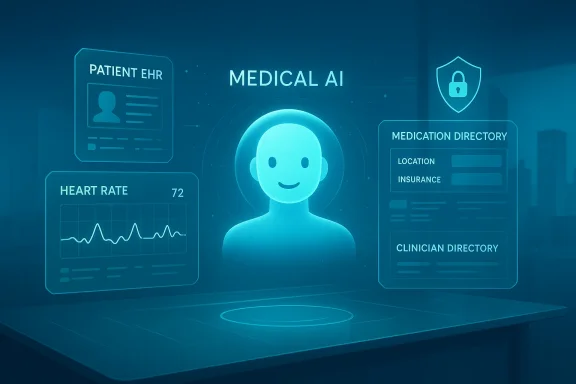
Futuristic Medical AI interface showing a friendly avatar and patient data holograms.Background​

Microsoft has been accelerating investments in healthcare AI for several years, building clinical assistants for hospitals and tools for clinicians while also expanding consumer-facing Copilot services across devices and applications. Copilot Health arrives at a moment when major tech firms and cloud providers are racing to make AI useful — and profitable — in health care. The company positions this product as a distinct, secure space inside the broader Copilot experience: a place where users can ask medical questions, surface insights drawn from their own data, and search for clinicians or care options tailored to their location and insurance.
From a product standpoint, Microsoft frames Copilot Health as augmentation, not replacement: the company repeatedly clarifies the service is not intended to replace professional medical advice. Still, the launch narrative leans heavily on a more ambitious long-term thesis: that increasingly sophisticated AI systems — exemplified by Microsoft’s internal research platform, the Microsoft AI Diagnostic Orchestrator (MAI‑DxO) — can combine breadth and depth of clinical knowledge to approach what the company terms “medical superintelligence.”
This announcement matters on several levels. It extends AI-driven health experiences into the consumer market, it attempts to blend personal data with sophisticated clinical models, and it raises immediate questions about safety, privacy, clinical validation, and regulatory oversight.

Overview: What Copilot Health Promises​

Core value proposition​

Copilot Health aims to be a centralized health assistant that can:
  • Ingest and harmonize electronic health records (EHRs), user-entered health history, and wearable device data.
  • Surface personalized observations and trends (for example, changes in heart rate patterns, medication interactions, or gaps in preventative care).
  • Answer clinical questions in natural language and link explanations to authoritative guidance.
  • Help users search for local clinicians and specialists with filters for location and insurance coverage in the U.S.
  • Route or escalate to licensed providers where appropriate, depending on the product’s integration with provider networks.
Microsoft’s messaging emphasizes that Copilot Health will only show AI features that have passed rigorous clinical evaluations and will label them clearly. The product is initially launching in English in the United States for users aged 18 and older, with regional expansion planned later.

The clinical backbone: MAI‑DxO and the idea of “medical superintelligence”​

A prominent technical claim tied to this rollout is the company’s work on the Microsoft AI Diagnostic Orchestrator, or MAI‑DxO, a system designed to emulate a virtual panel of physicians working collaboratively on diagnostic cases. Microsoft has reported high performance in controlled experiments, using cases published in peer-reviewed medical journals to benchmark the system. The company presents MAI‑DxO as a stepping stone toward more powerful, safety‑tested health copilots.
Microsoft also says Copilot Health was developed with its internal clinical team and an external advisory panel of clinicians — reportedly numbering in the hundreds and spanning multiple countries — to guide design, safety modeling, and clinical evaluation.

How Copilot Health Works (Product Architecture and Data Flow)​

Data sources and personalization​

Copilot Health is designed to integrate multiple personal data streams to generate context-rich responses:
  • Electronic health records (EHRs): Users can connect or upload records so that the assistant has a baseline of diagnoses, medications, allergies, and past encounters.
  • Wearables and sensors: Activity and biometric streams (heart rate, sleep, step count) are used to detect trends or red flags.
  • User-reported information: Symptoms, family history, and lifestyle data provide additional context.
  • Curated clinical knowledge: The system is said to ground answers in materials from established health organizations and clinical references.
The system reportedly uses retrieval-augmented generation (RAG) techniques — combining a knowledge retrieval layer with generative models — to produce answers grounded in retrieved documents rather than purely invented text. Microsoft asserts the platform will attach source material to answers so users can see where guidance came from.

Model orchestration and safety layers​

Rather than relying on a single large language model, Microsoft’s architecture for medical applications appears to use an orchestration approach: multiple models and subcomponents handle tasks like clinical reasoning, triage, and retrieval, with guardrails layered on top to detect hallucinations, unsafe outputs, and requests requiring escalation.
Key safety elements described in the company’s materials include:
  • Clinical validation pipelines that evaluate outputs against expert-labeled cases before release.
  • Transparency labels that identify when an answer is AI-generated and whether it is based on personal data or public references.
  • Human-in-the-loop review for higher-risk outputs or product features.
  • Access controls and encryption that protect health data in transit and at rest, tied to Microsoft’s enterprise compliance tools.

Clinical Validation: What Microsoft Has Demonstrated — and What’s Still Unknown​

Reported MAI‑DxO performance​

Microsoft has published internal results—benchmarked on curated clinical cases such as those published in major medical journals—which suggest MAI‑DxO achieves significantly higher diagnosis accuracy in those constrained scenarios than individual physicians or traditional baselines. In that setting, Microsoft reports accuracy rates as high as 85% on selected case sets, and claims performance that is multiple times better than physician panels in some experiments.
These results are notable and, if reproducible, could signal meaningful clinical potential. However, there are important caveats:
  • The datasets used for benchmarking are carefully constructed case vignettes (for example, NEJM case records) and may not reflect the messy, incomplete, and ambiguous data typical of real-world clinical practice.
  • Performance on curated test sets does not automatically translate to safety and effectiveness across broad, heterogeneous patient populations.
  • There is limited public detail on how the model handles missing or conflicting data, how it reasons under uncertainty, and how it prioritizes differential diagnoses.

External review and transparency​

Microsoft says it has engaged an external advisory panel of clinicians during development and plans to publish peer-reviewed evaluations of the MAI‑DxO work. Independent, peer‑reviewed validation is essential for any claim of clinical efficacy; without it, impressive internal numbers are necessary but not sufficient.
I verified that Microsoft has publicly discussed MAI‑DxO’s benchmarking results and has a pipeline for continuing research and publication. That said, widespread clinical adoption requires multi-center prospective trials and evaluations across diverse populations — steps that have not been completed or publicly disclosed for Copilot Health at launch.

Privacy, Security, and Compliance​

Data stewardship in consumer health AI​

Combining EHR data and wearables creates substantial privacy obligations. Microsoft’s enterprise tools include Purview, compliance frameworks, and encryption features that are designed for health systems and regulated customers, and the company has announced features intended to isolate health data within a secure Copilot space.
Key privacy and security considerations:
  • HIPAA applicability: HIPAA regulates covered entities and their business associates, not consumer-facing apps per se. Whether Copilot Health’s handling of EHR data creates a HIPAA-covered relationship depends on integration details with healthcare providers and business associate agreements.
  • Data minimization and retention: Consumers should be informed about what data is stored, for how long, and how it can be deleted. Clear controls for exporting or removing data are necessary.
  • Legal access and subpoenas: Like any data stored in the cloud, Copilot Health data could be subject to legal process unless special legal protections apply.
  • Third‑party model dependencies: If model orchestration calls external partner models, data flows to those models must be tightly governed and auditable.
Microsoft indicates Copilot Health will draw on established security and compliance tooling and will provide distinct safeguards for health data. Still, consumer trust hinges on granular, transparent controls and legal commitments — not just marketing claims.

Encryption, consent, and device security​

Wearables and mobile devices introduce endpoint risks. Consent flows need to be explicit: users should know whether their data is being uploaded, how it will be used for model training or personalization, and whether de-identified data may be reused for research.
Microsoft says health features will be clearly labeled and only released after evaluation, but product teams must publish clear privacy defaults and controls at launch to meet consumer expectations.

Regulatory and Ethical Considerations​

Will Copilot Health be regulated as a medical device?​

A central question is whether any given feature of Copilot Health meets the legal definition of a medical device in a jurisdiction like the United States. The regulatory status depends on:
  • The intended use and claims (diagnostic vs. general informational support).
  • The risk class of the software’s function.
  • Whether outputs are actionable clinical recommendations.
Microsoft has previously cautioned that some of its clinical tools are not medical devices and included disclaimers. For consumer-facing diagnostic or triage features that influence clinical decision-making, regulatory clearance or approval may be necessary. At the time of launch, Microsoft’s public materials emphasize clinical evaluation and labeling, but they do not indicate blanket regulatory clearances for all Copilot Health features.
Consumers and clinicians should treat actionable diagnostic outputs cautiously until regulators and independent reviewers confirm safety and efficacy in the real world.

Bias, equity, and data representativeness​

Any clinical AI trained on limited or skewed datasets will carry biases. Microsoft claims to have consulted clinicians across many countries and to have used clinical sources from dozens of countries to broaden coverage. That outreach is positive but does not eliminate risks:
  • Wearable data is unevenly distributed across socioeconomic lines; models that rely on long-term wearables may underperform for those without access.
  • Clinical documentation practices vary by health system and geography, which can introduce representational gaps.
  • Minority populations and rare diseases are frequently underrepresented in development datasets.
Until prospective, diverse evaluations are released, we should assume bias risks remain and treat model outputs as one input among many, not a definitive answer.

Clinical Workflow and Provider Impact​

Opportunities for clinicians​

If Copilot Health’s tools reliably surface trends, medication interactions, or gaps in preventive care, they could:
  • Reduce administrative burden by summarizing records and highlighting high-impact issues.
  • Improve patient engagement through personalized education and triage suggestions.
  • Help primary care teams prioritize patients at highest risk.
Microsoft already has enterprise tools (Dragon Copilot, DAX) aimed at clinicians; Copilot Health appears intended to expand the consumer-facing layer, while enterprise products focus on clinical workflows.

Burden and downstream effects​

There are also risks of increased workload and alert fatigue. If millions of users receive AI-generated recommendations and seek clinician follow-up, care systems must be prepared to handle the surge. Insurers and telehealth providers offering in-app escalation could partially mitigate access issues, but the net impact on primary care and specialty wait times is uncertain.

Consumer Experience: What to Expect at Launch​

  • Copilot Health will be available in English in the United States for adults (18+).
  • The experience emphasizes clear labeling and links to authoritative material for answers.
  • Users can expect integration with EHRs and wearables where those connections are supported.
  • The product will provide directories to find clinicians and potentially show insurance and location filters.
Microsoft says features will roll out gradually and only after clinical evaluation. Early adopters should treat the assistant as a guide for questions and navigation, not a substitute for professional clinical judgment.

Strengths: Where Copilot Health Could Matter​

  • Personalized synthesis of disparate data: Very few consumer tools can fuse EHRs, wearables, and conversational AI in a single interface. That integration has practical value for patients managing chronic conditions.
  • Clinical-scale model orchestration: If MAI‑DxO’s orchestration techniques generalize, they could provide more robust reasoning than single-model answers.
  • Transparency and labeling commitments: Microsoft’s stated intent to label AI outputs and publish evaluation results is a constructive step toward responsible deployment.
  • Potential for improved access: For patients in underserved areas, better triage and navigation can help connect people to appropriate care faster.

Risks and Limitations: What Could Go Wrong​

  • Overconfidence and misdiagnosis: Generative systems can be persuasive even when incorrect. Without strong guardrails, people may act on faulty recommendations.
  • Insufficient external validation: Internal benchmarks are useful but not definitive. Independent, peer-reviewed and prospective clinical trials are required to confirm safety.
  • Privacy and legal exposure: Storage of sensitive health data with cloud providers raises questions about data access, retention, and legal protections.
  • Regulatory gray zones: Blurred lines between information and medical advice complicate regulatory oversight and can place companies at legal risk if harms occur.
  • Health equity concerns: Disparities in device access and representativeness of training data may reduce effectiveness for vulnerable populations.
  • Healthcare system burden: Increased patient follow-ups driven by AI recommendations could strain clinicians and escalate costs.

Practical Guidance for Users and Clinicians​

  • Treat Copilot Health as an information and navigation tool, not a definitive diagnosis engine.
  • Verify important medical suggestions with a licensed clinician before changing treatment or medications.
  • Use the product’s privacy controls: review data sharing settings, retention policies, and deletion options.
  • Clinicians should anticipate and plan for patient-generated AI outputs in workflows, clarifying how to triage AI-originated questions.
  • Health systems evaluating integration should require contractual commitments on data governance, auditability, and performance monitoring.

What Regulators and Policymakers Should Watch​

  • Distinguish features that are purely informational from those that make diagnostic or treatment recommendations; the latter should trigger higher regulatory scrutiny.
  • Require transparent public evaluations and post-market surveillance for consumer health AI.
  • Mandate clarity on data usage, including whether consumer data is used for model training or research.
  • Ensure equitable access and require bias audits across diverse patient subgroups.
  • Encourage interoperability standards that let patients port data and control where it’s used.

Conclusion​

Microsoft’s Copilot Health is a high‑stakes experiment in bringing clinical-scale AI to everyday consumers. The product leverages years of enterprise healthcare investments, an orchestration approach to clinical reasoning, and promises of rigorous evaluation. If the company delivers on transparent validation, privacy-first data governance, and robust regulatory compliance, Copilot Health could become a useful tool for patients navigating complex health questions.
But lofty internal benchmarks and persuasive conversational answers do not substitute for independent validation, careful regulation, and the cautious stewardship that healthcare requires. For now, Copilot Health should be viewed as a well‑resourced, ambitious assistant that can augment health literacy and navigation — a helpful companion that can point you to possibilities, not a replacement for a trained clinician’s judgment. Users, clinicians, and regulators will need to insist on transparency, rigorous external evaluation, and clear safeguards as this technology moves from preview to everyday use.

Source: Phandroid Microsoft's "Copilot Health" is Designed to Answer Medical Queries Online - Phandroid
 

Microsoft’s Copilot Health preview reframes the company’s consumer AI play into something far more intimate: a privacy‑segmented, U.S.‑only workspace that promises to ingest electronic health records, lab results and continuous wearable telemetry, then synthesize those fragments into plain‑language explanations, trend highlights and appointment‑ready next steps.

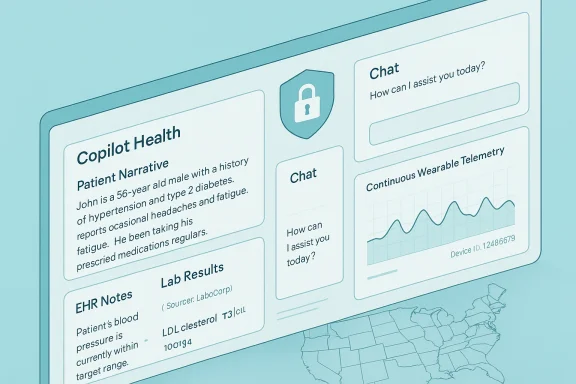
Copilot Health dashboard showing patient narrative, chat, lab results, and wearable telemetry chart.Background​

Microsoft has been steadily expanding the Copilot family from productivity helpers into verticalized assistants tailored to specific domains, and healthcare has emerged as a major frontier. Earlier Microsoft efforts like Dragon Copilot targeted clinical workflows and ambient documentation for providers, signaling the company’s long-term intent to embed AI across the health IT stack.
Copilot Health is the consumer‑facing extension of that strategy: a “health lane” inside Copilot where users can place their personal medical data and wearable streams in service of clearer context and better preparation for clinical encounters. The preview, announced in mid‑March 2026, is explicitly pitched as a tool to help people understand the connections between symptoms, bloodwork and device metrics—not as a replacement for medical professionals.

Overview: what Copilot Health says it will do​

At launch the product is a preview available to U.S. adults with an early‑access waitlist. The core capabilities Microsoft has described include:
  • Aggregation of clinical data such as EHR notes, prescriptions and laboratory reports into a single personal workspace.
  • Ingestion of continuous telemetry from consumer wearables — examples called out by commentators include Apple Health, Fitbit and similar trackers — to provide longitudinal physiological context.
  • Natural‑language synthesis that turns discrete measurements, imaging results and symptom descriptions into coherent stories and actionable suggestions for patients.
  • Privacy segmentation that separates clinically focused interactions from general Copilot chats and (as Microsoft emphasizes) from the company’s broader model‑training pipelines.
Those elements combine into what TrendHunter and multiple contemporaneous reports frame as part of a larger movement toward unified personal health data and AI‑generated health narratives—an attempt to reveal trends invisible in siloed records and to surface clinically meaningful signals derived from real‑world device telemetry.

Why this matters now: the trend context​

Three converging trends make Copilot Health a particularly consequential initiative:

1. Explosion of personal data sources​

Wearables, home devices and patient portals have multiplied the number of places a person’s health information can live. Users increasingly accumulate device streams and lab PDFs but lack an easy way to see how a week‑to‑week heart‑rate pattern correlates with medication changes or lab anomalies. Microsoft’s preview explicitly targets that fragmentation by offering an AI layer to harmonize these signals.

2. Advances in natural language synthesis​

Large language models (LLMs) and domain‑aware systems can now translate raw clinical text, tables and time series into concise narratives that are more accessible to non‑clinicians. Copilot Health’s promise to turn “symptoms, bloodwork, and images into coherent stories” builds on this capability but also inherits its known limitations (hallucination risk, contextual misinterpretation), which we’ll address below.

3. Interoperability pressure and new workflows​

Health systems and device vendors have been moving toward more open data exchange. Consumer platforms that can bridge device ecosystems and clinical records could enable continuous monitoring scenarios and preventive care models that are more proactive than episodic. Copilot Health sits at the intersection: a consumer hub that must earn trust from both device makers and clinical providers to be useful.

How Copilot Health is positioned: product and privacy design​

Microsoft describes Copilot Health as a privacy‑segmented “lane” inside Copilot. That design is intended to reassure users that medical conversations are treated differently from routine assistant queries, and that the data ingested will be governed by stricter provenance and access controls. Early coverage stresses the separation and the company’s emphasis that Copilot Health is not a replacement for licensed care.
Key product components reported by early briefings include:
  • A private workspace for personal health records and device telemetry that the user controls.
  • AI‑driven summaries that prepare users for appointments and help them ask better questions of clinicians.
  • Trending and anomaly detection across longitudinal data to surface changes worth clinical attention.
These are powerful use cases in principle. The challenge will be execution: ingesting diverse file formats, mapping terms across different EHR vendors, and aligning device metrics (which vary significantly by platform) into clinically meaningful units. Microsoft’s prior healthcare projects—such as Dragon Copilot for clinician documentation—show the company understands clinical workflows, but consumer health brings a different set of risks and regulatory constraints.

Industry implications: who gains, who must adapt​

Healthcare providers​

AI summaries and pre‑visit trend reports can shorten the time clinicians spend on history gathering and surface subtle longitudinal trends before a visit. That could improve triage and decision‑making, especially in overloaded primary care settings. However, integrating consumer‑generated insights into clinical workflows raises questions about data provenance, liability, and the additional verification burden on clinicians. Several professional workflows will need new rules to accept or reconcile AI‑curated patient summaries with authoritative clinical records.

Consumer wearables and device makers​

Wearable vendors have historically presented raw metrics and basic trends; aggregated analytics from a platform like Copilot Health could let them shift to clinically meaningful insights, increasing device stickiness and perceived medical value. Device vendors that proactively enable standardized, interoperable exports will have a competitive advantage—those that don’t may be left out of integrated care narratives.

Digital health platforms and intermediaries​

Platforms that specialize in ingestion, normalization and AI interpretation of heterogeneous health data are well positioned to offer subscription services and white‑label clinician decision support. Copilot Health’s arrival will likely accelerate investment in middleware that can bridge EHR formats, wearable APIs and lab data feeds—creating opportunities for startups and existing health‑IT firms.

Strengths: what Copilot Health could deliver well​

  • User‑centric synthesis. Many users already have PDFs from labs and screenshots of device graphs; offering a coherent narrative that ties these together lowers the barrier to understanding and could improve health literacy.
  • Longitudinal insights. Continuous wearable streams provide context that single clinic snapshots cannot; combining these with EHR timelines could reveal medication‑related trends or early warning signs of chronic deterioration.
  • Appointment preparation. Summaries and suggested questions can make clinical encounters more focused and efficient, potentially improving the clinician‑patient dialogue and decision quality.
  • Platform advantage for Microsoft. If Microsoft successfully integrates Copilot Health into the broader Copilot ecosystem and Microsoft 365 workflows, the company could be the default place consumers choose to centralize health data, increasing engagement across services.

Risks and limitations: what can go wrong​

  • Accuracy and hallucination. LLM‑driven summaries can misstate relationships or generate plausible‑sounding but incorrect assertions. In health, even small factual errors can have serious consequences. Early reporting repeatedly flags the tension between helpfulness and clinical risk. Users and clinicians must treat AI outputs as advisory, not determinative.
  • Data provenance and trust. Consumer device metrics vary by manufacturer and model; integrating those signals with EHR labs demands rigorous normalization and provenance tracking so clinicians know what to trust. Without transparent data lineage, clinicians may be reluctant to act on AI‑generated summaries.
  • Liability and clinical responsibility. When a consumer receives AI‑generated “next steps” and acts on them, questions arise about who bears responsibility if outcomes are adverse. Microsoft’s messaging that Copilot Health is not a replacement for care acknowledges this issue, but regulatory and legal frameworks remain unsettled.
  • Privacy and governance. Centralizing sensitive health data in a consumer AI platform intensifies privacy risk. While Microsoft promises privacy segmentation, the mechanics—encryption at rest, data sharing policies, audit logs and how data may interact with other Microsoft services—will determine real user risk. Early previews emphasize separation, but the details will matter.
  • Inequity and access. Services that rely on wearables and portals risk widening disparities: those with newer devices, stable broadband and digital literacy will get richer insights while underserved populations may see no benefit. Designing for equity will require alternative data‑collection pathways and low‑barrier UX.

Interoperability and technical hurdles​

Making a unified health assistant work requires surmounting longstanding interoperability challenges. Copilot Health needs to reliably ingest:
  • EHR exports and structured data from thousands of providers with divergent schemas.
  • Laboratory reports in many formats and units that must be normalized to clinical reference ranges.
  • Continuous time‑series telemetry from multiple wearable manufacturers, each with different sampling rates, sensor calibrations and meaning for derived metrics (e.g., resting heart rate vs. sleep‑stage heart‑rate estimations).
Those are nontrivial engineering problems. Middleware that exposes standardized interfaces and rigorous metadata will be essential. Platforms that can demonstrate robust mapping, unit conversion and provenance tracking will have a decisive advantage in persuading clinicians to rely on AI summaries.

Governance: regulatory and ethical contours​

Copilot Health touches on regulated terrain. Bringing clinical summaries to consumers intersects with medical device and health information protection regimes, raising these governance questions:
  • How will regulators view AI summaries that suggest actions? Will certain outputs be considered clinical decision support subject to oversight? Early reports note Microsoft’s careful language around not replacing clinicians, but regulatory clarity is still evolving.
  • What are the requirements for auditability and model provenance when used in a health context? Transparent model behavior and documented training sources become critical when outputs affect clinical decisions.
  • How will HIPAA and other privacy frameworks govern consumer‑side integrations that pull data from provider systems into a corporate cloud? Microsoft’s privacy segmentation and enterprise health ties provide some context, but legal boundaries will need to be tested and clarified.
These are not academic concerns: product teams, health system partners and regulators will need to work in lockstep before the feature moves beyond preview.

Practical advice for IT leaders and clinicians​

If you’re a health system CIO, clinician leader or IT pro evaluating whether to pilot Copilot Health with patients, consider these pragmatic steps:
  • Start with a limited pilot population and defined clinical questions where longitudinal device context is likely to add value (e.g., heart‑failure monitoring, arrhythmia follow‑up, or metabolic syndrome management).
  • Insist on explicit provenance and audit logs for each AI assertion—clinicians should be able to trace recommendations back to source labs or device streams.
  • Create a verification workflow: AI summaries should be a triage tool, not an automated action engine; require clinician confirmation before care changes are made.
  • Address equity: provide alternatives for patients without wearables or reliable portal access, and monitor for disparities in who benefits from the service.
These steps reduce risk while allowing organizations to learn how AI‑assisted patient narratives can complement clinical judgment.

Business models and market reactions​

Copilot Health could catalyze business shifts across three fronts:
  • Device makers may reposition themselves as data suppliers into more clinically oriented ecosystems rather than standalone consumer gadgets. This could create licensing or data‑sharing agreements with platform providers.
  • Digital health intermediaries that provide normalization and analytics could monetize through enterprise partnerships, white‑label services or subscription models tied to patient engagement.
  • Healthcare organizations may experiment with patient‑facing AI summaries as part of value‑based care efforts to reduce preventable admissions and improve chronic‑disease management. If Copilot Health demonstrably improves early detection or adherence, payors and health systems will take notice.
However, monetization will be contingent on trust and verifiable clinical value. If clinicians treat AI outputs as noise, the platform economics will struggle. Early product success will therefore depend as much on governance and integration work as on raw AI polish.

What to watch next (signals of healthy product maturation)​

  • Clearer interoperability commitments and partner lists from Microsoft that show which EHRs and wearable manufacturers are supported. Early previews mention broad goals but details will determine adoption.
  • Published safety evaluations or third‑party audits that measure Copilot Health’s accuracy on real patient records and compare AI summaries to clinician judgments. Independent validation will be essential to reduce clinician skepticism.
  • Regulatory guidance or precedent clarifying when consumer AI health assistants cross into regulated medical device behavior. Any enforcement actions or guidance will shape product design choices.
  • Evidence of meaningful clinical outcomes in pilot studies—reduced no‑shows, improved medication adherence or earlier detection of deterioration—that can justify scale. Payors and health systems will look for ROI signals.

A constructive skepticism​

Copilot Health represents a bold and logical next step for platform companies: build the hub where users collect their most sensitive, consequential data. The promise is compelling—personalized, contextualized health narratives that help people make better decisions and use clinical time more efficiently. Yet the list of engineering, clinical and regulatory hurdles is long, and each must be addressed for the promise to become durable.
Early reporting shows Microsoft is aware of these tensions and is positioning Copilot Health as a preview with privacy segmentation and a non‑replacement stance. That is responsible early framing, but it is not a substitute for transparent safety evidence, interoperable standards commitments, and clear governance about who is accountable when AI guidance conflicts with clinician judgment.

Conclusion​

Unified AI health assistants like Microsoft’s Copilot Health point toward a future where personal devices, lab systems and clinical records no longer live in separate silos but feed a single assistant that helps people understand their health story. The potential benefits are real—improved health literacy, better appointment preparation, and earlier detection of trends that matter. But realizing that potential requires engineering rigour, transparent governance, independent validation and careful integration with clinical workflows.
For organizations and clinicians, the sensible path is cautious experimentation: pilot, measure, verify provenance, and protect patients with workflows that keep clinicians in the loop. For consumers, Copilot Health offers promise—if it can demonstrate accuracy, protect privacy and clearly communicate the limits of AI guidance. The coming months of preview testing and independent assessment will determine whether unified AI health assistants become a trusted part of everyday care or another well‑intentioned technology that stumbles on the realities of medicine.

Source: Trend Hunter https://www.trendhunter.com/trends/microsoft-copilot-health/
 

Back
Top