Microsoft’s entry into consumer-facing healthcare AI with Copilot Health is the latest, high-stakes chapter in a fast-moving contest among the cloud giants to own how people ask — and act on — medical questions, and it crystallizes a simple strategic truth: if users are willing to hand over their health data, the winners will be the platforms they already trust to hold everything else.
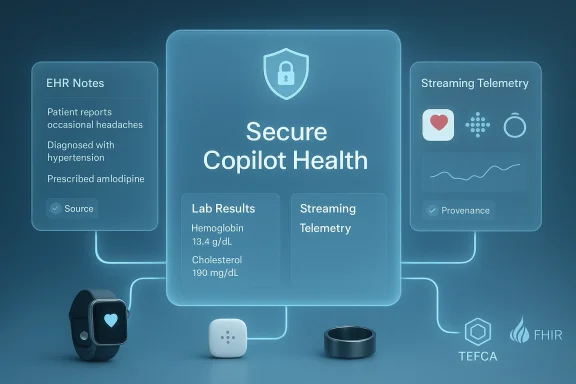
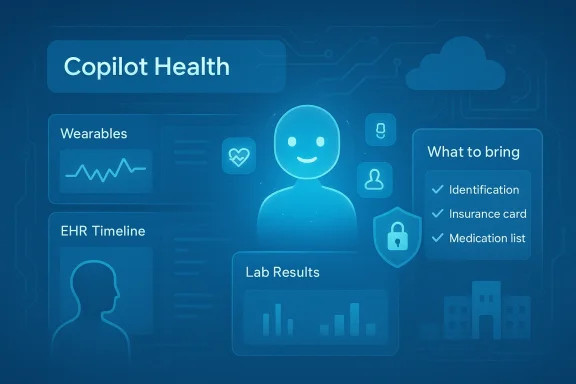
Microsoft announced Copilot Health in a preview that lets U.S. users upload electronic health records, lab results and wearable data so Copilot can synthesize those inputs into personalized insights. The company positioned the capability as part of a broader push to bring Copilot into domain-specific, high-value use cases like healthcare, building on prior investments such as Nuance’s clinical speech stack, Dragon Copilot and enterprise integrations with EHR vendors.
Amazon answered in kind just days earlier with a Health AI agent that integrates its One Medical capabilities and is being expanded to Prime members, offering message-based consultations for a set of common conditions as part of an introductory package. Both launches are initially limited to the United States but signal clear global ambitions from both firms.
Amazon’s architecture for Health AI leverages internal Bedrock/bedrock-like tooling and a multi-agent orchestration approach that offloads specialized tasks to subagents (triage, medication checks, referral routing, etc.) and uses auditor agents to keep safety and compliance checks in the loop. That design reflects Amazon’s operational instinct: automate at scale while embedding fail-safe human escalation points.
A few investor-focused takeaways:
Microsoft and Amazon have staked visible claims on a future where AI sits between ordinary people and their medical world. That future promises greater convenience and better-organized care — but it also rests on fragile ingredients: robust governance, demonstrable safety, airtight data controls, and public trust. Copilot Health and Amazon’s Health AI will move quickly from preview to everyday use only if they can prove those ingredients work at scale; until they do, the prudent approach for users and organizations is cautious experimentation coupled with stringent privacy and clinical safeguards.
Conclusion: This is not a one-off product press release — it is a strategic escalation. Expect rapid iteration, regulatory scrutiny and a battle for user trust, with winners determined less by initial feature lists and more by who can operationalize safety, privacy and clinical accuracy while delivering measurable benefits in real healthcare workflows.
Source: TipRanks MSFT vs. AMZN: Microsoft Launches Copilot Health to Challenge Amazon’s AI Agent - TipRanks.com
 Background
Microsoft announced Copilot Health in a preview that lets U.S. users upload electronic health records, lab results and wearable data so Copilot can synthesize those inputs into personalized insights. The company positioned the capability as part of a broader push to bring Copilot into domain-specific, high-value use cases like healthcare, building on prior investments such as Nuance’s clinical speech stack, Dragon Copilot and enterprise integrations with EHR vendors.Amazon answered in kind just days earlier with a Health AI agent that integrates its One Medical capabilities and is being expanded to Prime members, offering message-based consultations for a set of common conditions as part of an introductory package. Both launches are initially limited to the United States but signal clear global ambitions from both firms.
What Copilot Health actually does
Microsoft’s public description of Copilot Health focuses on three interlocking capabilities:- Aggregation: Users can combine records from providers, lab systems and popular wearable platforms (Microsoft said more than 50,000 U.S. health providers and roughly 50 wearable device types are supported at launch).
- Synthesis: Copilot Health applies Copilot’s multimodal reasoning and Copilot Studio agent orchestration to surface patterns, flag abnormal trends and generate patient‑oriented explanations or next-step suggestions.
- Control and lifecycle: Microsoft says Copilot Health conversations are kept separate from general Copilot chats, encrypted, not used to train its foundational generative models, and can be deleted by users. The company frames these controls as essential to building trust in an arena where data sensitivity is among the highest.
How the product differs from Microsoft’s clinical offerings
It’s important to separate Copilot Health (a consumer/patient-facing assistant) from Microsoft’s enterprise healthcare tooling such as Dragon Copilot, which is explicitly designed to support clinician workflows and EHR documentation. Dragon Copilot and other provider tools are built with different compliance expectations and deployment models (enterprise contracts, HIPAA business‑associate agreements, EHR integrations), whereas Copilot Health is presented as a consumer feature that ingests personal health data under user consent. Microsoft’s prior work in clinical AI gives it technical depth, but the risk and governance models for clinician‑grade AI and consumer health assistants are very different in practice.Amazon’s push: Health AI for Prime and One Medical integration
Amazon’s Health AI rollout follows a two‑stage strategy: first develop clinical-grade features inside One Medical and AWS, then expand consumer access through Prime membership benefits. The initial consumer offer gives eligible Prime members a limited number of free message‑based consultations with One Medical providers to cover “more than 30 common conditions,” with the agent functioning as a multi‑agent system (core agent + subagents + audit/sentinel agents) designed to escalate to human clinicians when needed. Amazon emphasizes HIPAA‑compliant privacy and real‑time auditing agents as part of its safety stack.Amazon’s architecture for Health AI leverages internal Bedrock/bedrock-like tooling and a multi-agent orchestration approach that offloads specialized tasks to subagents (triage, medication checks, referral routing, etc.) and uses auditor agents to keep safety and compliance checks in the loop. That design reflects Amazon’s operational instinct: automate at scale while embedding fail-safe human escalation points.
Security and privacy claims: what the companies promise — and what to verify
Both Microsoft and Amazon emphasize familiar safeguards: encryption in transit and at rest, separate handling of healthcare conversations, deletion controls and internal promises not to use consumer-submitted health data to train broad foundation models. Those commitments are necessary, but they are not the same thing as auditable, third‑party verification of HIPAA compliance, contractual business‑associate protections, or independent security attestations.- Microsoft’s consumer‑facing statements say data in Copilot Health is encrypted and not used to train generative models; they also note the separation of clinical conversations from general Copilot exchanges and offer deletion controls. Those assertions align with Microsoft’s broader Copilot privacy and enterprise controls documentation, which already distinguishes between consumer chat surfaces and enterprise-protected environments.
- Amazon doubles down on HIPAA‑style safeguards inside its One Medical/Health AI context and describes an agent architecture designed with auditing and human escalation. Amazon’s consumer offer for Prime members is explicitly wrapped around One Medical clinicians where human involvement and escalation are central to the safety story.
- A vendor promise “not used to train models” is meaningful but must be operationalized: look for explicit contractual language (data use terms, DPA addenda, SOC reports, third‑party audits). Public statements are a first step; documented, auditable controls are the difference between marketing and risk reduction.
- Data residency and access controls are crucial. Consumer applications that aggregate provider data, labs and wearables create complex flows — copies, transforms, third‑party connectors — that expand attack surface and policy complexity.
- Regulatory risk and liability remain ambiguous. Neither company is offering a medical device approval or claiming to replace clinician judgment; both frame these systems as decision support. That choice reduces regulatory friction but does not eliminate malpractice, liability or data‑protection exposures if erroneous guidance is acted on without clinician supervision.
Clinical safety and accuracy: the gap between “helpful” and “safe”
It’s tempting to treat these new assistants as clinical triage engines, but clinical accuracy and patient safety require more than large-model reasoning.- Clinical validation matters. Amazon says it ran synthetic conversation evaluations plus clinical review pathways; Microsoft points to its enterprise clinical partnerships and prior Nuance/Dragon work as a foundation. Neither claim replaces prospective clinical validation against real-world outcomes.
- Human-in-the-loop remains mandatory for anything beyond informational queries. Both companies appear to design for escalation to clinicians; where that escalation is seamless and timely determines safety for urgent problems.
- Overconfidence and hallucination remain technical risks. Large models are prone to plausible-sounding errors; the healthcare setting amplifies harm when such errors affect diagnosis, medication lists or care escalation decisions. The audit/sentinel agent model Amazon describes and Microsoft’s separation of health conversations are practical mitigations, but they are not foolproof.
Market and strategic implications: Azure vs. AWS in healthcare AI
Healthcare is both strategically attractive and uniquely challenging:- Strategic attraction: Healthcare is a high-margin, high-frequency domain where platform control can create long-term subscription or services revenue and deep user engagement. Access to health data also unlocks differentiated AI products that become sticky when embedded into clinical workflows or personal health routines.
- Competitive positioning: Microsoft’s advantage is enterprise relationships (EHR partnerships, hospital deployments, Microsoft 365 stickiness) and mergers like Nuance, which give it institutional trust. Amazon’s advantage is consumer reach, retail-to-health cross-sell, and an operational model built for scale and logistics — plus Prime as a distribution lever for consumer adoption. Both have cloud advantages (Azure vs. AWS) for training and serving models at scale.
- Open questions: Will providers allow consumer-facing AI to become primary triage points? How will insurers and regulators respond as these systems become more common? The answers will determine monetization pathways (direct-to-consumer subscriptions, provider contracts, insurer partnerships).
Investors and the stock narrative
News moves markets, and healthcare‑AI launches are being read as strategic advantages in the broader AI arms race. TipRanks — one of several analyst aggregate platforms — shows both Microsoft and Amazon carrying Strong Buy consensus ratings from analysts, though the specific upside figures vary by date and data refresh. For example, TipRanks’ Microsoft and Amazon summary pages list consensus Strong Buy ratings and average analyst price targets that imply material upside from then‑current prices; those consensus metrics are actively updated and should be read as short‑term snapshots rather than immutable forecasts.A few investor-focused takeaways:
- Market reaction to product launches like Copilot Health or Amazon Health AI is layered: short-term sentiment may lift shares, but sustainable upside depends on measurable monetization, uptake and regulatory clarity.
- Analyst price targets and “upside potential” figures are useful for framing institutional expectations, but they move quickly as new data arrives; cross-check live aggregator pages and the companies’ earnings commentary for the most accurate picture.
- Competitive differentiation — enterprise partnerships for Microsoft versus consumer distribution for Amazon — will drive different revenue streams and margin profiles, which matters to long-term investors evaluating risk-adjusted returns.
Regulatory and compliance landscape: unresolved but evolving
Regulators globally are still catching up to consumer healthcare AI. A few pragmatic points:- HIPAA and business‑associate obligations apply when covered entities use services that handle protected health information. Microsoft’s enterprise offerings for providers typically include contractual BAAs and enterprise-grade audits; consumer products are more ambiguous, relying on user consent models and product privacy statements rather than formal BAAs unless explicitly wrapped with a provider contract. That difference will matter if providers try to incorporate consumer-uploaded data into clinical records.
- The “not used to train models” pledge can be compliance-positive, but independent verification (SOC 2, ISO/IEC attestations, third‑party audits) will be essential for risk‑averse health systems and large employers.
- Expect evolving enforcement and guidance. Regulators are increasingly focused on algorithmic accountability, transparency around training data, and safety testing in high‑risk domains like health.
What IT leaders, clinicians, and consumers should watch next
- Governance and contracts: Hospitals and clinics evaluating Copilot Health integrations should insist on written BAAs, access controls, encryption details, and audit logs that show who accessed what and when.
- Interoperability details: How Copilot Health ingests EHR data (direct connectors, FHIR APIs, patient-mediated access) determines data fidelity and the effort needed for clinical reconciliation.
- Clinical validation studies: Look for peer‑reviewed or vendor‑sponsored prospective studies that measure accuracy, false positives/negatives and workflow impact before deploying these agents in any safety-critical path.
- Data lifecycle tooling: Confirm whether data can be exported in standard formats, how deletion is implemented (complete erasure vs. logical deletion), and whether derivative artifacts (summaries, embeddings) are treated as the same protection class.
Strengths, risks and the honest trade-offs
Strengths
- Scale and integration: Microsoft and Amazon can combine massive platform reach, cloud compute and enterprise distribution, enabling product rollouts at a velocity few competitors can match. This gives them a realistic path to mainstreaming healthcare AI.
- Engineering depth: Longstanding investments (Nuance for Microsoft; One Medical and AWS for Amazon) provide practical clinical and operational know‑how that reduces some go‑to‑market friction.
- Pragmatic safety designs: Multi‑agent orchestration, auditor/sentinel agents, human escalation and conversation separation are design choices that responsibly acknowledge model limitations.
Risks
- Data governance and trust: Consumers may be reluctant to upload full medical histories absent clear legal guarantees and third‑party audits. Breaches or misuses would cause enormous reputational damage.
- Clinical accuracy and liability: Even well‑designed assistants can hallucinate or misinterpret clinical nuance — the legal and clinical fallout from such errors is unresolved.
- Regulatory and insurer reaction: If payers or regulators constrain AI recommendations or insist on human-only decision authority, the growth and monetization trajectory could be limited.
- Competitive escalation: Expect fast feature cycles and possible feature parity from other entrants (OpenAI, Anthropic, specialty healthcare AI startups). Market leadership will require sustained clinical validation and commercial partnerships, not just a feature announcement.
Practical bottom line for WindowsForum readers
- If you’re a consumer interested in Copilot Health or Amazon’s Health AI: treat these tools as assistants to organize your records, flag trends and prepare for clinician visits — not as replacements for professional care. Confirm deletion controls and privacy settings before uploading sensitive data.
- If you’re an IT or security pro advising a healthcare organization: insist on documented BAAs, independent audit reports, data flow diagrams, and explicit contractual limits on data use and retention before any integration involving protected health information.
- If you’re an investor: view these product launches as strategic positioning in a long multi‑year race. Short‑term stock moves will reflect sentiment; long‑term value will come from validated clinical outcomes, durable revenue models and clear regulatory pathways.
Microsoft and Amazon have staked visible claims on a future where AI sits between ordinary people and their medical world. That future promises greater convenience and better-organized care — but it also rests on fragile ingredients: robust governance, demonstrable safety, airtight data controls, and public trust. Copilot Health and Amazon’s Health AI will move quickly from preview to everyday use only if they can prove those ingredients work at scale; until they do, the prudent approach for users and organizations is cautious experimentation coupled with stringent privacy and clinical safeguards.
Conclusion: This is not a one-off product press release — it is a strategic escalation. Expect rapid iteration, regulatory scrutiny and a battle for user trust, with winners determined less by initial feature lists and more by who can operationalize safety, privacy and clinical accuracy while delivering measurable benefits in real healthcare workflows.
Source: TipRanks MSFT vs. AMZN: Microsoft Launches Copilot Health to Challenge Amazon’s AI Agent - TipRanks.com