

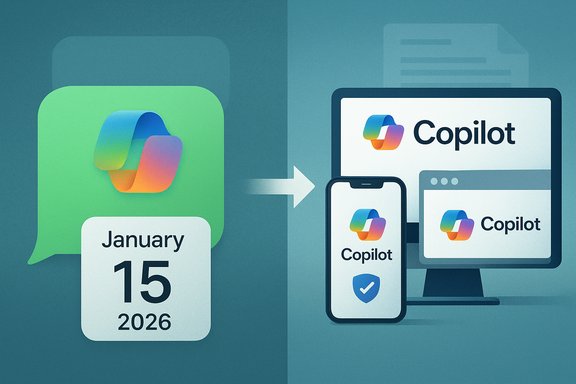
Microsoft confirmed this week that its consumer-facing AI assistant Copilot will be removed from WhatsApp on January 15, 2026, a direct consequence of a WhatsApp Business API policy rewrite that bars third‑party, general‑purpose large‑language‑model (LLM) chatbots from operating through the platform.
Since late 2024, vendors including Microsoft and OpenAI used the WhatsApp Business Solution as a low-friction distribution channel for conversational AI: users could message a Copilot contact in WhatsApp and receive replies without installing a separate app. That era is ending because Meta (WhatsApp’s owner) updated the Business Solution terms in October 2025 to add an explicit prohibition on “AI providers” — language that prevents providers of LLMs, generative AI platforms, and general‑purpose AI assistants from using the Business API when those capabilities are the primary functionality. The policy takes effect January 15, 2026. Microsoft’s official Copilot blog post confirms the service will stop working on WhatsApp on that date and urges users to migrate to native Copilot surfaces (Copilot mobile apps, Copilot on the web, and Copilot on Windows). The company also warns that the WhatsApp integration was unauthenticated and that chat histories cannot be migrated automatically to Microsoft’s account‑linked Copilot experiences — users should export chats if they want to preserve them.
For now, the concrete actions are clear: export any WhatsApp Copilot chats you need, install Copilot’s mobile or web app if you rely on Microsoft’s assistant, and for developers and businesses, start diversifying distribution and building authenticated user experiences today.
Source: Indiablooms Microsoft Copilot AI to leave WhatsApp soon, check the date | Indiablooms - First Portal on Digital News Management
 Background
Since late 2024, vendors including Microsoft and OpenAI used the WhatsApp Business Solution as a low-friction distribution channel for conversational AI: users could message a Copilot contact in WhatsApp and receive replies without installing a separate app. That era is ending because Meta (WhatsApp’s owner) updated the Business Solution terms in October 2025 to add an explicit prohibition on “AI providers” — language that prevents providers of LLMs, generative AI platforms, and general‑purpose AI assistants from using the Business API when those capabilities are the primary functionality. The policy takes effect January 15, 2026. Microsoft’s official Copilot blog post confirms the service will stop working on WhatsApp on that date and urges users to migrate to native Copilot surfaces (Copilot mobile apps, Copilot on the web, and Copilot on Windows). The company also warns that the WhatsApp integration was unauthenticated and that chat histories cannot be migrated automatically to Microsoft’s account‑linked Copilot experiences — users should export chats if they want to preserve them. What changed — the policy in plain English
The new rule
- Meta inserted an “AI Providers” clause into WhatsApp’s Business Solution terms that, in effect, bans general‑purpose chatbots from using the business API as a primary service channel.
- The language is broad and gives Meta discretion to determine what counts as an “AI Provider” or “general‑purpose” assistant.
- The effective date is January 15, 2026, giving vendors and users a clear (but relatively short) runway to migrate.
What is still allowed
- Businesses may continue to use WhatsApp’s Business API for customer support, transactional messages, booking flows, notifications, and other incidental AI uses where automation is a small part of a larger business process.
- The restriction targets standalone AI assistants whose primary purpose is open‑ended conversation.
Immediate practical effects for users
Microsoft and other vendors will stop responding to messages sent to AI contacts inside WhatsApp after January 15, 2026. The most important user-facing points are simple and concrete:- Copilot on WhatsApp will continue to work until January 15, 2026; after that point it will cease to function.
- Because the WhatsApp integration was unauthenticated, Microsoft cannot port your WhatsApp-based Copilot history into Copilot’s account-based services automatically — export your chats if history matters to you.
- Copilot remains available via the Copilot mobile apps (iOS and Android), copilot.microsoft.com on the web, and the Copilot experience built into Windows; Microsoft says these surfaces include additional capabilities like Copilot Voice and Copilot Vision.
Why Meta changed course — stated reasons and plausible incentives
WhatsApp’s official explanation frames the change as a restoration of the Business API’s design intent: it exists to support businesses communicating with customers, not to serve as a mass distribution channel for consumer-facing chat assistants. Meta also cited operational strain: the unprecedented message volume generated by third‑party LLMs required different moderation, support, and engineering commitments than typical business traffic. But platform policy rarely lives in a vacuum. Independent reporting and regulatory probes highlight additional motives and consequences:- Restricting third‑party general-purpose assistants gives Meta more control over the AI experiences inside WhatsApp — a strategic advantage if Meta intends to surface its own assistant (Meta AI) as the native, integrated experience.
- Regulators are taking notice: Italy’s competition authority has broadened an antitrust probe into Meta over AI tools in WhatsApp and the new Business Solution terms, citing concerns that the policy could harm competition. That formal scrutiny underscores the competitive stakes of the rule change.
Why Microsoft (and others) relied on WhatsApp — and why removal matters
WhatsApp provided a compelling distribution model for AI assistants:- Massive reach and low friction: users could access AI inside an app many already use daily, without installing new software.
- Viral discovery: a contact or phone number is easy to share and embed in marketing.
- Simplicity for casual use: users seeking occasional help (summaries, quick drafting, image generation) didn’t need a full account flow.
Broader ecosystem consequences
For consumers
- Short-term friction: users who relied on WhatsApp for quick AI access must install apps, visit web pages, or find alternative messaging channels.
- Data portability headaches: unauthenticated integrations mean chat histories often live only on-device in WhatsApp and must be exported manually; failure to export before the January 15 deadline risks permanent loss of conversational context.
For startups and AI vendors
- Loss of a low-cost acquisition channel: many smaller AI startups used WhatsApp to reach broad audiences with minimal product friction. Those vendors now must invest in native apps, web experiences, or alternate messaging platforms (Telegram, SMS) — all costlier to scale.
- Business model pressure: discovery and conversion funnels may worsen; building a sustainable, account‑based experience is more expensive than offering an unauthenticated WhatsApp contact.
For platforms and competition
- Centralization risk: when major platforms restrict third‑party integrations, they consolidate distribution power and the data advantages that come with it — a core reason regulators are watching closely. Italy’s regulator expanding its probe is the first clear sign of legal scrutiny.
Technical and privacy implications
Authentication and data portability
The distinction between authenticated, account‑linked assistants and unauthenticated chat contacts is central. Authenticated experiences provide:- Account-linked history that can sync across devices.
- Integrated access to permissions and enterprise controls (e.g., Microsoft 365 data for enterprise Copilot).
- Predictable rate limits, billing, and policy enforcement.
Moderation and system load
Open, general-purpose assistants create unpredictable load and moderation complexity: long sessions, media generation, and high message velocity create engineering and safety burdens for a messaging platform designed around predictable business traffic. Meta cited these operational reasons in justifying its policy change.What users and admins should do now — practical checklist
- Export WhatsApp Copilot chats you want to keep before January 15, 2026. Use WhatsApp’s built-in export tools on iOS or Android; exports vary by media types and platform.
- Install the Copilot mobile app (iOS/Android) or bookmark copilot.microsoft.com on the web to preserve access after the WhatsApp cutoff.
- If you used ChatGPT or other assistants in WhatsApp, follow those vendors’ linking/migration guidance today — some vendors permit account linking that preserves history.
- For businesses that used AI via WhatsApp: verify whether your use case is eligible as an incidental AI feature (customer support flows) or whether the new terms require a migration to other channels or to a business partner program with Meta.
Strategic implications for Microsoft and other AI firms
Short-term: migration and messaging
Microsoft’s immediate message is straightforward: migrate users to first‑party surfaces and emphasize the superior capabilities (auth, multimodal features, synchronization). That reduces friction for power users and enterprise customers, but it’s not neutral for casual users who will miss the simplicity of an in-chat contact.Medium-term: product posture and distribution
Expect vendors to:- Double down on first‑party apps and web experiences that preserve account history and enable subscriptions or enterprise controls.
- Build or strengthen alternate messaging integrations where platform rules differ (Telegram, RCS, SMS).
- Re-examine the economics of offering a free, unattached contact vs. driving users to a paid or monetizable first‑party surface.
Long-term: who owns the assistant layer?
This policy shift is part of a broader industry pattern: platform owners are increasingly curating which third‑party services may sit inside their dominant properties. That can create closed gardens around high-value touchpoints (messaging, search, social feeds) and favor in‑house or tightly controlled partners. Regulators in Europe and other jurisdictions will likely keep watching.Risks, strengths, and unanswered questions
Strengths of Meta’s approach (from its perspective)
- Reduces operational load and moderation complexity from unpredictable LLM traffic.
- Reinforces the Business API’s enterprise/commercial focus.
- Creates runway to integrate Meta’s own assistant as a native experience.
Risks and downsides
- Competitive suppression concerns: broad, discretionary language could be used to favor first‑party services and harm rivals, which is why antitrust authorities are paying attention.
- User inconvenience and potential loss of data for users who fail to export conversations.
- Startup churn: small vendors lose a low-cost user acquisition and distribution channel.
Unverifiable or disputed claims
- The degree to which strategic competition (rather than operational necessity) drove the policy cannot be proven from public statements alone; it is a plausible inference supported by market context and regulatory attention, but it remains an interpretation. Readers should treat such motive claims as analytical rather than conclusive.
How developers and businesses should adapt
- Prioritize authenticated product experiences. Account linking reduces portability risk and gives access to richer features and billing models.
- Diversify distribution channels. Reliance on a single messaging API for customer acquisition is a fragile strategy.
- Architect for rate limits and moderation. If you plan to operate at scale, build batching, backpressure, and content moderation into the stack to avoid sudden cutoffs.
- Keep legal and regulatory teams engaged. Policy shifts like this may have jurisdictional knock-on effects; prepare for inquiries if your product was materially affected.
The future of conversational AI distribution
This event is an inflection point, not an endpoint. Expect a few parallel developments:- Consolidation toward first‑party and account‑based surfaces where vendors can sustain richer experiences and monetization.
- Platform-specific carve-outs: some messaging vendors will favor third‑party integrations; others will centralize AI in‑house.
- Increased regulatory oversight where dominant platforms’ policy changes have anti‑competitive effects.
- New technical patterns to enable safer, lighter in-chat assistants (rate-limited agents, third‑party “widgets” with stricter controls, or brokered integrations that satisfy platform rules).
Conclusion
The removal of Copilot from WhatsApp on January 15, 2026 crystallizes a larger shift in how conversational AI will be delivered: platforms are reclaiming control of their messaging channels, favoring authenticated, revenue-friendly surfaces over low‑friction, unauthenticated contacts. Microsoft’s guidance to migrate users to Copilot apps and the web is pragmatic and technically sensible, but the change imposes real costs on users and smaller vendors that treated WhatsApp as a primary distribution layer. Regulators’ rapid interest makes this story as much about market structure and competition as it is about technical policy.For now, the concrete actions are clear: export any WhatsApp Copilot chats you need, install Copilot’s mobile or web app if you rely on Microsoft’s assistant, and for developers and businesses, start diversifying distribution and building authenticated user experiences today.
Source: Indiablooms Microsoft Copilot AI to leave WhatsApp soon, check the date | Indiablooms - First Portal on Digital News Management
