

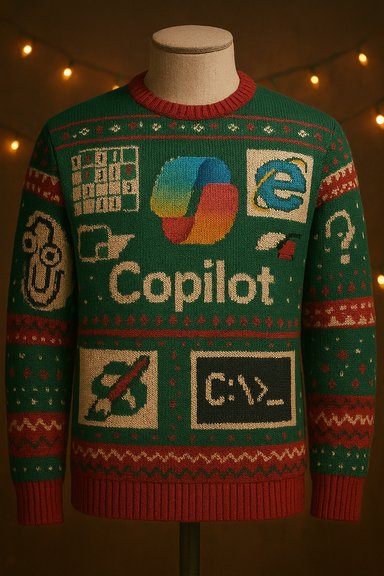
Microsoft putting the Copilot AI logo on its 2025 “Artifact” ugly Windows sweater is more than a quirky holiday merch decision — it’s a revealing moment in Microsoft’s year-long campaign to normalize Copilot as an omnipresent part of Windows, and a tiny but telling example of why that campaign increasingly collides with user fatigue, brand confusion, and a growing public conversation about how—and whether—AI should be stitched into everyday software experiences.
Background
Microsoft’s annual ugly sweaters have become a cult holiday tradition: pixel nostalgia, intentional kitsch, and a little corporate self-parody rolled into limited-run apparel. The “Artifact” sweater for 2025 reunites familiar retro graphics — Clippy, Minesweeper, Internet Explorer, MS-DOS and the old Windows 3.0 brush icons — and places the 2020s squarely among the 1990s throwback imagery by adding modern Microsoft emblems, including the Copilot logo. The company’s official Windows Experience Blog lays out the icon collage and confirms Copilot’s inclusion among the sweater’s motifs. The broader context matters. Microsoft paused its public sweater sales in 2024 and returned in force this holiday season with three designs: the Artifact sweater, a Zune-brown throwback, and an Xbox green variant. Prices and distribution were confirmed through Microsoft’s channels and coverage in mainstream tech press; this is not an underground gag but an explicit corporate branding exercise.Why a Copilot logo on a novelty sweater is noteworthy
A sweater is, in isolation, a harmless piece of seasonal merch. But branding decisions function as signals. Putting Copilot — Microsoft’s generative-AI umbrella brand and an in-OS assistant that has driven both product strategy and marketing this year — directly next to Clippy and the Minesweeper tiles does three things at once:- It positions Copilot as an icon in Windows history, not merely a feature.
- It sends a cultural message: Copilot is as much a part of Microsoft lore as the pixelated Paintbrush.
- It highlights the company’s desire to normalize Copilot through playful visibility, even in contexts where it may clash with user sentiment.
The hard reality: Copilot’s mixed reception
For many users, Copilot is a promise as much as a product — and promises are judged against day-to-day usefulness, reliability, and trust. Coverage across gaming and tech outlets, as well as sustained forum conversation, has recorded a steady drumbeat of skepticism and fatigue about Copilot’s ubiquity.- Voices in the gaming press framed the Copilot appearance on the sweater as emblematic of AI overreach, treating the logo’s inclusion as a punchline about Microsoft’s obsession with AI. The tone is mocking rather than celebratory.
- The wider Windows community has reacted negatively to a related strategic signal this fall: Microsoft’s Windows leadership described an ambition to evolve Windows into an “agentic OS,” a characterization that attracted vocal backlash online and prompted public responses from Microsoft management. That controversy matters because it illustrates a larger dissonance between executive positioning (AI-first operating system) and user expectations (stability, control, transparency).
- Forum archives and Windows‑focused discussion channels show repeated user complaints over Copilot-related UX issues, naming confusion, pricing changes tied to AI tiers, and the sense that Microsoft is pushing AI before the core experience is reliably solved. These discussions are consistent and substantive across multiple community threads.
The branding play: why Microsoft put Copilot on the sweater
From a marketing and product-strategy perspective, the inclusion is a logical output of a multi-pronged approach:- Normalize an emerging brand: Copilot has become Microsoft’s shorthand for on-device and cloud‑assisted intelligence. Visibility—even through novelty items—helps embed the symbol in public consciousness.
- Tie nostalgia to future-facing tech: juxtaposing Copilot with 1990s icons attempts a narrative: Windows has always evolved, and AI is the next chapter.
- Free PR and viral moments: ugly sweaters generate social media images, memes, and earned coverage — low-cost amplification. For a brand that wants Copilot name recognition to be ubiquitous, the sweater accomplishes that instantly.
Technical and messaging issues the sweater spotlights
The Copilot-as-core-symbol strategy collides with several concrete problems Microsoft has struggled to fully resolve, and the sweater sharpens attention on these friction points:- Brand dilution and user confusion
- The Copilot mark now appears in multiple product positions: Windows Copilot, Microsoft 365 Copilot, Copilot+ PCs, Copilot chat, plus signage on keyboards and accessories. Repetition without clarity risks blurring product boundaries and reducing the logo’s communicative power.
- Users have reported confusion and complaints when Copilot-style icons and labels appear across the OS with inconsistent affordances and different capabilities by license tier. Evidence for this confusion is visible in community conversation and critical coverage across outlets.
- Perception-versus-reality on feature usefulness
- Marketing can place a logo on a sweater; sustained adoption depends on Copilot reliably delivering material productivity improvements without creating new burdens. Reports of hallucinations, intrusive suggestions, or inconsistent value in specialized workflows erode the persuasive case for ubiquitous Copilot integration. Technical previews like Copilot Actions show potential but also reveal edge‑case security and reliability risks that must be guarded against.
- Accessibility and design fidelity
- The Copilot logo has been criticized in previous rollouts for legibility on low-DPI displays when small, and for adding text elements that do not scale cleanly. While that’s a purely design critique, it reflects a broader problem: the AI-first push must also meet the practical constraints of millions of devices and users. Otherwise, ubiquity becomes annoyance.
The PR calculus: viral fun vs. strategic risk
Microsoft’s ugly sweaters are intentionally tongue-in-cheek and built to spark nostalgia-driven shares. That calculus usually favors a bit of risk: a goofy sweater will generate attention, which is often marketing gold. But the Copilot logo is not a neutral mascot: it is an emblem representing a contested product strategy. The sweater gamble therefore carries additional strategic weight:- Upside: social visibility, normalized iconography, mild fandom among loyalists who enjoy being early adopters of Microsoft’s latest bets.
- Downside: reinforcing user resentment if the product behind the icon is perceived as intrusive, buggy, or monetized in ways users find unfair. When the company’s executives are publicly defending “agentic” AI features while many customers say they simply want Windows to be reliable, the optics can cut the other way.
Community reaction: mockery, nostalgia, and genuine concern
Responses to the Artifact sweater span the predictable spectrum:- Amused nostalgia: many fans enjoy the retro montage and view Copilot’s inclusion as a wink to the future, or at least a collectible nod. The sweater sells on that charm.
- Mockery and skepticism: gaming and tech outlets highlighted the absurdity of placing a divisive modern feature in the same pantheon as beloved retro icons; the tone is often sarcastic.
- Policy and product concerns: a subset of users responded with serious questions about Microsoft’s direction—particularly after leadership explicitly used the phrase “agentic OS” and faced backlash. In those threads, the sweater is read as confirmation that Microsoft is doubling down on a strategy some users don’t want.
Business and security implications
Beyond PR, Copilot’s prominence has operational consequences for Microsoft and enterprises:- Commercialization: Microsoft has revised subscription tiers and introduced paid Copilot features in Microsoft 365 and other services. That monetization strategy is part of why visibility matters — more recognition can justify higher price points — but it also invites scrutiny from customers who feel they are paying to be experimental subjects.
- Security and governance: embedding agentic or agent-like features in the OS increases the attack surface and introduces new risk vectors for automation and permissions. Microsoft has publicly emphasized opt-in defaults, sandboxing, and telemetry controls for agentic capabilities, but skepticism remains in the security community until those controls are independently validated at scale. Evidence from insider previews suggests the company is aware of the risk and is moving incrementally, but enterprise acceptance will require demonstrable safeguards.
What Microsoft could (and should) do next
A tactical roadmap that balances marketing with product maturity and user trust could look like this:- Prioritize clarity over ubiquity
- Distinguish Copilot instances by function and place clearer labels in the UI to avoid icon confusion. Ensure small iconography scales well on low-DPI displays.
- Tighten opt-in and transparency
- Make agentic automation features strictly opt-in with visible, granular control panels and transparent logs of agent activity. Independent third‑party audits of these controls will accelerate enterprise trust.
- Slow public messaging when core experience lags
- Holding off on maximalist branding until Copilot features reach stable, repeatable value across typical workflows will reduce the risk that merch becomes a lightning rod for criticism.
- Use merch strategically, not declaratively
- Merchandise should reflect products that users cherish or widely adopt. If a brand element is polarizing, use it sparingly in nostalgia collections rather than as a declaration that it has “arrived.”
What this episode reveals about Microsoft’s broader AI posture
The Copilot sweater moment is a microcosm of the company’s 2025 tensions: rapid AI rollout, aggressive brand normalization, vocal community pushback, and an executive narrative that signals ambition (e.g., “agentic OS”) while on-the-ground sentiment calls for refinement and restraint. Microsoft is investing heavily in AI and has legitimate technical progress to show; merch, logos, and keyboard keys are marketing artifacts of a broader strategic bet. But the bet’s success hinges on trust, utility, and design discipline — not just familiarity by repetition.This is not to suggest Microsoft is doomed for choosing visibility. The Verge’s coverage of Microsoft’s sweater lineup and the Windows Experience Blog’s product page both show that the move will generate attention and sales. There is real value in cultural gestures when those gestures align with customer experiences. The risk occurs when symbol outpaces substance.
Conclusion
The Copilot logo on the 2025 Artifact sweater is an amusing holiday anecdote and an instructive case study. It reveals how a company’s desire to normalize an AI brand collides with real-world perceptions of usefulness, privacy, and product identity. Merchandise can seed recognition, but recognition without functional satisfaction fosters frustration. Microsoft has made Copilot a summative symbol of its AI-first approach; the sweater simply fast‑forwards that narrative into the cultural sphere.If Microsoft wants Copilot to be more than a marketing mascot, the next steps must prioritize user-facing reliability, clear product boundaries, and meaningful control. Otherwise, the Copilot symbol will be remembered less as a beloved icon in the Windows pantheon and more as the logo that arrived before the product earned its place — and that’s exactly the kind of irony that ugly sweaters are meant to celebrate, whether the company intended it or not.
Quick reference (high‑level facts verified)
- Microsoft’s 2025 “Artifact” sweater lists Copilot among its icons on the official Windows Experience Blog.
- Press coverage of the sweater and its price/availability ran across mainstream outlets; the return from a 2024 hiatus was widely noted.
- The “agentic OS” phrasing by Microsoft leadership and the resulting backlash are documented across Windows-focused media and tech outlets, underscoring the dispute between executive messaging and user sentiment.
Source: PC Gamer Proving truly nothing is sacred, Microsoft has included the Copilot AI logo on this year's ugly Windows Christmas sweater
