

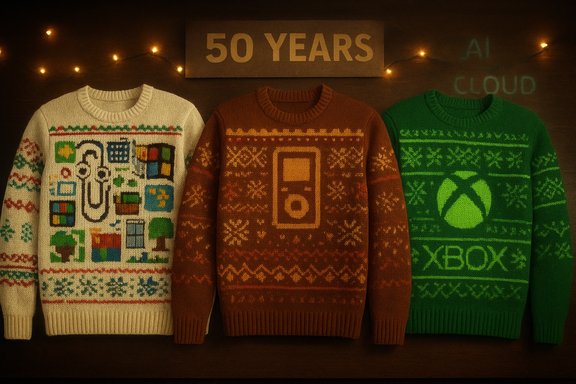
Microsoft’s holiday merch has leaned into nostalgia for years, but the 2025 drop is the most explicit throwback yet: three new “ugly” sweaters — the icon-packed Artifact sweater, a Zune-brown variant, and an Xbox green edition — released as part of Microsoft’s ongoing 50th‑anniversary celebrations and already stirring the same mix of delight, bemusement and reseller anxiety that accompanies any limited‑run fandom drop.
Microsoft’s seasonal “ugly sweater” tradition began as an insider gag before becoming a public merchandising staple. The company first distributed themed holiday knitwear to employees and fans in 2018, then opened sales to the public in 2020; after a one‑year pause in 2024 the sweaters returned for the 2025 season. This year’s release is explicitly tied to Microsoft’s 50th anniversary and leans hard into brand archaeology — the Artifact sweater stitches together decades of icons and inside jokes. The company that started in a strip mall in Albuquerque on April 4, 1975, has used anniversary moments to trade on nostalgia and to remind the public of its cultural footprint. The 50th anniversary has not only produced merch and tongue‑in‑cheek giveaways but also corporate messaging that emphasizes AI and cloud as the company’s next act. That strategic pivot contrasts with the playful, self‑aware merchandising that marks these sweater drops.
This is not merely schmaltzy nostalgia. Successful brands reuse their history to build authenticity; fans respond when brands are self‑aware. The risk is that nostalgia can ossify into a performance that replaces substantive innovation messaging. If Copilot and Azure are to be the engines of Microsoft’s next 50 years, the company will need to balance archival charm with substantive product progress.
Yet there’s a tension between affection and ire. Nostalgia releases can be interpreted as tone‑deaf if the company is simultaneously engaged in contentious business moves, antitrust scrutiny, or workforce reductions. Timing and context matter: festive merch can humanize a giant, but it can also be dismissed as trivial when stakeholders expect sober leadership on product reliability, pricing, or regulatory compliance. Microsoft’s 50th celebrations oscillate between the two — a reminder that corporate theater and corporate responsibility must be carefully balanced.
That can be an asset. Good brand storytelling embraces failure because it makes success credible. But it’s also a safe narrative: the sweater pokes fun without addressing the harder questions about where Microsoft goes next — privacy posture, the economics of AI, or the social impacts of platform dominance. Nostalgia is a comfort; strategy requires answers.
If nothing else, the Artifact sweater is a reminder that corporate memory is an asset you can put on a chest. For fans that’s delightful. For observers, it’s another data point in a larger story: a half‑century tech behemoth that still courts culture, even as it races to define the next era of computing.
Source: theregister.com Want to win a Microsoft Ugly Sweater? It's uglier than ever
 Background
Microsoft’s seasonal “ugly sweater” tradition began as an insider gag before becoming a public merchandising staple. The company first distributed themed holiday knitwear to employees and fans in 2018, then opened sales to the public in 2020; after a one‑year pause in 2024 the sweaters returned for the 2025 season. This year’s release is explicitly tied to Microsoft’s 50th anniversary and leans hard into brand archaeology — the Artifact sweater stitches together decades of icons and inside jokes. The company that started in a strip mall in Albuquerque on April 4, 1975, has used anniversary moments to trade on nostalgia and to remind the public of its cultural footprint. The 50th anniversary has not only produced merch and tongue‑in‑cheek giveaways but also corporate messaging that emphasizes AI and cloud as the company’s next act. That strategic pivot contrasts with the playful, self‑aware merchandising that marks these sweater drops. What’s in the 2025 line
The three sweaters, at a glance
- Artifact Sweater — an off‑white, multicolored collage of Microsoft history: Clippy, MSN, Minesweeper, Internet Explorer, MS‑DOS, Windows icons, and even a Minecraft Creeper motif. It’s packaged as a nostalgia scavenger hunt for anyone who’s lived through multiple Windows eras. The first batch sold out quickly.
- Zune Holiday Sweater — a deliberately “brown” Zune homage that leans into the cult‑classic status of Microsoft’s defunct music player. Priced the same as the Artifact sweater, it’s marketed as a premium throwback.
- Xbox Holiday Sweater — a green, gamer‑oriented design, slightly cheaper than the other two options and positioned to be the broadest seller among mainstream Xbox fans.
Pricing, materials and sizes
Microsoft’s 2025 lineup is priced in tiers: the Artifact and Zune sweaters are reported at around $79.95, with the Xbox variant offered at roughly $59.95 (pre‑order price reported by outlets). Sizing runs from XS to 4XL, and early product descriptions from media coverage indicate knit compositions in the acrylic/polyester family — a common choice for novelty seasonal sweaters because it’s inexpensive and dye‑friendly. One outlet specifically listed the sweaters as 100% polyester for the Xbox variant; material claims vary slightly across reporting and the company’s retail page.Where to buy
For this release Microsoft directed buyers to official channels: the Microsoft Company Store (online), the Redmond campus store and the Microsoft Experience Center in New York City. Limited stock and the “first batch sold out in record time” language have been used in official and press materials, fuelling urgency and possible aftermarket activity.Design, nostalgia and brand archaeology
Microsoft’s Artifact sweater is a deliberate museum‑piece: it weaponizes nostalgia as a visual language. The sweater assembles a lineup of icons that have been alternately beloved, mocked and mourned — Clippy (the paperclip assistant that became a punchline), Internet Explorer (the sluggish browser with a long, complicated legacy), MSN, Minesweeper, the Windows Recycle Bin and even elements from the Xbox/Minecraft ecosystem. The effect is less festive knitting than a wearable timeline. Why does this work? Nostalgia merchandising is effective because it collapses memory into commodity. For fans, the artifacts trigger recognition and belonging; for the company, they are inexpensive cultural capital that remind customers of Microsoft’s long shadow across consumer tech. But the Artifact sweater’s density also underlines a paradox: the more brands mine their archive, the more those archives risk becoming a substitute for fresh storytelling. That’s a rhetorical risk when the company’s public narrative is supposed to be about the future of AI and cloud services. A running joke among commentators — and one implied by The Register’s cheeky copy — is that the design looks like it was “sprayed” across the textile by a Copilot instance asked to collage Microsoft logos. That’s playful speculation rather than fact, but it captures how the current Microsoft brand is inseparable from both its past and its present AI obsession. If Copilot had any role in art direction it’s not been publicly stated; treat that suggestion as humorous conjecture rather than a verified design story.Microsoft at 50: merchandising as message
Microsoft’s 50th anniversary has been more than a corporate party. The company has used the milestone to showcase both heritage and future—limited edition goods like Windows XP Crocs and anniversary Surface SKUs sit beside messaging about Copilot and Azure as the engine of Microsoft’s next era. This mixture of nostalgia and forward positioning is a deliberate branding posture: legacy fosters authority, while AI promises growth. That strategy works on multiple levels:- It keeps consumer fandom alive through collectible physical products.
- It generates earned media — quirky merch tends to be covered across general press and fan sites.
- It creates a low‑risk revenue stream and promotional touchpoints tied to other campaigns.
The economics of limited‑run merch: scarcity, scalpers and counterfeits
Limited‑edition drops are now a standard tactic for consumer tech brands. Microsoft’s “sold out in record time” language — echoed by media coverage — is both an operational reality for limited runs and a deliberate signaling tactic that can drive aftermarket prices. Early coverage already warned about copycat listings and scalpers marking up genuine items on secondary markets. Buyers who want authenticity and returns protection should prefer Microsoft’s own store or the physical company outlets over third‑party marketplaces. Material and sizing inconsistencies are another practical snag. Veteran press coverage suggests Microsoft’s holiday knitwear has run small in previous releases, and the fabric choice (acrylic/polyester blends) is typical for novelty apparel but not ideal for durability or breathability. Expect knits that photograph well but may show wear after repeated washes — a trade‑off for novelty collectibles.Environmental and ethical considerations
There are three sustainability angles buyers and observers should weigh:- Materials: Polyester and acrylic are petroleum‑based and not biodegradable. They also shed microfibers when laundered. Fast novelty merch fuels short product lifecycles.
- Manufacturing transparency: Limited‑run items often have opaque supply chains. Unless the product page explicitly lists factories, certifications, or responsible sourcing policies, consumers should assume standard mass‑production practices.
- Resale market waste: Scalped items often move between hands quickly, raising the odds they become single‑use fashion rather than durable keepsakes.
Cultural reading: why Clippy, Zune and Internet Explorer still matter
Clippy is an emblem of imperfect AI assistance — the perfect mascot for a company now selling Copilot as a productivity panacea. Internet Explorer is a symbol of both ubiquity and obsolescence. Zune is a cult relic that represents product failure turned affectionate memory. By assembling these elements, Microsoft is acknowledging its stumbles as part of its identity and turning them into cultural assets.This is not merely schmaltzy nostalgia. Successful brands reuse their history to build authenticity; fans respond when brands are self‑aware. The risk is that nostalgia can ossify into a performance that replaces substantive innovation messaging. If Copilot and Azure are to be the engines of Microsoft’s next 50 years, the company will need to balance archival charm with substantive product progress.
Practical buying guide: how to get a 2025 Microsoft sweater without getting burned
- Buy from official channels first: Microsoft Company Store (online) or Microsoft’s physical locations. This ensures authenticity and legitimate returns.
- Check sizing carefully: past releases were reported to run small — if the store offers a sizing chart, consult it and consider ordering up if you prefer a relaxed fit.
- Avoid third‑party listings that lack clear receipts or tags; counterfeit sweaters are already starting to appear after every high‑profile drop.
- If you miss the initial drop, set alerts on reputable marketplaces but budget for markup and factor in shipping costs. Consider buying pre‑owned if sustainability is a priority.
- Inspect materials on the official product tag for washing instructions and fiber content before making long‑term value judgments; press reports may generalize fiber claims.
The public relations angle: community engagement vs. brand theater
Microsoft’s decision to run a reader giveaway through media outlets and to tie the collection to its anniversary is a shrewd PR move. The Register’s contest copy — a mix of wry humour and editorial nostalgia — underscores how these sweaters function as community touchpoints. They generate social media content, give brand advocates tangible items to show off, and create memes that keep the company trending for a short burst.Yet there’s a tension between affection and ire. Nostalgia releases can be interpreted as tone‑deaf if the company is simultaneously engaged in contentious business moves, antitrust scrutiny, or workforce reductions. Timing and context matter: festive merch can humanize a giant, but it can also be dismissed as trivial when stakeholders expect sober leadership on product reliability, pricing, or regulatory compliance. Microsoft’s 50th celebrations oscillate between the two — a reminder that corporate theater and corporate responsibility must be carefully balanced.
Design critique: celebration, satire, or safe nostalgia?
The Artifact sweater is both celebration and caricature. Its charm comes from recognition — spotting an old logo tucked between a Minesweeper tile and a Clippy charm sparks a microthrill among tech veterans. But the design also flirts with satire: by compressing decades of sometimes‑embarrassing product history into a single knit, it invites a wry reading of corporate memory as a scrapbook of hits and misses.That can be an asset. Good brand storytelling embraces failure because it makes success credible. But it’s also a safe narrative: the sweater pokes fun without addressing the harder questions about where Microsoft goes next — privacy posture, the economics of AI, or the social impacts of platform dominance. Nostalgia is a comfort; strategy requires answers.
Verdict: who should buy one, and why it matters
- Buy a 2025 Microsoft sweater if you collect tech memorabilia, enjoy tongue‑in‑cheek corporate art, or want a conversation starter at holiday gatherings. The Artifact sweater is a compact, wearable exhibit of Microsoft’s cultural footprint.
- Skip it if you prioritize sustainability in clothing, need long‑lasting wardrobe staples, or hate novelty knits. The materials and likely short lifecycle of novelty merch make it a poor choice for eco‑minded minimalists.
- Watch for scalpers and fakes if you plan to resell. The economics of scarcity will make these sweaters targets for markup and counterfeit listings. Buy official if authenticity matters.
Final thoughts
Limited‑edition merch is a small corner of Microsoft’s business, but the 2025 sweaters are a neat distillation of how the company wants to be seen at 50: self‑aware, playful, and rooted in a platform history that most tech companies can only envy. They also raise familiar tradeoffs — environmental and quality compromises in novelty goods, the spectacle of scarcity, and the risk that nostalgia substitutes for forward‑looking substance.If nothing else, the Artifact sweater is a reminder that corporate memory is an asset you can put on a chest. For fans that’s delightful. For observers, it’s another data point in a larger story: a half‑century tech behemoth that still courts culture, even as it races to define the next era of computing.
Source: theregister.com Want to win a Microsoft Ugly Sweater? It's uglier than ever
