

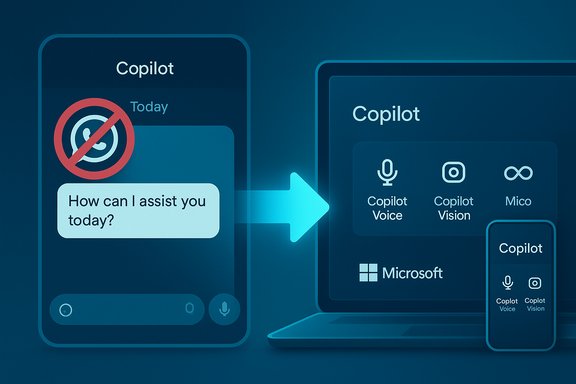
Microsoft confirmed that Copilot will stop working on WhatsApp on January 15, 2026, after WhatsApp updated its platform rules to remove general-purpose large-language-model (LLM) chatbots from the Business API — a change that forces Microsoft and other AI providers to move their assistants off the messaging platform and onto native apps, the web, and Windows.
Background
Since late 2024, Microsoft has offered Copilot through a variety of channels, including a WhatsApp integration designed to meet users where they already communicate. The integration allowed people to summon Copilot inside individual or group chats, providing conversational assistance without requiring a separate app install. Microsoft says Copilot on WhatsApp served millions of people during that period.In October 2025, WhatsApp — operated by Meta — revised its Business API terms to add a new category for “AI Providers,” explicitly restricting general-purpose AI assistants and LLM-based services from using the platform when those AI capabilities are the primary functionality being offered. The new language takes effect on January 15, 2026, and it is this policy change that Microsoft cites as the reason Copilot must be discontinued on WhatsApp.
Microsoft’s response is pragmatic: continue offering Copilot via native Microsoft channels — the Copilot mobile app for iOS and Android, the Copilot web experience, and Copilot on Windows — and tell WhatsApp users who want to keep their conversations to export them before the January 15 cutoff because those chat logs cannot be migrated automatically to Microsoft’s other Copilot surfaces.
What Microsoft announced and what it means for users
Microsoft’s official communication is straightforward: Copilot on WhatsApp will remain active until January 15, 2026, and will stop working on that date. Users who rely on the WhatsApp integration will need to transition to other Copilot surfaces or export chats to preserve a record of conversations.Key points Microsoft emphasized:
- Copilot access via WhatsApp ends on January 15, 2026.
- Copilot remains available on the Copilot mobile app (iOS/Android), Copilot on the web, and Copilot on Windows.
- The Copilot app and website offer the core experience available on WhatsApp, plus additional features such as Copilot Voice, Copilot Vision, and Mico (a companion presence).
- Conversations on WhatsApp cannot be transferred to other Copilot surfaces because the WhatsApp integration used unauthenticated sessions.
- Users who want records of their WhatsApp-Copilot chats should export them using WhatsApp’s built-in export tools prior to January 15, 2026.
- The Copilot app and web access are mostly free, though some features may require a subscription or be subject to usage limits.
Why WhatsApp changed course (technical and business rationale)
WhatsApp’s Business API has long been framed as an enterprise channel for businesses to communicate with customers — appointment reminders, shipping updates, and support workflows — rather than a public channel for distributing general-purpose chat assistants. The updated terms add an explicit clause targeting companies that provide LLMs, generative AI platforms, or general-purpose AI assistants, and prohibit those providers from using the Business API when AI is the primary functionality.Two likely drivers behind the policy change are:
- Infrastructure and operational strain. High-volume, back-and-forth sessions with large language models can produce heavy message loads and server-side processing demands. Platforms must balance infrastructure capacity across many use cases.
- Product and monetization strategy. Meta has been integrating its own AI assistant across its ecosystem; reserving message-stream real estate for in-house AI could help centralize user engagement and monetization options.
This policy change is not a technical ban on conversational AI per se — rather, it is a platform-level restriction on AI providers using the Business API as a distribution channel for general-purpose chat assistants. Businesses can still deploy chatbots for customer support and transactional workflows where AI is incidental to the service.
The immediate user-facing impacts
The change will have several practical consequences for end users and businesses that adopted Copilot on WhatsApp:- Loss of in-place Copilot access on WhatsApp after January 15, 2026. Users will no longer be able to invoke Copilot inside WhatsApp conversations.
- Chat history will not be auto-migrated. Because the WhatsApp integration was unauthenticated (sessions not linked to a persistent Copilot account), Microsoft cannot import those histories into Copilot accounts on its app or web experiences.
- Users must export chats themselves. Anyone who wants to preserve interactions with Copilot on WhatsApp must export those conversations using WhatsApp’s export feature before the service stops functioning on January 15.
- Business workflows relying on Copilot via WhatsApp must be rearchitected. Companies that used Copilot on WhatsApp will need to move to alternative channels (native apps, web widgets, other messaging channels) or rework bots to fit within WhatsApp’s permitted Business API use cases.
How to export WhatsApp chat history (practical steps and caveats)
Exporting your chat is the only reliable way to preserve a record of Copilot conversations on WhatsApp. The export produces text (and optionally media) files that you can store locally or in cloud storage, but the exported data loses WhatsApp’s end-to-end encryption protections and cannot be reimported into WhatsApp as an interactive thread.General export steps:
- On Android:
- Open WhatsApp and the chat to export.
- Tap the three-dot menu (⋮) > More > Export chat.
- Choose “Without media” or “Include media.”
- Select the app or cloud service to receive the exported ZIP/TXT file.
- On iPhone:
- Open the chat > tap the contact or group name at the top > scroll down > Export Chat.
- Choose “Attach Media” or “Without Media.”
- Pick a destination (Files, Mail, cloud storage).
- Exported text and media are no longer covered by WhatsApp’s end-to-end encryption. Store exported files securely and treat them as sensitive data.
- Including media can significantly enlarge the export file and may hit limits (e.g., iOS historically caps the number of media items included).
- Exports are a copy only — they do not remove the chat from WhatsApp.
- Exported chat files are typically plain-text transcripts and cannot be imported back into WhatsApp or into Copilot to resume chat context.
- For businesses with high-volume needs, automated archiving or API-based logging (outside WhatsApp) should be implemented long before the cutoff.
Migration options and recommended transition steps
Users and organizations affected by the removal will have three main paths forward: move to Microsoft’s Copilot surfaces; switch to another third-party assistant that has a supported channel; or rework workflows to fit within WhatsApp’s permitted Business API scenarios.Practical transition checklist:
- Inventory: Identify all active Copilot–WhatsApp threads and usage patterns (personal threads for consumers; workflows and customer journeys for businesses).
- Export: Export important conversations and attachments before January 15, 2026. Prioritize threads with legal, financial, or operational value.
- Choose destinations:
- Individuals: Install the Copilot mobile app or use Copilot on the web to continue conversational access.
- Businesses: Migrate conversational flows to web chat widgets, SMS/OTT alternatives, or to the Copilot API integrated into owned channels.
- Choose destinations:
- Update customer messaging: For businesses, proactively notify customers about the channel change and provide new contact instructions.
- Audit privacy and storage: Secure exported data and ensure compliance with data retention policies and regulations relevant to the business.
- Monitor quotas and pricing: Review Copilot usage limits and subscription tiers if the new surface involves paid features or usage caps.
What’s different on Copilot’s native surfaces
Microsoft describes the Copilot mobile app, web, and Windows surfaces as offering the same core features as the WhatsApp integration — plus additional capabilities that leverage richer permissions and authenticated user accounts. Notable functionality highlighted by Microsoft includes:- Copilot Voice: Real-time voice interactions for conversational assistants with longer dialogues and follow-up questions.
- Copilot Vision: Upload images and documents for multimodal analysis, enabling Copilot to see and interpret visual inputs.
- Mico: A persistent companion presence that personalizes interactions across Copilot surfaces.
- On native surfaces, Copilot sessions are typically authenticated to the user’s Microsoft account, allowing history, personalization, and cross-device continuity.
- Some advanced features and higher usage limits may require a subscription tier or Microsoft 365 integration.
- Native apps can offer expedited support and integrations with Microsoft 365 applications, file systems, and storage options.
Privacy, authentication, and the unauthenticated-session problem
A technical detail with outsized user impact is Microsoft’s confirmation that Copilot sessions on WhatsApp were unauthenticated. In plain terms, the WhatsApp Copilot integration did not reliably link a user’s WhatsApp identity to a persistent Copilot account. That decision simplified onboarding — people could chat with Copilot without creating or linking accounts — but it has two wholesale downsides now:- No portable history. Without an authenticated identity tethered to the session, there is no secure way for Microsoft to port a user’s WhatsApp conversation into a Copilot account on a different surface.
- Limited personalization and data continuity. The unauthenticated model restricted long-term personalization, saved preferences, and cross-device synchronization — capabilities that are available when Copilot sessions are linked to a Microsoft account.
When exporting chat transcripts, remember:
- Exported files are readable and searchable but no longer encrypted end-to-end.
- Treat exported transcripts like any sensitive text file: encrypt them at rest, limit access, and use secure transfer channels if sharing.
Broader ecosystem implications
This policy move signals a broader trend in how platform owners manage the distribution of AI assistants.- Platform consolidation of AI experiences. Meta’s policy effectively consolidates general-purpose conversational AI inside Meta-owned assistants on its messaging platforms. That creates a controlled environment where the platform owner can optimize and monetize AI experiences directly.
- Distribution friction for AI providers. Companies that used messaging platforms as lightweight distribution channels (to acquire users where they already chat) will need to invest in native apps, web experiences, or alternate distribution partnerships.
- Competitive and regulatory scrutiny. Restricting third-party AI assistants from a mass-market channel invites questions about competition and gatekeeping. Regulators in multiple jurisdictions are already scrutinizing large platforms for anti-competitive conduct; restricting independent AI distribution on a dominant messaging service may attract attention.
- Operational migration costs. Startups and teams that built WhatsApp-based assistants face nontrivial migration or shutdown costs. Enterprises that relied on WhatsApp as a customer channel must redesign engagement strategies.
Risks, unanswered questions, and what to watch
While the policy is now public and Microsoft’s response is clear, several areas remain uncertain or require careful attention:- Policy interpretation and enforcement. The line between “primary functionality” and “ancillary use” could be interpreted inconsistently. Providers may find edge cases where AI is embedded in a broader business process and still permitted.
- Scope creep in enforcement. The clause granting platform discretion to determine what counts as an AI provider could invite broader enforcement actions beyond the initial wave.
- Data portability and user rights. Users losing in-platform access to conversations raises questions about portability rights and how platforms should handle user-generated AI interactions that have value to the user.
- Security and privacy of exported archives. Many users will export chats without appreciating the reduced protections for those files; those exports could be exposed if stored in insecure cloud accounts or shared via email.
- Market impacts on small developers. Smaller AI firms may not have the resources to rapidly migrate to first-party apps and could be disproportionately harmed.
What consumers and businesses should do now (practical checklist)
- Back up and export any Copilot–WhatsApp chats you want to keep, and store them securely.
- Install and configure the Copilot app (iOS/Android) or add copilot.microsoft.com as a bookmarked web app.
- For businesses: map customer journeys relying on WhatsApp AI and plan migration to supported channels well before January 15, 2026.
- Audit exported transcripts, remove or redact any sensitive personal data if required by policy or law, and encrypt exported files in storage.
- Review subscription and quota options for Copilot on Microsoft platforms to ensure continuity of service where usage is heavy.
- Monitor WhatsApp Business API updates closely in case the platform revises guidance or offers clarifying rules for AI use cases.
Final assessment: what this change means for the future of conversational AI distribution
The removal of Copilot (and other LLM-based assistants) from WhatsApp’s Business API marks a pivot point in how conversational AI is distributed to mass audiences. Messaging platforms were attractive because they offered immediate, low-friction distribution inside apps people already use. With that channel restricted for general-purpose assistants, the market will reallocate distribution toward:- Native apps and web-based assistants controlled by AI providers.
- Enterprise integrations where AI is clearly ancillary to broader business processes and therefore allowed by platform terms.
- New distribution models such as embeddable web widgets, browser-based assistants, and direct partnerships with device makers or platform owners.
The policy shift crystallizes a moment in the AI economy: distribution channels are as strategic as model quality. Companies that control the places people inhabit — social platforms and messaging apps — are asserting the right to shape how AI appears there. Providers that want to remain widely accessible will need deeper investments in their own surfaces and clearer account models to preserve history, personalization, and continuity.
The immediate calendar is set: January 15, 2026, is the functional cutoff for Copilot on WhatsApp. The next months are a migration window for users and businesses alike — a period to export, plan, and move conversations to platforms that will continue to host the AI experiences they rely on.
Source: digit.in Microsoft Copilot to leave WhatsApp on Jan 15, 2026: Here’s why
