

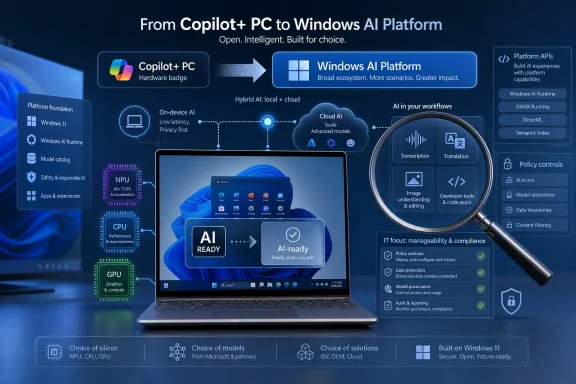
Microsoft’s Copilot+ PC push lost the center of the company’s Windows strategy in 2026 as Microsoft shifted emphasis from a branded hardware promise to a broader Windows AI platform spanning NPUs, CPUs, GPUs, cloud agents, and subscription-tied Copilot services. The retreat is not an abandonment of AI PCs. It is a correction after Microsoft discovered that a badge, a keyboard key, and a 40-TOPS requirement could not by themselves create trust, repeatable value, or enterprise urgency. For device buyers, the lesson is blunt: buy for workloads and manageability, not for the logo on the palm rest.
The Copilot+ PC was introduced as a clean story at a messy moment. Windows needed a new reason to make people care about local hardware again, PC makers needed a post-pandemic refresh cycle, and Microsoft wanted to show that the AI boom was not confined to cloud subscriptions and browser tabs. The pitch was elegant: a new class of Windows 11 machines with neural processing units powerful enough to run AI experiences locally, with better performance, better battery life, and more privacy than shipping everything to the cloud.
That simplicity was also the weakness. “Copilot+” sounded like a product category, a software entitlement, a Windows feature bundle, and a marketing promise all at once. The term asked buyers to believe that the hardware badge would translate into a coherent experience, when the actual Windows AI stack was still being assembled in public.
The 40-TOPS NPU threshold gave OEMs something concrete to print on spec sheets. Qualcomm’s Snapdragon X Elite systems arrived first with a clean lead in the category, while Intel and AMD pushed their own roadmaps toward the same bar. For a few months, the industry had the makings of a classic PC upgrade narrative: this generation has the AI chip, the old one does not.
But Windows is not a console. The value of a new PC class depends on the software that appears on day one, the software that appears later, and the software that works reliably enough for normal users to notice. Copilot+ PCs entered the market with a gap between certification and lived experience, and that gap became harder to ignore as Microsoft’s own messaging evolved.
The backlash was predictable in hindsight because Recall combined three sensitive ideas at once. It dealt with screenshots, it dealt with personal history, and it was attached to the operating system rather than presented as a narrow app feature. Even with local storage and later security changes, the first impression was that Windows was gaining a surveillance-shaped capability before Microsoft had earned the benefit of the doubt.
Microsoft delayed Recall, reworked parts of the security model, and moved more carefully through Windows Insider testing. Those changes mattered technically, but the reputational damage landed earlier. For many administrators and privacy-minded users, Copilot+ stopped being shorthand for “efficient local inference” and became shorthand for “the next thing I need to review before it appears on my fleet.”
That matters because enterprise device adoption is often less about the best demo and more about the worst meeting. A procurement team can sell a faster laptop. A security team can support a local AI workload if controls are clear. But a feature associated with persistent capture, even if opt-in and secured later, forces legal, compliance, records management, and employee relations teams into the conversation.
The irony is that Recall embodied Microsoft’s strongest technical argument for AI PCs. If sensitive AI work happens locally, the PC should be more private than a cloud-only assistant. But trust is not inherited from architecture diagrams. It is earned through defaults, controls, transparency, and restraint.
That was a bold move, and not an irrational one. Microsoft has used hardware cues before to normalize software behavior, from Windows keys to precision touchpads. If Copilot had quickly become a beloved daily assistant, the key might have looked prescient.
Instead, many users experienced Copilot as clutter. Buttons appeared in places where the value was not obvious. App surfaces gained AI affordances that felt less like workflow improvements and more like corporate insistence. The more Microsoft scattered Copilot across Windows, the more it trained skeptical users to see the brand as an interruption rather than an assistant.
By early 2026, Microsoft was publicly talking about reducing unnecessary Copilot entry points in apps such as Notepad, Photos, Widgets, and Snipping Tool. That was not a repudiation of AI, but it was a notable change in posture. The company was no longer simply maximizing Copilot’s surface area; it was admitting that placement and usefulness had to be more selective.
For WindowsForum readers, the shift should feel familiar. Windows has repeatedly gone through cycles where Microsoft inserts a strategic service into the shell, encounters resistance, and then tunes the integration after users object. The difference this time is that AI arrived with higher privacy stakes, higher licensing stakes, and a much louder marketing campaign.
But the broader AI computing market did not agree to remain that tidy. GPUs remain the default workhorse for many AI workloads, especially developer workflows and larger models. CPUs continue to matter for compatibility and fallback paths. Cloud inference remains essential for the largest models and enterprise data-connected copilots. The NPU is important, but it is not the whole board.
Microsoft’s Build 2026 messaging reflected that reality. The company talked more broadly about Windows as a platform for AI development, local models, agent runtimes, and APIs that can target different accelerators. Expanding Windows AI APIs beyond the narrow Copilot+ PC lane may be good for developers and users, but it inevitably dilutes the marketing exclusivity of the original badge.
This is the classic platform-owner dilemma. If Microsoft keeps the best AI experiences locked to certified Copilot+ hardware, it strengthens the hardware story but narrows the developer audience. If it opens more APIs across GPUs, CPUs, and a wider range of PCs, it strengthens Windows as an AI platform but weakens the idea that Copilot+ is the only meaningful upgrade path.
The company appears to be choosing platform breadth. That is probably the right long-term decision. But it means OEMs can no longer rely on the Copilot+ label alone to explain why a buyer should choose one premium laptop over another.
But enterprise PC buyers do not move like consumer launch events. They care about application compatibility, driver maturity, manageability, repair channels, peripheral behavior, VPN clients, security agents, and the boring details that decide whether a laptop survives contact with a corporate image. Arm on Windows has improved dramatically, but “dramatically improved” is not the same as “invisible to support.”
Intel and AMD’s arrival in the Copilot+ class reduced Qualcomm’s differentiation while making the category more familiar to enterprise buyers. That is good for adoption of AI-capable PCs, but less good for the original story that the Copilot+ era had a single obvious hardware face. Once every major silicon vendor can claim an NPU story, the badge becomes a baseline rather than a headline.
The same pressure comes from the high end. Microsoft’s developer-focused Surface hardware with NVIDIA RTX branding tells a different story: for serious local AI development, the GPU remains central. That does not make NPUs irrelevant. It does remind buyers that “AI PC” is not one workload, one chip, or one purchase rationale.
A sales deck can compress all of this into a tidy phrase. A deployment plan cannot.
For enterprise buyers, this creates a practical accounting problem. If a laptop includes the NPU needed for local Windows AI experiences but the most valuable business assistant features require Microsoft 365 Copilot licenses, what exactly is the device premium buying? The answer may still be meaningful: better battery life for AI tasks, offline-capable models, lower latency, local media features, and future readiness. But it is no longer the simple answer implied by early branding.
This is where the Copilot name hurts Microsoft. Copilot can mean the consumer assistant, the Windows app, Microsoft 365 Copilot, GitHub Copilot, security copilots, role-based agents, and hardware-adjacent Windows experiences. That brand sprawl may help Microsoft tell Wall Street that AI is everywhere, but it makes procurement conversations harder.
A CIO does not buy “Copilot” in the abstract. A CIO buys devices, licenses, management tools, risk controls, and measurable productivity improvements. When those pieces are bundled under overlapping names, the buyer has to unpack the stack before evaluating the benefit.
Microsoft’s shift toward the broader “Windows AI” frame is partly a cleanup operation. It lets the company talk about the operating system as an AI-capable platform without making every feature sound like part of the same paid assistant bundle. That distinction may be less exciting in an advertisement, but it is more useful in a planning meeting.
That is a healthier strategy because it matches how Windows actually wins. Windows is valuable not because Microsoft controls every experience, but because it gives hardware makers, software vendors, developers, and IT departments a broad compatibility surface. If AI becomes another Windows subsystem with APIs, runtimes, security boundaries, and hardware abstraction, it has a better chance of becoming boring enough to be useful.
The word “boring” is not an insult here. Enterprise technology succeeds when it stops demanding theatrical belief. Containers, virtualization, endpoint detection, single sign-on, and device management all became strategic because they became operational. AI in Windows will follow the same path only if it can be governed, measured, disabled, audited, updated, and explained.
That is why Build 2026’s emphasis on agents, local models, Windows AI APIs, and developer tooling matters more than the fate of any single badge. Microsoft needs developers to build AI features that solve real problems, not just Microsoft-authored demos that make new PCs look futuristic. It also needs those features to run across enough machines that developers can justify the investment.
The Copilot+ PC label may remain a useful premium tier. But the strategic center of gravity is shifting toward Windows as the place where local and cloud AI meet. That is a platform argument, not a sticker argument.
Creative workers, analysts, developers, accessibility-heavy users, and employees who rely on transcription, translation, image handling, or repetitive content workflows may see earlier gains. Field workers and regulated users may benefit from local inference if it reduces cloud dependency. But many office users will not justify a premium device solely because Windows has a stronger AI roadmap.
IT departments should start by identifying workloads rather than chasing certification. Which apps are expected to use the NPU in the next 12 to 24 months? Which features require Microsoft 365 Copilot licenses? Which experiences run locally, which send data to Microsoft services, and which can be disabled through policy? Which vendors have committed to AI acceleration on Windows, and on what silicon?
This is also a lifecycle issue. A device purchased in 2026 may remain in service into 2029 or 2030. Buying machines with capable NPUs may be prudent future-proofing even if today’s killer app is absent. But future-proofing has a price, and that price should be compared with RAM, storage, repairability, display quality, battery life, docking reliability, and the other attributes that still affect every user every day.
The trap is treating AI readiness as a substitute for normal endpoint discipline. An AI PC with poor fleet manageability is still a poor enterprise PC. A Copilot+ device that cannot run a critical driver, security tool, or line-of-business app without friction is still a support liability.
Now the OEM job is harder. If Microsoft reduces visible Copilot branding in Windows while expanding AI APIs beyond Copilot+ hardware, PC makers have to explain their differentiation in more specific terms. Battery life under AI workloads matters. Thermals matter. NPU performance matters. GPU options matter. ISV certification matters. Manageability matters. The marketing has to become less magical and more empirical.
That is not necessarily bad for the market. The PC industry has spent decades turning abstract platform shifts into concrete buying criteria. Centrino, Ultrabook, Evo, Secured-core PC, and now Copilot+ all tried to compress many engineering decisions into a memorable label. Some labels endure as useful shorthand; others fade once the underlying capabilities become normal.
Copilot+ may end up somewhere in the middle. It can remain a meaningful certification for a baseline class of AI-capable Windows PCs, especially for consumers and small businesses. But enterprise OEM pitches will increasingly need to show how a given model performs in specific workflows, how it is managed through Intune or existing tools, and how its AI features behave under corporate policy.
In other words, OEMs have to stop selling the future tense. They need to sell what the machine does in the customer’s environment.
The deeper contest is between local and cloud AI. Local inference offers latency, privacy, offline access, and potentially lower marginal cost. Cloud inference offers larger models, centralized control, faster updates, and integration with enterprise data. Most real workflows will use both, which means the winning platform is the one that makes the split understandable and governable.
Microsoft is well positioned for that hybrid world, but only if it communicates clearly. Windows can host local models, Microsoft 365 can connect to organizational context, Azure can provide scalable inference, and management tools can enforce policy. That is a strong enterprise architecture. But the architecture gets harder to sell when every layer is called some flavor of Copilot.
This is why the de-emphasis of Copilot+ PCs may help Microsoft in the long run. The company can reserve Copilot for assistant experiences and use Windows AI to describe the operating-system substrate. It can let hardware vendors compete on capability while developers target APIs rather than slogans. It can also give administrators a cleaner map of what is local, what is cloud, and what is licensed separately.
A less flashy strategy may be a more credible one.
 Microsoft Sold a Future Before Windows Could Absorb It
The Copilot+ PC was introduced as a clean story at a messy moment. Windows needed a new reason to make people care about local hardware again, PC makers needed a post-pandemic refresh cycle, and Microsoft wanted to show that the AI boom was not confined to cloud subscriptions and browser tabs. The pitch was elegant: a new class of Windows 11 machines with neural processing units powerful enough to run AI experiences locally, with better performance, better battery life, and more privacy than shipping everything to the cloud.That simplicity was also the weakness. “Copilot+” sounded like a product category, a software entitlement, a Windows feature bundle, and a marketing promise all at once. The term asked buyers to believe that the hardware badge would translate into a coherent experience, when the actual Windows AI stack was still being assembled in public.
The 40-TOPS NPU threshold gave OEMs something concrete to print on spec sheets. Qualcomm’s Snapdragon X Elite systems arrived first with a clean lead in the category, while Intel and AMD pushed their own roadmaps toward the same bar. For a few months, the industry had the makings of a classic PC upgrade narrative: this generation has the AI chip, the old one does not.
But Windows is not a console. The value of a new PC class depends on the software that appears on day one, the software that appears later, and the software that works reliably enough for normal users to notice. Copilot+ PCs entered the market with a gap between certification and lived experience, and that gap became harder to ignore as Microsoft’s own messaging evolved.
Recall Turned the Badge Into a Trust Test
The defining early feature for Copilot+ PCs was not the one Microsoft needed it to be. Recall was supposed to dramatize the value of local AI: your PC could remember what you had seen and help you retrieve it, with processing handled on-device. Instead, Recall became a public exam in whether users trusted Microsoft to place an always-indexing memory layer inside Windows.The backlash was predictable in hindsight because Recall combined three sensitive ideas at once. It dealt with screenshots, it dealt with personal history, and it was attached to the operating system rather than presented as a narrow app feature. Even with local storage and later security changes, the first impression was that Windows was gaining a surveillance-shaped capability before Microsoft had earned the benefit of the doubt.
Microsoft delayed Recall, reworked parts of the security model, and moved more carefully through Windows Insider testing. Those changes mattered technically, but the reputational damage landed earlier. For many administrators and privacy-minded users, Copilot+ stopped being shorthand for “efficient local inference” and became shorthand for “the next thing I need to review before it appears on my fleet.”
That matters because enterprise device adoption is often less about the best demo and more about the worst meeting. A procurement team can sell a faster laptop. A security team can support a local AI workload if controls are clear. But a feature associated with persistent capture, even if opt-in and secured later, forces legal, compliance, records management, and employee relations teams into the conversation.
The irony is that Recall embodied Microsoft’s strongest technical argument for AI PCs. If sensitive AI work happens locally, the PC should be more private than a cloud-only assistant. But trust is not inherited from architecture diagrams. It is earned through defaults, controls, transparency, and restraint.
The Copilot Button Became a Symbol of Overreach
Microsoft’s trouble was not limited to Recall. The company also spent 2024 and 2025 putting Copilot entry points across Windows and Microsoft 365 with the confidence of a vendor that believed visibility would become usage. The dedicated Copilot key on new keyboards captured that ambition in hardware: AI was not merely another app, it was now part of the PC’s physical grammar.That was a bold move, and not an irrational one. Microsoft has used hardware cues before to normalize software behavior, from Windows keys to precision touchpads. If Copilot had quickly become a beloved daily assistant, the key might have looked prescient.
Instead, many users experienced Copilot as clutter. Buttons appeared in places where the value was not obvious. App surfaces gained AI affordances that felt less like workflow improvements and more like corporate insistence. The more Microsoft scattered Copilot across Windows, the more it trained skeptical users to see the brand as an interruption rather than an assistant.
By early 2026, Microsoft was publicly talking about reducing unnecessary Copilot entry points in apps such as Notepad, Photos, Widgets, and Snipping Tool. That was not a repudiation of AI, but it was a notable change in posture. The company was no longer simply maximizing Copilot’s surface area; it was admitting that placement and usefulness had to be more selective.
For WindowsForum readers, the shift should feel familiar. Windows has repeatedly gone through cycles where Microsoft inserts a strategic service into the shell, encounters resistance, and then tunes the integration after users object. The difference this time is that AI arrived with higher privacy stakes, higher licensing stakes, and a much louder marketing campaign.
The Hardware Story Fractured Just as Buyers Needed Clarity
Copilot+ PCs began with a hardware line in the sand: an NPU capable of more than 40 trillion operations per second, plus baseline memory and storage requirements. That made sense as a certification mechanism. It gave developers a target, helped Microsoft avoid a support nightmare, and gave OEMs a way to distinguish new machines from ordinary Windows 11 PCs.But the broader AI computing market did not agree to remain that tidy. GPUs remain the default workhorse for many AI workloads, especially developer workflows and larger models. CPUs continue to matter for compatibility and fallback paths. Cloud inference remains essential for the largest models and enterprise data-connected copilots. The NPU is important, but it is not the whole board.
Microsoft’s Build 2026 messaging reflected that reality. The company talked more broadly about Windows as a platform for AI development, local models, agent runtimes, and APIs that can target different accelerators. Expanding Windows AI APIs beyond the narrow Copilot+ PC lane may be good for developers and users, but it inevitably dilutes the marketing exclusivity of the original badge.
This is the classic platform-owner dilemma. If Microsoft keeps the best AI experiences locked to certified Copilot+ hardware, it strengthens the hardware story but narrows the developer audience. If it opens more APIs across GPUs, CPUs, and a wider range of PCs, it strengthens Windows as an AI platform but weakens the idea that Copilot+ is the only meaningful upgrade path.
The company appears to be choosing platform breadth. That is probably the right long-term decision. But it means OEMs can no longer rely on the Copilot+ label alone to explain why a buyer should choose one premium laptop over another.
Qualcomm Won the First Lap, Not the Whole Race
The first Copilot+ wave gave Qualcomm a rare moment of Windows PC leadership. Snapdragon X systems arrived with the right NPU number, strong battery-life claims, and the appeal of an Arm-based reset after years of x86 incrementalism. For Microsoft, Qualcomm’s platform helped make Copilot+ feel like a generational break rather than a sticker on the same old laptop.But enterprise PC buyers do not move like consumer launch events. They care about application compatibility, driver maturity, manageability, repair channels, peripheral behavior, VPN clients, security agents, and the boring details that decide whether a laptop survives contact with a corporate image. Arm on Windows has improved dramatically, but “dramatically improved” is not the same as “invisible to support.”
Intel and AMD’s arrival in the Copilot+ class reduced Qualcomm’s differentiation while making the category more familiar to enterprise buyers. That is good for adoption of AI-capable PCs, but less good for the original story that the Copilot+ era had a single obvious hardware face. Once every major silicon vendor can claim an NPU story, the badge becomes a baseline rather than a headline.
The same pressure comes from the high end. Microsoft’s developer-focused Surface hardware with NVIDIA RTX branding tells a different story: for serious local AI development, the GPU remains central. That does not make NPUs irrelevant. It does remind buyers that “AI PC” is not one workload, one chip, or one purchase rationale.
A sales deck can compress all of this into a tidy phrase. A deployment plan cannot.
Subscription Copilot Pulled Value Back Toward the Cloud
The Copilot+ PC pitch leaned heavily on local capability, but Microsoft’s business model still leans heavily on cloud services and subscriptions. That tension was always going to shape the product. The more valuable Copilot becomes inside Microsoft 365, the more Microsoft has reason to tie premium productivity features to licensed cloud services rather than to a one-time hardware purchase.For enterprise buyers, this creates a practical accounting problem. If a laptop includes the NPU needed for local Windows AI experiences but the most valuable business assistant features require Microsoft 365 Copilot licenses, what exactly is the device premium buying? The answer may still be meaningful: better battery life for AI tasks, offline-capable models, lower latency, local media features, and future readiness. But it is no longer the simple answer implied by early branding.
This is where the Copilot name hurts Microsoft. Copilot can mean the consumer assistant, the Windows app, Microsoft 365 Copilot, GitHub Copilot, security copilots, role-based agents, and hardware-adjacent Windows experiences. That brand sprawl may help Microsoft tell Wall Street that AI is everywhere, but it makes procurement conversations harder.
A CIO does not buy “Copilot” in the abstract. A CIO buys devices, licenses, management tools, risk controls, and measurable productivity improvements. When those pieces are bundled under overlapping names, the buyer has to unpack the stack before evaluating the benefit.
Microsoft’s shift toward the broader “Windows AI” frame is partly a cleanup operation. It lets the company talk about the operating system as an AI-capable platform without making every feature sound like part of the same paid assistant bundle. That distinction may be less exciting in an advertisement, but it is more useful in a planning meeting.
Windows AI Is the More Durable Strategy
The retreat of the Copilot+ spotlight does not mean Microsoft is backing away from AI in Windows. The opposite is true. The company is moving from a branded-device campaign toward a platform strategy that treats AI as a layer developers can use across hardware, apps, agents, and cloud-connected workflows.That is a healthier strategy because it matches how Windows actually wins. Windows is valuable not because Microsoft controls every experience, but because it gives hardware makers, software vendors, developers, and IT departments a broad compatibility surface. If AI becomes another Windows subsystem with APIs, runtimes, security boundaries, and hardware abstraction, it has a better chance of becoming boring enough to be useful.
The word “boring” is not an insult here. Enterprise technology succeeds when it stops demanding theatrical belief. Containers, virtualization, endpoint detection, single sign-on, and device management all became strategic because they became operational. AI in Windows will follow the same path only if it can be governed, measured, disabled, audited, updated, and explained.
That is why Build 2026’s emphasis on agents, local models, Windows AI APIs, and developer tooling matters more than the fate of any single badge. Microsoft needs developers to build AI features that solve real problems, not just Microsoft-authored demos that make new PCs look futuristic. It also needs those features to run across enough machines that developers can justify the investment.
The Copilot+ PC label may remain a useful premium tier. But the strategic center of gravity is shifting toward Windows as the place where local and cloud AI meet. That is a platform argument, not a sticker argument.
Enterprise Buyers Are Right to Slow Down
The most sensible enterprise response to Copilot+ turbulence is not panic. It is segmentation. Some users will benefit from AI-capable PCs sooner than others, and the right deployment pattern is unlikely to be a blanket refresh justified by a single feature family.Creative workers, analysts, developers, accessibility-heavy users, and employees who rely on transcription, translation, image handling, or repetitive content workflows may see earlier gains. Field workers and regulated users may benefit from local inference if it reduces cloud dependency. But many office users will not justify a premium device solely because Windows has a stronger AI roadmap.
IT departments should start by identifying workloads rather than chasing certification. Which apps are expected to use the NPU in the next 12 to 24 months? Which features require Microsoft 365 Copilot licenses? Which experiences run locally, which send data to Microsoft services, and which can be disabled through policy? Which vendors have committed to AI acceleration on Windows, and on what silicon?
This is also a lifecycle issue. A device purchased in 2026 may remain in service into 2029 or 2030. Buying machines with capable NPUs may be prudent future-proofing even if today’s killer app is absent. But future-proofing has a price, and that price should be compared with RAM, storage, repairability, display quality, battery life, docking reliability, and the other attributes that still affect every user every day.
The trap is treating AI readiness as a substitute for normal endpoint discipline. An AI PC with poor fleet manageability is still a poor enterprise PC. A Copilot+ device that cannot run a critical driver, security tool, or line-of-business app without friction is still a support liability.
OEMs Now Have to Sell Outcomes, Not Microsoft’s Slogan
For Dell, HP, Lenovo, Acer, ASUS, Samsung, and other Windows OEMs, Copilot+ initially looked like a gift. Microsoft had created a premium category that could refresh consumer and commercial lines, motivate new designs, and give sales teams a reason to talk about something other than CPU generations. Co-branding around Copilot+ let OEMs ride Microsoft’s AI wave.Now the OEM job is harder. If Microsoft reduces visible Copilot branding in Windows while expanding AI APIs beyond Copilot+ hardware, PC makers have to explain their differentiation in more specific terms. Battery life under AI workloads matters. Thermals matter. NPU performance matters. GPU options matter. ISV certification matters. Manageability matters. The marketing has to become less magical and more empirical.
That is not necessarily bad for the market. The PC industry has spent decades turning abstract platform shifts into concrete buying criteria. Centrino, Ultrabook, Evo, Secured-core PC, and now Copilot+ all tried to compress many engineering decisions into a memorable label. Some labels endure as useful shorthand; others fade once the underlying capabilities become normal.
Copilot+ may end up somewhere in the middle. It can remain a meaningful certification for a baseline class of AI-capable Windows PCs, especially for consumers and small businesses. But enterprise OEM pitches will increasingly need to show how a given model performs in specific workflows, how it is managed through Intune or existing tools, and how its AI features behave under corporate policy.
In other words, OEMs have to stop selling the future tense. They need to sell what the machine does in the customer’s environment.
The Real Competition Is Not Mac Versus PC, But Local Versus Cloud
It is tempting to frame the Copilot+ wobble as another chapter in the Windows PC versus Mac story. Apple has its Neural Engine, tight hardware-software integration, and a customer base accustomed to annual platform narratives. Microsoft has a broader ecosystem, more enterprise reach, and far more hardware diversity. The comparison is useful, but incomplete.The deeper contest is between local and cloud AI. Local inference offers latency, privacy, offline access, and potentially lower marginal cost. Cloud inference offers larger models, centralized control, faster updates, and integration with enterprise data. Most real workflows will use both, which means the winning platform is the one that makes the split understandable and governable.
Microsoft is well positioned for that hybrid world, but only if it communicates clearly. Windows can host local models, Microsoft 365 can connect to organizational context, Azure can provide scalable inference, and management tools can enforce policy. That is a strong enterprise architecture. But the architecture gets harder to sell when every layer is called some flavor of Copilot.
This is why the de-emphasis of Copilot+ PCs may help Microsoft in the long run. The company can reserve Copilot for assistant experiences and use Windows AI to describe the operating-system substrate. It can let hardware vendors compete on capability while developers target APIs rather than slogans. It can also give administrators a cleaner map of what is local, what is cloud, and what is licensed separately.
A less flashy strategy may be a more credible one.
Microsoft’s AI PC Course Correction Leaves a Clearer Buying Map
The practical reading is that Copilot+ PCs are neither a failed category nor a must-buy mandate. They are early hardware for a Windows AI transition that is moving more slowly, and more broadly, than Microsoft’s first marketing wave implied.- Organizations should treat Copilot+ certification as a useful baseline, not as proof that a device will deliver measurable AI productivity for every user.
- Device pilots should be tied to named workflows such as transcription, translation, image handling, developer tools, accessibility, or local model testing.
- Security and compliance teams should review Recall-class features by policy behavior and data handling, not by Microsoft’s branding language.
- Procurement teams should model Microsoft 365 Copilot licensing separately from AI PC hardware premiums, because the two value propositions overlap but are not identical.
- OEM evaluations should include NPU capability, GPU options, battery behavior, driver maturity, endpoint management, and application compatibility.
- Enterprises should expect Windows AI features to spread beyond the original Copilot+ boundary, reducing the urgency to refresh entire fleets solely for the badge.
References
- Primary source: AI CERTs
Published: 2026-06-08T16:12:08.012898
Why Copilot AI PCs Lost Spotlight in Microsoft's Strategy - AI CERTs News
Explore why Copilot AI PCs lost top billing, how Microsoft shifts Windows AI strategy, and what enterprise devices teams should do next. www.aicerts.ai
- Related coverage: tomshardware.com
Microsoft unveils Project Solara AI, a chip-to-cloud platform built to power a new generation of 'agent-first' enterprise devices — hardware designed to run AI agents instead of traditional apps | Tom's Hardware
Microsoft ditches Windows to build OS on Androidwww.tomshardware.com - Related coverage: windowscentral.com
Microsoft is making a Surface mini PC for AI developers: Meet the Surface RTX Spark Dev Box, featuring 128GB RAM and one petaflop of AI compute power | Windows Central
Coming later this year, Microsoft is shipping its first Surface branded mini PC, aimed solely at AI developers looking to adopt NVIDIA's new RTX Spark platform.www.windowscentral.com - Related coverage: techradar.com
From code-first to intent-first: Microsoft Build 2026 could be the end of programming as we know it | TechRadar
Redefining what it means to be a developer with agentic AIwww.techradar.com - Related coverage: tomsguide.com
Biggest Microsoft Build 2026 announcements — agentic AI, RTX Spark Dev Box, GitHub Copilot app, new MAI models, and more | Tom's Guide
All the big news from Microsoft's AI-focused eventwww.tomsguide.com - Related coverage: pcworld.com
Microsoft is halting forced installs of Microsoft 365 Copilot app | PCWorld
It comes at a time when Microsoft faces heavy backlash from users over its obsession with Copilot AI.www.pcworld.com
- Official source: microsoft.com
Shop High-Performance Laptops, Computers, PCs, and Tablets | Microsoft Windows
Shop high-performance laptops, PCs, and tablets built for multitasking, advanced AI capabilities, powerful graphics, and all-day performance. Explore premium, high-spec Windows devices.www.microsoft.com - Official source: support.microsoft.com
Getting started with Microsoft Copilot | Microsoft Support
Learn how to install and use Microsoft Copilot, your Artificial Intelligence companion, on all of your devices.support.microsoft.com - Related coverage: windowslatest.com
Microsoft 365 Copilot app will auto-install on Windows 11
Rebranded Microsoft 36 Copilot app will auto-install on Windows from next month. www.windowslatest.com
- Official source: blogs.microsoft.com
Microsoft Build 2026: Be yourself at work - The Official Microsoft Blog
Platforms shift when developers build. We explore, choose tools, dream, create. This platform shift comes with more information than ever, ready at your fingertips. This shift, it’s about building fast AND THEN: it’s about building, operating, optimizing and observing. Securing your...blogs.microsoft.com - Related coverage: arstechnica.com
Microsoft delays Recall again, won’t debut it with new Copilot+ PCs after all - Ars Technica
Recall will go through Windows Insider pipeline like any other Windows feature.arstechnica.com - Official source: learn.microsoft.com
- Official source: news.microsoft.com
Microsoft Build Live
The home for real-time coverage of the news as it is announced from Microsoft Build, June 2-3, 2026.news.microsoft.com - Official source: cdn-dynmedia-1.microsoft.com
!! SpecificProject Only -MSSurface_Logo_horizontal_C-CoPilot Gray_RGB
PDF documentcdn-dynmedia-1.microsoft.com
- Related coverage: techcrunch.com
Microsoft rolls back some of its Copilot AI bloat on Windows | TechCrunch
The company is reducing Copilot entry points on Windows, starting with Photos, Widgets, Notepad, and other apps.techcrunch.com - Related coverage: pcgamer.com
Microsoft is removing Copilot branding from Photos, Notepad, and more after promising to reduce 'unnecessary Copilot entry points' | PC Gamer
It's better than nothing, I suppose.www.pcgamer.com - Related coverage: theregister.com
Notepad loses Copilot icon as Microsoft gives subtlety a try
: AI gubbins still there, just tucked under 'Writing Tools'www.theregister.com - Related coverage: agent-wars.com
Microsoft quietly removes Copilot branding from Windows 11 apps
Agent Wars — Tracking the rise of AI agents. The definitive directory of AI agent platforms, tools, and frameworks. agent-wars.com
- Related coverage: letsdatascience.com
Microsoft removes Copilot icon from Notepad | Let's Data Science
Microsoft has removed the visible Copilot toolbar button from **Notepad** in a Windows Insider preview, replacing it with a neutral **Writing Tools** menu while keeping the AI capabilities intact. The change, delivered in build **11.2512.28.0**, swaps the Copilot logo for a pen icon and tucks... letsdatascience.com
- Related coverage: engadget.com
Microsoft starts removing unnecessary Copilot buttons in Windows 11
Microsoft has rolled out a Notepad update for Windows Insiders that removes the Copilot branding and icon from within the app, Windows Central has reported.www.engadget.com - Related coverage: promptloop.de
- Related coverage: gamespot.com
Microsoft Plans To Make Windows 11 Less Annoying - GameSpot
Some of the upcoming Windows 11 improvements include less AI/Copilot integration and more options.www.gamespot.com - Related coverage: itpro.com
Microsoft is rolling back 'unnecessary' Copilot features on Windows | IT Pro
Microsoft has announced plans to dial back AI features in Windows 11 as the company looks to counter growing customer pushback.www.itpro.com
