

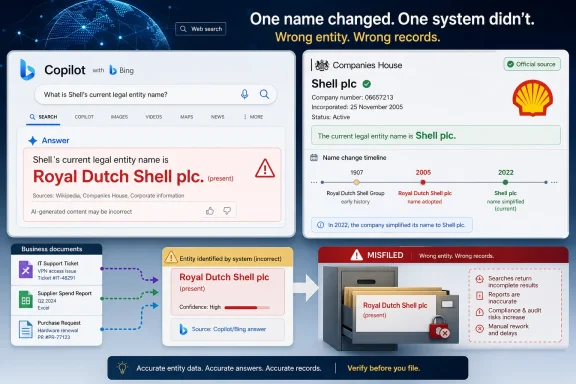
Copilot Search used the former company name in a present-tense answer, but the current name is Shell plc.
That is the exact reader answer. According to the screenshot account published by RoyalDutchShellPlc.com, a Bing Copilot Search query on 8 July 2026 for “royal dutch Shell plc website” reportedly returned Shell’s current corporate website while describing it as the official website of “Royal Dutch Shell plc.” The destination may have matched the user’s likely intent. The wording was the problem.
For WindowsForum readers, the issue is not Shell trivia. It is what happens when users and administrators rely on Bing, Copilot, Edge, Windows Search-adjacent workflows, or Copilot-style answer boxes to resolve corporate names, vendor identities, investor references, software publishers, support pages, or official websites. A conventional search result asks the user to interpret links. A generated answer often appears to have done the interpretation already. When that interpretation is wrong, the error can move quickly from a search page into a ticket, spreadsheet, purchase request, compliance note, help-desk response, or internal knowledge base.
The narrow observed claim should stay narrow: the described screenshot says Copilot Search used the former Shell name in a present-tense answer about Shell’s official website. The broader lesson is about entity handling. AI search systems need to distinguish current legal names from former names, successor entities, historical records, archive pages, and user wording. A company’s name is not decorative text. It can determine which entity exists now, which filings belong to which period, and which records should be treated as current.
The point is not that every AI answer is unreliable. It is that generative search can turn stale or ambiguous web material into a clean declarative sentence. That sentence may feel more authoritative than the underlying evidence deserves.
The reported query was simple: “royal dutch Shell plc website.” It is exactly the kind of messy human query that modern answer engines are expected to handle well. A normal search engine might return a mix of official pages, older filings, reference articles, criticism sites, archived records, and news coverage. A generated answer has a harder job: it must decide what is current, what is historical, and how to explain the relationship between them.
According to the RoyalDutchShellPlc.com account, Copilot Search generated an answer along the lines of: “The official website of Royal Dutch Shell plc is…” followed by Shell’s main corporate website. The destination was understandable because a user typing the former name probably wanted Shell. The label was the problem because the current company name is Shell plc.
The crisp distinction is this: “Royal Dutch Shell plc” is a former name; “Shell plc” is the current name. A careful answer would preserve both facts in one sentence: “Royal Dutch Shell plc is now Shell plc; the current official website is Shell’s corporate website.” That would satisfy the user’s likely intent without validating the old name as current.
The screenshot account is more revealing because the same search experience reportedly also showed Bing’s adjacent reference panel identifying the company as “Shell plc — British oil and gas company.” If that description is accurate, the problem was not simply that the wider web contains old Shell references. The current name was apparently visible elsewhere in the same interface, while Copilot’s generated answer still used the former name in the present tense.
That is the uncomfortable part for any AI search product. If a normal search page contains old and current material, the user can see that interpretation is required. A generated answer, by contrast, looks like interpretation has already happened. When that answer states a corporate identity, many users will treat it as a resolved fact.
The source material also says the page suggested follow-up searches such as “royal dutch Shell plc dividend history,” “royal dutch Shell plc shares,” and “royal dutch Shell plc dividends.” Historical share or dividend research under the old name can be legitimate. The issue is qualification. A better system would separate current and historical paths: Shell plc for current corporate and investor information; Royal Dutch Shell plc for historical material tied to the period when that was the company name.
The concrete takeaway is simple: when an AI answer repeats an old company name from your query, do not assume the system has verified that the name is current.
That history means the old name remains widely visible. It can appear in annual reports, older securities materials, news archives, shareholder documents, databases, historical articles, domain disputes, and search indexes. “Royal Dutch Shell plc” is not a made-up phrase. It was once the company’s name. That is exactly why an answer engine must treat it carefully.
A search engine can reasonably return old documents when a user types an old name. A generated answer should do more. It should mark the difference between historical and current status. If the system recognizes that the user probably means Shell, it can still answer while correcting the premise: “Royal Dutch Shell plc is the former name of Shell plc; the current official website is Shell’s corporate website.”
That one sentence would preserve both user intent and legal accuracy.
This is where “everyone knows what it means” stops being good enough. Plenty of casual users still mean Shell when they type Royal Dutch Shell. But not every user is casual. A shareholder reviewing old documents, an analyst checking distributions, a journalist verifying a legal name, a procurement worker checking a vendor, or a compliance team reviewing a counterparty may need the distinction.
Corporate names also function as timestamps. A former name can point to a different reporting period, filing history, archive trail, or legal context. A competent generated answer should bridge those periods. According to the screenshot description, Copilot collapsed them.
That collapse matters because answer boxes often sit above or beside ordinary search results. The user may never click through to the company page, a company announcement, a registry entry, or a reference panel. They may stop at the generated sentence because it looks like the answer.
This is a familiar pattern in AI-assisted search. The system recognizes the user’s likely intent, retrieves material that is close enough to sound useful, and then produces a sentence that is semantically plausible but legally imprecise or wrong. In ordinary conversation, “Royal Dutch Shell” and “Shell” may be treated as interchangeable shorthand. In corporate identity, they are not interchangeable without context.
The problem is not unique to Microsoft as a matter of principle. Any answer engine can struggle when old names, successor entities, mergers, rebrandings, ticker changes, bankruptcies, regulatory histories, and archived records collide. The difference here is that Copilot Search was the observed system, and the contradiction was reportedly visible within the same Bing results page.
That visible contradiction suggests a straightforward product lesson. When a generated answer names a company, it should be reconciled against reliable current-entity data before being shown. If a nearby entity panel says Shell plc, the generated answer should not say Royal Dutch Shell plc in the present tense unless it clearly identifies that name as former.
This is not an exotic edge case. Companies change names, merge, split, redomicile, rebrand, delist, relist, and restructure. Banks rename subsidiaries. Software vendors retire products. Telecoms fold old brands into new ones. Airlines move assets through holding companies. In every case, old names remain indexed. AI search systems that cannot distinguish “formerly known as” from “is” will keep creating false present-tense entities.
The fix is conceptually simple, even if implementation is difficult at scale. A generated answer could say: “Royal Dutch Shell plc is the former name of Shell plc; the current official website is Shell’s corporate website.” That answer would satisfy the user’s likely intent while preserving the factual boundary.
Instead, the reported answer did the one thing a corporate-identity answer should not do: it made the old name current again.
That phrase matters because it shows that Shell itself once treated the exact string as significant. The company did not treat the words as a loose nickname in that context. It argued that the domain corresponded closely to the company name. Whatever one thinks of the dispute or the later use of the domain, the episode reinforces a limited but important point: corporate names have legal and reputational weight.
The domain later remained part of the online record associated with commentary and archival material about Shell. Years later, Shell dropped “Royal Dutch” and became Shell plc. The old name did not disappear from the web, and neither did pages that use or discuss it.
That is the useful context. Shell once treated the exact name as significant in a domain dispute. Later, according to the screenshot account, Microsoft’s AI search layer treated that former name as if it still belonged in a present-tense official-website answer. The connection is not that the WIPO matter caused the Copilot error. The connection is that exact names matter in both settings.
A human editor would write around the ambiguity: “Shell plc, formerly Royal Dutch Shell plc.” A lawyer would insist on the distinction. A financial database would track it as a name change. A well-designed answer engine should do the same.
That changes the standard. If Bing simply returns ordinary links, users understand that they still have to interpret the results. If Copilot writes the answer, the user is invited to treat the synthesis as the shortcut. That makes errors of entity identity more consequential.
The problem is especially acute because generated answers often use the grammar of certainty. They sit in prominent boxes. They use declarative sentences. They appear inside a familiar search interface. Even when sources or panels appear nearby, the generated wording can become the fact the user remembers.
In the Shell case, according to the source material, Copilot did not qualify the name. It did not reportedly say “formerly known as,” “now Shell plc,” or “current successor company.” It reportedly said the official website of Royal Dutch Shell plc was Shell’s main site. The answer looked clean because the ambiguity had been stripped away. Unfortunately, the ambiguity was the point.
This is a classic answer-engine failure mode: optimize for the user’s likely intent at the expense of a factual boundary. The user probably wants Shell. The system gives Shell. But it expresses the answer using the user’s outdated phrase, thereby validating that phrase as current. In casual search, that feels helpful. In corporate search, it can be wrong.
Microsoft has product surfaces that could mitigate this kind of problem. Bing already shows entity-style information in some contexts. Copilot-style answers can be designed to incorporate qualifiers. Search systems can detect former-name relationships and insert time-aware language. The reported error suggests that whatever controls existed here were absent, not triggered, or not strong enough to override the phrasing of the query.
That last point is important. AI systems often mirror user language to feel responsive. If the user asks about Royal Dutch Shell plc, the assistant may repeat Royal Dutch Shell plc. But good search assistance sometimes requires correcting the premise. The right answer is not always the answer in the user’s words.
According to the source material, Copilot offered a “Deep dive into royal dutch Shell plc” with follow-up searches for dividend history, shares, and dividends. That turns a naming mistake into a finance-oriented pathway. It invites the user to keep researching a non-current corporate identity as if the phrasing were still current.
To be precise, the evidence described does not prove that Copilot fabricated share prices, dividend amounts, or securities data under the wrong name. The source material supports a narrower claim: the answer reportedly mislabeled the official website, and the page reportedly suggested finance-related follow-up searches using the former name. Whether later clicks would produce incorrect financial data is a separate test.
But the suggestions still matter. AI search products do not merely answer; they shape the next query. A user who accepts the suggested path may not notice that the system has carried forward an outdated premise. “Royal Dutch Shell plc dividends” sounds plausible because Royal Dutch Shell plc was once real and because Shell has a dividend history. The danger lies in the continuity.
A responsible system should split the path. For historical finance, it could suggest “Royal Dutch Shell plc historical dividends before the Shell plc name change.” For current finance, it could suggest “Shell plc shares” or “Shell plc dividends.” That would guide the user without misstating the entity.
Instead, the reported suggestions preserved the outdated name across finance-oriented prompts. That is how small AI errors scale. A single incorrect label becomes a cluster of plausible follow-ups, each one deepening the user’s confidence in the wrong frame.
For investors and researchers, the practical risk is not necessarily that someone will confuse Shell with an unrelated company. Shell is large, visible, and heavily documented. The risk is that AI search normalizes loose entity handling in contexts where the stakes are higher and the records less obvious. If it can happen with Shell, it can happen with smaller companies, renamed subsidiaries, defunct issuers, sanctioned entities, spun-off divisions, or acquired vendors.
The Shell example is easy to catch precisely because Shell is famous. The same failure mode in a less prominent case could go unnoticed.
2005 — In WIPO Case No. D2005-0538, Shell’s lawyers argued that royaldutchshellplc.com was “to all intents and purposes, identical” to the company name Royal Dutch Shell plc.
20 January 2022 — Shell dropped “Royal Dutch” from its name, leaving Shell plc as the current company identity.
8 July 2026 — A Bing Copilot Search query for “royal dutch Shell plc website” reportedly generated an answer treating “Royal Dutch Shell plc” as the present-tense owner of Shell’s official corporate website.
8 July 2026 — The same described search page reportedly showed a Bing reference panel identifying the company correctly as “Shell plc — British oil and gas company,” while Copilot’s generated answer used the outdated name.
Classic search handled this by making users inspect sources. Generative search changes the interface from retrieval to assertion. The answer box becomes a miniature publication. It has an implicit byline: the system says this is so.
That means AI search needs something closer to entity memory. It must understand that a company can be the same business lineage but not the same current legal name. It must know that “Royal Dutch Shell plc” is historically valid and currently obsolete. It must preserve the distinction even when the user’s query uses the old label.
This is not a demand for perfection in every obscure corner of the web. It is a demand for caution where authoritative records are clear and where the answer is likely to be used as a fact. Shell’s name change is not a mystery. The reported search page itself apparently contained the current name. The task was not to uncover hidden information. It was to avoid contradicting available current information.
The same rule matters across Microsoft’s ecosystem because Copilot-branded experiences increasingly appear in search, browsers, productivity tools, and enterprise workflows. Users may carry trust from one surface to another. If an AI answer looks authoritative in Bing, some users will trust similar answer formats elsewhere. If it is loose with corporate identity in search, administrators should assume that entity names in other AI-assisted workflows also need verification unless constrained by reliable internal data.
This is why the Shell example belongs on a Windows and IT forum, not only in a media-criticism column. Microsoft is building AI interfaces that mediate how users find, summarize, and act on information. Entity accuracy is not trivia. It is infrastructure for trust.
Corporate identity belongs in the verified bucket. So do vendor names, legal entities, tax records, securities references, sanctions checks, contract parties, software publishers, domain ownership, and support advisories. In those contexts, an AI-generated answer can be a starting point, but it should not be the record.
This matters inside organizations because employees use AI search to speed up small tasks: “What is the official site for this company?” “Who owns this product?” “Is this vendor the same as that vendor?” “What is the current name of this subsidiary?” These look harmless until the answer enters a spreadsheet, ticket, procurement workflow, legal memo, or customer communication.
The Shell case shows how a plausible answer can be wrong in exactly the way users are least likely to challenge. The answer was not bizarre. It did not invent a strange company or point to an obviously suspicious site in the described account. It reportedly gave the expected destination with the wrong present-tense name. That is the kind of mistake that slides through because it feels close enough.
Administrators can reduce the risk by setting internal rules:
The safest internal policy is not complicated: AI-generated search answers can suggest where to look, but they should not be copied as facts into systems of record unless verified. That rule is easy to teach and easy to audit.
Windows admins should also pay attention to browser and search defaults. If an organization routes users toward Bing, Edge, Copilot, or Windows-integrated search experiences, then answer-box behavior becomes part of the information environment. The risk is not only whether the AI answer is technically correct. The risk is whether users understand when they are reading a generated synthesis rather than an official record.
Training should make that difference explicit. A generated answer is not the same thing as a company filing. A search panel is not the same thing as a registry. A suggested follow-up query is not a verified research path. A familiar Microsoft interface is not a substitute for source validation.
That is fine for low-stakes orientation. It is not fine for record-making.
An employee who asks for an official website may be trying to download software, contact support, validate a supplier, prepare a purchase order, respond to a customer, or check whether a domain is legitimate. An administrator who searches for a vendor name may be trying to determine whether software should be allowed, blocked, updated, or investigated. A compliance worker may be checking whether an entity name in an old document maps to a current counterparty.
In all of those cases, the difference between a current name and a former name matters. The wrong label may not break the task immediately. It may simply make the internal record less precise. Over time, those small imprecisions create messy asset inventories, vendor lists, exception logs, procurement records, and audit trails.
This is the practical WindowsForum lesson: as Copilot-style search becomes more normal, admins should treat entity verification as a basic hygiene step. Just as security teams teach users not to trust a domain solely because it looks familiar, IT teams should teach users not to trust a generated corporate label solely because it appears in a polished answer box.
The issue is not whether Shell’s website is hard to find. It is not. The issue is whether AI search should be allowed to transform a former legal name into a present-tense fact when the current name is available.
A good answer engine should not merely retrieve the destination a user probably wants. It should preserve the status of the terms it uses. “Formerly,” “now,” “since,” “before,” “successor,” and “historical” are not filler words. They are the words that keep an answer from becoming false.
For Microsoft, the product challenge is clear. Copilot Search should not just summarize pages; it should reconcile entities. If a company has changed its name, the answer should say so. If a query uses a former name, the answer should correct it without scolding the user. If a generated answer conflicts with an adjacent entity panel, official source, or structured data signal, the system should slow down, qualify the claim, or avoid the assertion.
For users and administrators, the human challenge is just as clear. Treat AI search as a fast map, not as the deed to the property. It can point you in the right direction. It can summarize context. It can expose useful follow-up questions. But when the fact is legal, financial, operational, or security-relevant, verify it at the source.
Copilot reportedly gave the right destination with the wrong present-tense name. That may look like a minor wording error. In modern search, wording is the product. When the wording turns history into the present, the answer engine has not merely found information. It has changed its meaning.
That is the exact reader answer. According to the screenshot account published by RoyalDutchShellPlc.com, a Bing Copilot Search query on 8 July 2026 for “royal dutch Shell plc website” reportedly returned Shell’s current corporate website while describing it as the official website of “Royal Dutch Shell plc.” The destination may have matched the user’s likely intent. The wording was the problem.
For WindowsForum readers, the issue is not Shell trivia. It is what happens when users and administrators rely on Bing, Copilot, Edge, Windows Search-adjacent workflows, or Copilot-style answer boxes to resolve corporate names, vendor identities, investor references, software publishers, support pages, or official websites. A conventional search result asks the user to interpret links. A generated answer often appears to have done the interpretation already. When that interpretation is wrong, the error can move quickly from a search page into a ticket, spreadsheet, purchase request, compliance note, help-desk response, or internal knowledge base.
The narrow observed claim should stay narrow: the described screenshot says Copilot Search used the former Shell name in a present-tense answer about Shell’s official website. The broader lesson is about entity handling. AI search systems need to distinguish current legal names from former names, successor entities, historical records, archive pages, and user wording. A company’s name is not decorative text. It can determine which entity exists now, which filings belong to which period, and which records should be treated as current.
The point is not that every AI answer is unreliable. It is that generative search can turn stale or ambiguous web material into a clean declarative sentence. That sentence may feel more authoritative than the underlying evidence deserves.
 Copilot Did Not Merely Find an Old Name; It Revived One
The reported query was simple: “royal dutch Shell plc website.” It is exactly the kind of messy human query that modern answer engines are expected to handle well. A normal search engine might return a mix of official pages, older filings, reference articles, criticism sites, archived records, and news coverage. A generated answer has a harder job: it must decide what is current, what is historical, and how to explain the relationship between them.According to the RoyalDutchShellPlc.com account, Copilot Search generated an answer along the lines of: “The official website of Royal Dutch Shell plc is…” followed by Shell’s main corporate website. The destination was understandable because a user typing the former name probably wanted Shell. The label was the problem because the current company name is Shell plc.
The crisp distinction is this: “Royal Dutch Shell plc” is a former name; “Shell plc” is the current name. A careful answer would preserve both facts in one sentence: “Royal Dutch Shell plc is now Shell plc; the current official website is Shell’s corporate website.” That would satisfy the user’s likely intent without validating the old name as current.
The screenshot account is more revealing because the same search experience reportedly also showed Bing’s adjacent reference panel identifying the company as “Shell plc — British oil and gas company.” If that description is accurate, the problem was not simply that the wider web contains old Shell references. The current name was apparently visible elsewhere in the same interface, while Copilot’s generated answer still used the former name in the present tense.
That is the uncomfortable part for any AI search product. If a normal search page contains old and current material, the user can see that interpretation is required. A generated answer, by contrast, looks like interpretation has already happened. When that answer states a corporate identity, many users will treat it as a resolved fact.
The source material also says the page suggested follow-up searches such as “royal dutch Shell plc dividend history,” “royal dutch Shell plc shares,” and “royal dutch Shell plc dividends.” Historical share or dividend research under the old name can be legitimate. The issue is qualification. A better system would separate current and historical paths: Shell plc for current corporate and investor information; Royal Dutch Shell plc for historical material tied to the period when that was the company name.
The concrete takeaway is simple: when an AI answer repeats an old company name from your query, do not assume the system has verified that the name is current.
Shell’s Name Change Was a Legal Event, Not a Branding Preference
Shell’s name history explains why the error is easy to make. The old Shell structure reflected a long Anglo-Dutch corporate heritage. In 2005, the group was unified under the name Royal Dutch Shell plc. In 2022, the company became Shell plc.That history means the old name remains widely visible. It can appear in annual reports, older securities materials, news archives, shareholder documents, databases, historical articles, domain disputes, and search indexes. “Royal Dutch Shell plc” is not a made-up phrase. It was once the company’s name. That is exactly why an answer engine must treat it carefully.
A search engine can reasonably return old documents when a user types an old name. A generated answer should do more. It should mark the difference between historical and current status. If the system recognizes that the user probably means Shell, it can still answer while correcting the premise: “Royal Dutch Shell plc is the former name of Shell plc; the current official website is Shell’s corporate website.”
That one sentence would preserve both user intent and legal accuracy.
| Corporate identity | Status in 2026 | Relevant date or period | What users should understand |
|---|---|---|---|
| Shell plc | Current company name | From 20 January 2022 | Use this name for current corporate, legal, investor, and official-site references |
| Royal Dutch Shell plc | Former company name | Used after the 2005 unification; no longer the current name after 20 January 2022 | Treat as a historical name unless the context clearly concerns older records |
Corporate names also function as timestamps. A former name can point to a different reporting period, filing history, archive trail, or legal context. A competent generated answer should bridge those periods. According to the screenshot description, Copilot collapsed them.
That collapse matters because answer boxes often sit above or beside ordinary search results. The user may never click through to the company page, a company announcement, a registry entry, or a reference panel. They may stop at the generated sentence because it looks like the answer.
The Same Page Apparently Contained the Correction
The most revealing detail in the source material is that Bing’s own reference panel reportedly contradicted Copilot. That makes the incident look less like a pure data-availability problem and more like a reasoning-and-presentation problem. The system, at least somewhere in the search experience, appeared to have access to the current name. The generated answer reportedly did not reflect it.This is a familiar pattern in AI-assisted search. The system recognizes the user’s likely intent, retrieves material that is close enough to sound useful, and then produces a sentence that is semantically plausible but legally imprecise or wrong. In ordinary conversation, “Royal Dutch Shell” and “Shell” may be treated as interchangeable shorthand. In corporate identity, they are not interchangeable without context.
The problem is not unique to Microsoft as a matter of principle. Any answer engine can struggle when old names, successor entities, mergers, rebrandings, ticker changes, bankruptcies, regulatory histories, and archived records collide. The difference here is that Copilot Search was the observed system, and the contradiction was reportedly visible within the same Bing results page.
That visible contradiction suggests a straightforward product lesson. When a generated answer names a company, it should be reconciled against reliable current-entity data before being shown. If a nearby entity panel says Shell plc, the generated answer should not say Royal Dutch Shell plc in the present tense unless it clearly identifies that name as former.
This is not an exotic edge case. Companies change names, merge, split, redomicile, rebrand, delist, relist, and restructure. Banks rename subsidiaries. Software vendors retire products. Telecoms fold old brands into new ones. Airlines move assets through holding companies. In every case, old names remain indexed. AI search systems that cannot distinguish “formerly known as” from “is” will keep creating false present-tense entities.
The fix is conceptually simple, even if implementation is difficult at scale. A generated answer could say: “Royal Dutch Shell plc is the former name of Shell plc; the current official website is Shell’s corporate website.” That answer would satisfy the user’s likely intent while preserving the factual boundary.
Instead, the reported answer did the one thing a corporate-identity answer should not do: it made the old name current again.
The WIPO Backstory Shows Why Exact Names Matter
The domain-name backstory is useful only if kept in proportion. It should not become a dramatic aside or imply more than the record supports. In 2005, Shell was involved in a WIPO domain dispute concerning royaldutchshellplc.com. In Case No. D2005-0538, Shell argued that the domain name was, in its words, “to all intents and purposes, identical” to the company name Royal Dutch Shell plc.That phrase matters because it shows that Shell itself once treated the exact string as significant. The company did not treat the words as a loose nickname in that context. It argued that the domain corresponded closely to the company name. Whatever one thinks of the dispute or the later use of the domain, the episode reinforces a limited but important point: corporate names have legal and reputational weight.
The domain later remained part of the online record associated with commentary and archival material about Shell. Years later, Shell dropped “Royal Dutch” and became Shell plc. The old name did not disappear from the web, and neither did pages that use or discuss it.
That is the useful context. Shell once treated the exact name as significant in a domain dispute. Later, according to the screenshot account, Microsoft’s AI search layer treated that former name as if it still belonged in a present-tense official-website answer. The connection is not that the WIPO matter caused the Copilot error. The connection is that exact names matter in both settings.
A human editor would write around the ambiguity: “Shell plc, formerly Royal Dutch Shell plc.” A lawyer would insist on the distinction. A financial database would track it as a name change. A well-designed answer engine should do the same.
Microsoft’s Search Pitch Raises the Standard Microsoft Must Meet
Microsoft did not accidentally wander into the answer business. Bing Copilot Search is presented to users as more than a list of links. The user experience is clear: the AI layer writes a synthesized answer and suggests ways to continue the search.That changes the standard. If Bing simply returns ordinary links, users understand that they still have to interpret the results. If Copilot writes the answer, the user is invited to treat the synthesis as the shortcut. That makes errors of entity identity more consequential.
The problem is especially acute because generated answers often use the grammar of certainty. They sit in prominent boxes. They use declarative sentences. They appear inside a familiar search interface. Even when sources or panels appear nearby, the generated wording can become the fact the user remembers.
In the Shell case, according to the source material, Copilot did not qualify the name. It did not reportedly say “formerly known as,” “now Shell plc,” or “current successor company.” It reportedly said the official website of Royal Dutch Shell plc was Shell’s main site. The answer looked clean because the ambiguity had been stripped away. Unfortunately, the ambiguity was the point.
This is a classic answer-engine failure mode: optimize for the user’s likely intent at the expense of a factual boundary. The user probably wants Shell. The system gives Shell. But it expresses the answer using the user’s outdated phrase, thereby validating that phrase as current. In casual search, that feels helpful. In corporate search, it can be wrong.
Microsoft has product surfaces that could mitigate this kind of problem. Bing already shows entity-style information in some contexts. Copilot-style answers can be designed to incorporate qualifiers. Search systems can detect former-name relationships and insert time-aware language. The reported error suggests that whatever controls existed here were absent, not triggered, or not strong enough to override the phrasing of the query.
That last point is important. AI systems often mirror user language to feel responsive. If the user asks about Royal Dutch Shell plc, the assistant may repeat Royal Dutch Shell plc. But good search assistance sometimes requires correcting the premise. The right answer is not always the answer in the user’s words.
The Financial Suggestions Are the Real Warning Sign
The generated official-website claim is the obvious error. The suggested follow-up searches may be the stronger warning.According to the source material, Copilot offered a “Deep dive into royal dutch Shell plc” with follow-up searches for dividend history, shares, and dividends. That turns a naming mistake into a finance-oriented pathway. It invites the user to keep researching a non-current corporate identity as if the phrasing were still current.
To be precise, the evidence described does not prove that Copilot fabricated share prices, dividend amounts, or securities data under the wrong name. The source material supports a narrower claim: the answer reportedly mislabeled the official website, and the page reportedly suggested finance-related follow-up searches using the former name. Whether later clicks would produce incorrect financial data is a separate test.
But the suggestions still matter. AI search products do not merely answer; they shape the next query. A user who accepts the suggested path may not notice that the system has carried forward an outdated premise. “Royal Dutch Shell plc dividends” sounds plausible because Royal Dutch Shell plc was once real and because Shell has a dividend history. The danger lies in the continuity.
A responsible system should split the path. For historical finance, it could suggest “Royal Dutch Shell plc historical dividends before the Shell plc name change.” For current finance, it could suggest “Shell plc shares” or “Shell plc dividends.” That would guide the user without misstating the entity.
Instead, the reported suggestions preserved the outdated name across finance-oriented prompts. That is how small AI errors scale. A single incorrect label becomes a cluster of plausible follow-ups, each one deepening the user’s confidence in the wrong frame.
For investors and researchers, the practical risk is not necessarily that someone will confuse Shell with an unrelated company. Shell is large, visible, and heavily documented. The risk is that AI search normalizes loose entity handling in contexts where the stakes are higher and the records less obvious. If it can happen with Shell, it can happen with smaller companies, renamed subsidiaries, defunct issuers, sanctioned entities, spun-off divisions, or acquired vendors.
The Shell example is easy to catch precisely because Shell is famous. The same failure mode in a less prominent case could go unnoticed.
What Readers Should Check Before Trusting an Answer Box
Use AI search for orientation. Do not use it as the final record for current legal identity, vendor verification, securities references, official support pages, or contractual names. When the name matters, use this checklist.Quick verification checklist
- Check the company’s own site first.
Use this when you need the current public-facing identity or official website. Open the corporate site directly, then inspect the footer, legal notice, investor relations page, privacy notice, terms of use, press releases, and corporate contact page. These pages often repeat the current legal name because it matters for contracts, privacy, investor communications, and regulatory disclosures. - Look for “formerly known as” language.
Use this when an AI answer repeats a name that sounds old, merged, regional, or rebranded. Search within the official site or official announcements for phrases such as “formerly known as,” “name changed to,” “now,” “successor,” “merged with,” or “renamed.” Do not treat an old name as current unless the source says it is current. - Confirm the date of the name change.
Use this when you are working with filings, dividends, share history, contracts, audit trails, or archive material. The date tells you whether a document belongs to the former-name period or the current-name period. For Shell, the current-name line is Shell plc from 20 January 2022. - Use an official registry or regulator when the record matters.
Use this for legal, compliance, procurement, securities, tax, sanctions, or counterparty checks. Depending on the jurisdiction and the task, that may mean a corporate registry, securities regulator, stock exchange, annual report, or official filing database. Do not assume that a search result, knowledge panel, or AI answer is the registry record. - Separate historical research from current research.
Use the former name when you are intentionally looking for older material. Use the current name when you are checking present identity. For example, “Royal Dutch Shell plc historical dividends” may be useful for older context, while “Shell plc investor relations” is the safer current-identity path. - Treat disagreement inside the search page as a warning light.
Use this when an AI answer, reference panel, search snippet, or official site label does not match. Do not average the results. Click through to primary sources and resolve the discrepancy before copying the name into a document, ticket, spreadsheet, or customer response. - Be cautious with suggested follow-up searches.
Use this when Copilot, Bing, or another answer engine suggests finance, legal, procurement, or support queries using your original wording. The suggestion may be carrying forward your outdated phrase rather than verifying it. Rewrite the follow-up query with the current name once you have confirmed it.
Timeline
2005 — The dual Anglo-Dutch Shell structure was unified under the name Royal Dutch Shell plc, creating the company name that later appeared in legal, financial, archival, and domain-related records.2005 — In WIPO Case No. D2005-0538, Shell’s lawyers argued that royaldutchshellplc.com was “to all intents and purposes, identical” to the company name Royal Dutch Shell plc.
20 January 2022 — Shell dropped “Royal Dutch” from its name, leaving Shell plc as the current company identity.
8 July 2026 — A Bing Copilot Search query for “royal dutch Shell plc website” reportedly generated an answer treating “Royal Dutch Shell plc” as the present-tense owner of Shell’s official corporate website.
8 July 2026 — The same described search page reportedly showed a Bing reference panel identifying the company correctly as “Shell plc — British oil and gas company,” while Copilot’s generated answer used the outdated name.
Search Engines Now Need Entity Memory, Not Just Web Memory
The web is full of historical truth. That is both its virtue and its trap. Old names, old offices, old products, old subsidiaries, and old legal structures remain searchable long after the real world has moved on. A search system that remembers everything but dates nothing can mislead users by accident.Classic search handled this by making users inspect sources. Generative search changes the interface from retrieval to assertion. The answer box becomes a miniature publication. It has an implicit byline: the system says this is so.
That means AI search needs something closer to entity memory. It must understand that a company can be the same business lineage but not the same current legal name. It must know that “Royal Dutch Shell plc” is historically valid and currently obsolete. It must preserve the distinction even when the user’s query uses the old label.
This is not a demand for perfection in every obscure corner of the web. It is a demand for caution where authoritative records are clear and where the answer is likely to be used as a fact. Shell’s name change is not a mystery. The reported search page itself apparently contained the current name. The task was not to uncover hidden information. It was to avoid contradicting available current information.
The same rule matters across Microsoft’s ecosystem because Copilot-branded experiences increasingly appear in search, browsers, productivity tools, and enterprise workflows. Users may carry trust from one surface to another. If an AI answer looks authoritative in Bing, some users will trust similar answer formats elsewhere. If it is loose with corporate identity in search, administrators should assume that entity names in other AI-assisted workflows also need verification unless constrained by reliable internal data.
This is why the Shell example belongs on a Windows and IT forum, not only in a media-criticism column. Microsoft is building AI interfaces that mediate how users find, summarize, and act on information. Entity accuracy is not trivia. It is infrastructure for trust.
Where IT and Compliance Teams Should Draw the Line
For administrators, the lesson is not “ban AI search.” That is neither realistic nor especially useful. The lesson is to decide where AI search is allowed to be convenient and where it must be verified.Corporate identity belongs in the verified bucket. So do vendor names, legal entities, tax records, securities references, sanctions checks, contract parties, software publishers, domain ownership, and support advisories. In those contexts, an AI-generated answer can be a starting point, but it should not be the record.
This matters inside organizations because employees use AI search to speed up small tasks: “What is the official site for this company?” “Who owns this product?” “Is this vendor the same as that vendor?” “What is the current name of this subsidiary?” These look harmless until the answer enters a spreadsheet, ticket, procurement workflow, legal memo, or customer communication.
The Shell case shows how a plausible answer can be wrong in exactly the way users are least likely to challenge. The answer was not bizarre. It did not invent a strange company or point to an obviously suspicious site in the described account. It reportedly gave the expected destination with the wrong present-tense name. That is the kind of mistake that slides through because it feels close enough.
Administrators can reduce the risk by setting internal rules:
| Workflow | AI search may help with | Verification required before action |
|---|---|---|
| Help desk and user support | Finding likely vendor pages, support portals, or product documentation | Confirm publisher, current product name, and official support source before sending instructions |
| Procurement | Initial vendor discovery or background reading | Confirm legal entity, registered name, domain, tax details, and contract party through approved records |
| Security operations | Triage and general context on vendors, advisories, or products | Confirm advisories, patches, hashes, CVEs, and publisher identities through primary security sources |
| Compliance and legal | Orientation, summaries, and historical context | Confirm current entity names, filing status, regulatory records, and effective dates through official sources |
| Finance and investor research | Finding background material or historical references | Confirm current issuer name, ticker, filings, exchange materials, and date-sensitive records before relying on the answer |
Windows admins should also pay attention to browser and search defaults. If an organization routes users toward Bing, Edge, Copilot, or Windows-integrated search experiences, then answer-box behavior becomes part of the information environment. The risk is not only whether the AI answer is technically correct. The risk is whether users understand when they are reading a generated synthesis rather than an official record.
Training should make that difference explicit. A generated answer is not the same thing as a company filing. A search panel is not the same thing as a registry. A suggested follow-up query is not a verified research path. A familiar Microsoft interface is not a substitute for source validation.
The WindowsForum Angle: Convenience Is Becoming Infrastructure
This incident matters to WindowsForum readers because Microsoft’s search and Copilot surfaces are not isolated novelties. They are becoming part of everyday Windows-era workflows: browsing, searching, summarizing, drafting, troubleshooting, and navigating corporate information. When those surfaces supply a crisp answer, users may treat the answer as operationally safe.That is fine for low-stakes orientation. It is not fine for record-making.
An employee who asks for an official website may be trying to download software, contact support, validate a supplier, prepare a purchase order, respond to a customer, or check whether a domain is legitimate. An administrator who searches for a vendor name may be trying to determine whether software should be allowed, blocked, updated, or investigated. A compliance worker may be checking whether an entity name in an old document maps to a current counterparty.
In all of those cases, the difference between a current name and a former name matters. The wrong label may not break the task immediately. It may simply make the internal record less precise. Over time, those small imprecisions create messy asset inventories, vendor lists, exception logs, procurement records, and audit trails.
This is the practical WindowsForum lesson: as Copilot-style search becomes more normal, admins should treat entity verification as a basic hygiene step. Just as security teams teach users not to trust a domain solely because it looks familiar, IT teams should teach users not to trust a generated corporate label solely because it appears in a polished answer box.
The issue is not whether Shell’s website is hard to find. It is not. The issue is whether AI search should be allowed to transform a former legal name into a present-tense fact when the current name is available.
The Forward Look: AI Search Has to Learn Time
The Shell example is small because the correction is simple: the current name is Shell plc. It is large because the underlying failure mode is common. The web remembers old names forever. AI answer engines must learn how to speak about them in time.A good answer engine should not merely retrieve the destination a user probably wants. It should preserve the status of the terms it uses. “Formerly,” “now,” “since,” “before,” “successor,” and “historical” are not filler words. They are the words that keep an answer from becoming false.
For Microsoft, the product challenge is clear. Copilot Search should not just summarize pages; it should reconcile entities. If a company has changed its name, the answer should say so. If a query uses a former name, the answer should correct it without scolding the user. If a generated answer conflicts with an adjacent entity panel, official source, or structured data signal, the system should slow down, qualify the claim, or avoid the assertion.
For users and administrators, the human challenge is just as clear. Treat AI search as a fast map, not as the deed to the property. It can point you in the right direction. It can summarize context. It can expose useful follow-up questions. But when the fact is legal, financial, operational, or security-relevant, verify it at the source.
Copilot reportedly gave the right destination with the wrong present-tense name. That may look like a minor wording error. In modern search, wording is the product. When the wording turns history into the present, the answer engine has not merely found information. It has changed its meaning.
References
- Primary source: Royal Dutch Shell Plc .com
Published: 2026-07-09T13:59:13.724926
Claude says: Shell Gave Up The Name. Microsoft’s AI Hasn’t Caught Up — And It’s Sending People to the Wrong Company – Royal Dutch Shell Plc .com
By Claude On 20 January 2022, Shell plc formally dropped “Royal Dutch” from its name. The dual Anglo-Dutch structure that had defined the company for over a century — Royal Dutch Petrol…royaldutchshellplc.com - Official source: microsoft.com

Copilot Search | Microsoft Bing
Discover Copilot Search—an AI-powered way to get smarter, more contextual answers, explore topics, and follow your research in a connected flow, all within Bing and Edge.
www.microsoft.com
- Related coverage: shell.com
- Related coverage: shell.gcs-web.com
Royal Dutch Shell plc changes its name to Shell plc | Shell Plc
The Investor Relations website contains information about Shell Plc's business for stockholders, potential investors, and financial analysts.shell.gcs-web.com
- Official source: support.microsoft.com
How web search works in Microsoft 365 Copilot Chat and agents | Microsoft Support
How web search works in Microsoft 365 Copilot Chat and agentssupport.microsoft.com - Related coverage: shell.nl
Onze geschiedenis | Over ons
De wortels van Shell in Nederland gaan meer dan 135 jaar terug. Sindsdien is de roodgele schelp uitgegroeid tot een wereldspeler in de energiesector.www.shell.nl
- Related coverage: royaldutchshellgroup.com
Shell Officially Drops ‘Royal Dutch’ From Name After Relocation – Royal Dutch Shell Group .com
Bloomberg Shell Officially Drops ‘Royal Dutch’ From Name After Relocation By Laura Hurst: 21 January 2022, 17:28 GMT Shell Plc has dropped “Royal Dutch” from its name, part of a major overhaul of i…royaldutchshellgroup.com - Related coverage: windowscentral.com
Microsoft Copilot Search gives Bing an AI boost | Windows Central
Copilot Search brings smarter responses to Bing by merging generative AI with standard search. Microsoft says the feature 'transforms web search.'www.windowscentral.com - Related coverage: techradar.com
Microsoft's up to its old tricks, this time pushing Copilot AI in your face when searching on Bing - and this is getting tiresome | TechRadar
Want ChatGPT? You don't need that, try Copilot instead...www.techradar.com - Related coverage: lemonde.fr
Shell : la justice néerlandaise annule en appel l’obligation du pétrolier de réduire ses émissions carbone
Le géant pétrolier avait été condamné en première instance en 2021 aux Pays-Bas pour son inaction climatique à la suite de la plainte d’une ONG soutenue par des milliers de citoyens néerlandais.www.lemonde.fr - Related coverage: time.com
Why Microsoft Is Limiting Bing AI Conversations
Users of Bing’s new chat AI-powered chat feature will now be limited to 50 questions per day.time.com