

Microsoft’s Copilot has quietly been stitched into a full-fledged shopping experience, and the company appears to be accelerating that rollout ahead of the holiday season — adding price tracking, order history, curated recommendations, and AI-driven “price” and “review” insights that together aim to make Copilot a one-stop AI shopping assistant.
Microsoft has been recasting Copilot from a productivity add-on into a broad consumer-facing AI platform over the past year. The company’s public messaging and product releases during Copilot’s expansion stressed agentic features — memory, actions, and tighter integrations across Windows, Edge, and Microsoft apps — and included hints that shopping and commerce would be first-class uses for the assistant. Coverage of those platform moves and Microsoft’s own Copilot blog posts set the stage for a more comprehensive retail effort. In May and June 2025 Microsoft formally pushed Copilot Shopping into its product pages and promotional material, positioning the assistant as a way to compare prices, track deals, summarize reviews, and — importantly — complete purchases inside the Copilot environment through native checkout flows. Industry outlets reported the feature’s initial testing and limited availability shortly afterward. That official positioning is critical context: Microsoft is not simply experimenting with price-tracking widgets; it is building an end-to-end commerce capability inside Copilot.
For WindowsForum readers, the immediate takeaway is pragmatic: Copilot Shopping will likely be a useful tool for discovery and quick purchases, but it should be used with a healthy degree of skepticism until its price insights and review summaries prove consistently accurate and transparent. Microsoft’s staged rollout and explicit cautions in its support documentation are reminders that user vigilance remains essential.
Microsoft’s foray into integrated, AI-powered shopping is an unsurprising next step given Copilot’s broader ambitions. The product now aspires to be more than a productivity assistant — it wants to be the shopping hub on your device. If Microsoft can deliver accurate price insights, meaningful review summarization, and a secure native checkout while preserving user control over data and delivering strong merchant partnerships, Copilot Shopping could become a major new battleground in digital commerce. For now, the feature is rolling out and under active tuning; its long-term success will hinge on trust, transparency, and tangible value for both users and merchants.
Source: TestingCatalog Microsoft prepares Copilot Shopping ahead of Black Friday
 Background
Microsoft has been recasting Copilot from a productivity add-on into a broad consumer-facing AI platform over the past year. The company’s public messaging and product releases during Copilot’s expansion stressed agentic features — memory, actions, and tighter integrations across Windows, Edge, and Microsoft apps — and included hints that shopping and commerce would be first-class uses for the assistant. Coverage of those platform moves and Microsoft’s own Copilot blog posts set the stage for a more comprehensive retail effort. In May and June 2025 Microsoft formally pushed Copilot Shopping into its product pages and promotional material, positioning the assistant as a way to compare prices, track deals, summarize reviews, and — importantly — complete purchases inside the Copilot environment through native checkout flows. Industry outlets reported the feature’s initial testing and limited availability shortly afterward. That official positioning is critical context: Microsoft is not simply experimenting with price-tracking widgets; it is building an end-to-end commerce capability inside Copilot. What’s in the new Copilot Shopping flow
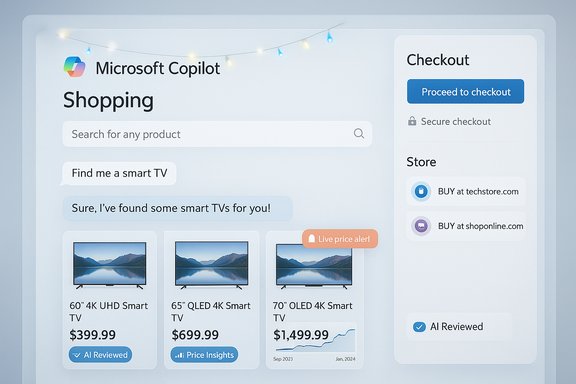
Early reports and Microsoft’s own documentation describe a set of concrete features — some already live in limited form, others flagged as coming soon. Taken together they indicate a single design goal: reduce decision friction and keep commerce inside Copilot rather than sending users to third-party marketplaces.Tracked prices and price history
- Price tracking is already part of Copilot’s public documentation: users can ask Copilot to Track Price, set a price goal, and receive alerts when the price target is met. The Copilot product pages also show a price history chart for product pages, plus management controls for alerts and the tracking period.
- Industry coverage confirms Microsoft intends these tools to operate similarly to existing price trackers in browsers and shopping services: historical price ranges, alerts, and a slider-based goal mechanism. Microsoft’s support material specifically outlines how to set goals and manage notifications inside the Copilot app.
Order history and post-purchase management
- A visible Order History area has been reported in leak/preview coverage, implying Copilot will centralize users’ past purchases inside the app. That aligns with Microsoft’s Cloud for Retail materials showing Copilot templates that learn from order history to personalize recommendations — a capability Microsoft has already documented in its enterprise release plans. In short, order history is both a surfaced user feature and an ingredient for personalization.
- Centralizing orders inside Copilot lets Microsoft create a continuous shopping loop: discover, compare, buy, and then re-engage with order data. That’s a deeper commerce play than simple price alerts.
Recommendations and contextual shopping prompts
- Copilot’s new layout reportedly includes themed recommendation decks (fashion, travel, family, flavors, holiday) that open as preloaded Copilot chats to jump-start exploration. This design emphasizes conversational shopping, where discovery begins in chat and is guided by curated prompts. TestingCatalog’s preview indicates a fall-themed UI pointing at a seasonal push.
- Microsoft’s Copilot positioning explicitly frames the assistant as a discovery engine that returns visual cards with prices, ratings, and store links — a pattern repeated in multiple product announcements. The end-user experience is one of guided discovery rather than raw search results.
Price Insights and Review Insights (AI-driven signals)
- Price Insights: Copilot will offer an AI analysis of a product’s price relative to observed historical ranges and market listings, with a judgment on whether an item is “overpriced now” or a “good time to buy.” This is conceptually close to what Google Shopping and other price-tracking tools provide, but Copilot’s version pairs that with conversational context and timing recommendations. TestingCatalog identified the feature in previews; Microsoft’s own docs and press material on Copilot Shopping also highlight price comparison and tracking as core capabilities.
- Review Insights: Copilot will summarize user reviews into concise pros and cons, surface representative comments, and show an aggregated rating. AI summarization of reviews is increasingly common in commerce interfaces; Microsoft is positioning Copilot to reduce the “noise” of raw review feeds through AI summarization and sentiment extraction. Third-party articles covering the Copilot Shopping launch reference this exact intent.
Native checkout
- Several outlets reported that Copilot Shopping supports native checkout, meaning users may be able to complete purchases without leaving the Copilot environment. That capability shortens the buyer journey and provides Microsoft with more control over the transaction flow and merchant integrations. Microsoft’s promotional messaging and multiple news reports confirm this is part of the planned experience.
How this stacks up against incumbents
Microsoft is not inventing the problems — it is attacking an entrenched set of players with a different integration thesis.- Amazon remains the heavyweight in e-commerce and owns the end-to-end shopper relationship on its platform. Microsoft cannot displace Amazon overnight, but it can interrupt the discovery and decision phases by inserting Copilot into users’ everyday computing surfaces (Windows, Edge, and mobile apps). The goal is to turn Copilot into the first stop for product research and deal discovery. TestingCatalog frames the effort as a direct challenge to Amazon and other AI-first entrants.
- Google Shopping already offers price-tracking and insights in search results; OpenAI and other startups are experimenting with shopping summaries inside chat interfaces. Microsoft has the advantage of system-level presence — Windows and Edge — plus deep enterprise retail investments (Dynamics 365 Commerce, Cloud for Retail) that make it easier to offer merchant integrations and point-of-sale tie-ins. Reuters and coverage of Microsoft’s Copilot expansion underscore this platform advantage.
- The differentiator for Microsoft’s approach is convergence: merging personal data (purchase history, preferences) with web-wide price and review data, all surfaced through Copilot’s conversational layer. If executed with solid merchant relationships and good UX, that could make Copilot the default shopping companion for users who prefer an integrated assistant over visiting multiple marketplaces.
Strengths: Where Copilot Shopping could excel
- Seamless discovery-to-checkout flow — Copilot’s native checkout and in-chat discovery reduce friction and could materially shorten purchase time, particularly for mainstream, low-consideration buys. This is a direct product advantage for users who value convenience.
- Integrated price tracking and timing advice — Combining historical price graphs with AI judgments on whether a price is favorable can save users time and mental overhead. Microsoft’s documented price tracking features already support setting price goals and alert preferences.
- Conversational summarization of reviews — Review Insights has the potential to reduce information overload, surface the most meaningful pros and cons, and accelerate confident buying decisions. AI summaries can be especially helpful for complex electronics or niche products with thousands of noisy reviews.
- Cross-product personalization — If Copilot correctly uses order history and preference memory (with clear user controls), suggestions and deals can become sharply relevant, increasing utility and engagement. Microsoft’s retail templates and Copilot personalization roadmaps already describe such personalization mechanics.
Risks, trade-offs, and open questions
The promise of an AI shopping hub also carries real risks. These aren’t theoretical — they’re operational and ethical challenges Microsoft must manage.Data privacy and personalization trade-offs
- Copilot Shopping’s usefulness depends on access to personal data: past purchases, wish lists, and possibly browsing history. Microsoft’s shopping documentation clarifies personalization controls and limits, but centralized order history and tracking raise concerns about how long this data is retained, who can access it, and whether it’s used for ad personalization. Users and regulators increasingly scrutinize such trade-offs. Microsoft itself warns that Copilot can make mistakes and that prices or terms should be validated on retailer sites.
Accuracy and hallucination risk
- AI-powered review summaries and price assessments can be highly valuable — but they also risk overconfidence. Summaries may omit edge cases or mischaracterize review sentiment. Price Insights that give explicit buy/hold recommendations create liability if they’re wrong or misinterpreted by users. Microsoft’s documentation explicitly cautions users to verify key information on retailer websites. Any authoritative-sounding AI advice around buying needs clear uncertainty signals and easy paths to the original data.
Manipulation and fraudulent signals
- E-commerce is susceptible to manipulation: fake reviews, “brushing” scams, and coordinated pricing tactics can distort AI signals. AI summarizers may be fooled by manufactured or low-quality review clusters unless they actively detect verification badges and cross-source consistency. The broader retail ecosystem is already wrestling with these problems, and Copilot will face them at scale. Industry sources on AI and commerce caution that summarization tools must guard against manipulated review corpora.
Merchant relations and commerce economics
- Native checkout means Microsoft will need robust merchant integrations, fraud controls, payments processing, and dispute resolution flows. Merchants and marketplaces will scrutinize fees, referral economics, and the visibility Microsoft gives competitors. Success depends on Microsoft striking workable commercial models that attract both merchants and customers. Microsoft’s Commerce/Dynamics initiatives and Cloud for Retail investments suggest they are pursuing enterprise ties, but operational complexity is non-trivial.
Partial rollouts and fragmentation
- Early testing reports show partial, staggered rollouts. That generates uneven experiences across accounts and geographies, and inconsistent expectations among users who read previews. Some outlets reported Copilot declining to “actively monitor” prices in certain contexts, or behavior variance between Edge and the Copilot app. Microsoft’s staged approach helps control risk but complicates initial user trust.
Verification, transparency, and trust: Practical safeguards Copilot needs
If Copilot Shopping is to become a trusted shopping hub, Microsoft must pair convenience with visible guardrails. Key expectations include:- Transparent provenance — Every AI summary or price judgment should link to the underlying data and show when the data was collected. Users need quick access to retailer pages and the sources Copilot used for its conclusions.
- Clear uncertainty indicators — AI recommendations should state confidence levels and offer the raw review snippets or price logs that shaped the assessment. This reduces the risk of AI overreach.
- Easy opt-out and data controls — Users must be able to toggle price tracking, delete order history, and control personalization settings. Microsoft’s support pages point to personalization controls for advertising and data usage — those controls should be prominent in any shopping UI.
- Robust merchant and payment safeguards — Native checkout demands hardened fraud detection, dispute resolution flows, and clear merchant terms. A poor checkout experience could undermine Copilot’s perceived value.
- Anti-manipulation measures — Review Insights should weight verified-purchase badges, cross-platform consistency, and recency to detect and downrank suspicious review clusters. AI summarizers without these signals remain brittle.
What this means for users and Windows enthusiasts
For users who live inside Microsoft’s ecosystem — Windows users, Edge loyalists, and Microsoft 365 subscribers — Copilot Shopping could become a convenient first stop for product research and deal discovery. The promise is particularly strong for:- People who prefer a conversational assistant to traditional search.
- Shoppers seeking faster decision-making for common purchases.
- Users who value centralized post-purchase management (returns, tracking, receipts).
Strategic implications: Why Microsoft is pushing this now
Timing matters. Microsoft’s push toward shopping features coincides with broader market dynamics:- The holiday shopping season (Black Friday and Cyber Week) amplifies the value of price tracking and deal discovery. TestingCatalog’s preview and the fall-themed UI signals appear intentionally timed to capture seasonal shopping behavior. Early rollouts let Microsoft refine the experience under load.
- Competitive pressure from Google, OpenAI, and AI-first shopping tools has forced major platforms to integrate commerce capabilities into conversational agents. Microsoft’s advantage is systemic: Copilot can become a default assistant across multiple devices and services if it delivers consistent value. Coverage of Copilot’s broader product upgrades and the company’s retail initiatives underscores that commerce is a strategic priority.
- Enterprise and retail partnerships matter. Microsoft’s Dynamics 365 and Cloud for Retail investments give it an enterprise pathway to merchant integration that independent startups lack, enabling deeper commerce features beyond simple search or price alerts.
Bottom line: convenience with caveats
Microsoft’s Copilot Shopping represents a credible move to fold AI-first commerce into the daily computing experience. The combination of tracked prices, order history, curated recommendations, price insights, review summaries, and native checkout creates a powerful stitched-together experience that could reshape how many people discover and buy online. Multiple product pages and independent news coverage corroborate the broad contours of this strategy. At the same time, the transition from experimentation to full public launch exposes practical risks: data-privacy trade-offs, potential AI inaccuracies, susceptibility to manipulated reviews, and the heavy operational burden of native checkout. Microsoft’s existing documentation and product notes show awareness of these hazards — but real-world performance, merchant cooperation, and robust anti-abuse measures will determine whether Copilot is a trusted shopping companion or simply another convenient but imperfect channel.For WindowsForum readers, the immediate takeaway is pragmatic: Copilot Shopping will likely be a useful tool for discovery and quick purchases, but it should be used with a healthy degree of skepticism until its price insights and review summaries prove consistently accurate and transparent. Microsoft’s staged rollout and explicit cautions in its support documentation are reminders that user vigilance remains essential.
Practical user checklist before relying on Copilot Shopping
- Confirm the seller and price on the retailer’s site before completing a purchase.
- Check whether a review summary links to verified-purchase reviews or shows provenance for the review corpus.
- Review and, if necessary, clear Copilot’s order history and personalization settings if you’re uncomfortable with data retention.
- Use price-tracking only for items where waiting makes sense — for urgent purchases trust the immediate price.
- Keep an eye on reported behavior during the initial public rollout (inconsistent experiences are common in partial previews).
Microsoft’s foray into integrated, AI-powered shopping is an unsurprising next step given Copilot’s broader ambitions. The product now aspires to be more than a productivity assistant — it wants to be the shopping hub on your device. If Microsoft can deliver accurate price insights, meaningful review summarization, and a secure native checkout while preserving user control over data and delivering strong merchant partnerships, Copilot Shopping could become a major new battleground in digital commerce. For now, the feature is rolling out and under active tuning; its long-term success will hinge on trust, transparency, and tangible value for both users and merchants.
Source: TestingCatalog Microsoft prepares Copilot Shopping ahead of Black Friday
