

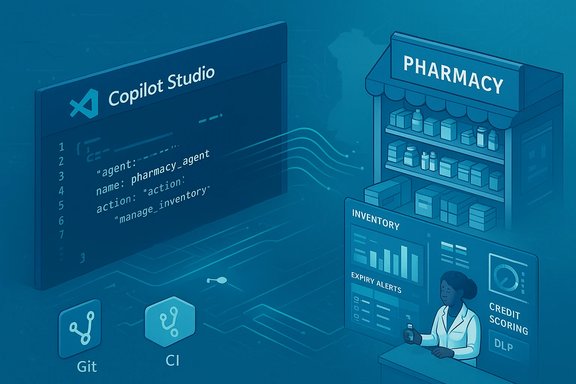
Microsoft’s Copilot push accelerated again this week with two related but distinct developments: the Copilot Studio extension for Visual Studio Code has been declared generally available, and Microsoft’s Copilot-powered partnership with Kenyan startup Zendawa is rolling out practical, revenue‑preserving AI tools for neighborhood pharmacies. Together these moves illustrate Microsoft’s two-track Copilot strategy — expanding developer tooling inside VS Code while exporting Copilot capabilities to industry-specific, field‑level applications — but they also raise familiar questions about governance, data residency, and the real‑world impact of generative AI in small businesses.
The Copilot family now covers a wide span of products: GitHub/GitHub Copilot for developer productivity, Microsoft 365 Copilot for knowledge work, and Copilot Studio as the low-code/no-code environment for building and governing Copilot agents that connect to tenant data and external systems. Microsoft’s decision to push the Copilot Studio experience into VS Code as a supported extension completes a natural integration between agent design and developer workflows: you can author, test, and version agent definitions alongside code and CI pipelines. Microsoft’s product documentation lists the Visual Studio Code extension as generally available (GA) and points to a monthly release cadence delivered via the VS Code marketplace. At the same time, Microsoft Source published a feature on Zendawa, a Kenyan health‑tech startup that uses Microsoft 365 Copilot and Power BI to help small pharmacies manage inventory, reduce expired stock losses, and tie transaction telemetry into credit‑scoring for inventory financing. Zendawa’s field results — faster stocktaking, reduced waste, and initial credit‑access pilots — have been reported by Microsoft and independently covered by regional outlets.
Source: Neowin https://www.neowin.net/news/microso...crosoft-copilot-zendawa-ai-kenya-pharmacies/]
 Background
The Copilot family now covers a wide span of products: GitHub/GitHub Copilot for developer productivity, Microsoft 365 Copilot for knowledge work, and Copilot Studio as the low-code/no-code environment for building and governing Copilot agents that connect to tenant data and external systems. Microsoft’s decision to push the Copilot Studio experience into VS Code as a supported extension completes a natural integration between agent design and developer workflows: you can author, test, and version agent definitions alongside code and CI pipelines. Microsoft’s product documentation lists the Visual Studio Code extension as generally available (GA) and points to a monthly release cadence delivered via the VS Code marketplace. At the same time, Microsoft Source published a feature on Zendawa, a Kenyan health‑tech startup that uses Microsoft 365 Copilot and Power BI to help small pharmacies manage inventory, reduce expired stock losses, and tie transaction telemetry into credit‑scoring for inventory financing. Zendawa’s field results — faster stocktaking, reduced waste, and initial credit‑access pilots — have been reported by Microsoft and independently covered by regional outlets. Copilot Studio extension for VS Code: what GA means
A developer‑centric way to build Copilot agents
With Copilot Studio’s VS Code extension in GA, Microsoft is explicitly enabling developers to treat Copilot agent artifacts like code. The extension lets teams:- Author and edit full agent definitions in a text/JSON format inside VS Code.
- Version control agent definitions with Git and use pull requests for review.
- Run local testing workflows and debug agents in a development loop that mirrors standard application development.
Verified availability and update cadence
Microsoft Learn explicitly marks the Visual Studio Code extension as generally available (GA) and documents a monthly release schedule via the VS Code extension package manager. That means organizations can expect feature parity improvements and bug fixes to arrive through the marketplace and can configure automatic or manual updates per their change control policies. This is the definitive source for availability claims. A number of community posts and forum archives that track Copilot and VS Code releases corroborate the move to consolidate Copilot experiences (chat, inline suggestions, agent tooling) and the increasing integration of Copilot features across IDE surfaces — though they also point to a phased rollout for some agentic features and governance controls. Where possible, administrators should verify feature flags and tenant‑level opt‑ins in the Microsoft 365 admin and Power Platform admin centers before production rollouts.Key features developers should expect
- Full agent definitions editable in VS Code with source control support.
- Local testing and simulation of agent actions, including retrieval grounding and connector behavior.
- Packaging and migration tools for moving agents between environments (solutions import/export).
- Admin and governance hooks exposed in the authoring lifecycle so security teams can run reviews before wide distribution.
Zendawa + Microsoft Copilot: AI on the pharmacy counter
What Zendawa does — practical, measurable outcomes
Zendawa is a Nairobi‑based startup that provides a digital suite to neighborhood pharmacies: a point‑of‑sale and inventory management system, last‑mile order matching and delivery, and an analytics layer powered by Microsoft 365 Copilot and Power BI. The product solves three immediate pain points:- Inventory waste from expired medicines.
- Time‑consuming manual stocktaking in small shops.
- Lack of transaction data that would enable access to inventory financing.
Business model and financing angle
Zendawa collects transaction and inventory telemetry and uses Power BI analytics to create an internal credit score that helps pharmacies access inventory financing from third‑party lenders. By turning previously paper‑based cash flow into verifiable digital records, the startup reduces the friction to extend working capital — a classic data‑to‑credit pipeline that unlocks growth for micro and small enterprises. Microsoft’s coverage and regional reporting emphasize the potential of this mechanism to change how last‑mile healthcare retail operates in markets with limited formal financing options.Scale and timing — note the evolution
Published numbers in Microsoft’s piece state Zendawa had onboarded roughly 820 pharmacies (as of the Microsoft feature date). Earlier local reporting from 2024 listed a smaller footprint (for example, a citation of 520 pharmacies in mid‑2024), which shows rapid scale but also underlines the importance of checking dates when relying on reported figures. For planning or procurement exercises, confirm the current footprint directly with Zendawa or recent press coverage. This is an example where temporal verification matters: numbers can and do change quickly for startups in active expansion phases.What these two developments mean together
Microsoft’s dual push — smoothing the developer journey for building Copilot agents, and demonstrating vertical, tenant‑grounded Copilot use cases in markets like Kenya — is strategically coherent. Copilot Studio GA in VS Code turns agents into code artifacts that can be versioned and governed, which addresses one of the main enterprise objections to AI in production: lifecycle control. Zendawa’s use of Copilot capabilities shows the complementary business case: when agents are tethered to retrieval‑grounded data (inventory, sales, supplier feeds), outputs become actionable and auditable, rather than purely speculative.- For developers: expect a more formalized workflow for agents (author → PR → test → deploy).
- For enterprises: Copilot agents can now be treated like code assets subject to the same governance and compliance frameworks as other software.
- For small businesses and local markets: AI can deliver rapid operational improvements when it’s paired with digitization and a workable financing model.
Strengths and immediate benefits
- Developer velocity and traceability: Authoring agents in VS Code removes the “black box” stigma and brings agents into established Git workflows. This accelerates safe experimentation while preserving an audit trail.
- Low‑cost productivity for SMEs: Zendawa’s evidence of reduced expired stock and time saved on stocktaking shows that modest AI investments can deliver outsized operational ROI in tight‑margin retail.
- New financing pathways: Data‑driven credit scores built from transaction flows enable access to working capital otherwise unavailable to micro‑pharmacy owners. This is a practical, local solution with economic multiplier effects.
- Governance tooling on the horizon: Microsoft’s Copilot Studio and associated Power Platform governance features provide DLP, Purview sensitivity labels, and tenant admin controls — building blocks for responsible enterprise adoption.
Risks, caveats, and what to watch closely
While the promise is real, the risks are also significant and deserve careful mitigation.Hallucination and correctness
Generative models can produce plausible‑sounding but incorrect outputs. In developer contexts (code edits, automated refactors) this can introduce subtle bugs. In pharmacy operations, an incorrect inventory recommendation or a misinterpreted expiry date could have business and patient safety implications. Microsoft advocates retrieval‑grounded workflows (where Copilot’s outputs are anchored to tenant data), but actual safety depends on indexing quality, prompt engineering, and human review processes.Data privacy and residency
Agents often require access to tenant datasets and connectors (SharePoint, Dataverse, Microsoft Graph). For regulated industries or cross‑border business, where data is processed and stored matters. Microsoft’s enterprise materials and community analyses caution organizations to confirm processing locales and any in‑country options when legal compliance or sovereignty concerns apply. This is particularly relevant for healthcare data collected by platforms like Zendawa when integration points expose patient or transactional information.Intellectual property and training data concerns
Development tools trained on public code raise license‑and‑ownership questions. Copilot suggestions might, in rare cases, reproduce copyrighted code patterns; organizations must maintain code review gates and policy enforcement to avoid inadvertent IP leakage. The GA of Copilot Studio does not remove the need for legal and security review in the CI pipeline.Operational dependency and vendor lock‑in
Small businesses leveraging a platform like Zendawa gain immediate benefits but also become dependent on the platform for inventory, deliveries, and access to lending channels. Changes in terms, pricing, or connector availability could introduce business risk. Enterprises building agents should plan for exportable agent artifacts, vendor‑neutral data backups, and contingency processes.Practical recommendations
For enterprises, ISVs, and small businesses considering these Copilot advances, the following checklist will help manage risk and capture value.- Verify GA features and tenant controls before production deployment.
- Confirm that the VS Code extension is the version your org supports and that monthly updates align with your change control schedule.
- Implement a PR + CI pipeline for agent definitions.
- Treat agent JSON/definitions like code: enforce code review, run automated tests, and gate deployment.
- Ground Copilot outputs in trusted data sources.
- Use retrieval grounding (tenant data, indexed files, verified connectors) wherever outputs inform business decisions.
- Define DLP and sensitivity labels for shared connectors.
- Prevent sensitive sources from being inadvertently exposed to agent queries; apply Purview and Power Platform DLP where applicable.
- For SMEs (like pharmacies) exploring apps like Zendawa:
- Start with a short pilot, track measurable KPIs (waste reduction, sales uplift), and validate lender terms for any embedded credit products.
- Plan for data portability.
- Ensure that transaction and inventory data can be exported to standard formats so businesses aren’t locked into a single provider.
Governance and regulatory posture: what enterprise security teams must demand
Enterprises should demand three core guarantees before broadly deploying agentic Copilot workflows:- Traceability — full audit logs of agent prompts, retrieval sources, and actions taken.
- Enforceable limits — tenant‑level controls that restrict which connectors and knowledge bases an agent can query.
- Human‑in‑the‑loop for high‑impact actions — require human approval for financial operations, customer communications, or workflow changes that affect customers or regulatory reporting.
Where verification and caution are required
- Any numeric claims (for example, Zendawa’s number of onboarded pharmacies or reported monthly savings) should be treated as time‑sensitive. The Microsoft feature and local press pieces provide snapshots; confirm the latest figures directly with Zendawa for procurement planning or academic evaluation.
- Feature timelines for agentic autonomy and certain channel integrations may be rolled out regionally and phased across tenant types. Administrators should verify tenant‑specific availability in the Microsoft 365 admin center and consult updated Copilot Studio release notes before designating features as “production‑ready.”
Final assessment
Microsoft’s GA release of the Copilot Studio extension for Visual Studio Code marks a pragmatic and necessary step: agents must be code, versionable and testable, if organizations are to trust them in production. The extension’s GA status means enterprises and developer teams can more confidently integrate agent authoring into established software lifecycles, provided they adopt robust governance, DLP, and review processes. Meanwhile, the Zendawa case shows the other side of the ledger: Copilot’s value is not purely technical, it’s economic. When AI is paired with digitization and sensible business models — in this case, inventory tracking, demand forecasting, and data‑to‑credit — outcomes are immediate and measurable for small businesses. That combination of technical enablement and commercial utility is precisely the point of the Copilot ecosystem. The caveat remains: the gains are real but conditional on governance, data quality, and prudent, human‑centred controls. Both developments — Copilot Studio GA in VS Code and Copilot‑powered Zendawa deployments in Kenya — are forward steps. They show how enterprise‑grade agent authoring and verticalized AI services can coexist in a practical ecosystem. The work that remains is organizational: ensuring governance keeps pace with capability, and that small businesses using these tools retain agency over their data, finances, and operations.Source: Neowin https://www.neowin.net/news/microso...crosoft-copilot-zendawa-ai-kenya-pharmacies/]
