

Microsoft’s November updates to Copilot Studio mark a decisive shift: the product is moving from a workflow automation tool toward a governed platform for building, operating, and scaling AI agents across enterprises, with production-ready model choices, human-in-the-loop checkpoints, and a new tenant-level control plane designed for agent lifecycle management.
Copilot Studio began as a low-code authoring surface that let makers and developers design conversational agents and automation flows that interact with Microsoft 365, Power Platform connectors, and third-party systems. Over the last year Microsoft has layered in identity, telemetry, and compliance controls so agents can be treated as operational assets — discoverable, auditable, and manageable under corporate policy.
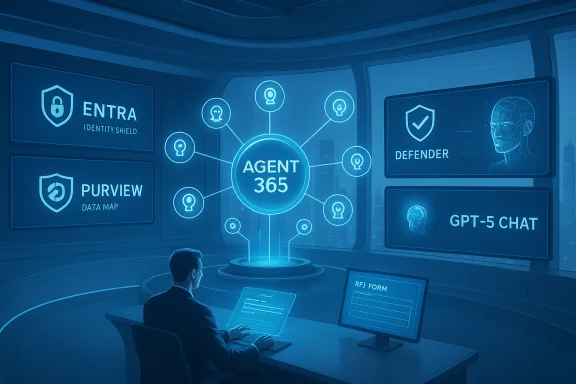
At Ignite 2025 Microsoft presented this strategy as an enterprise-first approach: enable rapid creation for makers while giving IT the governance tools to scale safely. The November updates consolidate that direction by adding model choice (including GPT-5 Chat), human-in-the-loop controls (HITL) for approval and review, and Agent 365 — a central control plane for agent fleets — plus integration points with Defender, Purview, and Entra identity.
Source: gHacks Technology News Microsoft Expands Copilot Studio With AI Agent and Governance Features - gHacks Tech News
 Background
Copilot Studio began as a low-code authoring surface that let makers and developers design conversational agents and automation flows that interact with Microsoft 365, Power Platform connectors, and third-party systems. Over the last year Microsoft has layered in identity, telemetry, and compliance controls so agents can be treated as operational assets — discoverable, auditable, and manageable under corporate policy.At Ignite 2025 Microsoft presented this strategy as an enterprise-first approach: enable rapid creation for makers while giving IT the governance tools to scale safely. The November updates consolidate that direction by adding model choice (including GPT-5 Chat), human-in-the-loop controls (HITL) for approval and review, and Agent 365 — a central control plane for agent fleets — plus integration points with Defender, Purview, and Entra identity.
What shipped in November — the highlights
GPT-5 Chat: production-ready model choice in key regions
One of the headline items is that GPT-5 Chat is now offered as a general-availability model option inside Copilot Studio for customers in the United States and the European Union. That removes a prior regional limitation and gives organizations the ability to standardize on the same model behavior across major markets. Admins and makers can set GPT-5 Chat as the runtime model for an agent from the agent’s overview page. Microsoft also introduced experimental early-release access to newer GPT-5.x variants in U.S. early-release environments (for evaluation and testing), while cautioning that those experimental models are best used outside production until Microsoft completes its validation gates. This gives teams a path to test advanced capabilities while preserving a stable production baseline.Human-in-the-loop (HITL) controls — preview
A formal human-in-the-loop capability (called “Request for Information” / RFI) is now available in preview. Agents can pause mid-flow and present structured forms — delivered via Outlook or other integrated channels — to designated reviewers. Once reviewers supply the required inputs or approvals, agents resume execution with the submitted values as parameters. This is explicitly positioned as a governance primitive to reduce risk when agents interact with sensitive data or invoke downstream actions. Microsoft’s documentation shows RFI as a configurable action in agent flows where makers define the title, message, assignee, and the input schema (text, numbers, binary, etc., enabling structured review checkpoints that can be enforced at decision boundaries.Agent 365 — a control plane for fleets
Agent 365 is introduced as the tenant-level control plane for discovering, cataloging, authorizing, monitoring, and governing agents at scale. It ties agents into Microsoft Entra (giving them directory identities), integrates telemetry into Purview and Microsoft Defender, and provides quarantine/remediation primitives that let admins isolate or block agents when they behave unexpectedly. The feature set is aimed at preventing “agent sprawl” from becoming an unmanageable compliance and cost problem.Expanded integration, testing, and observability
Copilot Studio now includes:- Built-in agent evaluations to run agents through pre-defined scenarios for regression testing.
- Model Context Protocol (MCP) server support to standardize how agents access application logic and data.
- Computer use / UI automation via hosted Windows 365 browser pools for interacting with legacy UIs where APIs don’t exist.
- OneNote and People as living knowledge sources so agents can ground answers in directory attributes and meeting notes.
Why this matters — the strategic shift
Microsoft’s product language and recent releases show a strategic pivot: Copilot Studio is now positioned as the enterprise “agent factory” where AI agents are not ad-hoc automations but governed, identity-bound, auditable services that do real work. That shift matters for three practical reasons.- Operationalization: Agents become reusable, versioned assets with owners, SLAs, and cost controls — not one-off automations.
- Governance-in-depth: Identity plumbing (Entra Agent ID), detection (Defender integration), audit trails (Purview/Sentinel) and a control plane (Agent 365) create the familiar surfaces security teams need to accept agentic automation.
- Model management as policy: Selecting a model is now a governance decision (speed/cost vs. reasoning depth), and Copilot Studio surfaces model choice as an explicit tenant-level control. That gives IT another lever to balance cost and risk.
Technical verification and independent corroboration
Several vendor claims in the November update are verifiable from Microsoft’s product documentation and major press coverage:- Microsoft’s Copilot blog and Microsoft 365 product posts describe the November feature set and GPT-5 Chat availability in the US and EU.
- Microsoft Learn and Power Platform release notes document the Request for Information (HITL) feature and show public-preview timelines and configuration details.
- Independent outlets reported on Agent 365 and the enterprise governance angle at Ignite and described Microsoft’s ambitions to treat agents as managed assets.
Strengths: what Microsoft got right
1) Identity-first governance
Treating agents as first-class directory objects (Entra Agent ID) is a practical breakthrough: it lets organizations apply the same lifecycle and conditional access policies they already use for service principals and service accounts. That reduces governance friction and makes audits tractable.2) Human judgment at decision boundaries
The structured HITL/RFI mechanic addresses the single biggest operational concern for agentic automation: letting humans validate or supply missing data where the business, legal, or financial stakes are material. Implemented correctly, it turns agents into collaborators rather than autonomous decision-makers.3) Model choice and experimentation pathways
Giving tenants explicit model selection — including production-grade GPT-5 Chat and experimental GPT-5.x releases — helps teams match tasks to models (e.g., GPT-5 Chat for high-volume employee support, GPT-5.2 for complex reasoning in sandbox). The separation between GA and experimental models helps prevent unintentional production use of non‑validated variants.4) Operational controls to limit runaway costs
Copilot Credits, consumption metrics, monthly caps, and capacity packs are now part of the metering story. These controls are essential because agent sprawl can produce unexpectedly high cloud and model consumption bills.Risks and gaps: where teams must be cautious
1) Complexity — agents are powerful and fragile
Agents that combine retrieval, UI automation, and action execution are powerful but increase operational brittleness. UI-level automation particularly can break when web layouts or legacy applications change, and it widens the attack surface for credential abuse. Treat these automations like RPA artifacts with rigorous testing and monitoring.2) Auditability vs. explainability
While Copilot Studio improves audibility (logs, run histories, model selection traces), the deeper problem of explainability — why a model produced a specific recommendation — remains unsolved. Enterprises should instrument decision boundaries with structured outputs (schemas), deterministic checks, and human approvals for high-risk flows.3) Regulatory uncertainty and data residency
Model availability and legal obligations differ across regions. The EU AI Act, evolving U.S. guidance, and tenant-specific compliance requirements mean organizations must validate that agent architectures meet regulatory obligations — especially when agents use third-party models or cross-border data flows. Microsoft’s GA statements are region-limited and often phased; tenants must verify their exact entitlements.4) Vendor lock-in / switching costs
Deep integration of agents with Entra, Purview, Defender, and Copilot Studio increases operational efficiency but also concentrates control inside Microsoft’s ecosystem. While that is beneficial for manageability, it raises switching costs and complicates multi-cloud or multi-model strategies. Enterprises should design portability and data export plans where feasible.5) Over-reliance on model outputs
Even production-ready models can hallucinate or return incorrect structured data. The human-in-the-loop feature mitigates risk at checkpoints, but organizations must define which outputs require human sign-off and which can be automated end-to-end. Mistakes in high-impact workflows (finance, legal, HR) can have immediate business consequences.Practical guidance for IT leaders and makers
- Start small and govern early: pilot with narrowly-scoped agents (employee self-service, invoice triage) and enable Agent 365 governance from day one to develop policies and SLAs.
- Use sandbox tenants for experimental models: reserve GPT-5.x and GPT-5.2 variants for non-production environments until you can validate behavior and costs. Establish a model-change approval workflow.
- Map decision boundaries: explicitly list actions that require HITL approvals (financial write-backs, contract changes, customer refunds) and implement RFI steps with measurable SLA expectations for reviewers.
- Instrument everything: log model selection, prompt inputs, knowledge sources, and final outputs. Integrate run histories into Purview and Sentinel so security and compliance teams can reconstruct events.
- Cap consumption: configure Copilot Credits, monthly caps, and capacity packs to prevent unbudgeted spend. Monitor “hot” agents and model usage patterns to reassign cheaper models for routine tasks.
- Treat UI automation like RPA: build tests, allow-lists, credential vaults, and rollback plans. Prefer API-based connectors when available, and limit UI-based automations to well-defined, monitored flows.
How to evaluate Copilot Studio for your organization — a checklist
- Governance readiness:
- Is Agent 365 enabled or available to your tenant?
- Can Entra lifecycle processes include Agent IDs?
- Are Purview and Defender integrated with agent telemetry?
- Risk control:
- Have you defined which agent actions require HITL?
- Are monthly consumption caps and billing alerts configured?
- Operational readiness:
- Are evaluation test suites (prompt evaluations) in place?
- Is there a rollback and quarantine procedure for misbehaving agents?
- Legal & compliance:
- Do you understand model residency and the regulatory implications of using third-party models?
- Have you classified agent use cases for AI Act or equivalent compliance regimes?
What remains to be proven
Microsoft’s November updates offer the building blocks for enterprise agent governance, but several practical questions remain that only real-world deployments will answer:- How effective will Defender‑integrated runtime protections be at preventing prompt‑injection attacks or unauthorized writes in practice?
- Will Agent 365 scale to manage thousands of agents without becoming an administrative bottleneck?
- How seamless will rollback and remediation be when agents make stateful changes across multiple systems?
- Will tenants be able to run hybrid or multi-model strategies easily, or will switching costs entrench a single-provider architecture?
Conclusion
The November Copilot Studio updates crystallize Microsoft’s enterprise strategy: agents at scale with governance by design. By making GPT-5 Chat production-ready in major regions, adding structured human-in-the-loop checkpoints, and introducing Agent 365 as a control plane, Microsoft has framed agentic automation as an operational discipline rather than a speculative experiment. This is a pragmatic evolution: organizations gain power and productivity, but they also inherit new operational and compliance responsibilities. The most successful adopters will be those that combine rapid maker-driven innovation with rigorous lifecycle controls — sandboxing experimental models, instrumenting decision boundaries with HITL, and treating agents as identity-bound, auditable assets. That balance, not the technology alone, will determine whether Copilot Studio becomes a scalable engine of business value or a new class of enterprise risk.Source: gHacks Technology News Microsoft Expands Copilot Studio With AI Agent and Governance Features - gHacks Tech News
