

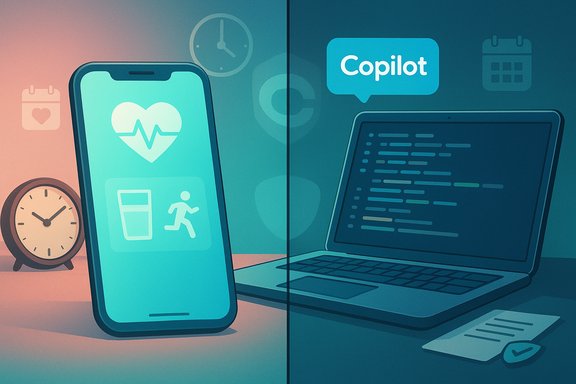
Microsoft’s Copilot team has published one of the largest looks yet at how real people use conversational AI, analyzing 37.5 million de‑identified Copilot conversations from January through September 2025 and concluding that when and where people talk to Copilot matters as much as what they ask it to do. The headline: on personal mobile devices Copilot behaves like a round‑the‑clock health and wellness aide, on desktops it functions as a punctual workday assistant, and late‑night sessions skew toward introspection, philosophy, and emotional advice. These findings — summarized in Microsoft’s Copilot Usage Report 2025 and widely reported by independent outlets — carry both clear product opportunities and serious governance and safety questions for users, IT teams, and regulators.
Microsoft AI’s preprint, titled “It’s About Time: The Copilot Usage Report 2025,” describes an analysis of 37.5 million anonymized chat summaries gathered from consumer Copilot interactions between January and September 2025. The dataset explicitly excluded enterprise and educational accounts; the research team used automated classifiers to tag each conversation by topic and intent (for example, “Health & Fitness — Information” or “Technology — Create”), and relied on aggregated statistics rather than human review of raw chats. That methodological framing is central: Microsoft presents the work as a privacy‑preserving, high‑level behavioral study rather than a content audit. Independent coverage by mainstream tech publications confirms the broad contours of the study: device type (mobile vs. desktop), time of day (work hours vs. late night), day of week (weekday vs. weekend) and calendar effects (e.g., Valentine’s Day) were the primary axes along which usage patterns diverged. Multiple outlets picked up the finding that health‑related topics dominated mobile conversations at virtually every hour, while desktop conversations clustered tightly around work, productivity, and technical questions during typical office hours.
The report’s scale and the consistency of major patterns across independent reporting make its headline claims credible, but the study also surfaces the toughest questions yet for AI governance: how to safely support health and emotional use, how to audit large‑scale classifier pipelines, and how to ensure corporate controls keep pace with consumer behavior. Addressing those questions will determine whether Copilot’s role as a trusted workday assistant and nighttime confidant becomes an unambiguous public good — or a source of new systemic risk.
In short: the Copilot Usage Report 2025 maps a human pattern around AI use with clarity and scale. The findings are immediately useful — and immediately consequential. Designing for that reality means balancing product innovation with transparent methods, rigorous safety engineering, and governance that recognizes AI is no longer an experimental add‑on but a companion in people’s lives.
Source: The Indian Express Microsoft Copilot is now a workday assistant and nighttime confidant, report finds
 Background and overview
Microsoft AI’s preprint, titled “It’s About Time: The Copilot Usage Report 2025,” describes an analysis of 37.5 million anonymized chat summaries gathered from consumer Copilot interactions between January and September 2025. The dataset explicitly excluded enterprise and educational accounts; the research team used automated classifiers to tag each conversation by topic and intent (for example, “Health & Fitness — Information” or “Technology — Create”), and relied on aggregated statistics rather than human review of raw chats. That methodological framing is central: Microsoft presents the work as a privacy‑preserving, high‑level behavioral study rather than a content audit. Independent coverage by mainstream tech publications confirms the broad contours of the study: device type (mobile vs. desktop), time of day (work hours vs. late night), day of week (weekday vs. weekend) and calendar effects (e.g., Valentine’s Day) were the primary axes along which usage patterns diverged. Multiple outlets picked up the finding that health‑related topics dominated mobile conversations at virtually every hour, while desktop conversations clustered tightly around work, productivity, and technical questions during typical office hours. What the data shows — key findings
Health dominates mobile, always
The single most consistent result in the report is the dominance of Health & Fitness topic‑intent pairings on mobile devices. Across every hour and month observed, mobile users more often interacted with Copilot for health‑related information and advice than for entertainment, travel, or pure productivity. Microsoft frames this as a striking behavioral constant: one reason the team emphasizes device context is that the intimacy and immediacy of mobile screens appear to drive personal and wellness use. Implication: Copilot on mobile is being used as a first‑line wellness tool — for routine guidance, reminders, exercise tips, and symptom checks. That raises immediate product design questions (how to convey uncertainty or risk when handling health queries? and regulatory questions (when does helpful advice become medical practice? that deserve careful attention.Desktop equals work, especially 8 a.m.–5 p.m.
On desktop and laptop devices the pattern flips: Copilot is used primarily for work and technology tasks during business hours. The report shows a pronounced concentration of productivity, coding, and document‑creation intents between roughly 8 a.m. and 5 p.m., suggesting Copilot has become an integrated component of many people’s daily workflows even on personal machines. Microsoft’s analysis excluded corporate tenants, so these desktop patterns come from consumer accounts — which hints strongly at blurred lines between personal and professional device use. This has product consequences (prioritize workflow execution, code assistance, and file grounding for desktop Copilot) and governance consequences (IT admins need to anticipate employee behavior across mixed personal/corporate endpoints).Weekdays, weekends and the rhythm of use
The report highlights clear weekday/weekend differences: programming and technical queries spike Monday through Friday, while gaming and leisure topics climb on Saturdays and Sundays. Temporal rhythms were also visible at smaller scales: travel planning tends to rise around commuting hours, and social or cultural topics increase in later months as new holidays and events appear in the calendar. These rhythms reinforce the central claim: AI behavior is not monolithic; usage is a function of context and calendar, which should inform product roadmaps and moderation priorities.Late‑night introspection: philosophy, religion, and life advice
A striking behavioral pattern is the uplift of Religion & Philosophy and long‑form reflective topics during early morning and late night hours. Microsoft’s report shows an overnight rise in existential questions, spiritual queries, and personal decision‑making conversations. The company also notes an overall increase in advice‑seeking (not just fact retrieval): more users are using Copilot to discuss relationships, life choices, and emotional concerns. This raises ethical issues: when people treat a chatbot as a confidant, there must be safeguards for emotional safety, transparency about limitations, and pathways to human help when questions verge on crisis.Calendar effects: Valentine’s Day and seasonal spikes
Microsoft documents seasonal spikes — the clearest being a Valentine’s Day surge in relationship and personal growth queries in February. The report shows people seek Copilot for planning, tips, and emotional guidance around specific events, with a rise in personal growth queries in the days prior. Seasonal and event‑driven usage is predictable and presents opportunities for contextually tuned features (event templates, empathetic prompts, or risk flags).How Microsoft ran the analysis (methodology and limits)
- Sample window: January–September 2025.
- Sample size: 37.5 million de‑identified conversations (consumer accounts only — enterprise and educational tenants excluded).
- Labeling: Automated machine classifiers assigned topic and intent labels; Microsoft reports no human review of raw chats for the published metrics.
- Aggregation: Results are presented as rank‑ordered topics, hourly and monthly trends, and heatmaps across devices and days.
Cross‑checking the headline claims
To validate the most consequential claims, the report’s numbers and principal patterns were cross‑checked against independent reporting from reputable outlets:- The 37.5 million figure and the Jan–Sep 2025 timeframe are repeated in Microsoft’s report and by independent tech press outlets.
- Mobile health dominance and desktop productivity peaks are described both in the Microsoft write‑up and in third‑party coverage.
- Trends like programming on weekdays, gaming on weekends, late‑night philosophical spikes, and the February Valentine’s pattern appear across multiple summaries and journalistic accounts.
Strengths — why this report matters
- Scale: 37.5 million conversations is a large, real‑world dataset that provides population‑level signal about how conversational AI is actually used day to day.
- Actionable segmentation: device × time × calendar segmentation is an immediately practical lens for product design — it suggests tailored UX, safety policies, and features for mobile vs desktop.
- Privacy framing: Microsoft’s approach to de‑identification and using automated summaries rather than raw chat logs is a reasonable privacy‑minded tradeoff for producing public insights at scale.
- Behavioral signal: the move from pure information retrieval to advice and emotional support as identifiable intents is arguably the most important trend — it signals a maturity of user expectations and warrants investment in safety, escalation, and human‑in‑the‑loop pathways.
Risks, caveats, and potential harms
1) Privacy and re‑identification risk
Even de‑identified aggregates carry re‑identification and inference risks when datasets are large and combine temporal, device, and topical metadata. The risk rises if datasets are correlated with other telemetry or if aggregated results are sliced too finely. De‑identification practices should be transparent and independently audited; the paper’s high‑level privacy claims are a start but not a substitute for independent review.2) Medical and wellbeing risks
Health dominance on mobile is a double‑edged sword. Many mobile queries are benign (exercise tips, sleep hygiene), but symptom checking and treatment suggestions can have real clinical consequences. A consumer Copilot providing confident but incorrect medical advice could cause harm. That risk calls for clear guardrails: explicit medical‑information disclaimers, referral to licensed professionals, and constrained behavior on queries that imply emergency or diagnostic intent.3) Advice illusions and over‑trust
The report’s finding that people increasingly use Copilot as an emotional advisor highlights the danger of over‑trust: users may rely on a probabilistic language model for advice that should involve human judgment, professional expertise, or regulatory oversight. Systems must be designed to signal uncertainty, present evidence, and avoid asserting judgements beyond the model’s competence.4) Classifier bias and label opacity
Automated topic/intent classifiers power the report’s conclusions. If classifiers systematically mislabel certain dialects, cultures, or phrasing, usage counts for specific topics could be skewed. Public transparency on classifier performance (confidence intervals, error rates, demographic performance) would greatly improve interpretability.5) Governance gaps for enterprises and admins
The report excluded enterprise accounts, but its core behavioral conclusions (personal devices, blurred personal/work use) imply governance headaches for IT: employees will use more capable consumer Copilots on personal phones than the corporate Copilot they are allowed on work machines. That gulf risks data leakage, shadow use, and regulatory exposure; administrators need policies and toolsets to address that reality. Microsoft’s own internal governance writing underscores how quickly these gaps can create risk if not proactively managed.What this means for Windows users, IT teams, and product leaders
For Windows users
- Treat Copilot as a capable assistant but not a professional or human substitute. Verify health and legal advice with authoritative sources and professionals.
- Protect personal data: avoid pasting sensitive identifiers (SSNs, account numbers, proprietary corporate text) into chat prompts.
- Use platform controls: review privacy and history settings in Copilot apps and the Microsoft account.
For IT and security teams
- Reassess DLP and endpoint policies to account for conversational AI referrals and copy/paste risks.
- Ensure SSO and conditional access are enforced for corporate Copilot deployments and consider feature gating for sensitive datasets.
- Provide education: employees should know when using consumer Copilot is permitted and how to handle sensitive queries.
- Monitor telemetry for shadow AI usage and prioritize governance for mixed personal/corporate device ecosystems.
For product teams and designers
- Build device‑aware experiences: prioritize workflow execution, long‑document grounding, and accurate context retrieval on desktop; favor empathetic framing, risk deferral, and concise advice cues on mobile.
- Surface uncertainty and provenance: always show when answers are model‑generated, include citations for factual claims, and where appropriate prompt users to seek professional help.
- Tune moderation and safety by time and topic: late‑night emotional queries may require different escalation flows than lunchtime travel planning.
Recommendations and next steps
- Publish classifier metrics: model owners should release confusion matrices, per‑topic precision/recall, and sample failure modes so policy makers and researchers can evaluate robustness.
- Formalize safety flows for health and crisis queries: add detection for emergency intent, immediate signposting to help resources, and conservative non‑actionable responses for high‑risk prompts.
- Strengthen auditability: independent third‑party audits of de‑identification procedures and privacy protections would increase public confidence in large‑scale behavioral studies.
- Harmonize enterprise governance: vendors and enterprises should co‑design policies so employees aren’t forced to choose between personal Copilots and safe corporate equivalents.
- Educate users: clear in‑app explanations about what Copilot can and cannot do — especially for health, legal, and financial advice — will reduce over‑trust and misuse.
Final appraisal — opportunity with responsibility
Microsoft’s Copilot Usage Report 2025 delivers a rare, large‑scale empirical look into how conversational AI has woven itself into daily routines. The core insight is simple and profound: context shapes behavior. Device, time of day, day of week, and calendar events reliably predict not only the topics people ask about but the intent behind those questions. That pattern is powerful for product teams and dangerous if ignored by governance bodies.The report’s scale and the consistency of major patterns across independent reporting make its headline claims credible, but the study also surfaces the toughest questions yet for AI governance: how to safely support health and emotional use, how to audit large‑scale classifier pipelines, and how to ensure corporate controls keep pace with consumer behavior. Addressing those questions will determine whether Copilot’s role as a trusted workday assistant and nighttime confidant becomes an unambiguous public good — or a source of new systemic risk.
In short: the Copilot Usage Report 2025 maps a human pattern around AI use with clarity and scale. The findings are immediately useful — and immediately consequential. Designing for that reality means balancing product innovation with transparent methods, rigorous safety engineering, and governance that recognizes AI is no longer an experimental add‑on but a companion in people’s lives.
Source: The Indian Express Microsoft Copilot is now a workday assistant and nighttime confidant, report finds
