

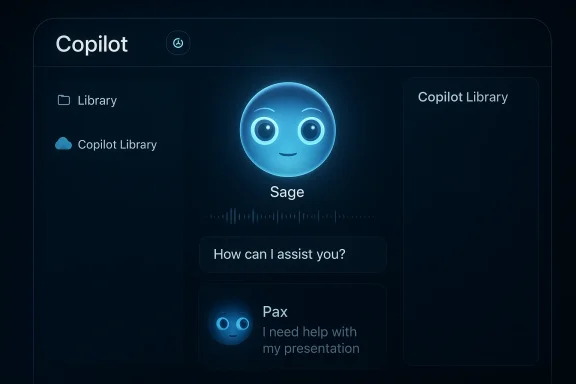
Microsoft is quietly pushing Copilot in a direction that looks less like a conventional assistant and more like a personalized AI companion, and the timing is telling. TestingCatalog’s report on new Portraits in Voice Mode suggests Microsoft is experimenting with additional avatar characters—Sage and Pax—alongside Miko, while also exploring tighter OneDrive integration for Copilot-generated files. That comes just days after Microsoft publicly emphasized a renewed Copilot strategy and a leadership reshuffle aimed at unifying consumer and commercial efforts under a single organization.
The result is more than a cosmetic UI tweak. It hints at a broader product thesis: Copilot is being shaped into a more emotionally legible, more persistent, and more workflow-connected experience. If Microsoft executes this well, the company could make Copilot feel less like a floating chat box and more like an always-available interface that users actually return to. If it executes poorly, the same move could deepen concerns about anthropomorphic AI, privacy, and product focus.
Microsoft has spent the last two years steadily broadening Copilot from a text assistant into a multi-surface AI layer that spans Windows, Edge, the web, mobile, and Microsoft 365. The early pitch was simple: use generative AI to help users search, draft, summarize, and automate. Over time, that pitch expanded into voice, vision, agents, and more contextual experiences that try to meet users where they already work.
The Voice Mode work is especially important because it changes the emotional texture of the product. Microsoft has repeatedly said voice is a defining interaction pattern for Copilot, and it has already experimented with visually richer representations of that mode. The September 2025 launch of Copilot Portraits showed stylized animated faces tied to voice conversations, available to a limited audience in the US, UK, and Canada through Copilot Labs. Microsoft described the experiment as intentionally stylized rather than photorealistic, with time limits, age gating, and safety guardrails.
That matters because the new Sage and Pax characters appear to be an evolution rather than a reset. The TestingCatalog report indicates that Microsoft is testing more human-like selectable companions in the mobile and web experience, with emotional facial reactions in real time. The shift from Miko’s blob-like abstraction toward full-face avatars is not just a design decision; it is a strategic statement about how much personality Microsoft wants Copilot to project.
The OneDrive piece is equally consequential, though for a different reason. Copilot has become much more capable at producing outputs—documents, spreadsheets, presentations, and other files—but AI generation without durable storage is only half a product. Microsoft already has official documentation and release notes showing Copilot-generated artifacts being saved to OneDrive in enterprise contexts, so bringing that kind of sync to the consumer Copilot app would be a logical extension of a broader Microsoft 365 direction.
The leadership change adds yet another layer. Microsoft’s March 2026 messaging around Copilot and agents frames the product as central to the company’s next phase, and the company has stressed growth in paid seats and daily active usage in Microsoft 365 Copilot. Even if consumer Copilot is not the same business as Microsoft 365 Copilot, the organizational momentum is clearly toward tighter alignment, clearer ownership, and more rapid iteration.
There is also a platform story here. On mobile, a responsive face can make Copilot feel more like a live conversational presence than a utility service. That is especially valuable in a market where text-only chatbots often struggle to differentiate themselves, and where the strongest consumer AI experiences increasingly rely on identity, memory, and tone as much as raw model capability. That is not a trivial UX upgrade.
The risk, of course, is that personality becomes the product. If users are drawn to the avatar more than the underlying assistant, Microsoft may be nudging Copilot into a territory where emotional attachment matters more than productivity. That can be powerful, but it is also delicate, because it raises obvious questions about trust, dependency, and the line between helpfulness and simulation.
A few signals make the feature feel especially plausible. Microsoft has already shipped voice controls, Copilot Vision, and portrait-based experiments, and it has been steadily layering more expressive UI elements around the assistant. The company’s own framing of voice as “the interface of the future for AI companions” signals that it sees visual embodiment as a natural extension of the voice stack.
That previous experiment matters because it shows Microsoft is not just adding animation for fun. It is testing how much visual embodiment users will tolerate, enjoy, and trust. The company seems to be approaching the question the way it approaches many Copilot features: narrow launch, feedback-driven iteration, and gradual expansion if usage and safety metrics hold up.
But avatars are strategic for another reason: they are a differentiator Microsoft can own. Many AI services can generate text, images, and even speech; fewer can offer a distinctive, branded, emotionally responsive visual layer that is deeply integrated with their ecosystem. If Microsoft can make Copilot instantly recognizable while keeping it safe and useful, it may create a stronger moat than raw model parity alone would provide. That is likely the real prize.
Still, there is a fine line between memorable and manipulative. The more human the face becomes, the more scrutiny Microsoft will face over anthropomorphism, emotional design, and whether the assistant is optimized for comfort rather than clarity. In the current AI market, that tradeoff is not theoretical; it is one of the defining product debates of 2026.
This kind of segmentation is smart because the audience is not uniform. Enterprise users may prefer minimal distraction, while consumer users may respond better to warmth and personality. The problem is that Microsoft’s consumer and business lines increasingly inform one another, so product choices in one lane can influence expectations in the other.
That problem is bigger than it sounds. A generated draft is only useful if the user can find it later, edit it elsewhere, and access it across devices. By tying Copilot outputs to OneDrive, Microsoft would be folding AI generation into its core cloud storage layer, making the assistant less disposable and more operational. That is a meaningful product maturity milestone.
For Microsoft, the benefits are structural. Sync creates stickiness, ties Copilot more tightly to the Microsoft 365 ecosystem, and makes the assistant harder to replace. Once user-generated content lives in OneDrive, Copilot is no longer just an interface; it becomes a content creation front end for Microsoft’s storage and productivity stack.
There is also a competitive angle. OpenAI, Google, and other rivals are all trying to make AI more session-aware and more useful across contexts, but Microsoft already has a deeply entrenched storage and productivity backbone. If Copilot can seamlessly write into OneDrive, it gains a distribution advantage that pure-model competitors have to replicate through partnerships or new file workflows.
That means Microsoft will need to be careful about defaults. Consumer users may welcome automatic saving, while business customers may require tighter admin controls and stronger policy enforcement. The company’s recent emphasis on trust, governance, and secure deployment makes it likely that any OneDrive tie-in will eventually need to fit into that broader control framework.
That kind of reorganization usually happens when a product has outgrown its original shape. Copilot now spans multiple surfaces, multiple audiences, and multiple use cases, and it needs a tighter product center if Microsoft wants consistent execution. The timing also reflects the reality that Microsoft is not treating Copilot as a side project anymore; it is a core strategic bet.
The leadership transition also matters because voice avatars and cloud sync are not standalone features. They are connective tissue between interface, content, and ecosystem. If those pieces are owned by separate teams with different goals, the user experience can become inconsistent very quickly. A single owner reduces that risk.
Still, this is not just a management story. It is a signal that Microsoft wants Copilot to behave like a platform, not a collection of experiments. The stronger the alignment between design, storage, and model development, the more likely Microsoft is to ship a product that feels intentional rather than improvised.
Microsoft is entering that race with an unusual advantage: it owns a massive productivity and storage ecosystem, which gives it more practical leverage than a pure consumer chatbot. If Copilot can be both emotionally engaging and functionally indispensable, it could carve out a powerful niche between entertainment-style companions and work-first assistants.
The bigger competitive tension is that Microsoft can blend consumer appeal with enterprise readiness in a way most rivals cannot. That is especially true if OneDrive and Microsoft 365 workflows become part of the same AI loop. In that scenario, rivals are not just competing against a chatbot; they are competing against a distribution and persistence layer.
The new Sage and Pax testing raises the intensity of that experiment. A more human face can increase rapport, but it can also create expectations the assistant cannot meet. Users may infer empathy, continuity, or understanding that the system does not truly possess, which means the UI has to be honest even while it is expressive. That balance is hard.
At the same time, mobile is where user sensitivity is highest. People are more protective of their attention, more sensitive to perceived persuasion, and more likely to bounce if the product feels gimmicky. So the success of Sage and Pax will depend on whether they enhance utility rather than distract from it.
The open question is whether users will embrace a Copilot that looks, speaks, and stores files more like a digital companion and less like a simple assistant. Microsoft has the ecosystem, the distribution, and now the organizational focus to make that happen. But it still needs to prove that the emotional layer serves the practical layer, because in AI products personality can attract attention, but utility is what earns repeat use.
Source: TestingCatalog Microsoft tests Portraits in Voice Mode for Copilot
The result is more than a cosmetic UI tweak. It hints at a broader product thesis: Copilot is being shaped into a more emotionally legible, more persistent, and more workflow-connected experience. If Microsoft executes this well, the company could make Copilot feel less like a floating chat box and more like an always-available interface that users actually return to. If it executes poorly, the same move could deepen concerns about anthropomorphic AI, privacy, and product focus.
 Background
Microsoft has spent the last two years steadily broadening Copilot from a text assistant into a multi-surface AI layer that spans Windows, Edge, the web, mobile, and Microsoft 365. The early pitch was simple: use generative AI to help users search, draft, summarize, and automate. Over time, that pitch expanded into voice, vision, agents, and more contextual experiences that try to meet users where they already work.The Voice Mode work is especially important because it changes the emotional texture of the product. Microsoft has repeatedly said voice is a defining interaction pattern for Copilot, and it has already experimented with visually richer representations of that mode. The September 2025 launch of Copilot Portraits showed stylized animated faces tied to voice conversations, available to a limited audience in the US, UK, and Canada through Copilot Labs. Microsoft described the experiment as intentionally stylized rather than photorealistic, with time limits, age gating, and safety guardrails.
That matters because the new Sage and Pax characters appear to be an evolution rather than a reset. The TestingCatalog report indicates that Microsoft is testing more human-like selectable companions in the mobile and web experience, with emotional facial reactions in real time. The shift from Miko’s blob-like abstraction toward full-face avatars is not just a design decision; it is a strategic statement about how much personality Microsoft wants Copilot to project.
The OneDrive piece is equally consequential, though for a different reason. Copilot has become much more capable at producing outputs—documents, spreadsheets, presentations, and other files—but AI generation without durable storage is only half a product. Microsoft already has official documentation and release notes showing Copilot-generated artifacts being saved to OneDrive in enterprise contexts, so bringing that kind of sync to the consumer Copilot app would be a logical extension of a broader Microsoft 365 direction.
The leadership change adds yet another layer. Microsoft’s March 2026 messaging around Copilot and agents frames the product as central to the company’s next phase, and the company has stressed growth in paid seats and daily active usage in Microsoft 365 Copilot. Even if consumer Copilot is not the same business as Microsoft 365 Copilot, the organizational momentum is clearly toward tighter alignment, clearer ownership, and more rapid iteration.
What Microsoft is Testing
The most visible change in the leak is the arrival of Sage and Pax as avatar companions. In practical terms, that means Copilot would offer users more than one visual identity for voice conversations, which is a meaningful step beyond a single default look. The presence of both male and female character options also suggests Microsoft is thinking carefully about variety and preference in a way that mirrors consumer companion apps.Why selectable companions matter
Selectable companions are a subtle but powerful retention tool. A voice assistant with a face can be easier to engage with, but a face that can be chosen, remembered, and returned to becomes a relationship mechanic. That can increase session frequency, session length, and brand affinity, which are all attractive outcomes for a product trying to become a daily habit.There is also a platform story here. On mobile, a responsive face can make Copilot feel more like a live conversational presence than a utility service. That is especially valuable in a market where text-only chatbots often struggle to differentiate themselves, and where the strongest consumer AI experiences increasingly rely on identity, memory, and tone as much as raw model capability. That is not a trivial UX upgrade.
The risk, of course, is that personality becomes the product. If users are drawn to the avatar more than the underlying assistant, Microsoft may be nudging Copilot into a territory where emotional attachment matters more than productivity. That can be powerful, but it is also delicate, because it raises obvious questions about trust, dependency, and the line between helpfulness and simulation.
What the leaked builds imply
The report says the portraits are already partially functional in test builds, which usually means the work is beyond mockups and into implementation. In Microsoft’s world, that does not guarantee a launch date, but it does imply active productization rather than a speculative prototype. In other words, this is not just a concept slide.A few signals make the feature feel especially plausible. Microsoft has already shipped voice controls, Copilot Vision, and portrait-based experiments, and it has been steadily layering more expressive UI elements around the assistant. The company’s own framing of voice as “the interface of the future for AI companions” signals that it sees visual embodiment as a natural extension of the voice stack.
- Sage and Pax would expand Copilot’s identity choices.
- The avatars appear to react emotionally in real time.
- The feature is being tested in both mobile and web builds.
- The shift is more human-like than the existing Miko design.
- Microsoft has already primed users for voice-centered Copilot experiences.
The Role of Portraits
Microsoft’s September 2025 Portraits experiment is the clearest precedent for what is happening now. Those portraits were stylized, animated, and tied to Copilot Voice, with Microsoft explicitly positioning them as a limited experiment. The company also made clear that the rollout would stay conservative, with age restrictions, visible AI indicators, and session limits.That previous experiment matters because it shows Microsoft is not just adding animation for fun. It is testing how much visual embodiment users will tolerate, enjoy, and trust. The company seems to be approaching the question the way it approaches many Copilot features: narrow launch, feedback-driven iteration, and gradual expansion if usage and safety metrics hold up.
Why avatars are becoming strategic
Avatars are useful because they can reduce friction in voice interactions. A speaking face gives the user a social cue, which can make the experience feel more natural than a blank audio interface. That matters in short conversations, brainstorming sessions, and tutorial-style interactions where the user benefits from some sense of presence.But avatars are strategic for another reason: they are a differentiator Microsoft can own. Many AI services can generate text, images, and even speech; fewer can offer a distinctive, branded, emotionally responsive visual layer that is deeply integrated with their ecosystem. If Microsoft can make Copilot instantly recognizable while keeping it safe and useful, it may create a stronger moat than raw model parity alone would provide. That is likely the real prize.
Still, there is a fine line between memorable and manipulative. The more human the face becomes, the more scrutiny Microsoft will face over anthropomorphism, emotional design, and whether the assistant is optimized for comfort rather than clarity. In the current AI market, that tradeoff is not theoretical; it is one of the defining product debates of 2026.
The Miko-Sage-Pax progression
The transition from Miko to Sage and Pax suggests a deliberate design spectrum. Miko feels abstract and safe, while the newer characters appear to move closer to conventional human likeness. That gives Microsoft room to segment users: some may prefer an approachable non-human presence, while others may want a more conversational, face-to-face feel.This kind of segmentation is smart because the audience is not uniform. Enterprise users may prefer minimal distraction, while consumer users may respond better to warmth and personality. The problem is that Microsoft’s consumer and business lines increasingly inform one another, so product choices in one lane can influence expectations in the other.
OneDrive Integration and File Persistence
The other notable leak is the appearance of a OneDrive button in Copilot’s library section. On the surface, that sounds mundane. In practice, it suggests Microsoft wants to solve one of the biggest problems in consumer AI workflows: what happens to the files after the model creates them.That problem is bigger than it sounds. A generated draft is only useful if the user can find it later, edit it elsewhere, and access it across devices. By tying Copilot outputs to OneDrive, Microsoft would be folding AI generation into its core cloud storage layer, making the assistant less disposable and more operational. That is a meaningful product maturity milestone.
Why file sync changes the value proposition
For consumers, OneDrive sync would make Copilot-generated work portable. A report created on mobile could later be opened on the web or in Office apps, which is exactly the kind of continuity that makes AI outputs feel real rather than ephemeral. That could be especially useful for images, notes, and draft documents produced in the flow of conversation.For Microsoft, the benefits are structural. Sync creates stickiness, ties Copilot more tightly to the Microsoft 365 ecosystem, and makes the assistant harder to replace. Once user-generated content lives in OneDrive, Copilot is no longer just an interface; it becomes a content creation front end for Microsoft’s storage and productivity stack.
There is also a competitive angle. OpenAI, Google, and other rivals are all trying to make AI more session-aware and more useful across contexts, but Microsoft already has a deeply entrenched storage and productivity backbone. If Copilot can seamlessly write into OneDrive, it gains a distribution advantage that pure-model competitors have to replicate through partnerships or new file workflows.
Consumer and enterprise implications
In the consumer market, cloud sync mainly solves convenience. People want the ability to resume a conversation, retrieve a draft, or revisit an output later without hunting through app history. In the enterprise market, the stakes are higher because persistence touches governance, retention, discovery, and permissions.That means Microsoft will need to be careful about defaults. Consumer users may welcome automatic saving, while business customers may require tighter admin controls and stronger policy enforcement. The company’s recent emphasis on trust, governance, and secure deployment makes it likely that any OneDrive tie-in will eventually need to fit into that broader control framework.
Leadership and Product Strategy
Microsoft’s March 2026 Copilot restructuring is the backdrop that makes these leaks more interesting. The company said Jacob Andreou will lead a unified Copilot organization spanning consumer and commercial, while Mustafa Suleyman shifts focus toward superintelligence and model development. That change suggests Microsoft wants cleaner product ownership and less fragmentation as Copilot enters a more competitive phase.That kind of reorganization usually happens when a product has outgrown its original shape. Copilot now spans multiple surfaces, multiple audiences, and multiple use cases, and it needs a tighter product center if Microsoft wants consistent execution. The timing also reflects the reality that Microsoft is not treating Copilot as a side project anymore; it is a core strategic bet.
Why organizational design matters here
AI products fail as often from execution drift as from model weakness. A fragmented team can ship clever features that never connect into a coherent user journey. By unifying consumer and commercial efforts, Microsoft is trying to avoid the fate of a feature-rich but disjointed assistant.The leadership transition also matters because voice avatars and cloud sync are not standalone features. They are connective tissue between interface, content, and ecosystem. If those pieces are owned by separate teams with different goals, the user experience can become inconsistent very quickly. A single owner reduces that risk.
Still, this is not just a management story. It is a signal that Microsoft wants Copilot to behave like a platform, not a collection of experiments. The stronger the alignment between design, storage, and model development, the more likely Microsoft is to ship a product that feels intentional rather than improvised.
Competitive Positioning
The speculative but unavoidable question is whether Microsoft is trying to compete with the emotional stickiness of AI companions on other platforms. The user prompt’s suggestion is not proven, but it is reasonable to ask. AI assistants are increasingly judged not just on answer quality, but on how comfortable, vivid, and repeatable the experience feels.Microsoft is entering that race with an unusual advantage: it owns a massive productivity and storage ecosystem, which gives it more practical leverage than a pure consumer chatbot. If Copilot can be both emotionally engaging and functionally indispensable, it could carve out a powerful niche between entertainment-style companions and work-first assistants.
How rivals may respond
Rivals will likely respond in two ways. First, they may lean harder into their own personality systems and voice experiences. Second, they may emphasize trust, utility, and neutrality to counter any impression that Microsoft is turning Copilot into a companion-first product.The bigger competitive tension is that Microsoft can blend consumer appeal with enterprise readiness in a way most rivals cannot. That is especially true if OneDrive and Microsoft 365 workflows become part of the same AI loop. In that scenario, rivals are not just competing against a chatbot; they are competing against a distribution and persistence layer.
- Microsoft has a built-in ecosystem advantage through OneDrive and Microsoft 365.
- Avatars can improve engagement without requiring a full app redesign.
- Human-like visuals may improve retention on mobile.
- Competitors may answer with stronger companion-style branding.
- Enterprise integration could become Microsoft’s clearest differentiator.
Product Design and User Psychology
The design question here is not whether avatars are technically possible. It is whether they produce a better interaction model. Microsoft’s earlier Portraits rollout answered that cautiously by using stylized faces and guardrails, implying the company knows the emotional and ethical stakes of making an AI assistant feel human.The new Sage and Pax testing raises the intensity of that experiment. A more human face can increase rapport, but it can also create expectations the assistant cannot meet. Users may infer empathy, continuity, or understanding that the system does not truly possess, which means the UI has to be honest even while it is expressive. That balance is hard.
The mobile factor
Mobile is where this becomes most compelling. On a smaller screen, a face fills more of the user’s attention, and the interaction can feel closer to a live call than a typed chat. That might be exactly what Microsoft wants: a lightweight but memorable relationship layer that makes Copilot feel present whenever users open the app.At the same time, mobile is where user sensitivity is highest. People are more protective of their attention, more sensitive to perceived persuasion, and more likely to bounce if the product feels gimmicky. So the success of Sage and Pax will depend on whether they enhance utility rather than distract from it.
Strengths and Opportunities
Microsoft’s strategy has several obvious strengths, and they are not limited to the visual novelty of a talking face. The combination of voice, avatars, file persistence, and ecosystem integration creates a coherent path toward a more durable Copilot experience. If Microsoft can keep the product useful while making it more engaging, it has a real chance to deepen daily usage across both consumer and professional contexts.- Stronger engagement through a more personable voice interface.
- Better retention if users can choose characters they prefer.
- More useful outputs when generated files sync to OneDrive.
- Tighter ecosystem lock-in across Copilot, OneDrive, and Microsoft 365.
- Clearer differentiation from text-only AI assistants.
- Better cross-device continuity for files and conversations.
- Improved mobile appeal through a richer, more expressive UI.
Risks and Concerns
The risks are just as real, and some are uniquely tied to the very qualities that make the feature interesting. Human-like avatars can invite emotional over-attachment, cloud sync can intensify privacy concerns, and a more companion-like assistant can muddy the line between productivity and emotional engagement. Microsoft has been careful so far, but the margin for error gets smaller as the design becomes more human.- Anthropomorphism risk if users project too much intention onto the avatar.
- Privacy concerns around automatically saving generated content.
- Safety and trust issues if emotional cues outpace actual capability.
- Feature bloat if the interface becomes more theatrical than useful.
- Enterprise governance challenges if consumer and business workflows converge.
- Regulatory scrutiny if the assistant feels manipulative or misleading.
- Execution risk if the experience is inconsistent across mobile and web.
Looking Ahead
The next phase for Copilot will likely be judged less by one-off announcements and more by how well Microsoft connects the pieces. Portraits, voice mode, OneDrive persistence, and the new leadership structure all point toward the same conclusion: Microsoft wants Copilot to be more immersive, more useful, and more central to everyday workflows. If that vision holds, the product could finally begin to feel like a unified platform rather than a sequence of experiments.The open question is whether users will embrace a Copilot that looks, speaks, and stores files more like a digital companion and less like a simple assistant. Microsoft has the ecosystem, the distribution, and now the organizational focus to make that happen. But it still needs to prove that the emotional layer serves the practical layer, because in AI products personality can attract attention, but utility is what earns repeat use.
- Watch for a public rollout of Sage and Pax in Copilot voice mode.
- Watch for OneDrive sync to appear in consumer-facing builds.
- Watch for more explicit controls around avatar selection and privacy.
- Watch for tighter integration with Microsoft 365 file workflows.
- Watch for Microsoft to keep emphasizing safety, age gating, and transparent AI labeling.
Source: TestingCatalog Microsoft tests Portraits in Voice Mode for Copilot
