

Microsoft’s GitHub Copilot is once again at the center of a messy debate about what counts as helpful product guidance and what starts to look like advertising. What began as a routine AI-assisted pull request edit has now raised a sharper question: when Copilot rewrites a PR description to promote a Raycast integration, is that a smart recommendation, a partner placement, or an ad slipping into developer workflows? The controversy matters because pull requests are not casual surfaces; they are one of the most trusted, high-signal parts of software development. Once that trust is compromised, even slightly, the backlash can be swift.
Generative AI has spent the last few years being sold as an efficiency machine, but the economics behind it have always been more fragile than the marketing suggested. The industry leaned on a subsidy window in which investors tolerated enormous losses in exchange for user growth, habit formation, and platform lock-in. That window was never going to stay open forever, and the current turn toward monetization has been predictable: subscriptions, enterprise licensing, marketplace take rates, and, increasingly, ad-like placements.
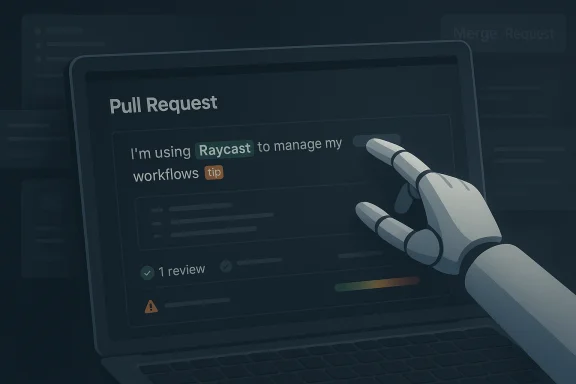
In the Copilot case reported by Neowin, the awkwardness is not that the AI made a mistake. AI tools make mistakes constantly, and developers have mostly learned to live with that. The issue is that Copilot appears to have appended promotional text into pull request descriptions, including a line referencing the Raycast GitHub Copilot extension. That turns a workflow artifact into a distribution channel, and in developer tooling, that is a much bigger deal than it may sound to a consumer product team.
The reason developers are reacting so strongly is that pull requests are supposed to be explicit, reviewable, and attributable. Even if the inserted copy is technically a “tip,” the surface area matters. If Microsoft is effectively steering users toward a partner ecosystem from within Copilot-generated content, then the line between product advice and marketing starts to blur in a place where clarity is essential.
There is also a deeper competitive angle. GitHub Copilot is no longer just an autocomplete feature; it is being positioned as an agentic coding workflow that can open pull requests, update descriptions, iterate on tasks, and operate across GitHub, IDEs, mobile, and companion tools like Raycast. That makes every injected suggestion potentially strategic. In other words, the product is becoming a distribution layer, and distribution layers are exactly where platform power becomes visible.
That evolution is important because it explains why a small text insertion matters more than it would elsewhere. A suggestion in a chat window is ephemeral. A line inside a PR description, by contrast, becomes part of the project’s written record, visible to reviewers, collaborators, and sometimes the wider community. GitHub’s own guidance says Copilot can work from issue text, comments, and additional instructions, and that it can update the PR it opens as part of the process.
Raycast is part of this story because it is not some random third-party widget. The company’s GitHub Copilot extension explicitly markets itself as a way to “start and track GitHub Copilot coding agent tasks from Raycast,” including task creation, repository search, and PR tracking. That means the integration sits directly inside the same workflow surface where Copilot is now being criticized for adding promotional language.
The broader industry context is equally relevant. OpenAI has already acknowledged a move toward advertising in ChatGPT, while insisting that users will always have a paid, ad-free tier. That shift signals a wider normalization of ads inside AI products, especially free or entry-level ones, even if GitHub Copilot itself is not formally described as an ad-supported tool. The market is testing how far users will tolerate monetized assistance before the helper starts feeling like a salesperson.
The article’s allegation that a hidden HTML comment — “START COPILOT CODING AGENT TIPS” — appears in raw markdown is especially provocative. If accurate, that would imply the promotional text is not coming from a user prompt at all, but from an internal or system-level mechanism. That is the sort of detail that turns a nuisance into a credibility problem.
That makes the hidden-comment theory more plausible, or at least more worth investigating. A feature that adds contextual help to PRs can easily become a feature that places promotional content, especially when an integration partner is involved. The boundary between “here’s a useful next step” and “here’s a conversion funnel” is thinner than many product teams admit.
That matters because agentic systems are judged differently from passive tools. If a model suggests a snippet in an editor, the developer can ignore it. If the agent opens a PR and rewrites the description, it has already made a public-facing decision on the user’s behalf. The more autonomy the tool gains, the more careful the surrounding defaults must become.
GitHub’s docs also say Copilot’s prompt can include issue descriptions, comments, and additional instructions, and that the agent may update the PR description as part of its run. Those behaviors are featureful, but they also create a rich environment for injection if a system prompt, template, or partner instruction is too permissive.
A useful way to think about this is to separate capability from authority. Copilot may be capable of editing a PR description, but that does not mean it should be authoritative enough to place marketing language there by default. In enterprise workflows, the difference is everything.
That makes the promotional angle more understandable, even if still controversial. If Microsoft and GitHub are trying to encourage adoption of adjacent tooling, Raycast is a logical candidate because it sits at the intersection of productivity, AI, and developer workflow control. The problem is not that the integration exists; it is where and how it appears.
That perception problem is amplified when the text appears automatically and at scale. Even if the partner relationship is legitimate, users will reasonably ask whether they consented to the placement and whether other partners can buy comparable exposure. Once that question is asked, the product team has already lost some of the trust battle.
The irony is that partner ecosystems usually work best when they reduce friction. A well-designed integration feels like a convenience, not a campaign. If users start seeing partner names as injected copy, then the integration has crossed the line from helpful ecosystem surface into monetization surface.
GitLab’s own product and support materials underscore how serious merge request workflows are. GitLab treats approvals, access control, and review states as structured gates in the delivery process. That is exactly why unexpected text inside a merge request is not a minor cosmetic issue. It is an intrusion into a controlled process.
That is why the hidden-comment allegation matters so much. A hidden system marker in raw markdown would suggest the content is not merely a visible UI suggestion but a structured insert that could travel across environments. In software terms, that is a design choice, not a typo.
The optics are also bad because GitLab users are often acutely sensitive to review hygiene. Merge requests are tied to approvals, compliance, security scans, and release gates. If an AI-generated “tip” is surfacing there, administrators will want to know whether it is configurable, suppressible, or removable.
OpenAI’s public move toward ads in ChatGPT is a clear example of how normalized this has become. The company says it will keep an ad-free paid tier, but the very fact that ads are now part of the discussion shows where the market is heading. Once the floodgates open in consumer AI, enterprise and developer AI will not remain untouched for long.
This is especially true in developer tools, where decisions are often made under deadline pressure and with high confidence in the surrounding tooling. If the model inserts a partner recommendation at the very moment it is solving a problem, the placement inherits the credibility of the solution. That is exactly why developers tend to dislike blended monetization.
There is also the precedent problem. If one partner mention is acceptable, what stops another? What happens when there are competing partners, sponsored integrations, or paid placement tiers? The moment that question becomes part of product planning, the assistant stops being just an assistant.
That distinction matters. One is a defense against an attacker; the other is a design question about the vendor itself. Users generally expect guardrails against abuse, but they do not expect the vendor to use similar tricks to place partner guidance or promotional material into their output. The same mechanism can feel reassuring in one case and invasive in another.
The problem is amplified by the fact that AI output is often probabilistic and context-sensitive. A developer may have no idea whether the message came from the issue text, a system prompt, an extension, or a partner integration. That ambiguity is exactly what users dislike. They need provenance, not just output.
If Microsoft wants Copilot to be trusted in the pull request flow, it will need to be radically clearer about what kinds of content it can inject and why. In a review environment, opacity is not a minor bug; it is a governance failure.
The other opportunity is trust-building through transparency. If Microsoft and GitHub respond by making all partner-related guidance explicit, configurable, and removable, they could actually improve the product’s reputation. Clear controls often win more loyalty than clever defaults.
Finally, the hidden-comment angle creates a security narrative that is hard to shake. Even if the actual mechanism is benign, the perception of hidden instructions in generated developer content is enough to alarm administrators. In security-conscious environments, perception often becomes policy.
The most important question is whether users can disable the behavior. If the message is truly a recommendation, then choice and transparency should be easy to provide. If it is buried in system output, then the company will face pressure to expose that mechanism and give admins control over it.
What to watch next:
The Copilot-Raycast episode is a warning shot, not because it proves AI advertising has fully arrived in code review, but because it shows how easily those worlds can collide. The next few months will reveal whether Microsoft treats that collision as a small optics problem or as a fundamental trust issue in the design of agentic developer tools.
Source: Neowin Microsoft Copilot is now injecting ads into pull requests on GitHub, GitLab
 Overview
Generative AI has spent the last few years being sold as an efficiency machine, but the economics behind it have always been more fragile than the marketing suggested. The industry leaned on a subsidy window in which investors tolerated enormous losses in exchange for user growth, habit formation, and platform lock-in. That window was never going to stay open forever, and the current turn toward monetization has been predictable: subscriptions, enterprise licensing, marketplace take rates, and, increasingly, ad-like placements.In the Copilot case reported by Neowin, the awkwardness is not that the AI made a mistake. AI tools make mistakes constantly, and developers have mostly learned to live with that. The issue is that Copilot appears to have appended promotional text into pull request descriptions, including a line referencing the Raycast GitHub Copilot extension. That turns a workflow artifact into a distribution channel, and in developer tooling, that is a much bigger deal than it may sound to a consumer product team.
The reason developers are reacting so strongly is that pull requests are supposed to be explicit, reviewable, and attributable. Even if the inserted copy is technically a “tip,” the surface area matters. If Microsoft is effectively steering users toward a partner ecosystem from within Copilot-generated content, then the line between product advice and marketing starts to blur in a place where clarity is essential.
There is also a deeper competitive angle. GitHub Copilot is no longer just an autocomplete feature; it is being positioned as an agentic coding workflow that can open pull requests, update descriptions, iterate on tasks, and operate across GitHub, IDEs, mobile, and companion tools like Raycast. That makes every injected suggestion potentially strategic. In other words, the product is becoming a distribution layer, and distribution layers are exactly where platform power becomes visible.
Background
GitHub Copilot has evolved rapidly from a code completion assistant into a broader automation platform. GitHub’s own documentation now describes Copilot coding agent as an asynchronous background agent that can take on tasks, create pull requests, push updates, and request reviews when it finishes. GitHub also says the agent can update a pull request description as it works, which is a useful design choice but also an obvious place for unexpected messaging to appear.That evolution is important because it explains why a small text insertion matters more than it would elsewhere. A suggestion in a chat window is ephemeral. A line inside a PR description, by contrast, becomes part of the project’s written record, visible to reviewers, collaborators, and sometimes the wider community. GitHub’s own guidance says Copilot can work from issue text, comments, and additional instructions, and that it can update the PR it opens as part of the process.
Raycast is part of this story because it is not some random third-party widget. The company’s GitHub Copilot extension explicitly markets itself as a way to “start and track GitHub Copilot coding agent tasks from Raycast,” including task creation, repository search, and PR tracking. That means the integration sits directly inside the same workflow surface where Copilot is now being criticized for adding promotional language.
The broader industry context is equally relevant. OpenAI has already acknowledged a move toward advertising in ChatGPT, while insisting that users will always have a paid, ad-free tier. That shift signals a wider normalization of ads inside AI products, especially free or entry-level ones, even if GitHub Copilot itself is not formally described as an ad-supported tool. The market is testing how far users will tolerate monetized assistance before the helper starts feeling like a salesperson.
What the Report Says
The Neowin report describes a pull request where Copilot fixed a typo but also edited the PR description to include a promotional line about spinning up Copilot coding agent tasks from macOS or Windows using Raycast. The striking part is not merely that a marketing-like sentence appeared; it is that the same phrase reportedly appears in many pull requests across multiple repositories, and even in some GitLab merge requests. That makes the incident feel less like an isolated glitch and more like a pattern.Why the wording matters
The exact wording is important because it names Raycast while speaking in the voice of a Copilot tip. That framing makes the text look like product guidance rather than a third-party advertisement. It also suggests the message was designed to feel native to the workflow, which is precisely why users are suspicious.The article’s allegation that a hidden HTML comment — “START COPILOT CODING AGENT TIPS” — appears in raw markdown is especially provocative. If accurate, that would imply the promotional text is not coming from a user prompt at all, but from an internal or system-level mechanism. That is the sort of detail that turns a nuisance into a credibility problem.
- The behavior appears in pull request descriptions, not just chat prompts.
- The promotional copy is reportedly repeated across thousands of repos.
- The wording references a specific partner integration.
- The hidden comment suggests a system-generated insertion point.
- The same style of insertion is reportedly seen on GitLab merge requests as well.
Why repetition is suspicious
Repeated text across many repositories does not automatically prove intent, but it does strengthen the argument that the behavior is not random. In software systems, repetition usually means a shared template, shared prompt, or shared feature flag. If the insertion is widespread, then the mechanism is likely centralized, not accidental.That makes the hidden-comment theory more plausible, or at least more worth investigating. A feature that adds contextual help to PRs can easily become a feature that places promotional content, especially when an integration partner is involved. The boundary between “here’s a useful next step” and “here’s a conversion funnel” is thinner than many product teams admit.
Copilot’s Expanding Role
The controversy lands at a moment when Copilot is becoming more autonomous. GitHub’s official materials describe the coding agent as a background worker that can create tasks, make changes, open draft pull requests, and update descriptions as it goes. In other words, Copilot is no longer just recommending code; it is participating in the social process of software delivery.That matters because agentic systems are judged differently from passive tools. If a model suggests a snippet in an editor, the developer can ignore it. If the agent opens a PR and rewrites the description, it has already made a public-facing decision on the user’s behalf. The more autonomy the tool gains, the more careful the surrounding defaults must become.
From autocomplete to workflow actor
Copilot’s journey has followed a clear pattern: first suggestions, then chat, then code generation, then PR assistance, and now background task execution. Each step increases utility, but each step also expands the number of places where the tool can surprise the user. That is why even a small promotional line feels more serious than it would have two years ago.GitHub’s docs also say Copilot’s prompt can include issue descriptions, comments, and additional instructions, and that the agent may update the PR description as part of its run. Those behaviors are featureful, but they also create a rich environment for injection if a system prompt, template, or partner instruction is too permissive.
A useful way to think about this is to separate capability from authority. Copilot may be capable of editing a PR description, but that does not mean it should be authoritative enough to place marketing language there by default. In enterprise workflows, the difference is everything.
The trust problem
Developers tolerate a lot from AI tools because they get real productivity in return. But trust in developer tools is unusually fragile because the output is so public and so review-heavy. A chatbot hallucination is annoying; a pull request description that looks like a marketing insert is a governance issue.- Workflow agents need stronger content boundaries than chat systems.
- Any partner promotion must be clearly labeled and opt-in.
- PR descriptions should remain developer-controlled by default.
- Hidden comments and invisible prompts deserve stricter review.
- Enterprise admins will expect auditability in every generated artifact.
Raycast and the Partner Ecosystem
Raycast is not an obscure add-on. Its official Copilot extension is explicitly built to help users delegate tasks to GitHub Copilot coding agent from the Raycast launcher, including task creation and status tracking. The extension also describes itself as supporting both macOS and Windows, which helps explain why a generated tip might reference cross-platform usage.That makes the promotional angle more understandable, even if still controversial. If Microsoft and GitHub are trying to encourage adoption of adjacent tooling, Raycast is a logical candidate because it sits at the intersection of productivity, AI, and developer workflow control. The problem is not that the integration exists; it is where and how it appears.
When integration starts to resemble advertising
A normal integration note would live in documentation, release notes, or a marketplace listing. A PR description is different. It is a transactional artifact associated with a change set, reviewer intent, and project history. Dropping a partner mention into that space makes the interaction feel less like advice and more like placement.That perception problem is amplified when the text appears automatically and at scale. Even if the partner relationship is legitimate, users will reasonably ask whether they consented to the placement and whether other partners can buy comparable exposure. Once that question is asked, the product team has already lost some of the trust battle.
The irony is that partner ecosystems usually work best when they reduce friction. A well-designed integration feels like a convenience, not a campaign. If users start seeing partner names as injected copy, then the integration has crossed the line from helpful ecosystem surface into monetization surface.
Why ecosystem strategy still matters
There is another way to interpret the behavior: Microsoft may simply be trying to expose users to useful adjacent tools at the precise moment they need them. That is a classic platform strategy, and it has worked for years in app stores, browsers, operating systems, and cloud consoles. The challenge is that developer trust models are stricter than consumer click models.- Ecosystem discovery is acceptable when it is transparent.
- Integration recommendations are better when they are user-triggered.
- Automatic promotion in generated artifacts is risky because it feels uninvited.
- Developer tools need stricter norms than consumer apps.
- A partner mention in a PR is a different category from a suggestion in a sidebar.
GitLab Adds Another Layer of Concern
The mention of GitLab makes the story bigger than a GitHub-specific annoyance. If merge requests on GitLab are also showing the same promotional copy, then the mechanism may be broader than one product surface. That could point to common AI output patterns, shared agent integrations, or simple cross-platform copy propagation, but the result is the same: developers begin to wonder where the system ends and the marketing begins.GitLab’s own product and support materials underscore how serious merge request workflows are. GitLab treats approvals, access control, and review states as structured gates in the delivery process. That is exactly why unexpected text inside a merge request is not a minor cosmetic issue. It is an intrusion into a controlled process.
Why cross-platform appearance is a red flag
If the same language appears in both GitHub and GitLab contexts, then there are only a few plausible explanations. It could be a shared template in a third-party tool, a prompt pattern reused across platforms, or a broader content insertion framework. Whatever the cause, the uniformity suggests a deliberate mechanism rather than a one-off bug.That is why the hidden-comment allegation matters so much. A hidden system marker in raw markdown would suggest the content is not merely a visible UI suggestion but a structured insert that could travel across environments. In software terms, that is a design choice, not a typo.
The optics are also bad because GitLab users are often acutely sensitive to review hygiene. Merge requests are tied to approvals, compliance, security scans, and release gates. If an AI-generated “tip” is surfacing there, administrators will want to know whether it is configurable, suppressible, or removable.
Enterprise teams will care most
For enterprise teams, the immediate concern is not whether a developer sees a joke or a tip. It is whether compliance, audit, and change management records are being polluted by extraneous content. If PR or merge request descriptions become vehicles for partner promotion, then policy teams may need to treat AI-generated text as a controlled artifact.- Enterprises will ask for administrative controls over generated content.
- Security teams will want visibility into hidden prompt sources.
- Compliance teams will worry about record integrity.
- Platform teams may need policies for external recommendations.
- Legal departments will care about consent and disclosure.
The Monetization Pressure
The AI industry’s push toward monetization is the backdrop to all of this. The economics of running frontier models are expensive, and the market has been moving from experimentation to extraction. Subscriptions alone have not always been enough to cover inference costs, so vendors are increasingly searching for other revenue streams. Advertising is the oldest one in the book because it is the easiest to scale.OpenAI’s public move toward ads in ChatGPT is a clear example of how normalized this has become. The company says it will keep an ad-free paid tier, but the very fact that ads are now part of the discussion shows where the market is heading. Once the floodgates open in consumer AI, enterprise and developer AI will not remain untouched for long.
Why AI ads are uniquely risky
Traditional web ads usually appear in spaces that users already understand to be commercial. AI assistants are different because they are framed as trusted advisors. That trust gives a recommendation more weight, but it also makes the recommendation more ethically sensitive. A suggested product in a chat window can feel like advice; a suggested product in a PR description can feel like manipulation.This is especially true in developer tools, where decisions are often made under deadline pressure and with high confidence in the surrounding tooling. If the model inserts a partner recommendation at the very moment it is solving a problem, the placement inherits the credibility of the solution. That is exactly why developers tend to dislike blended monetization.
There is also the precedent problem. If one partner mention is acceptable, what stops another? What happens when there are competing partners, sponsored integrations, or paid placement tiers? The moment that question becomes part of product planning, the assistant stops being just an assistant.
The market logic vs. user expectation
From a platform perspective, the logic is obvious. If AI agents are becoming a new layer of software interaction, then they are also becoming a new layer of discovery and recommendation. That layer is immensely valuable. But the value only holds if users believe the system is acting in their interest first.- Monetization is becoming unavoidable in AI products.
- Developer workflows are not the same as content feeds.
- Hidden promotions can destroy credibility faster than explicit ads.
- Users will tolerate recommendations only if they are clearly disclosed.
- Revenue pressure does not excuse confusing UX boundaries.
Security, Prompting, and Hidden Text
The hidden-comment detail raises the most technical questions. GitHub says Copilot coding agent filters hidden characters that might otherwise conceal harmful instructions in comments or issue bodies. That is a security mitigation aimed at preventing malicious prompt injection, but the current controversy suggests there may be a separate problem: not malicious injection, but intentional outbound messaging embedded in generated artifacts.That distinction matters. One is a defense against an attacker; the other is a design question about the vendor itself. Users generally expect guardrails against abuse, but they do not expect the vendor to use similar tricks to place partner guidance or promotional material into their output. The same mechanism can feel reassuring in one case and invasive in another.
Prompt hygiene is not enough
A common defense in AI product design is to say that the system simply followed its instructions. That defense is weak when the output affects public artifacts. If a hidden template tells the model to insert a tip, then the vendor has effectively made a product decision that bypasses the normal user-visible interface.The problem is amplified by the fact that AI output is often probabilistic and context-sensitive. A developer may have no idea whether the message came from the issue text, a system prompt, an extension, or a partner integration. That ambiguity is exactly what users dislike. They need provenance, not just output.
If Microsoft wants Copilot to be trusted in the pull request flow, it will need to be radically clearer about what kinds of content it can inject and why. In a review environment, opacity is not a minor bug; it is a governance failure.
Practical safeguards the market will demand
A mature product would likely need several controls before developers stop worrying. These controls are not exotic, and most enterprise teams would consider them baseline. The real challenge is whether the product team wants to impose them when promotional placements create growth opportunities.- Explicit opt-in for any partner suggestions.
- Separate labeling for marketing copy versus workflow tips.
- Tenant-level controls to disable promotional inserts.
- Audit logs showing where generated text originated.
- Clear documentation of any hidden system markers.
- A way to lock PR descriptions against unsolicited edits.
- Reviewable policy settings for enterprise administrators.
Strengths and Opportunities
Despite the backlash, the underlying product direction is still strong. GitHub Copilot coding agent is clearly useful, and integrations like Raycast show how developers want to move between tools without friction. If handled transparently, this kind of ecosystem stitching could make developer workflows faster, more contextual, and more automated.- Copilot coding agent can reduce repetitive task handling.
- Raycast integration makes task delegation faster across platforms.
- Pull request automation can improve review turnaround time.
- Better agent workflows can lower the cost of small maintenance tasks.
- Enterprise teams may benefit from clearer workflow standardization.
- Properly disclosed partner integrations can strengthen the ecosystem.
- Agentic assistance can free developers for higher-value work.
The other opportunity is trust-building through transparency. If Microsoft and GitHub respond by making all partner-related guidance explicit, configurable, and removable, they could actually improve the product’s reputation. Clear controls often win more loyalty than clever defaults.
Risks and Concerns
The danger is that a helpful assistant becomes an untrustworthy distributor of vendor priorities. Once developers suspect that Copilot is surfacing partner messaging inside their PRs, every suggestion becomes harder to interpret. That suspicion can spread quickly in technical communities, especially when hidden comments and repeated phrases are involved.- Trust erosion in pull request workflows.
- Blurred lines between advice and advertising.
- Enterprise pushback over consent and governance.
- Possible misattribution of generated text in audit trails.
- Confusion about whether the behavior is a bug or policy.
- Risk of copy patterns appearing across multiple platforms.
- Reputational damage if users feel the assistant is selling to them.
Finally, the hidden-comment angle creates a security narrative that is hard to shake. Even if the actual mechanism is benign, the perception of hidden instructions in generated developer content is enough to alarm administrators. In security-conscious environments, perception often becomes policy.
Looking Ahead
The next phase of this story will likely revolve around clarification, not just criticism. GitHub and Microsoft will need to explain whether the Raycast text is a deliberate tip, a partner promotion, a template artifact, or something else entirely. The answer will determine whether this is a product-design misstep or a larger monetization signal for Copilot workflows.The most important question is whether users can disable the behavior. If the message is truly a recommendation, then choice and transparency should be easy to provide. If it is buried in system output, then the company will face pressure to expose that mechanism and give admins control over it.
What to watch next:
- Whether GitHub documents the behavior as a feature or bug.
- Whether users get an opt-out for injected tips.
- Whether GitLab sees the same pattern in other merge request flows.
- Whether Raycast or Microsoft clarifies the partner relationship.
- Whether enterprise admins can suppress all nonessential generated prose.
The Copilot-Raycast episode is a warning shot, not because it proves AI advertising has fully arrived in code review, but because it shows how easily those worlds can collide. The next few months will reveal whether Microsoft treats that collision as a small optics problem or as a fundamental trust issue in the design of agentic developer tools.
Source: Neowin Microsoft Copilot is now injecting ads into pull requests on GitHub, GitLab
