

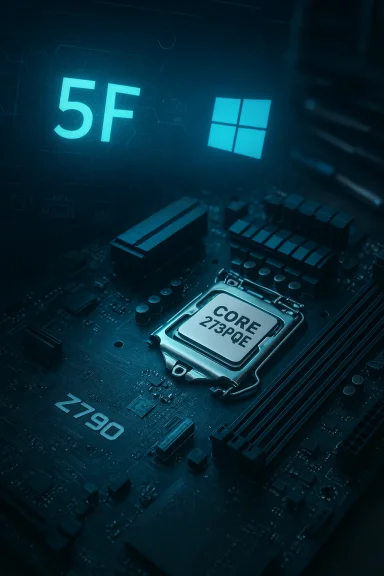
After weeks of leaks, firmware experiments, and a fair amount of enthusiast stubbornness, Intel’s Bartlett Lake story has taken a new and more interesting turn: the Core 9 273PQE has reportedly been booted into Windows on a consumer Z790 motherboard. That matters because Bartlett Lake chips are not supposed to be supported on mainstream LGA 1700 boards, even though they share the same physical socket as Raptor Lake. In practical terms, this is the kind of breakthrough that turns a “platform mismatch” from a hard wall into a solvable puzzle.
The breakthrough is notable not because it changes Intel’s product roadmap, but because it exposes how much of desktop CPU compatibility is governed by firmware policy rather than pin count alone. The user behind the achievement, posting as Kryptonfly, appears to have modified the BIOS so the motherboard would initialize the chip as if it were a Raptor Lake part during early boot. That is a very different proposition from official support, but it does prove the hardware may be far closer than Intel’s platform segmentation would suggest.
What emerges from this episode is a familiar enthusiast lesson with fresh implications: when a processor is physically compatible but logically blocked, the gap can sometimes be bridged with enough firmware knowledge and enough risk tolerance. For Intel, that is both a reminder of platform control and a warning that user communities still love to test the edges of vendor boundaries. For buyers, it raises a much more practical question: if Bartlett Lake can be coaxed onto Z790, what does that say about the future of Intel’s desktop segmentation?
Intel’s Bartlett Lake line has been discussed for months as an unusual branch of the company’s desktop roadmap, one that leans heavily toward P-core-only designs rather than the hybrid P-core plus E-core formula that has defined recent Core desktop generations. Intel’s own product pages now list the Core 9 273PQE as a launched part under the Bartlett Lake codename, with 12 Performance cores, 24 threads, and a 5.9 GHz maximum turbo. That alone makes it a headline-grabbing chip, especially for enthusiasts who still prefer all-big-core configurations for certain workloads and tuning scenarios.
The key twist is that Bartlett Lake is positioned as an embedded product, not a mainstream retail desktop launch. Intel’s listing for the 273PQE places it in the Embedded vertical segment and marks it as a Q1’26 product, which is a strong signal that the part was intended for specialized systems rather than the retail DIY market. Intel’s own Bartlett Lake product brief also points readers toward Windows 11 IoT Enterprise Long-Term Servicing, reinforcing the idea that these chips are meant for controlled, appliance-like deployments rather than consumer upgrades.
That distinction matters because desktop enthusiasts have long treated socket compatibility as an invitation to experiment. LGA 1700 has already hosted multiple CPU generations, and the chipset ecosystem around Z790 is familiar to builders who have swapped in everything from modest Core i5 parts to flagship Core i9 models. Intel’s Z790 chipset materials emphasize that it is the platform for pairing with Intel Core desktop processors, and motherboard vendors have spent years refining BIOS support for that ecosystem. But official support is always narrower than physical possibility, and Bartlett Lake appears to sit squarely in that gap.
The Wccftech report describes a user on the Overclock forums successfully tricking the firmware into identifying the Bartlett Lake chip as a Raptor Lake CPU during early initialization, thereby getting past the point where the board would ordinarily stop at a 5F code and refuse to proceed. That is the essence of this story: not a new retail product launch, but a firmware workaround that suggests the board and processor may be more compatible than Intel’s official platform rules allow. The fact that Windows booted after the modification gives the experiment a different weight from a simple POST-screen screenshot.
Historically, this kind of enthusiast achievement sits in a long line of platform boundary testing. Builders have regularly tried to run newer or unsupported CPUs on older chipsets, especially when sockets are physically shared and BIOS vendors can be persuaded to cooperate. Sometimes the result is a dead end; other times it becomes a proof of concept that exposes how much firmware policy determines what a platform “supports.” Bartlett Lake’s Z790 boot is interesting because it pushes that boundary without an official vendor blessing, and because Intel itself has not marketed the part as a consumer desktop upgrade.
Wccftech says the user then posted screenshots showing the chip running normally in Windows, including a readout that placed the processor at 3,418 MHz. More importantly, the system was able to move from a firmware-level recognition issue into a working operating system environment, which is the real milestone here. A CPU that can merely appear in a diagnostic menu is one thing; a CPU that survives the boot path, enumerates correctly, and reaches Windows is far more convincing.
In other words, the barrier may be policy rather than physics.
For enthusiasts, the moment is satisfying because it transforms a rumor into a live experiment. For Intel, it is less comfortable because it suggests the company’s segmentation strategy can be challenged by firmware tinkering when the underlying platform shares enough DNA. That does not mean the chip is a consumer product now, but it does mean the line between “unsupported” and “impossible” is narrower than many casual buyers assume.
That configuration matters because it simplifies certain performance narratives. Many enthusiasts still prefer a pure P-core layout for workloads that benefit from consistent high-performance threads, predictable scheduling, and less variability when tuning memory or voltage behavior. A 12 P-core design also invites direct comparison with popular all-core-heavy chips from prior generations, especially when users are already mentally benchmarking against familiar flagships like the Core i9-13900K and Core i9-14900K. Those comparisons are not perfect, but they are intuitive and commercially relevant.
The attraction is partly technical and partly emotional.
Intel’s own published specifications show the 273PQE carrying a 5.9 GHz max turbo, 125 W processor base power, and 36 MB of Intel Smart Cache. Those numbers place it firmly in flagship territory for clock speed and cache capacity, which is why enthusiasts are so curious about its real-world performance. The chip looks like a serious part, even if Intel’s commercial strategy keeps it out of the usual consumer channel.
That is why the Bartlett Lake boot is such a compelling test case. If a firmware modification can push a non-supported embedded CPU into a retail Z790 board and all the way into Windows, then the platform compatibility story becomes more nuanced than a simple yes-or-no answer. It suggests that Intel and its board partners may be enforcing support boundaries through firmware policy, not because the silicon is utterly incompatible, but because they have chosen not to validate it for consumer release. That is a familiar industry practice, but it always feels different when enthusiasts prove a workaround exists.
The difference shows up in several practical ways:
On a broader market level, this matters because desktop buyers increasingly expect platform continuity. If a CPU with the same socket can be made to work only through custom firmware, buyers may start asking whether official support restrictions are about engineering limits or segmentation strategy. That question has commercial consequences for Intel and for motherboard vendors trying to manage their own support burden.
That does not mean everything is interchangeable. Power delivery, microcode handling, BIOS hooks, ACPI tables, and Windows enumeration can still introduce problems later. But the fact that the user reached Windows suggests the platform passed a much more demanding test than a superficial POST. It is the difference between a theory and an operational workaround.
That makes this case especially interesting because it reveals the interaction between:
There is also a subtle point here about why these experiments matter to hardware journalists and power users. They show where the real boundaries are. A socket diagram can suggest compatibility, but firmware can override that promise in either direction. Enthusiasts learn more about the platform by seeing where it bends than by reading the marketing sheet that says what should happen. That is one reason stories like this spread quickly: they offer both a technical puzzle and a small act of rebellion.
That simplicity is part of the attraction. In theory, a 12-core all-P-core chip could feel more coherent in mixed desktop use than a hybrid part with a larger total thread count. It may not win every benchmark, but it could appeal to users who prioritize sustained responsiveness, legacy compatibility, or tunability over maximum hybrid throughput. That is especially true for workloads that do not map cleanly onto the P/E distinction.
A serious benchmark suite would include:
The practical question is whether Bartlett Lake would offer enough advantage over existing used-market or discounted Raptor Lake parts to matter to enthusiasts. If the answer is yes, then the chip becomes more than a curiosity. If the answer is no, then it remains an impressive proof of concept with limited real-world impact. Either way, the boot itself gives the community a new reference point.
Bartlett Lake also highlights the tension between product strategy and enthusiast demand. Intel appears to see the part as an embedded offering, perhaps optimized for systems that value predictable behavior and long-term availability. Enthusiasts, by contrast, see a 12-core all-P-core Intel chip and immediately imagine a retail box, motherboard bios updates, and benchmark charts. That mismatch is what creates the excitement.
The split matters for several reasons:
There is also a reputational angle. When the enthusiast community proves that a non-consumer chip can be coaxed into a consumer board, it creates a subtle expectation gap. People start wondering whether the lack of support is driven by technical necessity or by product management. Even if the answer is “both,” the perception still matters.
The other risk is overinterpreting one successful boot. A system reaching Windows is an important milestone, but it is not proof that every workload, every BIOS revision, or every motherboard will behave the same way. Single-point success can be misleading, and the hardware community has seen enough false starts to know that a screenshot is the beginning of validation, not the end.
For DIY builders, this should reinforce a few practical truths. First, a matching socket does not guarantee a bootable system. Second, BIOS maturity often matters more than a motherboard’s headline specifications. Third, the enthusiast community still plays an important role in uncovering the real capabilities of hardware, even when vendors would prefer a tidy product matrix.
The incentives are clear:
The other thing to watch is whether motherboard communities continue to document the exact conditions needed to make the chip work. A one-off mod is interesting; a reproducible methodology is transformative. If the boot path can be generalized across multiple Z790 boards, then the debate over Intel’s support model becomes harder to ignore.
Intel may never market Bartlett Lake as a consumer desktop option, and that is still the most likely outcome. But the fact that a Core 9 273PQE can be pushed into Windows on a Z790 board changes the conversation from “it cannot be done” to “it was never meant to be easy.” That is a meaningful difference, and in the enthusiast world, it is often enough to keep the story alive long after the first boot screen disappears.
Source: Wccftech Intel Core 9 273PQE User Finally Succeeds To Boot Into Windows Using Consumer-Grade Z790 Motherboard
The breakthrough is notable not because it changes Intel’s product roadmap, but because it exposes how much of desktop CPU compatibility is governed by firmware policy rather than pin count alone. The user behind the achievement, posting as Kryptonfly, appears to have modified the BIOS so the motherboard would initialize the chip as if it were a Raptor Lake part during early boot. That is a very different proposition from official support, but it does prove the hardware may be far closer than Intel’s platform segmentation would suggest.
What emerges from this episode is a familiar enthusiast lesson with fresh implications: when a processor is physically compatible but logically blocked, the gap can sometimes be bridged with enough firmware knowledge and enough risk tolerance. For Intel, that is both a reminder of platform control and a warning that user communities still love to test the edges of vendor boundaries. For buyers, it raises a much more practical question: if Bartlett Lake can be coaxed onto Z790, what does that say about the future of Intel’s desktop segmentation?
 Background
Intel’s Bartlett Lake line has been discussed for months as an unusual branch of the company’s desktop roadmap, one that leans heavily toward P-core-only designs rather than the hybrid P-core plus E-core formula that has defined recent Core desktop generations. Intel’s own product pages now list the Core 9 273PQE as a launched part under the Bartlett Lake codename, with 12 Performance cores, 24 threads, and a 5.9 GHz maximum turbo. That alone makes it a headline-grabbing chip, especially for enthusiasts who still prefer all-big-core configurations for certain workloads and tuning scenarios.The key twist is that Bartlett Lake is positioned as an embedded product, not a mainstream retail desktop launch. Intel’s listing for the 273PQE places it in the Embedded vertical segment and marks it as a Q1’26 product, which is a strong signal that the part was intended for specialized systems rather than the retail DIY market. Intel’s own Bartlett Lake product brief also points readers toward Windows 11 IoT Enterprise Long-Term Servicing, reinforcing the idea that these chips are meant for controlled, appliance-like deployments rather than consumer upgrades.
That distinction matters because desktop enthusiasts have long treated socket compatibility as an invitation to experiment. LGA 1700 has already hosted multiple CPU generations, and the chipset ecosystem around Z790 is familiar to builders who have swapped in everything from modest Core i5 parts to flagship Core i9 models. Intel’s Z790 chipset materials emphasize that it is the platform for pairing with Intel Core desktop processors, and motherboard vendors have spent years refining BIOS support for that ecosystem. But official support is always narrower than physical possibility, and Bartlett Lake appears to sit squarely in that gap.
The Wccftech report describes a user on the Overclock forums successfully tricking the firmware into identifying the Bartlett Lake chip as a Raptor Lake CPU during early initialization, thereby getting past the point where the board would ordinarily stop at a 5F code and refuse to proceed. That is the essence of this story: not a new retail product launch, but a firmware workaround that suggests the board and processor may be more compatible than Intel’s official platform rules allow. The fact that Windows booted after the modification gives the experiment a different weight from a simple POST-screen screenshot.
Historically, this kind of enthusiast achievement sits in a long line of platform boundary testing. Builders have regularly tried to run newer or unsupported CPUs on older chipsets, especially when sockets are physically shared and BIOS vendors can be persuaded to cooperate. Sometimes the result is a dead end; other times it becomes a proof of concept that exposes how much firmware policy determines what a platform “supports.” Bartlett Lake’s Z790 boot is interesting because it pushes that boundary without an official vendor blessing, and because Intel itself has not marketed the part as a consumer desktop upgrade.
What Actually Happened
The reported breakthrough is straightforward on the surface but technically meaningful underneath. The user allegedly altered the BIOS so that, during the platform’s early initialization steps, the system would treat the Core 9 273PQE as though it were a Raptor Lake processor. In a firmware environment, that sort of identification logic often determines whether the motherboard continues the boot sequence or halts with an error state. By clearing that hurdle, the board no longer lingered on the error code that had previously blocked progress.Wccftech says the user then posted screenshots showing the chip running normally in Windows, including a readout that placed the processor at 3,418 MHz. More importantly, the system was able to move from a firmware-level recognition issue into a working operating system environment, which is the real milestone here. A CPU that can merely appear in a diagnostic menu is one thing; a CPU that survives the boot path, enumerates correctly, and reaches Windows is far more convincing.
Why the firmware trick matters
The interesting part is not the overclocking, the screenshots, or even the exact clock rate. It is the fact that the motherboard likely rejected Bartlett Lake because its firmware did not recognize the chip as a supported identity, not because the socket physically could not accept it. That distinction is crucial for understanding how modern desktop compatibility works.In other words, the barrier may be policy rather than physics.
- The socket is shared with LGA 1700-era CPUs.
- The firmware lacks official Bartlett Lake support.
- The boot process can be stopped by identification logic before OS loading.
- Reclassifying the chip during initialization can bypass that block.
- A successful Windows boot implies the platform is not wholly alien to the board.
For enthusiasts, the moment is satisfying because it transforms a rumor into a live experiment. For Intel, it is less comfortable because it suggests the company’s segmentation strategy can be challenged by firmware tinkering when the underlying platform shares enough DNA. That does not mean the chip is a consumer product now, but it does mean the line between “unsupported” and “impossible” is narrower than many casual buyers assume.
Bartlett Lake’s Place in Intel’s Roadmap
Bartlett Lake is not simply “another Intel CPU.” It looks like a deliberate departure from the hybrid model that has dominated recent Core desktop discussions, particularly among users who still favor dense, symmetrical P-core designs. Intel’s own product data for the 273PQE confirms it as a 12-core, 24-thread part with no E-cores, which makes it unusual in the context of modern mainstream Intel desktops.That configuration matters because it simplifies certain performance narratives. Many enthusiasts still prefer a pure P-core layout for workloads that benefit from consistent high-performance threads, predictable scheduling, and less variability when tuning memory or voltage behavior. A 12 P-core design also invites direct comparison with popular all-core-heavy chips from prior generations, especially when users are already mentally benchmarking against familiar flagships like the Core i9-13900K and Core i9-14900K. Those comparisons are not perfect, but they are intuitive and commercially relevant.
Why enthusiasts care about all-P-core designs
There is a reason forum threads light up when a P-core-only part appears. Hybrid CPUs can be excellent, but they also introduce scheduler complexity, workload balancing issues, and a more nuanced relationship between core count and real-world responsiveness. That makes P-core-only designs attractive to users who want a more traditional desktop feel.The attraction is partly technical and partly emotional.
- Predictability in scheduling and latency-sensitive tasks.
- Simpler tuning when optimizing voltages and memory.
- Cleaner comparisons against older high-end Intel chips.
- Potentially better behavior in some legacy software environments.
- Less dependence on operating-system core classification logic.
Intel’s own published specifications show the 273PQE carrying a 5.9 GHz max turbo, 125 W processor base power, and 36 MB of Intel Smart Cache. Those numbers place it firmly in flagship territory for clock speed and cache capacity, which is why enthusiasts are so curious about its real-world performance. The chip looks like a serious part, even if Intel’s commercial strategy keeps it out of the usual consumer channel.
Why Z790 Support Is a Big Deal
The consumer Z790 platform matters because it is the most visible modern expression of Intel’s LGA 1700 desktop ecosystem. Intel positions Z790 as the chipset paired with Intel Core desktop processors, and motherboard vendors have invested heavily in support, overclocking features, and BIOS refinement for that family. In enthusiast terms, Z790 is the board you expect to work with the right CPU, at least within the normal rules of the platform.That is why the Bartlett Lake boot is such a compelling test case. If a firmware modification can push a non-supported embedded CPU into a retail Z790 board and all the way into Windows, then the platform compatibility story becomes more nuanced than a simple yes-or-no answer. It suggests that Intel and its board partners may be enforcing support boundaries through firmware policy, not because the silicon is utterly incompatible, but because they have chosen not to validate it for consumer release. That is a familiar industry practice, but it always feels different when enthusiasts prove a workaround exists.
Consumer support versus validation
There is an important distinction between “can boot” and “is supported.” A board that boots an unsupported CPU after modification may still be outside every warranty boundary that matters. That includes BIOS updates, long-term stability assurances, and any vendor obligation to troubleshoot issues.The difference shows up in several practical ways:
- No official BIOS profile for the CPU.
- No vendor validation for memory or power behavior.
- No guarantee of update compatibility later.
- Possible security or boot guard complications.
- No support path if something breaks.
On a broader market level, this matters because desktop buyers increasingly expect platform continuity. If a CPU with the same socket can be made to work only through custom firmware, buyers may start asking whether official support restrictions are about engineering limits or segmentation strategy. That question has commercial consequences for Intel and for motherboard vendors trying to manage their own support burden.
The Engineering Implications
The engineering significance of the boot is not limited to the chip itself. It points to the way early boot, CPU identification, and vendor firmware tables work together to decide whether a platform moves forward or stops dead. If the system can be made to misidentify Bartlett Lake as Raptor Lake long enough to get through early initialization, then some of the relevant hardware pathways are evidently close enough to cooperate.That does not mean everything is interchangeable. Power delivery, microcode handling, BIOS hooks, ACPI tables, and Windows enumeration can still introduce problems later. But the fact that the user reached Windows suggests the platform passed a much more demanding test than a superficial POST. It is the difference between a theory and an operational workaround.
Microcode, identity, and initialization
Modern CPUs are not just lumps of silicon; they are deeply mediated by firmware instructions and update logic. During boot, the motherboard has to recognize the processor correctly, load the right initialization paths, and configure the platform around its characteristics. If any one of those stages rejects the chip, the system may never reach a usable state.That makes this case especially interesting because it reveals the interaction between:
- CPU CPUID recognition
- Firmware initialization paths
- Board-level microcode assumptions
- OS-level device enumeration
- Vendor validation tables
There is also a subtle point here about why these experiments matter to hardware journalists and power users. They show where the real boundaries are. A socket diagram can suggest compatibility, but firmware can override that promise in either direction. Enthusiasts learn more about the platform by seeing where it bends than by reading the marketing sheet that says what should happen. That is one reason stories like this spread quickly: they offer both a technical puzzle and a small act of rebellion.
How This Compares With Raptor Lake
The obvious comparison is against Intel’s Raptor Lake flagships, particularly the Core i9-13900K and Core i9-14900K, which many enthusiasts still treat as the yardsticks for high-end LGA 1700 performance. Bartlett Lake’s 12 P-core / 24-thread structure means it lacks the extra E-core thread count that helps those parts dominate highly parallel workloads on paper. But it also makes Bartlett Lake much easier to reason about from a performance-scaling perspective.That simplicity is part of the attraction. In theory, a 12-core all-P-core chip could feel more coherent in mixed desktop use than a hybrid part with a larger total thread count. It may not win every benchmark, but it could appeal to users who prioritize sustained responsiveness, legacy compatibility, or tunability over maximum hybrid throughput. That is especially true for workloads that do not map cleanly onto the P/E distinction.
What benchmarkers will want to know
The moment Bartlett Lake reaches real testing on consumer boards, enthusiasts will want hard answers, not firmware lore. The obvious test matrix is broad because the architecture invites comparison across several axes.A serious benchmark suite would include:
- Single-thread performance.
- Gaming at CPU-bound settings.
- Multi-threaded productivity workloads.
- Memory latency and bandwidth tuning.
- Power and thermals under sustained load.
- Scheduler behavior under mixed workloads.
- Stability across BIOS revisions.
The practical question is whether Bartlett Lake would offer enough advantage over existing used-market or discounted Raptor Lake parts to matter to enthusiasts. If the answer is yes, then the chip becomes more than a curiosity. If the answer is no, then it remains an impressive proof of concept with limited real-world impact. Either way, the boot itself gives the community a new reference point.
What This Means for Intel’s Market Position
Intel’s mainstream desktop position has been under pressure for a while, and that makes every interesting CPU story feel slightly more consequential. Even when the product in question is embedded-only, users cannot help reading it through the lens of Intel’s broader desktop competitiveness. A chip that has enthusiasts asking “what if?” is a useful signal even if it never reaches shelves in the form they want.Bartlett Lake also highlights the tension between product strategy and enthusiast demand. Intel appears to see the part as an embedded offering, perhaps optimized for systems that value predictable behavior and long-term availability. Enthusiasts, by contrast, see a 12-core all-P-core Intel chip and immediately imagine a retail box, motherboard bios updates, and benchmark charts. That mismatch is what creates the excitement.
Enterprise intent, consumer curiosity
The enterprise and embedded angle should not be overlooked. Intel’s product brief language around IoT Enterprise servicing and embedded positioning suggests long deployment cycles and stable validation targets. That is the opposite of the consumer DIY market, which is volatile, experimental, and deeply focused on chipset flexibility.The split matters for several reasons:
- Embedded buyers want predictable lifecycle support.
- Consumers want upgrade freedom and BIOS experimentation.
- Intel wants channel discipline and product segmentation.
- Enthusiasts want socket reuse and maximum platform value.
- Motherboard vendors want to limit support complexity.
There is also a reputational angle. When the enthusiast community proves that a non-consumer chip can be coaxed into a consumer board, it creates a subtle expectation gap. People start wondering whether the lack of support is driven by technical necessity or by product management. Even if the answer is “both,” the perception still matters.
Strengths and Opportunities
The strongest part of this story is that it reveals a real technical achievement, not just a rumor cycle. It also opens a broader conversation about Intel desktop segmentation, platform continuity, and how much of CPU compatibility lives in firmware rather than the socket itself. For enthusiasts, that creates a rare combination of intrigue and genuine practical curiosity.- Proof of concept that Bartlett Lake can reach Windows on Z790 with the right BIOS modifications.
- Evidence of platform overlap between Bartlett Lake and Raptor Lake at the firmware level.
- Strong enthusiast interest in a 12 P-core / 24-thread Intel desktop design.
- Potential benchmark value for comparing all-P-core behavior against hybrid flagships.
- New insight into how vendor support boundaries are enforced.
- Opportunity for community experimentation around microcode and initialization behavior.
- A reminder that embedded-class silicon can still capture consumer imagination.
Risks and Concerns
The biggest concern is obvious: this is not official support, and users should not confuse a successful boot with a stable or endorsed platform. BIOS modification can break other system functions, introduce security issues, or simply make the board harder to recover if something goes wrong. The achievement is real, but so are the risks.- No vendor support if the system becomes unstable or unbootable.
- Potential firmware corruption when experimenting with custom BIOS modifications.
- Security implications from altering early boot identification logic.
- Unknown long-term stability under heavy loads or repeated sleep/wake cycles.
- Risk of partial compatibility even if Windows boots successfully.
- Warranty concerns for both motherboard and processor usage.
- Possible update fragility when future BIOS versions change internals.
The other risk is overinterpreting one successful boot. A system reaching Windows is an important milestone, but it is not proof that every workload, every BIOS revision, or every motherboard will behave the same way. Single-point success can be misleading, and the hardware community has seen enough false starts to know that a screenshot is the beginning of validation, not the end.
The Bigger Lesson for DIY Builders
The real lesson here is not that everyone should go hunting for unsupported embedded CPUs. It is that modern desktop compatibility is a layered negotiation between socket design, firmware policy, chipset rules, and product segmentation. When one layer changes, the entire meaning of “supported” can shift beneath it. That is why these experiments fascinate serious builders: they make the invisible rules visible.For DIY builders, this should reinforce a few practical truths. First, a matching socket does not guarantee a bootable system. Second, BIOS maturity often matters more than a motherboard’s headline specifications. Third, the enthusiast community still plays an important role in uncovering the real capabilities of hardware, even when vendors would prefer a tidy product matrix.
Why these experiments keep happening
There is a cultural dimension too. Enthusiasts do this because modern hardware often feels too locked down, too segmented, and too carefully positioned for the kinds of tinkering that built PC culture in the first place. Every successful workaround is a reminder that the community still values experimentation for its own sake.The incentives are clear:
- Builders want to extend platform life.
- Enthusiasts want to test hidden compatibility.
- Modders enjoy solving boot-level puzzles.
- Benchmarkers want fresh performance data.
- Forum communities reward technical originality.
Looking Ahead
What happens next will likely depend on whether the firmware trick spreads, whether more users reproduce the result, and whether actual benchmark data appears from the 273PQE on consumer boards. If that happens, the story will move from “possible” to “characterized,” and the enthusiast discussion will shift from boot success to performance, thermals, and tuning. That would make Bartlett Lake much more than a curiosity.The other thing to watch is whether motherboard communities continue to document the exact conditions needed to make the chip work. A one-off mod is interesting; a reproducible methodology is transformative. If the boot path can be generalized across multiple Z790 boards, then the debate over Intel’s support model becomes harder to ignore.
Key developments to watch
- Independent reproductions of the Windows boot on other Z790 boards.
- Benchmark results comparing the 273PQE with Raptor Lake flagships.
- BIOS details showing what exactly was modified in firmware.
- Thermal and power data under sustained desktop workloads.
- Whether more Bartlett Lake parts appear in similar modded tests.
- Potential motherboard vendor reactions if the workaround becomes widely discussed.
- Any sign of official validation or quiet BIOS accommodation.
Intel may never market Bartlett Lake as a consumer desktop option, and that is still the most likely outcome. But the fact that a Core 9 273PQE can be pushed into Windows on a Z790 board changes the conversation from “it cannot be done” to “it was never meant to be easy.” That is a meaningful difference, and in the enthusiast world, it is often enough to keep the story alive long after the first boot screen disappears.
Source: Wccftech Intel Core 9 273PQE User Finally Succeeds To Boot Into Windows Using Consumer-Grade Z790 Motherboard
