

Intel’s Core Ultra Series 3 transition is doing more than refreshing laptop silicon for 2026; it is broadening Intel’s vPro story into a tighter package of security, manageability, and efficiency features aimed squarely at business fleets. The headline is simple enough: Panther Lake-based systems inherit the platform’s newer battery-life and AI strengths, while Intel is layering in richer telemetry, hardware-assisted threat detection, and more enterprise-friendly management through tools like Microsoft Intune. For IT teams, that combination matters because it shifts more of the endpoint burden into silicon and away from fragile, software-only defenses. For workers, the promise is quieter but still important: a PC that lasts longer, responds faster, and is harder to compromise.
Intel has spent the last several years repositioning Core Ultra around the AI PC narrative, but the business angle has remained just as important as consumer hype. The company’s client strategy now rests on three pillars: performance per watt, local AI acceleration, and hardware-backed enterprise control. Core Ultra Series 3, code-named Panther Lake, is the latest expression of that strategy, and Intel is clearly pushing it as a platform rather than a standalone CPU family.
That platform emphasis matters because vPro is not a sticker Intel adds after the fact. It is a set of hardware and firmware capabilities that OEMs must integrate into business systems, which means enterprise buyers get a more predictable baseline for security and remote management. Intel’s own description of vPro stresses built-in security, out-of-band management, and the stability guarantees that keep corporate IT departments from dealing with endless configuration drift.
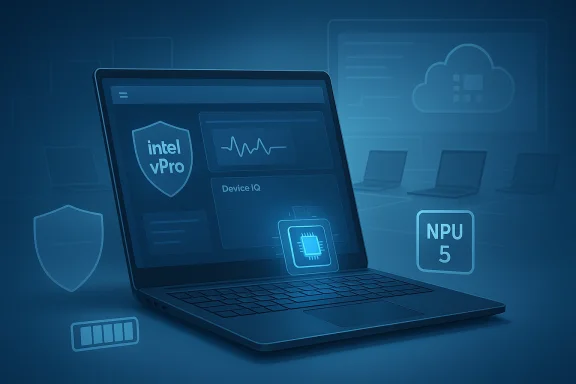
Panther Lake extends that formula by bringing newer silicon blocks into the mix. Intel says Core Ultra Series 3 uses a new NPU 5 tile, offers up to 46–50 TOPS from the NPU alone, and can reach much higher total platform throughput when CPU, GPU, and NPU are all working together. That is not just marketing theater. For enterprises, the practical benefit is that AI-assisted security and productivity workloads can be handled locally, often with lower latency and less exposure than cloud-based processing.
At the same time, Intel is continuing to tune the enterprise narrative around durability and fleet control. The company’s recent Intune integration for vPro Fleet Services underscores that this is no longer a niche feature for a few laptop SKUs. It is becoming part of a broader device-management stack that spans remote recovery, secure provisioning, and even operational continuity when the OS is down or the machine is powered off.
The second change is that Intel is using the Series 3 launch to sharpen the distinction between consumer AI features and enterprise AI utility. On the consumer side, the message is usually about Copilot+ PC capabilities, creative workloads, and faster local inference. On the enterprise side, Intel is framing the same hardware as a way to improve threat detection, reduce background overhead, and support security tools that benefit from on-chip telemetry. That shift is subtle, but it is strategically important.
The bigger implication is that Intel is nudging the PC toward a more autonomous maintenance model. Rather than waiting for a user ticket or a scripted management cycle, telemetry from the platform can reveal battery degradation, driver anomalies, thermal issues, or security concerns before they become visible failures. That does not eliminate IT management, but it changes its shape from cleanup to prevention.
The caveat is that telemetry only helps if it is accurate, timely, and actionable. Too much noise and the IT team ignores it; too little context and it becomes another dashboard nobody trusts. Intel therefore has to prove that Device IQ and related tools can cut through the clutter rather than adding to it, especially in large heterogeneous fleets where device behavior varies by OEM, workload, and policy. That is the real test, not the acronym count.
That distinction matters because modern enterprise threats increasingly target the cracks between software layers. Fileless malware, stealthy payloads, and supply-chain compromises are not problems a single antivirus engine can always solve on its own. Intel’s pitch is that the silicon can watch for suspicious behavior from below the OS, while security vendors continue to do the higher-level policy and response work above it.
The enterprise upside is obvious: if security scanning becomes less intrusive, organizations can be more aggressive about detection without creating a productivity tax. That is especially relevant in remote and hybrid work environments, where a user’s machine may be the primary line of defense. The consumer benefit is less direct, but it still exists in the form of stronger default protection and fewer resource-hungry background scans.
Longer battery life is not just a convenience feature. It affects how IT departments configure power policies, how often employees need chargers, and how much thermal headroom the system has for sustained workloads. A cooler, more efficient notebook is often a more reliable notebook, and reliability is one of the most underrated enterprise purchasing criteria.
The enterprise story becomes even stronger when battery gains are paired with on-device AI. If the NPU can handle local inference, then some tasks can be processed without constant cloud round-trips, which can further improve responsiveness and potentially reduce power draw in specific workflows. That does not mean every AI feature saves energy, but it does mean the platform is at least architected with efficiency in mind.
That makes sense. Enterprises are often more cautious than consumers about sending sensitive prompts, files, and workflow data to the cloud. Local AI execution is not only faster for some tasks, it also keeps more data inside the device boundary, which is easier to align with compliance, retention, and zero-trust policies.
This is also where Intel has a chance to differentiate itself from generic AI PC claims. Plenty of vendors can advertise an NPU, but fewer can link that NPU to a mature enterprise management story, a long-standing business platform, and broad OEM availability. In other words, AI acceleration is the headline, but fleet readiness is the moat.
Intel is clearly trying to build a more complete commercial workstation proposition. If the CPU, NPU, and GPU are all optimized for business use, then the company can pitch a cleaner platform story to OEMs and IT buyers. That does not automatically make Intel the workstation leader, but it does reduce the distance between “business laptop” and “business creative machine.”
Intel’s workstation push also helps reinforce vPro’s identity as a platform for serious deployments rather than just standard office laptops. A company that buys business-class notebooks today may want the option to standardize on desktop workstations tomorrow, and a coherent CPU/GPU/security stack helps Intel make that transition easier. That kind of continuity sells.
This integration also lowers the activation barrier. Instead of requiring a separate mental model or a complex custom deployment, IT administrators can use a familiar console and still get out-of-band management capabilities. That is important because enterprise tools win not only on capability, but on adoption friction.
That matters for procurement too. When IT teams assess business PCs, they are no longer just comparing processors and battery specs. They are evaluating the entire device lifecycle: provisioning, policy enforcement, repairability, recovery, and ongoing compliance. vPro’s Intune story strengthens Intel’s position on all of those fronts.
It will also matter how quickly software partners turn Panther Lake’s AI and security blocks into real productivity gains. If security vendors, OEM management tools, and Microsoft keep deepening their support, Intel’s hardware advantages will compound. If not, the platform risks becoming another respectable but underused business feature set.
Source: Windows Central Intel's vPro platform expands to Core Ultra Series 3 to protect your new PC
 Overview
Intel has spent the last several years repositioning Core Ultra around the AI PC narrative, but the business angle has remained just as important as consumer hype. The company’s client strategy now rests on three pillars: performance per watt, local AI acceleration, and hardware-backed enterprise control. Core Ultra Series 3, code-named Panther Lake, is the latest expression of that strategy, and Intel is clearly pushing it as a platform rather than a standalone CPU family.That platform emphasis matters because vPro is not a sticker Intel adds after the fact. It is a set of hardware and firmware capabilities that OEMs must integrate into business systems, which means enterprise buyers get a more predictable baseline for security and remote management. Intel’s own description of vPro stresses built-in security, out-of-band management, and the stability guarantees that keep corporate IT departments from dealing with endless configuration drift.
Panther Lake extends that formula by bringing newer silicon blocks into the mix. Intel says Core Ultra Series 3 uses a new NPU 5 tile, offers up to 46–50 TOPS from the NPU alone, and can reach much higher total platform throughput when CPU, GPU, and NPU are all working together. That is not just marketing theater. For enterprises, the practical benefit is that AI-assisted security and productivity workloads can be handled locally, often with lower latency and less exposure than cloud-based processing.
At the same time, Intel is continuing to tune the enterprise narrative around durability and fleet control. The company’s recent Intune integration for vPro Fleet Services underscores that this is no longer a niche feature for a few laptop SKUs. It is becoming part of a broader device-management stack that spans remote recovery, secure provisioning, and even operational continuity when the OS is down or the machine is powered off.
What Changed with Core Ultra Series 3
The first and most obvious change is generational: Core Ultra Series 3 moves vPro onto Panther Lake, which Intel positioned as the company’s latest AI PC architecture and first client platform on 18A. That means the business-oriented parts of vPro now ride on a newer efficiency and AI foundation than previous generations, rather than being bolted onto yesterday’s silicon. The result is a more coherent story for enterprise buyers who want one platform that can handle productivity, security, and on-device intelligence.The second change is that Intel is using the Series 3 launch to sharpen the distinction between consumer AI features and enterprise AI utility. On the consumer side, the message is usually about Copilot+ PC capabilities, creative workloads, and faster local inference. On the enterprise side, Intel is framing the same hardware as a way to improve threat detection, reduce background overhead, and support security tools that benefit from on-chip telemetry. That shift is subtle, but it is strategically important.
Why the silicon shift matters
The move to Panther Lake gives Intel a chance to unify power efficiency and management in ways that older business platforms could not. A more efficient platform means longer battery life for mobile workers, less thermal stress for thin-and-light systems, and a better foundation for always-on telemetry without punishing battery life. In enterprise procurement, those are not small details; they are the difference between a system that gets embraced and one that gets quietly replaced early.What enterprises will notice first
The visible gains will probably be boring in the best possible way. Faster wake times, fewer battery complaints, more reliable fleet behavior, and better consistency across devices are the kinds of improvements that IT departments notice before users do. Intel’s vPro program has always been about reducing friction, and Core Ultra Series 3 appears designed to do exactly that while also making room for AI workloads that can be processed on-device.- Better battery endurance for mobile employees
- More predictable performance under mixed workloads
- Lower overhead for always-on security tooling
- Stronger on-device AI acceleration for enterprise apps
- Less dependence on cloud processing for sensitive tasks
Device IQ and the Move Toward Self-Healing PCs
One of the more interesting additions tied to the newer vPro push is Device IQ, which Intel describes as a telemetry-driven layer for understanding device behavior and applying real-time fixes. That sounds like another acronym in a sea of enterprise jargon, but the practical idea is easy to grasp: the PC should help explain what is wrong with itself before the help desk has to intervene. If that works well, it could reduce downtime and make endpoint support less reactive.The bigger implication is that Intel is nudging the PC toward a more autonomous maintenance model. Rather than waiting for a user ticket or a scripted management cycle, telemetry from the platform can reveal battery degradation, driver anomalies, thermal issues, or security concerns before they become visible failures. That does not eliminate IT management, but it changes its shape from cleanup to prevention.
Why telemetry is becoming strategic
Telemetry has often been treated as a support tool, yet in modern fleets it is increasingly a security and reliability asset. Intel’s own vPro materials say the wealth of data generated by its device discovery capabilities can be used to assess health, determine posture, and guide maintenance. In other words, the data is not just diagnostic; it is operational. That is a major reason why enterprise customers keep paying attention to vPro even when consumer buyers barely notice it.The caveat is that telemetry only helps if it is accurate, timely, and actionable. Too much noise and the IT team ignores it; too little context and it becomes another dashboard nobody trusts. Intel therefore has to prove that Device IQ and related tools can cut through the clutter rather than adding to it, especially in large heterogeneous fleets where device behavior varies by OEM, workload, and policy. That is the real test, not the acronym count.
What this could mean for support desks
If Intel gets this right, support teams could see fewer repeat incidents and faster root-cause analysis. A system that can correlate battery drain, thermal throttling, and security posture in near real time is much easier to manage than a pile of disconnected monitoring tools. That could also reduce the need for manual image refreshes and blanket remediation steps.- Faster identification of battery and power anomalies
- More precise device-health scoring
- Better root-cause analysis for recurring faults
- Less reliance on manual troubleshooting
- Improved fleet-level policy tuning
Security Above and Below the Operating System
Intel is leaning hard into the idea that hardware-based security is more trustworthy than software alone. On vPro systems, that means features like Intel TDT for threat detection, firmware-level protections, and tighter hardware validation to support safer endpoints. Intel says its threat detection approach leverages CPU telemetry and machine learning to identify attacks that try to evade traditional software security.That distinction matters because modern enterprise threats increasingly target the cracks between software layers. Fileless malware, stealthy payloads, and supply-chain compromises are not problems a single antivirus engine can always solve on its own. Intel’s pitch is that the silicon can watch for suspicious behavior from below the OS, while security vendors continue to do the higher-level policy and response work above it.
Intel TDT and the security stack
Intel TDT is one of the clearest examples of this approach. Intel says it can offload certain security workloads away from the CPU and use AI-assisted analysis to detect ransomware, cryptojacking, and memory-based attacks with less performance penalty. In practical terms, that gives security tools more room to work without dragging down the user experience as much as older software-only methods might.The enterprise upside is obvious: if security scanning becomes less intrusive, organizations can be more aggressive about detection without creating a productivity tax. That is especially relevant in remote and hybrid work environments, where a user’s machine may be the primary line of defense. The consumer benefit is less direct, but it still exists in the form of stronger default protection and fewer resource-hungry background scans.
BitLocker and trusted device setup
Intel is also highlighting hardware-level BitLocker protection and attestation mechanisms like Trusted Device Setup. These features help validate that the device is what it claims to be and that its security state has not been tampered with. For enterprises, that is especially important during provisioning, refresh cycles, and remote support scenarios where trust has to be established without physical access.- Hardware-assisted threat detection
- Below-the-OS visibility into suspicious behavior
- Stronger attestation during provisioning
- Better alignment with endpoint security vendors
- Reduced performance impact from security tools
Battery Life and Efficiency Are the Quiet Killer Feature
Intel’s marketing often leads with AI, but battery life is the more universal enterprise win. The company says Core Ultra Series 3 inherits the efficiency gains associated with Panther Lake, and those gains flow straight into vPro-certified notebooks. For workers who spend the day on calls, in transit, or away from a dock, that can matter more than any on-paper AI score.Longer battery life is not just a convenience feature. It affects how IT departments configure power policies, how often employees need chargers, and how much thermal headroom the system has for sustained workloads. A cooler, more efficient notebook is often a more reliable notebook, and reliability is one of the most underrated enterprise purchasing criteria.
Why efficiency changes management
There is also a management angle here that does not get enough attention. Better efficiency can reduce battery-health complaints, extend replacement cycles, and make mixed-use workloads less variable across a fleet. That is a good thing for admins because the fewer exceptions a fleet creates, the easier it is to standardize policy and support.The enterprise story becomes even stronger when battery gains are paired with on-device AI. If the NPU can handle local inference, then some tasks can be processed without constant cloud round-trips, which can further improve responsiveness and potentially reduce power draw in specific workflows. That does not mean every AI feature saves energy, but it does mean the platform is at least architected with efficiency in mind.
Consumer spillover
Consumer users will benefit too, even if they never think about vPro. The same underlying power improvements that make enterprise laptops attractive also improve personal productivity notebooks sold by OEM partners. In that sense, business features often act as the proving ground for the broader platform. What starts as fleet management can eventually shape the mainstream laptop market.- Fewer charging interruptions
- Better thermals in thin notebooks
- More stable sustained performance
- Improved remote-work usability
- Longer useful life between replacements
AI PCs Are Becoming More Business-Centric
Intel has been talking about the AI PC for a while, but the market is now splitting into consumer AI theatrics and enterprise AI utility. Core Ultra Series 3 sits closer to the second category. Its NPU, GPU, and CPU are designed to work together for local tasks, and Intel is increasingly framing that as a privacy and control benefit as much as a performance feature.That makes sense. Enterprises are often more cautious than consumers about sending sensitive prompts, files, and workflow data to the cloud. Local AI execution is not only faster for some tasks, it also keeps more data inside the device boundary, which is easier to align with compliance, retention, and zero-trust policies.
Local inference and enterprise privacy
Intel’s own security messaging emphasizes that hardware-backed protections can cover AI models and associated data through all execution stages. That is a meaningful statement because it moves the AI conversation from “cool features” to “controlled workloads.” Enterprises do not just need AI; they need AI that fits within governance rules and endpoint security architecture.This is also where Intel has a chance to differentiate itself from generic AI PC claims. Plenty of vendors can advertise an NPU, but fewer can link that NPU to a mature enterprise management story, a long-standing business platform, and broad OEM availability. In other words, AI acceleration is the headline, but fleet readiness is the moat.
The limit of the AI PC narrative
The risk is that AI PCs can still feel over-promised if the software ecosystem does not keep pace. If the only visible value is a few transcription features or background tasks, business users may not feel the benefit immediately. Intel therefore needs third-party software, security vendors, and Microsoft’s own platform features to continue broadening the use cases.- Better privacy for sensitive workloads
- Lower latency for local prompts and inference
- Reduced dependence on cloud AI services
- Stronger alignment with enterprise policy
- More useful AI when tied to business software
Arc Pro, Graphics, and Workstation Credibility
Another notable piece of the Series 3 vPro story is the appearance of Intel Arc Pro graphics in the business stack. Intel says the new generation brings Xe3-based graphics cores into integrated and discrete variants, with workstation-focused cards like the Arc Pro B65 and Pro B70 aimed at professional workloads. That matters because graphics is no longer just about display output; it is about AI, rendering, simulation, and content pipelines.Intel is clearly trying to build a more complete commercial workstation proposition. If the CPU, NPU, and GPU are all optimized for business use, then the company can pitch a cleaner platform story to OEMs and IT buyers. That does not automatically make Intel the workstation leader, but it does reduce the distance between “business laptop” and “business creative machine.”
Why businesses care about graphics
Many people still think of GPU upgrades as a consumer gaming issue, but in enterprise settings graphics capability can affect everything from product design to video production to AI-assisted visualization. A better professional GPU can shorten render times, smooth collaboration, and improve the responsiveness of applications that have become far more graphically demanding than they used to be. That is especially true as more software shifts into GPU-accelerated workflows.Intel’s workstation push also helps reinforce vPro’s identity as a platform for serious deployments rather than just standard office laptops. A company that buys business-class notebooks today may want the option to standardize on desktop workstations tomorrow, and a coherent CPU/GPU/security stack helps Intel make that transition easier. That kind of continuity sells.
What is still missing
What Intel does not yet have, at least in this part of the narrative, is a fresh consumer Arc GPU launch to complement the workstation cards. That omission is noticeable because it keeps Arc’s visibility uneven: present in professional tools, absent where many enthusiasts still expect competition. For now, the Series 3 graphics story is more about enterprise credibility than broad retail excitement.- Xe3 graphics for integrated and discrete business variants
- Workstation-oriented Arc Pro cards
- Better fit for rendering and professional AI tasks
- Stronger platform coherence for OEMs
- Limited consumer halo effect for now
Intune, Fleet Services, and the Admin Experience
Intel’s recent work with Microsoft Intune may be the most underappreciated part of the vPro evolution. The company has positioned vPro Fleet Services as a cloud-native way to manage, recover, and secure devices through the Intune partner portal. That is a big deal because it takes one of Intel’s most distinctive hardware advantages and makes it easier to access inside a mainstream Microsoft workflow.This integration also lowers the activation barrier. Instead of requiring a separate mental model or a complex custom deployment, IT administrators can use a familiar console and still get out-of-band management capabilities. That is important because enterprise tools win not only on capability, but on adoption friction.
Why integration beats isolation
A management platform that lives in a silo often struggles to gain traction, even if it is technically impressive. By contrast, embedding vPro access into Intune makes the feature easier to evaluate, deploy, and support at scale. Intel’s messaging suggests the company understands that the future of enterprise hardware is as much about workflow integration as raw capability.That matters for procurement too. When IT teams assess business PCs, they are no longer just comparing processors and battery specs. They are evaluating the entire device lifecycle: provisioning, policy enforcement, repairability, recovery, and ongoing compliance. vPro’s Intune story strengthens Intel’s position on all of those fronts.
What admins actually gain
The practical value is best understood in ugly scenarios, not happy-path demos. If a device is powered off, wedged, or broken at the OS level, remote management can still provide a path forward. That can save hours or days in a large organization, especially when the affected machine belongs to someone who cannot wait for in-person support.- Remote recovery even when the OS fails
- Faster remediation for critical endpoints
- Reduced dependence on desk-side support
- Easier policy enforcement across large fleets
- Better alignment with Microsoft’s device-management ecosystem
Strengths and Opportunities
Intel’s vPro expansion onto Core Ultra Series 3 has several obvious strengths, and most of them come from how neatly the company is bundling silicon, security, and manageability into one story. The platform is not trying to wow everyone equally; it is trying to be indispensable to enterprises that care about uptime, compliance, and mobility. That is a smart place to compete because those buyers pay for measurable value rather than buzzwords.- Stronger battery life for mobile workers and lighter support load for IT.
- Hardware-backed security that can complement software defenses instead of fighting them.
- Deeper Intune integration that lowers adoption friction for enterprise customers.
- Local AI acceleration that supports privacy-sensitive workloads.
- More consistent fleet behavior through platform-level standardization.
- Workstation credibility from Arc Pro and Xe3-based graphics options.
- Better vendor positioning against rivals that rely more heavily on software-only management.
Risks and Concerns
The biggest risk is familiar: Intel may be layering too much marketing language on top of features that only shine in the right environment. Enterprise buyers will absolutely care about hardware detection, out-of-band management, and energy efficiency, but they will also demand proof that these tools work reliably across OEMs, software stacks, and real-world deployments. If the experience feels fragmented, the platform premium gets harder to justify.- Acronym overload can obscure actual value and make the product harder to explain.
- Telemetry privacy concerns may arise if organizations do not fully understand data flows.
- Feature fragmentation across OEM implementations could weaken the platform message.
- Software ecosystem dependence means AI and security benefits still need vendor support.
- Consumer ambiguity may limit broader awareness outside IT procurement circles.
- Pricing pressure could make vPro systems harder to justify in budget-sensitive refresh cycles.
- Execution risk remains if Intel cannot consistently deliver on battery and efficiency claims across models.
Looking Ahead
The next phase of this story will be less about launch-day claims and more about deployment reality. Intel needs Core Ultra Series 3 systems to show up in enough enterprise notebooks, desktops, and workstations to prove that the platform is not a one-off refresh but a durable commercial foundation. The important question is whether administrators feel the difference after three months of use, not whether a roadmap slide looked impressive on day one.It will also matter how quickly software partners turn Panther Lake’s AI and security blocks into real productivity gains. If security vendors, OEM management tools, and Microsoft keep deepening their support, Intel’s hardware advantages will compound. If not, the platform risks becoming another respectable but underused business feature set.
What to watch next
- OEM rollout breadth across premium and midrange business laptops
- Real-world battery and thermals versus prior vPro systems
- Expanded security vendor support for Intel TDT
- Deeper Intune and fleet-management features
- Adoption of Arc Pro in workstation-focused deployments
Source: Windows Central Intel's vPro platform expands to Core Ultra Series 3 to protect your new PC
