

3mdeb’s Dasharo port of coreboot with AMD openSIL can now boot Windows 11 without workarounds on the MSI PRO B850-P WiFi, a consumer AM5 Ryzen motherboard, according to Phoronix’s July 3, 2026 report on the project’s latest progress. That sentence sounds small only if firmware is treated as plumbing. In reality, it marks a meaningful step toward proving that open-source x86 platform firmware can satisfy not just Linux enthusiasts, but the much fussier Windows PC contract. The bigger story is not that one MSI board boots Windows; it is that the open-firmware movement is inching from ideological demo to ordinary PC behavior.
For years, coreboot’s strongest case has been philosophical and operational: less opaque firmware, faster boots, auditable code, and more control for users who are willing to accept some sharp edges. That argument works well in developer laptops, Chromebooks, embedded systems, and Linux-heavy communities. It works less well on the mainstream desktop, where the operating system most likely to expose firmware sins is still Windows.
Windows is not simply another boot target. It expects a firmware environment that looks conventional in very specific ways: ACPI tables must be plausible, interrupt routing must be correct, TPM behavior must line up with platform expectations, power-management objects need to exist, and device enumeration must not surprise driver installers. Linux can often be coaxed past rough firmware with kernel parameters, quirks, or a developer who knows what to ignore. Windows tends to punish the same roughness with missing devices, broken sleep, driver failures, failed installation paths, or security-feature complaints.
That is why the Windows 11 milestone matters. The open-source firmware world does not win the desktop by telling users to boot with a workaround forever. It wins by making the weird firmware disappear into the background, where Windows Update, AMD chipset drivers, Radeon software, TPM-backed security, and ordinary power states behave as if the system shipped that way.
The irony is obvious. A project born from dissatisfaction with opaque PC firmware needs Microsoft’s operating system to demonstrate that it can become mainstream. But that is the reality of the PC ecosystem: Windows remains the reference workload for compatibility, even when the firmware itself is built by people who would rather talk about Linux first.
The historical problem is that this part of the x86 boot chain has been one of the least transparent and most consequential pieces of the PC. Traditional AGESA-based firmware workflows have left most users, many developers, and even plenty of system integrators dependent on opaque blobs and vendor release notes that rarely explain the true nature of fixes. When something breaks, the answer is usually “try the next BIOS,” not “inspect the failing initialization path.”
openSIL does not magically remove every binary dependency. The 3mdeb work still involves firmware blobs, AMD platform components, PSP-related pieces, GOP integration, and board-specific configuration that cannot be wished away. But the architectural direction is different: more of the silicon initialization logic can be reviewed, ported, adapted, and reasoned about outside the closed BIOS pipeline.
That distinction matters for security as much as ideology. Firmware is now part of the attack surface, the supply chain, the compliance story, and the recovery plan. Enterprises talk about measured boot, TPM identity, firmware updates, and platform attestation because attackers and regulators have forced the conversation below the operating system. An open initialization layer does not guarantee safer firmware, but it improves the odds that more people can inspect and fix what would otherwise remain unknowable.
Open firmware has often advanced on hardware selected because it was controllable, constrained, or backed by an unusually cooperative vendor. The mainstream DIY desktop market is different. Motherboards are dense with vendor-specific decisions: USB routing, audio codecs, Wi-Fi modules, Super I/O chips, chipset quirks, debug LEDs, flash recovery mechanisms, and ACPI expectations for software utilities that most enthusiasts barely notice until they stop working.
3mdeb’s work on the MSI board has therefore been less about flipping a “coreboot support” switch and more about reconstructing a platform personality. The firmware has to describe the board accurately enough that operating systems can trust it. It has to initialize the AMD silicon and the B850-era I/O topology. It has to deal with board-specific display outputs, memory training behavior, chipset-provided ports, and the recovery mechanisms that users expect from MSI hardware.
This is the unglamorous work that separates a boot demo from a useful machine. A POST screen is not a platform. A kernel log is not a product. Windows 11 reaching a usable state without special tricks suggests that enough of the motherboard’s identity is now being communicated through the open stack to satisfy a very demanding consumer OS.
3mdeb’s recent work included interrupt routing improvements, ACPI device descriptions, Super I/O handling, platform event support, and Windows-oriented compatibility details. Those are not glamorous changes, but they are exactly the kinds of changes that Windows notices. An incorrectly routed interrupt can look like a flaky driver. A missing ACPI object can look like a power-management bug. An incomplete SMBIOS description can make management tools misreport the machine.
This is also where many open-firmware projects discover that “open” does not mean “simple.” A motherboard is a pile of negotiated conventions. Some are documented specifications; some are inherited PC behavior; some are vendor choices encoded in firmware tables; and some are just the shape of Windows compatibility after decades of hardware vendors doing whatever worked.
The Windows milestone says that the Dasharo stack is now speaking more of that language. It does not mean every sleep state, utility, driver, and corner case is perfect. It means the project has crossed from “can we get code execution?” into “can we behave like a PC?”
Earlier progress on the MSI port still required compromises on Linux because the
The newer report says that the AMDGPU graphics-driver error has been addressed as part of the broader progress. That is important because graphics handoff is one of the places where firmware and OS drivers meet in a very practical way. If the firmware initializes the display just enough to show a logo but not enough for the driver to inherit the machine cleanly, users do not experience that as a philosophical firmware problem. They experience it as a broken PC.
For Windows 11, the graphics path is equally unforgiving. The system may boot, but display drivers, sleep transitions, device power states, and hardware acceleration all depend on a coherent platform description. The fact that Windows now runs without workarounds suggests that the project has moved closer to a normal firmware-to-driver handoff, even if deeper validation remains essential.
That is why AMD PSP firmware TPM support in the Dasharo port is not a footnote. It is a passport stamp. Without a working firmware TPM, Windows 11 compatibility becomes either impossible, unofficial, or dependent on user-hostile workarounds. With it, the open firmware stack begins to look less like a hobbyist detour and more like something that could survive the ordinary Windows install path.
There is a broader tension here. Open-firmware advocates often view platform security engines with suspicion because they are closed, privileged, and hard to audit. Windows, meanwhile, increasingly depends on hardware-rooted identity and security features that involve those same trust anchors. The MSI port does not resolve that tension. It demonstrates how open host firmware may have to coexist with closed platform security components if it wants to run on modern consumer AMD systems.
That coexistence will disappoint purists. It will also be necessary for most real machines. The realistic near-term goal is not a perfectly open PC from reset vector to desktop. It is a substantially more inspectable and maintainable firmware stack that still honors the security and compatibility contracts modern operating systems require.
3mdeb’s earlier work added Promontory21 support as a substantial new block in openSIL and coreboot integration. That is the kind of feature that rarely attracts mainstream attention because users do not buy motherboards to admire chipset initialization. They buy them because the rear-panel USB ports work, storage is detected, networking appears, and PCIe devices enumerate correctly.
The lesson is that open firmware cannot merely support a CPU generation. It must support platform topologies. Every consumer board is a particular interpretation of a chipset: which lanes go where, which ports are routed, which devices sit behind which bridges, which GPIOs control which hardware, and how the vendor firmware originally configured all of it. A working port is therefore a blend of silicon support, board archaeology, and disciplined table generation.
This also explains why the MSI PRO B850-P WiFi may remain special for a while. Once the work is done, it can inform other AM5 boards, but it does not automatically make the whole AM5 ecosystem open-firmware-ready. Each additional board still has to be mapped, described, validated, and maintained. The path gets easier; it does not become free.
Linux has long served as the proving ground for firmware experiments because it offers visibility. Kernel logs reveal what the firmware claimed. Driver errors expose bad tables. Boot parameters give engineers temporary escape hatches. The community is technically literate enough to test, complain usefully, and understand why a system that boots is not necessarily correct.
Windows brings a different kind of validation. It is less transparent, but more representative of the consumer PC contract. A machine that behaves under Linux with careful tuning is interesting. A machine that boots Windows 11 cleanly is harder to dismiss as a lab specimen.
The healthiest interpretation is not Linux versus Windows. It is that open firmware needs both. Linux helps engineers see the machine. Windows proves whether the machine can blend into the ecosystem that most desktop users still inhabit.
This is where Dasharo’s role matters. 3mdeb is not just publishing a weekend hack; it is building a firmware distribution model around coreboot, validation, release engineering, and supportable configurations. That does not eliminate risk, but it changes the sustainability question. Users need more than a Git branch and a flashing guide if the firmware is going to replace the vendor BIOS on a daily-driver system.
The MSI port still appears to be developmental rather than something ordinary users should flash casually. That distinction is important. A Windows 11 boot milestone is not the same as a production release, and it certainly is not a warranty from MSI. Anyone treating it as a drop-in BIOS replacement today is accepting the risks of early firmware: failed boots, incomplete device support, update complications, and recovery procedures that demand more than optimism.
But maintenance starts with a board worth maintaining. The MSI PRO B850-P WiFi now looks like one of the more credible consumer AMD targets for open firmware experimentation. If the project continues toward stable releases, automated validation, and upstreamable pieces, it could become a template rather than a curiosity.
That makes Windows an accidental auditor of open firmware. It does not audit source code, and it does not care whether the firmware is philosophically open. It simply enforces expectations. If the TPM is missing, the platform fails a visible test. If ACPI is wrong, power management suffers. If device enumeration is sloppy, drivers do not bind cleanly. If firmware handoff is fragile, users feel it.
For a project like coreboot plus openSIL, passing those expectations is valuable precisely because Windows is not grading on a curve. A Linux enthusiast may forgive a boot parameter. Windows users expect setup to run, drivers to install, sleep to work, updates to apply, and security status pages to stop complaining.
That does not mean Microsoft defines good firmware. It means Microsoft defines much of the consumer PC compatibility surface. Any alternative firmware stack that wants out of the lab has to meet that surface on its own terms.
To replace that, open firmware has to be better in ways users can feel. Faster boot is nice. Auditability is important. Cleaner code paths matter to developers. But a user who loses sleep reliability, fan behavior, memory compatibility, RGB controls, BIOS Flashback behavior, or Windows driver harmony will quickly rediscover the appeal of boring vendor firmware.
3mdeb’s work on MSI FlashBIOS support is therefore more significant than it might appear. Recovery matters. Firmware experimentation on desktop boards is only sane when users have a reliable path back from a bad flash. The closer open firmware integrates with board-level recovery mechanisms, the less it feels like a one-way trip into enthusiast danger.
The project also has to compete with vendor release cadence. AMD platforms often receive firmware updates tied to new CPUs, memory compatibility, security advisories, and chipset behavior. If openSIL makes more of that process reviewable and portable, it could eventually narrow the gap. But until then, users will reasonably ask whether openness is worth stepping outside the official update channel.
Still, the direction is promising. Firmware security has suffered from opacity, slow disclosure, uneven vendor communication, and a lack of independent verification. More open silicon initialization gives researchers and platform owners a better chance to understand what happens before the OS loads. For enterprises and security-minded users, that is not academic; it affects trust, incident response, and long-term platform ownership.
The messy part is the continued presence of blobs and privileged controllers. AMD PSP-related components, firmware TPM behavior, chipset firmware, and graphics option ROM paths remind us that openness is arriving unevenly. The host firmware may become more open while pieces of the platform remain sealed.
That should not be treated as failure. It should be treated as the actual battlefield. The PC did not become opaque in one layer, and it will not become transparent in one release. The practical win is incremental: move more logic into the light, document more assumptions, reduce unnecessary vendor lock-in, and make the remaining closed pieces easier to identify and reason about.
That is why “Windows 11 works without workarounds” is such a loaded phrase. Workarounds are lifestyle changes. They demand that users remember special boot flags, avoid certain drivers, ignore warnings, or accept that a feature is “not supported yet.” Normal users do not want firmware that turns PC ownership into a research project.
If Dasharo on the MSI board can reach the point where Windows users install, update, sleep, wake, game, virtualize, and secure the system normally, then open firmware becomes a choice rather than a sacrifice. That would be a different proposition from the one enthusiasts have accepted for years.
For sysadmins, the appeal could be even sharper. A fleet of systems with more transparent firmware, reproducible builds, policy-friendly updates, and documented platform behavior would be easier to trust than a pile of opaque BIOS images accompanied by vague changelogs. But that future depends on repeatability across more than one motherboard.
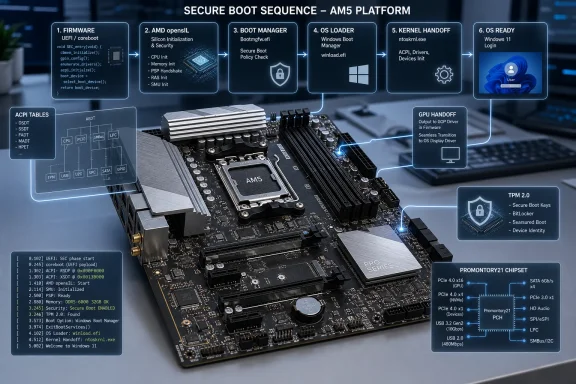 Windows Is the Compatibility Test Open Firmware Could Not Dodge
For years, coreboot’s strongest case has been philosophical and operational: less opaque firmware, faster boots, auditable code, and more control for users who are willing to accept some sharp edges. That argument works well in developer laptops, Chromebooks, embedded systems, and Linux-heavy communities. It works less well on the mainstream desktop, where the operating system most likely to expose firmware sins is still Windows.Windows is not simply another boot target. It expects a firmware environment that looks conventional in very specific ways: ACPI tables must be plausible, interrupt routing must be correct, TPM behavior must line up with platform expectations, power-management objects need to exist, and device enumeration must not surprise driver installers. Linux can often be coaxed past rough firmware with kernel parameters, quirks, or a developer who knows what to ignore. Windows tends to punish the same roughness with missing devices, broken sleep, driver failures, failed installation paths, or security-feature complaints.
That is why the Windows 11 milestone matters. The open-source firmware world does not win the desktop by telling users to boot with a workaround forever. It wins by making the weird firmware disappear into the background, where Windows Update, AMD chipset drivers, Radeon software, TPM-backed security, and ordinary power states behave as if the system shipped that way.
The irony is obvious. A project born from dissatisfaction with opaque PC firmware needs Microsoft’s operating system to demonstrate that it can become mainstream. But that is the reality of the PC ecosystem: Windows remains the reference workload for compatibility, even when the firmware itself is built by people who would rather talk about Linux first.
AMD’s openSIL Bet Starts to Look Less Theoretical
AMD openSIL is meant to replace the old model of vendor-supplied silicon initialization code with something more open, modular, and host-firmware-friendly. In plain English, it is the layer that gets AMD silicon into a usable state before an operating system ever has a chance. Memory, CPU fabric, PCIe, chipset links, graphics initialization, power features, and platform topology all depend on this early code being right.The historical problem is that this part of the x86 boot chain has been one of the least transparent and most consequential pieces of the PC. Traditional AGESA-based firmware workflows have left most users, many developers, and even plenty of system integrators dependent on opaque blobs and vendor release notes that rarely explain the true nature of fixes. When something breaks, the answer is usually “try the next BIOS,” not “inspect the failing initialization path.”
openSIL does not magically remove every binary dependency. The 3mdeb work still involves firmware blobs, AMD platform components, PSP-related pieces, GOP integration, and board-specific configuration that cannot be wished away. But the architectural direction is different: more of the silicon initialization logic can be reviewed, ported, adapted, and reasoned about outside the closed BIOS pipeline.
That distinction matters for security as much as ideology. Firmware is now part of the attack surface, the supply chain, the compliance story, and the recovery plan. Enterprises talk about measured boot, TPM identity, firmware updates, and platform attestation because attackers and regulators have forced the conversation below the operating system. An open initialization layer does not guarantee safer firmware, but it improves the odds that more people can inspect and fix what would otherwise remain unknowable.
The MSI Board Is Ordinary, and That Is the Point
The MSI PRO B850-P WiFi is not a boutique open-hardware workstation board. It is a consumer AM5 motherboard for desktop Ryzen systems, the kind of board a Windows user might buy because it is available, affordable, and compatible with modern CPUs and DDR5 memory. That ordinariness is precisely why the port is interesting.Open firmware has often advanced on hardware selected because it was controllable, constrained, or backed by an unusually cooperative vendor. The mainstream DIY desktop market is different. Motherboards are dense with vendor-specific decisions: USB routing, audio codecs, Wi-Fi modules, Super I/O chips, chipset quirks, debug LEDs, flash recovery mechanisms, and ACPI expectations for software utilities that most enthusiasts barely notice until they stop working.
3mdeb’s work on the MSI board has therefore been less about flipping a “coreboot support” switch and more about reconstructing a platform personality. The firmware has to describe the board accurately enough that operating systems can trust it. It has to initialize the AMD silicon and the B850-era I/O topology. It has to deal with board-specific display outputs, memory training behavior, chipset-provided ports, and the recovery mechanisms that users expect from MSI hardware.
This is the unglamorous work that separates a boot demo from a useful machine. A POST screen is not a platform. A kernel log is not a product. Windows 11 reaching a usable state without special tricks suggests that enough of the motherboard’s identity is now being communicated through the open stack to satisfy a very demanding consumer OS.
The Real Breakthrough Was ACPI, Not the Screenshot
The easy image is Windows 11 running on a coreboot-plus-openSIL system. The harder achievement is the firmware scaffolding that makes such a boot boring. In modern PCs, ACPI is the treaty between firmware and operating system: it describes devices, power states, interrupt routing, thermal behavior, buttons, buses, and platform-specific control methods. If that treaty is poorly drafted, the OS may still boot, but the machine becomes an unreliable citizen.3mdeb’s recent work included interrupt routing improvements, ACPI device descriptions, Super I/O handling, platform event support, and Windows-oriented compatibility details. Those are not glamorous changes, but they are exactly the kinds of changes that Windows notices. An incorrectly routed interrupt can look like a flaky driver. A missing ACPI object can look like a power-management bug. An incomplete SMBIOS description can make management tools misreport the machine.
This is also where many open-firmware projects discover that “open” does not mean “simple.” A motherboard is a pile of negotiated conventions. Some are documented specifications; some are inherited PC behavior; some are vendor choices encoded in firmware tables; and some are just the shape of Windows compatibility after decades of hardware vendors doing whatever worked.
The Windows milestone says that the Dasharo stack is now speaking more of that language. It does not mean every sleep state, utility, driver, and corner case is perfect. It means the project has crossed from “can we get code execution?” into “can we behave like a PC?”
Graphics Initialization Turned Out to Be a Firmware Problem
One of the more revealing parts of the project is the graphics path. Integrated graphics on modern AMD platforms is not merely a matter of letting the operating system load a driver. The firmware needs to configure memory regions, provide information in expected formats, describe display interfaces, and often rely on a GOP driver in the UEFI phase before the OS graphics driver takes over.Earlier progress on the MSI port still required compromises on Linux because the
amdgpu kernel driver could fault when taking over from firmware-initialized display output. The workaround was to boot with nomodeset, leaving the machine in a simpler framebuffer mode. That is acceptable for proving life, but not for a usable desktop in the ordinary sense.The newer report says that the AMDGPU graphics-driver error has been addressed as part of the broader progress. That is important because graphics handoff is one of the places where firmware and OS drivers meet in a very practical way. If the firmware initializes the display just enough to show a logo but not enough for the driver to inherit the machine cleanly, users do not experience that as a philosophical firmware problem. They experience it as a broken PC.
For Windows 11, the graphics path is equally unforgiving. The system may boot, but display drivers, sleep transitions, device power states, and hardware acceleration all depend on a coherent platform description. The fact that Windows now runs without workarounds suggests that the project has moved closer to a normal firmware-to-driver handoff, even if deeper validation remains essential.
The TPM Detail Is a Windows 11 Passport Stamp
Windows 11 changed the firmware conversation by making TPM 2.0, Secure Boot capability, and newer platform security expectations part of the mainstream upgrade story. Enthusiasts can argue about enforcement, bypasses, and Microsoft’s motivations, but the practical consequence is simple: a Windows 11-ready PC needs firmware that presents security hardware in the expected way.That is why AMD PSP firmware TPM support in the Dasharo port is not a footnote. It is a passport stamp. Without a working firmware TPM, Windows 11 compatibility becomes either impossible, unofficial, or dependent on user-hostile workarounds. With it, the open firmware stack begins to look less like a hobbyist detour and more like something that could survive the ordinary Windows install path.
There is a broader tension here. Open-firmware advocates often view platform security engines with suspicion because they are closed, privileged, and hard to audit. Windows, meanwhile, increasingly depends on hardware-rooted identity and security features that involve those same trust anchors. The MSI port does not resolve that tension. It demonstrates how open host firmware may have to coexist with closed platform security components if it wants to run on modern consumer AMD systems.
That coexistence will disappoint purists. It will also be necessary for most real machines. The realistic near-term goal is not a perfectly open PC from reset vector to desktop. It is a substantially more inspectable and maintainable firmware stack that still honors the security and compatibility contracts modern operating systems require.
Promontory21 Shows Why Desktop Boards Are Harder Than They Look
A desktop AM5 motherboard is not just an SoC with slots attached. The B850 platform depends on AMD’s Promontory21 I/O chipset for much of the connectivity users actually touch: USB, SATA, PCIe expansion paths, and related board plumbing. If that chipset is not initialized correctly, a machine can appear alive while half its usefulness is missing.3mdeb’s earlier work added Promontory21 support as a substantial new block in openSIL and coreboot integration. That is the kind of feature that rarely attracts mainstream attention because users do not buy motherboards to admire chipset initialization. They buy them because the rear-panel USB ports work, storage is detected, networking appears, and PCIe devices enumerate correctly.
The lesson is that open firmware cannot merely support a CPU generation. It must support platform topologies. Every consumer board is a particular interpretation of a chipset: which lanes go where, which ports are routed, which devices sit behind which bridges, which GPIOs control which hardware, and how the vendor firmware originally configured all of it. A working port is therefore a blend of silicon support, board archaeology, and disciplined table generation.
This also explains why the MSI PRO B850-P WiFi may remain special for a while. Once the work is done, it can inform other AM5 boards, but it does not automatically make the whole AM5 ecosystem open-firmware-ready. Each additional board still has to be mapped, described, validated, and maintained. The path gets easier; it does not become free.
The Linux Community Built the Road Windows Is Now Driving On
There is a temptation to frame this as a Windows story because Windows 11 is the headline milestone. That would miss the sequencing. The open-firmware work, the Phoronix attention, the 3mdeb engineering culture, the coreboot community, and the Dasharo product line all come from a world where Linux users have been willing to tolerate early hardware enablement pain.Linux has long served as the proving ground for firmware experiments because it offers visibility. Kernel logs reveal what the firmware claimed. Driver errors expose bad tables. Boot parameters give engineers temporary escape hatches. The community is technically literate enough to test, complain usefully, and understand why a system that boots is not necessarily correct.
Windows brings a different kind of validation. It is less transparent, but more representative of the consumer PC contract. A machine that behaves under Linux with careful tuning is interesting. A machine that boots Windows 11 cleanly is harder to dismiss as a lab specimen.
The healthiest interpretation is not Linux versus Windows. It is that open firmware needs both. Linux helps engineers see the machine. Windows proves whether the machine can blend into the ecosystem that most desktop users still inhabit.
Coreboot’s Desktop Problem Has Always Been Maintenance
Coreboot support is often discussed as if the hard part is the first boot. The harder part is the second year. Motherboards receive CPU compatibility updates, memory-training fixes, security mitigations, AGESA or openSIL changes, device quirks, and Windows compatibility adjustments long after launch. A community firmware port must either keep pace or become an impressive fossil.This is where Dasharo’s role matters. 3mdeb is not just publishing a weekend hack; it is building a firmware distribution model around coreboot, validation, release engineering, and supportable configurations. That does not eliminate risk, but it changes the sustainability question. Users need more than a Git branch and a flashing guide if the firmware is going to replace the vendor BIOS on a daily-driver system.
The MSI port still appears to be developmental rather than something ordinary users should flash casually. That distinction is important. A Windows 11 boot milestone is not the same as a production release, and it certainly is not a warranty from MSI. Anyone treating it as a drop-in BIOS replacement today is accepting the risks of early firmware: failed boots, incomplete device support, update complications, and recovery procedures that demand more than optimism.
But maintenance starts with a board worth maintaining. The MSI PRO B850-P WiFi now looks like one of the more credible consumer AMD targets for open firmware experimentation. If the project continues toward stable releases, automated validation, and upstreamable pieces, it could become a template rather than a curiosity.
Microsoft’s OS Is Becoming an Accidental Firmware Auditor
Windows 11 is often criticized for hardware requirements that feel arbitrary to users with capable older machines. Yet those requirements also changed the baseline firmware conversation. TPM support, Secure Boot capability, virtualization-based security, modern power management, and driver signing all push firmware bugs into the open because the operating system is less willing to pretend the platform is fine.That makes Windows an accidental auditor of open firmware. It does not audit source code, and it does not care whether the firmware is philosophically open. It simply enforces expectations. If the TPM is missing, the platform fails a visible test. If ACPI is wrong, power management suffers. If device enumeration is sloppy, drivers do not bind cleanly. If firmware handoff is fragile, users feel it.
For a project like coreboot plus openSIL, passing those expectations is valuable precisely because Windows is not grading on a curve. A Linux enthusiast may forgive a boot parameter. Windows users expect setup to run, drivers to install, sleep to work, updates to apply, and security status pages to stop complaining.
That does not mean Microsoft defines good firmware. It means Microsoft defines much of the consumer PC compatibility surface. Any alternative firmware stack that wants out of the lab has to meet that surface on its own terms.
The Vendor BIOS Is Still the Invisible Competitor
The standard against which Dasharo will be judged is not an idealized open platform. It is the vendor BIOS already on the board. MSI’s firmware may be closed and imperfect, but it is what the motherboard was sold with, what MSI validates, what support teams understand, and what most users can update through familiar tools.To replace that, open firmware has to be better in ways users can feel. Faster boot is nice. Auditability is important. Cleaner code paths matter to developers. But a user who loses sleep reliability, fan behavior, memory compatibility, RGB controls, BIOS Flashback behavior, or Windows driver harmony will quickly rediscover the appeal of boring vendor firmware.
3mdeb’s work on MSI FlashBIOS support is therefore more significant than it might appear. Recovery matters. Firmware experimentation on desktop boards is only sane when users have a reliable path back from a bad flash. The closer open firmware integrates with board-level recovery mechanisms, the less it feels like a one-way trip into enthusiast danger.
The project also has to compete with vendor release cadence. AMD platforms often receive firmware updates tied to new CPUs, memory compatibility, security advisories, and chipset behavior. If openSIL makes more of that process reviewable and portable, it could eventually narrow the gap. But until then, users will reasonably ask whether openness is worth stepping outside the official update channel.
The Security Argument Gets Stronger, But Also Messier
The clean version of the security argument says open firmware is safer because more people can inspect it. The real version is more complicated. Inspection helps only when the code is buildable, understandable, reviewed, validated, and deployed through a trustworthy release process. Open code with poor update hygiene is not automatically safer than closed code maintained by a competent vendor.Still, the direction is promising. Firmware security has suffered from opacity, slow disclosure, uneven vendor communication, and a lack of independent verification. More open silicon initialization gives researchers and platform owners a better chance to understand what happens before the OS loads. For enterprises and security-minded users, that is not academic; it affects trust, incident response, and long-term platform ownership.
The messy part is the continued presence of blobs and privileged controllers. AMD PSP-related components, firmware TPM behavior, chipset firmware, and graphics option ROM paths remind us that openness is arriving unevenly. The host firmware may become more open while pieces of the platform remain sealed.
That should not be treated as failure. It should be treated as the actual battlefield. The PC did not become opaque in one layer, and it will not become transparent in one release. The practical win is incremental: move more logic into the light, document more assumptions, reduce unnecessary vendor lock-in, and make the remaining closed pieces easier to identify and reason about.
For Windows Users, the Payoff Is Control Without a Lifestyle Change
Most Windows users will not flash coreboot because they want to read firmware source code. They will care if open firmware gives them longer-lived hardware, clearer security properties, less vendor bloat, better recovery, faster boot, or an escape from abandoned BIOS updates. The technology matters only if it changes the ownership experience.That is why “Windows 11 works without workarounds” is such a loaded phrase. Workarounds are lifestyle changes. They demand that users remember special boot flags, avoid certain drivers, ignore warnings, or accept that a feature is “not supported yet.” Normal users do not want firmware that turns PC ownership into a research project.
If Dasharo on the MSI board can reach the point where Windows users install, update, sleep, wake, game, virtualize, and secure the system normally, then open firmware becomes a choice rather than a sacrifice. That would be a different proposition from the one enthusiasts have accepted for years.
For sysadmins, the appeal could be even sharper. A fleet of systems with more transparent firmware, reproducible builds, policy-friendly updates, and documented platform behavior would be easier to trust than a pile of opaque BIOS images accompanied by vague changelogs. But that future depends on repeatability across more than one motherboard.
The MSI Milestone Narrows the Gap Between Principle and Product
The concrete lesson from this week’s report is that open firmware on modern consumer AMD hardware is no longer stuck at the level of inspirational architecture diagrams. It is now colliding with the ordinary mess of Windows compatibility, chipset initialization, ACPI tables, TPM plumbing, display handoff, and board recovery. That collision is where the project becomes real.- Windows 11 now reportedly boots on the MSI PRO B850-P WiFi using 3mdeb’s coreboot and AMD openSIL-based Dasharo work without the earlier class of workarounds.
- The project’s progress depends on board-specific engineering, including ACPI, graphics initialization, Promontory21 chipset support, SMBIOS reporting, and firmware TPM enablement.
- The Windows milestone is important because Microsoft’s operating system exposes compatibility problems that a Linux-only bring-up can sometimes route around.
- The port remains a development story rather than a casual recommendation for ordinary MSI owners to replace their vendor BIOS today.
- The broader significance is that AMD’s openSIL strategy is starting to show practical value on a consumer AM5 platform ahead of any mass-market open-firmware transition.
References
- Primary source: Phoronix
Published: Fri, 03 Jul 2026 15:07:00 GMT
Coreboot + AMD openSIL On MSI Ryzen Motherboard Now Works With Windows 11 - Phoronix
With 3mdeb's Dasharo port of AMD openSIL and Coreboot running on the Gigabyte EPYC motherboard, 3mdeb engineers have been devoting more time to their bring-up of Coreboot+openSIL on the MSI PRO B850-P consumer motherboard for desktop AMD Ryzenwww.phoronix.com
- Related coverage: tweaktown.com
Coreboot port almost complete for MSI Pro B850-P AM5 motherboard, current implementation almost boots into Linux
coreboot is one step closer to being bootable on MSI's AM5 Pro B850-P motherboard, after fixing USB initialization and PCIe enumeration issues. www.tweaktown.com
- Related coverage: techspot.com
AMD moves closer to open-source firmware with openSIL test, set to replace AGESA | TechSpot
This early implementation is purely experimental. 3mdeb describes it as a proof of concept rather than a stable release, noting that it's not suitable for production systems....www.techspot.com - Related coverage: tomshardware.com
AMD's open-source openSIL firmware is being ported to Zen 5 motherboard early — replacement for AGESA shows up ahead of Zen 6 | Tom's Hardware
AMD is going to transition from AGESA to openSIL, starting with Zen 6.www.tomshardware.com
