

Cozy Grove: Camp Spirit is now listed for Xbox pre-order on Microsoft’s store, bringing Spry Fox’s 2024 Netflix Games sequel to Microsoft’s console ecosystem with pre-order costumes, pet cosmetics, asynchronous gifting, campsite customization, and the same real-time cozy-life structure that defined the original game. The store page is more than a routine product listing: it is a small but telling sign that one of Netflix’s more interesting game exclusives is no longer being treated as a mobile-only experiment. For Xbox players, it means another quiet, daily-life sim is joining a console catalog still heavily shaped by spectacle. For the wider games business, it hints at the limits of subscription silos when a game’s audience wants to live across devices.
When Cozy Grove: Camp Spirit arrived in 2024, its platform story was almost as interesting as its premise. Spry Fox had made its name on gentle, clever games such as Triple Town, Alphabear, Road Not Taken, and the first Cozy Grove, but by the time Camp Spirit shipped, the studio was operating inside Netflix’s gaming operation. That made the sequel a useful test case for Netflix’s ambitions: could a streaming company use beloved indie studios to build a games catalog that felt valuable enough to keep subscribers engaged?
The answer was always complicated. Netflix Games had a clean consumer pitch — no ads, no in-app purchases, no extra fee beyond the subscription — but it also confined many titles to mobile devices, even when their design lineage came from PC and console. Cozy Grove was not born as a phone-first brand in the minds of many players. The original game became familiar across Switch, PC, Xbox, PlayStation, and Apple Arcade, which meant the sequel’s initial mobile focus felt less like a natural home and more like a strategic detour.
That is why the Xbox pre-order page matters. It suggests Camp Spirit is being repositioned from subscription perk to broader commercial product. The game’s heart may still be the same: helping ghostly bears remember themselves, decorating a haunted campsite, tending chores in daily real time. But the business around it is shifting from “available if you are already in this ecosystem” to “available where this audience already plays.”
There is a quiet irony here. Cozy Grove is built around patience, routine, and small acts of restoration, while the platforms around it are engaged in a much louder fight over exclusivity, storefront leverage, and subscription retention. Camp Spirit landing on Xbox does not settle that fight, but it does show how even the gentlest games can expose hard commercial realities.
The setup remains classic Cozy Grove: a Spirit Scout becomes stranded after a bus crash on a mysterious but adorable island, meets ghostly bear residents, and helps them recover memories and find peace. The player restores color and life by completing quests, crafting furniture, decorating spaces, gathering resources, cooking, fishing, catching bugs, and gradually expanding what the island allows them to see and do. It is a loop built less around mastery than return.
That design philosophy is unusually well-suited to Xbox in 2026, even if it does not look like the stereotypical Xbox release. Microsoft’s console audience is no longer defined only by shooters, racers, and sprawling RPGs. Game Pass, cloud saves, cross-device play habits, and the mainstreaming of indies have made the Xbox library broader and weirder than its old branding suggested. A game like Camp Spirit fits not because it resembles Halo or Forza, but because the Xbox ecosystem now has room for a half-hour decompression game.
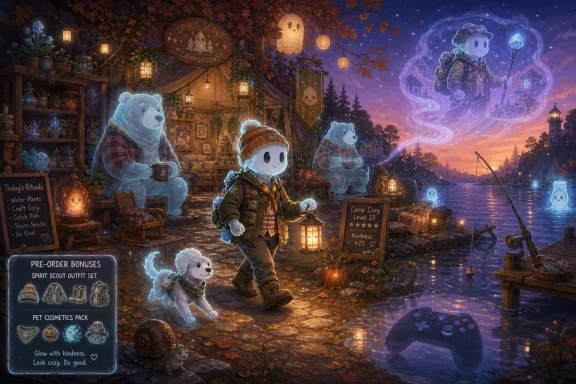
The pre-order bonus is modest but on-brand: exclusive costumes for the player and pets. That matters because Cozy Grove’s appeal is bound up in self-expression and habitation. Cosmetics here are not merely vanity items; they are part of the slow accumulation of a place that feels lived in.
Camp Spirit uses time not as a monetization pressure but as a pacing device. You show up, do what the island has for you, and then decide whether to keep fishing, crafting, decorating, gathering shells, skipping rocks, or tinkering with the campsite. The store description even frames this explicitly: if the day’s quests are finished, there are still low-pressure activities to continue. The game is not empty after the checklist; it just stops pretending that constant progression is the only reason to play.
That approach is closer to Animal Crossing than to most modern service games, but Cozy Grove’s tone is distinct. Its ghosts are not just cute quest dispensers. They are melancholy figures working through memory, loss, regret, and closure under a watercolor surface that keeps the mood from becoming oppressive. Camp Spirit’s thesis — “all those who are lost deserve kindness” — is not subtle, but subtlety is not the point. The game believes in care as a mechanic.
On Xbox, that pacing could be both a selling point and a hurdle. Console players who discover the game through pre-order marketing may expect a more conventional life-sim arc, with longer sessions and faster unlocks. Camp Spirit asks for a different contract: visit often, do a little, leave before the spell breaks. That is commercially risky, but artistically coherent.
Camp Spirit became one of the clearer expressions of that strategy. It was not a cynical tie-in to a Netflix show, nor was it a casino-adjacent mobile product dressed up as entertainment. It was a fully authored sequel to a known indie game, released inside Netflix’s ad-free, no-microtransaction mobile catalog. In theory, this was the model Netflix wanted people to notice.
The problem is that games do not behave like film and television libraries. A show can be meaningfully “on Netflix” because the television screen and mobile screen are both natural places to watch it. A game’s platform is part of its identity. Controls, save persistence, session length, input method, and community expectations all change how a game is understood.
Cozy Grove: Camp Spirit is a useful example because it can work on mobile, but it does not only belong there. Its daily structure maps well to phones, yet its decorating, atmosphere, and long-term collection also suit a couch-and-controller rhythm. A console release acknowledges that the audience for cozy games has never been limited to the device in your pocket.
That matters because the cozy genre is often misunderstood as escapism without design rigor. In reality, the best cozy games are highly tuned systems of friction reduction. They must give players goals without anxiety, surprise without punishment, and repetition without resentment. Camp Spirit’s island chores, merit badges, resource gathering, and character arcs all have to sit in that narrow emotional band.
The sequel also adds features that make sense for a broader platform audience. New animal companions, including a pettable dog and a helpful snail, deepen the game’s companion layer. Asynchronous multiplayer lets players see astral projections of others and exchange gifts through the mail without forcing real-time interaction. That is a particularly savvy feature for a cozy game, because it adds social presence without social pressure.
The Microsoft listing’s reassurance to introverts is unusually direct, but it gets at something important. Many games treat multiplayer as an escalation: more people, more urgency, more noise. Camp Spirit treats it as ambience. Other players can exist at the edge of your island life without demanding that you perform for them.
The original Cozy Grove’s Apple Arcade history already showed how this can feel to players. When games leave subscription catalogs, they do not merely rotate out like a film you meant to watch. They can take routines, saves, and personal spaces with them. For a life sim, that loss feels sharper because the player has spent weeks or months turning a system into a home.
A console store listing is not a guarantee of permanence, of course. Digital storefronts change, licenses expire, and servers eventually go dark. But a traditional Xbox release gives Camp Spirit another foothold outside the narrow channel of Netflix’s mobile app ecosystem. It makes the game easier to discuss as part of Spry Fox’s catalog, not just as part of Netflix’s subscription pitch.
That distinction matters for players who discovered the first Cozy Grove on console or PC. They are not simply asking for convenience when they want Camp Spirit on more platforms. They are asking for continuity — of controls, of collection habits, of where they keep their favorite small worlds.
The reward, exclusive costumes for players and pets, is harmless enough. It does not appear to alter the underlying economy or gate meaningful mechanics. But the structure still reflects the modern storefront’s default behavior: every release, even the quiet ones, must arrive with a call to secure something early.
That tension is not unique to Camp Spirit, but it is more visible here because the game’s values are so clear. Cozy Grove does not want to exploit impatience once you are playing; it wants you to come back tomorrow. The store wants you to act now. The result is not scandalous, just revealing.
For Xbox players, the sensible read is simple: pre-order if the cosmetic bundle matters to you or if you already know the series is your thing. Otherwise, the game’s design does not reward rushing. Camp Spirit’s entire premise is that care accumulates slowly.
That rise has created a new kind of competition. Platforms want cozy games because they broaden the audience and improve the emotional range of a catalog. A subscription service full only of prestige dramas, shooters, and roguelikes can feel intense; a service with a few gentle daily rituals feels more habitable. Cozy games are retention tools precisely because they are not always trying to dominate attention.
Netflix understood that, which is why Spry Fox made sense as an acquisition. Microsoft understands it too, which is why the Xbox store has steadily become friendlier to indies and lower-pressure genres. Nintendo, of course, has understood it for decades. The fight is not just for the biggest exclusive; it is for the game players open when they are tired, anxious, or between larger commitments.
Camp Spirit is not likely to become the loudest weapon in that fight. It is too modest, too soft-spoken, too committed to its own rhythms. But that modesty is why it is valuable. A platform’s identity is shaped as much by its quiet defaults as by its tentpoles.
Real-time multiplayer could easily break Cozy Grove’s mood. A friend sprinting through your island, optimizing tasks, or demanding voice chat would undermine the contemplative pace. Asynchronous gifting, by contrast, lets the game admit that comfort is often social while preserving the solitude that makes the series work.
This design also suits Xbox’s broader ecosystem. Console networks are built around presence: friends lists, activity feeds, achievements, messages, captures, and invitations. Camp Spirit does not need to reject that infrastructure, but it does need to domesticate it. Seeing another Spirit Scout as a gentle apparition is a much better fit than turning the island into a lobby.
The gift system also reinforces the game’s moral vocabulary. Cozy Grove is about helping the lost, restoring color, and making small gestures meaningful. Sending gifts through the mail is not just a feature; it is the multiplayer version of the game’s core ethic.
For Netflix, console availability could be read two ways. It may signal confidence that Camp Spirit can earn money beyond its subscription role, or it may suggest that exclusivity did not generate enough value to keep the game confined. Those explanations are not mutually exclusive. The longer a game’s life, the more pressure there is to meet players where they are.
For Microsoft, the calculus is easier. Xbox benefits from a wider store catalog, especially as the line between console, PC, and cloud keeps blurring. A cozy life sim with an established name, a distinctive art style, and a daily loop is exactly the kind of game that can fill gaps between bigger releases. It may not drive headlines, but it can drive habits.
For players, the practical impact is more immediate. Camp Spirit on Xbox means controller-first play, television-scale art, and a platform many Cozy Grove veterans already used for the original. It also means the game can sit alongside the rest of a player’s library rather than living behind a separate mobile subscription habit.
 Netflix’s Softest Exclusive Starts Looking Less Exclusive
When Cozy Grove: Camp Spirit arrived in 2024, its platform story was almost as interesting as its premise. Spry Fox had made its name on gentle, clever games such as Triple Town, Alphabear, Road Not Taken, and the first Cozy Grove, but by the time Camp Spirit shipped, the studio was operating inside Netflix’s gaming operation. That made the sequel a useful test case for Netflix’s ambitions: could a streaming company use beloved indie studios to build a games catalog that felt valuable enough to keep subscribers engaged?The answer was always complicated. Netflix Games had a clean consumer pitch — no ads, no in-app purchases, no extra fee beyond the subscription — but it also confined many titles to mobile devices, even when their design lineage came from PC and console. Cozy Grove was not born as a phone-first brand in the minds of many players. The original game became familiar across Switch, PC, Xbox, PlayStation, and Apple Arcade, which meant the sequel’s initial mobile focus felt less like a natural home and more like a strategic detour.
That is why the Xbox pre-order page matters. It suggests Camp Spirit is being repositioned from subscription perk to broader commercial product. The game’s heart may still be the same: helping ghostly bears remember themselves, decorating a haunted campsite, tending chores in daily real time. But the business around it is shifting from “available if you are already in this ecosystem” to “available where this audience already plays.”
There is a quiet irony here. Cozy Grove is built around patience, routine, and small acts of restoration, while the platforms around it are engaged in a much louder fight over exclusivity, storefront leverage, and subscription retention. Camp Spirit landing on Xbox does not settle that fight, but it does show how even the gentlest games can expose hard commercial realities.
The Store Page Sells Comfort, Not Content Volume
The Microsoft listing leans heavily on the language of emotional utility. This is a game for the end of a stressful day, a relaxing island oasis, a place where kindness rules. That might sound like marketing fluff, but it is also a precise description of the niche Cozy Grove occupies. It is not trying to be an infinite live-service machine or a competitive hobby with a ranked ladder; it is trying to be a daily ritual.The setup remains classic Cozy Grove: a Spirit Scout becomes stranded after a bus crash on a mysterious but adorable island, meets ghostly bear residents, and helps them recover memories and find peace. The player restores color and life by completing quests, crafting furniture, decorating spaces, gathering resources, cooking, fishing, catching bugs, and gradually expanding what the island allows them to see and do. It is a loop built less around mastery than return.
That design philosophy is unusually well-suited to Xbox in 2026, even if it does not look like the stereotypical Xbox release. Microsoft’s console audience is no longer defined only by shooters, racers, and sprawling RPGs. Game Pass, cloud saves, cross-device play habits, and the mainstreaming of indies have made the Xbox library broader and weirder than its old branding suggested. A game like Camp Spirit fits not because it resembles Halo or Forza, but because the Xbox ecosystem now has room for a half-hour decompression game.
The pre-order bonus is modest but on-brand: exclusive costumes for the player and pets. That matters because Cozy Grove’s appeal is bound up in self-expression and habitation. Cosmetics here are not merely vanity items; they are part of the slow accumulation of a place that feels lived in.
Real-Time Design Is the Feature and the Friction
Cozy Grove’s most divisive trait has always been its real-world clock. The game unfolds in sync with actual time, serving up daily quests and seasonal surprises rather than letting players binge through everything in a weekend. In an era when players often judge games by hours-per-dollar, that constraint can feel almost antagonistic. In practice, it is central to the series’ identity.Camp Spirit uses time not as a monetization pressure but as a pacing device. You show up, do what the island has for you, and then decide whether to keep fishing, crafting, decorating, gathering shells, skipping rocks, or tinkering with the campsite. The store description even frames this explicitly: if the day’s quests are finished, there are still low-pressure activities to continue. The game is not empty after the checklist; it just stops pretending that constant progression is the only reason to play.
That approach is closer to Animal Crossing than to most modern service games, but Cozy Grove’s tone is distinct. Its ghosts are not just cute quest dispensers. They are melancholy figures working through memory, loss, regret, and closure under a watercolor surface that keeps the mood from becoming oppressive. Camp Spirit’s thesis — “all those who are lost deserve kindness” — is not subtle, but subtlety is not the point. The game believes in care as a mechanic.
On Xbox, that pacing could be both a selling point and a hurdle. Console players who discover the game through pre-order marketing may expect a more conventional life-sim arc, with longer sessions and faster unlocks. Camp Spirit asks for a different contract: visit often, do a little, leave before the spell breaks. That is commercially risky, but artistically coherent.
Spry Fox’s Sequel Carries the Weight of a Platform Strategy
Spry Fox is not just another indie studio in this story. Netflix acquired the developer in 2022, during a period when the streamer was trying to prove that games could become a serious pillar of its subscription bundle. Buying a studio known for humane, approachable systems was a smart move. It gave Netflix credibility in a space where merely licensing recognizable names would not be enough.Camp Spirit became one of the clearer expressions of that strategy. It was not a cynical tie-in to a Netflix show, nor was it a casino-adjacent mobile product dressed up as entertainment. It was a fully authored sequel to a known indie game, released inside Netflix’s ad-free, no-microtransaction mobile catalog. In theory, this was the model Netflix wanted people to notice.
The problem is that games do not behave like film and television libraries. A show can be meaningfully “on Netflix” because the television screen and mobile screen are both natural places to watch it. A game’s platform is part of its identity. Controls, save persistence, session length, input method, and community expectations all change how a game is understood.
Cozy Grove: Camp Spirit is a useful example because it can work on mobile, but it does not only belong there. Its daily structure maps well to phones, yet its decorating, atmosphere, and long-term collection also suit a couch-and-controller rhythm. A console release acknowledges that the audience for cozy games has never been limited to the device in your pocket.
Xbox Gets Another Argument for the Living Room as a Quiet Space
The Xbox store has spent years absorbing the full range of indie life sims, farming games, narrative adventures, and meditative puzzlers that used to be treated as edge cases. Camp Spirit’s arrival belongs to that broader migration. The living room console is no longer just a site for high-performance spectacle; it is also a place for slow games that ask little and give back in texture.That matters because the cozy genre is often misunderstood as escapism without design rigor. In reality, the best cozy games are highly tuned systems of friction reduction. They must give players goals without anxiety, surprise without punishment, and repetition without resentment. Camp Spirit’s island chores, merit badges, resource gathering, and character arcs all have to sit in that narrow emotional band.
The sequel also adds features that make sense for a broader platform audience. New animal companions, including a pettable dog and a helpful snail, deepen the game’s companion layer. Asynchronous multiplayer lets players see astral projections of others and exchange gifts through the mail without forcing real-time interaction. That is a particularly savvy feature for a cozy game, because it adds social presence without social pressure.
The Microsoft listing’s reassurance to introverts is unusually direct, but it gets at something important. Many games treat multiplayer as an escalation: more people, more urgency, more noise. Camp Spirit treats it as ambience. Other players can exist at the edge of your island life without demanding that you perform for them.
The Xbox Release Also Reopens the Preservation Question
There is another, less sentimental reason to care about Camp Spirit leaving a mobile-only frame. Subscription games can be wonderful for discovery, but they raise awkward questions about access and preservation. If a game is tied too tightly to one subscription service, one app store policy, or one mobile account system, its future becomes fragile.The original Cozy Grove’s Apple Arcade history already showed how this can feel to players. When games leave subscription catalogs, they do not merely rotate out like a film you meant to watch. They can take routines, saves, and personal spaces with them. For a life sim, that loss feels sharper because the player has spent weeks or months turning a system into a home.
A console store listing is not a guarantee of permanence, of course. Digital storefronts change, licenses expire, and servers eventually go dark. But a traditional Xbox release gives Camp Spirit another foothold outside the narrow channel of Netflix’s mobile app ecosystem. It makes the game easier to discuss as part of Spry Fox’s catalog, not just as part of Netflix’s subscription pitch.
That distinction matters for players who discovered the first Cozy Grove on console or PC. They are not simply asking for convenience when they want Camp Spirit on more platforms. They are asking for continuity — of controls, of collection habits, of where they keep their favorite small worlds.
Pre-Order Culture Looks Strange in a Game Built Against Urgency
There is something almost funny about pre-ordering Cozy Grove: Camp Spirit. This is a game that explicitly asks players to slow down, accept daily limits, and treat progress as a ritual rather than a race. The pre-order apparatus, by contrast, belongs to an industry trained to manufacture urgency before release day.The reward, exclusive costumes for players and pets, is harmless enough. It does not appear to alter the underlying economy or gate meaningful mechanics. But the structure still reflects the modern storefront’s default behavior: every release, even the quiet ones, must arrive with a call to secure something early.
That tension is not unique to Camp Spirit, but it is more visible here because the game’s values are so clear. Cozy Grove does not want to exploit impatience once you are playing; it wants you to come back tomorrow. The store wants you to act now. The result is not scandalous, just revealing.
For Xbox players, the sensible read is simple: pre-order if the cosmetic bundle matters to you or if you already know the series is your thing. Otherwise, the game’s design does not reward rushing. Camp Spirit’s entire premise is that care accumulates slowly.
The Cozy Boom Has Become a Platform War by Other Means
Camp Spirit’s Xbox pre-order is part of a larger moment for cozy games. The genre has moved from niche comfort food to one of the industry’s most reliable counterweights against blockbuster fatigue. Farming sims, decorating games, town builders, creature collectors, shopkeeping RPGs, and low-pressure exploration games now occupy serious space in release calendars and showcases.That rise has created a new kind of competition. Platforms want cozy games because they broaden the audience and improve the emotional range of a catalog. A subscription service full only of prestige dramas, shooters, and roguelikes can feel intense; a service with a few gentle daily rituals feels more habitable. Cozy games are retention tools precisely because they are not always trying to dominate attention.
Netflix understood that, which is why Spry Fox made sense as an acquisition. Microsoft understands it too, which is why the Xbox store has steadily become friendlier to indies and lower-pressure genres. Nintendo, of course, has understood it for decades. The fight is not just for the biggest exclusive; it is for the game players open when they are tired, anxious, or between larger commitments.
Camp Spirit is not likely to become the loudest weapon in that fight. It is too modest, too soft-spoken, too committed to its own rhythms. But that modesty is why it is valuable. A platform’s identity is shaped as much by its quiet defaults as by its tentpoles.
The Sequel’s New Systems Nudge Cozy Grove Toward Community
The most consequential addition in Camp Spirit may be asynchronous multiplayer. The first Cozy Grove was largely solitary, even when it felt emotionally crowded by ghosts and memories. The sequel lets other players appear as astral projections and exchange gifts without requiring synchronized sessions. That is a careful compromise.Real-time multiplayer could easily break Cozy Grove’s mood. A friend sprinting through your island, optimizing tasks, or demanding voice chat would undermine the contemplative pace. Asynchronous gifting, by contrast, lets the game admit that comfort is often social while preserving the solitude that makes the series work.
This design also suits Xbox’s broader ecosystem. Console networks are built around presence: friends lists, activity feeds, achievements, messages, captures, and invitations. Camp Spirit does not need to reject that infrastructure, but it does need to domesticate it. Seeing another Spirit Scout as a gentle apparition is a much better fit than turning the island into a lobby.
The gift system also reinforces the game’s moral vocabulary. Cozy Grove is about helping the lost, restoring color, and making small gestures meaningful. Sending gifts through the mail is not just a feature; it is the multiplayer version of the game’s core ethic.
A Haunted Island Makes a Better Console Test Than It First Appears
At first glance, Cozy Grove: Camp Spirit might seem like a minor Xbox addition. It is a cozy sequel that already exists elsewhere, not a hardware showcase or a system seller. But platform strategy is increasingly decided in these middle spaces. The question is not only where the biggest games launch, but where smaller games can find durable audiences after their first exclusive window.For Netflix, console availability could be read two ways. It may signal confidence that Camp Spirit can earn money beyond its subscription role, or it may suggest that exclusivity did not generate enough value to keep the game confined. Those explanations are not mutually exclusive. The longer a game’s life, the more pressure there is to meet players where they are.
For Microsoft, the calculus is easier. Xbox benefits from a wider store catalog, especially as the line between console, PC, and cloud keeps blurring. A cozy life sim with an established name, a distinctive art style, and a daily loop is exactly the kind of game that can fill gaps between bigger releases. It may not drive headlines, but it can drive habits.
For players, the practical impact is more immediate. Camp Spirit on Xbox means controller-first play, television-scale art, and a platform many Cozy Grove veterans already used for the original. It also means the game can sit alongside the rest of a player’s library rather than living behind a separate mobile subscription habit.
The Campfire Lessons Xbox Players Should Take With Them
Camp Spirit’s Xbox pre-order is not a seismic announcement, but it is a revealing one. It tells us how a once-mobile-only Netflix sequel is being reframed, how cozy games now function inside platform catalogs, and how player expectations keep pushing games beyond the walls built around them.- Cozy Grove: Camp Spirit is a sequel to Spry Fox’s original Cozy Grove, built around daily quests, ghostly bear stories, campsite customization, crafting, gathering, and real-world time progression.
- The Xbox pre-order listing includes exclusive costumes for the player character and pets, which fits the series’ emphasis on personalization rather than power.
- The game’s asynchronous multiplayer is designed around low-pressure gifting and player presence, not real-time coordination or competitive play.
- Its move toward Xbox matters because Camp Spirit originally arrived as a Netflix Games mobile title, making console availability a meaningful expansion of access.
- The release gives Xbox another low-stress daily ritual game at a time when cozy titles have become strategically important to platform libraries.
- Players should expect a slow-burn life sim rather than a bingeable progression game, because Cozy Grove’s real-time pacing is central to its appeal.
References
- Primary source: Microsoft
Published: 2026-06-04T02:12:12.615924
Osta Cozy Grove: Camp Spirit Pre-order | Xbox
All those who are lost deserve kindness. Help cute, ghostly bears find peace in this relaxing sequel to the beloved life-sim game Cozy Grove, where kindness rules and new crafting, building, and camping island adventures await.www.microsoft.com - Related coverage: whats-on-netflix.com
'Cozy Grove: Camp Spirit' Opens Pre-Registration Ahead of June 2024 Launch on Netflix Games
The mobile game comes from Netflix's internal studio, Spry Fox.www.whats-on-netflix.com
- Related coverage: netflix.com
Cozy Grove: Camp Spirit Mobile for iOS and Android Everything to Know - Netflix Tudum
In Camp Spirit, a sequel to the original Cozy Grove, players embark on a quest of caring adventure on a haunted island.www.netflix.com
- Related coverage: pocketgamer.com
Cozy Grove: Camp Spirit is coming to mobile via Netflix Games | Pocket Gamer
Cozy Grove: Camp Spirit, the sequel to the original Cozy Grove, is coming to Netflix Games.www.pocketgamer.com
- Related coverage: cozygrove.fandom.com
Cozy Grove: Camp Spirit | Cozy Grove Wiki | Fandom
Cozy Grove: Camp Spirit is an indie life-sim game from Spry Fox about life on a haunted, ever-changing island and is a sequel to Cozy Grove. Cozy Grove: Camp Spirit is an indie life-sim game from Spry Fox about everyday life on a haunted, ever-changing island. As a spirit scout it’s your job to...cozygrove.fandom.com
- Official source: apps.apple.com
Cozy Grove: Camp Spirit App - App Store
Download Cozy Grove: Camp Spirit by Netflix, Inc. on the App Store. See screenshots, ratings and reviews, user tips, and more apps like Cozy Grove: Camp Spirit. apps.apple.com
- Related coverage: xbox.com
Buy Cozy Grove | Xbox
Welcome to Cozy Grove, a game about camping on a haunted, ever-changing island. As a Spirit Scout, you'll wander the island's forest each day, finding new hidden secrets and helping soothe the local ghosts. With a little time and a lot of crafting, you'll bring color and joy back...www.xbox.com - Related coverage: shacknews.com
Cozy Grove: Camp Spirit sets June release for Netflix subscribers | Shacknews
The sequel to Cozy Grove will be a mobile-only effort for Netflix members, at least for now.www.shacknews.com
