

Windows Central’s June 2026 showcase roundup highlights ten indie games announced or reintroduced around Summer Game Fest and the Xbox Games Showcase, including Grave Seasons, Moss: The Forgotten Relic, Bad Magpie, Momento, The Witch’s Bakery, Magicians: The Devil’s Deal, Cassette Beasts 2002, Deer and Boy, Cozy Grove: Camp Spirit, and Grim Trials. The list is framed as a wishlist, but it also says something more interesting about Xbox’s current indie posture. Microsoft’s platform pitch is no longer just “big games on Game Pass.” It is increasingly “small games everywhere you own the ecosystem.”
The problem with June showcase season is not that there are too few announcements. It is that there are too many announcements arranged for maximum spectacle, which means smaller games tend to become emotional punctuation between louder trailers for blockbusters, service games, and hardware-adjacent promises.
That is what makes this particular indie crop worth lingering over. On paper, it looks like the usual post-showcase assortment: cozy farming, monster collecting, roguelike combat, narrative platforming, and stylized adventure. In practice, the list shows how much indie design has become the place where Xbox can broaden its identity without waiting for another tentpole to land.
The games Windows Central picked are not united by genre. They are united by a specific kind of friction against mainstream production: they are personal, often strange, often compact, and usually built around one design hook that would be too risky or too small to carry a blockbuster budget. That is precisely why they matter.
Xbox spent years trying to convince players that it could compete on scale. These games argue that scale is not the only fight worth having.
This is where indie games have quietly become research and development for the rest of the industry. The big-budget business is often punished for novelty because novelty makes forecasts harder. The indie business, especially when supported by subscription deals and platform showcases, can survive by being legible in one sentence and surprising in the second.
That is why “cozy horror life sim” is more than a cute elevator pitch. It is a commercial strategy. Players instantly understand the cozy life-sim half, but the murder-mystery intrusion gives the game a reason to exist in a crowded genre.
Grave Seasons may be the cleanest example. It borrows the familiar loop of crops, mines, fishing, neighbors, and romance, then corrupts the village fantasy with a killer whose identity can change across playthroughs. That one twist changes the entire social contract of the genre. The romantic interest is no longer just a relationship track; they may be a suspect.
The same logic runs through Momento, which takes the post-Unpacking appetite for intimate environmental storytelling and shifts the emphasis from puzzle placement to consequence. It is not simply asking where an object belongs. It is asking what kind of life a player is building by choosing one object over another.
That is why Grave Seasons can put murder inside a life sim without breaking the fantasy. The farm still gives structure. The romance still gives attachment. The mystery gives the player a reason to look at the town with suspicion rather than simple affection.
The Witch’s Bakery makes a similar move in a softer register. Its Parisian bakery premise could have been pure comfort food: bake, sell, decorate, repeat. Instead, Lunne’s witchcraft turns customer service into emotional archaeology, with “heart palaces” that literalize the work of understanding other people’s pain.
Cozy Grove: Camp Spirit, meanwhile, sits at the older and more melancholic edge of cozy design. The original Cozy Grove was never merely cute. Its ghost-bear stories worked because the game understood that comfort and grief are not opposites; they are often experienced together, especially in games built around daily rituals.
That Camp Spirit is now coming more broadly to consoles and PC after its Netflix-mobile period also gives it a platform story. For Xbox players, the appeal is not just a new island and new spirits. It is the restoration of a game that had been functionally fenced off from much of the traditional console audience.
A strange game still has to be good. Subscription distribution does not magically solve discoverability, and Game Pass can be a crowded shelf in its own right. But it lowers the initial risk for players who might never spend full price on “one-winged magpie falls in love with a star” or “Victorian stage magician makes a deal with the Devil.”
That matters because several games in this list are high-concept in a way that thrives on curiosity. Bad Magpie, in particular, sounds like a spiritual cousin to the modern mischief-sandbox lineage: compact world, tactile interactions, environmental storytelling, no heavy dialogue, and the promise that the player’s job is to be a problem.
On a conventional storefront, that kind of game needs a sharp trailer, strong word of mouth, and luck. In Game Pass, it also gets a second chance through boredom, browsing, and social recommendation. The player who would not buy it might still try it for twenty minutes. For an indie game with a strong opening idea, twenty minutes can be enough.
The danger, of course, is that subscription economics can also flatten perception. When everything is “included,” a game’s value may become harder for players to perceive. Xbox’s challenge is not merely to acquire indie games, but to make them feel like events rather than filler between AAA releases.
For indies, that matters because many of these games fit irregular play patterns. A cozy sim may be perfect on a handheld PC at night. A narrative adventure may work better on a living-room display. A roguelike might become a lunch-break game on a Windows device and a longer-session game on console.
Microsoft has spent years telling players that Xbox exists across console, PC, cloud, and handheld-like devices. Indie games are often where that pitch feels least strained. They do not always need cutting-edge hardware, and their session structures frequently travel well.
That makes Play Anywhere more than a bullet point. It is a distribution philosophy that aligns with how many people actually play smaller games. If Xbox wants to be the platform where a game follows the player, these indies are the proof case.
Bringing Quill’s adventure to non-VR platforms is therefore more than a porting exercise. It is a recognition that some of VR’s best design work has been trapped behind adoption barriers the broader market never fully crossed. The headset made Moss special, but the headset also limited Moss.
A flatscreen version has to solve a delicate problem. It cannot simply pretend the original medium did not matter. Moss worked in part because the player’s presence had a storybook intimacy, like leaning into a diorama while guiding a tiny hero through a world that felt hand-placed.
If The Forgotten Relic can preserve that intimacy without the headset, it may become a model for how VR-native games can age into broader availability. The industry has a long history of platform exclusives finding second lives. VR exclusives now need that same path, not as a retreat from VR, but as an act of preservation.
For Xbox, the optics are useful. A game once admired from afar by console players becomes part of the library. That is an easy win, but also a reminder that platform strategy often comes down to removing one annoying barrier at a time.
Bad Magpie appears to be working in that tradition, but with a more melancholic center. The premise is not just chaos; it is loneliness, desire, and a fallen star. That emotional hinge is what can separate a gimmick from a game that lingers.
The lack of text, dialogue, and cutscenes is also notable. Wordless games force developers to be ruthless about animation, sound, affordance, and environmental staging. If players are meant to understand a story by stealing, burning, draining, poking, and exploring, then every interaction becomes narrative grammar.
That is harder than it sounds. Many games use dialogue as scaffolding for weak world design. A game like Bad Magpie cannot hide that way. It has to make mischief readable.
The first Cassette Beasts stood out because it treated media technology as a combat and identity system. You did not simply capture monsters; you recorded them. That is a small language shift with big aesthetic consequences, turning creature collection into an act of playback, remixing, and fusion.
The sequel’s promise of more than 57,000 fully animated fusion forms is the kind of number that sounds absurd until you remember why it matters. Monster-collecting games live or die on attachment and possibility. Fusion systems create the sense that the player is not just building a roster, but discovering a grammar.
The danger for Cassette Beasts 2002 is abundance. A huge possibility space can become noise if the choices do not feel meaningful. But Bytten Studio has already shown it understands that the appeal of its world is not just quantity; it is tone, music, companions, and the strange melancholy of obsolete technology made magical.
In a showcase season dominated by known brands, Cassette Beasts 2002 is a reminder that nostalgia works best when it is not merely decorative. The cassette is not just a prop. It is the verb.
That distinction matters. Plenty of games use magic as colored projectiles. Far fewer build magic around deception, misdirection, props, spectacle, and theatrical power. If Uppercut Games can make the player feel like an illusionist rather than a wizard with a gun, the game has room to stand apart in a crowded first-person field.
The studio history is also intriguing. Uppercut’s Submerged games were known for exploration, atmosphere, and non-combat storytelling. Magicians looks more aggressive, but that background may be exactly what gives it a chance. A first-person action game from a team that thinks about place and pacing differently may avoid some of the genre’s more numbing habits.
Its 2027 window means expectations should remain measured. Showcase trailers are promises, not evidence. Still, the Xbox Game Pass commitment gives the game room to become a curiosity-driven success if its systems are as theatrical as its premise.
The most interesting version of Magicians is not a shooter wearing a top hat. It is a game where every fight feels like a performance and every new power feels stolen from a rival act.
The modern release calendar often treats length as value. Players are trained to ask how many hours a game provides, how many systems it includes, how many endgame loops it can sustain. But some of the most memorable games are built around a complete emotional arc that knows when to leave.
A boy and a deer moving through a cinematic platforming adventure is not a novel premise by itself. The promise is in the changing relationship: the fawn becomes a deer, and that growth changes how the player navigates the world. Good companion design makes attachment mechanical, not just sentimental.
Wordless storytelling is also doing double duty here. It makes the game more broadly accessible across ages and languages, while inviting older players to read metaphor into what younger players may experience as a straightforward bond. That layered readability is difficult to achieve, but when it works, it gives a small game unusual reach.
In a showcase environment obsessed with future roadmaps, a short game arriving soon can feel almost radical. Not every game needs to become a hobby. Some just need to land cleanly.
The premise follows Avelin, a young woman recruited into Death’s service and forced to confront her own death while hunting impure souls. That gives the game a useful emotional engine. Roguelikes need repetition, and repetition becomes stronger when each run feels tied to unresolved identity rather than mere progression.
The crafting and customization elements are important because they suggest the game is not relying only on reflex combat. Weapons, armor, consumables, blessings, and boss structure can give players a sense of authorship over each run. The trick is keeping that authorship legible rather than burying players in marginal upgrades.
Grim Trials also reflects a broader indie truth: genres do not belong to one tone anymore. Cozy games can include murder. Roguelikes can carry coming-of-age drama. Monster collectors can be nostalgic media fantasies. The old store categories still exist, but the design energy is in the borders.
That border-crossing is what makes this list feel more coherent than it first appears.
That does not guarantee success. Indie games can still disappear under the weight of a crowded subscription catalog, weak marketing, or poor timing. But the strongest games here have hooks that are easy to explain and hard to confuse with anything else.
The healthiest version of Xbox’s future is not one where every showcase is judged solely by the biggest franchise on screen. It is one where a player can come for Fable, Gears, or Call of Duty, then stay because the library keeps producing smaller surprises with enough personality to survive the noise. If June’s indie slate is any indication, the next phase of Xbox’s identity may be built less from a single blockbuster comeback than from dozens of odd, portable, emotionally specific games that make the ecosystem feel worth opening again tomorrow.
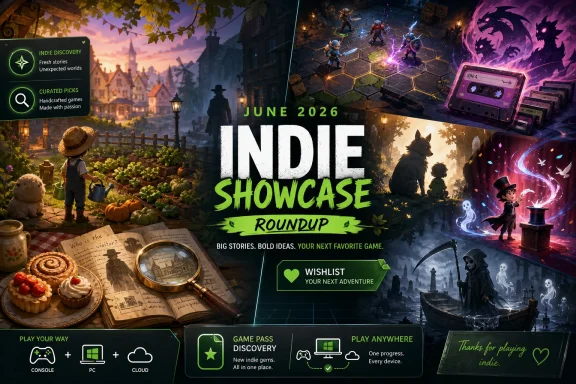 Xbox’s Loudest Week Still Needed Its Quiet Games
The problem with June showcase season is not that there are too few announcements. It is that there are too many announcements arranged for maximum spectacle, which means smaller games tend to become emotional punctuation between louder trailers for blockbusters, service games, and hardware-adjacent promises.That is what makes this particular indie crop worth lingering over. On paper, it looks like the usual post-showcase assortment: cozy farming, monster collecting, roguelike combat, narrative platforming, and stylized adventure. In practice, the list shows how much indie design has become the place where Xbox can broaden its identity without waiting for another tentpole to land.
The games Windows Central picked are not united by genre. They are united by a specific kind of friction against mainstream production: they are personal, often strange, often compact, and usually built around one design hook that would be too risky or too small to carry a blockbuster budget. That is precisely why they matter.
Xbox spent years trying to convince players that it could compete on scale. These games argue that scale is not the only fight worth having.
The Indie Showcase Has Become Xbox’s Emotional R&D Lab
The most revealing through line in the roundup is how many of the games lean into hybridization. Grave Seasons is not content to be a farming sim; it has to be a murder mystery. The Witch’s Bakery is not just a shop-management game; it folds emotional repair into magical pastry-making. Cassette Beasts 2002 is not just monster collecting; it doubles down on retro media, online play, companion relationships, and fusion systems.This is where indie games have quietly become research and development for the rest of the industry. The big-budget business is often punished for novelty because novelty makes forecasts harder. The indie business, especially when supported by subscription deals and platform showcases, can survive by being legible in one sentence and surprising in the second.
That is why “cozy horror life sim” is more than a cute elevator pitch. It is a commercial strategy. Players instantly understand the cozy life-sim half, but the murder-mystery intrusion gives the game a reason to exist in a crowded genre.
Grave Seasons may be the cleanest example. It borrows the familiar loop of crops, mines, fishing, neighbors, and romance, then corrupts the village fantasy with a killer whose identity can change across playthroughs. That one twist changes the entire social contract of the genre. The romantic interest is no longer just a relationship track; they may be a suspect.
The same logic runs through Momento, which takes the post-Unpacking appetite for intimate environmental storytelling and shifts the emphasis from puzzle placement to consequence. It is not simply asking where an object belongs. It is asking what kind of life a player is building by choosing one object over another.
Cozy Games Have Learned to Bare Their Teeth
The word “cozy” has been stretched thin enough to cover almost anything with pastel colors, gardening, or a low-stress loop. But this roundup suggests the genre is mutating. Cozy no longer means conflict-free. It increasingly means conflict that is approachable, emotionally readable, and wrapped in systems that invite routine.That is why Grave Seasons can put murder inside a life sim without breaking the fantasy. The farm still gives structure. The romance still gives attachment. The mystery gives the player a reason to look at the town with suspicion rather than simple affection.
The Witch’s Bakery makes a similar move in a softer register. Its Parisian bakery premise could have been pure comfort food: bake, sell, decorate, repeat. Instead, Lunne’s witchcraft turns customer service into emotional archaeology, with “heart palaces” that literalize the work of understanding other people’s pain.
Cozy Grove: Camp Spirit, meanwhile, sits at the older and more melancholic edge of cozy design. The original Cozy Grove was never merely cute. Its ghost-bear stories worked because the game understood that comfort and grief are not opposites; they are often experienced together, especially in games built around daily rituals.
That Camp Spirit is now coming more broadly to consoles and PC after its Netflix-mobile period also gives it a platform story. For Xbox players, the appeal is not just a new island and new spirits. It is the restoration of a game that had been functionally fenced off from much of the traditional console audience.
Game Pass Is Doing More Than Filling a Calendar
It is easy to reduce the Xbox angle to Game Pass availability, because that is the most visible commercial hook. Grave Seasons, Bad Magpie, and Magicians: The Devil’s Deal all benefit from the promise of day-one subscription access. But the deeper story is that Game Pass changes what kind of indie game can plausibly find an audience on Xbox.A strange game still has to be good. Subscription distribution does not magically solve discoverability, and Game Pass can be a crowded shelf in its own right. But it lowers the initial risk for players who might never spend full price on “one-winged magpie falls in love with a star” or “Victorian stage magician makes a deal with the Devil.”
That matters because several games in this list are high-concept in a way that thrives on curiosity. Bad Magpie, in particular, sounds like a spiritual cousin to the modern mischief-sandbox lineage: compact world, tactile interactions, environmental storytelling, no heavy dialogue, and the promise that the player’s job is to be a problem.
On a conventional storefront, that kind of game needs a sharp trailer, strong word of mouth, and luck. In Game Pass, it also gets a second chance through boredom, browsing, and social recommendation. The player who would not buy it might still try it for twenty minutes. For an indie game with a strong opening idea, twenty minutes can be enough.
The danger, of course, is that subscription economics can also flatten perception. When everything is “included,” a game’s value may become harder for players to perceive. Xbox’s challenge is not merely to acquire indie games, but to make them feel like events rather than filler between AAA releases.
Play Anywhere Is Quietly Becoming the Indie Feature That Matters
The roundup repeatedly notes Xbox Play Anywhere support, and that detail deserves more attention than it usually gets. For enthusiasts and IT-minded readers, Play Anywhere is one of Microsoft’s more coherent platform ideas: buy or access a game once, move between console and Windows PC, and preserve the sense that Xbox is an account and library rather than a plastic box under the TV.For indies, that matters because many of these games fit irregular play patterns. A cozy sim may be perfect on a handheld PC at night. A narrative adventure may work better on a living-room display. A roguelike might become a lunch-break game on a Windows device and a longer-session game on console.
Microsoft has spent years telling players that Xbox exists across console, PC, cloud, and handheld-like devices. Indie games are often where that pitch feels least strained. They do not always need cutting-edge hardware, and their session structures frequently travel well.
That makes Play Anywhere more than a bullet point. It is a distribution philosophy that aligns with how many people actually play smaller games. If Xbox wants to be the platform where a game follows the player, these indies are the proof case.
Moss Escaping VR Is a Small Industry Correction
Moss: The Forgotten Relic is one of the most interesting entries because it is not a simple new reveal. It is a migration. The original Moss and Moss: Book II built a devoted reputation in VR, but VR exclusivity has always carried a cruel trade-off: it can make a game more magical for the people who have the hardware while making it invisible to everyone else.Bringing Quill’s adventure to non-VR platforms is therefore more than a porting exercise. It is a recognition that some of VR’s best design work has been trapped behind adoption barriers the broader market never fully crossed. The headset made Moss special, but the headset also limited Moss.
A flatscreen version has to solve a delicate problem. It cannot simply pretend the original medium did not matter. Moss worked in part because the player’s presence had a storybook intimacy, like leaning into a diorama while guiding a tiny hero through a world that felt hand-placed.
If The Forgotten Relic can preserve that intimacy without the headset, it may become a model for how VR-native games can age into broader availability. The industry has a long history of platform exclusives finding second lives. VR exclusives now need that same path, not as a retreat from VR, but as an act of preservation.
For Xbox, the optics are useful. A game once admired from afar by console players becomes part of the library. That is an easy win, but also a reminder that platform strategy often comes down to removing one annoying barrier at a time.
Bad Magpie Understands That Mischief Is a Design Language
Bad Magpie may be the oddest pitch in the group, and that is its strength. A grounded, one-winged bird causing chaos for shiny objects sounds unserious until you remember how many beloved games are built from similar acts of permission. Untitled Goose Game was not great because geese are inherently funny. It was great because every system served the fantasy of being a small menace in a world that took itself just seriously enough.Bad Magpie appears to be working in that tradition, but with a more melancholic center. The premise is not just chaos; it is loneliness, desire, and a fallen star. That emotional hinge is what can separate a gimmick from a game that lingers.
The lack of text, dialogue, and cutscenes is also notable. Wordless games force developers to be ruthless about animation, sound, affordance, and environmental staging. If players are meant to understand a story by stealing, burning, draining, poking, and exploring, then every interaction becomes narrative grammar.
That is harder than it sounds. Many games use dialogue as scaffolding for weak world design. A game like Bad Magpie cannot hide that way. It has to make mischief readable.
Cassette Beasts 2002 Bets Nostalgia Still Has Mechanical Value
Cassette Beasts 2002 is the most obviously sequel-shaped game in the list, but it is not merely trading on affection for the 2023 original. Its title points to a specific era, and that specificity matters. “Retro” is often a vague texture; “2002 London through cassette-tape monster transformation” is a more deliberate cultural object.The first Cassette Beasts stood out because it treated media technology as a combat and identity system. You did not simply capture monsters; you recorded them. That is a small language shift with big aesthetic consequences, turning creature collection into an act of playback, remixing, and fusion.
The sequel’s promise of more than 57,000 fully animated fusion forms is the kind of number that sounds absurd until you remember why it matters. Monster-collecting games live or die on attachment and possibility. Fusion systems create the sense that the player is not just building a roster, but discovering a grammar.
The danger for Cassette Beasts 2002 is abundance. A huge possibility space can become noise if the choices do not feel meaningful. But Bytten Studio has already shown it understands that the appeal of its world is not just quantity; it is tone, music, companions, and the strange melancholy of obsolete technology made magical.
In a showcase season dominated by known brands, Cassette Beasts 2002 is a reminder that nostalgia works best when it is not merely decorative. The cassette is not just a prop. It is the verb.
Magicians Turns the Shooter Into a Stage Act
Magicians: The Devil’s Deal is the list’s sharpest departure from cozy and contemplative territory. A narrative-driven first-person game about a stage magician in a hellish Theatreland could easily collapse into style without substance. But the premise has a strong mechanical promise: stage magic as combat language.That distinction matters. Plenty of games use magic as colored projectiles. Far fewer build magic around deception, misdirection, props, spectacle, and theatrical power. If Uppercut Games can make the player feel like an illusionist rather than a wizard with a gun, the game has room to stand apart in a crowded first-person field.
The studio history is also intriguing. Uppercut’s Submerged games were known for exploration, atmosphere, and non-combat storytelling. Magicians looks more aggressive, but that background may be exactly what gives it a chance. A first-person action game from a team that thinks about place and pacing differently may avoid some of the genre’s more numbing habits.
Its 2027 window means expectations should remain measured. Showcase trailers are promises, not evidence. Still, the Xbox Game Pass commitment gives the game room to become a curiosity-driven success if its systems are as theatrical as its premise.
The most interesting version of Magicians is not a shooter wearing a top hat. It is a game where every fight feels like a performance and every new power feels stolen from a rival act.
Deer and Boy Shows the Value of Small, Finished Things
Deer and Boy occupies a different space from the louder indies on the list. It is described as short, accessible, family-suitable, and wordless, with a companion animal that grows over the course of the journey. That may sound modest, but modesty can be a strength in a market stuffed with infinite games.The modern release calendar often treats length as value. Players are trained to ask how many hours a game provides, how many systems it includes, how many endgame loops it can sustain. But some of the most memorable games are built around a complete emotional arc that knows when to leave.
A boy and a deer moving through a cinematic platforming adventure is not a novel premise by itself. The promise is in the changing relationship: the fawn becomes a deer, and that growth changes how the player navigates the world. Good companion design makes attachment mechanical, not just sentimental.
Wordless storytelling is also doing double duty here. It makes the game more broadly accessible across ages and languages, while inviting older players to read metaphor into what younger players may experience as a straightforward bond. That layered readability is difficult to achieve, but when it works, it gives a small game unusual reach.
In a showcase environment obsessed with future roadmaps, a short game arriving soon can feel almost radical. Not every game needs to become a hobby. Some just need to land cleanly.
Grim Trials Brings the Afterlife Back to Work
Grim Trials closes the roundup on a harder edge: reapers, heavy metal, hex-grid arenas, bosses, crafting, and roguelike action. It is also the entry most visibly walking in the shadow of Hades and Hades II, which is both a blessing and a burden. The market now understands how stylish afterlife action can work. It also has a very high benchmark.The premise follows Avelin, a young woman recruited into Death’s service and forced to confront her own death while hunting impure souls. That gives the game a useful emotional engine. Roguelikes need repetition, and repetition becomes stronger when each run feels tied to unresolved identity rather than mere progression.
The crafting and customization elements are important because they suggest the game is not relying only on reflex combat. Weapons, armor, consumables, blessings, and boss structure can give players a sense of authorship over each run. The trick is keeping that authorship legible rather than burying players in marginal upgrades.
Grim Trials also reflects a broader indie truth: genres do not belong to one tone anymore. Cozy games can include murder. Roguelikes can carry coming-of-age drama. Monster collectors can be nostalgic media fantasies. The old store categories still exist, but the design energy is in the borders.
That border-crossing is what makes this list feel more coherent than it first appears.
The Ten-Game Wishlist Is Really a Map of Xbox’s Next Indie Argument
The practical appeal of the roundup is obvious: Xbox players get a set of names to wishlist, demo, or watch. But the broader pattern is more useful than any one recommendation. These games show Xbox leaning into indies that support its ecosystem strategy: Game Pass discovery, Play Anywhere flexibility, PC parity, and console visibility.That does not guarantee success. Indie games can still disappear under the weight of a crowded subscription catalog, weak marketing, or poor timing. But the strongest games here have hooks that are easy to explain and hard to confuse with anything else.
- Grave Seasons turns the cozy life sim into a social deduction engine by making the village’s warmth coexist with a changing murder mystery.
- Moss: The Forgotten Relic gives a celebrated VR series a wider future by removing the headset requirement for console and PC players.
- Bad Magpie uses mischief, wordless storytelling, and tactile sandbox design to make a small protagonist feel mechanically expressive.
- Cassette Beasts 2002 treats nostalgia as a system, not a skin, by tying retro media to transformation, companionship, and fusion.
- Cozy Grove: Camp Spirit’s broader console and PC release shows how platform access can change the fate of a game previously constrained by mobile exclusivity.
- Magicians: The Devil’s Deal and Grim Trials suggest Xbox’s indie slate still has room for sharper action alongside its cozy and narrative experiments.
The healthiest version of Xbox’s future is not one where every showcase is judged solely by the biggest franchise on screen. It is one where a player can come for Fable, Gears, or Call of Duty, then stay because the library keeps producing smaller surprises with enough personality to survive the noise. If June’s indie slate is any indication, the next phase of Xbox’s identity may be built less from a single blockbuster comeback than from dozens of odd, portable, emotionally specific games that make the ecosystem feel worth opening again tomorrow.
References
- Primary source: Windows Central
Published: 2026-06-24T09:20:08.400078
10 indie games from Summer Game Fest and the Xbox Games Showcase that I immediately added to my wishlist | Windows Central
There were a lot of good ones to choose from, but I managed to narrow my most anticipated indie game announcements down to these ten.www.windowscentral.com - Related coverage: gamesradar.com
Upcoming Xbox Series X games for 2026 and beyond | GamesRadar+
Here are all of the upcoming Xbox Series X games landing in 2026 and beyond, from Fable to Assassin's Creed Black Flag Resyncedwww.gamesradar.com - Related coverage: gematsu.com
- Related coverage: xbox.com
Play Day One with XBOX Game Pass | XBOX
Play new PC and console games the same day they release with XBOX Game Pass Ultimate and PC Game Pass.www.xbox.com - Related coverage: shacknews.com
Netflix Games sells Cozy Grove developer Spry Fox back to its founders | Shacknews
Co-founders David Edery and Daniel Cook are retaking ownership of Spry Fox as the studio continues work on its upcoming Spirit Crossing game.www.shacknews.com - Related coverage: moss.game
Moss: The Forgotten Relic
Moss: The Forgotten Relic is an emotional and atmospheric puzzle-adventure set within a living storybook, where a tiny hero and a watchful spirit must work together to overcome challenges far greater than either alone.www.moss.game
- Related coverage: pixelsinorbit.com
- Related coverage: news.xbox.com
XBOX Games Showcase 2026 Recap: The Return of Exclusives, World Premieres, and Anniversary Hardware - XBOX Wire
XBOX Game Showcase 2026 just concluded. Find out everything announced - from the return of exclusives, to anniversary hardware, to games from XBOX and our partners – inside.news.xbox.com - Related coverage: gamespot.com
Moss: The Forgotten Relic - GameSpot
 www.gamespot.com
- Related coverage: whats-on-netflix.com
Netflix Loses Game Studio Studio SpryFox But Still Plans To Support 'Spirit Crossing'
Spry Fox is no longer one of Netflix's internal studios.www.whats-on-netflix.com
- Related coverage: pcgamer.com
Netflix sells the studio behind Cozy Grove back to its original owners, freeing the studio to bring its mobile life sim to other platforms | PC Gamer
Spry Fox is an indie once again.www.pcgamer.com - Related coverage: techradar.com
One of my all-time favourite JRPGs has been announced for the Xbox Game Pass lineup for June ahead of the Xbox Games Showcase | TechRadar
Microsoft has announced the Xbox Game Pass lineup for the first half of June ahead of the 2026 Xbox Games Showcase.www.techradar.com - Related coverage: ashgabattimes.com
- Related coverage: factorportalprod.blob.core.windows.net
{[9TFNS]} ALL XBOX GAME PASS GAMES EVERYTHING CURRENTLY AVAILABLE {[9TFNS]}
SEO Optimized PDFfactorportalprod.blob.core.windows.net
