

Dragon Loop arrived on the Xbox store on June 11, 2026, as a $14.99 open-world Metroidvania from Happy Player, playable across Xbox One, Xbox Series X|S, PC, and handhelds through Xbox Play Anywhere. The storefront pitch is familiar in genre terms but unusually specific in structure: a hand-drawn world, a five-day loop, and a heroine named Xi trying to reconstruct both a map and a missing memory. For Xbox players, the more interesting story is not that another indie Metroidvania has appeared on the store. It is that Dragon Loop represents the kind of smaller, systems-driven game Xbox’s ecosystem is now unusually well positioned to amplify—if the store can help people find it.
The Xbox listing for Dragon Loop does not read like a blockbuster launch. There is no platform-holder fanfare, no Game Pass headline, no giant marketing beat designed to dominate a showcase. It is a compact store page for a compactly priced game, one that asks players to care about structure rather than spectacle.
That makes it more revealing than it first appears. The modern Xbox store is crowded with service games, legacy franchises, discounted bundles, licensed curiosities, and a steady flow of small releases that can vanish almost instantly beneath the weekly churn. A game like Dragon Loop lives or dies not simply by whether it is good, but by whether the storefront can communicate what makes it distinct before the player scrolls away.
The hook here is strong enough to deserve that chance. Dragon Loop is not just another side-scrolling adventure with ability gates and boss fights. It tries to bolt the logic of a time-loop game onto the muscle memory of a Metroidvania, then reassure players that this is not a roguelike wearing a prettier jacket.
That reassurance matters. “Time loop” has become one of those phrases that can attract and repel in equal measure. To some players it promises elegant systemic design; to others it sounds like repetition, lost progress, and a game that will punish them for taking a wrong turn. Dragon Loop’s Xbox page tries to split the difference: time is limited, routes matter, but you are not starting from scratch.
That is an ambitious move for a Metroidvania because the genre already depends on controlled frustration. The player sees a ledge they cannot reach, a door they cannot open, a path that obviously means something later. Add time to that formula and the designer gains a powerful extra variable: not only what ability the player has, but when they arrive.
The danger is that this can become busywork if handled poorly. A five-day structure can either make the world feel alive or make it feel like an appointment book. The difference lies in whether time opens interesting decisions or merely forces players to repeat travel until the correct window appears.
Dragon Loop’s store description suggests that the developers understand the trap. The Time Map is described as easy to navigate, and the listing emphasizes branching worldlines rather than permadeath resets. That wording is doing a lot of work. It frames the loop less as punishment and more as route planning, closer to a strategic layer laid over exploration than a hard reset machine.
For Xbox players browsing casually, that distinction should be front and center. This is not a game selling infinite replay through randomization. It is selling authored exploration through controlled repetition.
That pressure is healthy, but it is also unforgiving. A small game cannot rely on the genre label alone. It needs a point of view.
Dragon Loop’s point of view is that time itself can be the missing ability. The Xbox description still includes expected genre furniture—bosses, movement powers, upgrades, exploration, fast combat—but the calendar is what gives those elements shape. If the loop is more than a gimmick, then Dragon Loop’s map is not simply a geography problem. It is a schedule.
That design idea has lineage. Time-loop games have taught players to read worlds as repeating systems, while Metroidvanias have taught them to read spaces as layered promises. Dragon Loop’s pitch is to combine those forms without turning the result into a roguelike. That last part is important because it tells players what kind of patience the game expects.
It does not ask for the patience of rebuilding a character from zero. It asks for the patience of learning a world well enough to bend it.
Metroidvanias are at their best when every system points back toward exploration. A boss should not just be a wall that tests whether the player has learned the dodge timing. It should change how the player thinks about the world after the fight ends.
Summonable spirits can do that if they are integrated well. Explosive spirits sound like burst tools for damage or tactical openings, while persistent companions suggest a more continuous layer of support. The promise that they can be upgraded and evolved adds a light role-playing spine without necessarily turning the game into a loot treadmill.
This also gives Dragon Loop a useful identity on Xbox. Plenty of indie Metroidvanias offer new weapons or traversal skills after major encounters. Fewer make the boss itself part of the player’s toolkit. In a store environment where screenshots and short descriptions carry enormous weight, that is the kind of concrete mechanic that can separate a game from the pile.
A double jump is useful because it changes the verb set. A dash changes movement, combat, and risk. A grappling hook changes not only where the player can go, but how they read the screen.
Dragon Loop’s storefront pitch leans into multipurpose tools, promising that powers matter in both combat and traversal. That is exactly where the genre tends to shine. A tool that exists only to open one type of door is inventory clutter. A tool that changes how the player fights, moves, and solves environmental problems becomes part of the game’s language.
The examples also signal a lighter tonal register than the “lost memories in a mysterious loop” premise might imply. Spiky pufferfish and whale spirits do not sound like dour prestige-game iconography. They sound like a developer team willing to make utility strange, and in a genre saturated with grim cathedrals and ruined kingdoms, strangeness is an asset.
This is where Xbox’s ecosystem can still make a compelling argument even when the individual release is not exclusive. A player may start on a Series X, continue on a Windows handheld, and clean up routes on a laptop without treating each device as a separate purchase. For a game about learning a world through iteration, the ability to pick up the same save across contexts is not just convenient. It fits the rhythm of the design.
The handheld mention is especially notable in 2026, because Windows-based portable gaming has become a real, if still messy, part of the PC ecosystem. A 2D action-adventure with a manageable price and cloud-save continuity is exactly the kind of game that benefits from that shift. It does not need to be a technical showcase to become a good portable companion.
Smart Delivery also reduces friction on the console side. Players do not have to parse which version belongs on which Xbox generation. In theory, they buy the game once and let Microsoft’s infrastructure handle the versioning. For a small release, removing even small points of hesitation can matter.
Localization is not the same as cultural reach, of course. A translated store page does not guarantee localized in-game text, strong regional marketing, or community support. The Xbox page lists nine supported languages, which is useful, but the store itself still has to do the work of making a game legible to different audiences.
Still, the presence of Arabic storefront copy matters in a practical sense. It lowers the first barrier to understanding the premise. For a systems-heavy game, that first explanation is not trivial. If the player cannot quickly grasp that this is a time-loop Metroidvania rather than a roguelike reset grinder, the sale may be lost before the trailer finishes loading.
The broader lesson is that storefront language has become part of game design’s public face. A clever system that is explained poorly might as well not exist for most buyers. Dragon Loop’s page has a fairly clear pitch, even if it still leans on genre shorthand that only some players will parse.
This is one of the side effects of genre language becoming marketing language. “Loop” can mean a narrative cycle, a mechanical reset, a run-based structure, or simply a repeated gameplay rhythm. Without clarification, players fill in the blanks with whatever has annoyed them most recently.
Dragon Loop needs players to understand that its loop is closer to knowledge accumulation and route branching than disposable runs. That is a very different psychological contract. In a roguelike, death and reset are often the engine of mastery. In a time-loop adventure, repetition is ideally the path to revelation.
The distinction matters for accessibility as well. Not accessibility in the narrow settings-menu sense, but accessibility of commitment. Some players avoid roguelikes because they dislike losing progress or replaying early sections under pressure. Dragon Loop’s store copy makes a direct appeal to those players: the clock is real, but your effort is not erased.
Those are different jobs. The first is transaction processing. The second is editorial discovery.
Microsoft has spent years improving the platform mechanics around ownership, compatibility, and cross-device continuity. Those investments are visible in Dragon Loop’s feature set. Smart Delivery, cloud saves, and Xbox Play Anywhere are not glamorous bullet points, but they make the purchase cleaner.
Discovery remains harder. A game like Dragon Loop benefits from being searchable by genre, price, platform support, and release date, but those filters do not explain taste. They do not tell a Hollow Knight fan whether the time-loop structure is exciting or exhausting. They do not tell a roguelike-averse player whether “five days” means stress or strategy.
That is where editorial context matters, whether it comes from platform curation, community discussion, critic coverage, or user reviews. Store pages can describe mechanics. Communities explain whether those mechanics actually cohere.
That price matters because it frames expectations. Low enough to invite experimentation, high enough to imply a complete authored experience. For a niche Metroidvania with a time-loop system, that may be the right lane.
The store page also lists an Everyone 10+ rating with fantasy violence and mild blood, suggesting that the game is not aiming for the grim-dark edge that sometimes dominates action-platformers. Combined with the hand-drawn world and creature-based powers, Dragon Loop appears to be positioning itself as accessible in tone while still offering mechanical density.
That combination can be powerful. Some of the best genre games hide complexity under inviting art. The trick is to avoid confusing approachable presentation with shallow design. Dragon Loop’s success will depend on whether its loop, map, and combat systems reward the player long after the premise has been understood.
It has to track not just where things are, but when they matter. It has to help players distinguish between a path blocked by ability, a path blocked by timing, and a path blocked by ignorance. If Dragon Loop’s Time Map succeeds, it could turn a potentially confusing structure into the game’s signature pleasure.
If it fails, the whole design risks becoming opaque. A time-loop system can quickly overwhelm players if the interface does not reduce cognitive load. The player should feel clever for planning a route, not punished for forgetting which event belonged to Day 3.
This is why the “easy to navigate” claim is so central. It is not a minor quality-of-life promise. It is a statement about whether the game understands the burden its own premise places on the player.
That shift matters most for games that do not require fixed-session spectacle. A five-day loop structure could fit naturally into shorter play sessions, provided the game’s checkpoints and route planning are forgiving enough. A player might explore a path during lunch on a handheld, then tackle a boss later on a console.
This is not the old console-war version of value. It is quieter and more infrastructural. Xbox’s advantage, when it works, is that the player does not have to think too much about where a game lives.
For Dragon Loop, that means the platform features may be more important than any single marketing beat. The game’s world repeats; the player’s access does not have to.
The mechanics are more memorable than the title. Bosses becoming spirits, a five-day map, pufferfish and whale tools, X-Rating combat speed boosts—these are the details that stick. They are also the details that a platform storefront must surface quickly if the game is going to find the right audience.
The “X-Rating” phrase is especially risky in English-language marketing because it carries unrelated cultural baggage outside the game’s mechanics. In context, it appears to be a combat-performance system that boosts speed and power. Out of context, it may confuse more than it clarifies.
None of this is fatal. Plenty of excellent indie games have names that only become meaningful after players fall in love with them. But Dragon Loop’s store page has to work harder because the title alone does not do the whole job.
That second opening is valuable. Indie games often launch into a burst of attention and then rely on ports, updates, discounts, and community recommendations to build a longer tail. A console release can act less like a late arrival and more like a relaunch.
The simultaneous presence across Xbox console and PC also softens the divide between those audiences. For developers, that can mean a wider addressable market without forcing separate purchase silos. For players, it means less anxiety about choosing the “right” version.
This is where the Xbox ecosystem’s boring parts become meaningful. Save portability, achievements, entitlement across supported devices, and clear version handling are not the headline. They are the conditions that let a small game travel.
That problem is not unique to Microsoft. Every digital storefront has become a firehose. The difference is that Xbox has spent years arguing that its ecosystem is broader than a console, and that argument is most persuasive when smaller games benefit from it.
If Dragon Loop finds an audience, it will probably be because players explain it to each other in better language than the store can manage. They will say it is a Metroidvania where the map has a calendar, where bosses become tools, where the loop is not a punishment but a plan. That is the sentence the store is circling around.
For WindowsForum readers, the release is worth watching not because it will redefine Xbox, but because it shows what Xbox’s current model is good at when the pieces align: small games, cross-device ownership, and systems clever enough to reward attention. The next challenge is making sure those games are not merely available everywhere, but visible somewhere.
 Microsoft’s Storefront Has Become a Test of Indie Visibility
The Xbox listing for Dragon Loop does not read like a blockbuster launch. There is no platform-holder fanfare, no Game Pass headline, no giant marketing beat designed to dominate a showcase. It is a compact store page for a compactly priced game, one that asks players to care about structure rather than spectacle.That makes it more revealing than it first appears. The modern Xbox store is crowded with service games, legacy franchises, discounted bundles, licensed curiosities, and a steady flow of small releases that can vanish almost instantly beneath the weekly churn. A game like Dragon Loop lives or dies not simply by whether it is good, but by whether the storefront can communicate what makes it distinct before the player scrolls away.
The hook here is strong enough to deserve that chance. Dragon Loop is not just another side-scrolling adventure with ability gates and boss fights. It tries to bolt the logic of a time-loop game onto the muscle memory of a Metroidvania, then reassure players that this is not a roguelike wearing a prettier jacket.
That reassurance matters. “Time loop” has become one of those phrases that can attract and repel in equal measure. To some players it promises elegant systemic design; to others it sounds like repetition, lost progress, and a game that will punish them for taking a wrong turn. Dragon Loop’s Xbox page tries to split the difference: time is limited, routes matter, but you are not starting from scratch.
The Five-Day Loop Is the Sales Pitch and the Risk
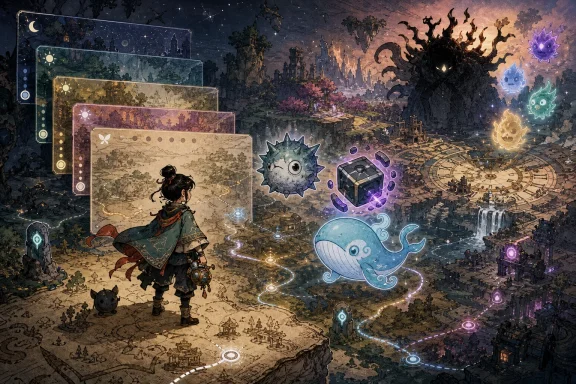
The premise is clean. Xi is trapped in a five-day cycle, accompanied by Ouro, and must explore a hand-drawn world where time alters terrain, encounters, and available paths. Instead of treating the map as a static puzzle box, Dragon Loop treats the calendar as part of the level design.That is an ambitious move for a Metroidvania because the genre already depends on controlled frustration. The player sees a ledge they cannot reach, a door they cannot open, a path that obviously means something later. Add time to that formula and the designer gains a powerful extra variable: not only what ability the player has, but when they arrive.
The danger is that this can become busywork if handled poorly. A five-day structure can either make the world feel alive or make it feel like an appointment book. The difference lies in whether time opens interesting decisions or merely forces players to repeat travel until the correct window appears.
Dragon Loop’s store description suggests that the developers understand the trap. The Time Map is described as easy to navigate, and the listing emphasizes branching worldlines rather than permadeath resets. That wording is doing a lot of work. It frames the loop less as punishment and more as route planning, closer to a strategic layer laid over exploration than a hard reset machine.
For Xbox players browsing casually, that distinction should be front and center. This is not a game selling infinite replay through randomization. It is selling authored exploration through controlled repetition.
The Metroidvania Crowd Has Become Harder to Impress
Dragon Loop lands in a genre that has never been more crowded or more demanding. The word Metroidvania used to be a useful shortcut; now it is a sorting problem. Players have been trained by years of excellent indie releases to ask sharper questions: How good is the map? How meaningful are the upgrades? Does backtracking reveal new ideas, or just new chores?That pressure is healthy, but it is also unforgiving. A small game cannot rely on the genre label alone. It needs a point of view.
Dragon Loop’s point of view is that time itself can be the missing ability. The Xbox description still includes expected genre furniture—bosses, movement powers, upgrades, exploration, fast combat—but the calendar is what gives those elements shape. If the loop is more than a gimmick, then Dragon Loop’s map is not simply a geography problem. It is a schedule.
That design idea has lineage. Time-loop games have taught players to read worlds as repeating systems, while Metroidvanias have taught them to read spaces as layered promises. Dragon Loop’s pitch is to combine those forms without turning the result into a roguelike. That last part is important because it tells players what kind of patience the game expects.
It does not ask for the patience of rebuilding a character from zero. It asks for the patience of learning a world well enough to bend it.
Bosses Becoming Spirits Gives Combat a Second Job
The combat description on the Xbox page is more interesting than the usual “fast-paced battles” language suggests. Dragon Loop lets players defeat bosses and turn them into summonable spirits, split between explosive attacks and persistent companions. That is a smart way to make combat feed progression rather than sit beside it.Metroidvanias are at their best when every system points back toward exploration. A boss should not just be a wall that tests whether the player has learned the dodge timing. It should change how the player thinks about the world after the fight ends.
Summonable spirits can do that if they are integrated well. Explosive spirits sound like burst tools for damage or tactical openings, while persistent companions suggest a more continuous layer of support. The promise that they can be upgraded and evolved adds a light role-playing spine without necessarily turning the game into a loot treadmill.
This also gives Dragon Loop a useful identity on Xbox. Plenty of indie Metroidvanias offer new weapons or traversal skills after major encounters. Fewer make the boss itself part of the player’s toolkit. In a store environment where screenshots and short descriptions carry enormous weight, that is the kind of concrete mechanic that can separate a game from the pile.
Pearls, Pufferfish, and the Joy of Weird Tools
The traversal powers sound deliberately odd: rare Pearls that summon tools such as spiky pufferfish, magnetic boxes, and a vacuuming whale spirit. That phrasing is almost whimsical, but it points to a design philosophy that is easy to underestimate. The best Metroidvania abilities are not just keys; they are verbs.A double jump is useful because it changes the verb set. A dash changes movement, combat, and risk. A grappling hook changes not only where the player can go, but how they read the screen.
Dragon Loop’s storefront pitch leans into multipurpose tools, promising that powers matter in both combat and traversal. That is exactly where the genre tends to shine. A tool that exists only to open one type of door is inventory clutter. A tool that changes how the player fights, moves, and solves environmental problems becomes part of the game’s language.
The examples also signal a lighter tonal register than the “lost memories in a mysterious loop” premise might imply. Spiky pufferfish and whale spirits do not sound like dour prestige-game iconography. They sound like a developer team willing to make utility strange, and in a genre saturated with grim cathedrals and ruined kingdoms, strangeness is an asset.
Xbox Play Anywhere Quietly Changes the Value Proposition
The Xbox listing’s platform details are more than boilerplate. Dragon Loop supports Xbox Play Anywhere, Smart Delivery, cloud saves, achievements, and play across console, PC, and handheld. For a small Metroidvania built around route planning and repeated exploration, that cross-device flexibility matters.This is where Xbox’s ecosystem can still make a compelling argument even when the individual release is not exclusive. A player may start on a Series X, continue on a Windows handheld, and clean up routes on a laptop without treating each device as a separate purchase. For a game about learning a world through iteration, the ability to pick up the same save across contexts is not just convenient. It fits the rhythm of the design.
The handheld mention is especially notable in 2026, because Windows-based portable gaming has become a real, if still messy, part of the PC ecosystem. A 2D action-adventure with a manageable price and cloud-save continuity is exactly the kind of game that benefits from that shift. It does not need to be a technical showcase to become a good portable companion.
Smart Delivery also reduces friction on the console side. Players do not have to parse which version belongs on which Xbox generation. In theory, they buy the game once and let Microsoft’s infrastructure handle the versioning. For a small release, removing even small points of hesitation can matter.
The Store Page Speaks Arabic, but the Platform Strategy Is Global
The user-facing listing surfaced here in Arabic, specifically through Microsoft’s regional storefront. That detail is easy to skim past, but it says something about how digital releases now move. A small Metroidvania can appear across regions with localized store copy, platform features, ratings, and purchase options all wrapped into the same global commerce machine.Localization is not the same as cultural reach, of course. A translated store page does not guarantee localized in-game text, strong regional marketing, or community support. The Xbox page lists nine supported languages, which is useful, but the store itself still has to do the work of making a game legible to different audiences.
Still, the presence of Arabic storefront copy matters in a practical sense. It lowers the first barrier to understanding the premise. For a systems-heavy game, that first explanation is not trivial. If the player cannot quickly grasp that this is a time-loop Metroidvania rather than a roguelike reset grinder, the sale may be lost before the trailer finishes loading.
The broader lesson is that storefront language has become part of game design’s public face. A clever system that is explained poorly might as well not exist for most buyers. Dragon Loop’s page has a fairly clear pitch, even if it still leans on genre shorthand that only some players will parse.
The “Not a Roguelike” Line Does More Work Than It Should
The most important sentence in Dragon Loop’s description may be the reassurance that this is not a roguelike and that players never start from scratch. That line exists because the market has trained players to expect loops to mean resets. It is both a clarification and a defensive maneuver.This is one of the side effects of genre language becoming marketing language. “Loop” can mean a narrative cycle, a mechanical reset, a run-based structure, or simply a repeated gameplay rhythm. Without clarification, players fill in the blanks with whatever has annoyed them most recently.
Dragon Loop needs players to understand that its loop is closer to knowledge accumulation and route branching than disposable runs. That is a very different psychological contract. In a roguelike, death and reset are often the engine of mastery. In a time-loop adventure, repetition is ideally the path to revelation.
The distinction matters for accessibility as well. Not accessibility in the narrow settings-menu sense, but accessibility of commitment. Some players avoid roguelikes because they dislike losing progress or replaying early sections under pressure. Dragon Loop’s store copy makes a direct appeal to those players: the clock is real, but your effort is not erased.
A Small Release Shows the Store’s Big Tension
Dragon Loop’s arrival also highlights a persistent Xbox problem: the storefront is asked to serve two different audiences at once. It must sell the massive, obvious games to people who already know they want them, and it must introduce smaller games to people who do not yet know why they should care.Those are different jobs. The first is transaction processing. The second is editorial discovery.
Microsoft has spent years improving the platform mechanics around ownership, compatibility, and cross-device continuity. Those investments are visible in Dragon Loop’s feature set. Smart Delivery, cloud saves, and Xbox Play Anywhere are not glamorous bullet points, but they make the purchase cleaner.
Discovery remains harder. A game like Dragon Loop benefits from being searchable by genre, price, platform support, and release date, but those filters do not explain taste. They do not tell a Hollow Knight fan whether the time-loop structure is exciting or exhausting. They do not tell a roguelike-averse player whether “five days” means stress or strategy.
That is where editorial context matters, whether it comes from platform curation, community discussion, critic coverage, or user reviews. Store pages can describe mechanics. Communities explain whether those mechanics actually cohere.
Happy Player Is Selling Design Confidence, Not Scale
The developer and publisher listed on Xbox is Happy Player, and the game’s price sits in the indie middle ground rather than the bargain-bin floor. At $14.99, Dragon Loop is asking to be judged as a purposeful small game, not as a disposable impulse purchase.That price matters because it frames expectations. Low enough to invite experimentation, high enough to imply a complete authored experience. For a niche Metroidvania with a time-loop system, that may be the right lane.
The store page also lists an Everyone 10+ rating with fantasy violence and mild blood, suggesting that the game is not aiming for the grim-dark edge that sometimes dominates action-platformers. Combined with the hand-drawn world and creature-based powers, Dragon Loop appears to be positioning itself as accessible in tone while still offering mechanical density.
That combination can be powerful. Some of the best genre games hide complexity under inviting art. The trick is to avoid confusing approachable presentation with shallow design. Dragon Loop’s success will depend on whether its loop, map, and combat systems reward the player long after the premise has been understood.
The Time Map May Be the Real Main Character
The Xbox listing mentions an “easily-navigable Time Map,” and that phrase deserves attention. In most Metroidvanias, the map is the player’s external memory. It stores geography, suspected secrets, closed doors, and future intentions. In a time-loop Metroidvania, the map has to remember more.It has to track not just where things are, but when they matter. It has to help players distinguish between a path blocked by ability, a path blocked by timing, and a path blocked by ignorance. If Dragon Loop’s Time Map succeeds, it could turn a potentially confusing structure into the game’s signature pleasure.
If it fails, the whole design risks becoming opaque. A time-loop system can quickly overwhelm players if the interface does not reduce cognitive load. The player should feel clever for planning a route, not punished for forgetting which event belonged to Day 3.
This is why the “easy to navigate” claim is so central. It is not a minor quality-of-life promise. It is a statement about whether the game understands the burden its own premise places on the player.
The Xbox Audience Is Broader Than the Console Box
Dragon Loop’s platform list includes Xbox One, Xbox Series X|S, PC, and handheld, which reflects the modern ambiguity of the Xbox brand. Xbox is no longer just the hardware under the television. It is a purchase system, a save system, an achievement system, and increasingly a promise that some games can move with the player.That shift matters most for games that do not require fixed-session spectacle. A five-day loop structure could fit naturally into shorter play sessions, provided the game’s checkpoints and route planning are forgiving enough. A player might explore a path during lunch on a handheld, then tackle a boss later on a console.
This is not the old console-war version of value. It is quieter and more infrastructural. Xbox’s advantage, when it works, is that the player does not have to think too much about where a game lives.
For Dragon Loop, that means the platform features may be more important than any single marketing beat. The game’s world repeats; the player’s access does not have to.
The Store Copy Is Good, but the Name May Fight It
There is a small branding problem here: Dragon Loop is descriptive but slightly generic. It tells players there is a dragon and a loop, but it does not immediately convey Metroidvania structure, hand-drawn exploration, or the Xi-and-Ouro character pairing. In crowded stores, that kind of name can blur into the background.The mechanics are more memorable than the title. Bosses becoming spirits, a five-day map, pufferfish and whale tools, X-Rating combat speed boosts—these are the details that stick. They are also the details that a platform storefront must surface quickly if the game is going to find the right audience.
The “X-Rating” phrase is especially risky in English-language marketing because it carries unrelated cultural baggage outside the game’s mechanics. In context, it appears to be a combat-performance system that boosts speed and power. Out of context, it may confuse more than it clarifies.
None of this is fatal. Plenty of excellent indie games have names that only become meaningful after players fall in love with them. But Dragon Loop’s store page has to work harder because the title alone does not do the whole job.
The Console Release Gives the PC Game a Second Opening
Dragon Loop had already been visible in PC circles before this Xbox release, including through Steam listings and community discussion. The June 11, 2026 Xbox launch gives it a second chance to be discovered by a broader audience, especially those who prefer console play or who follow the Xbox store’s new-release flow.That second opening is valuable. Indie games often launch into a burst of attention and then rely on ports, updates, discounts, and community recommendations to build a longer tail. A console release can act less like a late arrival and more like a relaunch.
The simultaneous presence across Xbox console and PC also softens the divide between those audiences. For developers, that can mean a wider addressable market without forcing separate purchase silos. For players, it means less anxiety about choosing the “right” version.
This is where the Xbox ecosystem’s boring parts become meaningful. Save portability, achievements, entitlement across supported devices, and clear version handling are not the headline. They are the conditions that let a small game travel.
The Useful Facts Hidden Inside the Loop
Dragon Loop is not a release that needs a grand theory of the industry to justify its existence, but it does reward a clear-eyed read of what is actually being offered. The most concrete points are also the ones most likely to determine whether it belongs in your backlog.- Dragon Loop launched on Xbox on June 11, 2026, with support for Xbox One, Xbox Series X|S, PC, and handheld play through the Xbox ecosystem.
- The game is priced at $14.99 on the Xbox store and is listed with Xbox Play Anywhere, Smart Delivery, cloud saves, achievements, and single-player support.
- The core design combines Metroidvania exploration with a five-day time loop, but the store page explicitly says it is not a roguelike and does not reset players from scratch.
- Progression includes summonable spirits earned from defeated bosses and multipurpose traversal tools created through rare Pearls.
- The game’s success will likely depend on whether its Time Map makes route planning satisfying rather than confusing.
- For Xbox players, the platform features may make Dragon Loop easier to sample across devices than a typical single-platform indie release.
The Next Great Xbox Indie May Need Better Shelves
Dragon Loop is the sort of release that exposes both the strengths and weaknesses of Xbox in 2026. The platform can make ownership feel modern, with one purchase spanning console, PC, and handheld contexts. But the store still has to prove that it can elevate games whose appeal depends on systems, not screenshots alone.That problem is not unique to Microsoft. Every digital storefront has become a firehose. The difference is that Xbox has spent years arguing that its ecosystem is broader than a console, and that argument is most persuasive when smaller games benefit from it.
If Dragon Loop finds an audience, it will probably be because players explain it to each other in better language than the store can manage. They will say it is a Metroidvania where the map has a calendar, where bosses become tools, where the loop is not a punishment but a plan. That is the sentence the store is circling around.
For WindowsForum readers, the release is worth watching not because it will redefine Xbox, but because it shows what Xbox’s current model is good at when the pieces align: small games, cross-device ownership, and systems clever enough to reward attention. The next challenge is making sure those games are not merely available everywhere, but visible somewhere.
References
- Primary source: Microsoft
Published: 2026-06-11T00:30:16.947487
شراء Dragon Loop | Xbox
Escape The Time Loop In This Open-World Metroidvania Help Xi navigate a five-day time loop and figure out what happened to her memories in a vast hand-drawn world. Together with her companion, Ouro, travel through a true metroidvania world where time changes the terrain in subtle ways. Escape...www.microsoft.com - Related coverage: xbox.com
Buy Dragon Loop | Xbox
Escape The Time Loop In This Open-World Metroidvania Help Xi navigate a five-day time loop and figure out what happened to her memories in a vast hand-drawn world. Together with her companion, Ouro, travel through a true metroidvania world where time changes the terrain in subtle ways. Escape...www.xbox.com - Related coverage: metroidvania.gg
Metroidvania.GG
The heroine who lost her memory was trapped in a five-day loop. Connect with your partners to travel through a world with strange time changes, continue to become stronger, retrieve memories, and understand the truth. The game is a time loop Metroidvania.www.metroidvania.gg
- Related coverage: a4at.com
Dragon Loop gets a Physical Edition and it Launches June 11th | Blog PPN
Leoful has announced that the Nintendo Switch physical release of Dragon Loop will launch on June 11, 2026. The time-loop metroidvania is being published inwww.a4at.com - Related coverage: cogconnected.com
Dragon Loop Lands Physical Edition on Nintendo Switch On 11 June - COGconnected
Indie publisher Leoful and developer Happy Player have announced that Dragon Loop will launch physically for the Nintendo Switch on June 11. cogconnected.com
- Related coverage: gamefaqs.gamespot.com
- Official source: news.microsoft.com
