

Microsoft’s Xbox release calendar for July 6 through July 10, 2026, is set to bring more than 20 new games to Xbox players, led by Assassin’s Creed Black Flag Resynced, Palworld 1.0, Wuthering Waves, and a new DOOM: The Dark Ages expansion. The week is not just busy; it is revealing. As Windows Report summarized from PureXbox’s roundup, Xbox is entering July with the kind of release density that makes the platform look healthier than its first-party narrative sometimes suggests. The catch is that quantity, Game Pass visibility, and actual player attention are now three very different currencies.
A week with more than 20 Xbox releases used to be a store-management problem. In 2026, it is a platform-positioning problem. Microsoft no longer needs to prove that Xbox has games in the narrow console-war sense; it needs to prove that the Xbox ecosystem can make sense of abundance.
That is why the July 6–10 slate matters. It bundles together recognizable brands, subscription entries, survival hits, horror experiments, cozy puzzles, sports annualization, and anime-adjacent RPG spectacle. On paper, this is the exact spread Microsoft wants associated with Xbox: big enough for mainstream players, varied enough for Game Pass grazers, and broad enough to serve both console and PC-adjacent audiences.
PureXbox’s weekly release format, amplified by Windows Report, is useful because it captures the rhythm of the modern Xbox store better than a showcase trailer does. The platform is not experienced in quarterly marketing beats. It is experienced in weekly drops, preload reminders, Game Pass carousels, discount tiles, and the creeping anxiety that there is too much to play and too little time to decide.
The result is a July week that looks less like a traditional release window and more like a storefront stress test. Xbox is not short of content here. The question is whether any platform can turn this much content into clarity.
That makes Resynced a useful test of the remake economy. The pitch is not simply nostalgia. It is a bet that a 2013 open-world structure, refreshed for modern hardware and expectations, can still compete against live-service schedules and subscription discovery. If Ubisoft lands the balance, Xbox gets a high-recognition premium release in a summer window that traditionally leaves room for older franchises to reclaim attention.
DOOM: The Dark Ages – Revelations plays a different role. An expansion for an already established shooter is not about discovery; it is about retention. It gives existing players a reason to return, and it gives fence-sitters another reason to treat the base game as an ongoing proposition rather than a finished box on the shelf.
Then there is Palworld 1.0, listed for July 10. Pocketpair’s survival-and-creature-collection phenomenon has already lived through the volatile attention cycle that can turn early access success into either a durable franchise or a frozen meme. A 1.0 release is not merely a version number. It is a public claim that the game is ready to be judged as a complete product.
Wuthering Waves, also on July 10, is yet another kind of Xbox signal. A story-rich open-world action RPG with gacha-era design DNA speaks to the platform’s need to court players whose habits were shaped as much by mobile and PC ecosystems as by console generations. For Xbox, this kind of game is not filler. It is part of a long push to make the console feel less isolated from the broader global games market.
This is the post-honeymoon phase of Game Pass. Microsoft’s subscription service remains one of Xbox’s defining advantages, but every busy release week also exposes its limits. A game being on Xbox no longer means it is on Game Pass, and a game being on Game Pass no longer guarantees that players will notice it.
That distinction matters for July. If Assassin’s Creed Black Flag Resynced is a premium purchase, DOOM DLC is an add-on proposition, and Palworld 1.0 is a subscription-visible relaunch, then Xbox players are being asked to move across multiple economic models in the same week. Buy the remake. Download the subscription title. Return for the expansion. Sample the indie. Wishlist the horror game. The modern Xbox dashboard is less a store than a behavioral funnel.
For Microsoft, that is both strength and risk. The strength is flexibility: Xbox can support premium launches, Game Pass drops, indie debuts, and ongoing content without forcing everything into one model. The risk is cognitive overload. When every tile is competing for the same evening, even Game Pass can become just another shelf.
These games represent the long tail that keeps the Xbox store moving between tentpoles. Puzzle games, horror shorts, card games, rage platformers, vertical shooters, and management sims are not there to dominate social media for a week. They are there because a platform’s health depends on a constant middle and lower tier of releases that give players reasons to browse.
The problem is that discovery has not kept pace with supply. Xbox has become much better at accepting and publishing a wide range of games than at explaining why a particular player should care about a particular small release on a particular day. Weekly roundups help, but they are editorial scaffolding built outside the storefront itself.
That is why a game like Viking Frontiers can sound compelling in a release list and still risk disappearing almost instantly. A Viking settlement survival and management game has an obvious audience. The challenge is whether Xbox’s interface, recommendation systems, and community channels can get it in front of that audience before Friday’s new batch arrives.
The same is true for horror. Echoes from Umbra and Welcome to Kowloon point to the continued strength of short-form and indie horror on console, a genre that has thrived on streaming culture and word-of-mouth discovery. But horror games are especially dependent on timing, mood, and social proof. If the store treats them as just two more tiles, much of their potential evaporates.
The collision is especially sharp because these games serve different audiences. A college football player looking for dynasty modes and school pride is not necessarily choosing between that and a vertical shoot ’em up. But storefront placement does not care about intent. New releases sit together, and attention flows toward the names players already recognize.
That puts smaller games at a structural disadvantage even when they are not directly competing by genre. The enemy is not Assassin’s Creed as a pirate adventure. The enemy is Assassin’s Creed as a thumbnail that consumes oxygen.
For Xbox, this is where curation becomes more important than catalog size. A platform that celebrates a busy week should also be able to segment it. The puzzle fan should see Book It! and Sokocat. The survival player should see Viking Frontiers and Palworld. The horror audience should see Welcome to Kowloon before it is buried under the weekend.
Without that layer, the platform’s diversity becomes theoretical. Players can only choose from what they can understand quickly.
A 1.0 launch changes the conversation. The language shifts from potential to verdict. Players who were willing to say “it’s early access” in January will be less patient when the game presents itself as finished in July.
For Xbox and Game Pass, that makes Palworld 1.0 a useful subscription showcase. Game Pass is at its best when it lowers the friction around a major update or relaunch. Someone who bounced off the game months ago can try again without making a new purchase decision, and someone who missed the original wave can arrive when the systems are more mature.
But the 1.0 label also raises expectations for polish. Survival crafting games can live for years after launch, but only if their foundations feel stable enough to justify the grind. If Palworld uses 1.0 as a genuine reset, Xbox benefits from having one of the week’s most conversation-friendly releases inside its subscription orbit. If it feels like a marketing milestone more than a product milestone, the backlash will be just as easy to sample.
That gives the remake a harder job than its nostalgic marketing might suggest. It must satisfy players who remember the original as one of the franchise’s high points while convincing newer players that pirate Assassin’s Creed is not merely historical homework. It also has to justify itself in a year when the remake label can mean anything from lavish reconstruction to cautious asset refresh.
Xbox players will be watching the practical details. Performance on Xbox Series X and Series S, install size, edition pricing, achievement handling, and upgrade clarity all matter. A remake with a clean technical profile can become a summer comfort game. A remake with compromises becomes another argument about whether publishers are selling memory at full price.
Still, the timing is smart. July gives Resynced room to breathe before the heavier late-year release cycle. It also gives Xbox a marquee single-player adventure in a week otherwise dominated by variety. Even if it is not a Game Pass title at launch, its presence lifts the perceived weight of the schedule.
Players do not approach a college football game the way they approach a puzzle adventure. They bring school loyalties, dynasty ambitions, roster expectations, and a calendar tied to real-world sports culture. For Xbox, sports releases are retention machines. They give players reasons to keep controllers connected long after the launch-week headlines fade.
Hell Clock and Red Titans represent a more arcade-driven counterweight. One points toward action and warped time; the other toward unforgiving vertical shooting built around precision and survival. These are not likely to dominate the week’s mainstream conversation, but they preserve something important in the Xbox catalog: the old idea that a console should be good at immediate, high-pressure play.
Then there is the survival-management thread running through Viking Frontiers, Wall World 2, and Palworld 1.0. These games speak to one of the defining player habits of the last decade: the desire to build, optimize, gather, defend, and iterate. Whether the fiction is a wall, a clan, or a creature-filled open world, the loop is about turning time into structure.
That does not mean hiding games or picking winners unfairly. It means understanding that players arrive with moods, constraints, and incomplete information. Someone with 30 minutes on a weeknight needs a different recommendation than someone ready to sink 80 hours into an open-world RPG. Someone looking for couch-friendly puzzle logic should not have to decode the same queue as someone chasing a grim first-person horror game.
This is where Xbox still has room to improve. Game Pass has trained users to browse, but browsing is not the same as discovery. The former is passive movement through tiles. The latter is the moment when a player understands why a game fits their taste right now.
A week like July 6–10 makes that distinction impossible to ignore. Microsoft can celebrate having a packed slate, but players will judge the platform by whether the slate feels navigable. In a subscription-and-store hybrid ecosystem, curation is not a luxury feature. It is infrastructure.
Players should come away with a few concrete expectations before the week begins:
July’s Xbox slate is exciting precisely because it is messy: premium nostalgia beside subscription experimentation, early access graduation beside indie obscurity, and annual sports certainty beside strange little games that might become someone’s favorite weekend surprise. Microsoft has spent years arguing that Xbox is bigger than a console box, but weeks like July 6–10 reveal the harder next step. The platform now has to make abundance feel intentional, because in 2026 the winning ecosystem will not simply be the one with the most games — it will be the one that helps players find the right one before they stop looking.
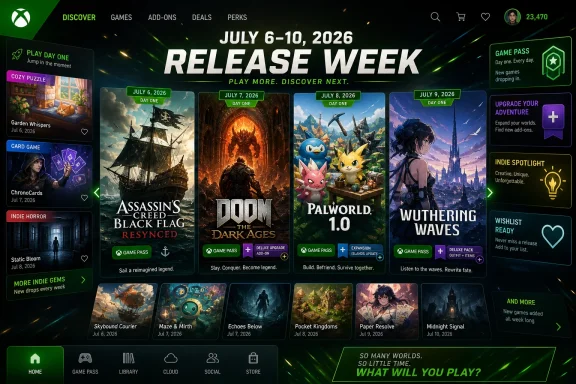 Xbox’s July Calendar Makes Volume the Message
A week with more than 20 Xbox releases used to be a store-management problem. In 2026, it is a platform-positioning problem. Microsoft no longer needs to prove that Xbox has games in the narrow console-war sense; it needs to prove that the Xbox ecosystem can make sense of abundance.That is why the July 6–10 slate matters. It bundles together recognizable brands, subscription entries, survival hits, horror experiments, cozy puzzles, sports annualization, and anime-adjacent RPG spectacle. On paper, this is the exact spread Microsoft wants associated with Xbox: big enough for mainstream players, varied enough for Game Pass grazers, and broad enough to serve both console and PC-adjacent audiences.
PureXbox’s weekly release format, amplified by Windows Report, is useful because it captures the rhythm of the modern Xbox store better than a showcase trailer does. The platform is not experienced in quarterly marketing beats. It is experienced in weekly drops, preload reminders, Game Pass carousels, discount tiles, and the creeping anxiety that there is too much to play and too little time to decide.
The result is a July week that looks less like a traditional release window and more like a storefront stress test. Xbox is not short of content here. The question is whether any platform can turn this much content into clarity.
The Headliners Are Doing Different Jobs for Xbox
The most obvious name in the list is Assassin’s Creed Black Flag Resynced, arriving July 9. Ubisoft’s return to Edward Kenway’s pirate story is the kind of release that does not need an introduction, because the original Black Flag already occupies a strange place in the franchise: beloved by people who adore Assassin’s Creed, and often defended by people who grew tired of Assassin’s Creed.That makes Resynced a useful test of the remake economy. The pitch is not simply nostalgia. It is a bet that a 2013 open-world structure, refreshed for modern hardware and expectations, can still compete against live-service schedules and subscription discovery. If Ubisoft lands the balance, Xbox gets a high-recognition premium release in a summer window that traditionally leaves room for older franchises to reclaim attention.
DOOM: The Dark Ages – Revelations plays a different role. An expansion for an already established shooter is not about discovery; it is about retention. It gives existing players a reason to return, and it gives fence-sitters another reason to treat the base game as an ongoing proposition rather than a finished box on the shelf.
Then there is Palworld 1.0, listed for July 10. Pocketpair’s survival-and-creature-collection phenomenon has already lived through the volatile attention cycle that can turn early access success into either a durable franchise or a frozen meme. A 1.0 release is not merely a version number. It is a public claim that the game is ready to be judged as a complete product.
Wuthering Waves, also on July 10, is yet another kind of Xbox signal. A story-rich open-world action RPG with gacha-era design DNA speaks to the platform’s need to court players whose habits were shaped as much by mobile and PC ecosystems as by console generations. For Xbox, this kind of game is not filler. It is part of a long push to make the console feel less isolated from the broader global games market.
Game Pass Is Present, but Not Dominant
The most important detail in the week’s Game Pass story is how small it is. Winds of Arcana: Ruination is listed for July 6 as a Game Pass arrival, while Palworld 1.0 is also flagged in the Game Pass context for July 10. That is meaningful, but it is not the whole slate.This is the post-honeymoon phase of Game Pass. Microsoft’s subscription service remains one of Xbox’s defining advantages, but every busy release week also exposes its limits. A game being on Xbox no longer means it is on Game Pass, and a game being on Game Pass no longer guarantees that players will notice it.
That distinction matters for July. If Assassin’s Creed Black Flag Resynced is a premium purchase, DOOM DLC is an add-on proposition, and Palworld 1.0 is a subscription-visible relaunch, then Xbox players are being asked to move across multiple economic models in the same week. Buy the remake. Download the subscription title. Return for the expansion. Sample the indie. Wishlist the horror game. The modern Xbox dashboard is less a store than a behavioral funnel.
For Microsoft, that is both strength and risk. The strength is flexibility: Xbox can support premium launches, Game Pass drops, indie debuts, and ongoing content without forcing everything into one model. The risk is cognitive overload. When every tile is competing for the same evening, even Game Pass can become just another shelf.
The Indie Flood Is the Real Platform Story
It is tempting to treat the smaller July releases as background noise around the big names. That would be a mistake. The week’s identity is shaped as much by Book It!, Sokocat: Castaway, Damways, Black Spades, Quest Arrest, Echoes from Umbra, and Welcome to Kowloon as it is by Ubisoft or Pocketpair.These games represent the long tail that keeps the Xbox store moving between tentpoles. Puzzle games, horror shorts, card games, rage platformers, vertical shooters, and management sims are not there to dominate social media for a week. They are there because a platform’s health depends on a constant middle and lower tier of releases that give players reasons to browse.
The problem is that discovery has not kept pace with supply. Xbox has become much better at accepting and publishing a wide range of games than at explaining why a particular player should care about a particular small release on a particular day. Weekly roundups help, but they are editorial scaffolding built outside the storefront itself.
That is why a game like Viking Frontiers can sound compelling in a release list and still risk disappearing almost instantly. A Viking settlement survival and management game has an obvious audience. The challenge is whether Xbox’s interface, recommendation systems, and community channels can get it in front of that audience before Friday’s new batch arrives.
The same is true for horror. Echoes from Umbra and Welcome to Kowloon point to the continued strength of short-form and indie horror on console, a genre that has thrived on streaming culture and word-of-mouth discovery. But horror games are especially dependent on timing, mood, and social proof. If the store treats them as just two more tiles, much of their potential evaporates.
July 9 Is the Week’s Collision Point
The July 9 lineup is where the schedule becomes crowded enough to change player behavior. Assassin’s Creed Black Flag Resynced, EA SPORTS College Football 27, Hell Clock, Red Titans, Viking Frontiers, and Book It! all land on the same day in the supplied roundup. That is not a release date; it is a traffic jam.The collision is especially sharp because these games serve different audiences. A college football player looking for dynasty modes and school pride is not necessarily choosing between that and a vertical shoot ’em up. But storefront placement does not care about intent. New releases sit together, and attention flows toward the names players already recognize.
That puts smaller games at a structural disadvantage even when they are not directly competing by genre. The enemy is not Assassin’s Creed as a pirate adventure. The enemy is Assassin’s Creed as a thumbnail that consumes oxygen.
For Xbox, this is where curation becomes more important than catalog size. A platform that celebrates a busy week should also be able to segment it. The puzzle fan should see Book It! and Sokocat. The survival player should see Viking Frontiers and Palworld. The horror audience should see Welcome to Kowloon before it is buried under the weekend.
Without that layer, the platform’s diversity becomes theoretical. Players can only choose from what they can understand quickly.
Palworld’s 1.0 Moment Is Bigger Than One Patch
Palworld 1.0 may be the most interesting release of the week because it comes with baggage that new games do not have. Early access success creates a strange contract with players. They buy into momentum, forgive rough edges, and participate in a public construction project — but they also remember every delay, controversy, exploit, missing feature, and half-kept promise.A 1.0 launch changes the conversation. The language shifts from potential to verdict. Players who were willing to say “it’s early access” in January will be less patient when the game presents itself as finished in July.
For Xbox and Game Pass, that makes Palworld 1.0 a useful subscription showcase. Game Pass is at its best when it lowers the friction around a major update or relaunch. Someone who bounced off the game months ago can try again without making a new purchase decision, and someone who missed the original wave can arrive when the systems are more mature.
But the 1.0 label also raises expectations for polish. Survival crafting games can live for years after launch, but only if their foundations feel stable enough to justify the grind. If Palworld uses 1.0 as a genuine reset, Xbox benefits from having one of the week’s most conversation-friendly releases inside its subscription orbit. If it feels like a marketing milestone more than a product milestone, the backlash will be just as easy to sample.
Assassin’s Creed Returns to a Different Xbox Audience
When Black Flag first arrived in 2013, Xbox was still defined by a console generation transition, boxed retail, and a very different Ubisoft. In 2026, Assassin’s Creed Black Flag Resynced lands in a market where players are more skeptical of remakes, more accustomed to performance-mode debates, and more likely to wait for subscription or sale access.That gives the remake a harder job than its nostalgic marketing might suggest. It must satisfy players who remember the original as one of the franchise’s high points while convincing newer players that pirate Assassin’s Creed is not merely historical homework. It also has to justify itself in a year when the remake label can mean anything from lavish reconstruction to cautious asset refresh.
Xbox players will be watching the practical details. Performance on Xbox Series X and Series S, install size, edition pricing, achievement handling, and upgrade clarity all matter. A remake with a clean technical profile can become a summer comfort game. A remake with compromises becomes another argument about whether publishers are selling memory at full price.
Still, the timing is smart. July gives Resynced room to breathe before the heavier late-year release cycle. It also gives Xbox a marquee single-player adventure in a week otherwise dominated by variety. Even if it is not a Game Pass title at launch, its presence lifts the perceived weight of the schedule.
Sports, Shooters, and Survival Keep the Week From Becoming a Nostalgia Play
The lineup would look far narrower if it were only about remakes and updates. EA SPORTS College Football 27 brings the annual sports audience into the same week, and that matters because sports games behave differently from most releases. They are not just content; they are seasonal rituals.Players do not approach a college football game the way they approach a puzzle adventure. They bring school loyalties, dynasty ambitions, roster expectations, and a calendar tied to real-world sports culture. For Xbox, sports releases are retention machines. They give players reasons to keep controllers connected long after the launch-week headlines fade.
Hell Clock and Red Titans represent a more arcade-driven counterweight. One points toward action and warped time; the other toward unforgiving vertical shooting built around precision and survival. These are not likely to dominate the week’s mainstream conversation, but they preserve something important in the Xbox catalog: the old idea that a console should be good at immediate, high-pressure play.
Then there is the survival-management thread running through Viking Frontiers, Wall World 2, and Palworld 1.0. These games speak to one of the defining player habits of the last decade: the desire to build, optimize, gather, defend, and iterate. Whether the fiction is a wall, a clan, or a creature-filled open world, the loop is about turning time into structure.
The Storefront Now Has to Be an Editor
The more varied Xbox’s release calendar becomes, the more Microsoft’s storefront has to behave like an editor. Not a neutral database. Not a passive list. An editor.That does not mean hiding games or picking winners unfairly. It means understanding that players arrive with moods, constraints, and incomplete information. Someone with 30 minutes on a weeknight needs a different recommendation than someone ready to sink 80 hours into an open-world RPG. Someone looking for couch-friendly puzzle logic should not have to decode the same queue as someone chasing a grim first-person horror game.
This is where Xbox still has room to improve. Game Pass has trained users to browse, but browsing is not the same as discovery. The former is passive movement through tiles. The latter is the moment when a player understands why a game fits their taste right now.
A week like July 6–10 makes that distinction impossible to ignore. Microsoft can celebrate having a packed slate, but players will judge the platform by whether the slate feels navigable. In a subscription-and-store hybrid ecosystem, curation is not a luxury feature. It is infrastructure.
The July 6–10 Slate Shows Xbox at Its Most Promising and Most Crowded
This week’s release window is a useful snapshot because it contains almost every modern Xbox tension in miniature. There is a big remake, a major expansion, a 1.0 survival launch, a Game Pass platformer, a sports release, indie horror, cozy puzzles, card play, tower defense, and open-world RPG ambition. That is the promise. It is also the problem.Players should come away with a few concrete expectations before the week begins:
- Assassin’s Creed Black Flag Resynced is the week’s most recognizable premium launch, arriving July 9 with the burden of proving that a beloved 2013 adventure can justify a modern return.
- Palworld 1.0 is the most important Game Pass-adjacent moment, because its full-release label invites both returning curiosity and tougher judgment.
- Winds of Arcana: Ruination gives Game Pass a day-one-style discovery beat on July 6, but it will need visibility to avoid being swallowed by the bigger names later in the week.
- July 9 is the schedule’s busiest pressure point, especially for smaller games launching beside Assassin’s Creed and EA SPORTS College Football 27.
- The indie horror, puzzle, and management games are not filler; they are the part of the Xbox ecosystem that most depends on better curation.
- More Game Pass announcements may shift the conversation again, but the existing slate already shows how crowded July has become for Xbox players.
July’s Xbox slate is exciting precisely because it is messy: premium nostalgia beside subscription experimentation, early access graduation beside indie obscurity, and annual sports certainty beside strange little games that might become someone’s favorite weekend surprise. Microsoft has spent years arguing that Xbox is bigger than a console box, but weeks like July 6–10 reveal the harder next step. The platform now has to make abundance feel intentional, because in 2026 the winning ecosystem will not simply be the one with the most games — it will be the one that helps players find the right one before they stop looking.
References
- Primary source: Windows Report
Published: 2026-07-05T13:20:12.719107
Loading…
windowsreport.com - Related coverage: gamesradar.com
Upcoming Xbox Series X games for 2026 and beyond | GamesRadar+
Here are all of the upcoming Xbox Series X games landing in 2026 and beyond, from Fable to Assassin's Creed Black Flag Resyncedwww.gamesradar.com - Related coverage: windowscentral.com
Loading…
www.windowscentral.com - Related coverage: pcgamer.com
July may be seriously lacking big new game releases, but co-op horror fans are feastin' | PC Gamer
Our July 2026 new PC game release date calendar includes several co-op horror staff picks, Palworld 1.0, and a lengthy list of new game updates and DLC.www.pcgamer.com - Related coverage: digitaltrends.com
Loading…
www.digitaltrends.com - Related coverage: thewincentral.com
Loading…
thewincentral.com
- Related coverage: wemedia.it
Loading…
www.wemedia.it - Related coverage: kopodo.com
Loading…
kopodo.com - Related coverage: xboxuk.com
Loading…
www.xboxuk.com - Related coverage: games.gg
Loading…
games.gg - Related coverage: techloy.com
Loading…
www.techloy.com - Related coverage: gamepressure.com
Loading…
www.gamepressure.com - Related coverage: lotkeys.com
Loading…
www.lotkeys.com
