

Resonance: A Plague Tale Legacy is now available to pre-order on Xbox, with the Microsoft Store listing confirming a $59.99 pre-order edition, Xbox Series X|S and PC support, Xbox Play Anywhere, Game Pass availability, and an August 27, 2026 launch window announced during Xbox’s June 7 showcase. The store page does more than open the cash register early: it makes clear that Asobo Studio is not simply producing A Plague Tale 3. Microsoft and Focus are positioning this as a franchise pivot, a myth-soaked action adventure built around Sophia, the smuggler-turned-companion who helped carry Requiem through its final act. That makes the pre-order page a small but revealing document in Xbox’s larger 2026 strategy: fewer vague promises, more dated releases, more Play Anywhere hooks, and more third-party prestige titles presented as part of the platform’s identity.
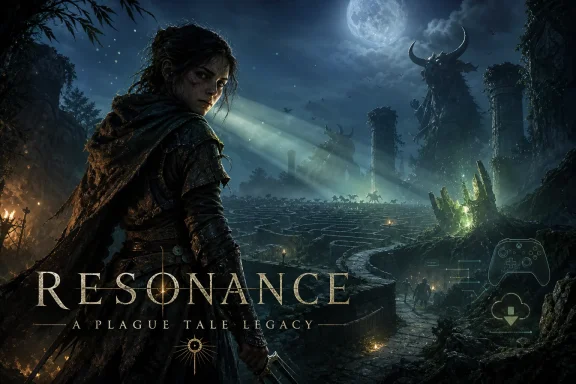
The headline change is obvious: Amicia and Hugo are not the center of this story. Resonance is set 15 years before A Plague Tale: Requiem and casts players as Sophia, described by the store page as a “fierce young plunderer” on the run and searching for the truth about her past. That is a bolder turn than it first appears, because the emotional architecture of the previous two games was built around sibling dependency, moral exhaustion, and the escalating horror of the Macula.
Sophia gives Asobo a way to keep the universe alive without dragging Amicia and Hugo back into a story that had already paid a heavy emotional price. She was memorable in Requiem because she brought pragmatism, mobility, and a little pirate swagger into a series otherwise defined by plague, helplessness, and grief. Making her the lead changes the mechanical promise as much as the narrative one.
The Microsoft Store description leans hard into that difference. It speaks of parries, powerful strikes, agility, reflexes, and close-quarters survival. That vocabulary is not the language of Innocence, where combat was often an emergency improvisation, or even Requiem, where Amicia’s growing competence still felt like a terrible adaptation to trauma.
That matters because A Plague Tale has always been strongest when it made the player feel under-equipped. Resonance appears to be asking whether the same world can remain frightening when its protagonist is more capable from the start. If Sophia can fight, dodge, strike, and outmaneuver trained enemies, then the horror has to come from somewhere else.
The previous games used history as a suffocating frame. The Hundred Years’ War, the Inquisition, plague-ridden villages, and collapsing social order gave the story a recognizable brutality. Resonance appears to trade that mud-and-blood specificity for a more symbolic island structure: maze, monster, treasure, curse, trial.
That is both promising and risky. A mythical island can give designers a cleaner playspace, a more game-like progression, and a stronger justification for puzzles, ruins, and supernatural echoes. It can also flatten the distinctive historical dread that made A Plague Tale stand apart from more conventional action-adventure series.
The store description tries to bridge the gap by tying the island to the Macula’s legacy. That is the franchise glue. The Macula, previously embodied through Hugo’s affliction and the rats that followed in apocalyptic swarms, is being widened into something older and more culturally adaptable.
In practical terms, that means Resonance can tell a story about Minoan myth without abandoning the series’ central infection-as-fate idea. In editorial terms, it is Asobo attempting the hardest maneuver in franchise design: making the world bigger without making the original tragedy feel smaller.
Xbox Play Anywhere is particularly important here. For years, it was a nice-to-have badge attached mostly to Microsoft’s own ecosystem experiments. In 2026, it is increasingly a way for Xbox to argue that buying on its store is not a console-only decision.
For Windows users, that distinction matters. A Play Anywhere purchase traditionally means one digital entitlement across Xbox console and Windows PC, with cloud saves and achievements tied into the same account ecosystem. For people who split time between a living-room console, a desktop GPU, and a handheld PC, that makes the Microsoft Store version more interesting than it would have been in the Xbox One era.
The store page’s “Play with” list includes Xbox Series X|S, PC, and handheld. That language reflects Microsoft’s newer reality: Xbox is no longer just a box under the television. It is a storefront, a subscription, a cloud layer, a save system, and increasingly a certification label for portable Windows gaming hardware.
That does not automatically make the Xbox version the best version. PC players will still compare Steam, Epic, Microsoft Store, mod flexibility, refund norms, and performance reporting. But the Resonance listing shows Microsoft trying to make the value proposition less abstract: buy once, play across the Windows-and-Xbox continuum, and get the same release through Game Pass if you subscribe.
The more meaningful signal is the timing. Opening pre-orders after a release-date showcase is the healthier version of modern hype management. Microsoft and Focus are not asking players to reserve a game attached only to a cinematic reveal and a distant “coming soon.” They are attaching the transaction to a dated launch, a platform feature set, and a clearer gameplay pitch.
That does not mean pre-ordering is suddenly a virtue. WindowsForum readers know the drill: PC performance can still wobble, day-one patches can still be mandatory, and “optimized” remains a marketing word until benchmarks arrive. The responsible stance is not cynicism for its own sake; it is patience until Asobo shows how the game runs on actual hardware.
Still, the pre-order page gives administrators, parents, and budget-conscious players useful metadata. The game carries a Mature 17+ rating with violence, blood, and strong language. It supports HDR10, single-player play, achievements, and Xbox Play Anywhere. It also lists in-app purchases, a phrase that deserves attention even when it may simply refer to DLC entitlements rather than live-service monetization.
The important thing is that Resonance is not being sold as a multiplayer platform or a seasonal treadmill. It is being sold as a single-player action-adventure with puzzle and role-playing tags. In 2026, that is almost a positioning statement.
That change could unlock the series. A protagonist with training, physicality, and a morally flexible background can support encounters that Amicia could not. A plunderer can sneak, fight dirty, improvise, and survive in a hostile ruin without the story constantly needing to explain why a teenager is cutting through armed men.
It could also sand away the series’ edge. If Resonance becomes too comfortable as an action game, the franchise risks losing the vulnerability that made its earlier stealth sequences and rat swarms so oppressive. The question is not whether Sophia should be more capable; she clearly should be. The question is whether Asobo can make capability feel like pressure rather than empowerment fantasy.
The island’s stalking presence may be the counterweight. The store copy says it follows Sophia, knows her moves, and turns every pause into a risk. That sounds like Asobo wants to preserve the old sensation of being hunted, even if the moment-to-moment combat has become sharper.
If that system is real and not just trailer language, it could become the game’s signature. A more combat-ready Sophia paired with an adversary that cannot simply be beaten would let Resonance modernize the series without turning it into a standard sword-and-dodge adventure. The danger is that such systems are difficult to tune: too aggressive and they become irritation; too scripted and they become scenery.
Resonance appears to relocate that idea into a much older register. The store description mentions ancient Minoan times, echoes of the past, entwined destinies, and the Macula’s mysterious legacy. That suggests a dual-timeline or time-echo structure rather than a simple prequel.
The stolen Minoan sphere is the clearest mechanical clue. Sophia uses it to manipulate light, a force said to be woven by Daedalus into the island’s heart. On paper, that is classic action-adventure design: a named artifact, environmental puzzles, ancient machinery, and mythological architecture.
For the franchise, though, light is not neutral. In A Plague Tale, light was safety, boundary, weapon, and fragile comfort. Rats turned darkness into territory. Fire, lamps, and alchemical tricks became the grammar of survival. If Resonance builds its puzzles around manipulating light, it may be translating one of the series’ oldest mechanics into a more elaborate mythic system.
That is the best version of this pivot. Rather than abandoning the language of the earlier games, Asobo can recompose it. The rats may or may not occupy the same mechanical role here, but the relationship between light, fear, infection, and fate remains the connective tissue.
That has real creative consequences. Subscription availability can give a developer more room to shift tone, protagonist, and combat model because the audience friction is lower. Players who might hesitate at a full-price pre-order may still download a day-one Game Pass release out of curiosity.
The downside is discoverability pressure. Game Pass can widen the funnel, but it also trains players to churn quickly. A slower narrative adventure has to earn attention in the first hour against an increasingly crowded library of enormous games, remakes, indies, and live-service obligations.
Resonance may be better positioned than most because it has a recognizable brand without requiring players to remember every plot beat. Sophia was important in Requiem, but the prequel framing gives new players an entry point. That balance is useful for Microsoft: the game looks premium in a showcase, has franchise credibility, and still functions as a relatively accessible subscription title.
It also reinforces the current Xbox message. Microsoft wants Game Pass to feel like the place where large third-party narrative games still show up on day one. After years of debate over whether subscription economics favor service games, Resonance is the kind of release that helps Xbox argue the opposite.
The “Optimized for handhelds” ecosystem language around Xbox has become more prominent as Windows portable devices have matured. That does not guarantee Steam Deck support, because the Microsoft Store version lives in a different distribution world, and Linux compatibility is a separate question. It does, however, suggest Microsoft wants games like Resonance to work well on Windows-based handhelds and future Xbox-branded portable experiences.
For IT-minded readers, the store path also matters because Microsoft account entitlements, family settings, content ratings, and parental controls remain tied into the broader Microsoft ecosystem. The listing’s Mature 17+ rating and parental-control notices are not decorative. They are part of the platform machinery that determines who can buy, install, and launch the game across devices.
The in-app purchase note is worth monitoring, but not panicking over. Storefronts often apply that label broadly to games with deluxe upgrades, bonus packs, cosmetics, or DLC. The key question is whether Resonance remains a self-contained campaign with optional extras or whether additional monetization creeps closer to the experience.
At this stage, the evidence points to the former. The pre-order SKU includes the main game and Heritage Pack, and the feature set emphasizes single-player play. Until Focus or Asobo says more, the fair reading is that the label is a storefront disclosure rather than proof of a larger monetization scheme.
Resonance helped serve that function. An August 27 date places it in the late-summer corridor, before the most brutal part of the fall release crush but close enough to the holiday season to remain part of Xbox’s 2026 story. It also gives Game Pass a prestige narrative entry in a window where subscribers often look for something substantial after summer showcases fade.
The game’s third-party status is important. Microsoft’s platform pitch cannot rely only on first-party exclusives, especially as Xbox continues to put more of its own catalog on more devices. What it needs instead is the sense that buying into Xbox, whether through console, PC, cloud, or subscription, remains a high-convenience way to play the year’s major releases.
That is why the Play Anywhere badge matters almost as much as the Game Pass badge. Game Pass says access. Play Anywhere says ownership still has cross-device value. Together, they are Microsoft’s answer to the increasingly fragmented way people play games.
For Resonance, that may be a fortunate alignment. A single-player narrative adventure benefits from frictionless continuation. The ideal use case is obvious: start on Series X in the living room, continue on a Windows handheld, finish a chapter on PC with headphones. That is exactly the kind of lifestyle pitch Xbox has been trying to make concrete.
Asobo appears to have chosen a more dangerous route. A new lead, a mythological island, heavier combat, ancient time echoes, and a named pre-order DLC pack all signal a franchise moving outward. The word Legacy in the title is doing exactly what franchise subtitles often do: promising continuity while making room for reinvention.
The risk is dilution. The more A Plague Tale becomes a broad universe, the more it has to prove that its defining horror was not just rats, children, and medieval misery. If the Macula can appear across myths and eras, it must remain thematically sharp rather than becoming generic supernatural branding.
The opportunity is equally clear. Sophia can carry a different kind of story, one less defined by innocence under siege and more by agency under pursuit. A plunderer haunted by an ancient curse can still belong to A Plague Tale if the game remembers that this universe is not about power fantasies. It is about inheritance, contamination, and the cost of survival.
That is why the pre-order listing’s emphasis on being unable to stop is so interesting. The best Plague Tale moments were never just about sneaking past enemies. They were about forward motion under moral and physical constraint. If Resonance can preserve that pressure while giving Sophia a blade and a stronger body, the pivot could work.
Resonance is the kind of prequel that reveals the health of a franchise: not because it answers every lingering question, but because it tests whether the world can survive without its original emotional center. If Asobo can make Sophia’s island feel as oppressive, strange, and morally expensive as Amicia and Hugo’s road, Xbox will have more than a dated Game Pass release on August 27, 2026. It will have proof that one of the last decade’s most distinctive narrative series can grow without embalming itself.
 Sophia Moves From Supporting Player to Franchise Stress Test
The headline change is obvious: Amicia and Hugo are not the center of this story. Resonance is set 15 years before A Plague Tale: Requiem and casts players as Sophia, described by the store page as a “fierce young plunderer” on the run and searching for the truth about her past. That is a bolder turn than it first appears, because the emotional architecture of the previous two games was built around sibling dependency, moral exhaustion, and the escalating horror of the Macula.Sophia gives Asobo a way to keep the universe alive without dragging Amicia and Hugo back into a story that had already paid a heavy emotional price. She was memorable in Requiem because she brought pragmatism, mobility, and a little pirate swagger into a series otherwise defined by plague, helplessness, and grief. Making her the lead changes the mechanical promise as much as the narrative one.
The Microsoft Store description leans hard into that difference. It speaks of parries, powerful strikes, agility, reflexes, and close-quarters survival. That vocabulary is not the language of Innocence, where combat was often an emergency improvisation, or even Requiem, where Amicia’s growing competence still felt like a terrible adaptation to trauma.
That matters because A Plague Tale has always been strongest when it made the player feel under-equipped. Resonance appears to be asking whether the same world can remain frightening when its protagonist is more capable from the start. If Sophia can fight, dodge, strike, and outmaneuver trained enemies, then the horror has to come from somewhere else.
The Minotaur’s Island Is a Franchise Escape Route
The setting is doing a lot of work. Sophia’s journey leads to “the Minotaur’s Island,” a place of deadly trials, treacherous trails, puzzles, buried curses, and a presence that stalks her through the shadows. That phrasing is not accidental; Asobo is pushing the series away from medieval France and toward a broader mythological grammar.The previous games used history as a suffocating frame. The Hundred Years’ War, the Inquisition, plague-ridden villages, and collapsing social order gave the story a recognizable brutality. Resonance appears to trade that mud-and-blood specificity for a more symbolic island structure: maze, monster, treasure, curse, trial.
That is both promising and risky. A mythical island can give designers a cleaner playspace, a more game-like progression, and a stronger justification for puzzles, ruins, and supernatural echoes. It can also flatten the distinctive historical dread that made A Plague Tale stand apart from more conventional action-adventure series.
The store description tries to bridge the gap by tying the island to the Macula’s legacy. That is the franchise glue. The Macula, previously embodied through Hugo’s affliction and the rats that followed in apocalyptic swarms, is being widened into something older and more culturally adaptable.
In practical terms, that means Resonance can tell a story about Minoan myth without abandoning the series’ central infection-as-fate idea. In editorial terms, it is Asobo attempting the hardest maneuver in franchise design: making the world bigger without making the original tragedy feel smaller.
Xbox Is Selling the Platform, Not Just the Game
The pre-order listing is also a platform statement. Resonance is marked for Xbox Series X|S, PC, and handheld play, with Xbox Play Anywhere support and Game Pass placement. That is exactly the kind of configuration Microsoft wants every prestige third-party partner to normalize.Xbox Play Anywhere is particularly important here. For years, it was a nice-to-have badge attached mostly to Microsoft’s own ecosystem experiments. In 2026, it is increasingly a way for Xbox to argue that buying on its store is not a console-only decision.
For Windows users, that distinction matters. A Play Anywhere purchase traditionally means one digital entitlement across Xbox console and Windows PC, with cloud saves and achievements tied into the same account ecosystem. For people who split time between a living-room console, a desktop GPU, and a handheld PC, that makes the Microsoft Store version more interesting than it would have been in the Xbox One era.
The store page’s “Play with” list includes Xbox Series X|S, PC, and handheld. That language reflects Microsoft’s newer reality: Xbox is no longer just a box under the television. It is a storefront, a subscription, a cloud layer, a save system, and increasingly a certification label for portable Windows gaming hardware.
That does not automatically make the Xbox version the best version. PC players will still compare Steam, Epic, Microsoft Store, mod flexibility, refund norms, and performance reporting. But the Resonance listing shows Microsoft trying to make the value proposition less abstract: buy once, play across the Windows-and-Xbox continuum, and get the same release through Game Pass if you subscribe.
The Pre-Order Bonus Is Small, but the Timing Is Loud
The pre-order edition includes the Heritage Pack DLC. The listing does not, at least in the material surfaced here, make the Heritage Pack sound like a major expansion or story chapter. It is the sort of pre-order incentive publishers attach to give early buyers something tangible without fragmenting the core campaign.The more meaningful signal is the timing. Opening pre-orders after a release-date showcase is the healthier version of modern hype management. Microsoft and Focus are not asking players to reserve a game attached only to a cinematic reveal and a distant “coming soon.” They are attaching the transaction to a dated launch, a platform feature set, and a clearer gameplay pitch.
That does not mean pre-ordering is suddenly a virtue. WindowsForum readers know the drill: PC performance can still wobble, day-one patches can still be mandatory, and “optimized” remains a marketing word until benchmarks arrive. The responsible stance is not cynicism for its own sake; it is patience until Asobo shows how the game runs on actual hardware.
Still, the pre-order page gives administrators, parents, and budget-conscious players useful metadata. The game carries a Mature 17+ rating with violence, blood, and strong language. It supports HDR10, single-player play, achievements, and Xbox Play Anywhere. It also lists in-app purchases, a phrase that deserves attention even when it may simply refer to DLC entitlements rather than live-service monetization.
The important thing is that Resonance is not being sold as a multiplayer platform or a seasonal treadmill. It is being sold as a single-player action-adventure with puzzle and role-playing tags. In 2026, that is almost a positioning statement.
Asobo’s New Combat Promise Changes the Bargain
The most consequential line in the store description may be the one about parries and powerful strikes. A Plague Tale has had violence before, but it usually framed direct confrontation as costly, clumsy, or desperate. Sophia’s toolkit sounds more deliberate.That change could unlock the series. A protagonist with training, physicality, and a morally flexible background can support encounters that Amicia could not. A plunderer can sneak, fight dirty, improvise, and survive in a hostile ruin without the story constantly needing to explain why a teenager is cutting through armed men.
It could also sand away the series’ edge. If Resonance becomes too comfortable as an action game, the franchise risks losing the vulnerability that made its earlier stealth sequences and rat swarms so oppressive. The question is not whether Sophia should be more capable; she clearly should be. The question is whether Asobo can make capability feel like pressure rather than empowerment fantasy.
The island’s stalking presence may be the counterweight. The store copy says it follows Sophia, knows her moves, and turns every pause into a risk. That sounds like Asobo wants to preserve the old sensation of being hunted, even if the moment-to-moment combat has become sharper.
If that system is real and not just trailer language, it could become the game’s signature. A more combat-ready Sophia paired with an adversary that cannot simply be beaten would let Resonance modernize the series without turning it into a standard sword-and-dodge adventure. The danger is that such systems are difficult to tune: too aggressive and they become irritation; too scripted and they become scenery.
The Macula Becomes Myth Instead of Just Disease
The earlier games made the Macula intimate. It was a curse, a condition, and a cosmic horror filtered through a child. The rats were spectacular, but the emotional horror came from the impossibility of separating love from catastrophe.Resonance appears to relocate that idea into a much older register. The store description mentions ancient Minoan times, echoes of the past, entwined destinies, and the Macula’s mysterious legacy. That suggests a dual-timeline or time-echo structure rather than a simple prequel.
The stolen Minoan sphere is the clearest mechanical clue. Sophia uses it to manipulate light, a force said to be woven by Daedalus into the island’s heart. On paper, that is classic action-adventure design: a named artifact, environmental puzzles, ancient machinery, and mythological architecture.
For the franchise, though, light is not neutral. In A Plague Tale, light was safety, boundary, weapon, and fragile comfort. Rats turned darkness into territory. Fire, lamps, and alchemical tricks became the grammar of survival. If Resonance builds its puzzles around manipulating light, it may be translating one of the series’ oldest mechanics into a more elaborate mythic system.
That is the best version of this pivot. Rather than abandoning the language of the earlier games, Asobo can recompose it. The rats may or may not occupy the same mechanical role here, but the relationship between light, fear, infection, and fate remains the connective tissue.
Game Pass Makes the Risk Easier to Take
For Xbox and Windows players, Game Pass changes the psychology of Resonance. A franchise pivot is always easier to sample than to buy blind. If the game arrives day one on Game Pass, as Xbox’s showcase recap and store placement indicate, subscribers can test Asobo’s new direction without treating the $59.99 pre-order as a referendum on the whole series.That has real creative consequences. Subscription availability can give a developer more room to shift tone, protagonist, and combat model because the audience friction is lower. Players who might hesitate at a full-price pre-order may still download a day-one Game Pass release out of curiosity.
The downside is discoverability pressure. Game Pass can widen the funnel, but it also trains players to churn quickly. A slower narrative adventure has to earn attention in the first hour against an increasingly crowded library of enormous games, remakes, indies, and live-service obligations.
Resonance may be better positioned than most because it has a recognizable brand without requiring players to remember every plot beat. Sophia was important in Requiem, but the prequel framing gives new players an entry point. That balance is useful for Microsoft: the game looks premium in a showcase, has franchise credibility, and still functions as a relatively accessible subscription title.
It also reinforces the current Xbox message. Microsoft wants Game Pass to feel like the place where large third-party narrative games still show up on day one. After years of debate over whether subscription economics favor service games, Resonance is the kind of release that helps Xbox argue the opposite.
Windows Players Should Watch the Store Details Closely
The Microsoft Store listing is encouraging for Windows users, but it also raises the usual practical questions. Play Anywhere support is valuable only if the PC version is treated as a first-class build. That means graphics options, ultrawide behavior, shader compilation, controller and keyboard support, cloud-save reliability, and handheld scaling all matter.The “Optimized for handhelds” ecosystem language around Xbox has become more prominent as Windows portable devices have matured. That does not guarantee Steam Deck support, because the Microsoft Store version lives in a different distribution world, and Linux compatibility is a separate question. It does, however, suggest Microsoft wants games like Resonance to work well on Windows-based handhelds and future Xbox-branded portable experiences.
For IT-minded readers, the store path also matters because Microsoft account entitlements, family settings, content ratings, and parental controls remain tied into the broader Microsoft ecosystem. The listing’s Mature 17+ rating and parental-control notices are not decorative. They are part of the platform machinery that determines who can buy, install, and launch the game across devices.
The in-app purchase note is worth monitoring, but not panicking over. Storefronts often apply that label broadly to games with deluxe upgrades, bonus packs, cosmetics, or DLC. The key question is whether Resonance remains a self-contained campaign with optional extras or whether additional monetization creeps closer to the experience.
At this stage, the evidence points to the former. The pre-order SKU includes the main game and Heritage Pack, and the feature set emphasizes single-player play. Until Focus or Asobo says more, the fair reading is that the label is a storefront disclosure rather than proof of a larger monetization scheme.
The Showcase Needed Dates, and Resonance Supplied One
Microsoft’s June 2026 showcase had a broader job than selling any one game. It needed to convince players that Xbox’s pipeline is not merely a constellation of logos. Release dates matter because they turn brand theater into calendar reality.Resonance helped serve that function. An August 27 date places it in the late-summer corridor, before the most brutal part of the fall release crush but close enough to the holiday season to remain part of Xbox’s 2026 story. It also gives Game Pass a prestige narrative entry in a window where subscribers often look for something substantial after summer showcases fade.
The game’s third-party status is important. Microsoft’s platform pitch cannot rely only on first-party exclusives, especially as Xbox continues to put more of its own catalog on more devices. What it needs instead is the sense that buying into Xbox, whether through console, PC, cloud, or subscription, remains a high-convenience way to play the year’s major releases.
That is why the Play Anywhere badge matters almost as much as the Game Pass badge. Game Pass says access. Play Anywhere says ownership still has cross-device value. Together, they are Microsoft’s answer to the increasingly fragmented way people play games.
For Resonance, that may be a fortunate alignment. A single-player narrative adventure benefits from frictionless continuation. The ideal use case is obvious: start on Series X in the living room, continue on a Windows handheld, finish a chapter on PC with headphones. That is exactly the kind of lifestyle pitch Xbox has been trying to make concrete.
The Series Can Grow Only If It Risks Alienating Purists
There will be fans who wanted a direct continuation. That is understandable. Requiem ended with enough emotional wreckage and enough implication to make any return feel loaded. The safest commercial path would have been a sequel that looked and played recognizably like the previous games.Asobo appears to have chosen a more dangerous route. A new lead, a mythological island, heavier combat, ancient time echoes, and a named pre-order DLC pack all signal a franchise moving outward. The word Legacy in the title is doing exactly what franchise subtitles often do: promising continuity while making room for reinvention.
The risk is dilution. The more A Plague Tale becomes a broad universe, the more it has to prove that its defining horror was not just rats, children, and medieval misery. If the Macula can appear across myths and eras, it must remain thematically sharp rather than becoming generic supernatural branding.
The opportunity is equally clear. Sophia can carry a different kind of story, one less defined by innocence under siege and more by agency under pursuit. A plunderer haunted by an ancient curse can still belong to A Plague Tale if the game remembers that this universe is not about power fantasies. It is about inheritance, contamination, and the cost of survival.
That is why the pre-order listing’s emphasis on being unable to stop is so interesting. The best Plague Tale moments were never just about sneaking past enemies. They were about forward motion under moral and physical constraint. If Resonance can preserve that pressure while giving Sophia a blade and a stronger body, the pivot could work.
The Xbox Listing Gives Players Enough to Wait Wisely
The pre-order page is not a review, and it should not be treated like one. It is a sales document, shaped to turn post-showcase excitement into early purchases. But it contains enough concrete information for players to make a more informed decision than they could after a teaser alone.- Resonance: A Plague Tale Legacy is positioned as a prequel starring Sophia, set 15 years before A Plague Tale: Requiem.
- The Xbox listing confirms a $59.99 pre-order edition that includes the Heritage Pack DLC.
- The game is listed for Xbox Series X|S, PC, and handheld play, with Xbox Play Anywhere support.
- Xbox’s showcase materials put the release date at August 27, 2026, with Game Pass availability on day one.
- The store description points to a more action-forward design built around parries, strikes, agility, exploration, and light-based puzzles.
- The Mature 17+ rating, single-player focus, HDR10 support, achievements, and in-app purchase disclosure are the practical details Windows and Xbox players should keep in mind before buying early.
Resonance is the kind of prequel that reveals the health of a franchise: not because it answers every lingering question, but because it tests whether the world can survive without its original emotional center. If Asobo can make Sophia’s island feel as oppressive, strange, and morally expensive as Amicia and Hugo’s road, Xbox will have more than a dated Game Pass release on August 27, 2026. It will have proof that one of the last decade’s most distinctive narrative series can grow without embalming itself.
References
- Primary source: Microsoft
Published: 2026-06-07T22:12:10.191007
Kjøp Resonance: A Plague Tale Legacy (Pre-order) | Xbox
Embark on an original story, prequel to the award-winning games: A Plague Tale. As Sophia, journey to the Minotaur’s Island, outsmart deadly foes, unravel ancient secrets, and confront a mythical creature at the heart of a devastating curse.www.microsoft.com - Related coverage: gamesradar.com
Upcoming Xbox Series X games for 2026 and beyond | GamesRadar+
Here are all of the upcoming Xbox Series X games landing in 2026 and beyond, from Fable to Assassin's Creed Black Flag Resyncedwww.gamesradar.com - Related coverage: xbox.com
Buy Resonance: A Plague Tale Legacy | Xbox
Embark on an original story, prequel to the award-winning games: A Plague Tale. As Sophia, journey to the Minotaur’s Island, outsmart deadly foes, unravel ancient secrets, and confront a mythical creature at the heart of a devastating curse.www.xbox.com - Related coverage: windowscentral.com
A Plague Tale: Resonance is a prequel coming to Xbox in 2026 | Windows Central
A Plague Tale: Resonance is a prequel following Sophia through myth, danger, and shifting timelines, and it drops on Xbox in 2026www.windowscentral.com - Related coverage: news.xbox.com
XBOX Games Showcase 2026 Recap: The Return of Exclusives, World Premieres, and Anniversary Hardware - XBOX Wire
XBOX Game Showcase 2026 just concluded. Find out everything announced - from the return of exclusives, to anniversary hardware, to games from XBOX and our partners – inside.news.xbox.com - Related coverage: gematsu.com
Resonance: A Plague Tale Legacy announcement leaked - Gematsu
Publisher Focus Entertainment and developer Asobo Studio will release Resonance: A Plague Tale Legacy, the third game in the A Plague Tale series…www.gematsu.com
- Related coverage: asobostudio.com
Resonance: A Plague Tale Legacy | Asobo Studio
We are delighted to expand the universe of A Plague Tale, this time telling the story of Sophia. The entire team would like to thank you for the warm welcome you gave our first trailer.www.asobostudio.com
- Related coverage: xboxachievements.com
Resonance: A Plague Tale Legacy Announced For 2026 Xbox Series X|S Release | XboxAchievements.com
Focus Entertainment and Asobo Studio have announced Resonance: A Plague Tale Legacy, the latest instalment in the rat-infested series, set fifteen yea...www.xboxachievements.com - Related coverage: purexbox.com
- Related coverage: gameinformer.com
Resonance: A Plague Tale Legacy Gets August Release Date In New Gameplay Trailer
This prequel puts players in control of Sophia, from A Plague Tale: Requiemgameinformer.com - Related coverage: xbox-gamer.net
XGS - Resonance: A Plague Tale Legacy annoncé au Showcase
XGS - Resonance: A Plague Tale Legacy annoncé au Showcase. Malheureusement, les leaks avaient gaché la surprise mais malgré tout, on ne...www.xbox-gamer.net - Related coverage: insidexbox.de
Resonance: A Plague Tale Legacy – Prequel angekündigt, Release 2026
Mit Resonance wagt sich Asobo Studio in neue Gefilde: Mehr Action, neue Heldin, mythische Schauplätze. TL;DR: Mit Resonance: A Plague Tale Legacy bringt Asobo Studio 2026 ein neues Kapitel der gefeierten Reihe – diesmal als Prequel mit Fokus auf Action, Lichtpuzzles und einer tödlichen Insel...www.insidexbox.de - Related coverage: focus-entmt.com
- Related coverage: as.com
- Related coverage: techradar.com
'The coming months are critical' — dev confirms Resonance: A Plague Tale Legacy's release is 'almost here' | TechRadar
Asobo Studio has provided a development update on Resonance: A Plague Tale Legacy, suggesting the game is months away from launch.www.techradar.com - Related coverage: los40.com
Microsoft el 25 aniversario de XBOX presentando una nueva consola y un aluvión de juegos | Videojuegos | LOS40
El Xbox Games Showcase ha dejado muchos títulos importantes y una máquina que para algunos será muy especial.los40.com - Related coverage: cdn.focus-home.com
- Related coverage: revenantjournal.com
