

Google’s July 2026 Pixel security update, build CP2A.260705.006, gives devices running Android 17 Beta 4 or Beta 4.1 the missing stable-release OTA path, allowing users to leave the beta program and return to the stable channel without factory-resetting the phone or wiping its data. The update closes an unusually consequential gap in Google’s beta-exit process: stable Android 17 had arrived, but some of the people who tested it could not safely move to the finished release. For those who avoided a separate Beta 4.1 bootloop, the July patch finally restores the low-risk exit that the Android Beta Program was supposed to provide.
This is not merely another monthly Pixel update with a few bug fixes attached. It is a repair to the machinery that separates experimental software from the stable operating system people depend on, and it arrives after that machinery failed precisely when testers needed it most.
Android beta programs depend on an implicit bargain. Users accept unfinished software, regressions, and occasional instability in exchange for early access and the expectation that, once the stable release arrives, Google will provide an orderly path back to ordinary production software.
The danger is not usually entering the beta. Enrollment is deliberately straightforward, and subsequent beta builds can arrive like normal over-the-air updates. The difficult part is leaving without crossing into a build that Android considers a downgrade, an operation that typically triggers a data wipe to protect the integrity of the device.
Google’s own Android Beta Program documentation describes a limited opportunity to opt out without erasing the phone when the stable release corresponding to the tested version becomes available. That window is what makes the end of a beta cycle fundamentally different from abandoning it halfway through: instead of downgrading to an older stable platform, the user moves laterally from a near-final beta branch to the completed release.
For Pixel owners running Android 17 Beta 4 and Beta 4.1, that expected bridge did not appear. As Joe Maring reported for Android Authority, affected devices did not receive the Android 17 stable-release OTA, leaving users stranded even though the software they were supposed to transition to had already been released.
The phone still worked for many of them, but the absence of the OTA transformed a routine update problem into a data-preservation problem. Users could remain on beta software and wait, or attempt a manual recovery path whose consequences depended heavily on which package they selected and how they installed it.
That distinction matters. A full factory image can restore a Pixel to a chosen software release, but the conventional flashing process generally entails erasing the device. A full OTA package, by contrast, can be sideloaded to produce the effect of installing the corresponding system software without requiring an unlocked bootloader or a wipe, according to Google’s official Pixel OTA documentation.
The July update restores that safer route. It does not retroactively protect people who already wiped their phones to escape a bootloop, but it prevents patient users from having to make the same sacrifice merely to reach stable Android 17.
Here, however, the missing update carried special meaning. It was not simply the newest monthly patch; it was the transition package that would reconcile a device’s beta state with the stable Android 17 branch while preserving locally stored data.
Without it, the normal consumer workflow broke down. Opting out could leave the user facing a wipe-based exit offer, while staying enrolled meant continuing to run prerelease software after the corresponding stable version had become available.
That is a poor choice architecture for any user, but particularly for the enthusiasts Google relies on to test late-stage Android builds. Beta 4 and Beta 4.1 were close enough to release that many participants would reasonably have installed them on regularly used Pixels rather than isolated development hardware.
The result was a trap created not by a catastrophic operating-system failure, but by version sequencing and update eligibility. The desired stable build existed, yet the update system did not present the path needed to install it safely.
Android Authority’s account correctly centers the practical consequence: users attempting to preserve their phone’s data could not simply flash the stable factory image and call the problem solved. Doing so would defeat the very reason for waiting for the no-wipe OTA.
The July 2026 security update resolves that impasse with build CP2A.260705.006. Affected users can allow the package to arrive through the normal rollout or obtain the device-specific full OTA package and sideload it.
As Reddit user bazilion explained in the discussion cited by Android Authority, both routes reach the same crucial outcome. Users can wait for the OTA on the phone or download the correct device-specific package and sideload it immediately; either path preserves the phone’s data.
That does not make the two methods equally suitable for every user. Waiting is slower but keeps the process inside the familiar system-update interface. Sideloading provides more control over timing, but it requires identifying the correct package, using Android’s recovery and debugging tools appropriately, and accepting the operational risk that accompanies any manual firmware procedure.
The fix therefore restores the destination more completely than it restores the simplicity. Google has reopened the no-wipe route, but users who do not receive the update promptly may still need to choose between patience and a procedure that is routine for developers but foreign to ordinary Pixel owners.
For a Beta 4 user whose phone remained operational, waiting was aggravating but viable. The device was stuck on the beta branch, yet the owner could continue using it while Google prepared the missing transition.
Beta 4.1 made that calculation more dangerous. Android Authority reports that a bootloop forced several users to manually flash the factory image, an intervention that wiped their data.
That sequence exposes the weakness in treating “wait for an OTA” as a universally safe recommendation. Waiting preserves data only while the installed beta remains bootable and usable. Once the phone can no longer start normally, the user’s priorities shift from preserving the ideal update path to restoring a functioning device by whatever supported recovery mechanism remains available.
The July patch is therefore both a solution and a dividing line. People who survived the waiting period can now transition safely; people pushed into a factory-image recovery before the patch arrived have already paid the cost the OTA was designed to avoid.
This is why the timing of update infrastructure matters as much as the correctness of the final package. A fix that arrives after a subset of users has been forced to wipe is still valuable, but it is not equivalent to a transition that worked on stable-release day.
The system evaluates the device model, current build, enrollment state, release channel, carrier or regional variant where applicable, and whether the proposed package is considered an upgrade or downgrade. A build can be publicly available and still remain invisible to a particular device because its current state does not match the update path Google has authorized.
That appears to be the core of the Android 17 beta-exit failure. The stable release existed, but Beta 4 and Beta 4.1 devices were not receiving the package required to cross from the test branch to the stable one without erasure.
The distinction between a factory image and a full OTA illustrates why “just flash it” was an inadequate answer. Google describes full OTA packages as useful when a device has failed to receive an over-the-air update, with an installation effect similar to a corresponding factory image but without the need to wipe the device or unlock its bootloader.
A factory image is a more comprehensive restoration mechanism. That makes it invaluable when a device will not boot or when partitions must be rebuilt, but it also makes the procedure more destructive in the scenario confronting Android 17 testers.
The safest package was therefore not merely the one containing stable Android 17. It was the package Google would permit the device to accept while maintaining userdata and preserving the supported update sequence.
Build CP2A.260705.006 supplies that missing step. Its significance lies less in the number printed on the About phone screen than in the transition it authorizes.
This is an important lesson for IT teams that use Pixel phones as Android reference devices. Firmware availability should not be confused with a validated migration path. Before moving a test fleet between beta and stable channels, administrators need to verify not only that the target release exists, but that the current source build is actually eligible for a no-wipe update to it.
That patience is now rewarded. Android Authority’s reporting says the July 2026 update is the patch to install for users who want to exit Android 17 Beta 4 or Beta 4.1 without wiping their data.
But that outcome should not obscure the asymmetric risk of beta participation. Google can repair an update channel later; it cannot remotely reconstruct local data that was never backed up before a forced recovery.
Beta warnings generally state that prerelease software may contain errors capable of causing serious damage or loss of use. Those warnings are legally and technically accurate, but they can become abstract after several uneventful beta cycles.
The Android 17 incident makes the warning concrete. The failure did not require an exotic exploit or obscure developer configuration. It involved the ordinary end-of-cycle task of moving from a release candidate-style beta to stable software, followed by a bootloop that reportedly made destructive recovery unavoidable for several users.
This is the point at which the consumer framing of public beta programs collides with their engineering reality. The enrollment interface may be simple, and the OTA may look like any other phone update, but the installed software remains part of an active test program.
The closer a beta gets to stable, the easier it is to forget that distinction. Late betas often feel polished enough for daily use, while the release schedule encourages users to believe the remaining journey is procedural rather than risky.
Android 17 Beta 4.1 demonstrated that late-cycle risk can be concentrated in the transition itself. A user may experience no serious trouble during weeks of testing and still encounter the most consequential failure while trying to leave.
That makes sideloading the technically appropriate manual route here. It avoids the destructive characteristics associated with flashing a factory image and does not require the bootloader to be unlocked.
Still, “no wipe” should not be confused with “no risk.” The user must obtain the correct package for the specific Pixel, ensure that the download is complete, place the phone into the appropriate recovery state, and issue the sideload command from a correctly configured computer.
Selecting the wrong file or interrupting a low-level update procedure can create new complications. A backup remains necessary even when the intended installation process preserves data, because preservation is an expected property of the path rather than a guarantee against every hardware, software, power, or operator failure.
The normal OTA remains the preferable route for most Pixel owners. It minimizes opportunities for package-selection errors and keeps the process within Google’s managed rollout.
Sideloading is more attractive in a lab, for an administrator managing a small pool of test hardware, or for an experienced user who needs to leave the beta immediately. It provides deterministic timing and avoids waiting for the update service to offer the package.
That division of use cases is important. Android Authority’s statement that either route preserves data describes the expected outcome, not a claim that both require the same expertise.
For anyone unfamiliar with recovery mode or command-line Android tooling, waiting for CP2A.260705.006 to appear on the phone is the prudent choice. For those who do sideload, the device-specific nature of the package is not a suggestion; it is a requirement.
That level of vertical control is supposed to reduce update ambiguity. There is no third-party Android skin waiting to be merged and no separate vendor beta program deciding when a stable build should be offered.
When Pixel testers nevertheless become stuck between beta and stable, the failure points toward Google’s release-channel governance. The stable software itself was not necessarily unavailable or unsuitable; the service responsible for presenting it to eligible beta devices failed to complete the handoff.
This matters because beta testing is not a one-way delivery system. Google benefits from broader hardware use, bug reports, application testing, and real-world feedback. In return, testers depend on Google to manage enrollment, update eligibility, and exit conditions predictably.
A missing exit OTA weakens that exchange. It tells participants that even if the final operating system is ready, the mechanism for safely leaving the experiment may not be.
The July patch resolves the immediate fault, but the more durable engineering question is why the stable-release transition was not validated against both Android 17 Beta 4 and Beta 4.1 before the public rollout. A release process that tests the target build without testing every supported source-to-target path can still strand users.
For enterprise and development teams, this is familiar territory. Successful deployment is not defined only by whether a cleanly provisioned device can run the new release. It also requires testing upgrades from every build state that exists in the managed population, including preview versions and exceptions that may have accumulated near the end of a test program.
Google’s consumer-facing beta infrastructure needs the same discipline. The late-cycle betas were known source states, and the stable release was the planned destination. The no-wipe route between them should have been treated as a release-blocking migration scenario.
A no-wipe OTA preserves the userdata partition during the expected installation path. It does not protect against a pre-existing bootloop, failing storage, battery loss, an unrelated hardware defect, or a mistake during manual recovery.
It also does not help users who have already reached the point where a factory image is their only practical restoration option. Once a phone cannot boot and no non-destructive update is accepted, the theoretical availability of a future preserving path offers little comfort.
This is why backup advice should come before beta enrollment, not after a device becomes unstable. Photos and files may be synchronized, but application state, authenticator migrations, locally downloaded documents, messaging archives, and device-specific configurations can require separate attention.
For organizations, test Pixels should be treated as rebuildable endpoints. Any unique business data should live elsewhere, credentials should be recoverable, and the team should maintain a record of the installed channel and build state.
For individuals using a personal Pixel, the standard should be slightly different but no less serious: do not install a beta on a phone whose unrecoverable local contents matter more than early access to the software.
The Android 17 exit failure did not invalidate the usefulness of public testing. It clarified the price of assuming that “stable next month” means “safe exit next month.”
What it cannot do is erase the uncertainty users experienced while the route was missing. Some had to decide whether to wait on prerelease software, accept a wipe, or perform a manual installation without knowing when Google’s official fix would arrive.
A more resilient beta program would communicate the state of that transition directly. If a no-wipe stable OTA is delayed, affected users should see an explicit notice explaining that they remain eligible, that a corrective package is being prepared, and that installing a wipe-based downgrade is unnecessary unless they intentionally want to erase the device.
Silence encourages improvisation. Users begin comparing build timestamps, experimenting with packages meant for other release paths, or following community instructions that may be correct for one Pixel and dangerous for another.
The reporting trail reflects that dynamic. Android Authority identified the problem and later reported the July fix, while Pixel and Android beta communities supplied immediate observations about missing OTAs, bootloops, and successful sideloads.
Community reporting is valuable, particularly when rollout behavior varies between devices. It should not have to substitute for an authoritative status message inside the update system.
Google already knows whether a device is enrolled, which beta it is running, and whether opting out would currently trigger a wipe. That information should be used to make the consequences of every offered update unmistakable.
The Android Beta Program’s limited no-wipe exit window is also easy to misunderstand. Users may assume that once stable Android 17 exists, they can opt out safely at any later point. In reality, applying a subsequent beta can move the phone beyond the straightforward stable transition and restore the risk of a wipe-based downgrade.
The July patch therefore should not be treated as permission to postpone indefinitely. Users who want stable Android 17 should install CP2A.260705.006 through one of the supported paths while their devices remain in the affected Beta 4 or Beta 4.1 state.
This is not merely another monthly Pixel update with a few bug fixes attached. It is a repair to the machinery that separates experimental software from the stable operating system people depend on, and it arrives after that machinery failed precisely when testers needed it most.
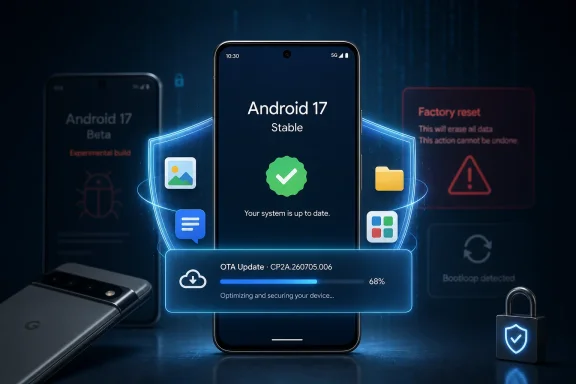 Google’s Beta Exit Failed at the Moment It Mattered
Android beta programs depend on an implicit bargain. Users accept unfinished software, regressions, and occasional instability in exchange for early access and the expectation that, once the stable release arrives, Google will provide an orderly path back to ordinary production software.The danger is not usually entering the beta. Enrollment is deliberately straightforward, and subsequent beta builds can arrive like normal over-the-air updates. The difficult part is leaving without crossing into a build that Android considers a downgrade, an operation that typically triggers a data wipe to protect the integrity of the device.
Google’s own Android Beta Program documentation describes a limited opportunity to opt out without erasing the phone when the stable release corresponding to the tested version becomes available. That window is what makes the end of a beta cycle fundamentally different from abandoning it halfway through: instead of downgrading to an older stable platform, the user moves laterally from a near-final beta branch to the completed release.
For Pixel owners running Android 17 Beta 4 and Beta 4.1, that expected bridge did not appear. As Joe Maring reported for Android Authority, affected devices did not receive the Android 17 stable-release OTA, leaving users stranded even though the software they were supposed to transition to had already been released.
The phone still worked for many of them, but the absence of the OTA transformed a routine update problem into a data-preservation problem. Users could remain on beta software and wait, or attempt a manual recovery path whose consequences depended heavily on which package they selected and how they installed it.
That distinction matters. A full factory image can restore a Pixel to a chosen software release, but the conventional flashing process generally entails erasing the device. A full OTA package, by contrast, can be sideloaded to produce the effect of installing the corresponding system software without requiring an unlocked bootloader or a wipe, according to Google’s official Pixel OTA documentation.
The July update restores that safer route. It does not retroactively protect people who already wiped their phones to escape a bootloop, but it prevents patient users from having to make the same sacrifice merely to reach stable Android 17.
One Missing OTA Turned an Update into a Recovery Decision
The phrase “missing OTA” sounds almost trivial. It suggests a delayed notification, a server rollout that has not reached every device, or the familiar need to tap Check for update a few more times.Here, however, the missing update carried special meaning. It was not simply the newest monthly patch; it was the transition package that would reconcile a device’s beta state with the stable Android 17 branch while preserving locally stored data.
Without it, the normal consumer workflow broke down. Opting out could leave the user facing a wipe-based exit offer, while staying enrolled meant continuing to run prerelease software after the corresponding stable version had become available.
That is a poor choice architecture for any user, but particularly for the enthusiasts Google relies on to test late-stage Android builds. Beta 4 and Beta 4.1 were close enough to release that many participants would reasonably have installed them on regularly used Pixels rather than isolated development hardware.
The result was a trap created not by a catastrophic operating-system failure, but by version sequencing and update eligibility. The desired stable build existed, yet the update system did not present the path needed to install it safely.
Android Authority’s account correctly centers the practical consequence: users attempting to preserve their phone’s data could not simply flash the stable factory image and call the problem solved. Doing so would defeat the very reason for waiting for the no-wipe OTA.
The July 2026 security update resolves that impasse with build CP2A.260705.006. Affected users can allow the package to arrive through the normal rollout or obtain the device-specific full OTA package and sideload it.
As Reddit user bazilion explained in the discussion cited by Android Authority, both routes reach the same crucial outcome. Users can wait for the OTA on the phone or download the correct device-specific package and sideload it immediately; either path preserves the phone’s data.
That does not make the two methods equally suitable for every user. Waiting is slower but keeps the process inside the familiar system-update interface. Sideloading provides more control over timing, but it requires identifying the correct package, using Android’s recovery and debugging tools appropriately, and accepting the operational risk that accompanies any manual firmware procedure.
The fix therefore restores the destination more completely than it restores the simplicity. Google has reopened the no-wipe route, but users who do not receive the update promptly may still need to choose between patience and a procedure that is routine for developers but foreign to ordinary Pixel owners.
Beta 4 and Beta 4.1 Shared the Exit Problem, but Not the Same Risk
The affected releases belong to the same late Android 17 test cycle, and both were denied the expected stable OTA. Their practical risk profiles nevertheless diverged because Beta 4.1 was also associated with a bootloop bug that reportedly forced several users into manual recovery.| Android 17 release | Stable Android 17 OTA | No-wipe exit before July patch | Additional reported problem |
|---|---|---|---|
| Beta 4 | Missing | Unavailable through the expected transition | No separate bootloop issue identified in the supplied reporting |
| Beta 4.1 | Missing | Unavailable through the expected transition | Bootloop bug forced several users to flash a factory image and wipe data |
Beta 4.1 made that calculation more dangerous. Android Authority reports that a bootloop forced several users to manually flash the factory image, an intervention that wiped their data.
That sequence exposes the weakness in treating “wait for an OTA” as a universally safe recommendation. Waiting preserves data only while the installed beta remains bootable and usable. Once the phone can no longer start normally, the user’s priorities shift from preserving the ideal update path to restoring a functioning device by whatever supported recovery mechanism remains available.
The July patch is therefore both a solution and a dividing line. People who survived the waiting period can now transition safely; people pushed into a factory-image recovery before the patch arrived have already paid the cost the OTA was designed to avoid.
This is why the timing of update infrastructure matters as much as the correctness of the final package. A fix that arrives after a subset of users has been forced to wipe is still valuable, but it is not equivalent to a transition that worked on stable-release day.
The Stable Release Was Present, but the State Machine Was Broken
Modern operating-system updates are often discussed as if they were files: download the correct build, install it, and the device moves forward. In reality, an OTA is also a policy decision encoded by the update service.The system evaluates the device model, current build, enrollment state, release channel, carrier or regional variant where applicable, and whether the proposed package is considered an upgrade or downgrade. A build can be publicly available and still remain invisible to a particular device because its current state does not match the update path Google has authorized.
That appears to be the core of the Android 17 beta-exit failure. The stable release existed, but Beta 4 and Beta 4.1 devices were not receiving the package required to cross from the test branch to the stable one without erasure.
The distinction between a factory image and a full OTA illustrates why “just flash it” was an inadequate answer. Google describes full OTA packages as useful when a device has failed to receive an over-the-air update, with an installation effect similar to a corresponding factory image but without the need to wipe the device or unlock its bootloader.
A factory image is a more comprehensive restoration mechanism. That makes it invaluable when a device will not boot or when partitions must be rebuilt, but it also makes the procedure more destructive in the scenario confronting Android 17 testers.
The safest package was therefore not merely the one containing stable Android 17. It was the package Google would permit the device to accept while maintaining userdata and preserving the supported update sequence.
Build CP2A.260705.006 supplies that missing step. Its significance lies less in the number printed on the About phone screen than in the transition it authorizes.
This is an important lesson for IT teams that use Pixel phones as Android reference devices. Firmware availability should not be confused with a validated migration path. Before moving a test fleet between beta and stable channels, administrators need to verify not only that the target release exists, but that the current source build is actually eligible for a no-wipe update to it.
The July Patch Rewards Patience but Exposes the Cost of Testing
The users best served by the new update are those who did almost nothing. They avoided the Beta 4.1 bootloop, resisted wipe-based downgrade prompts, did not force a factory-image installation, and waited for Google to correct the OTA path.That patience is now rewarded. Android Authority’s reporting says the July 2026 update is the patch to install for users who want to exit Android 17 Beta 4 or Beta 4.1 without wiping their data.
But that outcome should not obscure the asymmetric risk of beta participation. Google can repair an update channel later; it cannot remotely reconstruct local data that was never backed up before a forced recovery.
Beta warnings generally state that prerelease software may contain errors capable of causing serious damage or loss of use. Those warnings are legally and technically accurate, but they can become abstract after several uneventful beta cycles.
The Android 17 incident makes the warning concrete. The failure did not require an exotic exploit or obscure developer configuration. It involved the ordinary end-of-cycle task of moving from a release candidate-style beta to stable software, followed by a bootloop that reportedly made destructive recovery unavoidable for several users.
This is the point at which the consumer framing of public beta programs collides with their engineering reality. The enrollment interface may be simple, and the OTA may look like any other phone update, but the installed software remains part of an active test program.
The closer a beta gets to stable, the easier it is to forget that distinction. Late betas often feel polished enough for daily use, while the release schedule encourages users to believe the remaining journey is procedural rather than risky.
Android 17 Beta 4.1 demonstrated that late-cycle risk can be concentrated in the transition itself. A user may experience no serious trouble during weeks of testing and still encounter the most consequential failure while trying to leave.
Sideloading Is the Fast Route, Not the Casual Route
For users who do not want to wait for the staged OTA rollout, the device-specific package offers an immediate alternative. Google publishes full OTA images specifically for circumstances in which a normal over-the-air update has failed to arrive or complete.That makes sideloading the technically appropriate manual route here. It avoids the destructive characteristics associated with flashing a factory image and does not require the bootloader to be unlocked.
Still, “no wipe” should not be confused with “no risk.” The user must obtain the correct package for the specific Pixel, ensure that the download is complete, place the phone into the appropriate recovery state, and issue the sideload command from a correctly configured computer.
Selecting the wrong file or interrupting a low-level update procedure can create new complications. A backup remains necessary even when the intended installation process preserves data, because preservation is an expected property of the path rather than a guarantee against every hardware, software, power, or operator failure.
The normal OTA remains the preferable route for most Pixel owners. It minimizes opportunities for package-selection errors and keeps the process within Google’s managed rollout.
Sideloading is more attractive in a lab, for an administrator managing a small pool of test hardware, or for an experienced user who needs to leave the beta immediately. It provides deterministic timing and avoids waiting for the update service to offer the package.
That division of use cases is important. Android Authority’s statement that either route preserves data describes the expected outcome, not a claim that both require the same expertise.
For anyone unfamiliar with recovery mode or command-line Android tooling, waiting for CP2A.260705.006 to appear on the phone is the prudent choice. For those who do sideload, the device-specific nature of the package is not a suggestion; it is a requirement.
The Incident Is an Update-Governance Failure, Not Just a Pixel Glitch
Google’s Pixel line serves as the reference implementation for Android platform releases. Pixels receive Android betas directly, stable releases arrive without an intervening handset manufacturer, and Google controls both the software image and the beta enrollment system.That level of vertical control is supposed to reduce update ambiguity. There is no third-party Android skin waiting to be merged and no separate vendor beta program deciding when a stable build should be offered.
When Pixel testers nevertheless become stuck between beta and stable, the failure points toward Google’s release-channel governance. The stable software itself was not necessarily unavailable or unsuitable; the service responsible for presenting it to eligible beta devices failed to complete the handoff.
This matters because beta testing is not a one-way delivery system. Google benefits from broader hardware use, bug reports, application testing, and real-world feedback. In return, testers depend on Google to manage enrollment, update eligibility, and exit conditions predictably.
A missing exit OTA weakens that exchange. It tells participants that even if the final operating system is ready, the mechanism for safely leaving the experiment may not be.
The July patch resolves the immediate fault, but the more durable engineering question is why the stable-release transition was not validated against both Android 17 Beta 4 and Beta 4.1 before the public rollout. A release process that tests the target build without testing every supported source-to-target path can still strand users.
For enterprise and development teams, this is familiar territory. Successful deployment is not defined only by whether a cleanly provisioned device can run the new release. It also requires testing upgrades from every build state that exists in the managed population, including preview versions and exceptions that may have accumulated near the end of a test program.
Google’s consumer-facing beta infrastructure needs the same discipline. The late-cycle betas were known source states, and the stable release was the planned destination. The no-wipe route between them should have been treated as a release-blocking migration scenario.
Data Preservation Depends on More Than the Installer
The central promise of CP2A.260705.006 is straightforward: affected Pixel users can move to stable Android 17 without erasing their phones. That is the right message, but it should not encourage users to treat backup hygiene as optional.A no-wipe OTA preserves the userdata partition during the expected installation path. It does not protect against a pre-existing bootloop, failing storage, battery loss, an unrelated hardware defect, or a mistake during manual recovery.
It also does not help users who have already reached the point where a factory image is their only practical restoration option. Once a phone cannot boot and no non-destructive update is accepted, the theoretical availability of a future preserving path offers little comfort.
This is why backup advice should come before beta enrollment, not after a device becomes unstable. Photos and files may be synchronized, but application state, authenticator migrations, locally downloaded documents, messaging archives, and device-specific configurations can require separate attention.
For organizations, test Pixels should be treated as rebuildable endpoints. Any unique business data should live elsewhere, credentials should be recoverable, and the team should maintain a record of the installed channel and build state.
For individuals using a personal Pixel, the standard should be slightly different but no less serious: do not install a beta on a phone whose unrecoverable local contents matter more than early access to the software.
The Android 17 exit failure did not invalidate the usefulness of public testing. It clarified the price of assuming that “stable next month” means “safe exit next month.”
Action checklist for admins
- Inventory Pixel test devices and identify any still running Android 17 Beta 4 or Beta 4.1.
- Confirm that important local data, authentication credentials, and recovery information are backed up before updating.
- Prefer the normal OTA delivery of CP2A.260705.006 for users without Android recovery experience.
- If timing requires sideloading, download the device-specific full OTA package rather than using a factory image.
- Verify that the phone boots successfully on stable Android 17 before removing it from the test inventory or returning it to production use.
- Document any device that previously entered a bootloop or required a wipe, since those failures may indicate a need for additional application and hardware validation.
Google Fixed the Exit, but It Still Owes Testers a Better Contract
The July update succeeds at the most important technical task. It gives operational Beta 4 and Beta 4.1 devices a stable Android 17 installation path that does not require a factory reset.What it cannot do is erase the uncertainty users experienced while the route was missing. Some had to decide whether to wait on prerelease software, accept a wipe, or perform a manual installation without knowing when Google’s official fix would arrive.
A more resilient beta program would communicate the state of that transition directly. If a no-wipe stable OTA is delayed, affected users should see an explicit notice explaining that they remain eligible, that a corrective package is being prepared, and that installing a wipe-based downgrade is unnecessary unless they intentionally want to erase the device.
Silence encourages improvisation. Users begin comparing build timestamps, experimenting with packages meant for other release paths, or following community instructions that may be correct for one Pixel and dangerous for another.
The reporting trail reflects that dynamic. Android Authority identified the problem and later reported the July fix, while Pixel and Android beta communities supplied immediate observations about missing OTAs, bootloops, and successful sideloads.
Community reporting is valuable, particularly when rollout behavior varies between devices. It should not have to substitute for an authoritative status message inside the update system.
Google already knows whether a device is enrolled, which beta it is running, and whether opting out would currently trigger a wipe. That information should be used to make the consequences of every offered update unmistakable.
The Android Beta Program’s limited no-wipe exit window is also easy to misunderstand. Users may assume that once stable Android 17 exists, they can opt out safely at any later point. In reality, applying a subsequent beta can move the phone beyond the straightforward stable transition and restore the risk of a wipe-based downgrade.
The July patch therefore should not be treated as permission to postpone indefinitely. Users who want stable Android 17 should install CP2A.260705.006 through one of the supported paths while their devices remain in the affected Beta 4 or Beta 4.1 state.
What Pixel Owners Should Carry Forward
The fix is narrow, but its lessons extend beyond this release. It shows how update eligibility, beta enrollment, recovery tooling, and local-data protection can converge around what appears to be a routine monthly patch.- CP2A.260705.006 is the July 2026 Pixel update that restores the no-wipe route to stable Android 17.
- The affected source releases are Android 17 Beta 4 and Beta 4.1.
- The missing package was the Android 17 stable-release OTA, not merely an optional feature update.
- Waiting for the normal OTA and sideloading the correct device-specific OTA are both data-preserving paths.
- A factory-image flash is not equivalent to the full OTA route and generally introduces a wipe.
- Users already forced into Beta 4.1 bootloop recovery cannot recover erased data through the July patch.
References
- Primary source: Android Authority
Published: Wed, 08 Jul 2026 07:48:00 GMT
Loading…
www.androidauthority.com - Related coverage: androidcentral.com
Loading…
www.androidcentral.com - Related coverage: developer.android.com
Loading…
developer.android.com - Official source: developers.google.com
Loading…
developers.google.com - Official source: google.com
Loading…
www.google.com - Related coverage: cincodias.elpais.com
Android 17 Beta 4 ya está aquí, estas son las novedades que ha incluido Google | Smartphones | Smartlife | Cinco Días
Son bastantes las soluciones que ha acometido y arreglado Google con esta versión de su sistema operativo para dispositivos móviles.cincodias.elpais.com