

Japan’s anime studios are testing AI tools for labor-intensive production work as staffing shortages and expanding output put pressure on schedules, according to an MBS Television report republished by News On Japan.
The immediate target is in-between animation: the large volume of drawings that connect key poses and make a scene move smoothly. MBS reported that a single episode can require roughly 4,000 drawings, with some productions exceeding 10,000. Individual cuts pass through key animators, supervisors, cleanup artists and in-between specialists before color and backgrounds are applied.
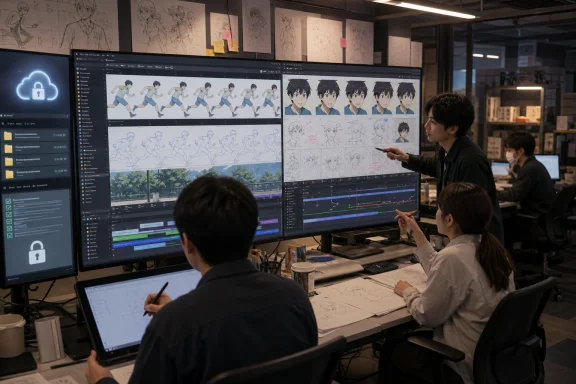
CrestLab’s ANICRA platform is among the systems being positioned as a production assistant rather than a replacement for artists. In an example shown to MBS, five prepared drawings produced 80 in-between frames in about 10 minutes. CrestLab says its system can generate roughly 200 such images in 10 to 20 minutes, compared with an average manual workload of around 30 minutes per frame.
The technical pitch is straightforward: automate repetitive steps, reduce bottlenecks, and give studios room in tight production calendars. The hard part is proving that the tool and its outputs are safe to use commercially.
Studios cited by MBS said they remain cautious where the origin of model-training data is unclear. A generated image that resembles protected material can create a legal and distribution risk late in a project, when the cost of correcting or withdrawing a scene is highest.
CrestLab says ANICRA is trained only on materials entrusted by participating anime studios, an approach designed to make rights management more workable. The company’s own announcements describe the platform as covering processes including in-betweening, coloring and finishing. That distinction matters: a studio-built or studio-licensed dataset is very different from sending production assets into a broadly trained public image or video model.
But the industry’s concern is not limited to whether the results look right. In-between and cleanup work have traditionally been entry points where junior animators learn timing, anatomy, consistency and production discipline. Removing too much of that work may ease a short-term labor shortage while weakening the pipeline that develops future key animators and directors.
Veteran animator Akiko Nakano told MBS that fully AI-generated production could make the drawing department disappear, although she also argued that artists may retain a role in correction, emotional expression and final polish. That reflects the current compromise being tested: AI produces a draft or handles repetitive motion, while human staff retain creative control and quality responsibility.
For Windows users and IT teams supporting creative shops, the story is less about a consumer AI feature than workflow governance. Studios adopting these tools will need controlled datasets, documented permissions, isolated project storage, review checkpoints and clear rules on whether cloud services may receive unreleased artwork or voice assets.
The next practical test is whether studios can demonstrate that AI-assisted footage is legally traceable, artist-reviewed and acceptable to audiences before it becomes a standard production tool.
The immediate target is in-between animation: the large volume of drawings that connect key poses and make a scene move smoothly. MBS reported that a single episode can require roughly 4,000 drawings, with some productions exceeding 10,000. Individual cuts pass through key animators, supervisors, cleanup artists and in-between specialists before color and backgrounds are applied.
CrestLab’s ANICRA platform is among the systems being positioned as a production assistant rather than a replacement for artists. In an example shown to MBS, five prepared drawings produced 80 in-between frames in about 10 minutes. CrestLab says its system can generate roughly 200 such images in 10 to 20 minutes, compared with an average manual workload of around 30 minutes per frame.
 Rights clearance is the central constraint
The technical pitch is straightforward: automate repetitive steps, reduce bottlenecks, and give studios room in tight production calendars. The hard part is proving that the tool and its outputs are safe to use commercially.Studios cited by MBS said they remain cautious where the origin of model-training data is unclear. A generated image that resembles protected material can create a legal and distribution risk late in a project, when the cost of correcting or withdrawing a scene is highest.
CrestLab says ANICRA is trained only on materials entrusted by participating anime studios, an approach designed to make rights management more workable. The company’s own announcements describe the platform as covering processes including in-betweening, coloring and finishing. That distinction matters: a studio-built or studio-licensed dataset is very different from sending production assets into a broadly trained public image or video model.
Efficiency still creates a staffing problem
AI tools are also being developed for lip movement, blinking, character motion and background styling. MBS reported that one tool can generate basic facial motion from a character image and audio in about a minute, while another applies motion to hair, clothing and expressions from CG reference movement.But the industry’s concern is not limited to whether the results look right. In-between and cleanup work have traditionally been entry points where junior animators learn timing, anatomy, consistency and production discipline. Removing too much of that work may ease a short-term labor shortage while weakening the pipeline that develops future key animators and directors.
Veteran animator Akiko Nakano told MBS that fully AI-generated production could make the drawing department disappear, although she also argued that artists may retain a role in correction, emotional expression and final polish. That reflects the current compromise being tested: AI produces a draft or handles repetitive motion, while human staff retain creative control and quality responsibility.
For Windows users and IT teams supporting creative shops, the story is less about a consumer AI feature than workflow governance. Studios adopting these tools will need controlled datasets, documented permissions, isolated project storage, review checkpoints and clear rules on whether cloud services may receive unreleased artwork or voice assets.
The next practical test is whether studios can demonstrate that AI-assisted footage is legally traceable, artist-reviewed and acceptable to audiences before it becomes a standard production tool.