

Cricket Australia has pushed a major update to its Cricket Australia Live app, embedding real‑time artificial intelligence that delivers automated match analysis, conversational follow‑up queries and access to the organisation’s official scorecards stretching back to 1886 — a move that blends near‑instant editorial commentary with a deep historical archive and places the sport squarely in the vanguard of “agentic” sports apps.
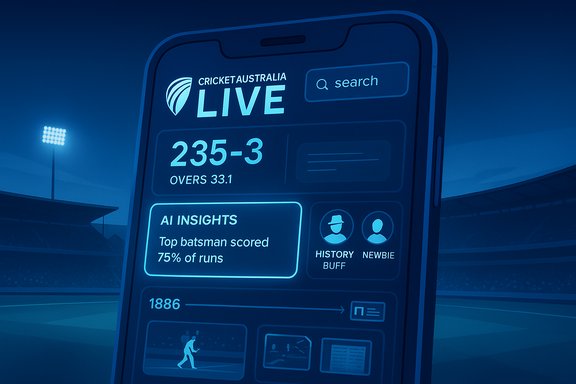
Cricket Australia’s new release converts the app from a passive scoreboard and commentary companion into an interactive, AI‑driven second‑screen product. The headline features are:
For fans, the promise is immediate contextualisation: when a batter reaches a milestone, the app will not only show the score but can instantly link that feat to similar performances from the 19th, 20th or 21st centuries. For broadcasters and sponsors, the same system creates rapid content hooks and sponsored moments that can be surfaced to specific fan segments.
The partnership mix (Insight as integrator, Microsoft for cloud and model hosting, HCL/Skewer for integration) is also telling. Vendors are converging on prebuilt patterns — Foundry + RAG + caching + editorial templates — that reduce technical uncertainty but concentrate risk in platform dependence and ongoing costs. The same architecture has been used in other high‑profile sports rollouts and brings both speed and familiar trade‑offs.
Source: futurefive.com.au https://futurefive.com.au/story/cricket-australia-updates-app-with-ai-insights-analysis-history/
 Overview
Cricket Australia’s new release converts the app from a passive scoreboard and commentary companion into an interactive, AI‑driven second‑screen product. The headline features are:- AI Insights: automated, short‑form editorial analysis generated as matches progress, designed to surface milestones, records and narrative hooks alongside ball‑by‑ball coverage.
- Conversational follow‑ups: users can ask questions during matches and receive on‑screen answers; future updates will introduce selectable AI “personas” (for example, a History Buff or Newbie) to tailor tone and detail.
- Historic archive access: official Cricket Australia scorecards dating to 1886 are now searchable inside the app, enabling instant historical comparisons.
- Platform and partners: the rollout lists Insight Enterprises as lead integrator, with Microsoft supplying Azure AI Foundry hosting, and development/integration support from HCL Tech and Skewer.
Background: why this matters to fans and rights holders
Sports rights holders have been consolidating archives, telemetry and editorial content into productised data fabrics for several years. The Cricket Australia update follows a now‑common playbook: merge structured match data with long‑form historical content, index it for fast retrieval, and overlay generative AI to produce narrative outputs that are consumable, shareable and personalized. The result is a second‑screen experience that aims to keep fans engaged during live play, increase app session time and create new avenues for social sharing and monetisation.For fans, the promise is immediate contextualisation: when a batter reaches a milestone, the app will not only show the score but can instantly link that feat to similar performances from the 19th, 20th or 21st centuries. For broadcasters and sponsors, the same system creates rapid content hooks and sponsored moments that can be surfaced to specific fan segments.
Technical anatomy: what the app appears to be running under the hood
Cricket Australia and its partners describe an architecture built on Microsoft Azure AI Foundry hosting OpenAI models (reported as GPT‑5), backed by a searchable archive and a live telemetry feed. Independent and partner reporting places the solution into the familiar enterprise AI pattern used by other sports bodies: an ingestion and ETL layer to normalise match telemetry and editorial content; a vector/RAG (retrieval‑augmented generation) index for fast retrieval of relevant passages; an agent orchestration layer that composes answers; and caching and operational stores to meet match‑day latency requirements. Key technical components likely in play (as signalled by public reporting and parallel deployments in the sector):- Azure AI Foundry as the model and agent hosting layer, providing managed model deployment, agent orchestration and governance primitives.
- A foundational LLM (reported by press as OpenAI’s GPT‑5) performing live query and conversation handling. This model is described as the conversational brain for follow‑up Q&A and persona switching.
- A vector store / RAG pipeline and operational store (patterned after widely used designs) that holds embeddings and precomputed prompts so the system can rapidly pull historical scorecards, editorial snippets and small video clips to ground generated responses.
- Caching layers and fast NoSQL or in‑memory stores to ensure sub‑second retrieval for predictable queries and feed updates during peak concurrency. These are standard for live‑match systems and are described in partner materials and sector case studies.
What’s new in the user experience
Real‑time editorial feed
The AI Insights feed appears as short editorial blocks alongside live scores and video. These are not raw model outputs dumped into the UI; partner statements emphasise editorial style, implying human review, templates or editorial prompts are used to maintain tone and reliability. That editorial framing helps the product feel like a curated companion rather than an unchecked chatbot.Conversational follow‑ups and personas
The app supports follow‑up questions inside matches and is planned to offer multiple AI personas in later releases. Personas help tune verbosity and assumptions (for example, avoiding jargon when a user selects a newbie persona). Persona switching is a sensible UX choice: it lets the same underlying model produce outputs tailored by complexity and voice.Historical linking and search
By surfacing official scorecards from 1886 forward, the app embeds a searchable timeline of Cricket Australia’s data. This provides immediate use cases — “When was the last time a player hit five sixes in an over?” — but it also raises practical indexing and data‑cleansing work on the back end: older scorecards often need schema normalization before they can be reliably surfaced alongside modern telemetry.Strengths and strategic upsides
- Deeper, faster fan engagement: short‑form, analytic outputs combined with conversational queries turn passive viewers into active participants, increasing session length and social sharing opportunities.
- Historic narrative as a retention tool: linking live events to a 140‑year archive taps into nostalgia and enriches storytelling in a way simple box scores cannot.
- Operational maturity via established cloud platform: using Azure AI Foundry provides access to governance, observability and agent orchestration features enterprises need to run model‑driven products at scale. That lowers some operational risk compared to bespoke model hosting.
- Partner ecosystem and delivery velocity: Insight Enterprises as systems integrator, supported by HCL Tech and Skewer, brings delivery experience and packaged accelerators that reduce time‑to‑market for the feature set.
- Commercial upside: the product creates commercial hooks — personalised sponsor activations, sponsored insights, premium persona tiers and contextual merchandising — that rights holders can monetise without altering the broadcast product.
Risks, technical caveats and governance concerns
No practical AI deployment is risk‑free. The Cricket Australia update is ambitious and exposes several typical operational and ethical risks that should be actively managed.Hallucination and factual accuracy
Generative models can invent plausible but incorrect statements. In a sports context, a hallucinated record or misattributed milestone can damage credibility quickly. This risk is mitigated by retrieval‑grounded generation (RAG), editorial templates, human oversight, and conservative prompt design — but it remains an operational liability that requires ongoing evaluation and human‑in‑the‑loop controls. Public commentary indicates Cricket Australia is using archival scorecards to ground outputs, but the approach and auditing mechanisms are partner/dealer claims and should be monitored empirically.Data provenance, rights and copyright
Surfacing historical scorecards and editorial snippets raises rights issues: who owns which archive items, whether clips can be republished in generated context, and whether the system’s summaries respect licence terms. Enterprise agent platforms provide tool‑level governance that can restrict outputs, but legal clearance and editorial oversight are needed for archive reuse. Those agreements are normally negotiated behind the scenes; external reporting confirms partnerships but cannot verify licence details publicly. Treat archive availability as a rights‑holder claim until contracts or technical demos explicitly demonstrate permitted content flows.Privacy and data residency
If the conversational layer logs queries or personalises by linking to user profiles, Cricket Australia must manage PII, consent and residency requirements. Azure provides encryption, Entra identity controls and tenant isolation features, but the deployment’s compliance posture depends on the implementation choices made by Cricket Australia and its partners. Organisations commonly underestimate the ongoing data‑ops burden when delivering personalised experiences at scale.Cost, FinOps and scalability
Real‑time model inference at peak concurrency carries material compute costs. Caching, precomputation for common queries, and carefully scoped persona responses are cost‑mitigation tactics. Without FinOps guardrails, monthly bills for heavy match days (international Tests or major tournaments) can balloon. The industry has repeatedly emphasised the need for metering, quota controls and precomputed answers to balance latency and cost.Vendor lock‑in and portability
A Foundry + Azure‑native stack accelerates development but increases coupling to Microsoft’s cloud and tooling. If Cricket Australia later wishes to migrate models or index stores to alternative providers, doing so will incur extraction and re‑engineering costs. Organisations should plan exportable indexes, documented runbooks and contractual escape hatches where portability matters.Over‑reliance on a single foundation model version
The public coverage attributes the conversational brain to OpenAI’s GPT‑5. Model versions evolve; patching, governance, or performance regressions can change behaviour overnight. Production teams must build continuous evaluation, rollbacks and model‑version gating into release processes. If the GPT‑5 claim is vendor‑announced and not independently verifiable, that should be flagged as a vendor‑claimed technical detail.Practical recommendations for Cricket Australia and partners
- Maintain strong RAG guardrails and provenance metadata in every generated insight. Link every AI insight to a supporting archival record or telemetry snippet visible to users.
- Implement human‑in‑the‑loop editorial checks for high‑visibility matches and milestone items; automate lower‑risk items with conservative templates.
- Publish a clear privacy and data‑usage statement inside the app explaining what conversational logs are retained and how personalisation is performed.
- Build FinOps controls: budgeting, auto‑throttles for inference, precomputed responses for commonly asked questions and persona complexity caps.
- Expose a “source” toggle in the UI so advanced users can view the archival evidence behind each insight — this increases trust and supports fact‑checking by the community.
- Plan an exit/portability strategy for indexes and precomputation artifacts to reduce vendor lock‑in risk in the medium term.
- Run continuous evaluation and user‑feedback loops: surface a “disagree/flag” option for users to report inaccurate or misleading insights and log those events for model retraining.
What this means for the broader sports and tech ecosystem
Cricket Australia’s move is part of a larger industry shift: rights holders are increasingly productising their archives and building conversational experiences that package narrative value for fans. The commercial implications are clear — personalised sponsor tie‑ins, premium assistant tiers, and in‑app commerce — but so are the governance implications. Organisations that succeed will combine editorial standards, robust data engineering and active model governance with creative product design.The partnership mix (Insight as integrator, Microsoft for cloud and model hosting, HCL/Skewer for integration) is also telling. Vendors are converging on prebuilt patterns — Foundry + RAG + caching + editorial templates — that reduce technical uncertainty but concentrate risk in platform dependence and ongoing costs. The same architecture has been used in other high‑profile sports rollouts and brings both speed and familiar trade‑offs.
Community and broadcast implications
For fans, the UX is promising: the ability to ask a historical question mid‑match and receive an immediate, well‑sourced answer changes the real‑time conversation around cricket. For broadcasters, the app’s insights can be repurposed for second‑screen graphics and social clips, creating an integrated storytelling funnel. Rights holders should however be prudent about how generated content is scaled into broadcast environments — editorial gates and legal clearance remain necessary, particularly for archived media.Claims that require caution or further verification
- The deployment’s use of OpenAI’s GPT‑5 is consistently reported in press coverage; however, model branding and hosting arrangements are vendor claims and should be treated as such until a technical disclosure or product documentation confirms the specific model, fine‑tuning or safety layers being used in production. Independent verification would require either an official developer technical brief or a controlled demonstration.
- The figure “more than one million Australians use the app each summer” is a Cricket Australia–reported metric that appears across outlets; it is a credible usage indicator but remains an organisation‑declared statistic rather than an independently audited KPI.
Conclusion
Cricket Australia’s AI‑enhanced Live app is a logical, carefully orchestrated advance for sports fan engagement: it pairs a century of curated archival data with modern, conversational AI to produce editorial‑grade, shareable context in real time. The feature set — AI Insights, conversational follow‑ups, persona selection and archive search — follows a proven enterprise AI pattern underpinned by Azure AI Foundry and solutions integrators, and it unlocks meaningful engagement and monetisation paths for the sport. At the same time, success depends firmly on sound operational practices: retrieval‑grounding, tight editorial control, robust privacy and FinOps governance, and transparent provenance for every AI‑generated claim. With those guardrails in place, Cricket Australia’s update will likely raise the bar for how national sporting bodies use AI to deepen fan relationships — but the long‑term scorecard will depend as much on governance and reliability as it does on novelty and historical nostalgia.Source: futurefive.com.au https://futurefive.com.au/story/cricket-australia-updates-app-with-ai-insights-analysis-history/
