

A critical command‑injection flaw has been reported in the groov Manage REST API used by Opto22’s GRV‑EPIC and groov RIO families, allowing an authenticated administrator‑level API request to inject shell commands that execute with root privileges; vendor firmware updates and CISA guidance recommend urgent remediation and network hardening to prevent misuse. This is a root‑level remote code execution risk for GRV‑EPIC‑PR1, GRV‑EPIC‑PR2 and several groov RIO SKUs unless patched to the vendor‑recommended firmware baseline.
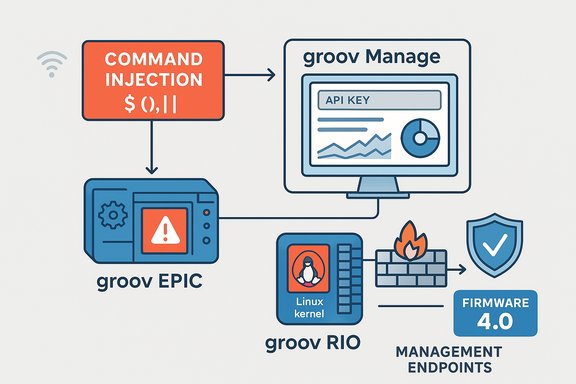
Opto22’s groov EPIC and groov RIO product lines are Linux‑based edge controllers and remote I/O modules that expose a management stack known as groov Manage (the management UI) and multiple REST APIs (groov Manage REST API, groov View REST API, PAC Control REST API) for programmatic operations. The management APIs are used for routine automation tasks, configuration, file operations, and I/O access; they require an API key tied to a user account and therefore carry administrative authority when used by admin accounts. The vendor documents that API usage is authenticated with an API key header and shows examples of file and I/O‑related endpoints being callable from scripts and automation tools. Opto22 has been actively publishing firmware updates and security‑related release notes for the groov platform, and in mid‑2025 it shipped the major Firmware 4.0 family that rebuilt the device stack on an updated Linux kernel and added a number of security and functional changes. The 4.0 branch is the foundation Opto22 references for continuing fixes and enhancements. The vulnerability at the heart of this advisory targets groov Manage’s REST interface: a POST endpoint reads HTTP header fields and unsafely composes shell commands from those fields, allowing an attacker who already possesses administrative API access to craft header data that results in shell command execution as root. Public coordination identified this as a command‑injection class issue (improper neutralization of special elements used in OS commands), leading to an assigned advisory identifier and vendor remediation guidance. The vendor and government coordination recommend upgrading affected devices to fixed firmware as the primary corrective action.
Host/EPIC signals
Source: CISA Opto 22 GRV-EPIC and groov RIO | CISA
 Background / Overview
Opto22’s groov EPIC and groov RIO product lines are Linux‑based edge controllers and remote I/O modules that expose a management stack known as groov Manage (the management UI) and multiple REST APIs (groov Manage REST API, groov View REST API, PAC Control REST API) for programmatic operations. The management APIs are used for routine automation tasks, configuration, file operations, and I/O access; they require an API key tied to a user account and therefore carry administrative authority when used by admin accounts. The vendor documents that API usage is authenticated with an API key header and shows examples of file and I/O‑related endpoints being callable from scripts and automation tools. Opto22 has been actively publishing firmware updates and security‑related release notes for the groov platform, and in mid‑2025 it shipped the major Firmware 4.0 family that rebuilt the device stack on an updated Linux kernel and added a number of security and functional changes. The 4.0 branch is the foundation Opto22 references for continuing fixes and enhancements. The vulnerability at the heart of this advisory targets groov Manage’s REST interface: a POST endpoint reads HTTP header fields and unsafely composes shell commands from those fields, allowing an attacker who already possesses administrative API access to craft header data that results in shell command execution as root. Public coordination identified this as a command‑injection class issue (improper neutralization of special elements used in OS commands), leading to an assigned advisory identifier and vendor remediation guidance. The vendor and government coordination recommend upgrading affected devices to fixed firmware as the primary corrective action.Affected products and versions
According to the coordinated advisory, the following devices and firmware ranges are in scope:- GRV‑EPIC‑PR1 — Firmware versions prior to 4.0.3
- GRV‑EPIC‑PR2 — Firmware versions prior to 4.0.3
- groov RIO GRV‑R7‑MM1001‑10 — Firmware versions prior to 4.0.3
- groov RIO GRV‑R7‑MM2001‑10 — Firmware versions prior to 4.0.3
- groov RIO GRV‑R7‑I1VAPM‑3 — Firmware versions prior to 4.0.3
Vulnerability technical summary
What the flaw is
- The flaw is a command‑injection (CWE family: improper neutralization of special elements used in an OS command) in groov Manage’s REST API.
- A crafted POST request to the vulnerable endpoint can cause the server to read attacker‑controlled header values and use them directly, unsafely, to assemble and execute shell commands on the device.
- The executed commands run with root privileges on the device.
Preconditions and attack model
- The vulnerability requires the ability to make authenticated API calls that the device treats as administrative. In practical terms, the attacker needs an account or API key with administrative privileges (the official scoring and advisory indicate higher privileges are required).
- Typical exploitation vectors are:
- Compromise or theft of an administrator API key / credentials (credential theft, misconfiguration, or insider threat).
- Abuse of an administrative session exposed via unsafe remote access or VPN that lacks sufficient endpoint controls.
- Because the API is network‑facing to authorized clients, a compromised engineering host, jump host, VPN session, or malicious insider can provide the prerequisite access for exploitation.
Severity scoring (as reported)
- Coordinated CVSS scoring produced both v3.1 and v4 assessments: the issue yields high impact on confidentiality and integrity due to root‑level execution, while some vectors flag elevated privileges required. The advisory assigns high overall severity due to the root RCE impact; confirm the precise vector strings and scores in the authoritative advisory for your risk model.
What an attacker achieves
- Arbitrary command execution as root, which can be used to:
- Install persistent backdoors or reverse shells.
- Modify I/O logic, tamper telemetry, or alter control behavior.
- Drop malicious firmware or manipulate filesystem contents.
- Use the compromised device as a pivot into adjacent OT or IT systems—particularly dangerous where network segmentation is weak.
Why Windows/IT teams should care
Although the vulnerability exists on Linux‑based OT devices, its ramifications extend into Windows‑centric IT environments because:- Engineering workstations, HMIs, and update management systems are typically Windows hosts and often hold credentials or jump‑host access to OT devices.
- A compromised groov EPIC with root access can be wielded to attack jump servers, harvest credentials, or manipulate management channels used by Windows administrators.
- Incident response and forensic analysis will likely involve Windows systems (for log aggregation, SIEM, EDR orchestration, and remediation tooling).
Verification and cross‑checks performed
- Confirmed: the groov Manage REST API exists and uses an API key header for authentication; the vendor documents the file and I/O endpoints that an authenticated user can invoke. This is relevant because the vulnerability affects headers passed to that API.
- Confirmed: Opto22 published a major firmware 4.0 release and continues to issue firmware updates in that branch. The release blog documents security updates and a re‑based kernel in Firmware 4.0.
- Cross‑checked: standard CISA‑style mitigations for ICS devices (network isolation, firewalling, VPN hygiene, minimize internet exposure) match the defensive guidance included with coordinated advisories and are standard practice for industrial devices. Practitioners should apply these as part of a defense‑in‑depth posture.
Practical risk evaluation — what this means for operations
- Immediate consequence: a full device compromise. Root execution grants an attacker complete control over the controller and its filesystem.
- Attack complexity: while exploitation requires an administrative API context (reduces the remote, unauthenticated likelihood), many real‑world incidents begin with credential theft (phishing, credential reuse, exposed jump hosts). Therefore the real attack path may be low in practice.
- Reach: groov EPIC and groov RIO devices are used in manufacturing and critical infrastructure; a compromised device can disrupt process control and safety functions.
- Lateral impact: with a foothold on a controller, attackers can manipulate data flows to SCADA/HMI or use the device to move laterally into engineering hosts (often Windows machines) and corporate IT networks if segmentation is weak.
- Supply/chain risk: attackers with persistent control could tamper with firmware or configuration updates, introducing malicious updates into the environment.
Immediate mitigation and remediation checklist (prioritized)
Follow a fast, ordered playbook to reduce exposure and contain risk. Treat this as an operational emergency checklist.- Inventory and identify
- Locate every GRV‑EPIC and groov RIO by model, serial, management IP, and current firmware string.
- Identify the management hosts and engineering workstations that have API keys or administrative access to these devices.
- Isolate exposed units
- If any affected devices are reachable from the Internet, remove that exposure immediately (block external access at the perimeter).
- Place devices behind management jump hosts and restrict access to a narrow set of hardened operator/engineering IPs.
- Apply vendor fixes
- Upgrade affected devices to the vendor‑supplied fixed firmware version (the coordinated advisory recommends firmware 4.0.3 as the fixed release baseline for affected SKUs).
- Test the firmware update in a staging environment before mass roll‑out where operational continuity matters.
- Verify the firmware image integrity (checksums/signatures) before applying.
- Rotate and limit credentials and API keys
- Revoke and rotate API keys for administrative accounts used against groov Manage.
- Remove or disable unnecessary administrative accounts; ensure only named, auditable service accounts remain active.
- Enforce unique passwords and multi‑factor authentication for accounts that manage OT devices where supported.
- Harden remote access
- If remote vendor access is needed, require just‑in‑time access or bastion/jump hosts with strong logging and ephemeral credentials.
- Update and patch VPN concentrators and remote access appliances—VPNs are only as strong as the endpoints they connect to.
- Monitor for indicators of compromise (IOC)
- Look for anomalous POSTs to groov Manage endpoints, unexpected file creation under /home or system directories, or sudden changes to crontab, SSH authorized_keys, or new services.
- Monitor firewall logs and SIEM for unusual traffic between engineering hosts and EPIC devices.
- On Windows engineering hosts, run EDR scans for suspicious tools or unexpected process launches tied to exploitation windows.
- Implement compensating network controls if patching is delayed
- Enforce strict firewall rules that limit API access to specific management hosts only.
- Apply web application firewall (WAF) or API gateway protections that can detect or block suspicious POSTs to management endpoints.
- Use application allow‑listing and restrict outbound connections from devices to known vendor update servers only.
Detection guidance: indicators and forensic signals
Because the vulnerability yields root command execution, detection must include host, network and management layers.Host/EPIC signals
- Unexpected new files in system locations (e.g., /tmp, /var/tmp, /home/dev/unsecured).
- New or modified cron entries, systemd units, or init scripts.
- New SSH keys added to /root/.ssh/authorized_keys.
- Unusual processes owned by root (reverse shell binaries, netcat/listeners).
- Tampered system logs or logs showing POST requests at the exploitation time.
- POST requests to groov Manage REST endpoints from unusual sources or outside scheduled maintenance windows.
- Large or persistent outbound connections from the EPIC/RIO to external IPs (possible C2).
- Unexpected file transfers (SCP/SFTP/HTTP) initiated from the device.
- Elevated or anomalous API key usage originating from a Windows engineering host.
- Unusual process creation or lateral movement activity on jump hosts and jump‑box Windows systems.
- Credential dumping or tool execution on engineering workstations timed with groov Manage calls.
- Enable and collect groov Manage logs and export them to a central SIEM.
- Configure alerting for management endpoint POSTs that include file write, create, or module update semantics.
- On Windows hosts that manage groov devices, ensure EDR scanning rules are enforced and memory/process captures are enabled where possible.
Hardening recommendations beyond patching
- Enforce least privilege for all groov Manage accounts. Create API‑only accounts with scoped permissions for automation scripts, and never use a generic admin API key for routine automation.
- Use network segmentation and deny‑by‑default firewall rules. Management VLANs should be strictly separated from corporate and Internet‑facing segments.
- Implement just‑in‑time (JIT) remote access and ephemeral credentials for vendor or external maintenance.
- Make firmware updates part of an OT change‑control process with code signing verification and pre/post‑update functional checks.
- Maintain offline, immutable backups of critical controller configurations and groov View projects.
- Keep a security‑oriented inventory (who has API keys, where those keys are stored, and how they are rotated).
If you detect compromise: response playbook (high level)
- Quarantine affected device(s) from the network immediately (preserve evidence).
- Collect forensic artifacts: system logs, /var/log contents, active process lists, crontabs, authorized_keys, firmware image checksums.
- Revoke API keys and rotate administrative credentials before reintroducing management connectivity.
- Reimage or restore the device from a known‑good image after confirming firmware integrity (where practical).
- Review adjacent systems (engineering workstations, jump hosts, logging servers) for indicators of lateral movement and clean them as needed.
- Report the incident into your internal IR process and relevant national authorities as required; coordinate with Opto22 support.
Critical analysis — strengths, gaps and residual risk
What’s good about the coordinated response- Vendor: Opto22 is maintaining an active firmware release cadence and provides integrated API documentation for device management—this transparency enables defenders to validate, patch and verify deployments. The groov 4.0 family demonstrates a move to a modernized stack and a path for security updates.
- Government coordination: CISA‑style advisories routinely provide practical mitigations and call for reducing Internet exposure of control devices, which aligns with operational best practice and helps standardize defender actions.
- Precondition of admin API access: although the vulnerability requires administrative API authority to trigger, many breach chains begin with credential compromise. If admin keys are not tightly protected or rotated, the barrier to exploitation effectively disappears.
- Visibility: many sites lack comprehensive monitoring for API activity against OT devices—without good logging and SIEM integration, exploitation may go unnoticed for long periods.
- Patch windows and operations: firmware updates on fielded OT assets often require maintenance windows and testing; the time between disclosure and full patch deployment leaves a risk window.
- Supply/firmware tampering risk: a root compromise can allow an attacker to modify subsequent update processes or images if update verification and signing are incomplete.
- The advisory material and CVE identifiers assigned in coordinated advisories should be confirmed through the vendor bulletin and authoritative vulnerability repositories (NVD/MITRE and the coordinating government advisory). At the time of writing, operators should actively confirm the CVE/NVD pages and vendor security bulletin for the exact fixed version and step‑by‑step upgrade guidance. If any discrepancy exists between the advisory and your device’s SKU/firmware mapping, contact Opto22 support for clarification.
Practical detection queries and hunt rules (examples)
- SIEM rule: alert on HTTP POSTs to paths matching /manage/api/ or /view/api/ where the source is not a whitelisted management host.
- Network IDS rule: flag HTTP headers with shell metacharacters typical of command injection attempts (e.g., semicolons, backticks, $, &&) when combined with APIKey authentication headers.
- Endpoint hunt: search for new setuid binaries, unexpected executable files in /tmp, and new root cron entries between date ranges coinciding with anomalous API calls.
- Windows IR: query recent network connections from engineering hosts to EPIC/RIO management ports and correlate with process creation events.
Final recommendations and wrap‑up
- Immediate: treat the advisory as urgent for any impacted groov EPIC or groov RIO installations. Inventory devices, isolate Internet‑exposed units, and patch to the vendor’s fixed firmware only after validating the correct image for your SKU.
- Short term: rotate administrative API keys, strengthen VPN/jump host protections, and implement strict firewall rules to limit who can access groov Manage.
- Medium term: incorporate groov device patching into your OT change‑control process, enforce least privilege on all API users, and instrument logging and SIEM rules to detect anomalous API calls and host changes.
- Verify: confirm the exact CVE entry and fixed firmware version on authoritative sources (Opto22 downloads and the coordinating government advisory) for your device SKU before and after remediation. Vendor documentation and official firmware release notes are the final word on the correct upgrade package.
Source: CISA Opto 22 GRV-EPIC and groov RIO | CISA
