

Colorado State University’s campus conversation about artificial intelligence moved from planning to product on Oct. 14 with the public debut of CSU‑GPT, a university‑hosted generative AI service launched at the CSU Ignites AI symposium in Fort Collins and positioned as a secure, systemwide tool for students, faculty and staff.
CSU‑GPT arrives as part of a broader CSU strategy to embed generative AI in higher education—paired with training, governance and platform experimentation—aimed at giving campus communities equitable, privacy‑minded access to large language model (LLM) capabilities. The CSU AI Hub describes CSU‑GPT as “secure, responsible, and built for CSU,” running on Microsoft Azure and NebulaOne and offering functionality such as file chat, web‑aware answers, custom agents and institutional governance controls. The Oct. 14 Ignites AI gathering brought campus leaders, students, local government partners and industry representatives together to demonstrate and debate what responsible AI adoption should look like in a public university. Student publications and on‑campus reporting highlighted live demos, breakout sessions on AI literacy and privacy, and an announced pilot for a student‑centric “Ram‑GPT” service slated for a Spring 2026 launch.
If CSU can secure enforceable vendor commitments, scale AI literacy across campus, and operate Ram‑GPT pilots with rigorous security and accuracy testing, the platform could become a model for responsible, student‑centered AI in higher education. Conversely, if procurement gaps, rushed agent deployments or inadequate training are allowed to persist, the same platform can quickly become a source of academic confusion and privacy risk. The stakes are high—and CSU’s next quarters of reporting, pilot metrics and governance disclosures will determine whether this launch truly delivers an accountable, equitable, and pedagogically sound AI future for Rams and the wider higher‑education community.
Source: Colorado State University CSU takes next steps into AI with launch of CSU-GPT
 Overview
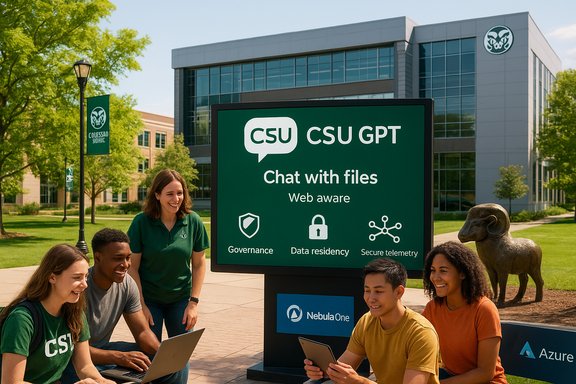
CSU‑GPT arrives as part of a broader CSU strategy to embed generative AI in higher education—paired with training, governance and platform experimentation—aimed at giving campus communities equitable, privacy‑minded access to large language model (LLM) capabilities. The CSU AI Hub describes CSU‑GPT as “secure, responsible, and built for CSU,” running on Microsoft Azure and NebulaOne and offering functionality such as file chat, web‑aware answers, custom agents and institutional governance controls. The Oct. 14 Ignites AI gathering brought campus leaders, students, local government partners and industry representatives together to demonstrate and debate what responsible AI adoption should look like in a public university. Student publications and on‑campus reporting highlighted live demos, breakout sessions on AI literacy and privacy, and an announced pilot for a student‑centric “Ram‑GPT” service slated for a Spring 2026 launch. Background: why CSU is moving fast on campus AI
Colorado State is joining a wave of higher‑education institutions that are moving beyond bans and ad hoc student use to provide managed, institutionally provisioned AI services. The California State University system’s earlier deployment of ChatGPT Edu to hundreds of thousands of students is a high‑profile example of colleges selecting enterprise options to provide equitable access while attempting to meet privacy and compliance needs. That broader context helps explain CSU’s emphasis on a university‑owned AI hub and a governance framework for use on campus. On the Fort Collins campus, CSU’s Ignites AI agenda, sponsors (Microsoft, Accenture and the City of Fort Collins) and sessions make clear the intent: combine vendor capability with campus oversight, training and curricular design to make AI a learning and operational tool rather than a forbidden shortcut. The event’s documented schedule shows a mix of technical, pedagogical and governance sessions, reflecting a whole‑institution approach.What CSU‑GPT is — features and technical baseline
A purpose‑built campus GPT
CSU‑GPT is marketed as an institutional instance of conversational AI designed for internal use and governed by CSU’s Responsible AI framework. According to CSU’s AI Hub, key platform features include:- Chat with files (PDFs, Word, spreadsheets) and retrieve contextual answers.
- Web‑aware search to surface current factual information alongside campus data.
- The ability to create and share custom AI agents built from CSU materials.
- Enterprise containment so prompts, uploads and telemetry remain inside CSU’s Azure tenant.
Model and compute claims
The CSU page presents CSU‑GPT as delivering the capabilities of GPT‑4.0 inside a managed environment. Running on Azure/OpenAI tooling and leveraging a managed NebulaOne deployment gives CSU operational control over the instance and the ability to integrate campus identity (NetID) and data sources. Those are important technical details: they define both capability and the security posture the university is trying to achieve.Ram‑GPT: a student‑focused next step
What Ram‑GPT is intended to do
CSU announced a complementary, student‑focused platform called Ram‑GPT (sometimes written RamGPT in campus materials). Unlike CSU‑GPT—which is broadly available to university personnel—Ram‑GPT is described in event coverage and the Ignites AI agenda as an initiative specifically tailored to student workflows, using multi‑agent techniques to answer complex, cross‑domain student questions (for example, combining housing, financial aid and dining information into a single conversational response). The campus press and student newspaper coverage indicate Ram‑GPT is in pilot/testing and expected to roll out in Spring 2026.Who’s building Ram‑GPT
CSU’s Ignites AI materials and event reporting show Microsoft as a major partner on CSU’s AI programs—helping with curriculum, certifications and platform integration. Some campus materials and event statements indicate Microsoft is supporting Ram‑GPT development efforts; however, available independent reporting focuses on Microsoft’s broader role as a sponsor and technical partner rather than enumerating specific engineering responsibilities. That means the claim that Microsoft is “building” Ram‑GPT should be read as corporate partnership and platform support, rather than an unambiguous declaration that Microsoft is the sole developer or funder. This nuance matters for governance, procurement and contracting oversight.Partnerships and the industry angle
Microsoft, Accenture and municipal collaboration
The Ignites AI event was co‑sponsored by Microsoft, Accenture and the City of Fort Collins—an arrangement that reflects a common model in higher education: vendor partnership plus municipal engagement to pilot public sector uses. Microsoft representatives participated in panels and networking sessions; Microsoft’s education leadership framed CSU’s platform as an example of democratizing AI access on campus. Accenture’s involvement signals a consulting and integration layer that many universities use to operationalize enterprise AI. The City of Fort Collins attended to learn how AI can be applied in municipal services and workforce development.Why vendor relationships matter
Managed LLM deployments rely on vendor clouds, prebuilt services and third‑party tooling; CSU’s use of Azure OpenAI and NebulaOne is typical. These partnerships accelerate time‑to‑value but create long‑term questions about vendor lock‑in, contractual rights over telemetry and the legal teeth behind promises like “we don’t use customer prompts to train models.” Procurement teams must insist on clear retention, deletion and audit rights, and universities should preserve portability where possible. The statewide CSU (California) ChatGPT Edu rollout shows why systemwide procurement is attractive for scale but also why legal terms and governance matter.Governance, Responsible AI, and campus rules
CSU’s Responsible AI framework
CSU emphasizes a governance approach: a Responsible AI framework, an AI Task Force, and educational resources for faculty and staff. The CSU AI Hub and the university’s planning documents position governance as the backbone of institutional AI adoption—covering acceptable use, privacy, and guidance for embedding AI in courses. This is consistent with best practices urged by education policy groups and IT governance experts.Practical governance levers CSU should lock in now
- Data residency and access controls (already signed to Azure tenant usage).
- Clear contractual language on prompt/telemetry retention and model retraining.
- Role‑based access and audit logs for agent creation and sharing.
- Academic integrity rules that distinguish acceptable AI use in coursework and assessment.
- A campus‑wide AI literacy program for students, faculty and staff—covering prompting, verification and citation.
Benefits CSU is aiming for
- Equitable access: Institutional provisioning removes paywall barriers and gives students consistent access to AI tools for learning and research.
- Operational efficiency: CSU anticipates automating routine administrative work—student FAQ triage, scheduling help, and form‑based support—freeing staff for complex human tasks.
- Pedagogical innovation: Faculty can integrate AI into curricula to teach prompt literacy, critical evaluation and AI‑augmented workflows.
- Research acceleration: A private, campus‑governed LLM instance enables researchers to experiment with generative workflows while preserving sensitive data protections.
Risks and open questions
Data privacy and telemetry
CSU’s “tenant‑contained” approach is a solid starting point, but institutions must still negotiate retention periods, third‑party telemetry, and hidden data flows in supporting services (logging, analytics, search indexing). A vendor’s marketing commitment to not use prompts for training is only meaningful when backed by contract terms and verifiable logs. Universities that rely on vendor assurances without contractual guarantees expose themselves to potential downstream risk.Hallucinations, accuracy, and academic integrity
Generative models produce fluent, plausible answers that can be incorrect. CSU’s emphasis on AI literacy and verification is necessary because students and staff may treat AI outputs as authoritative. Institutional curricula must teach how to verify model claims, demand citations, and design assessments that measure understanding rather than the ability to elicit answers from a chatbot.Vendor lock‑in and curriculum conditioning
Deep integration with a single cloud/LLM provider (Azure + NebulaOne, in CSU’s case) can ease operations but can also reduce future portability of pedagogical artifacts and student skills if curricula become platform‑dependent. Universities should promote vendor‑neutral AI literacy (teaching concepts, evaluation, and transfer skills) and insist on data portability in procurement.Equity, accessibility and digital divides
Managed deployments aim to close access gaps, but disparities remain: students without reliable devices or connectivity may still be disadvantaged. Campus programs should pair platform access with device lending, public access points and offline learning resources. Accessibility for students with disabilities must be designed in from day one.Security and adversarial risk
Agent‑based systems and multi‑agent coordination introduce new attack surfaces (agent exploits, supply‑chain compromises). Universities must integrate security testing (red teams), identity hardening and runtime guardrails before giving agents broad production permissions. Early industry research has highlighted runtime enforcement as an essential control for agent safety.Practical recommendations for CSU and peer institutions
For university leaders
- Place procurement protections first: require auditable telemetry and deletion rights in vendor contracts.
- Fund a multi‑disciplinary AI governance office (legal, IT security, pedagogy, accessibility).
- Define measurable KPIs for each pilot (service desk response time, student satisfaction, learning gains).
For IT teams and platform owners
- Integrate CSU NetID and role‑based access before broad rollout.
- Implement end‑to‑end logging with immutable retention for audits.
- Create sandbox environments for faculty to prototype course‑specific agents.
- Run adversarial tests on agents and connectors before production deployment.
For faculty and curriculum designers
- Build AI literacy into core learning outcomes: prompt design, sources verification, ethical use.
- Design assessments that test reasoning and process (not solely content regurgitation).
- Pair tool access with explicit citation and provenance requirements when grading.
What to watch next
- Ram‑GPT pilot outcomes and the Spring 2026 availability window. Early campus reports put Ram‑GPT in pilot status with a Spring 2026 launch target, and the multi‑agent approach it promises will be a valuable test case for student‑focused AI services. Watching how CSU manages privacy and agent orchestration for Ram‑GPT will be instructive for other universities.
- Procurement transparency: whether CSU secures enforceable deletion/audit rights from vendors and how it documents those terms for campus stakeholders. This will indicate the maturity of institutional AI governance.
- Adoption metrics and student learning outcomes: early gains in operational efficiency mean little without parallel evidence of improved student experience and measurable learning improvements. Institutions must track both operational and pedagogical KPIs.
Critical analysis: strengths, gaps, and risk mitigation
Notable strengths
- CSU’s systemwide, officially provisioned platform is the right approach to equity and compliance: it reduces paywall inequality and gives the university levers to impose governance controls. The institutional stance—pairing platform rollout with Responsible AI guidance and education—aligns with best practice.
- The Ignites AI event’s multi‑stakeholder design (students, faculty, vendors, city officials) demonstrates healthy engagement and a willingness to surface concerns publicly, a necessary cultural posture for responsible adoption.
- Technical design choices—tenant containment, NetID authentication and the ability to create controlled agents—are practical, enabling both experimentation and operational controls.
Gaps and risks to close
- Contractual clarity: the university must publish (or make available to governance committees) explicit procurement terms covering telemetry, model training guarantees and deletion rights. Absent these, the platform’s privacy assurances are aspirational rather than legally enforceable.
- Educational safeguards: CSU must scale AI literacy programs quickly. Offering the service without wide‑scale, mandatory literacy training invites misuse and weakens academic integrity safeguards.
- Operational maturity: agent orchestration (the heart of Ram‑GPT’s promise) comes with real security and correctness challenges—those should be validated via staged pilots, red‑team testing and an explicit rollback plan.
How other universities can learn from CSU’s rollout
- Start with a pilot that pairs access with mandatory literacy training and clear governance.
- Keep data in institutional control where possible, but insist on strong contract terms for telemetry.
- Design student‑facing services (like Ram‑GPT) around cross‑domain answer provenance and a human‑in‑the‑loop escalation pathway for complex, high‑stakes queries.
- Publicly publish the governance framework and measurement plan so campus communities can evaluate the program’s tradeoffs.
Conclusion
CSU’s public launch of CSU‑GPT at Ignites AI marks a decisive step from experimentation to institutional provisioning. The university’s model—tenant containment, vendor partnership and a governance framework—reflects a pragmatic pathway many higher‑education institutions will follow. Success will depend less on the novelty of the technology and more on the depth of governance, contractual protections and curricular integration that accompany it.If CSU can secure enforceable vendor commitments, scale AI literacy across campus, and operate Ram‑GPT pilots with rigorous security and accuracy testing, the platform could become a model for responsible, student‑centered AI in higher education. Conversely, if procurement gaps, rushed agent deployments or inadequate training are allowed to persist, the same platform can quickly become a source of academic confusion and privacy risk. The stakes are high—and CSU’s next quarters of reporting, pilot metrics and governance disclosures will determine whether this launch truly delivers an accountable, equitable, and pedagogically sound AI future for Rams and the wider higher‑education community.
Source: Colorado State University CSU takes next steps into AI with launch of CSU-GPT
