

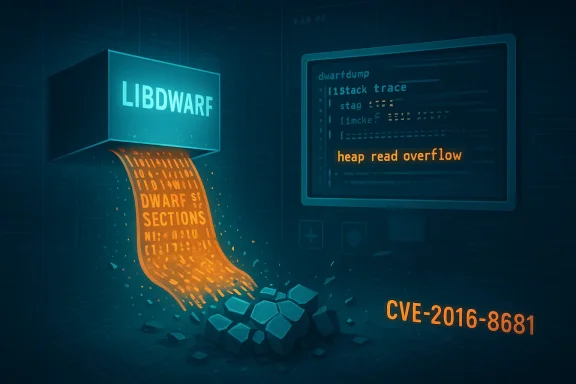
The _dwarf_get_abbrev_for_code bug in libdwarf — tracked as CVE‑2016‑8681 — is a kernel‑level style memory‑safety defect in DWARF parsing that can be triggered by the widely used dwarfdump utility to crash processes that inspect debug sections in crafted binaries, and it remains a useful case study in how binary‑parsing tools, distribution patching policies, and defensive deployment practices interact to create real‑world availability risk.
DWARF is the standard format for debugging information embedded in compiled binaries and object files. Developers and toolchains rely on libraries such as libdwarf to read and interpret DWARF sections; tools like dwarfdump build on libdwarf to print or analyze debug metadata. Because DWARF parsers accept richly structured, variable‑length data pulled from third‑party objects, they are a common target for fuzzing and memory‑safety analyses. The CVE in question was discovered by a Gentoo researcher using fuzzing and AddressSanitizer and was disclosed in October 2016.
At a technical level, the problem appears where libdwarf reads abbreviation tables and related structures: an out‑of‑bounds heap read occurs inside the function _dwarf_get_abbrev_for_code in dwarf_util.c when dwarfdump processes a specially crafted DWARF section. The bug produces a heap buffer over‑read that leads to crashes and a denial‑of‑service condition for the invoking process. Upstream source control contains the developer commit and patch references that address the specific check that was missing.
For any team that uses or ships tools that inspect debug sections, treat DWARF data as hostile input, and apply the principle of least trust: patch promptly, sandbox aggressively, and instrument to detect the moment a crafted file tries to crash your processing pipeline.
Source: MSRC Security Update Guide - Microsoft Security Response Center
 Background
DWARF is the standard format for debugging information embedded in compiled binaries and object files. Developers and toolchains rely on libraries such as libdwarf to read and interpret DWARF sections; tools like dwarfdump build on libdwarf to print or analyze debug metadata. Because DWARF parsers accept richly structured, variable‑length data pulled from third‑party objects, they are a common target for fuzzing and memory‑safety analyses. The CVE in question was discovered by a Gentoo researcher using fuzzing and AddressSanitizer and was disclosed in October 2016.At a technical level, the problem appears where libdwarf reads abbreviation tables and related structures: an out‑of‑bounds heap read occurs inside the function _dwarf_get_abbrev_for_code in dwarf_util.c when dwarfdump processes a specially crafted DWARF section. The bug produces a heap buffer over‑read that leads to crashes and a denial‑of‑service condition for the invoking process. Upstream source control contains the developer commit and patch references that address the specific check that was missing.
What the vulnerability actually is
The technical root cause
- Component: libdwarf, dwarf_util.c, function _dwarf_get_abbrev_for_code.
- Fault type: heap—out‑of‑bounds read (heap buffer over‑read), caused by insufficient bounds validation while reading DWARF abbreviation entries.
- Trigger: running dwarfdump (or any consumer of libdwarf that walks debug abbrev tables) on a crafted file containing malformed DWARF abbreviation data.
- Impact: process crash (denial of service); the vulnerability is not a straightforward remote RCE (remote code execution) on its face because dwarfdump is a local utility, but it can be weaponized to cause availability loss in contexts where untrusted files are processed automatically (for example, a server pipeline that dumps debug info from uploaded artifacts).
How severe is it?
Scoring varies by source. CVSS v3 scores reported in public trackers place the issue in the medium severity band (for example, Tenable and NVD entries list mid‑range scores around 5.5), reflecting that the primary impact is availability (crash) rather than confidentiality or code execution. That said, the practical risk depends heavily on how and where dwarfdump or libdwarf is used in your environment: a developer workstation is a much lower operational risk than an automated service that invokes dwarfdump on untrusted uploads.Timeline and upstream response
- Discovery: fuzzing and AddressSanitizer testing in early October 2016 revealed heap buffer overflows when dwarfdump processed crafted files; the issue was privately reported to upstream.
- Upstream patch: libdwarf maintainers produced code changes for dwarf_util.c to validate bounds and prevent the read; the patch and commit history are present in the upstream source control history. Several OSS security mailing‑list posts document the patch and link to the commit.
- Distribution fixes: different Linux distributions applied the upstream fixes at differing schedules. Arch Linux, Debian, SUSE, and others produced advisory entries and/or updated packages that incorporate the upstream corrections. In contrast, in at least one vendor tracker, Red Hat’s bug entry ended with a WONTFIX status — not because the bug is not real, but historically because Red Hat’s packaged variant or its support policy led to a decision not to ship a fix in certain older branches; consult your distribution’s security tracker.
Where this vulnerability matters in practice
Typical attack scenarios
- Local analysis tools: an unprivileged user running dwarfdump on a crafted ELF/PE/Mach‑O file can crash the dwarfdump process. In multi‑user environments, repeated crashes could be used to interfere with debug pipelines or to increase operational noise and load.
- Automated processing pipelines: Continuous integration systems, malware sandboxes, or build pipelines that extract debug info from uploaded artifacts and process them with dwarfdump could become denial‑of‑service targets if they accept attacker‑controlled files. Because the attacker controls the file contents, the crash is reliably triggered without special privileges.
- Tooling used in services: any network‑exposed service that, behind the scenes, parses or inspects DWARF sections via libdwarf or calls dwarfdump — for example, artifact indexing or binary analysis services — could translate a crafted upload into a remote‑triggerable crash. This is where an otherwise local CLI bug turns into a service‑impacting remote vulnerability.
Where it likely doesn’t — directly — lead to compromise
There is no public technical evidence showing a reliable path from this specific out‑of‑bounds read to arbitrary code execution, privilege escalation, or confidentiality loss. The primary consequence documented is availability: crashes and process termination. However, any ongoing memory‑safety defect in a parser is worth treating with high caution because small variations or other flaws in the same code base have historically converted into information leakage or code‑execution issues.How to detect if you’re affected
- Check installed packages: identify whether your system ships libdwarf and libdwarf‑tools (which contains dwarfdump) and inspect the package versions. Distribution trackers and advisories map CVE‑2016‑8681 to specific package revisions; confirm whether your installed package predates the fixed release. Debian’s security tracker and Arch’s security page provide package‑level status for many distributions.
- Watch for crashes and core dumps: crashing dwarfdump instances with similar AddressSanitizer or segfault traces — particularly stack frames pointing to dwarf_util.c and _dwarf_get_abbrev_for_code — are a direct indicator. Fuzzing researchers shared sanitized crash traces that point to the same function and code paths.
- File provenance and pipeline telemetry: if you maintain services that accept binary uploads, correlate crash events to recent file uploads. Identify UID/process owner, command line (dwarfdump invocation), and the offending file’s hash; this provides an IOC you can use to block offending inputs.
Concrete mitigation and remediation steps
If you manage systems that install or run libdwarf/dwarfdump, apply the following prioritized action plan.- Update packages (primary remediation)
- Upgrade libdwarf and libdwarf‑tools to the vendor‑provided fixed versions for your distribution. Most major distributions backported the upstream fix into point releases; check your distro security tracker and package changelogs to confirm the fix is included.
- If a packaged fix is not available for your distribution or release (for example, EOL branches), consider compiling a patched libdwarf from upstream source that contains the commit addressing the issue, and deploying it to affected hosts in a controlled manner. Upstream commit references are available in source control.
- Reduce the attack surface
- Avoid running dwarfdump (or any DWARF‑parsing tool) on untrusted files in contexts where the tool’s crash would impact availability. Treat dwarfdump like any other untrusted parser: run it in an isolated environment.
- Where integration is required, process untrusted files inside sandboxed containers, chroot jails, or lightweight VMs, and use least‑privilege execution models (unprivileged users, no network access, restricted filesystem).
- Hardening and runtime guards
- Use resource/time limits (ulimit/rlimit) and watchdogs around any automated processing that calls dwarfdump. This avoids a single crafted file from tying up service resources indefinitely.
- For production services, consider seccomp or AppArmor/SELinux profiles that restrict what dwarfdump can do if an exploit triggers anomalous behavior.
- Detection and response
- Log and alert on repeated dwarfdump crashes originating from input processing pipelines; pair this with upload telemetry to identify malicious inputs.
- If you see crashes with function names and frames matching the dwarf_util.c traces described by the original fuzzing reports, treat the event as high priority and isolate the affected host.
- Long‑term development controls
- If you operate code that consumes DWARF via libdwarf, add defensive checks: validate section lengths before passes, use library return codes carefully, and treat DWARF data as untrusted input subject to robust bounds checks. Upstream fixes for this cluster of issues adopt the defensive pattern of returning errors rather than trusting malformed lengths.
Why the CVE wording and exploitability language can be confusing
Public vulnerability trackers sometimes label the attack vector for CVE entries as remote or list network vectors; this can create misunderstanding for developers and administrators because many consumer tools (like dwarfdump) are local CLI programs. The core technical reality is:- The vulnerability is triggered by a crafted file; whether the attacker is remote depends entirely on the surrounding deployment.
- If your environment exposes a service that accepts files from remote parties and that service parses DWARF with libdwarf/dwarfdump, then the bug becomes remotely exploitable as a denial‑of‑service against that service.
- If dwarfdump is only ever run by trusted users on trusted files (e.g., local development machines), the practical risk is localized to those hosts.
Distribution and packaging notes — what administrators should check
- Package versions: examine your distro’s libdwarf and libdwarf‑tools package version and changelog to confirm the presence of the 2016 fixes. Arch and Debian trackers list fixed package versions and dates. If your distro ships a libdwarf older than the fixed commit or a package built from an old vendor fork, treat it as vulnerable until proven otherwise.
- Vendor decisions: some vendor bug reports historically show WONTFIX or “no backport” status for specific releases. This is often a policy decision (for example, not backporting to certain EOL branches) rather than a denial that the issue exists; when in doubt, consult vendor security policy and consider backporting the upstream patch yourself or upgrading to a supported release.
- Upstream source: the upstream libdwarf project maintains source control with explicit commit diffs for the problem areas — these commits are useful when generating in‑house patches for unsupported distro releases.
Risk analysis — strengths and residual risks
Notable strengths in how this vulnerability was handled
- Discovery and disclosure: the bug was found by modern fuzzing and sanitizer tooling (AFL + AddressSanitizer), demonstrating the effectiveness of fuzzing DWARF codepaths that historically have complex state machines. Public mailing lists and upstream commits document the responsible disclosure and patch process.
- Upstream remediation: libdwarf maintainers provided code changes and commits that correct the bounds checks and prevent the immediate out‑of‑bounds read. Distributions that track and ship newer libdwarf releases absorbed these fixes quickly.
Remaining and systemic risks
- Distribution lag: not all distributions or branches receive timely fixes — for hardened or long‑lived enterprise images this can leave otherwise supported systems vulnerable until an administrator upgrades or backports patches. The presence of vendor WONTFIX entries in bug trackers is an operational hazard if teams assume every distro ships a timely fix.
- Parser complexity: DWARF is complex and has a long history of edge‑case parsing bugs. Fixing one function’s bounds checking reduces risk but does not guarantee the absence of other failures in adjacent code paths. Ongoing fuzzing and defensive programming are required.
- Environment exposure: services that automatically process binary uploads remain a persistent risk if they use libdwarf or dwarfdump without sandboxing. Administrators must treat any file parser as hostile by default.
Practical checklist for sysadmins and developers
- Immediately check installed package versions of libdwarf and libdwarf‑tools on all hosts; if versions predate the 2016 fix commits, prioritize patching.
- For any service that accepts binaries from users, ensure DWARF parsing is performed in strong isolation (container/VM), with resource limits and crash monitoring in place.
- If a distro package with the fix is unavailable, build libdwarf from upstream with the patch commit applied and deploy the patched binary to a test environment first. Upstream commit references and tags exist in the project source control.
- Instrument dwarfdump calls with monitoring and correlate crashes to input provenance; add automated quarantining of offending files and rate limiting on file uploads.
- Integrate fuzzing and sanitizer testing in CI for any software that consumes DWARF — even if your product only consumes a thin subset of fields, the attack surface grows when third‑party objects are processed.
Conclusion
CVE‑2016‑8681 is a straightforward but instructive example: a single bounds‑checking omission in a widely used debug‑info parser produced a reliable crash when dwarfdump processed a crafted file. The technical fix is small and well documented, but the real lesson is operational. Administrators must map parser vulnerabilities to their own architectures — a bug that is “local” on a developer machine can be a remotely exploitable denial‑of‑service in a service that processes uploaded binaries. Updating libdwarf packages where available, sandboxing parsing tasks, and integrating fuzzing into QA pipelines are practical, high‑value steps that harden systems against this class of problems.For any team that uses or ships tools that inspect debug sections, treat DWARF data as hostile input, and apply the principle of least trust: patch promptly, sandbox aggressively, and instrument to detect the moment a crafted file tries to crash your processing pipeline.
Source: MSRC Security Update Guide - Microsoft Security Response Center
