

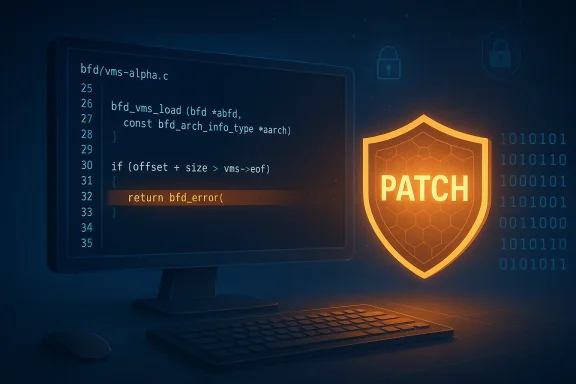
A subtle bounds-checking bug in GNU Binutils’ VMS debugging parser can be coaxed into reading past its intended buffer, producing crashes and potential information disclosure that operators should treat as a real risk when processing untrusted object files or debug sections. This flaw — tracked as CVE‑2023‑25584 and located in the parse_module function inside bfd/vms-alpha.c — was fixed upstream in the Binutils tree, and distributions have issued patches that all users processing third‑party or untrusted binaries should install immediately.
Binutils is the suite of low‑level developer utilities widely used to inspect, link, and manipulate binary files. The BFD (Binary File Descriptor) library inside Binutils parses many object, executable, and debugging formats to present symbol, relocation, and debug information to tools such as objdump, readelf, addr2line, and gdb’s support libraries. A flaw in a parsing routine inside BFD therefore has an outsized impact: malformed inputs can crash these utilities or — in some circumstances where memory beyond a buffer is read — reveal portions of process memory. This particular defect was introduced in the VMS‑format parsing code path and corrected upstream in late 2022.
The vulnerability is an out‑of‑bounds read in parse_module (bfd/vms-alpha.c). In practice this means that, when parsing specially crafted VMS debug records, the parser may read beyond the end of the supplied record or buffer. The consequences reported by vendors and vulnerability trackers include crashes (denial of service) and the potential for leaking memory content from the process’s address space (confidentiality impact). Multiple vulnerability databases assign a medium–high severity to the issue depending on scoring methodology; NVD and several major distributors report scores in the 6.3–7.1 range.
Distributors subsequently picked up the upstream fix in their Binutils packages and released distro‑specific updates. Debian, Ubuntu, SUSE and others list the CVE and reference the fixed package versions; distribution advisories give a stable path for operators who don’t build Binutils from source.
At the time public advisories were posted, there were no confirmed public exploit chains widely reported in the wild for remote compromise; the defect is local and needs a context in which a vulnerable binary is forced to parse attacker‑supplied VMS debug records. Several vulnerability trackers indicate no known active exploitation and show very low EPSS/likelihood scores, but low EPSS does not equate to zero risk for supply‑chain or developer‑facing systems. Always treat local parsing bugs as meaningful threats for systems that consume untrusted inputs.
2.) If updating is delayed, restrict access to tools that use BFD for untrusted inputs.
3.) Rebuild and test any internal toolchain that bundles Binutils statically.
These steps reflect the practical realities reported by upstream and distributors: updating to the fixed Binutils release eliminates the specific out‑of‑bounds read.
CVE‑level vulnerabilities in developer tools are easy to dismiss because the tools are not "server surface" in the classic sense. That attitude is precisely what makes them dangerous: development and CI infrastructure is increasingly automated and network‑exposed, and attackers have adapted to weaponize those exact pipelines. Patch Binutils where it matters, sandbox any parsing of untrusted artifacts, and add crash‑monitoring to your toolchain fleet — those are low‑cost steps that materially reduce the risk from this and the next parser bug that will inevitably be found.
Source: MSRC Security Update Guide - Microsoft Security Response Center
 Background / Overview
Binutils is the suite of low‑level developer utilities widely used to inspect, link, and manipulate binary files. The BFD (Binary File Descriptor) library inside Binutils parses many object, executable, and debugging formats to present symbol, relocation, and debug information to tools such as objdump, readelf, addr2line, and gdb’s support libraries. A flaw in a parsing routine inside BFD therefore has an outsized impact: malformed inputs can crash these utilities or — in some circumstances where memory beyond a buffer is read — reveal portions of process memory. This particular defect was introduced in the VMS‑format parsing code path and corrected upstream in late 2022.The vulnerability is an out‑of‑bounds read in parse_module (bfd/vms-alpha.c). In practice this means that, when parsing specially crafted VMS debug records, the parser may read beyond the end of the supplied record or buffer. The consequences reported by vendors and vulnerability trackers include crashes (denial of service) and the potential for leaking memory content from the process’s address space (confidentiality impact). Multiple vulnerability databases assign a medium–high severity to the issue depending on scoring methodology; NVD and several major distributors report scores in the 6.3–7.1 range.
What exactly is wrong in parse_module?
The technical root cause, in plain language
At a high level, the bug stems from insufficient bounds checks before the code indexes into arrays and sub‑fields of a VMS debug record. The parse_module routine receives a length and then iterates over entries and sub‑elements inside the record, but under certain malformed inputs it will compute offsets or assume lengths that are larger than the remaining bytes. That lets the code attempt to read beyond the valid buffer. The upstream commit that closed the issue makes this explicit: lengths were changed to a correctly typed size, prior “-1” sentinel checks were removed, and explicit sanity checks for record and element lengths were added. The commit message and diff are available in the Binutils tree.Why an out‑of‑bounds read matters
An out‑of‑bounds write is often more obviously dangerous (it can corrupt memory), but an out‑of‑bounds read is also serious:- It can crash the process (segmentation fault), producing a denial-of-service for any automated pipeline that relies on those utilities.
- It can disclose memory contents to an attacker who can control the program output (for example, a server that processes uploaded objects and returns parsed debugging text).
- Repeated exploitation may reveal arbitrary portions of memory over multiple attempts, escalating the confidentiality impact.
- Even if the tool is usually run in a developer context, supply‑chain scenarios and CI systems that process external binaries make the risk material.
Who and what is affected?
Affected component and versions
- The vulnerable code is inside GNU Binutils, specifically the bfd library’s VMS parsing implementation (file bfd/vms-alpha.c).
- Public advisories and vendor trackers indicate all Binutils versions prior to the first upstream fix are potentially affected; many distribution packages built from Binutils releases older than 2.40 are marked vulnerable. In distribution terms, affected packages existed across Debian, Ubuntu, Red Hat derivatives, and other Unix‑like systems until patched versions were shipped.
Attack vector and prerequisites
- Attack Vector: Local / file processing. The bug is triggered when Binutils (or any program using the BFD library) parses a crafted VMS debug record embedded inside an object file or related artifact.
- Privileges: No special privileges are required beyond the ability to get the victim to open or process the crafted file. Many vendors mark user interaction required where a user or an automated system must request parsing of the file.
- Exploitation complexity: Varying assessments exist — Red Hat and NVD characterize the attack complexity as low to medium, while some distributors (notably SUSE) rate specifics differently based on how they ship and update Binutils for developers. These differences reflect differing threat models rather than disagreement about the bug itself.
Practical exposure scenarios
- Developer workstations running tools like objdump, addr2line, or readelf where users open untrusted object files.
- Continuous integration (CI) servers that analyze third‑party binaries as part of a supply‑chain pipeline.
- Analysis systems and forensic appliances that accept untrusted artifacts.
- Any service that programmatically parses binaries and returns processed data to remote users — for example, web-based symbolization services or code-analysis automation.
How the issue was found and fixed
The upstream fix was a targeted hardening of the parse_module code path: the size parameter was normalized to the proper bfd_size_type, several "length == -1" legacy checks were removed, and explicit sanity checks for key record elements were added. The fix was committed by a Binutils maintainer and referenced in mailing list discussion when the issue was disclosed and closed. That commit and the mailing‑list thread provide a clear, verifiable record of the changes that removed the out‑of‑bounds reads.Distributors subsequently picked up the upstream fix in their Binutils packages and released distro‑specific updates. Debian, Ubuntu, SUSE and others list the CVE and reference the fixed package versions; distribution advisories give a stable path for operators who don’t build Binutils from source.
Severity, exploitability, and whether this is being actively exploited
Multiple vulnerability databases agree on the technical description, but their severity assessments differ slightly because scoring depends on assumptions about attack vector and environment. NVD shows the issue as an out‑of‑bounds read with score indications reflecting potential confidentiality and availability impacts. Distribution advisories list CVSS values between roughly 6.3 and 7.1 depending on how they weigh attack complexity and exploitability.At the time public advisories were posted, there were no confirmed public exploit chains widely reported in the wild for remote compromise; the defect is local and needs a context in which a vulnerable binary is forced to parse attacker‑supplied VMS debug records. Several vulnerability trackers indicate no known active exploitation and show very low EPSS/likelihood scores, but low EPSS does not equate to zero risk for supply‑chain or developer‑facing systems. Always treat local parsing bugs as meaningful threats for systems that consume untrusted inputs.
Mitigation and remediation guidance
Patching is the definitive mitigation. Operators should prioritize updates according to how the Binutils tooling is used in their environment.- Immediate steps (recommended)
- Upgrade Binutils to the patched version shipped by your distribution (e.g., packages incorporating the upstream fix around the 2.39.50/2.40 timeframe). Confirm your distro’s advisory and install the released security update.
- If you build Binutils from source, pull the upstream commit that corrects parse_module and rebuild from a fixed tree. The upstream commit message and diff are the authoritative patch record.
- Isolate processing of untrusted binaries. Run tools that parse third‑party binaries in sandboxed environments or ephemeral containers; avoid letting upload parsers run as persistent services with access to sensitive data.
- Add detection and monitoring. If you operate services that parse binaries from remote sources, add logging for abnormal crashes in tools that use BFD and alert on repeated crash patterns.
- Longer‑term mitigations and hardening
- Defense‑in‑depth: perform file format validation and accept‑known‑good strategies where possible. Do not process arbitrary debug sections when there is no operational need.
- Use least‑privilege: run parsing utilities under restricted accounts or inside containers with read‑only or minimal mount privileges.
- Supply‑chain hygiene: for CI pipelines that consume external artifacts, use isolated builder nodes that can be re‑provisioned and that do not contain secrets.
2.) If updating is delayed, restrict access to tools that use BFD for untrusted inputs.
3.) Rebuild and test any internal toolchain that bundles Binutils statically.
These steps reflect the practical realities reported by upstream and distributors: updating to the fixed Binutils release eliminates the specific out‑of‑bounds read.
Risk analysis and operational impact
Strengths in the fix and ecosystem response
- The upstream Binutils maintainers made a focused, conservative change — adding explicit sanity checks and normalizing types, rather than sweeping refactors — which reduces the risk of regressions.
- Most major distributions rapidly integrated the upstream patch into scheduled security updates, giving administrators a straightforward remediation path. Vendor advisories make it easy to find the fixed package versions for each distro.
Remaining risks and caveats
- Tooling ubiquity. Binutils is pervasive in development toolchains and build systems; many environments rely on older packaged versions or custom-built toolchains. Any machine that examines untrusted binaries is exposed until patched.
- Different scoring, different risk models. Not all vendors agree on the impact severity in their internal assessments (for example SUSE’s operational stance treats Binutils as a developer tool with a different threat model), which can lead to inconsistent prioritization across an organization. Administrators must adopt the most conservative posture relevant to their risk tolerance.
- Local vector still meaningful. Although exploitation is local (file processing), modern supply‑chain architectures and automated analysis services often give remote attackers an avenue to get a victim to process a crafted artifact — e.g., by uploading to a symbolization service or convincing CI to run a job that inspects a provided binary.
- No public exploit ≠ no exploitability. Public exploit code has not been widely reported, but the bug’s simplicity (bounds checks omitted in a parser) makes it an attractive target for research; attackers with access to a target that processes user‑supplied binaries could weaponize it.
Case comparisons and historical context
This Binutils parse_module bug is not the first time the function has been flagged. Earlier CVEs (for example in the addr2line tool) also originated from parse_module‑style lapses where unchecked indexing produced out‑of‑bounds reads and related crashes. These repeated findings underline a broader lesson: parsing complex, historical debug formats—especially those with many little‑used record types—requires an especially defensive coding style. The pattern shows maintainers responding with sanity checks and stronger typing across successive fixes.Practical checklist for sysadmins and developers
- Inventory: locate all instances of Binutils and tools that embed BFD (for example, static builds or vendor toolchains).
- Patch: apply your distribution’s security update or rebuild Binutils from the fixed upstream commit.
- Isolate: run parsing tools that touch untrusted files inside ephemeral containers or VMs without access to secrets.
- Monitor: enable alerts for repeated crashes or core dumps from parsing utilities.
- Educate: ensure developer workflows that ingest third‑party binaries understand the risk and follow isolation best practices.
- Patch CI/CD and public-facing analysis services immediately.
- Patch developer workstations used to process external binaries.
- Schedule less‑exposed build hosts for next maintenance window but monitor until patched.
When can you safely de‑prioritize?
If your environment only uses Binutils on fully controlled, internal compiled artifacts (for example, artifacts built in a fully isolated internal build farm that never accepts external inputs), the practical risk is lower. Vendor notes emphasize that Binutils is primarily a developer tool and many installations never encounter untrusted VMS debug records. That said, supply‑chain and operational best practices advise treating any tool that has ever parsed third‑party content as potentially at risk until patched. When in doubt, patch; it’s a low‑impact, high‑value update.Final verdict — what readers should take away
- CVE‑2023‑25584 is a real, fixed vulnerability in Binutils’ bfd/vms-alpha.c parse_module routine that can cause out‑of‑bounds reads, crashes, and possible disclosure of process memory.
- The upstream fix is documented in the Binutils repository and distribution maintainers have shipped patches; upgrade to the patched packages from your distro or pull and apply the upstream fix if you build from source.
- Assess your exposure not just by the theoretical attack vector (local file parsing), but by operational realities: do your CI systems, analysis services, or developer machines ever process untrusted binaries? If yes, treat patching as high priority.
- Even when exploit code is not publicly reported, the simple nature of parser mistakes makes early remediation and isolation the prudent course.
CVE‑level vulnerabilities in developer tools are easy to dismiss because the tools are not "server surface" in the classic sense. That attitude is precisely what makes them dangerous: development and CI infrastructure is increasingly automated and network‑exposed, and attackers have adapted to weaponize those exact pipelines. Patch Binutils where it matters, sandbox any parsing of untrusted artifacts, and add crash‑monitoring to your toolchain fleet — those are low‑cost steps that materially reduce the risk from this and the next parser bug that will inevitably be found.
Source: MSRC Security Update Guide - Microsoft Security Response Center
