

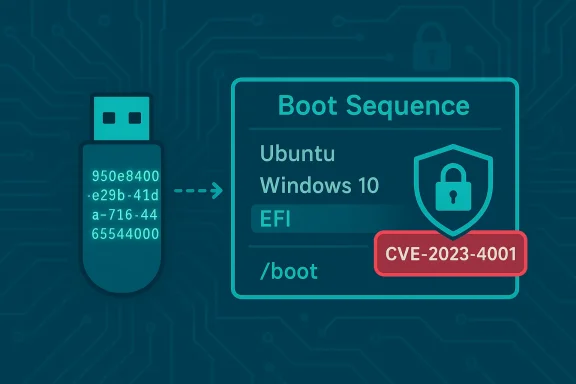
An authentication bypass in GRUB2 tracked as CVE-2023-4001 lets an attacker with physical access to a machine defeat GRUB’s boot-time password protection by tricking the bootloader into loading a configuration that doesn’t contain the password settings. The defect arises from how GRUB searches for its configuration using filesystem UUIDs and how some UEFI environments enumerate removable media before fixed drives; when a removable device carries a duplicate UUID that matches the system’s /boot volume, GRUB can be persuaded to use the wrong configuration and drop into an unauthenticated shell or allow menu edits without prompting for credentials. This issue was introduced in a downstream vendor patch (not in upstream GRUB) and has been addressed through vendor advisories and updates; operators should treat affected installations as high-priority for patching and physical-controls hardening.
Actionable priorities for IT teams:
Conclusion: Patch now, verify your boot chain, and harden the physical layer—because for bootloaders, an attacker who controls the pre‑OS environment controls everything that follows.
Source: MSRC Security Update Guide - Microsoft Security Response Center
 Background
What GRUB’s password protection is supposed to do
GRUB (GRand Unified Bootloader) implements optional boot-time authentication to restrict who can edit boot menu entries, invoke the GRUB command shell, or change boot parameters. Administrators enable this by embedding a password (or PBKDF2 hash) and a list of superusers in GRUB’s configuration—typically in a grub.cfg that the boot manager reads during startup. When properly enforced, GRUB’s authentication prevents an unauthenticated local user from instructing the bootloader to boot an alternative kernel, add initrd parameters, or otherwise perform actions that could lead to privilege escalation before the OS loads.How UEFI, EFI System Partition (ESP), and GRUB config discovery work
On UEFI systems GRUB commonly uses a small first-stage configuration stored in the EFI System Partition (ESP) to locate and chainload or source the main grub.cfg on the distribution’s /boot filesystem. To find that main configuration GRUB uses a device-search mechanism that, in some downstream builds, accepts a filesystem UUID argument. If GRUB’s search will return any filesystem with that UUID—and the platform enumerates removable drives ahead of the fixed drive—an attacker who inserts removable media carrying the same UUID can cause GRUB to choose the attacker-supplied filesystem instead of the trusted /boot. When that attacker-supplied filesystem lacks the password-setting commands, GRUB never sets the superusers or password variables and thus never prompts, enabling a bypass. This nuance is central to how CVE-2023-4001 works.Technical analysis: how CVE-2023-4001 works
The root cause: UUID-based search behavior combined with enumeration order
The vulnerability stems from two interacting conditions:- GRUB’s configuration discovery logic searches for a filesystem by UUID when the boot script asks it to, and this search can match any device that carries that UUID.
- Some UEFI firmware enumerates removable media (USB sticks) before non-removable internal storage during the boot process.
Attack prerequisites and scope
- Physical access is required in the normal case: attacker must be able to insert removable media (USB device) before or during boot. Several advisories describe the vector as a physical attack vector with medium-to-high impact.
- The flaw is downstream-specific: Red Hat’s downstream grub2 package contained a patch that introduced the risky search semantics; upstream GRUB is reported not to be affected by this particular regression. Practically, that means affected systems will generally be distributions that applied the vulnerable downstream patch.
- Not all UEFI systems are equally vulnerable: enumeration ordering and platform firmware behavior influence whether a removable device can be chosen ahead of the intended /boot device. In some uncommon configurations the attack can be performed without a previously authenticated user session.
Concrete effects when exploited
When successfully exploited, an attacker can:- Enter the GRUB command shell or edit menu entries without authentication.
- Modify kernel command-line parameters (including init=/bin/sh in contexts without full-disk encryption).
- Boot an arbitrary kernel or a malicious initramfs that can attempt to compromise the installed operating system, attempt credential harvesting, or aid offline attacks.
Timeline and vendor response
- Public disclosure: The CVE entry and multiple vendor advisories were published in January 2024 after Red Hat reported that the downstream change introduced the problem. The vulnerability was tracked as CVE-2023-4001 and assigned a CVSS v3.1 base score in the mid-range (NVD reports 6.8).
- Vendor advisories and errata: Red Hat and downstream distributors issued security updates and errata to replace the vulnerable behavior with a more constrained search that restricts the UUID lookup to the block device used to launch GRUB (or equivalent changes). The Red Hat advisory explicitly lists the fixes and the affected product lines.
- Community analysis and writeups: Several technical writeups (mailing lists and security lists) explain the exploitation path and recommend operational mitigations while vendors prepared fixes. These analyses walk through how embedding password commands in different config locations affects the attack surface.
Cross-verified facts and metrics
- Vulnerability summary: GRUB2 password protection can be bypassed by inserting removable media that duplicates the target UUID, taking advantage of UEFI enumeration order and a downstream search semantics change.
- CVSS v3.1 base score (as published by NVD / distributors): generally reported around 6.8 (NVD) and similar medium-high scores in vendor advisories; vector AV
 /AC:L/PR:N/UI:N/S:U/C:H/I:H/A:H is often referenced. These reflect the physical-attack restriction (AV) but high consequences if exploited.
 - Affected codeline: the vulnerability was introduced in specific downstream (distribution) builds—Red Hat’s packaged grub2—rather than in upstream GRUB sources. Administrators should consult their distribution’s errata to determine if their grub2 package was built from the vulnerable downstream tree.
Mitigation and remediation (practical, prioritized steps)
Below are concrete steps to reduce exposure and remediate systems. They are ordered to help busy teams prioritize work.- Patch first, confirm later
- Apply your vendor’s published GRUB/grub2 packages and errata immediately. For Red Hat and derivatives, install the updates referenced in RHSA advisories (for example, the advisories associated with REDHAT-RHSA-2024:0437 and related errata). Patching replaces the vulnerable search behavior with a restricted search argument. Confirm package versions after update.
- Restrict removable-media enumeration at firmware/UEFI when possible
- Where platform firmware allows, change boot/UEFI settings to enumerate internal storage before removable devices or disable boot from removable devices entirely. Setting a firmware (BIOS/UEFI) password prevents unauthorized changes to these settings and blocks booting from USB without that password. Note: firmware options vary by vendor—test on a representative device before broad rollout.
- Use Secure Boot and signed GRUB images
- Enabling UEFI Secure Boot and using signed bootloader images prevents unsigned or tampered GRUB images from executing. However, Secure Boot alone does not prevent the specific UUID-based configuration confusion unless the configuration itself is protected or signed; treat Secure Boot as part of a defense-in-depth approach.
- Harden physical security and media controls
- Apply strict physical access controls to servers and endpoints (locked racks, access logs, surveillance). Block or control USB ports (software policies, port locks, or hardware USB blockers) to eliminate the straightforward insertion of attacker-supplied media. For laptops and less-controlled endpoints, user training and port control reduce risk.
- Re-check GRUB config locations and embedded settings
- Verify where your distribution stores password commands: some builds store them in an initial embedded config inside the signed EFI executable, while others use external grub.cfg files on /boot. If your initial/embedded config contains the password commands, the attack path is more limited. If your main password entries live on /boot and are sourced at runtime, validate that your EFI bootstrap’s search logic cannot be rerouted to removable media.
- For critical systems, consider full-disk encryption and measured boot
- Full-disk encryption protects data at rest; without the disk passphrase, an attacker who can modify boot entries cannot directly read encrypted data. Measured boot / TPM-based attestation can detect boot-time tampering. These are complementary controls—do not rely on them as the only line of defense against boot-time manipulation. Be precise about operational tradeoffs: FDE protects disk contents but not necessarily against an attacker who can intercept or coerce users into revealing keys during recovery or who can modify the pre-boot environment to capture credentials.
- Monitor and log
- Although GRUB itself emits little logging visible to a host OS, maintain a checklist to detect suspicious boot-time events: unexpected changes to EFI boot variables, unexplained new EFI files on the ESP, or firmware configuration changes. Integrate hardware inventory and tamper-evidence checks into endpoint audits. If you operate fleets, automate checks that validate ESP contents and the UUIDs of boot partitions against known-good baselines.
Detection and incident response guidance
- If you suspect exploitation, first preserve the state: document attached media, photograph the device and inserted media, and capture the EFI System Partition (ESP) contents and timestamps from a trusted environment (live rescue media or a forensic workstation).
- Look for attacker-supplied grub.cfg files on removable media or unusual ESP files that deviate from vendor-provided images. Compare grub.cfg content against distribution-provided configuration templates; missing password-setting commands or a plainly edited config are strong indicators of tampering.
- If a system boots into an unexpected kernel or the initramfs differs from expected builds, treat it as compromised: perform offline imaging and recovery rather than continuing operation. Follow your organization’s incident response runbook for potential boot-time compromise, including key rotation and reinstallation of affected hosts where integrity cannot be assured.
Why this vulnerability matters: strengths and risks
Strengths (what the mitigation model demonstrates)
- The flaw is not remote: it requires physical access or insertion of removable media in the boot path, which narrows the threat model and reduces attack surface compared to network-facing vulnerabilities.
- Distributions and maintainers responded with specific errata and patches that repair the search semantics directly, indicating the issue is amenable to a clean, targeted fix. Red Hat’s errata and other downstream advisories list fixed packages and BZ tracking IDs for administrators to act on.
Risks and caveats
- The impact when exploited is severe: bypassing GRUB authentication can permit an attacker to influence boot choices and launch alternate kernels or recovery images, potentially resulting in system compromise, credential capture, or data exposure when additional protections are missing. That's why vendors treat confidentiality, integrity, and availability impacts as high even though the attack vector is physical.
- Not every distro/operator will have the same exposure. Because the root cause is a downstream packaging change, operators must map their environment to vendor advisories rather than assuming all GRUB2 installs are affected. Blindly treating every Linux host as vulnerable without checking package provenance may cause unnecessary disruption.
- Detection is difficult at scale. GRUB runs before the OS and typically leaves little trace inside the running system—meaning a localized physical compromise can go unnoticed unless organizations maintain strict hardware controls, firmware settings, and ESP file integrity checks.
Community context and historical parallels
Bootloader password bypasses and boot-sector attacks are not new; the community has long discussed how physical access compromises pre-OS components and how weak config practices can allow escalation. Forum archives and community threads from earlier years show similar concerns over boot password workarounds and the need for firmware/BIOS passwords and port controls—lessons that remain relevant for CVE-2023-4001. Those discussions are a reminder that human factors (unlocked rooms, unattended machines) often amplify purely technical regressions into real compromises.Practical checklist for administrators (quick reference)
- [ ] Identify whether your distribution’s grub2 package originated from the vulnerable downstream build.
- [ ] Apply vendor updates (RHSA/ALSA/ELSA advisories) that address CVE-2023-4001.
- [ ] If immediate patching is not possible, disable boot from removable devices in firmware and set a firmware password.
- [ ] Enable Secure Boot and verify GRUB images are signed where feasible.
- [ ] Block or control physical USB access on sensitive hosts.
- [ ] Validate ESP and /boot contents against known-good baselines; look for unexpected grub.cfg files.
- [ ] Document and rehearse incident playbooks for boot-time tamper and potential reimaging.
Final assessment and recommendations
CVE-2023-4001 is a classic example of how seemingly small packaging or configuration changes in foundational components can ripple into impactful security regressions. The vulnerability is not a remote takeover; it is a physically proximate exploit that leverages firmware ordering and a downstream search semantics change to bypass an intended authentication gate. Because the consequences of exploitation are severe—an attacker who gains unauthenticated GRUB control can influence early-boot behavior and, depending on additional protections, may be able to achieve system compromise—administrators should treat the issue seriously.Actionable priorities for IT teams:
- Patch affected systems immediately with vendor-provided updates and confirm the fix by inspecting grub behavior and scanned UUID logic.
- Harden firmware settings and tighten physical access and USB-media policies to eliminate the simplest exploitation path.
- Apply Secure Boot, consider disk encryption and measured-boot where appropriate, and add ESP /boot integrity checks into configuration management and monitoring.
Conclusion: Patch now, verify your boot chain, and harden the physical layer—because for bootloaders, an attacker who controls the pre‑OS environment controls everything that follows.
Source: MSRC Security Update Guide - Microsoft Security Response Center
