

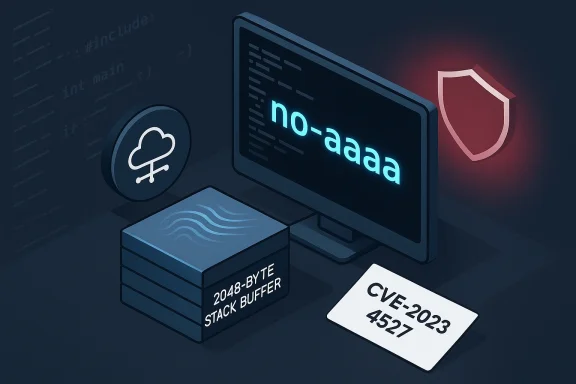
A subtle change to glibc’s DNS stub resolver has had consequences that administrators and application developers should treat as more than an academic footnote: CVE-2023-4527 is a stack read overflow in getaddrinfo that can be triggered when the resolver is run in no-aaaa mode and a DNS response over TCP exceeds the expected 2048‑byte buffer. In short: under a narrow but realistic configuration an attacker able to control or tamper with DNS replies can force glibc to return uninitialized stack bytes to an application or cause crashes that lead to denial-of-service—conditions that demand immediate verification and remediation for any Linux systems that use the no-aaaa stub-resolver option.
The GNU C Library (glibc) is the standard C library used by most Linux distributions; getaddrinfo is the broad, protocol-agnostic resolver API applications call to translate hostnames to addresses. In mid‑2022 a new diagnostic option was added to the glibc stub resolver—no-aaaa—which instructs the resolver to suppress AAAA (IPv6) queries and translate AAAA lookups into A lookups so that A-only DNS results can be produced while still preserving some behaviors of dual-stack name resolution.
That change—introduced as part of a commit adding the no-aaaa option—later turned out to contain a correctness bug in the path that handles DNS replies received over TCP. When a DNS TCP response is larger than the built-in stack buffer (2048 bytes in the vulnerable code path), glibc’s getaddrinfo path could return data beyond what was actually written into the buffer, exposing uninitialized stack contents to the calling application. In other circumstances the same failure mode can trigger a crash, producing denial-of-service for the affected process or service.
This issue was reported and fixed in 2023 (CVE-2023-4527). Although the bug requires a specific set of conditions, several mainstream distributors backported or included the changed code; vendors released advisories and patches. Administrators need to understand the trigger conditions, confirm whether they are affected, and take either the short-term mitigations or the recommended updates.
Source: MSRC Security Update Guide - Microsoft Security Response Center
 Background / Overview
The GNU C Library (glibc) is the standard C library used by most Linux distributions; getaddrinfo is the broad, protocol-agnostic resolver API applications call to translate hostnames to addresses. In mid‑2022 a new diagnostic option was added to the glibc stub resolver—no-aaaa—which instructs the resolver to suppress AAAA (IPv6) queries and translate AAAA lookups into A lookups so that A-only DNS results can be produced while still preserving some behaviors of dual-stack name resolution.That change—introduced as part of a commit adding the no-aaaa option—later turned out to contain a correctness bug in the path that handles DNS replies received over TCP. When a DNS TCP response is larger than the built-in stack buffer (2048 bytes in the vulnerable code path), glibc’s getaddrinfo path could return data beyond what was actually written into the buffer, exposing uninitialized stack contents to the calling application. In other circumstances the same failure mode can trigger a crash, producing denial-of-service for the affected process or service.
This issue was reported and fixed in 2023 (CVE-2023-4527). Although the bug requires a specific set of conditions, several mainstream distributors backported or included the changed code; vendors released advisories and patches. Administrators need to understand the trigger conditions, confirm whether they are affected, and take either the short-term mitigations or the recommended updates.
How the bug works (technical summary)
The trigger conditions, in plain language
- The system uses glibc’s stub resolver and has the no-aaaa option enabled (for example, via an entry such as
options no-aaaain /etc/resolv.conf, or an equivalent resolver configuration). - An application calls getaddrinfo with the AF_UNSPEC family (requesting any address family; i.e., “give me IPv4 or IPv6”).
- A DNS response is delivered over TCP (DNS over TCP is used when responses are large, e.g., truncated UDP responses or those using extensions like EDNS0) and the TCP reply is larger than the internal stack buffer used by the resolver (the vulnerable code path used a 2048‑byte stack-based buffer).
- The code that copies or parses the TCP response does not correctly bound the subsequent parsing reads to the amount of data actually stored on the stack, leading to a read beyond the initialized buffer. The parser then packages address results that may include bytes from uninitialized stack memory.
Consequences of the bug
- Information disclosure: Returned address data (or related resolver structures) can contain stale stack bytes—these may include pointers, internal state, or fragments of other stack-allocated secrets from the same process.
- Denial-of-service: The same overflow/over-read pattern can lead to crashes in the resolver or in consuming applications, producing a sustained or repeatable outage for services that rely on DNS name resolution.
- Exploitability profile: Remote attacker control of DNS replies (for example, a malicious recursive resolver, poisoned cache, or attacker-controllable authoritative server) can allow exploitation without requiring local privileges or user interaction—so long as the other trigger conditions are satisfied.
Why this matters (threat model and practical scope)
At first glance this looks like a niche diagnostic misfeature that only affects a small deployment profile. But the practical implications are broader:- DNS is trust boundary: Many services implicitly trust DNS answers from their configured resolvers. If an attacker can influence DNS responses (through cache poisoning, malicious resolver configuration, or controlling authoritative entries), they can attempt to trigger the overflow.
- No-aaaa is diagnostic but present: The no-aaaa option was introduced as a debugging/diagnostic tool and is not the default. However, it has been backported by some distributions into widely deployed releases, which means the configuration could exist in production images where operators enabled the option intentionally or where environments inherit it from a configuration template.
- Large responses happen: DNS replies over TCP larger than 2048 bytes are not purely theoretical. Zone transfers, DNSSEC-related payloads, and responses with many records or large EDNS0 payloads can exceed that threshold. The dependency on TCP (not UDP) constrains the attack surface but does not eliminate it.
- Potential secrecy leakage: The leak may expose stack bytes that include sensitive process data. The content of leaked bytes is not deterministic and depends on the runtime state, but even small leaks of pointers or memory fragments can be valuable to attackers attempting to fingerprint, escalate, or reconstruct useful data.
Vendor and timeline milestones (what was introduced and when)
- The code path that introduced the no-aaaa stub-resolver option was committed in mid‑June 2022 as part of additions to the resolver implementation.
- The stack read overflow itself was reported and fixed in 2023; the fix consists of ensuring the resolver parsing path does not read past the stack buffer or returns only the bytes actually received into an appropriately sized buffer.
- The CVE identifier CVE-2023-4527 was assigned in September 2023. Major distributions and vendors published advisories and released updated glibc packages or backports. Some vendors provided mitigation guidance recommending removal of the no-aaaa option if immediate patching was not possible.
Who is affected
- Systems that run glibc builds which include the no-aaaa support and where the no-aaaa option is enabled are susceptible.
- Not all glibc releases were affected; the problematic code path was introduced at a particular point and then backported into some vendor packages—this means older upstream glibc versions without the backport may not be affected, while certain vendor-supplied builds of older glibc can be.
- Containers and cloud images: any container image or cloud VM that inherits an affected glibc package and the no-aaaa configuration is at risk—particularly multi-tenant or internet-facing services that use external DNS resolvers.
Verification checklist — how to know if you’re affected
- Check /etc/resolv.conf on affected hosts for the presence of the option:
- Look for a line containing:
options no-aaaa - Some environments can set resolver options via environment variables (e.g., RES_OPTIONS) which can override or add options at process start; inspect process environments for RES_OPTIONS containing
no-aaaa. - Check the installed glibc package and vendor advisory:
- Use your distribution’s package manager to inspect the glibc version and verify whether it includes vendor backports that introduced no-aaaa or that carry the CVE fix.
- Consult your vendor/security vendor advisories and patch notes to match the exact package release that addresses CVE-2023-4527.
- Audit application behavior:
- Identify services or applications that call getaddrinfo with AF_UNSPEC (most networked apps do this unless explicitly constrained). Those calling getaddrinfo expecting both v4 and v6 addresses are the ones that may exercise the problematic path.
- Capture suspicious DNS/TCP traffic (optional validation):
- If you can replicate conditions safely in a test environment, capture DNS over TCP responses and confirm whether large replies (>2048 bytes) are handled without error in patched vs. unpatched builds.
Mitigation: immediate, medium-term, and long-term strategies
Immediate (while you patch)
- Remove the no-aaaa option: If any host is configured with
options no-aaaaand you cannot immediately install vendor patches, remove that option from /etc/resolv.conf (and unset RES_OPTIONS that sets it). This prevents the vulnerable code path from being exercised. - Restrict DNS trust: Ensure hosts use trusted recursive resolvers and firewall rules limit DNS traffic to known resolvers; prevent arbitrary network paths from feeding DNS replies to your hosts.
- Network-level blocking: Where possible, block inbound DNS/TCP flows from untrusted networks and monitor for unusual DNS over TCP traffic that could indicate attempts to deliver oversized responses.
Medium-term
- Apply vendor patches: Update glibc to the vendor-supplied patched version for your distribution. Patching glibc typically requires careful scheduling; use rolling updates or staged reboots where appropriate for stateful services.
- Rebuild/refresh images: Update container base images and cloud VM images used in your estate so newly provisioned hosts are not vulnerable.
- Application constraint: Where feasible, update applications to call getaddrinfo with a constrained address family (e.g., AF_INET if IPv6 is not used), or to prefer explicit address families, reducing the chance they exercise the specific vulnerable code path.
Long-term
- Harden resolver usage: Avoid enabling diagnostic resolver options like no-aaaa in production without explicit operational need and review the implications of resolver options on security.
- Defense-in-depth: Use DNSSEC validation at your recursive resolver to reduce the risk of maliciously crafted authoritative replies being accepted by resolvers upstream of your hosts.
- Supply-chain vigilance: Maintain an auditable, versioned catalog of base images and system packages, and monitor for vendor advisories so you can respond quickly to glibc or foundational-library CVEs.
Detection and forensic guidance
- Network detection: Create IDS/IPS signatures or network-monitoring alerts that flag DNS over TCP responses with total length >2048 bytes coming from unexpected sources. Such flows merit investigation: either they are legitimate (e.g., large DNSSEC responses) or manipulated.
- Host detection: Monitor logs for repeated getaddrinfo failures or resolver crashes. Processes that repeatedly crash during name resolution or services with intermittent name-resolution failures may be manifesting the denial-of-service side-effect.
- Memory forensics: If you suspect data exposure occurred, treat it as a high-priority incident: core-dump containment, process memory capture, and post-incident review are necessary. The content of leaked stack bytes is not guaranteed to be secrets, but you must assume the worst and rotate credentials or keys that could have been resident in leaked address space.
- Reproduction in lab: A test lab with a malicious resolver or a controllable authoritative server can be used to reproduce the behavior and verify patch effectiveness—strictly isolate such tests from production networks.
Exploitability and real-world risk assessment
- Ease of exploitation: The vulnerability is remote-exploitable in the sense that it can be triggered by a networked DNS reply, but it requires:
- The no-aaaa resolver option to be active on the target host.
- The ability to deliver or influence a DNS TCP reply that exceeds the vulnerable buffer size.
- Practical limitations:
- no-aaaa is not widely configured in default installations; many administrators will not have enabled it.
- DNS over TCP is commonly used for large or truncated responses; it is not the default for most simple queries.
- Impact if exploited:
- Information leakage of stack bytes could be leveraged in staged attacks to fingerprint or further compromise a process if the leaked data contains useful pointers, addresses, or secrets.
- Denial-of-service could be trivial to reproduce and can take down name-resolution-dependent services until remediation (restart, patch) is applied.
- Verdict: Moderate-to-high operational risk in environments where no-aaaa is or may inadvertently be enabled; lower risk where the option is not present and resolvers are trusted and patched. The presence of backports in vendor packages expands the realistic exposure beyond just the newest upstream glibc releases.
Recommended step-by-step remediation checklist
- Inventory: find all systems with
options no-aaaain /etc/resolv.conf and all systems where RES_OPTIONS might be set to includeno-aaaa. - Patch: schedule and apply vendor glibc updates that include the CVE-2023-4527 fixes. Follow vendor guidance for safe rollout (rolling updates for servers, image rebuilds for containers).
- Temporary mitigation: if patching is delayed, remove
options no-aaaaand restart affected services that may cache resolver state; ensure RES_OPTIONS is unset in environments where it may have been set. - Harden DNS: restrict DNS resolution to trusted resolvers and consider network controls to prevent untrusted DNS/TCP replies from reaching hosts.
- Detect: configure network monitoring for large DNS/TCP replies and host monitoring for resolver crashes or repeated getaddrinfo failures.
- Rotate secrets if you have reason to believe sensitive process memory might have been exposed.
- Document: log and track remediation status across your fleet and include the change in your patch-management records.
Critical analysis: strengths of the fix and remaining risks
- Good aspects of the fix
- The upstream fix is targeted and small in scope: it corrects buffer handling in the resolver path without broad functional regression.
- Vendors quickly issued advisories and backported fixes into stable distribution branches, which helps operators apply updates without waiting for major upgrades.
- The recommended temporary mitigation (removing the diagnostic option) is simple and effective; it avoids risky code paths without complicated configuration changes.
- Lingering risks and operational concerns
- The bug is a cautionary example of how diagnostic or rare configuration options can introduce security-relevant state into widely used libraries. Options intended for troubleshooting can become attack vectors when backported or misused.
- Even with patches available, operational inertia (out-of-date images, unmanaged containers, or appliances) means vulnerable configurations may persist in production for months.
- The information-exposure nature of the bug complicates incident response: leaked stack bytes are hard to quantify and may require conservative rotation of credentials and secrets when an exposure is suspected.
- Patching glibc is non-trivial in highly availability-sensitive environments. Rolling restarts, careful scheduling, and validation are necessary to avoid unintended outages from the remedial process itself.
Practical recommendations for WindowsForum readers (admins, devs, and security teams)
- Administrators: prioritize detection of
no-aaaain resolver configuration, then apply vendor glibc patches. Treat this as a configuration-first remediation: remove the option if you can’t patch immediately. - Developers: avoid relying on AF_UNSPEC in contexts where you know your environment is IPv4-only; prefer explicit address-family choices where it is safe to do so. Add defensive checks and robust error handling around name-resolution code paths that assume correct resolver behavior.
- DevOps teams: update CI/CD base images and container registries so built artifacts are not rebuilt from vulnerable images. Use automated scanning and patch-management pipelines to catch such foundational CVEs early.
- Security teams: include glibc and other foundational libraries in regular vulnerability scans and SBOM inventories. When a low-level library gets a CVE, the blast radius can be wide—track image builds and appliance suppliers.
Conclusion
CVE-2023-4527 is a textbook example of how a seemingly small resolver option and a single buffer-handling mistake can create a remote information-disclosure and availability risk. The vulnerability’s real-world impact depends on a specific configuration (no-aaaa) and on the attacker’s ability to deliver oversized DNS replies over TCP, but those conditions are achievable in some deployments. The remedy is straightforward: verify your resolver configuration, apply vendor-supplied glibc updates, and, if necessary, remove the diagnosticno-aaaa option until you can patch. Treat this CVE as a reminder to keep foundational libraries and their configurations under tight inventory and update control—small changes in core libraries can have outsized effects on system security and availability.Source: MSRC Security Update Guide - Microsoft Security Response Center
