

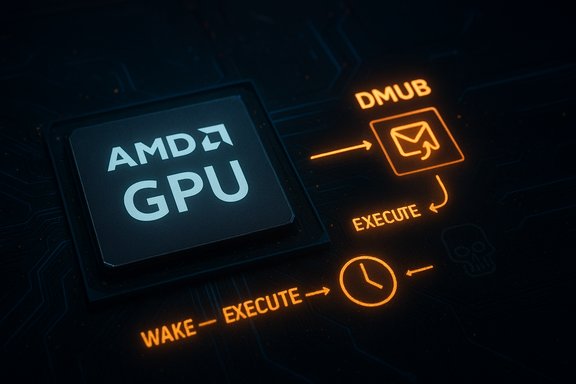
The Linux kernel vulnerability tracked as CVE-2023-52485 exposes a deterministic denial‑of‑service condition in the AMD display driver: under certain power‑management races the driver can attempt to send commands to the DMCUB microcontroller while it is powered down, causing the command path to hang and, in some cases, the host’s display stack or the entire system to become unresponsive.
Background / Overview
CVE‑2023‑52485 was published as part of coordinated Linux kernel security announcements and affects the AMD DRM display subsystem (drm/amd/display). The root cause is a power‑state race: the display microcontroller (DMCUB) can be in an idle or powered‑down state when the driver issues DMUB/DMCU mailbox commands. When that happens, the command submission path may block waiting for a response that never arrives, producing a deadlock or hang in privileged kernel context. The fix implemented in upstream trees wraps sensitive DMUB/GPINT submissions with explicit wake/enter sequencing so the microcontroller is guaranteed to be awake before command submission and returned to its prior state afterward. This is fundamentally an availability (denial‑of‑service) vulnerability: confidentiality and integrity are not reported as affected by the public advisories, but the availability impact is high because kernel‑level hangs or driver deadlocks can require module reloads or full system reboots to recover. The vulnerability is local in attack vector — a local process or user with access to DRM device nodes or the compositor can trigger the condition — but the practical risk is amplified in multi‑tenant hosts, CI runners, kiosk systems, or any environment that exposes GPU device nodes to untrusted accounts.Technical analysis: what went wrong and how the patch fixes it
The components involved
- DMCUB: an on‑chip display microcontroller used by modern AMD GPUs to offload low‑level display sequencing and power management tasks. It conserves energy by entering idle or sleep states when unused.
- DMUB / GPINT mailbox: command/response mechanisms the host driver uses to submit requests to the microcontroller.
- AMDGPU DRM driver (drm/amd/display): host kernel driver code that manages display pipelines, modesetting, and interactions with DMCU/DMUB firmware.
The patch pattern
The corrective change is intentionally minimal and defensive:- Add an API helper that explicitly wakes DMCUB, issues the GPINT/DMUB command, waits for the response if required, and then returns the microcontroller to its previous idle state when appropriate.
- Replace direct dm_execute_dmub_cmd/list or GPINT direct calls (from within DC context or DC locks) with calls to that helper.
- Ensure DM direct submissions that cannot use the helper either manage their own enter/exit sequencing or avoid invoking DMCUB commands from contexts where deadlock is possible.
Why the defect caused a kernel hang (not a simple user‑space failure)
In kernel space, blocking on a device that will never respond is far more severe than a user process hanging. The display driver runs in privileged kernel threads and often under locks (DC locks) during modesetting and stream enabling. A blocked path in that context can stall other kernel work, trigger watchdogs, or create inconsistent driver state that requires a reboot. That’s why the vulnerability received a CVSS score focused on availability and why vendors classify the impact as high for availability despite a medium base score in some trackers.Impact and exploitability
Who is affected
- Any Linux system running a kernel that includes the vulnerable drm/amd/display code and that interacts with AMD GPUs using the affected DMCU pathways.
- Desktop or workstation users where unprivileged processes (compositors, media players, sandboxed GPU runtimes) can reach DRM device nodes are at practical risk.
- Multi‑tenant hosts, CI runners, cloud images or virtual machines that expose AMD GPU device nodes to guests or containers (via device passthrough or --device=/dev/dri/) are high‑risk* environments because a local user can provoke a denial‑of‑service affecting other tenants.
Attack vector and prerequisites
- Attack vector: Local
- Privileges required: Low in typical desktop setups; higher in locked‑down server configurations
- Complexity: Low — once the code path is reached, the hang is deterministic under the failing power/state condition
- User interaction: Usually none beyond triggering a display action (hot‑plug, modeset, stream enable) or running a GPU workload in a process that can issue the ioctl
Detection and forensic signals
When hunting for this specific hang or validating an incident, look for these artifacts:- Kernel log messages referencing DMUB, GPINT, DMCUB, or repeated pageflip timeouts in journalctl/dmesg.
- Driver resets and watchdog traces labeled with amdgpu, DMUB or explicit DMUB status failures.
- Compositor crashes (Wayland/Xwayland) or sessions that consistently drop after hot‑plug events, link training failures, or specific display reconfiguration events.
- Reproducible triggers: connecting problematic docks or monitors, or running GPU workloads that exercise the DMUB command paths.
Patching, verification, and backporting realities
Where the fix landed
Upstream kernel repositories contain commits that implement the DMCUB wake helper and replace direct GPINT/DMUB calls with the wake‑execute pattern. The patch was merged to upstream trees and discussed for backporting to stable branches. Distribution maintainers have mapped the fix into package updates across various kernels; however, exact fixed package versions differ by distro and release. Debian’s tracker, SUSE, Amazon Linux and other vendors published mappings showing which package versions contain the remediation.Practical patching steps (recommended)
- Inventory: Identify hosts with AMD drivers loaded and DRM device nodes present.
- uname -r
- lsmod | grep amdgpu
- ls -l /dev/dri/*
- Consult your distribution or vendor security tracker for the package that contains the fix. Confirm the presence of the upstream commit or the listed CVE in the kernel package changelog.
- Apply the vendor-supplied kernel update and reboot into the updated kernel. Kernel updates require reboot to take effect.
- Verify post‑patch behavior by re‑exercising the previously problematic display operations (hot‑plug, docking, multi‑display modes) and monitoring kernel logs for DMUB/GPINT errors.
Verification commands and signs of a fixed system
- Confirm running kernel package version equals or exceeds the fixed release listed by your vendor.
- Reproduce the previous failing action in a controlled test environment; absence of prior GPINT/DMUB hang messages in dmesg/journalctl indicates the fix is effective.
- Monitor for absence of pageflip timeouts, repeated amdgpu resets or the specific DMUB status failures previously observed.
Compensating controls and mitigations while patching
If immediate patching is not possible, apply compensating operational controls to reduce exposure:- Restrict access to DRM device nodes:
- Use udev rules to bind /dev/dri/* to a trusted group and remove access for untrusted users.
- Example (conceptual): create a udev rule to set owner/group and mode so only members of "video" or a designated admin group can access /dev/dri.
- Avoid passing host DRM devices into untrusted containers:
- Remove --device=/dev/dri/* from container runtimes and avoid GPU passthrough for untrusted tenants.
- Harden compute runners and multi‑user workstations:
- Drop unnecessary capabilities in containers and remove module loading privileges for non‑admin users.
- Use configuration controls to limit which processes can drive modesetting or open DRM device nodes (session policies, stricter compositor socket ACLs).
Operational guidance: rollout and testing plan
- Triage and prioritization
- Prioritize multi‑tenant hosts, CI runners, desktop pools used by untrusted users, and embedded appliances with AMD GPUs.
- Staging
- Test vendor kernel updates in a staging pool with representative GPU hardware, docks, and MST hubs. Watch for regressions in clock/power sequencing, which are sensitive to hardware variations.
- Phased rollout
- Deploy to low‑risk groups first, then to broader production groups once validated.
- Monitoring
- Add SIEM rules to flag DMUB/GPINT failures and pageflip timeouts; collect kernel logs proactively from GPU hosts.
- Post‑deployment verification
- Reproduce previously failing scenarios and validate absence of hang traces.
Risk assessment and critical evaluation
Strengths of the upstream response
- The remediation is surgical and targeted — it adds explicit wake/enter sequencing rather than rearchitecting large subsystems. That makes verification and backporting tractable.
- Upstream maintainers and distribution vendors coordinated advisories and package updates, enabling administrators to obtain vendor patches rather than attempting fragile backports themselves.
Residual risks and caveats
- Long‑tail exposure: embedded devices, vendor kernels, and OEM images frequently lag upstream; these systems may remain vulnerable for months if vendors do not backport the minimal fixes. This long tail is the principal operational risk for this class of kernel CVE.
- Backport complexity: in some trees the patch depends on prior refactors; several maintainers reported conflicts applying the single commit to older stable trees. That creates the practical risk of delayed fixes in older kernel series.
- Regression risk in power sequencing: edits that change enter/exit semantics for microcontrollers and clocks require careful hardware testing. While the fix is small, the interaction surface with various docks, adapters, and monitor receivers means operators should test widely before broad rollout.
Exploitation in the wild
As of public advisories and vulnerability trackers at disclosure time there was no widely reported, weaponized in‑the‑wild exploitation for CVE‑2023‑52485. That does not eliminate operational urgency: deterministic DoS primitives are easy to weaponize in shared environments and the risk profile for multi‑tenant hosts remains significant.Short checklist for system administrators (actionable)
- Immediately identify AMD GPU hosts:
- uname -r
- lsmod | grep amdgpu
- ls -l /dev/dri/*
- Consult your distribution/vendor advisory and upgrade the kernel package that lists CVE‑2023‑52485 as fixed.
- Reboot into the patched kernel and validate display operations under representative workloads.
- If patching is delayed:
- Restrict /dev/dri access via udev and group policies.
- Remove /dev/dri device passthrough from untrusted containers.
- Monitor kernel logs for DMUB/GPINT failures and pageflip timeouts.
- For custom kernels:
- Prefer vendor/backported fixes where possible; if backporting is necessary, include dependent commits and test thoroughly on representative hardware. Documentation from upstream shows the commit lineage and dependency context for the fix.
Conclusion
CVE‑2023‑52485 is a clear example of how subtle power‑state races between host drivers and tiny on‑chip microcontrollers can escalate into operationally severe outcomes. The remediation is small and well‑focused — ensure the DMCUB is awake before submitting GPINT/DMUB commands — but operationally the challenge is making sure every affected kernel tree and vendor package delivers that change. Multi‑tenant and shared environments should treat this as a high‑priority availability risk: verify vendor package status, apply tested kernel updates, and use device‑access controls as a temporary mitigation where updates cannot be installed immediately. The deterministic nature of the hang makes it a dangerous DoS primitive for exposed systems, even though there is no public evidence of privilege escalation or in‑the‑wild exploitation at disclosure. This technical correction — a wake‑execute helper around DMCUB mailbox calls — is a small but important defensive hardening that restores predictable behavior across varied hardware topologies. System operators should prioritize inventory, patch, and validation cycles for AMD GPU hosts to eliminate the exposure and reduce the operational risk of unexpected system hangs.Source: MSRC Security Update Guide - Microsoft Security Response Center
