

A subtle annotation error in the x86 user-memory clearing path has been assigned CVE-2023-53749 and fixed in recent kernel trees; the bug did not introduce a new memory-corruption primitive, but it could transform a recoverable user-space fault into a kernel oops by pointing an exception fixup at the wrong instruction, making ordinary file or direct-IO reads look like filesystem bugs instead of safe -EFAULT returns.
The Linux kernel maintains small, architecture-specific helpers to copy and clear user-space memory from kernel context. These helpers must annotate any instruction that may fault during user-access (for example, a rep movsb that writes into user memory) in the kernel's exception/fixup table. If a user-accessing instruction faults, the kernel looks up the instruction address in the exception table and performs a controlled fixup, typically returning -EFAULT to the caller rather than crashing the kernel.
CVE-2023-53749 is rooted in a misplaced exception-table annotation for the final rep movsb in the x86 clear_user_rep_good implementation: the annotation targeted the register-move instruction immediately preceding the memory access rather than the rep movsb itself. The result is that, when a user-space access faulted, the exception handler would not locate the right entry in the exception table and the kernel would produce a page-fault oops instead of returning -EFAULT. The upshot: an otherwise recoverable user-space error could cause host instability and misleading crash reports. This problem is not an easy-to-exploit remote vulnerability. It is an availability/correctness defect with local/host-adjacent reachability: a user or guest action that triggers the vulnerable clear_user code path can provoke a kernel oops. Public vulnerability catalogs and distro advisories treat the issue as a correctness bug and describe small, surgical fixes and backports rather than a sweeping redesign.
A wrong address in the exception table means the faulting RIP (instruction pointer) won't be resolved to the correct fixup entry. The kernel will therefore fall through into its default "unable to handle page fault" path, producing an oops/panic instead of graceful handling. That is exactly what happened when the annotation pointed to the register move before the rep movsb, because the address in the table didn't match the actual instruction that faulted at runtime.
Upstream maintainers also note that the entire area of x86 user-memory clearing / copying was later reworked in a broader series that removes or simplifies REP_GOOD/ERMS usage and consolidates other adjustments. Because those larger changes are more invasive, a narrow annotation fix was chosen in stable/backport contexts where appropriate. The kernel commit history and stable-tree entries reflect both the one-line annotation fixes and the later, larger cleanup series. Key points from the patch discussion:
From an operational standpoint, the guidance is clear: confirm whether your vendor-supplied kernel includes the stable commit or explicit CVE mapping, apply vendor patches promptly, reboot into the patched kernel, and validate that previously observed oops traces no longer appear. In shared or multi-tenant environments, prioritize hosts that run untrusted guests and tighten monitoring for the characteristic kernel oops traces that indicate the misannotation was being hit. Multiple independent sources and the kernel stable-tree history corroborate the diagnosis and the patch path, so verifying vendor packaging against those commit references is the most reliable way to ensure remediation.
Source: MSRC Security Update Guide - Microsoft Security Response Center
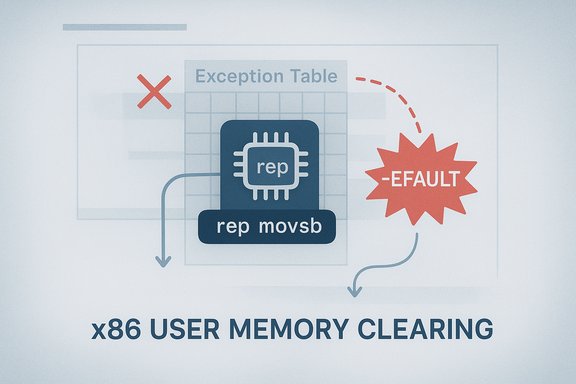 Background / Overview
The Linux kernel maintains small, architecture-specific helpers to copy and clear user-space memory from kernel context. These helpers must annotate any instruction that may fault during user-access (for example, a rep movsb that writes into user memory) in the kernel's exception/fixup table. If a user-accessing instruction faults, the kernel looks up the instruction address in the exception table and performs a controlled fixup, typically returning -EFAULT to the caller rather than crashing the kernel.CVE-2023-53749 is rooted in a misplaced exception-table annotation for the final rep movsb in the x86 clear_user_rep_good implementation: the annotation targeted the register-move instruction immediately preceding the memory access rather than the rep movsb itself. The result is that, when a user-space access faulted, the exception handler would not locate the right entry in the exception table and the kernel would produce a page-fault oops instead of returning -EFAULT. The upshot: an otherwise recoverable user-space error could cause host instability and misleading crash reports. This problem is not an easy-to-exploit remote vulnerability. It is an availability/correctness defect with local/host-adjacent reachability: a user or guest action that triggers the vulnerable clear_user code path can provoke a kernel oops. Public vulnerability catalogs and distro advisories treat the issue as a correctness bug and describe small, surgical fixes and backports rather than a sweeping redesign.
Why the annotation matters: technical context
How x86 exception fixups work (brief)
When kernel code performs potentially faulting accesses to user memory, the assembler macros or helpers mark the instruction addresses in an exception table. At runtime, if a page fault or general protection fault arises while executing one of those annotated instructions, the kernel consults the exception table and performs a well-defined recovery action (for example, set errno and return -EFAULT to the calling syscall) instead of crashing the kernel.A wrong address in the exception table means the faulting RIP (instruction pointer) won't be resolved to the correct fixup entry. The kernel will therefore fall through into its default "unable to handle page fault" path, producing an oops/panic instead of graceful handling. That is exactly what happened when the annotation pointed to the register move before the rep movsb, because the address in the table didn't match the actual instruction that faulted at runtime.
The clear_user_rep_good case
- clear_user_rep_good is an x86 assembly helper used to zero user memory in certain optimized code paths.
- The implementation included multiple small assembly sequences where control flow and instruction layout could make it tempting to annotate a nearby non-memory-moving instruction.
- For the final rep movsb in the function, the exception-table entry was attached to the preceding register-move instruction rather than the “rep movsb” itself.
- When that rep movsb faulted while writing to user memory, the fixup lookup failed and the kernel oopsed. The resulting trace often presented as an I/O or filesystem read problem (for example, in direct-IO/DIO paths) because higher-level stacks show the syscall and filesystem context rather than the assembly-level misannotation.
What was changed (patch summary)
The maintainers implemented a small, targeted correction: the exception-table annotation was moved to correctly point at the memory-accessing instruction (the rep movsb) so that a faulting user access is found in the exception table and the kernel performs the expected fixup (returning -EFAULT) rather than causing a kernel oops.Upstream maintainers also note that the entire area of x86 user-memory clearing / copying was later reworked in a broader series that removes or simplifies REP_GOOD/ERMS usage and consolidates other adjustments. Because those larger changes are more invasive, a narrow annotation fix was chosen in stable/backport contexts where appropriate. The kernel commit history and stable-tree entries reflect both the one-line annotation fixes and the later, larger cleanup series. Key points from the patch discussion:
- The fix is intentionally minimal — move the exception-table annotation to the actual instruction that performs the user-space access.
- An alternative is to adopt the larger upstream series that rewrites user-copy/clear logic (and in mainline the code was eventually removed/rewritten), but backporting that whole series to stable branches is more complex.
- The minimal change fixes the customer-visible failure mode (oops vs. -EFAULT) with very low regression risk.
Affected code and commit traces
The public vulnerability entries and kernel changelogs reference a combination of short stable fixes and a later upstream cleanup that removed old code paths. Notable references reported in public sources include:- The short annotation fix (author lines and stable-tree entry) that explicitly adjusts the exception table target for the final rep movsb. This change appears in stable/kernel patch lists and in the kernel's commit history.
- A later upstream removal/rewrite series that removed REP_GOOD/ERMS usage and replaced or simplified several user copy/clear helpers (commit id(s) such as d2c95f9d6802 and others are referenced in advisory text). If a distribution or vendor has already applied the upstream removal, the specific annotated code no longer exists in mainline.
- apply the narrow annotation fix into their stable kernel tree, or
- pick up the upstream cleanup series in full,
operators must look at the vendor changelog to confirm which approach was chosen. Ubuntu, Debian, and other distro trackers have mapped the fix into specific kernel package updates.
Practical impact and attack model
- Primary impact: Availability / Correctness. The vulnerability converts recoverable user-access faults into kernel oopses, which may crash a process or the host depending on overall state. It does not, by itself, provide a remote code-execution primitive.
- Attack vector: Local or host-adjacent. A local process (or a guest VM) that executes the kernel paths that clear user memory — for example, certain direct-IO or zeroing operations — can trigger the code path.
- Exploitability: Low for remote actors, but non-trivial in shared infrastructure. In multi-tenant cloud hosts, guests or untrusted tenants could intentionally trigger the code path to produce a denial-of-service condition for a host or to create misleading crash diagnostics.
- Public proof-of-concept: Not reported at disclosure. Major trackers and vendor advisories describe the defect and its fix but do not list active exploitation. That absence should not be treated as proof that the bug is safe in hostile environments.
Detection and telemetry signals
Look for the following telemetry patterns when hunting for evidence of this bug or its symptoms:- Kernel oops traces with messages like:
- “BUG: unable to handle page fault for address …”
- “#PF: supervisor write access in kernel mode”
- RIP pointing to clear_user_rep_good or to arch/x86/lib/clear_page_64.S lines in the stack trace
- Reproducible crashes during read or zeroing operations that involve iov_iter_zero, direct-IO paths (iomap_dio_rw, ext4_dio_read_iter) or other code that calls clear_user helpers.
- Correlated guest or user activity: if crashes happen when specific untrusted guests or local workloads perform large zeroing/IO patterns, treat this as a high-confidence indicator.
- Package and kernel changelog checks: absence of the stable commit or explicit CVE mention in your distro package changelog indicates your host may still be vulnerable.
Remediation and mitigation steps (prioritized)
- Inventory
- Identify hosts running kernels with vendor packages that predate the fix. Use uname -r, package manager queries (apt, rpm, dpkg, rpm -q kernel*), and your configuration management database.
- For cloud images and appliances, inspect the kernel shipped inside the image manifest or boot one test instance and check the running kernel version and changelog.
- Patch
- Apply the vendor-supplied kernel update or backport that explicitly references the CVE or the stable commit(s).
- Confirm the package changelog references the correct fix (annotation fix or the upstream cleanup series), or that the kernel tree includes the relevant stable commit(s).
- Reboot
- Kernel fixes require a reboot (or livepatch that explicitly contains the fix). Schedule reboots in a staged rollout and validate in a test environment first.
- Stage and validate
- Pilot the patched kernel on representative hosts, including any virtualization hosts that run untrusted guests.
- Re-run the workload or test vector that previously triggered the oops to confirm the crash no longer occurs.
- Compensating controls (if patching is delayed)
- Reduce scheduling of untrusted guests onto susceptible hosts.
- Restrict local process privileges to reduce the ability for untrusted code to exercise the vulnerable code path.
- Increase monitoring and automated remediation for repeated kernel oops patterns.
- Confirm vendor mapping
- Do not rely solely on kernel series numbers. Distributors often backport fixes; verify that the vendor package effectively contains the stable commit or an explicit CVE mention in its changelog. Vendor trackers (Ubuntu, Debian, Red Hat, SUSE) have mapped packages to fixes — consult those as authoritative for package-level verification.
- Identify kernel packages that map to affected commits.
- Apply vendor patch packages that list CVE-2023-53749 (or the relevant stable commit hashes).
- Reboot hosts into patched kernels.
- Validate crash reproduction no longer appears.
How vendors and distributions handled the fix
Different distributions and vendors took two common approaches:- Apply the minimal annotation fix into stable branches (low-risk, small diff).
- Adopt the broader upstream series that rewrote or removed the affected assembly helper entirely (larger change, but cleans up many related assumptions).
Risk analysis — strengths of the fix and remaining concerns
Strengths / Positive points
- The deployed fix is surgical and focused: moving or correcting an exception-table entry preserves intended behavior and has minimal surface for regressions.
- Upstream maintainers documented both the minimal fix and the preferred long-term cleanup, so vendors have clear options for either a quick stable backport or a full modernization.
- The nature of the change (annotation correction) is testable and deterministic; once applied, reproduction of the problematic oops should be eliminated in validated runs.
Residual risks and caveats
- Distribution and vendor heterogeneity: different vendors may choose different backport strategies. A distribution marking “Not affected” may reflect structural code differences rather than actual absence of the bug. Confirm by checking package changelogs and stable commit hashes.
- Misattribution during triage: because the oops can trace through filesystem/IO stacks, initial incident classification can be wrong and root cause analysis may blame the wrong subsystem. This makes detection and rapid identification more important.
- Multi-tenant exposure: although the bug is not a remote RCE, hosted environments and cloud hypervisors with untrusted tenants remain sensitive: a reliable host-oops triggered from a guest is a useful denial-of-service primitive for attackers or misbehaving tenants.
Forensics, testing and verification
- If you need absolute proof that a given kernel contains the fix, inspect the vendor package changelog for the stable commit hash or grep the kernel source used to build the package for the corrected exception-table annotation or for the presence/absence of the old clear_user_rep_good assembly helper.
- Reproduce the crash in an isolated test lab (if safe): construct a deterministic IO pattern that previously caused the rep movsb to fault and verify the behavior before and after the patch.
- Preserve vmcore and dmesg logs when investigating incidents — kernel oops traces are ephemeral across reboots and are central to proving whether the misannotation was the root cause.
Timeline and cross-checks
- The issue and the annotation correction appear in kernel changelogs and stable-tree commits; public bug trackers and advisories documented the corrected annotation and the related upstream cleanup series. Multiple independent sources (NVD/OSV, distro advisories, LWN commit lists) describe the same root cause and remedial approach, which provides cross-validation of the technical facts.
- Note on identifier confusion: some public trackers and advisories have listed closely related CVE identifiers in the same family of x86 user-copy fixes — operators should verify the canonical CVE mapping in their distro advisory or in NVD/OSV and should use commit hashes to map stable backports reliably. Where public feeds show adjacent CVE numbers, confirm by inspecting vendor changelogs and kernel commits rather than trusting a single aggregator.
Recommended operational checklist (quick reference)
- Inventory hosts and kernels: uname -r, package manager queries, CMDB.
- Check vendor advisories and package changelogs for CVE-2023-53749 or the stable commit that corrects the annotation.
- Apply vendor-supplied kernel packages that include the fix; if unavailable, request an appropriate backport or apply the stable commit if you maintain custom kernels.
- Reboot hosts into patched kernels and validate with representative workloads and the previously failing test case.
- Ramp patches in a staged rollout with monitoring for regressions.
- For unpatched hosts: reduce exposure to untrusted workloads, restrict scheduling of untrusted guests, and strengthen incident detection for the specific oops patterns described above.
Conclusion
CVE-2023-53749 is an example of a deceptively small kernel correctness problem with outsized operational consequences: a misplaced exception-table annotation turned otherwise recoverable user-access faults into kernel oopses. The fix is straightforward and low-risk — place the annotation on the instruction that actually performs the user-space memory access — and distributions have either applied the narrow correction or moved forward with a broader upstream cleanup.From an operational standpoint, the guidance is clear: confirm whether your vendor-supplied kernel includes the stable commit or explicit CVE mapping, apply vendor patches promptly, reboot into the patched kernel, and validate that previously observed oops traces no longer appear. In shared or multi-tenant environments, prioritize hosts that run untrusted guests and tighten monitoring for the characteristic kernel oops traces that indicate the misannotation was being hit. Multiple independent sources and the kernel stable-tree history corroborate the diagnosis and the patch path, so verifying vendor packaging against those commit references is the most reliable way to ensure remediation.
Source: MSRC Security Update Guide - Microsoft Security Response Center
