

A small, surgical change in the Linux kernel’s md (software RAID) code has been recorded as CVE-2024-26900: a memory-management bug where a serial-number allocation for a RAID disk device is not freed if a subsequent kobject_add() call fails, producing persistent kmemleak traces and an availability risk for systems that repeatedly exercise the md add-disk path.
The upstream Linux kernel patch described as “md: fix kmemleak of rdev->serial” closes a correctness gap in the device management flow used by the md (multiple device) subsystem. The bug appears when the kernel allocates the in-kernel buffer used to hold a block device serial string (rdev->serial) while binding a RAID device to an md array; if the subsequent kobject_add() call fails the code path did not free that allocation, leaving an unreferenced object that kmemleak will report.
This is not a classic remote code-execution vulnerability — the weakness is local and resource-oriented: uncontrolled, repeated triggering of the faulty code path can accumulate unreclaimed kernel memory and eventually degrade or deny availability. Distribution security advisories and public vulnerability databases classify the issue as a memory leak with availability impact rather than a confidentiality or integrity breach.
Multiple distribution advisories reference the upstream patch and the stable-kernel merges that carry it; distribution-specific fixes were then packaged into security updates for affected kernels. Where vendors published CVE mappings and advisories (for example Debian, Red Hat, Oracle, Amazon Linux and Ubuntu), they reference the same upstream description and patch set.
Caveat: while several secondary pages link to git.kernel.org commits, access to specific stable-tree commit pages may vary. Some third-party vulnerability databases list the upstream commit hashes that implement the fix, but depending on network or mirror access the raw git.kernel.org pages might not be directly fetchable in all contexts. For distribution-level verification, Debian/Ubuntu/Red Hat advisories and OSV/NVD entries provide independently corroborated descriptions.
CVE-2024-26900 is a reminder that the smallest lifecycle mismatches in kernel code can produce outsized operational headaches; the correct fix is simple, but the operational discipline to deploy it across fleets matters.
Source: MSRC Security Update Guide - Microsoft Security Response Center
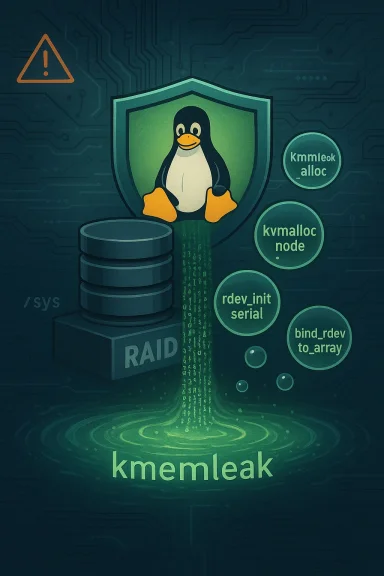 Background / Overview
The upstream Linux kernel patch described as “md: fix kmemleak of rdev->serial” closes a correctness gap in the device management flow used by the md (multiple device) subsystem. The bug appears when the kernel allocates the in-kernel buffer used to hold a block device serial string (rdev->serial) while binding a RAID device to an md array; if the subsequent kobject_add() call fails the code path did not free that allocation, leaving an unreferenced object that kmemleak will report.This is not a classic remote code-execution vulnerability — the weakness is local and resource-oriented: uncontrolled, repeated triggering of the faulty code path can accumulate unreclaimed kernel memory and eventually degrade or deny availability. Distribution security advisories and public vulnerability databases classify the issue as a memory leak with availability impact rather than a confidentiality or integrity breach.
Why this matters: practical impact and threat model
At first glance this reads like a maintenance bug: an allocation that should be released gets missed. But in kernel-land, even small leaks matter. The kernel allocators manage system-wide memory; a persistent, repeated leak in a hot code path can cause significant service disruption on long-lived hosts, storage nodes, or virtual machines that perform frequent md stack operations.- Availability-focused threat: The vulnerability enables a local actor (or a misbehaving process) to cause repeated small leaks that accumulate into an out-of-memory condition or heavy memory pressure, degrading I/O and service responsiveness. This is reflected in CVSS assessments published for distribution packages.
- Local access required: The attack surface is local — an adversary must be able to exercise md device creation or manipulation (for example, via mdadm or privileged ioctl paths) on the target host. This limits remote exploitation but still matters for multi-tenant hosts, container hosts, and shared storage appliances.
- Operational footprint: Systems that frequently attach or detach disks to md arrays (cloud images, hypervisor hosts, or software-defined storage nodes) are the most exposed. Over time the leak can trigger repeated kmemleak reports, dmesg warnings, or, in extreme cases, OOM kills or system instability.
Technical deep dive: what went wrong in the md code
To understand why this leak occurred and why the patch is small but necessary, we need to look at the relevant code paths and the kernel’s object-lifecycle expectations.The allocation and the missing free
- When an md device (rdev) is bound into an array, the md code will allocate memory to hold a device serial string for identification and management. This allocation is done via standard kernel allocation helpers (kvmalloc/kzalloc variants) and is subsequently registered with the kernel object model so user-visible sysfs attributes can be exposed.
- The registration path calls kobject_add() to attach the rdev kobject (and its attributes) into the sysfs hierarchy. If kobject_add() succeeds, the kernel expects the object lifecycle to be handled by the kobject teardown paths; if it fails, the code must explicitly undo earlier allocations.
- The bug: when kobject_add() failed in bind_rdev_to_array(), the code path forgot to free the earlier rdev->serial allocation, leaving an unreferenced kernel object. Kmemleak (the kernel memory-leak detector) will find and report such objects; repeated occurrences will cause sustained memory leakage.
The trace and stack frames seen in reports
Public advisories and the NVD description include a representative kmemleak backtrace showing the allocation and the chain of callers: kmemleak_alloc -> __kmalloc_large_node -> kvmalloc_node -> rdev_init_serial -> mddev_create_serial_pool -> bind_rdev_to_array -> md_add_new_disk -> md_ioctl -> blkdev_ioctl -> vfs_ioctl -> __x64_sys_ioctl. That trace makes the flow clear: the leak was visible when mdadm (or other ioctl path) asked the kernel to add a disk to an array.Patch and verification: what was changed
Linux maintainers applied a targeted fix to free the serial allocation when kobject_add() fails or otherwise ensure that the lifecycle is properly handled in all exit paths. The change is intentionally narrow: it does not alter md semantics or add new features — it closes an allocation/free mismatch.Multiple distribution advisories reference the upstream patch and the stable-kernel merges that carry it; distribution-specific fixes were then packaged into security updates for affected kernels. Where vendors published CVE mappings and advisories (for example Debian, Red Hat, Oracle, Amazon Linux and Ubuntu), they reference the same upstream description and patch set.
Caveat: while several secondary pages link to git.kernel.org commits, access to specific stable-tree commit pages may vary. Some third-party vulnerability databases list the upstream commit hashes that implement the fix, but depending on network or mirror access the raw git.kernel.org pages might not be directly fetchable in all contexts. For distribution-level verification, Debian/Ubuntu/Red Hat advisories and OSV/NVD entries provide independently corroborated descriptions.
Affected systems and distribution status
CVE-2024-26900 is an upstream Linux kernel fix; the exposure depends entirely on what kernel tree and version a distribution ships. The vulnerability was picked up by standard security databases, and major distributions have published security notices and backported fixes.- Amazon Linux (ALAS): Published entries indicate fixes and platform-specific advisory mappings (some kernel variants required updates, others were not affected). ALAS lists CVSS information and which kernel branches were fixed or pending.
- Debian: The Debian security tracker flags the issue and references distribution updates; Debian packaged kernel security updates that include the remedy.
- Ubuntu / Canonical: OSV and USN entries appear for Ubuntu releases, with USN identifiers and kernel updates that carry the patch into supported Ubuntu kernels.
- Red Hat / Oracle: Red Hat’s advisory listings and Oracle’s CVE pages show the same upstream description and vendor-specific packaging and advisory references.
Exploitation scenarios and realistic risk
This flaw is inherently constrained by the requirement to hit a local ioctl path that constructs rdev->serial and then sees kobject_add() fail. That combination limits remote, unauthenticated exploitation, but the risk is non-trivial in the following scenarios:- Multi-tenant hypervisors and container hosts: If guests or untrusted processes can trigger md operations (through misconfigured privileges or vulnerabilities that expose ioctl paths), an attacker could slowly sap kernel memory on a host that should be isolated. Multi-tenant environments must be cautious.
- Storage appliances and software-defined storage nodes: Nodes that frequently attach and detach block devices are high-risk; even non-malicious but buggy management scripts could inadvertently cause repeated kmemleak traces if the environment triggers the kobject_add() failure condition.
- Privilege escalation chains: While the bug itself does not enable privilege escalation or arbitrary code execution, a complex attack could combine local access to mdioctl paths with other weaknesses to deny service at opportune moments. Treat the vulnerability as a small building block for availability attacks.
Detection, monitoring, and forensic indicators
Kmemleak produces clear, reproducible traces that are often the first sign of this bug. Administrators should monitor the following indicators:- kmemleak kernel messages: dmesg lines and syslog entries that show unreferenced object reports, usually including a backtrace that points at rdev_init_serial/mddev_create_serial_pool/bind_rdev_to_array. These traces are the canonical signal that led to this CVE’s discovery.
- mdadm and ioctl failure logs: userland tools that interact with md may log errors if kobject_add() fails or if device binding fails; correlate such logs with kernel kmemleak reports.
- memory pressure and OOM events: progressive memory growth tied to mdadm workflows can surface as increased swap use, higher page reclaim rates, or eventual OOM-killer events if the leak is sufficiently large and repeated.
- Automated monitoring: set alerts for dmesg entries containing “kmemleak” and for md subsystem errors. Integrate detection into SIEM pipelines to correlate userland mdadm activity with kernel reports.
Immediate mitigations and remediation checklist
The authoritative remediation is to install a kernel update that contains the upstream fix. Beyond that, here is a prioritized checklist for operational teams:- Identify affected systems.
- Check kernel versions and vendor advisories for CVE-2024-26900 mappings. Use your distribution’s security tracker or OSV/NVD records for cross-checking.
- Apply vendor-supplied kernel updates.
- Install the security update your vendor provides; reboot or follow your vendor’s livepatch guidance. Distribution advisories indicate which kernel branches include the patch.
- If immediate patching is not possible, reduce exposure.
- Restrict who can manipulate md devices. Ensure mdadm and related tools are only accessible to trusted administrators. Harden privilege separation for systems that host storage.
- Monitor kmemleak and md logs.
- Enable kmemleak scanning and log collection. Alert on new unreferenced-object backtraces that match the md path.
- Test updates in staged environments.
- Validate vendor-provided kernels in pre-production before rolling updates to production. Watch for regressions in storage I/O performance and device management workflows.
- Document and schedule remediation windows.
- Because kernel updates often require reboots, coordinate with stakeholders to minimize impact.
Longer-term lessons for kernel and storage operators
CVE-2024-26900 is an instructive reminder that kernel object-lifecycle correctness is essential — even a single missed free can create sustained operational headaches at scale. For storage operators and system teams the incident underscores several best practices:- Test device lifecycle operations in CI: Automated tests that stress device attach/detach and simulate failure modes (including kobject add/remove failures) can catch lifecycle leaks before they reach production.
- Treat kmemleak reports seriously: Kmemleak exists to find exactly this class of issue — establish a routine to triage kmemleak findings rather than dismissing them as noisy diagnostics. Community archives show multiple kernel subsystems have received kmemleak-targeted fixes in recent years.
- Harden privileged ioctl surfaces: Minimize who can trigger kernel ioctl paths that manage block devices. Where possible, place stringent RBAC controls on tools like mdadm and on automation that manipulates arrays.
- Keep kernels reasonably up to date: Small maintenance changes in stable branches often contain important correctness fixes; running very old kernels increases the window of exposure to lifecycle bugs that have long been fixed upstream. Distribution advisories and OSV mappings make tracking easier.
Verification and caveats
I cross-checked the public descriptions and distribution advisories to ensure accurate representation of both the technical root cause and the operational impact:- The canonical description and stack trace are summarized in the NVD entry and distribution trackers.
- Distribution security advisories (Amazon Linux, Debian/Ubuntu, Red Hat/Oracle) all map to the same upstream fix narrative and list kernel package updates for affected branches.
- Secondary vulnerability databases and vendor trackers echo the upstream commit references; some list the git commit hashes that implement the change. Where direct access to specific git.kernel.org commit pages is restricted, distribution advisories and OSV/NVD serve as independent corroboration. I was unable to retrieve a raw git.kernel.org stable commit in this session due to access restrictions, so I relied on the distribution advisories and public vulnerability databases to verify the fix and its effect. Readers with direct repository access should consult the upstream commit history for the precise diff.
Actionable timeline for responders (concise)
- Immediately inventory hosts running kernels impacted by distribution advisories for CVE-2024-26900. Use package-management tooling and vendor advisories as the source of truth.
- Schedule and apply vendor-supplied kernel updates, following your change-control procedures. Prioritize storage nodes, hypervisors, and any host that runs mdadm or similar device-management tooling.
- If you cannot patch immediately, restrict access to md management interfaces and increase monitoring for kmemleak/dmesg traces.
- After applying updates, validate the absence of new kmemleak reports and confirm normal mdadm workflows. Maintain audit logs for post-patch verification.
Final assessment: practical severity and recommendation
CVE-2024-26900 is a meaningful but constrained kernel robustness bug: it does not enable code execution or data exfiltration on its own, but it does allow a local path to steadily leak kernel memory — a vector that, if left unpatched on critical storage hosts, can cause real availability damage. Distribution patching is available, and operators should treat this as a priority for storage-intensive and multi-tenant systems. Apply vendor kernel updates, harden access to md ioctl paths, and monitor kmemleak output and system memory pressure until all affected hosts are remediated.CVE-2024-26900 is a reminder that the smallest lifecycle mismatches in kernel code can produce outsized operational headaches; the correct fix is simple, but the operational discipline to deploy it across fleets matters.
Source: MSRC Security Update Guide - Microsoft Security Response Center
