

A logic bug in widely deployed BIND 9 resolvers—tracked as CVE-2024-4076—can cause named to hit an assertion and terminate when a single client query simultaneously triggers serving stale cache data and requires lookups in local authoritative zone content, creating a remotely exploitable denial-of-service condition with a CVSS v3.1 base score of 7.5.
BIND 9 is the Internet Systems Consortium’s (ISC) long-standing DNS implementation used by thousands of resolvers and authoritative servers worldwide. The CVE-2024-4076 defect is not a cryptographic weakness or a cache-poisoning primitive; it’s a logic error in the code paths that combine serve-stale behavior (returning cached answers while performing fresh upstream lookups) with queries that require consulting local authoritative zone data. Under certain conditions those two code paths interact and reach an assertion, which causes the named process to abort.
Security authorities — including the ISC and the U.S. Cybersecurity and Infrastructure Security Agency (CISA) — flagged the issue at public disclosure on 23 July 2024 and classified the problem as an availability-first vulnerability. Both vendors and downstream distributors added CVE-2024-4076 to their advisories and released packages or errata in the weeks afterward.
Key operational notes on scope:
Immediate remediation checklist (recommended order):
Operational suggestions for temporary mitigation:
Practical threat models to consider:
Be cautious: absence of public exploit code does not equal safety. The vulnerability is network-exploitable and lends itself to reliable denial-of-service, so assume attackers can and will weaponize it in targeted campaigns or automated scans. Patch aggressively, verify thoroughly, and use the mitigations described here to reduce exposure while you complete rollouts.
Conclusion
CVE-2024-4076 is a reminder that features designed to improve availability—like serve-stale—can interact with other code paths and create systemic fragility. The solution path is clear: prioritize patching to the patched BIND releases, apply reasonable short-term mitigations where needed, and harden DNS operational practices so you are not reliant on a single feature for resilience. Immediate action will reduce the window of service disruption risk and restore confidence in your DNS infrastructure.
Source: MSRC Security Update Guide - Microsoft Security Response Center
 Background / Overview
BIND 9 is the Internet Systems Consortium’s (ISC) long-standing DNS implementation used by thousands of resolvers and authoritative servers worldwide. The CVE-2024-4076 defect is not a cryptographic weakness or a cache-poisoning primitive; it’s a logic error in the code paths that combine serve-stale behavior (returning cached answers while performing fresh upstream lookups) with queries that require consulting local authoritative zone data. Under certain conditions those two code paths interact and reach an assertion, which causes the named process to abort.Security authorities — including the ISC and the U.S. Cybersecurity and Infrastructure Security Agency (CISA) — flagged the issue at public disclosure on 23 July 2024 and classified the problem as an availability-first vulnerability. Both vendors and downstream distributors added CVE-2024-4076 to their advisories and released packages or errata in the weeks afterward.
What exactly goes wrong (plain English)
- BIND supports a feature commonly known as serve-stale: when a cached record is expired or unreachable upstream, the resolver can respond with the last-good answer (stale) while concurrently attempting background refreshes. This improves client experience during upstream outages or transient failures.
- Separately, BIND performs lookups in local authoritative zones when a query concerns records hosted by that server (for example, parent or child zone NS/DS lookups).
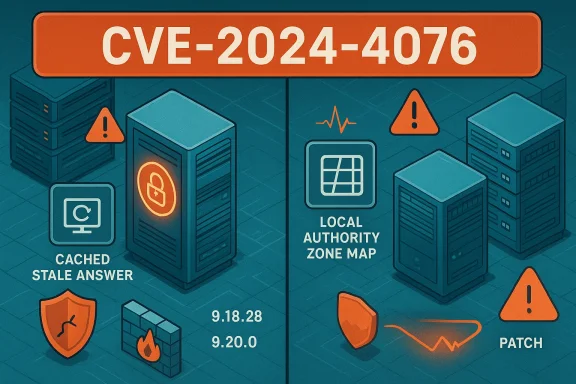
- CVE-2024-4076 arises when a single client query exercises both behaviors: the resolver serves stale cached data while also performing lookups that rely on local authoritative zone structures. A logic error in the code paths allows an assertion to be reached during that combined workflow, and the assertion aborts the named process.
Affected software, versions, and scope
ISC’s advisory lists the upstream affected ranges as follows:- BIND 9.16.13 → 9.16.50
- BIND 9.18.0 → 9.18.27
- BIND 9.19.0 → 9.19.24
Key operational notes on scope:
- If your build or distribution ships a newer BIND containing the upstream fixes, you are not affected. Conversely, many enterprise and embedded images that lag upstream may still carry vulnerable builds.
- The vulnerability is reachable over the network; no local privileges or user interaction are required to trigger the assertion, which is why the CVSS vector is network-exploitable with high availability impact.
Patched releases and remediation guidance
ISC published patched releases to address CVE-2024-4076. The principal upstream remediation points are:- Upgrade to BIND 9.18.28 or later, or 9.20.0 and later for the appropriate branch. ISC’s advisory explicitly lists these versions as fixed releases.
Immediate remediation checklist (recommended order):
- Inventory: Identify all named/BIND instances and their package versions across VMs, containers, appliances, and cloud images. Query package managers and check binary version strings.
- Patch: Apply vendor-provided security updates or upgrade to upstream patched BIND builds (9.18.28+ or 9.20.0+).
- If you cannot patch immediately, apply the short-term mitigation below (disable serve-stale) and restrict access to exposed resolvers.
- Verify: After patching, run functional DNS checks and watch for assertion logs or crash signatures.
Short-term mitigation: disable serve-stale
ISC’s advisory and multiple downstream advisories highlight a practical mitigation: disable the serve-stale behavior until you can apply the patch. Disabling serve-stale removes the overlapping code path that triggers the assertion and therefore mitigates the crash vector. Note that disabling serve-stale affects availability trade-offs — you will no longerreceive stale answers during upstream outages, so measure the operational impact before broadly applying this in production.Operational suggestions for temporary mitigation:
- Set serve-stale and related parameters to off or set max-stale-ttl to 0 in named configuration blocks where serve-stale is explicitly enabled.
- Apply access controls to limit which clients can query resolvers (ACLs, firewall rules, or split-horizon policies) — this reduces the chance of remote exploitation stemming from untrusted queriers.
- For managed or third-party DNS services, contact the provider to confirm they have applied the patch or ask for their mitigation timeline; do not assume managed resolvers were automatically updated.
Exploitability, PoC, and real-world risk
At disclosure time ISC reported no known active exploit code for CVE-2024-4076; vulnerability repositories show low EPSS (exploit prediction) values, indicating a modest probability of observed exploitation in the immediate term. Nevertheless, the bug is network-reachable and trivially useful for denial-of-service — a remote adversary can trigger repeated crashes by sending appropriate queries. Treat the absence of published PoCs cautiously; do not defer patching based on lack of public exploit evidence.Practical threat models to consider:
- Internet-facing resolvers and authoritative servers: High risk if running affected versions and exposed to public or semi-trusted clients.
- Internal resolvers: Risk depends on trust boundaries. Insider threat or lateral movement scenarios can exploit such bugs to create outages.
- Appliance and embedded images: Devices derived from older images that bundle vulnerable BIND versions may remain at risk for long periods if not updated.
Detection and forensic signals
If an attacker has triggered CVE-2024-4076 against your infrastructure, you should expect to see:- Process-level crashes and restarts of named; systemd journal or syslog entries showing abrupt termination and core dumps.
- Assertion messages in named’s log files referencing internal module/state checks (ISC advisories and downstream trackers indicate assertion failure traces).
- Correlation with specific client queries or query patterns immediately preceding the crash (use DNS query logging or capture pcap traces to reconstruct the triggering requests).
- Search name server logs for out-of-the-ordinary queries around crash timestamps and for log lines containing “assert” or other fatal diagnostic text.
- If you capture packet traces, inspect queries that cause named to consult local authoritative data while also requesting cached answers (this is the combined code path at the heart of the bug).
- Check systemd/journalctl for repeated process termination messages, core dumps, and stack traces from named at the times of interest.
Operational mitigation plan — step by step
- Inventory (first 1–24 hours)
- Run package checks across images and hosts. Example commands (adapt to your distro): query package manager or run named -v to list the version string.
- Map what BIND instances are Internet-facing versus internal.
- Priority triage (24–48 hours)
- Prioritize public resolvers and authoritative servers.
- Engage application owners for services dependent on internal resolution to assess impact if serve-stale is disabled.
- Patch (48–96 hours)
- Apply vendor security packages or upstream patched binaries (BIND 9.18.28 / 9.20.0 or distro-specific equivalents).
- Rebuild and redeploy container images that include vulnerable BIND builds.
- Interim mitigations (if patching delayed)
- Disable serve-stale on impacted instances and restrict network access to trusted clients.
- Add rate-limiting or WAF rules where possible to detect abnormal query patterns.
- Verification and monitoring (post-patch)
- Validate that assertions no longer occur by running integration tests and monitoring logs for crashes.
- Increase telemetry for DNS server errors and client-side resolution failures for a short monitoring window.
- Post-incident hardening
- Incorporate BIND version checks into your baseline configuration and continuous vulnerability scanning.
- For appliances and images, schedule rebuilds so that fixed binaries are baked into future releases.
Why this matters — technical and operational analysis
- DNS is foundational: A crash in a named instance can cascade through dependent services. Many internal and external systems rely on stable name resolution; a resolver outage causes application-level errors, failed certificate validations, and degraded user experience.
- Attack simplicity: While this is not a code-execution flaw, the fact that it’s network-reachable with no authentication significantly raises operational urgency — causing a crash is a low-effort disruption for a remote adversary.
- Patch/packaging lag: The real-world exposure window is often determined by vendor packaging cycles and image rebuild cadences. Many environments are compromised not by the severity of the bug but by the time it takes to get patched artifacts into production images and appliances. Multiple vendor trackers and distributors mapped CVE-2024-4076 into errata and fixed packages; operators must check their distro-specific advisories.
- Disabling serve-stale prevents the assertion but removes a high-availability feature that helps during transient upstream failures. In high-availability DNS architectures, disabling it may increase client-perceived outages during upstream disruptions.
- Network restrictions reduce exposure but are not a full substitute for patching: internal attackers or compromised hosts in trusted networks can still reach resolvers.
- Operational friction: Patching resolver fleets, especially in large, distributed, or appliance-heavy estates, is labor-intensive and may require maintenance windows and DNS warm-up plans (e.g., to prevent cache cold-start issues).
Recommended hardening beyond the immediate fix
- Standardize resolver configuration across fleet and add serve-stale as an auditable setting in your configuration management system so changes are visible and reviewed.
- Centralize DNS resolution where feasible (e.g., controlled caching resolvers) and enforce strict egress DNS controls so application processes cannot query arbitrary external nameservers.
- Add health-check and auto-restart protections with out-of-band alerting to ensure resolver crashes are detected immediately and remediation is escalated.
- Ensure all DNS server binaries in images and appliances are tracked via SBOMs (Software Bill of Materials) so you can quickly determine which deployed artifacts are affected by future advisories.
Final assessment and recommended timeline
CVE-2024-4076 is an availability-first vulnerability with a straightforward remediation: apply the upstream or vendor patch and, if you cannot patch immediately, disable serve-stale as a temporary mitigation. Given the low complexity of triggering the assertion and the broad use of BIND across public and private infrastructure, the correct operational posture is to treat this as a high-priority patching item: inventory and patch within your standard emergency window (for many organizations, 72 hours or less), otherwise accept the operational trade-offs of the serve-stale mitigation and network hardening until you can deploy the fix.Be cautious: absence of public exploit code does not equal safety. The vulnerability is network-exploitable and lends itself to reliable denial-of-service, so assume attackers can and will weaponize it in targeted campaigns or automated scans. Patch aggressively, verify thoroughly, and use the mitigations described here to reduce exposure while you complete rollouts.
Conclusion
CVE-2024-4076 is a reminder that features designed to improve availability—like serve-stale—can interact with other code paths and create systemic fragility. The solution path is clear: prioritize patching to the patched BIND releases, apply reasonable short-term mitigations where needed, and harden DNS operational practices so you are not reliant on a single feature for resilience. Immediate action will reduce the window of service disruption risk and restore confidence in your DNS infrastructure.
Source: MSRC Security Update Guide - Microsoft Security Response Center
