

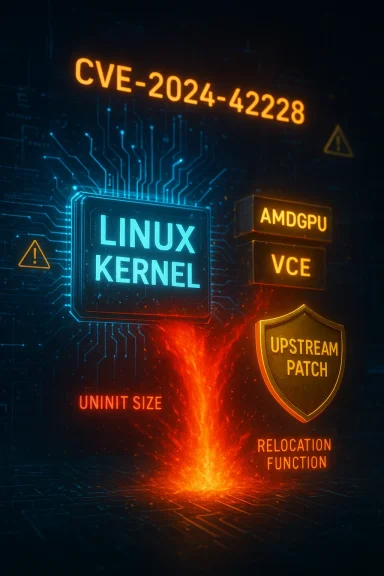
A critical robustness bug in the Linux kernel’s AMDGPU driver—tracked as CVE-2024-42228—allows a local actor to provoke a kernel-level denial-of-service by using an uninitialized value when the driver calls amdgpu_vce_cs_reloc, and upstream fixes have been merged into stable kernel trees and distributed in vendor updates to neutralize the crash primitive.
The AMDGPU driver is the in-kernel Direct Rendering Manager (DRM) device driver for modern AMD GPUs. It implements both display and compute/encode functionality and is widely used across desktops, servers, and cloud images that expose GPU hardware to guest workloads. The vulnerable code sits in the Video Coding Engine (VCE) / command submission path where user-provided command streams are parsed and validated before being forwarded to GPU microcontrollers or firmware. When input handling in that code uses an uninitialized variable for a size parameter, the kernel can reach an undefined state and produce a deterministic oops or hang—allowing an attacker who can submit GPU command streams to repeatedly crash a host.
Why this matters: the flaw is availability-focused. The attacker’s goal does not require remote network access; exploitation is local but can be highly disruptive in multi-tenant or shared environments (containers, VMs, or multi-user desktop systems) where untrusted code may reach the DRM device. Vendors have classified the issue as moderate-to-high severity depending on the scoring system, and multiple Linux distributions pushed kernel updates to remediate the defect.
Short-term mitigations (when immediate patching is not possible):
Note of caution: deliberately crafting and running PoCs that crash kernel hosts has real operational cost and ethical implications. Follow responsible disclosure norms and perform testing only in isolated lab environments.
Source: MSRC Security Update Guide - Microsoft Security Response Center
 Background / Overview
The AMDGPU driver is the in-kernel Direct Rendering Manager (DRM) device driver for modern AMD GPUs. It implements both display and compute/encode functionality and is widely used across desktops, servers, and cloud images that expose GPU hardware to guest workloads. The vulnerable code sits in the Video Coding Engine (VCE) / command submission path where user-provided command streams are parsed and validated before being forwarded to GPU microcontrollers or firmware. When input handling in that code uses an uninitialized variable for a size parameter, the kernel can reach an undefined state and produce a deterministic oops or hang—allowing an attacker who can submit GPU command streams to repeatedly crash a host.Why this matters: the flaw is availability-focused. The attacker’s goal does not require remote network access; exploitation is local but can be highly disruptive in multi-tenant or shared environments (containers, VMs, or multi-user desktop systems) where untrusted code may reach the DRM device. Vendors have classified the issue as moderate-to-high severity depending on the scoring system, and multiple Linux distributions pushed kernel updates to remediate the defect.
The vulnerability in plain terms
- What the code does: the VCE command submission path parses a client-supplied command stream, performs relocations and bounds checks, and builds GPU commands that are later executed by GPU micro-engines.
- What went wrong: a pointer-derived variable named *size (used to carry a length or slot count) can be left uninitialized before a call to amdgpu_vce_cs_reloc. When the code dereferences or relies on that value, control flow can take an unexpected route and trigger kernel-level faults.
- The practical effect: deterministic denial-of-service—a local process that can submit the crafted command stream can crash the driver or the entire kernel, causing a sustained or persistent outage until the host is rebooted or the driver is reloaded. This maps to the availability-impact language used by MSRC-style guidance for similar DoS vulnerabilities.
Technical analysis: where the code breaks down
The affected code path
Upstream tracking and vendor advisories identify the amdgpu VCE parsing code—specifically an amdgpu_vce_ring_parse_cs() / call-site that ultimately invokes amdgpu_vce_cs_reloc()—as the location where the *size value is used without a guaranteed initialization. Fixes submitted upstream initialize the size in all code paths or otherwise harden the relocation handling to avoid reading an indeterminate value.Why an uninitialized variable can be catastrophic in kernel space
User-controlled data flowing into a kernel parser creates a classic boundary problem: the kernel trusts that the user-provided command stream either contains well-formed entries or that the driver will defensively sanitize and bound-check every field. An uninitialized integer or pointer used as a size may:- Produce an extremely large value that bypasses checks and causes out-of-bounds accesses,
- Resolve to zero such that loops or allocations are skipped incorrectly,
- Or simply create non-deterministic control flows that trigger kernel WARNs, oopses, or memory corruption elsewhere.
Affected releases and distribution patches
Multiple upstream and downstream trackers list affected kernel trees and the stable fixes that were applied. The vulnerability was disclosed publicly in late July 2024 and patches were merged into the stable trees; downstream distributions then produced vendor kernel updates across a range of releases. Representative references include:- NVD and CVE trackers listing the issue and associated remediation references.
- Vendor distribution advisories from Ubuntu, Debian, SUSE, Oracle, Amazon, and others documenting fixed package updates and the kernel versions where the fix is present. Ubuntu and Debian list the CVE and show the fixed package builds; Amazon Linux, Oracle, AlmaLinux and Red Hat advisories reference vendor errata and kernel updates.
Exploitability: how easy is it to trigger?
- Attack vector: Local only. An attacker must be able to submit GPU command streams or otherwise invoke the amdgpu VCE code path from the host or guest OS. This includes processes with access to the GPU device nodes (/dev/dri/*) or workloads that can allocate GPU resources. Several vendor CVSS assessments classify the vector as Local.
- Privileges required: Low in many scoring variants—meaning unprivileged users who can open the DRM node could provoke the condition. The requirement that the attacker be local and able to interact with GPU devices means that in many multi-tenant clouds the attack surface depends on how device access is exposed to guests.
- Attack complexity: Varies. Some vendor scores report High complexity (because crafting the exact malformed command stream can be non-trivial), while others report Low (reflecting that tooling or existing userspace components may already be able to exercise the vulnerable path). Treat exploitability as non-trivial but practically achievable in constrained environments where GPU access is possible.
Real-world risk scenarios
Clouds and virtualized hosts
If a cloud provider exposes GPU passthrough or mediated device access to untrusted tenants, a single tenant could repeatedly crash the host kernel or trigger GPU resets, affecting co-located tenants and infrastructure services. Several security scanning and management tools flagged this CVE for cloud images (CBL Mariner, Azure Linux, etc.), and vendors produced distribution-specific kernel updates. Operators should assume multi-tenant hosts are at meaningful risk until patched or until GPU device access is constrained.Workstations and developer systems
On desktops or developer machines with local users, an unprivileged user or a malicious local binary could provoke repeated system crashes or rendering failures that require rebooting the workstation to recover. The user-visible impact is abrupt system unavailability and potential data loss for in-flight work.Embedded and appliance systems
APIs and management stacks on embedded appliances or appliances that accept user-provided workloads (for example, systems that process video streams via GPU-accelerated encoders) may be vulnerable if they process untrusted command streams or accept data from remote sources that are forwarded to the kernel-level VCE parsing path.Detection and monitoring guidance
Look for these operational signals in logs and runtime metrics:- Kernel oops and tracebacks mentioning amdgpu, VCE, or amdgpu_vce_cs_reloc in dmesg or systemd journal. Grep for these keywords in system logs.
- Repeated GPU resets, driver reloads, or device removal/reattach events in logs.
- Sudden system freezes or frequent panics that correlate with GPU-heavy workloads.
- Unexpected user-space crashes of GPU-accelerated processes (video encoders, machine-learning tasks) immediately before driver-level failures.
- Check kernel messages for amdgpu errors:
- sudo journalctl -k | grep -i amdgpu
- Search for VCE-specific oopses:
- sudo journalctl -k | egrep 'vce|amdgpu_vce|cs_reloc'
- Identify which processes have open GPU device nodes:
- sudo lsof /dev/dri/*
Mitigation and remediation
Primary action: patch. The only complete remediation is to apply the vendor-supplied kernel updates that incorporate the upstream fixes. All major distributions that shipped kernels containing the amdgpu driver published security advisories and fixed package builds; follow your distribution’s update channels and rely on package metadata to identify fixed kernel package versions.Short-term mitigations (when immediate patching is not possible):
- Restrict access to the DRM device nodes (/dev/dri/*). Ensure only trusted users and service accounts have read/write permissions to GPU device files, and consider using group-based access controls to limit exposure. This reduces the risk of unprivileged processes exercising the vulnerable parsing path.
- Disable or unload the amdgpu module on systems that do not require GPU acceleration. Note: this is intrusive and will stop all GPU workloads and may not be acceptable for production hosts. Use modprobe -r amdgpu on test systems only after verifying the impact.
- For virtualized hosts, block or limit GPU passthrough or mediated device assignment until the host is patched. Revoke GPU access for untrusted VMs where possible.
- Implement cgroup, container runtime, or SELinux policies to prevent untrusted containers from opening GPU device nodes.
Vendor and distribution guidance — what they said
- Ubuntu, Debian, SUSE, Oracle, Red Hat, Amazon Linux and other vendors published security advisories and kernel errata describing the issue, the fixed packages, and the recommended upgrade path. Administrators should inspect their distribution advisories and apply the listed kernel updates; most advisories explicitly call out the amdgpu VCE parsing issue and link to the upstream fixes.
- Security scanning vendors flagged the CVE in plugin checks and Nessus plugins; scanning results will often reference the CVE and recommend applying the vendor update. Use your vulnerability management pipeline to roll out fixes safely.
Proof-of-concept and responsible disclosure issues
To date, public advisories and vendor notes classify the defect primarily as a DoS/availability problem and reference upstream commits and patches rather than publishing exploit code. The upstream kernel fixes are small, defensive edits that explicitly initialize the size variable or adjust logic to avoid reading uninitialized state. Where code-level details are required, the stable kernel trees and vendor patches are the authoritative references; distribution updates typically include patch metadata that traces back to those upstream commits.Note of caution: deliberately crafting and running PoCs that crash kernel hosts has real operational cost and ethical implications. Follow responsible disclosure norms and perform testing only in isolated lab environments.
Why this class of bug keeps appearing — and what to do about it
Driver code is a high-risk area because it mixes complex hardware state, binary command formats, and performance-optimized parsing with kernel privileges. The amdgpu tree has been the subject of many small, targeted fixes addressing NULL dereferences, uninitialized reads, and off-by-one bounds errors in 2024–2025; these are not indicators of negligence but of the natural risk surface of sophisticated device drivers written in C. The practical controls are:- Aggressive code review and static analysis for user-supplied parsing paths.
- Kernel driver fuzzing and targeted coverage-guided tests against parsers that accept user-provided buffers.
- Defensive programming patterns: always initialize local variables and verify all return paths set sane defaults before use.
- Operational policies: minimize the exposure of privileged device nodes to untrusted workloads.
Practical checklist for administrators (recommended steps)
- Inventory hosts that have GPUs or that run kernels with amdgpu loaded:
- Check for /dev/dri entries and loaded amdgpu module.
- Identify distribution and kernel package versions:
- Consult your distro’s CVE advisory list for CVE-2024-42228 and confirm whether your kernel package build includes the fix.
- If vulnerable, prioritize patching:
- Plan maintenance windows for kernel upgrades where required.
- Apply distribution kernel updates that vendors list as containing the fix.
- If immediate patching is impossible, apply compensating controls:
- Restrict /dev/dri access, disable passthrough, mrstanding of operational impact).
- Monitor after patching:
- Watch for repeated amdgpu-related errors in dmesg and for GPU resets to verify remediation effectiveness.
- Retest workloads:
- Validate that GPU-accelerated applications continue to function and that the kernel no longer exhibits the previous oops traces.
Strengths of the response and remaining caveats
- Strengths: Upstream maintainers accepted and merged small, surgical fixes into stable branches, and major distributions distributed vendor patches—so a practical remediation path exists and is test-proven. Security scanners and distribution trackers widely list the issue and provide artefacts for detection and remediation, making coordinated action feasible for operators.
- Caveats and residual risks: the vulnerability is local and dependent on whether untrusted code has GPU access; operators must carefully assess their own exposure models. Also, exact CVSS vectors and severity labels vary among vendors due to differing assumptions about exploitability and confidentiality/ integrity impacts—consult your distribution’s advisory for the authoritative remediation timeline and package versions. Some trackers reported divergent CVSS values (ranging from medium to high) reflecting those differences.
Conclusion
CVE-2024-42228 is a classic kernel robustness defect in the AMDGPU VCE command parsing path that permits a local actor with GPU access to cause deterministic denial-of-service through use of an uninitialized size value. The vulnerability has been fixed upstream and distributed in vendor kernels; the correct operational response is straightforward: identify exposed hosts, apply the vendor-supplied kernel updates, and, where immediate patching is impractical, apply conservative mitigations such as restricting access to /dev/dri or disabling GPU passthrough. Monitoring for amdgpu-related oopses and integrating this CVE into your patching choreography will remove the crash primitive and materially reduce operational risk.Source: MSRC Security Update Guide - Microsoft Security Response Center
