
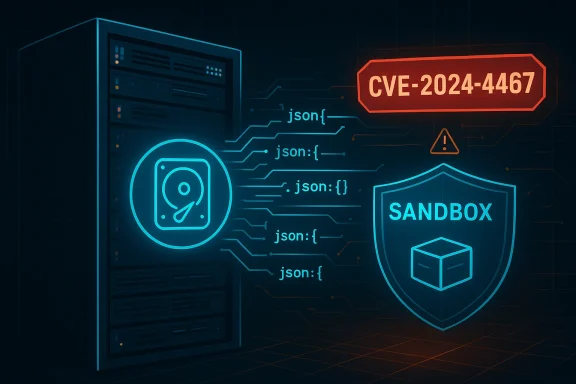
A subtle parsing bug in QEMU’s disk-image tool can do far more than crash a process: CVE-2024-4467 lets a crafted disk image fed to qemu-img’s info command trigger uncontrolled resource use and, in some configurations, cause the host process to open and read or even write an existing file on the host. The vulnerability is neither theoretical nor trivial — major distributions have classified it as important/high (CVSS 3.x score 7.8) and have shipped fixes — but its characteristics and the ubiquitous role of qemu-img in virtualization workflows make this an operational headache for administrators and a cautionary example of how management utilities can become attack surfaces.
qemu-img is the offline disk-image utility that administrators and automation tooling use to inspect, convert and repair virtual disk images used by QEMU/KVM. It can output information in human-readable or JSON formats, follow backing-file chains, and report format and allocation details without starting a VM. Because it needs to parse image metadata, qemu-img must interpret fields that can reference other resources — backing files, external extents, etc. Historically that metadata parsing has been treated as benign; CVE-2024-4467 shows how maliciously crafted metadata can weaponize a trusted utility into touching arbitrary host paths.
The CVE entry describes a specially crafted image containing a
CVE-2024-4467 specifically involved
(For context: our internal file archive of community vulnerability threads — the dataset uploaded with the user’s session — contains related QEMU and virtualization vulnerability discussions that echo the same operational concerns that CVE-2024-4467 raises: unattended image processing, multi-tenant risks, and the importance of backports. Those community threads are useful to understand operator experience and were reviewed as part of reporting. )
Source: MSRC Security Update Guide - Microsoft Security Response Center
 Background
qemu-img is the offline disk-image utility that administrators and automation tooling use to inspect, convert and repair virtual disk images used by QEMU/KVM. It can output information in human-readable or JSON formats, follow backing-file chains, and report format and allocation details without starting a VM. Because it needs to parse image metadata, qemu-img must interpret fields that can reference other resources — backing files, external extents, etc. Historically that metadata parsing has been treated as benign; CVE-2024-4467 shows how maliciously crafted metadata can weaponize a trusted utility into touching arbitrary host paths.The CVE entry describes a specially crafted image containing a
json:{} value describing block devices in QMP (QEMU Machine Protocol). When qemu-img processed that metadata, it could be tricked into consuming excessive memory or CPU and — more seriously — into reading from or writing to an external file on the host filesystem. The vulnerability was identified, publicly recorded on 2024‑07‑02, and assigned CVSS v3.1 vector CVSS:3.1/AV:L/AC:L/PR:L/UI:N/S:U/C:H/I:H/A:H with a base score of 7.8. Multiple Linux distributions and security vendors documented and pushed patches; the fix work traces back to upstream QEMU commits that change how filenames and inline JSON descriptors are handled.What went wrong: technical root cause
Parsing vs. treating strings as filenames
At a high level, the vulnerability stems from ambiguous interpretation of image metadata strings. qemu-img reads metadata that can reference other files (backing files, data extents) or embed device descriptions. Historically, some of those strings were handled in ways that caused qemu-img to attempt to open referenced files in contexts where doing so is unsafe.CVE-2024-4467 specifically involved
json:{} descriptors in QMP-style metadata. Some code paths interpreted strings with a json: prefix or similar constructs in ways that led qemu-img to treat parts of the input as directives requiring file I/O — opening or processing files that an attacker controlled or referenced. Upstream fixes change the behaviour to parse names only when explicitly requested, and to treat inline JSON that looks like a filename more cautiously so qemu-img does not open arbitrary files while merely printing image info. The upstream patch series and distribution backports make this explicit.Resource exhaustion and file operations
Two related problems combined to raise both availability and confidentiality/integrity risks:- Uncontrolled resource consumption: The crafted metadata could cause qemu-img to allocate or loop in ways that consumed significant CPU and memory, producing a denial-of-service (DoS) condition on the host where the utility was run. This is the canonical availability impact described by vendors and CVE records.
- Host file read/write: More alarming than DoS is that qemu-img — when tricked into treating a metadata string as an actionable reference — could open and operate on files outside the intended image. That means an attacker who can provide a malicious image to an environment where qemu-img runs (for example an image repository, ingestion pipeline, or a user’s workspace) might cause the qemu-img process to touch host files, leaking secret data or altering host files. Multiple advisories and distribution notes explicitly describe this risk.
Where the code was changed
Upstream QEMU and downstream packaging maintainers implemented targeted changes: sanitize or avoid automatic opening of referenced filenames during info-only operations, tighten parsing ofjson: descriptors, and adjust tests to avoid relying on the old behaviour where qemu-img would open referenced data files in info mode. The patchwork mailing list and distribution backports cite specific GitLab commits that adjust block format parsing and the iotest suite to reflect the safer behavior. These patches intentionally narrow what qemu-img will interpret as an instruction to open another file.Who is affected and how severe is the risk?
Attack vector and prerequisites
- Attack vector: Local. The attacker must be able to make a crafted image file available to the qemu-img process. That could be as a file on disk, an image uploaded to a server that runs qemu-img during ingestion, or an attacker-controlled image used in automation pipelines.
- Privileges required: Low. qemu-img typically runs with the privileges of the user invoking the tool. Because many operations in virtual-management workflows run under low-privileged system users or as part of automation, the required privileges are not high.
Impact classification
- Availability: High — qemu-img can be forced to consume CPU/memory leading to a sustained local DoS condition on the host where it runs. This can disrupt operations that rely on image processing pipelines.
- Confidentiality & Integrity: High — because qemu-img can be coerced into opening and potentially writing host files, an attacker may be able to read secrets stored on the host or alter files. That elevates this from a classic DoS to a possible host compromise vector when combined with other operational weaknesses.
Real-world exposure patterns
Operators with exposure include:- Build and CI systems that automatically invoke qemu-img for image validation or conversion.
- Image repositories that run content scanning or metadata extraction using qemu-img.
- Administrators or automation scripts that run qemu-img against user-supplied images without sandboxing.
- Multi-tenant virtualization hosts where images from different tenants are processed by a shared qemu-img instance.
What vendors and distributions said (and what they shipped)
Multiple vendors published advisories and patches:- Ubuntu assigned a CVSS 3.x score of 7.8 and marked the issue fixed in QEMU packages such as version 1:9.0.2+ds-4ubuntu2 across supported releases. Ubuntu’s security notice gives a clear remediation path.
- Amazon Linux (ALAS) documented the issue, assigned an Important severity, and provided a package update for Amazon Linux 2; Amazon also noted the complexity of backporting fixes into older Amazon Linux 1 builds and recommended upgrades.
- SUSE, Debian, Oracle Linux and others listed the CVE in their trackers, matched the Red Hat CNA writeup, and made distribution-specific fixes or backports available. SUSE and Oracle published remediation guidance and status entries.
- Upstream QEMU commits and downstream backports are documented in patchwork and packaging lists; the changes remove or constrain automatic file opening in qemu-img info and harden filename parsing.
- Security vendors (Tenable, Snyk, Aqua) published vulnerability summaries, CVSS ratings and recommended remediation steps; Snyk’s writeup credits a security researcher and recommends upgrading QEMU to a patched version (Snyk references upstream commit-based fixes and recommends 9.1.0-rc0+ where appropriate).
Immediate mitigation steps (what to do now)
If you run qemu-img anywhere in your infrastructure, treat this as an urgent operational item. Apply the following prioritized checklist:- Inventory qemu-img usage now. Find every host, CI runner, build server, image registry worker, and admin workstation that runs qemu-img (or qemu-kvm packages that contain qemu-img). Don’t forget ephemeral CI runners and containers. Checking package names like qemu, qemu-img, qemu-kvm is a reliable start.
- Patch immediately. Apply the vendor update for your distribution. Ubuntu, Amazon Linux 2, RHEL-derived distributions and SUSE have published fixed packages and backports; deploy them to production and test environments as soon as possible. If you rely on upstream QEMU builds, upgrade to the patched commits or safe release (packaging notes recommend releases or specific upstream commits).
- If you cannot patch immediately, constrain qemu-img execution.
- Run qemu-img in a restricted sandbox (container or VM) when processing untrusted images.
- Drop privileges and use filesystem ACLs so that qemu-img cannot read or write sensitive host paths.
- Use seccomp or other syscall filters to reduce qemu-img’s permission to open arbitrary files.
- Disable or remove automated pipelines that invoke qemu-img on user-submitted images until patched.
- Harden image ingestion pipelines. Treat images as untrusted input: perform content validation in sandboxed environments, avoid running host-level tooling on new images as root, and require signature/whitelisting for images used in production.
- Monitor and investigate. Look for signs of exploitation (see detection guidance below). If you suspect a host was touched by an untrusted qemu-img run, treat it as a possible compromise: collect forensic artifacts, check file modification times and access logs, and consider host isolation and credential rotation.
Detection and incident response: what to look for
CVE-2024-4467 can manifest as noisy CPU/memory use and suspicious file accesses from qemu-img. Key indicators:- High CPU or memory usage by qemu-img while processing image files where such usage is unexpected.
- Unexpected open/read/write system calls from qemu-img to host paths unrelated to an image’s defined backing file. Audit logs that record open(2)/openat(2) syscalls are useful here.
- Timestamps changes on sensitive files that coincide with qemu-img invocations.
- CI/build logs that show qemu-img being invoked against user- or third-party-supplied images shortly before system instability.
- Presence of crafted JSON descriptors in suspicious images — files that include
json:{-style entries in block device metadata.
- Collect qemu-img command lines and environment variables from shell histories, systemd service logs, and CI job logs.
- Use auditd (or equivalent) to extract open/read/write syscalls attributed to the qemu-img binary.
- If you have packet capture of administrative workflows (less common), look for metadata upload events that include suspicious JSON descriptors.
- Preserve the original image file and the exact qemu-img invocation for offline analysis and for sharing with vendors if needed.
Operational hardening: reduce the blast radius
Fixes eliminate the specific parsing bug, but defenders should not assume that qemu-img and other management tools are inherently safe. Adopt the following operational hardening steps to reduce the impact of future vulnerabilities:- Least privilege execution: Run qemu-img under a dedicated, unprivileged user account with a minimal accessible file tree. Do not run it as root except where absolutely necessary.
- Sandbox qemu-img for untrusted inputs: Use containers, lightweight VMs, or restricted chroots to keep image-processing tasks separated from production host filesystems.
- Use immutable image registries and signing: Accept only signed images in production and verify signatures as a gate before performing any server-side image inspection or conversion.
- Limit automation agent capabilities: CI runners and automation workers that handle images should run in networks and hosts that do not contain production secrets or credentials.
- Audit and monitoring posture: Add syscall auditing for image-processing binaries and treat unexpected filesystem accesses as alerts.
Why management utilities become attack surfaces
CVE-2024-4467 is a textbook example of a class of issues often overlooked in threat models: trusted tooling that processes untrusted inputs. Operators and security architects frequently treat image-format tools like qemu-img as safe and run them with broad host access. In practice:- Management utilities are used both interactively (admin workstations) and automatically (CI, ingestion pipelines), increasing opportunities for inadvertent exposure.
- Metadata formats evolve and can include references to other resources; without strict interpretation rules, a metadata string can become a directive that triggers file I/O.
- The gap between “info-only” operations and “open-for-processing” operations is subtle: commands designed merely to inspect a file may contain code paths that open referenced files or execute additional parsing logic.
Cross-checking and traceability: how we validated the facts
To build a reliable picture of CVE-2024-4467 and its operational impact, this article cross-references upstream commit traces and multiple vendor advisories. Upstream QEMU commits and patchwork backport notes document the code changes that prevent qemu-img from opening arbitrary files in info mode; distribution advisories from Ubuntu, Amazon Linux, SUSE and Oracle record the CVSS attribution, affected packages and the remediation paths. Independent security vendors (Snyk, Tenable) and distribution trackers (Debian security tracker) confirm the scope, CVSS vector, and recommended actions. Where vendor statements differed on backporting policy (for example, older Amazon Linux 1 images), those differences are noted rather than assumed to be universal.(For context: our internal file archive of community vulnerability threads — the dataset uploaded with the user’s session — contains related QEMU and virtualization vulnerability discussions that echo the same operational concerns that CVE-2024-4467 raises: unattended image processing, multi-tenant risks, and the importance of backports. Those community threads are useful to understand operator experience and were reviewed as part of reporting. )
Practical checklist for system administrators (quick reference)
- Immediately check package state:
- On Debian/Ubuntu:
apt list --installed | grep qemu(ordpkg -l qemu*) - On RHEL/CentOS/Alma/Oracle:
rpm -qa | grep qemu - On Amazon Linux:
yum list installed | grep qemu - If any of the installed packages are older than the distribution advisory, patch now per vendor instructions. Reboot or restart services only if the package notes require it.
- For pipelines and CI: pause automatic image-processing jobs until runners are updated or moved into sandboxed containers.
- Add monitoring rules for qemu-img:
- Alert on commands invoking qemu-img with unexpected arguments.
- Alert on high CPU/memory usage from qemu-img persisting longer than expected thresholds.
- Audit open/read/write syscalls for qemu-img for unexpected host paths.
- If you suspect a breach: isolate the host, preserve the image file that triggered the behaviour, gather auditd logs and strace if possible, and engage a forensic process.
Longer-term implications for virtualization security
Two durable takeaways emerge from CVE-2024-4467:- The attack surface is broadening: utilities and offline tooling are just as likely to be vectors as network-facing services when they process untrusted inputs in automation contexts.
- The value of least-privilege and sandboxing keeps rising: even well-scrutinized open-source projects can produce parsing ambiguities that cause serious host-level consequences, so operational mitigations are necessary complements to code fixes.
Conclusion
CVE-2024-4467 is a sharp reminder that tooling used to manage virtualization — particularly utilities that read or interpret complex image metadata — must be treated as exposed code paths. The bug’s combination of resource exhaustion and the potential for host file read/write elevates it above a simple denial-of-service; it is an operational risk that can lead to data exposure or host compromise in the wrong environment. Vendors and distributions have published fixes and backports, and upstream QEMU commits harden the behaviour, but the truly durable defenses are operational: patch promptly, sandbox untrusted image processing, enforce least privilege for management utilities, and monitor qemu-img behaviour where it’s used. Administrators who adopt a layered posture — combining timely patching with sandboxing and logging — will reduce both the immediate risk from CVE-2024-4467 and the likelihood that the next parsing bug leads to a host-level incident.Source: MSRC Security Update Guide - Microsoft Security Response Center
