

HAProxy operators should treat CVE-2024-45506 as an urgent availability risk: a logic flaw in the HTTP/2 zero‑copy forwarding path (the h2_send loop) can be triggered remotely to put HAProxy processes into an endless loop or crash them outright, and this weakness was observed being exploited in the wild in 2024.
HAProxy is the de facto load‑balancer and reverse proxy for high‑performance HTTP and TCP workloads. Its performance profile relies on sophisticated I/O optimizations, one of which is zero‑copy forwarding — a mechanism that reduces CPU and memory overhead by passing network data through the proxy without extra buffer copies. Under certain HTTP/2 multiplexing conditions, that optimization interacts with the HTTP/2 sending code path (the h2_send loop) in a way that can produce an infinite loop with an unreachable exit condition, allowing a remote attacker to deny service to the proxy.
The issue is tracked as CVE‑2024‑45506 and affects HAProxy releases in the 2.9 and 3.x series: specifically, 2.9.x before 2.9.10, 3.0.x before 3.0.4, and 3.1.x through 3.1‑dev6. Upstream vendor advisories and distribution trackers consistently mark the flaw as a denial‑of‑service (availability) issue and assign it important/high severity with a CVSS v3.1 score around 7.5 (A:H).
Operationally, the loop may be interrupted by HAProxy’s watchdog mechanism which kills a busy process after a short interval — the project’s mail archive notes a typical two‑second watchdog threshold may stop the loop but results in process termination nonetheless. Thus, a remote attacker can repeatedly trigger service outages by sending carefully formed HTTP/2 traffic that exercises the zero‑copy path.
Note: ordinary HAProxy instances that do not accept HTTP/2 or have zero‑copy forwarding disabled are not vulnerable in practice; the flaw requires the specific interaction of HTTP/2 multiplexing plus zero‑copy forwarding. However, many modern HAProxy deployments do enable HTTP/2 on frontends/backends (or use a pass‑through multiplexer), so the risk is widespread.
This directive disables the zero‑copy send optimization for HTTP/2; it is intentionally surgical and avoids disabling HTTP/2 support entirely. Upstream explicitly lists this as the recommended temporary mitigation until you can apply the patch.
Important operational note: there are other zero‑copy tuning knobs (for HTTP/1, QUIC, pass‑through) and a global
If you are responsible for a packaging or CI/CD pipeline that builds HAProxy images, ensure any automated builds pick up the patched upstream releases and run regression tests that cover HTTP/2 and zero‑copy pathways. Because the fix touches multiplexing and buffer handling, careful validation is recommended to avoid regressions under load.
Conclusion
Operational resilience matters. For any team relying on HAProxy for public or customer‑facing traffic, CVE‑2024‑45506 is not a theoretical bug — it was exploited in the wild and directly threatens availability. Patch to the fixed releases or apply the documented, narrow workaround immediately, monitor for signs of exploitation, and validate your proxy performance after mitigation. Acting now reduces the chance your next outage becomes a customer incident.
Source: MSRC Security Update Guide - Microsoft Security Response Center
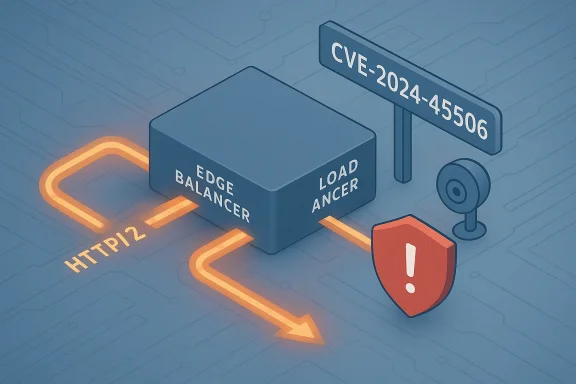 Background / Overview
HAProxy is the de facto load‑balancer and reverse proxy for high‑performance HTTP and TCP workloads. Its performance profile relies on sophisticated I/O optimizations, one of which is zero‑copy forwarding — a mechanism that reduces CPU and memory overhead by passing network data through the proxy without extra buffer copies. Under certain HTTP/2 multiplexing conditions, that optimization interacts with the HTTP/2 sending code path (the h2_send loop) in a way that can produce an infinite loop with an unreachable exit condition, allowing a remote attacker to deny service to the proxy.The issue is tracked as CVE‑2024‑45506 and affects HAProxy releases in the 2.9 and 3.x series: specifically, 2.9.x before 2.9.10, 3.0.x before 3.0.4, and 3.1.x through 3.1‑dev6. Upstream vendor advisories and distribution trackers consistently mark the flaw as a denial‑of‑service (availability) issue and assign it important/high severity with a CVSS v3.1 score around 7.5 (A:H).
What exactly goes wrong? A technical explanation
At a high level, the bug arises from the intersection of two features:- HTTP/2 multiplexing: HAProxy manages multiple concurrent logical streams over single TCP connections. The HTTP/2 multiplexer code coordinates reading, buffer management, and sending for many interleaved streams.
- Zero‑copy forwarding: This optimization allows HAProxy to "fast‑forward" data between sockets (and sometimes into kernel splice/sendfile mechanisms) without copying through an application buffer, to minimize overhead. The feature is controlled by fine‑grained tune directives.
Operationally, the loop may be interrupted by HAProxy’s watchdog mechanism which kills a busy process after a short interval — the project’s mail archive notes a typical two‑second watchdog threshold may stop the loop but results in process termination nonetheless. Thus, a remote attacker can repeatedly trigger service outages by sending carefully formed HTTP/2 traffic that exercises the zero‑copy path.
Which systems are affected?
- HAProxy 2.9.x: versions prior to 2.9.10.
- HAProxy 3.0.x: versions prior to 3.0.4.
- HAProxy 3.1.x: 3.1-dev6 and earlier development builds up to that commit.
Note: ordinary HAProxy instances that do not accept HTTP/2 or have zero‑copy forwarding disabled are not vulnerable in practice; the flaw requires the specific interaction of HTTP/2 multiplexing plus zero‑copy forwarding. However, many modern HAProxy deployments do enable HTTP/2 on frontends/backends (or use a pass‑through multiplexer), so the risk is widespread.
Confirmed exploitation in the wild
Multiple advisories and trackers record that CVE‑2024‑45506 was observed being exploited in the wild in 2024. Public CVE/NVD records and distribution trackers explicitly note this, and upstream HAProxy’s advisory warns operators that the issue can be triggered remotely and should be remediated promptly. The presence of in‑the‑wild exploitation raises the operational urgency: unlike low‑visibility issues, this one has already been weaponized to cause outages.Patch and workaround summary
Upstream HAProxy and downstream distributions have published fixes. Operators should prioritize upgrades along one of these lines:- Upgrade HAProxy 2.9 → 2.9.10 (or later).
- Upgrade HAProxy 3.0 → 3.0.4 (or later).
- Move off vulnerable 3.1 development builds (3.1-dev6) to a fixed stable release.
Code:
global
tune.h2.zero-copy-fwd-send offImportant operational note: there are other zero‑copy tuning knobs (for HTTP/1, QUIC, pass‑through) and a global
tune.disable-zero-copy-forwarding that disables zero‑copy forwarding entirely. Use the narrowest possible workaround consistent with your environment; disabling all zero‑copy features may incur a measurable performance cost.Detection: how to tell if you're being targeted or exploited
Because the attack triggers an endless loop or process termination, detection can be both network‑ and host‑centric.- Host signals:
- Repeated HAProxy worker crashes, watchdog kills, or unexpected process restarts. Check systemd/journald logs and HAProxy logs around the time of process termination. Watchdog kills that are repeatedly correlated with front‑end HTTP/2 traffic are a red flag.
- Core dumps or short uptimes for worker processes. System monitoring that alerts on high process CPU with no progress may detect a busy loop before the watchdog kills it.
- Network signals:
- Suspiciously frequent or malformed HTTP/2 frames from individual source IPs or clusters of IPs. Because exploitation requires exercising the HTTP/2 multiplexer, look for flows that open HTTP/2 connections and send unusual sequences of frames or repeated stream churn.
- If you have TLS termination elsewhere and HAProxy sees decrypted traffic, inspect the request/response patterns for repeated attempts that cause worker restarts.
- Telemetry / metrics:
- Sudden spikes in HAProxy process CPU or socket counts correlated with HTTP/2 listeners.
- Increased rate of process restarts in HAProxy process supervisors.
- Detection rules / signatures:
- There is no single simple frame signature for the bug: detection must focus on behavior (process reboots, watchdog kills, persistent busy loops) combined with anomalous HTTP/2 sequences from external clients. Use WAFs and HTTP/2 inspection tools to log suspicious framing-level behavior.
Practical mitigation plan — step‑by‑step
- Inventory
- Identify all HAProxy instances (standalone, containers, embedded appliances) in your estate.
- Record the version string shown by your HAProxy package or binary. Confirm if the running build is in the vulnerable ranges.
- Prioritize
- Treat public/edge HAProxy frontends and any proxies terminating public HTTP/2 traffic as highest priority.
- Rank by exposure: externally accessible listeners, gateways to critical applications, or customer‑facing APIs come first.
- Patch (recommended)
- For each instance, apply the vendor‑recommended HAProxy update: 2.9.10+, 3.0.4+, or equivalent patched vendor packages. Test upgrades in a staging environment first.
- Emergency workaround (if you cannot patch immediately)
- Add the global config line:
Code:global tune.h2.zero-copy-fwd-send off - Reload or restart HAProxy gracefully where possible and verify reduced zero‑copy usage.
- Monitor performance; disabling zero‑copy may increase CPU usage and buffer pressure for high‑throughput systems.
- Network controls
- If feasible, apply rate limiting on HTTP/2 frontends and limit connection rates per source IP.
- Use WAF rules to detect and block unusual HTTP/2 framing patterns or automated scanners.
- Post‑remediation validation
- After patching, run a planned test suite that includes HTTP/2 multiplexing scenarios and high‑throughput zero‑copy paths to validate there is no regression.
- Monitor for further anomalous watchdog events or worker restarts.
Operational tradeoffs and performance considerations
Disabling zero‑copy forwarding is a practical short‑term mitigation but is not performance‑neutral. Zero‑copy features exist to reduce CPU cycles and memory pressure for heavy traffic. Turning them off can:- Increase CPU utilization on busy proxies.
- Increase memory and buffer allocations, potentially exposing other edge cases if your HAProxy config is tuned tightly.
- Reduce throughput or increase latency for some workloads.
Risk analysis and likelihood of exploitation
- Exploitability: The vulnerability can be triggered remotely over the network without authentication, and the attack complexity is considered low by CVSS vectors because it does not require special privileges. Distributions and security trackers list the attack vector as network and attack complexity as low.
- Impact: High on availability. Successful exploitation crashes workers or forces watchdog termination; repeated exploitation can sustain an outage. CVSS assessments mark the availability impact as high with no confidentiality or integrity impact.
- Observed use in the wild: Confirmed. Public trackers and upstream notes indicate exploitation occurred in 2024, which increases the priority for patching. When vulnerabilities are actively exploited, the window for attackers to move from opportunistic scanning to targeted outages narrows.
Detection and incident response playbook (short checklist)
- Immediately gather:
- HAProxy version and process uptime.
- Systemd/journald logs and HAProxy logs covering recent restarts.
- Any recent core dumps or watchdog kill entries.
- Contain:
- If you see active exploitation evidence, apply the global workaround to disable HTTP/2 zero‑copy sends.
- Temporarily rate‑limit or throttle new HTTP/2 connections at network or edge appliances.
- Eradicate:
- Patch to the fixed version as soon as possible.
- Recover:
- Validate functional tests and monitor for recurring restarts.
- Post‑incident:
- Review logs to determine attack origin and extent.
- Harden monitoring (alerts for watchdog kills and repeated worker restarts).
For product teams and integrators
If you ship HAProxy as part of an appliance, container image, or embedded product (for example, Kubernetes ingress controllers or enterprise appliance images), update your base images and downstream packages immediately. Several commercial and open‑source integrators published coordinated updates following HAProxy’s advisory. Vendors including major Linux distributions incorporated the upstream fixes into their CVE trackers and release builds; check your vendor’s advisory for the specific package name and version number that contains the backport.If you are responsible for a packaging or CI/CD pipeline that builds HAProxy images, ensure any automated builds pick up the patched upstream releases and run regression tests that cover HTTP/2 and zero‑copy pathways. Because the fix touches multiplexing and buffer handling, careful validation is recommended to avoid regressions under load.
Why this matters to WindowsForum readers and IT operations
Windows shops increasingly rely on Linux‑based front‑end infrastructure, container platforms, or cloud load balancers that embed HAProxy. Even if your back‑end application stack is Windows‑centric, HAProxy often sits at the edge of traffic flows that reach Windows services. A sustained HAProxy outage can effectively make Windows web apps unreachable, triggering incident response and customer impact. This CVE is an availability risk that bridges Linux proxy infrastructure and Windows application availability — a cross‑platform operational concern.Key takeaways and final recommendations
- Treat CVE‑2024‑45506 as high‑priority for availability patching: upgrade to HAProxy 2.9.10, 3.0.4, or later fixes as appropriate to your branch.
- If you cannot patch immediately, apply the surgical workaround by disabling HTTP/2 zero‑copy sends in the global HAProxy config:
tune.h2.zero-copy-fwd-send off. Monitor the performance impact. - Look for behavioral indicators (watchdog kills, repeated worker restarts, anomalous HTTP/2 flows) rather than expecting a simple frame signature. Correlate process logs and network telemetry.
- Coordinate package updates across appliance images, containers, and integrator builds; validate HTTP/2 and zero‑copy paths under load after upgrading.
Conclusion
Operational resilience matters. For any team relying on HAProxy for public or customer‑facing traffic, CVE‑2024‑45506 is not a theoretical bug — it was exploited in the wild and directly threatens availability. Patch to the fixed releases or apply the documented, narrow workaround immediately, monitor for signs of exploitation, and validate your proxy performance after mitigation. Acting now reduces the chance your next outage becomes a customer incident.
Source: MSRC Security Update Guide - Microsoft Security Response Center
