

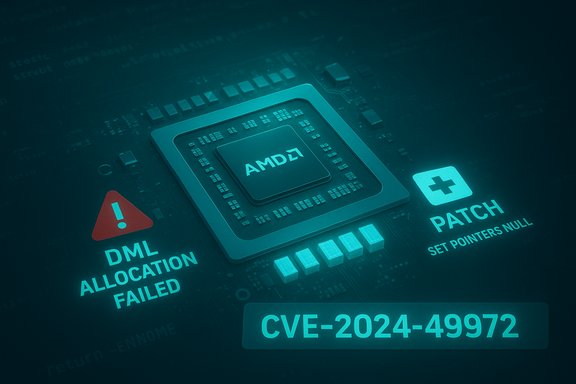
A Linux kernel vulnerability in the AMD DRM/display stack — tracked as CVE-2024-49972 — can leave driver state in an inconsistent condition when a Display Mode Library (DML) allocation fails, causing driver instability and a local denial-of-service until the host is rebooted or patched. The flaw is modest in code size but significant in operational effect: distributions and vulnerability databases list the issue as availability-first with a CVSS v3.1 base score of 5.5, and upstream maintainers fixed it with a small defensive change that ensures DML memory is released on allocation failure.
The Linux Direct Rendering Manager (DRM) contains vendor-specific GPU drivers; AMD’s amdgpu driver implements display sequencing and mode calculations in a component often referred to as the drm/amd/display path. Within that code the Display Mode Library (DML) is used to calculate timing, plane sizing, and other hardware‑specific mode parameters. When the kernel constructs a new dc_state it creates nested helper structures — including a DML context — and those allocations must be handled carefully across success and failure paths.
CVE-2024-49972 is a defensive‑coding error in that allocation/cleanup sequence: when DML allocation during DC state creation fails, the code did not reliably free previously allocated memory or clear pointers, leaving the resulting structure in a non-NULL but invalid state that later code paths may treat as valid. The proper fix is simple — ensure the newly allocated resources are deallocated on any error path and set pointers to sane values — but omitting that deallocation in kernel driver code can produce kernel oopses, driver resets, or cumulative resource exhaustion in long‑running processes.
Key data points confirmed across multiple trackers:
From a security operations perspective the consistent lessons are:
Administrators should prioritize patching for shared and multi‑tenant environments, apply short‑term mitigation for unpatched hosts, and verify the fix via vendor changelogs and kernel package versions. While the patch itself is small and conservative, the underlying lesson is enduring: tiny errors in privileged driver code can create outsized operational risk, and disciplined inventory, patching and device‑exposure controls remain the best defense.
Source: MSRC Security Update Guide - Microsoft Security Response Center
 Background / Overview
The Linux Direct Rendering Manager (DRM) contains vendor-specific GPU drivers; AMD’s amdgpu driver implements display sequencing and mode calculations in a component often referred to as the drm/amd/display path. Within that code the Display Mode Library (DML) is used to calculate timing, plane sizing, and other hardware‑specific mode parameters. When the kernel constructs a new dc_state it creates nested helper structures — including a DML context — and those allocations must be handled carefully across success and failure paths.CVE-2024-49972 is a defensive‑coding error in that allocation/cleanup sequence: when DML allocation during DC state creation fails, the code did not reliably free previously allocated memory or clear pointers, leaving the resulting structure in a non-NULL but invalid state that later code paths may treat as valid. The proper fix is simple — ensure the newly allocated resources are deallocated on any error path and set pointers to sane values — but omitting that deallocation in kernel driver code can produce kernel oopses, driver resets, or cumulative resource exhaustion in long‑running processes.
What exactly went wrong (technical anatomy)
How the bug appears in runtime
- During DC (display controller) state creation the driver requests kernel memory for a DML context.
- If that allocation fails (for example, transient out‑of‑memory conditions or other allocation constraints), the error path did not release already‑allocated resources or clear the DML pointer that callers expect to be NULL when absent.
- Later logic that inspects the DML pointer can see a non‑NULL but invalid value and either:
- attempt to use it, causing invalid memory accesses or kernel oops; or
- free it later believing it is the unique owner, which can lead to double‑free behavior if the memory had already been freed elsewhere; or
- simply leak kernel memory if tear‑down does not drop the reference.
Why the fix is small but important
Kernel drivers follow a standard defensive pattern: if an allocation fails, roll back any prior allocations and return an error. The remediation for CVE‑2024‑49972 is intentionally minimal — free the allocated DML on failure and set the pointer to NULL so subsequent state copies and release paths can operate safely. That makes the patch straightforward to backport to stable kernel branches and keeps regression risk low, a recognized best practice for hardware interaction code.Affected versions and distribution mapping
Independent vulnerability tracking sources and vendor advisories list the CVE and map it into kernel ranges and distribution package versions. Public mappings indicate the issue existed in upstream Linux kernels prior to the stable commit that fixed the defect; several distributions have already mapped the upstream commit into their security updates and released patched kernel packages.Key data points confirmed across multiple trackers:
- Public disclosure and tracking dates: the CVE entry and related advisories were published in October 2024 and updated in subsequent weeks.
- Typical affected kernel range reported: kernels earlier than the stable commit (for example, versions prior to 6.11.3 were indexed by some trackers). Operators should check their distro’s kernel changelog to confirm whether a specific kernel package includes the upstream fix.
- Distribution mapping varies: Debian, Ubuntu and other major distros list fixed package versions in their security trackers; embedded OEM kernels and custom vendor trees remain the principal “long‑tail” risk where backports may not have been applied.
Impact and exploitability
Primary impact: Availability
The dominant, credible risk from CVE‑2024‑49972 is availability. The mismanaged allocation and pointer state can produce deterministic driver crashes or kernel oopses when the invalid pointer is later used or freed. For single‑user desktops this typically manifests as compositor crashes, frozen displays or the need to reboot; for shared or multi‑tenant systems it can mean full host instability or repeated service outages. Vulnerability feeds consistently record High availability impact even though confidentiality and integrity impacts are not reported.Attack vector and privileges
- Attack vector: Local only. An attacker must run code on the target host to trigger the driver code paths that exercise DC state creation (for example, via processes that perform modesets, compositor actions, or GPU-accelerated workloads).
- Privileges required: Low to local. On many desktop and developer systems, unprivileged users and sandboxed processes can indirectly invoke DRM code via compositors or GPU-accelerated media playback. Servers that explicitly limit access to /dev/dri devices raise the attack bar substantially.
Complexity and proof-of-concept
The code path is deterministic under the right conditions (allocation failure plus later state copying/release), so exploitation to produce a denial of service is low‑complexity in exposed environments. There is no authoritative public proof‑of‑concept demonstrating privilege escalation or remote code execution stemming directly from CVE‑2024‑49972 at the time of disclosure; exploit chains that turn kernel memory‑management flaws into privilege gains require additional, often environment‑specific preconditions. Treat privilege escalation claims as unverified unless demonstrated in a reliable PoC.Detection and operational indicators
If you suspect a host is unpatched or being targeted, collect and examine these artifacts:- Kernel logs (dmesg and journalctl -k) for oops/panic messages referencing amdgpu, drm, or DML code paths.
- Repeated amdgpu resets, driver watchdog events, or pageflip timeouts recorded by compositors or browsers.
- User complaints: compositor crashes, sudden session termination when changing display modes (hotplug, full‑screen transitions), or frequent graphics hangs.
- Repro steps in a controlled lab: exercising display reconfiguration flows (hotplugging monitors, using multi‑display docking stations, or running GPU accelerated media) can reproduce the symptomology on vulnerable kernels.
- Run uname -r to get the running kernel.
- Check whether the amdgpu driver is loaded: lsmod | grep amdgpu.
- Inspect device nodes and access: ls -l /dev/dri/*.
- Preserve full kernel logs (dmesg, serial console output) immediately for vendor or upstream triage.
Remediation and mitigation
Primary remediation (recommended)
- Apply vendor/distribution kernel updates that explicitly reference CVE‑2024‑49972 or include the upstream stable commit which implements the fix.
- Reboot the host into the patched kernel — kernel fixes take effect only after a reboot.
Short‑term mitigations when patching is not immediately possible
- Restrict access to GPU device nodes (/dev/dri/*) via udev rules, group membership (remove untrusted users from video/render groups) or permission hardening.
- Avoid giving containers or untrusted workloads access to /dev/dri (no --device=/dev/dri unless absolutely required).
- Harden container capabilities and drop unnecessary privileges; do not use GPU passthrough for untrusted tenants on shared hosts.
- Increase logging/alerting for amdgpu oopses and pageflip timeouts in SIEMs so you can detect early signs of abuse.
Verification steps after patch
- Reboot into the patched kernel and re‑exercise representative display workloads (hotplug, multi‑monitor transitions, GPU accelerated playback) while monitoring kernel logs for the absence of the earlier oops traces.
- For teams that build custom kernels, cherry‑pick the upstream commit referenced in the advisories and run hardware smoke tests across representative boards.
Practical prioritization guidance
- Patch immediately: public-facing multi‑tenant hosts, GPU‑enabled CI runners, VDI servers, cloud images with GPU passthrough, and any environment that exposes /dev/dri to untrusted users.
- Next priority: developer and test workstations used to run untrusted code or multiple accounts on the same machine.
- Lower priority: single‑user desktops that have restricted accounts and where user activity is benign — still verify via changelog, but operational urgency can be lower.
Critical analysis: strengths of the remediation and residual risks
Strengths
- The upstream fix is small and defensive: releasing the DML memory on allocation failure and/or setting pointers to NULL is an idiomatic kernel fix. Small changes are easier to backport and are less likely to introduce regressions.
- Distributions tend to accept surgical fixes into stable kernel branches quickly, and many major distros have already published mapping advisories and package updates.
Residual risks and operational caveats
- Long‑tail exposure: embedded platforms, OEM kernels, and custom vendor images may lag upstream and remain vulnerable well after mainstream distributions have patched. These are common blind spots in operational fleets.
- Misconfiguration risk: organizations that allow broad access to DRM device nodes for containers or unprivileged users are much more exposed; mitigation requires operational configuration changes that are sometimes operationally burdensome.
- Composability to other issues: although no public PoC exists proving privilege escalation, kernel memory primitives are frequently components in more complex exploit chains. Treat kernel memory and pointer‑state bugs as high‑urgency for shared infrastructure even without public exploit evidence.
Unverifiable claims to watch for
- Any claim that this specific CVE has been used in the wild to achieve remote privilege escalation should be treated with caution unless accompanied by a reproducible PoC or authoritative vendor disclosure. Public advisories at disclosure time classify this CVE as availability-focused, and no reliable proof of elevation to full code execution was documented in the trackers reviewed.
Checklist for administrators (actionable steps)
- Inventory and triage:
- Identify hosts that load amdgpu: run lsmod | grep amdgpu.
- Inventory systems exposing /dev/dri device nodes or mounting them into containers.
- Map kernel package versions to vendor security advisories and changelogs to confirm presence of the fix.
- Patch lifecycle:
- Apply the vendor-provided kernel update that references CVE‑2024‑49972.
- Schedule and perform host reboots to boot into the patched kernel.
- Validate by running representative display workloads and monitoring kernel logs for recurring amdgpu errors.
- Short‑term compensations:
- Remove /dev/dri access from untrusted containers and CI runners.
- Restrict device access using udev rules and group policy.
- Add SIEM alerts on kernel oopses referencing amdgpu, DML, or drm subsystem messages.
- For custom kernels:
- Locate the upstream stable commit referenced by advisories and apply the patch to your kernel tree.
- Rebuild and smoke test across hardware topologies (docking, MST hubs, multi‑CRTC setups) to ensure the fix is present and regression‑free.
Broader context and lessons learned
Kernel display drivers frequently contain complex, hardware‑dependent paths that are exercised only on particular device topologies or when specific runtime conditions occur (hot‑plug, docking, multiple planes). That makes small defensive mistakes — missing a deallocation, an unchecked pointer, or an off‑by‑one index — capable of producing outsized operational impact in the form of host instability.From a security operations perspective the consistent lessons are:
- Treat kernel driver robustness fixes as operational security issues: the immediate result is often denial of service in shared environments.
- Maintain a regular inventory of which kernel features and drivers are enabled in your fleet images; avoid assuming that container isolation alone prevents host-level driver interaction.
- Preserve kernel logs and serial console captures: they are essential for mapping field crashes to a specific upstream commit and for convincing vendors or distributors to prioritize a backport. Several advisories and postmortems for related AMD DRM fixes emphasize the importance of preserving kernel oops output for triage.
Conclusion
CVE‑2024‑49972 is a compact, practical vulnerability in the AMD DRM/display code: an allocation failure path that did not free DML memory leaves driver state inconsistent and can trigger kernel‑level instability. Its operational footprint is clear — local actors or misconfigured containers can produce deterministic denial‑of‑service against hosts that expose GPU devices. The remediation is straightforward and low‑risk, but the real operational difficulty lies in comprehensive coverage: updating kernels across distributions, virtual machine images, OEM devices and custom builds, and removing inadvertent /dev/dri exposure for untrusted workloads.Administrators should prioritize patching for shared and multi‑tenant environments, apply short‑term mitigation for unpatched hosts, and verify the fix via vendor changelogs and kernel package versions. While the patch itself is small and conservative, the underlying lesson is enduring: tiny errors in privileged driver code can create outsized operational risk, and disciplined inventory, patching and device‑exposure controls remain the best defense.
Source: MSRC Security Update Guide - Microsoft Security Response Center
